九州大学学術情報リポジトリ
Kyushu University Institutional Repository
海底熱水系周辺堆積物の有機成分に関する地球化学 的研究
山中, 寿朗
九州大学理学研究科地球惑星科学専攻
https://doi.org/10.11501/3150700
出版情報:Kyushu University, 1998, 博士(理学), 課程博士 バージョン:
権利関係:
Chapter 5.
Hydrothermal petroleum generation at hydrothermal areas associated with arc
backarc system
5-1. Hydrothermal petroleum identified from Wakamiko Caldera, Kagoshima Bay
Hydrothermally altered sediment, had significant gasoline-like smell, were obtained from the bottom ofWakamiko Caldera (Yamanaka eta!.,
1999).
Experimental results are described below.5-1-1. Hydrocarbons and biomarker maturity indies in Wakamiko Caldera, Kagoshima Bay
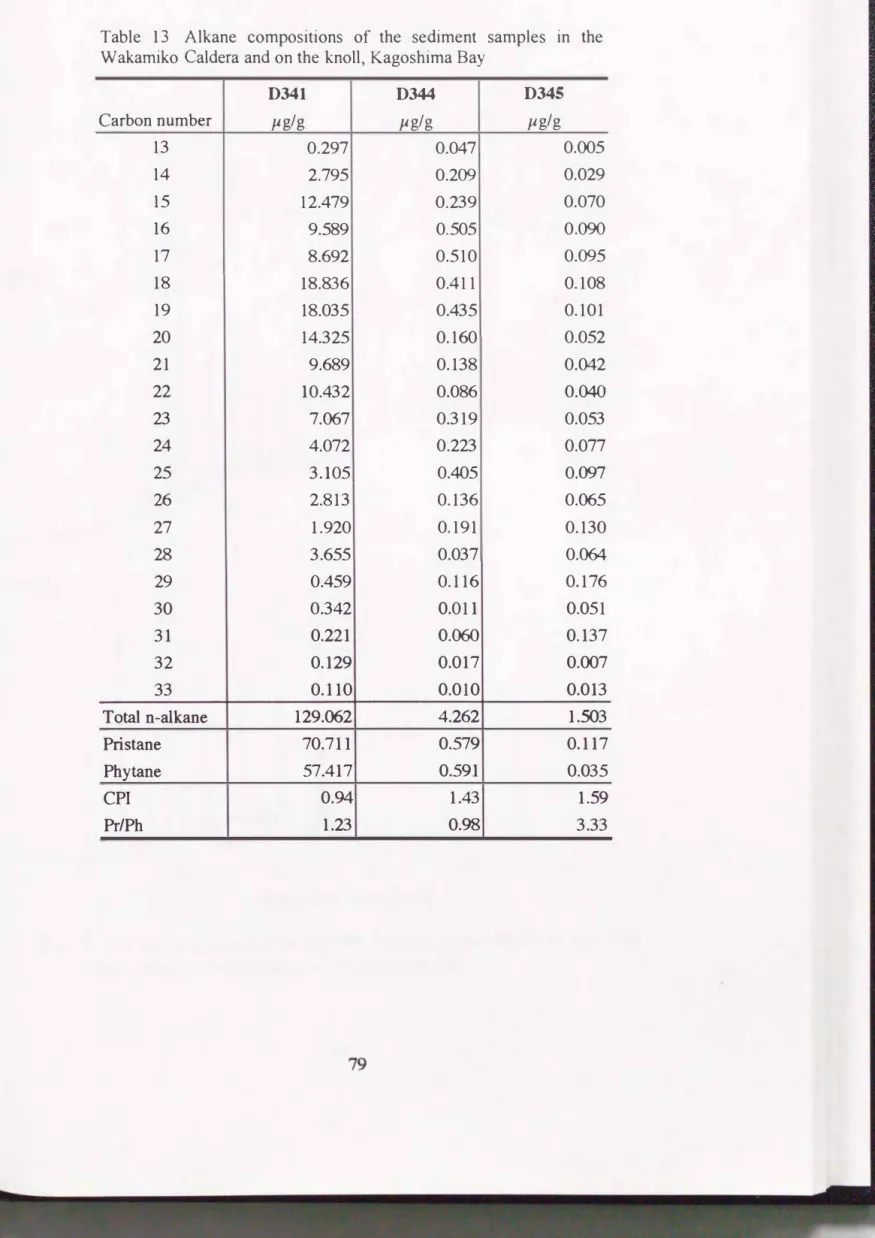
Alkane compositions of the three sediments and CPI are shown in Table 13. The CPI values of the normal alkanes (C14---c32) in D341, D344 and D345 samples were 0.94, 1.44 and
1.62 respectively. The TIC chromatograms of aliphatic fractions are shown in Fig. 29.
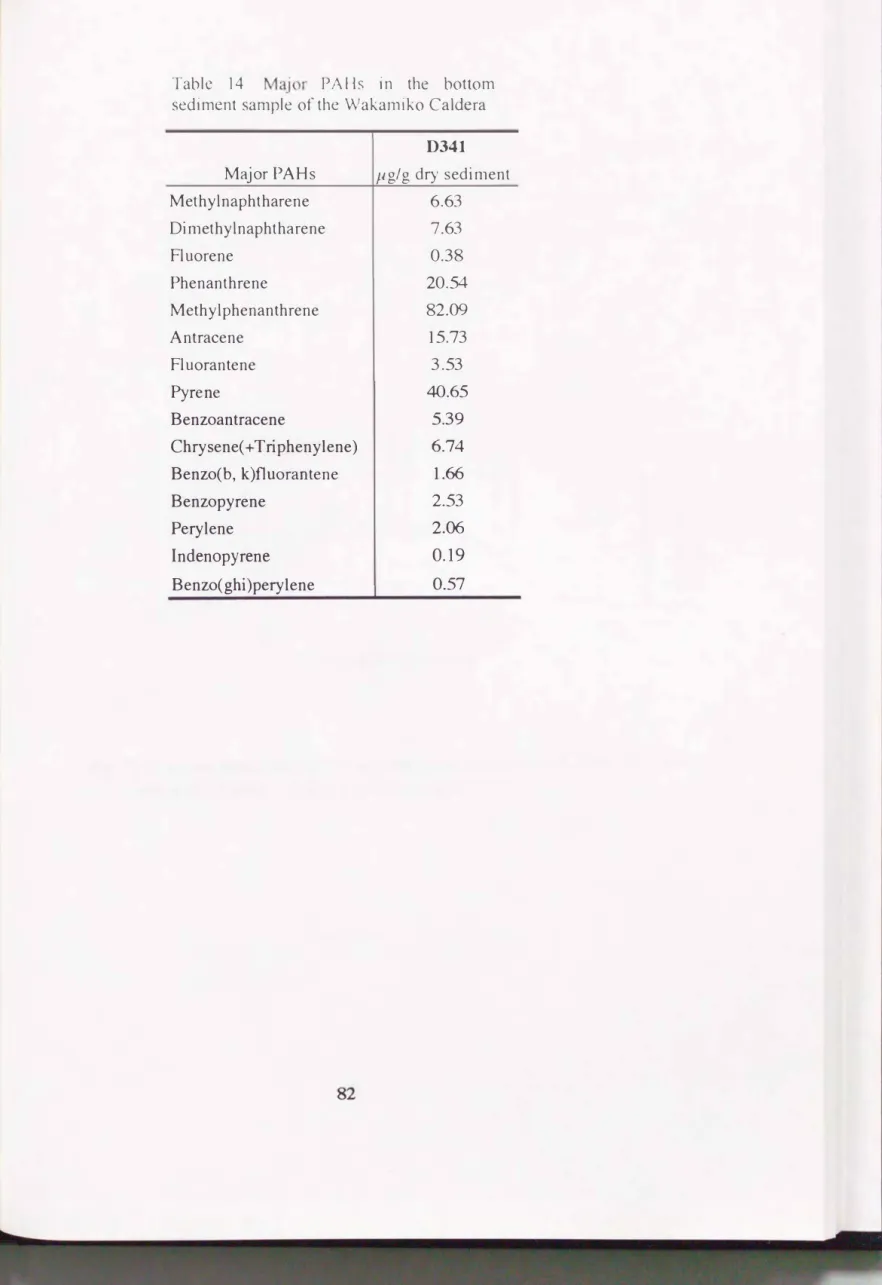
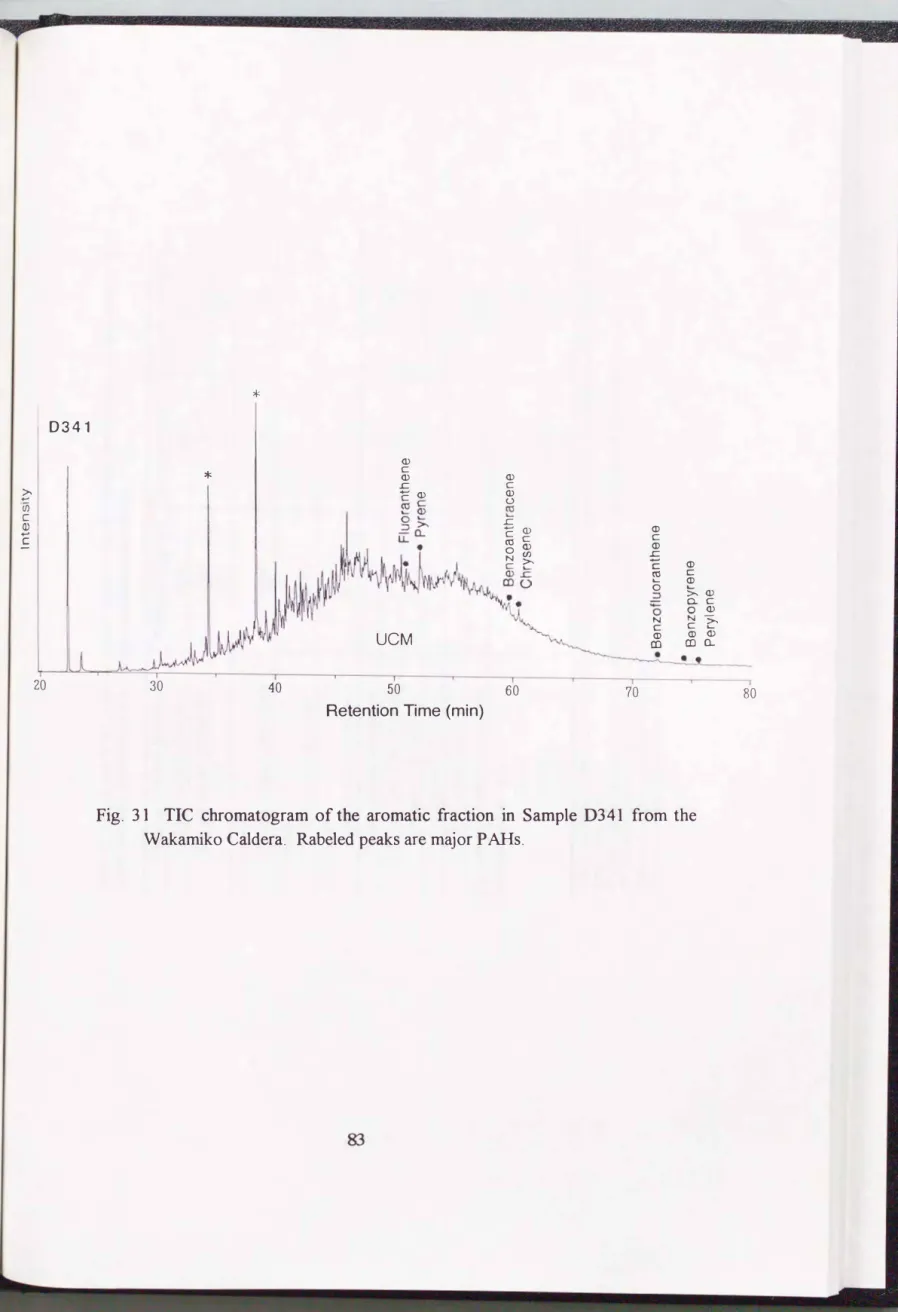
The samples from the caldera floor (D341) and from the top of the knoll (D344 and D345) show quite distinct patterns of normal hydrocarbon compositions. The chromatogram of the bitumen in the D341 sediment shows a large hump of unresolved complex mixture (UCM). The pattern of hydrocarbon composition of the D341 sediment are comparable with a typical crude oil. The hydrocarbons, however, were enriched in aromatic fractions rather than the crude oil and the hydrocarbon composition were comparable with hydrothermal petroleum reported from the Guaymas Basin and Escanaba Trough (Fig. 30). The major components of the bitumen in the D341 sediment are the aromatic compounds which composed of major polycyclic aromatic hydrocarbons (PARs) and an aromatic/naphthenic UCM (Table 14 and Fig.
31).
The unsubstituted pyrolytic origin PARs such as pyrene, fluoranthene, benzopyrene, and benzoperylene were also detected. Some biomarkers such as the steranes and the triterpanes were almost mature (Fig. 32) and the maturation indies of the biomarkers were comparable with hydrothermal petroleums reported from hydrothermal fields in the Guaymas Basin and Escanaba Trough (Table 15). Triterpane and sterane mature75
indies are based on maturation of organic matter, P
AHmature indies are based on thermal craking of alkyl-chains. The P
AHmature indies of D341 petroleum are smaller than that of Guaymas and Escanaba petroleums. Some sterenes, which is immature biomarkers, were also detected. The ratio of the two
C27pentacyclic triterpanes 17 a(H)-22,29,30-trisnorhopane
(Ts) and 18a(H)-22,29,30-trisnorhopane (T
m) which is known to be an indicator of maturity (Seifert and Moldowan, 1978), was 6.25 which signified a petroleum derived from particularly immature source rocks. The phenanthrene to methylphenanthrenes (PIMP) ratio and methylphenanthrene indices fall under the ranges of other hydrothermal petroleums (Kawka and Simoneit, 1990; Kvenvolden and Simoneit, 1990; Simoneit, 1994). The
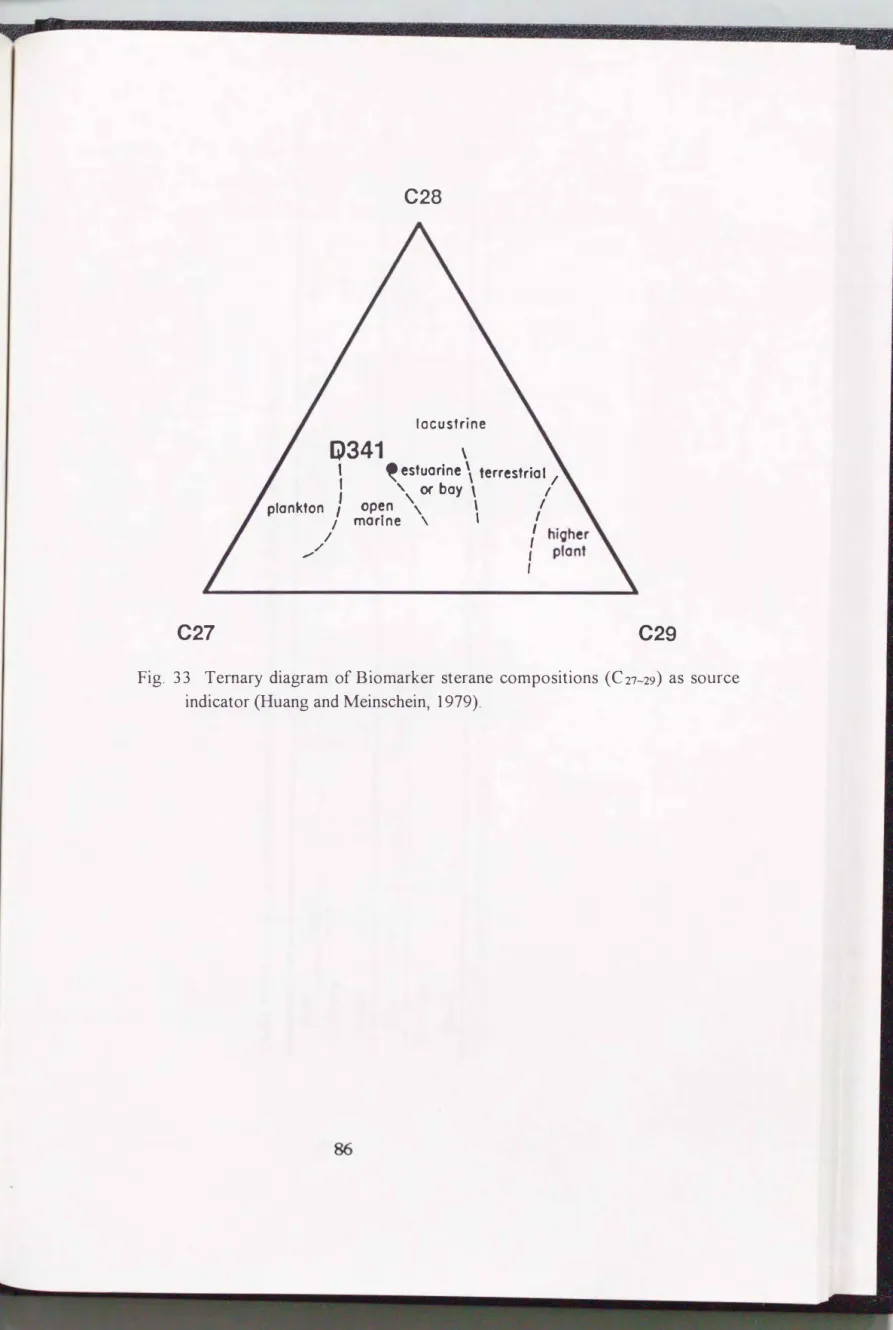
C27---c29steranes composition in the caldera deposits indicates that the source organic matter for the petroleum is accumulated in bay environment (Fig. 33; Huang and Meinschein, 1979).
In contrast, the small amount of the bitumen extracted from the knoll deposits was composed mainly of asphaltic compounds containing hetero atoms such as nitrogen, sulfur, and oxygen. The aromatic fraction in the knoll deposits was minor and the individual pyrolytic
PAHs were under detection limit. The TIC chromatogram of the aliphatic fraction in the knoll deposits (Fig. 29) showed a small hump of the UCM and some mono-unsaturated normal hydrocarbons can be distinguished. The bimodal distribution of the normal hydrocarbons suggests the organic sources are both of autochthonous and allochthonous origins. Many biomarkers in the knoll deposits were under detection limit, only immature isomers such as 5a,l4a,l7a-cholestane (20R) and 5a,l4a,l7a-ergostane (20R) were identified.
5-1-2. Carbon isotope ratios of light hydrocarbons in fumarolic gases and sulfur isotope ratios of hydrothermal minerals in
Wakamiko Caldera
For clarify the origin of light hydrocarbones and sulfide in fumarolic gases of the Kagoshima Bay, gas compositions of the fumarolic gases and isotope compositions of carbon and sulfur were measured (Table 16). The gases are demonstrated to be derived from volcanic
76
activity, and the gas compositions are changing associated with volcanic activity (Oosaka et a!., 1992). The maximum gas temperature >200°C were obsereved (Oosaka, et al., 1992), although measured temperature during "Dolphin 3K'' dive in 1998 was approx. 40°C. The major component of the gas was carbon dioxide (77.7% by volume) and methane (9.7%), ethane (43ppm) and propane (12ppm) were were minor component. 013CPDB value of carbon dioxide was -8 ± 0.5 o/oo. o13CPDB value of methane was -30 ± 0.1 %o.
A hardened sediment was obtained from the bottom of the Wakamiko Caldera. The sediment was altered by hydrothermal activity and black sulfides and yellow�orange arsenic sulfides were mineralized. Elemental sulfur was also extracted by organic solvents. Those sulfur isotope ratios were also measured (Table 16). The 034S values ( 4�6%o) were similar each other and were distinguished clearly from the values of the sulfide provided by sulfate reducing bacteria(< Oo/oo relative to CDT: Thode, 1988).
5-1-3. Organic geochemical features of petroleum-like hydrocarbons yielded from W akamiko Caldera
Table 15 shows maturation indices of sterane and triterpane biomarkers in the caldera are as high as the Guaymas and Escanaba hydrothermal petroleums by K venvolden and Simoneit (1990) and Simoneit (1994). These maturity levels of the hydrocarbons from the Wakamiko Caldera are slightly lower than those of the Tertiary crude oil in the Niigata sedimentary basin, Japan by Sakata eta/. (1988). The PIMP ratio indicates the alteration of the organic matter at <300°C (Ishiwatari and Fukushima, 1979). The other PAH mature indies are lower than the other hydrothermal petroleum, , indicating that generation temperature of the caldera hydrocarbons is lower than them. The pyrolytic P AHs, however, are made at high temperatures in excess of 300°C (Kawka and Simoneit, 1990). The various indices of maturation in the caldera hydrocarbons suggests the mixing of the hydrocarbons in several maturation stages, and significant content of pyrolytic P AHs indicates pyrolytic formation of the oil from immature kerogens rather than simple diagenesis. These geochemical features
77
indicate that the petroleum-like hydrocarbons in the caldera deposits are typical hydrothermal petroleum.
Organic geochemistry of the sediments from the knoll top indicate that bitumen 1s unaltered by hydrothermal activities. CPI values of aliphatic hydrocarbons in D344 and D345 sediments was very small, although it must be attributed to fossil fuel pollution through water column. It is important to notice that well altered hydrothermal petroleum was identified only in the caldera floor sample. Hydrothermal petroleum of the caldera is likely not migrate from the deeper beneath the caldera but to originate within the sediment deposited on the caldera floor. Very thin sediment cover on the knoll top must be attributed no significant petroleum generation.
Table 13 Alkane compositions of the sediment samples in the W akamiko Caldera and on the knoll, Kagoshima Bay
D341 D344 D34S
Carbon number pglg pglg pglg
13 0.297 0.047 0.005
14 2.795 0.209 0.029
15 12.479 0.239 0.070
16 9.589 0.505 0.090
17 8.692 0.510 0.095
18 18.836 0.411 0.108
19 18.035 0.435 0.101
20 14.325 0.160 0.052
21 9.689 0.138 0.042
22 10.432 0.086 0.040
23 7.067 0.319 0.053
24 4.072 0.223 0.077
25 3.105 0.405 0.097
26 2.813 0.136 0.065
27 1.920 0.191 0.130
28 3.655 0.037 0.064
29 0.459 0.116 0.176
30 0.342 0.011 0.051
31 0.221 0.060 0.137
32 0.129 0.017 0.007
33 0.110 0.010 0.013
Total n-alkane 129.062 4.262 1.503
Pristane 70.711 0.579 0.117
Phytane 57.417 0.591 0.035
CPI 0.94 1.43 1.59
Pr/Ph 1.23 0.98 3.33
20
Pr
0341 Ph
UCM
*
0344
*
30 40 50 60 70 80
Retention Time (min)
Fig. 29 TIC chromatograms of the aliphatic fractions in Samples D341 and D344 obtained from the northern part ofKagoshima Bay.
80
90 100 I
100°/o Aliphatic H.C.
Aromatic H.C.
100°/o
•
Escanaba Trough
•
Guaymas Basin
•
0344
100o/o
Asphaltic (NSO)
Fig. 30 Ternary diagram of saturated hydrocarbons, aromatic hydrocarbons and NSO plus asphaltic components. Data of the Guaymas Basin and Escanaba Trough from Simoneit (1993). Typical crude oils fall within the hatched area (Tis sot and Welte, 1984).
81
Table
14M ajor PAHs in
thebottom sediment sample of
theWakamiko
CalderaD341 Major PAHs }1-glg dry sediment
Methylnaphtharene 6.63
Dimethylnaphtharene 7.63
Ruorene 0.38
Phenanthrene 20.54
Methyl phenanthrene 82.09
Antracene 15.73
Ruorantene 3.53
Pyr
en
e 40.65Benzoantracene
5.39Chrysene(
+Triphenylene)
6.74Benzo(b, k)fl
uorantene 1.66Benzopyrene
2.53Perylene
2.06lndenopyrene
0.19Benzo(ghi )perylene
0.57I
0341>-
+-' 'if) c Q)
+-' E
20
*
* c (1) (1) (1)
.r:. c
+-'(1) (1)
c c 0
�� .J �c c c >-.r:. +-' (1) co (1) 2 B
(/) c c .r:. � <D <D 0 :::> <D <D c :>-<D
0 o...c 0 (1)
�
c N c N -cUCM <D <D (1)
(l) (l)Q_
•
30 40 50 60 70
Retention Time (min)
Fig. 31 TIC chromatogram of the aromatic fraction in Sample D341 from the Wakamiko Caldera. Rabeled peaks are major PARs.
----,
80
�
Table 15 Comparison of the molecular mature indices of biomarkers and PAHs between the Wakamiko Caldera (0341) and other hydrothermal areas bearing hydrothermal petroleums
Trlterpane mature biomarker Wakamiko Caldera Guaymas Basin* Escanaba Trough**
C32 hopane 22S/(22S+22R) 0.53 0.57 0.42
C31 hopane 22S/(22S+22R) 0.59 0.53 0.46
Tfts 6.25 6.4 27
C30 Hopane
17�(H),21a(H)/17a(H),2l�(H) 0.21 0.29 0.63
C31 Hopane
(22R+22S)/C30a� Hopane 0.62 C32 Hopane
(22R+22S)/C30a� Hopane 0.33 Sterane mature biomarker
C27 diasterane 20S(20S+ 20R) 0.50 0.62 0.53
C29 sterane 20S(20S+20R) 0.43 0.28 0.13
C21-29 sterane U(L+H)*** 0.27 P AH mature indices
Phenanthrene/Methy 1 phenanthrenes 0.25 0.57 3.33
Methylphenanthrene index
MPilt 0.75 1 0.39
MPI2t 0.71 1.25 0.41
MPI3tt 0.72 1.5
*Data from Kvenvolden and Simoeit (1990) and Kawka and Simoneit (1994). The sample was collected by DSV Alvin , dive 1172.
**Data from Kvenvolden and Sirnoeit (1990). The sample was collected by DSV Sea Cliff, diYc 659.
*** Sa-sterane (C21+C22)/(C21+C22+C27+C28+C29) ratio tRatios, as defind by Radke et al. (1982)
ttRatio, as defind by Garrigues et al. (1988)
·a) m/z=217
21a
22a
50 55 60
b) m/z=191
29aB
27a
80 90
65 270
(S)
270
: (R)
70
2 7o.(S)+?
2 7cx(R)
75 Retention Time (min) 30a�
30f)a
100
31aB s
R
110
32a�
s
Retention Time (min)
28a(R) 29a(R) 29a(S)
80 85
120 130
Fig. 32 Mass fragmentgram of biomarker steranes and triterpanes in Sample D341 from the W akarniko Caldera.
85
90
C27
C28
lacustrine
�341
\\
�
estuarine\
terrestrial 1)
', or boy \ . 1plankton 1 open , \ I
1 morlne \ \
f
/1 I
,; I
I
C29
Fig.
3 3Ternary diagram of Biomarker sterane compositions (C27-29) as source
indicator (Huang and Meinschein, 1979).
�
Table 16
Fumarolic gas compositions and isotope compositions of carbon and sulfur
in the gas
esSite C02% 02%
Caldera 77.7 1.2
Knoll 68.9 1.7
Site
b13CPDB methane %,
Caldera -30.28 Knoll -28.9 1
Nz% Ar%
7. 1 0.23
10.5 0. 19
bDsMow m
ethan
e%,
-1 60.3
-1 66.7
Cfit% CzH6 ppm 9.7 43
18.7 55
b13Cpoo col%
-8.52 -7.85
*Cli(C2+C3)=ratio of the cocentrations of methane to
sum
of ethane and propaneC3Hs ppm He ppm
12 4.2
6.6 4.3
034Scm H2S
%
+6.49
H2 ppm
4.1 347
Cli(C2+C3)*
874.9 1001.2
5-2. Hydrocarbon distributions in the sediments of the other hydrothermal areas 5-2-1. Hydrocarbons in DESMOS caldera
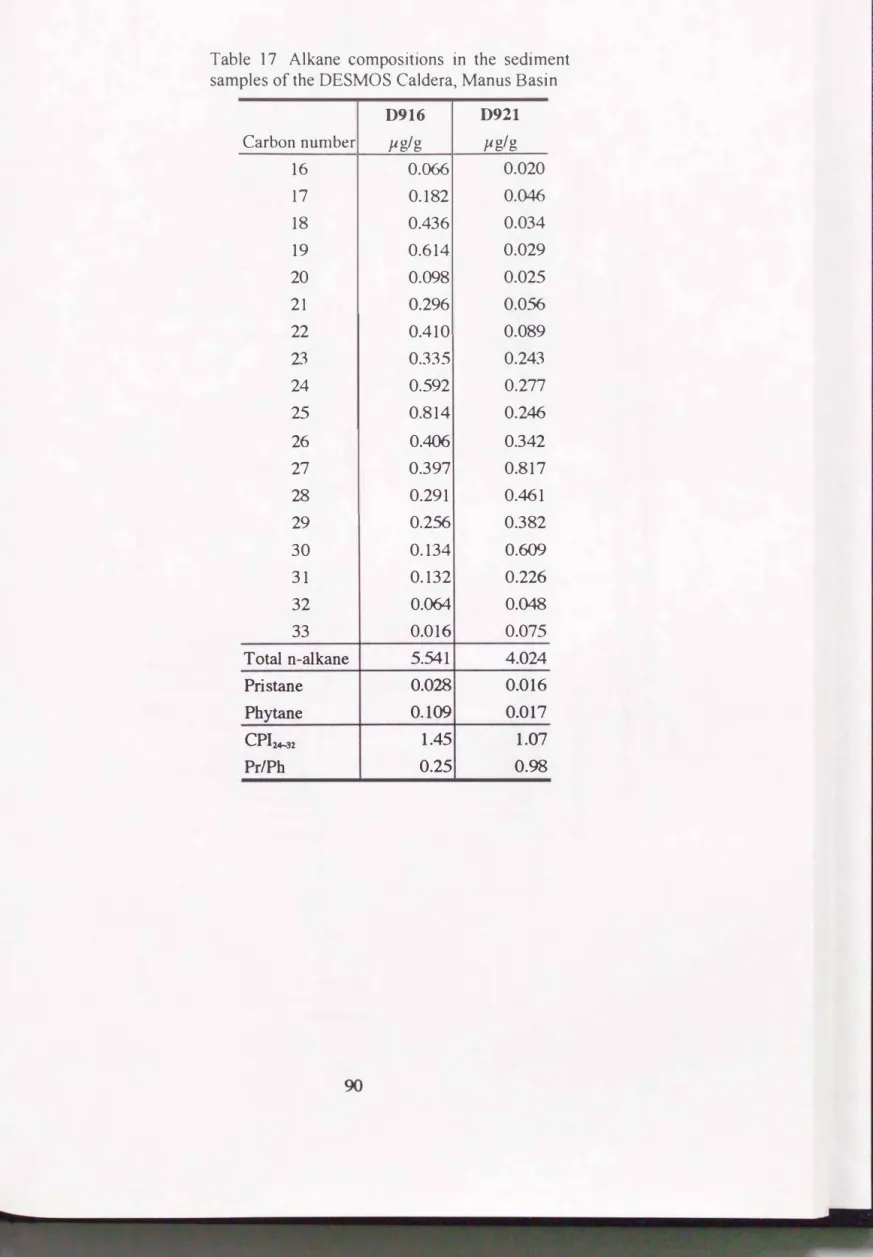
Remarkable amount of hydrocarbons are detected from both sediment samples (Table 17) The TIC chromatograms are shown in Fig. 34. Distribution patterns of n-alkanes show monomodal (maximum at
C2s)
and no carbon number preference, which are similar to that of conventional cruide oil. The CPI values of D916 and D921 sediments are 1.45 and 1. 02, respectively. Small hump of the back ground,UCM,
are also shown in also both TIC chromatograms of aliphatic fractions. Similar aromatic hydrocarbons are detected in both samples. Especially, poly aromatic hydrocarbons (PARs) are major components of aromatic fractions of both samples (Table 18). The concentrations of the PARs are very low (:S0.16Jlg/g dry sediment), and higherly polycyclic aromatics could not identified. The pyrolitic origin PARs such as pyrene and fluoranthene were detected.5-2-2. Hydrocarbons at the North Knoll of Iheya Ridge
Abundance of normal and other remarkable hydrocarbons in Sample D 1030 were shown in Table 19 and Fig. 35. Total concentration of normal alkanes in Sample D1030 was 4.56Jlg/g dry sediment. CPI value of normal alkanes (C14-c32) in Sample D1030 was 2.1. Long chain alkanes were abundance in Sample D1030 and remarkable odd carbon number preference could been seen. CPI value of the alkanes longer than C24 was 4. 1, indicating typical terrigenous input. Small hump ofUCM of TIC chromatogram could been seen at the range of short chain alkanes (C16-c26). Hydrocarbon fractions of D857R and D857B sediments were not measured because sample amounts are not enough for analyses.
Some PARs were identified in the aromatic fraction ofD1030 sediment (Table 20). The peak of each PARs on TIC chromatogram were quite low, therefore, their concentrations could not be calculated. Some alkylated naphthalene and phenanthrene were contained. The pyrolitic origin PARs such as pyrene and benzoanthracene were also detected.
88
5-2-3. Hydrocarbons in Myojin Caldera
Normal alkanes were identified ranging from C 15 to C32 by GC/MS. Total concentrations of n-alkanes in D 1008 and D 10 11 sediments were 4 and 4. 8 J..lg/ g dry sediment, respectively (Table 21 and Fig.
36).
The CPl. values of the both sediments were almost 1. Pristane and phytane, and also other isoprenoid type hydrocarbons were detected. The pristane/phytane ratios were 0.3 3
and 0. 97, indicating sedimentation under anoxic condition. While the concentrations of the aliphatics was quite low, the small hump of the background of UCM were confirmed from the mass fragmentgram of M/Z=57, which is a major fragment of alkanes. Those features strongly suggest that hydrocarbons originated from matured oil, although it is difficult to exclude possibility of fossil fuel pollution or hydrothermal alteration.Absence of long chain alkanes (>C26) in D 1011 sediment indicates dominant input of terrigenous material, although this is not accordance with the fatty acid composition.
While concentrations of aromatic fraction were very low, some P AHs were detected. All the detected P AHs were listed in Table 22. Methyl phenanthrenes were major components of P AHs. Pyrene and fluoranthene of pyrolitic origin were also detected. The other higher molecular weight P AHs were under detection limit.
89
Table 17 Alkane compositions in the sediment samples of the DESMOS Caldera, Manus Basin
D916 D921 Carbon number pglg pglg
16 0.066 0.020
17 0.182 0.046
18 0.436 0.034
19 0.614 0.029
20 0.098 0.025
21 0.296 0.0.56
22 0.410 0.089
23 0.335 0.243
24 0.592 0.277
25 0.814 0.246
26 0.406 0.342
27 0.397 0.817
28 0.291 0.461
29 0.2.56 0.382
30 0.134 0.609
31 0.132 0.226
32 0.064 0.048
33 0.016 0.075
Total n-alkane 5.541 4.024
Pristane 0.028 0.016
Phytane 0.109 0.017
CPiu.-3z 1.45 1.07
Pr/Ph 0.25 0.98
\0
-
>-
�
·c;;
c 11)
0916
10
E I 091 6
10
20 30
20 30
•
I. I .
40
.
.
. .
. . . .
u
'V ·���\\ ll"
50 60 70
60 70
Retention Time (min)
.
•
•
._A \1
80
80
M/Z=57
.
�
•
A
90 100
M/Z:99
90 100
0921 MIZ=S
.� I
I I ' I7 l!LJ-l�)!AklJJH"��.��Lf.JJL�J�--J�
-�en 10 20 30 40 50 60 70 ao go
E
c I 0921 MIZ=9920 30 40 50 60 70 80 90 1 OG
Retention Time (min)
Fig. 34 Mass fragmentgrams (M/Z=57 and 99) of the aliphatic fractions in Samples D916 and D921 obtained from the DESMOS Caldera, Manus Basin.
Table 18 Major PAHs in the sediment _am pies of the DESMOS Caldera, Manus Basin
ng/g dry sediments
Major PAHs D916 D921
Naphthalene + +
methyl-naphthalene 40.60 18.20
Dimethyl-naphthalene + 20.26
Acenaphthene n.d. +
acenaphthalene 5.92 +
phenanthrene 158.57 +
fl uoranthene + +
pyrene + +
tetrameth y l-phenanthrene + n.d.
Benzoanthracene+Chrysene + n.d. n.d., not detection
Table I q ;\I kane compo� it ions in the scdiemnt of the North Knoll, Iheya Ridge
01030 Carbon number pglg dry sediment
13 0.002
14 0.004
15 0.023
16 0.088
17 0.193
18 0.222
19 0.207
20 0.212
21 0.249
22 0.271
23 0.365
24 0.260
25 0.421
26 0.197
27 0.499
28 0.138
29 0.681
30 0.051
31 0.422
32 0.014
33 0.040
Total n-alkane 4.558
Pristane 0.153
Phytane 0.086
CPit4-31 2.11
CPI24-33 4.14
Pr/Ph 1.78
>
.�
tl) 10
c Q)
TIC
20 30 40 50 60 70 80
E MIZ=99
10
l ..!
JUt ���� ;! J\�.1.!.1 � �
II'W. -....;�
A
I 1 l _1 1 1
20 30 40 50 60 70 80
Retention Time (min)
Fig. 3 5 TIC chromatogram of aliphatic fraction of Sample D 103 0 obtained from the North Knoll oflheya Ridge, Okinawa Trough.
94
90 100
1 1
90 100
Table 20 Ma_1or PA Hs in the sediment sample of the North Knoll, lheya Ridge
Major PAHs Naphthalene
Methyl-naphthalene Acenaphthene Fluorene
Methyl-phenanthrene Dimethyl�phenanthrene R uoranthene
Pyrene
Benzoanthracene+Chrysene
Dl030 ng/g dry sediment
2.26 41.62
5.53 8.20
+
+ + + +
Table 21 Alkane composttlons in the sediment samples of the Myo
j
in Caldera, Izu-Ogasawara ArcD1008 DlOll Carbon number jlg!g jlg!g
15 0.059
16 0.191 0.073
17 0.381 0.188
18 0.522 0.261
19 0.438 0.363
20 0.582 0.346
21 0.464 0.342
22 0.387 0.314
23 0.271 0.329
24 0.197 0.309
25 0.304 0.379
26 0.244 0.463
27 0.443
28 0.339
29 0.338
30 0.141
31 0.102
32 0.055
Total n-alkane 4.040 4.785
pristane 0.157 0.066
phytane 0.478 0.068
CPI 0.98 1.11
Pr/Ph 0.33 0.97
>
.t: ct)
01008
TIC
��
90 100
>
.t: (/)
01011
20 30
.
•
1 � i i
;ijj_L i
•Pr'
\
... L.LJ40 50 60 70 pr
TIC
c 10 20 30 40 50 60 70 80 c 10
(1)
M/Z=99
� E
01008M/Z=99
1
111'':•o
II ''1'1 30, ,JJ.
40i]l��
50 60 70 80 ' 90. -�
100Retention Time (min)
... c 01011
10 20 30
I'
I
' I I___,---��·__,.._..-:_�t.·��-__.w �--.J-·
50 60 70 Pr
Retention Time (min)
Fig.
36 TICchromatograms and mass fragmentgrams
of aliphatic fractions in Samples D1008and
DlOll.Table 22 Major PAl-L in the sediment samples of the Myojin Caldera, Izu-Ogasawara Arc
ng/ g dry sediment
Major PAHs D1008 DlOll
Naphthalene + +
Methyl-naphthalene 55.25 215.03 Dimethyl-naphthalene 24.46 +
Acenaphthylene + n.d.
Acenaphthene + +
Auorene + +
Anthracene + +
Phenanthrene + +
Meth y 1-phenanthrene + +
Dimethyl-phenanthren<: n.d. n.d.
A uoranthene + +
Pyrene + +
n.d., not detection
5-3. Discussion
5-3-1. Distributions of petroleum-like hydrocarbons at the hydrothermal areas
The aliphatics characterized by no carbon number preference and presence ofUCM were found at the three hydrothermal areas, Kagoshima Bay, DESMOS Caldera and Myojin Caldera. Those three hydrothermal areas are located at submarine calderas. Especially, the sediments obtained from the bottom of the W akamiko Caldera, as described above, contained significant amount of hydrothermal petroleum. The D 1030 sediment obtained from Okinawa Trough contained many aliphatics including many alkenes characterized higher CPI value (>2).
The normal saturated hydrocarbons were enriched in long chain hydrocarbons (>C24) and show a distinct even carbon number preference (CPI24-33=4 .1 ), indicating large input of terrigenous matters. The fatty acid composition of the D 1030 sediment shows similar distribution such as low
L/Hratio.
The experimental results suggest that the petroleum-like hydrocarbons in the Wakamiko Caldera must be hydrothermal origin. The concentration of hydrocarbons is quite high and the bitumen is enrichment in aromatic fractions (Fig. 30). The aromatic fractions are contained remarkable amounts of pyrolytic P AHs such as pyrene, fluoranthene, benzopyrene, and benzoperylene. The detailed geochemical features are described above. From the seismic profiles a magma chamber is recognized below the Wakamiko Caldera (Ono
et al.,1978;
Takahashi, 1997). The magma is expected the heat source for hydrothermal activities.
Significantly high helium isotope ratio C He/4He=9.5X10-6) and carbon isotope ratios of C02 ( b13CPDB = -7.58 � -8.52o/oo) offumarolic gases support this suggestion.
The small amounts of petroleum-like hydrocarbons were also found in the DESMOS Caldera and Myojin Caldera. The concentrations of those hydrocarbons are remarkable lower than that of the W akamiko Caldera. The aromatic fractions contain small amounts of low
molecular weight
PAHs. As indicated by Youngblood and Blumer (1975), precence of pyrolitic
PAHs is interpretated as pyrolysate derived from air fall materials of oil and coal combustion in many case. However, both DESMOS Caldera and Myojin Caldera are located
99
at a distance of several hundred kilometers from land. The P AHs detectedin these these samples must be attributed to evidence for hydrothermal petroleum generation. It is notable that Sample D 1011 from the Myojin Caldera show enrichment in long chain alkanes, which is not agreement with proportions of fatty acids which low content of long chain fatty acids and preference even to odd carbon number fatty acids. It suggests that the source of the hydrocarbons and fatty acids are different, the long chain alkanes are not terrigenous origin.
The fatty acid compositions are considered to reflect just present ecosystem, so, the hydrocarbons may be migrated from the subsurface deposits in the caldera. In contrast, the aliphatics of the sediments obtained from Iheya Ridge occur as small humps of UCM ranged from C 16 to C26, suggesting precence of petroleum-like hydrocarbons. Some P AHs were also detected. While it is difficult to elucidate the origin of the UCM, the sediment containing terrigenous organic matter takes oil pollution. The diffusion of oil pollution is considered to use an example of Sagami Bay and discussed Chapter 4-4.
The petroleum-like hydrocarbons of possible hydrothermal origin are recognized in the
sediments obtained from the hydrothermal areas. In the depression such as submarine caldera the sedimentation rate is generally higher than that of the surroundings. The dissolved oxygen levels of the bottom water in the caldera are expected to decrease easily. In fact, the bottom water of Wakamiko Caldera was changed into anoxic and acidic by fumarolic gases and fluids particularly during summer in which stratified water structure is developed. Those geological and oceanographical conditions are expected to enhance the preservation of sedimentary organic matters. The submarine caldera involving active hydrothermal venting is expected to provide a good place for hydrothermal petroleum generation.
5-3-2. Possible fossil model of the simultaneously generation of petroleum and sulfide ore deposits associated with arc-backarc tectonics
Two distinct parallel mineralized belts, Oil-belt and Kuroko-belt, are recognized in the Green Tuff region of northeast Japan in the Middle Miocene. Both belts were running along the back-arc basin (proto-Japan Sea)(Fig. 3 7; Kajiwara and Sasaki, 1987). PUMOS hypothesis was purposed common source of these oil and sulfide ore deposits based on the oil and the sulfide ores that have the same range of sulfur and strontium isotope compositions (Kajiwara and Sasaki, 1987; Nakano eta/., 1989), although others had pail little attention to possible genetic links. Those parallel distributions were interpreted as a result of the differences for the required preservation factor between petroleum and sulfide ore minerals such as sedimentation rate and redox condition. This hypothesis has not been recognized the Kuroko ore deposits derived from hydrothermal fluids. However, discovery from the Wakamiko Caldera suggest that the genetic link between the petroleum and the Kuroko ore deposits can be interpreted by hydrothermal activity at sedimented caldera floor instead of PUMOS.
The light natural hydrocarbons in the Green Tuff resevoirs are also characterized by
higher �13C and �D values. Fig. 38 are summarized the carbon and hydrogen isotope ratios of methane in the fumarolic gases and the Green Tuff natural hydrocarbons. The both can be plotted in the closed area indicating the thermogenic origin of Bernard eta/. (1976). Methane involving the Guaymas petroleum with high �13C values ( -47--40%o relative to PDB) is also
thermogenic origin (Simoneit eta/., 1988). The methane in the both natural gases of the Green Tuff reservoirs and the fumarolic gases of Kagoshima Bay are generated associated with igneous activities of arc-backarc systems.
The �34S values of the hydrogen sulfide obtained from the fumaroles in the caldera
(+6--+7o/oo relative to CDT, Nedachi et al., 1997) and the sulfide minerals in the hardened sediments (+2-+4o/oo) are similar to the average values of Kuroko ore deposits (+4.0o/oo:
Kajiwara and Sasaki, 1987). Those �34S values were summarized in Fig. 39. The
101
environmental similarities between the Kagosruma Bay and the Miocene Green Tuff region have been suggested (Kitazato, 1979). The Kuroko ore deposits of the northeast Japan were generated in the back-arc depression just behind of the volcanic front (Fujioka, 1983). It is also suggests that the formation of caldera play an important role for Kuroko formation (Ohmoto, 1978). This tectonic setting is compare with the Kagoshima Graben.
The Kuroko ore deposits are well known to have been generated by seafloor hydrothermal systems related to submarine volcanisms (e.g. Ohmoto, 1996). High helium isotope ratios (3He/4He=6.90�8.67X10-6: Wakita et al., 1990) are reported from the natural gases in the Green Tuff volcanic rock reservoirs. The helium isotope ratio of the vent fluid characterized by high concentration of hydrocarbons in the Guaymas Basin eHe/4H e=6.95X10⁻⁶) is also as higher as that of21 ON East Pacific Rise (3He/4He=7.8X10-6) (Lupton, 1983). The ratio of the fumarole in the caldera is also high eHe/4He=9.5Xl0-6). The helium isotope ratios were plotted in Fig. 40.
The reservoirs of the Green tuff volcanic rocks are considered to improve the pore properties by hydrothermal alteration followed the felsic submarine volcanism (Yamada and Uchida, 1997). Then the petroleum generation is commenced by the hydrothermal heated in a shorter period of time than the maturation of organic matter during burial (Yamada and Uchida, 1997). Furthermore, the source rocks of the northeast Japanese oil fields are reported to contain significant amount of P AHs (Taguchi, 1968). The Green Tuff petroleum is most likely hydrothermal origin and preserved and accumulated in the geologic strata.
Geologic and topographic scales of the W akarniko Caldera is quite smaller than the Green Tuff region. It seems difficult to compare with the discovery from the W akarniko Caldera and the Green Tuff region. Comparable large scale formation of hydrothermal petroleum, however, has been already reported from the Guaymas Basin, Gulf of California (e.g. Simoneit eta/., 1988). It is not unreasonable to think that simultaneous generation of petroleum and sulfide deposits are cause of the parallel distribution of them in the Green Tuff region. If hydrothermal petroleum generation will be found in the Okinawa Trough, it become better
102
example for explanation of genetic links between oil-betl and Kuroko-belt in the Green Tuff reg� on.
The Myojin Caldera and Manus Basin also recognize the formation of Kuroko-like sulfide ore deposits (Iizasa et al, 1997; Binns and Scott, 1993), which enriched in Au and Ag, and the o34S values of sulfide deposits in the Myojin Caldera indicates fairly narrow range between + 3 .4---+4. 8%o (Iizasa et al., 1997). Considering geology, submarine topography and tectonic settings, the Manus Basin and Izu-Ogasawara Ridge is similar with the northeast Japan arc during late Miocene (Fujioka, 1997). Those area are also expected the simultaneously formation of the both hydrothermal petroleum and sulfide ore deposits. The petroleum formation depends on the abundance of the sedimentary organic matters.
N
•
OIL Field
a
Kuroko Ore and : Kuroko-type ,'
fdeposits,'
'
� 0 0'"' :
I 0 o 0�
/fij'
/ /CJ
I/ iii
/ t:/;)o
/
I/�
{}.,//0
/ // ""
/100
�
/ 0�
I 0 -�
I o
:0:::
/
at,./
"
/
"
"
"
•
"
/ -/ /
0 / / /o
/
� :p
0
o
Aizu
50 KMFig. 37 Paired distribution of the· metallic mineralization belt (Kuroko belt) and the oil-producing belt in the Neogene system of the northeast Japan (Kajiwara and Sasaki, 1987).
--30
Seawater sulfate
Framboidal pyrite in the sediment outside of the caldera Framboidal pyrite in the
-20 -10 0 +10 +20
•
---
sediment within the caldera
H2S in the fumarolic gases Extractable elemental sutfur in the sediment Sulfides in the hardened sediment
Kuroko suHide of NE Japan Sulfur in the petroleum of NE Japan
-30
•
•
• yellow (arsenic sulfide?)
{
• blackAv.
------�-- Av.
_______ _.... __ _
-20 -10 0 +10 +20
+30
+30
· Fig. 3 8 �34S distributions of the sulfur compounds in the sediment and the fumarolic gases of the W akamiko Caldera comparison with the Kuroko ore sulfides and organic sulfur in the petroleum yeilded in the northeast Japan (Kajiwara and Sasaki, 1987).
c ¢
-� �---�
-100- EPR
-150-... ..
iD
• -.200 -
: ...
···:
.. ... .
-�-·· «J.
. ...
oso
-250-. . .
Thermog�nic
D
0 NE NE Japan Japan VRR SRR gases gases� -
Bacterial
•
� Wakamiko Caldera gas
Knoll gas (east rim of the caldera) -��--��.--�.---.--�.---.----�.---.----�
-80 -70 -60 -50 -40 -30 -20 -1 0 0
Fig. 39 Plot of oD vs. o13C of the methane in the fumarolic gases and natural gases of the northeast Japan (from Sakata, 1997). The boundary of bacteria and thermogenic methanes are drawn after Schoell (1988). The fields BF and B R are attributed to pathways of bacterial methanes from fermentation of acetate, and reduction of C02, respectively. Area of four abiotic methanes are shown from comparison: EPR, geothermal methane from the East Pacific Rise; GFI, methane in fluid inclusions from alkalic igneous rocks, Greenland,; ZO, methane issuing from the Zambales Ophiolite, Philippines; OSO, methane issuing from the Oman-Semail Ophiolite.
106
3Hef4He (R/Ratm)
1 3 5 7 9
Wakamiko Caldera Knoll • • Caldera fumarolic gases
NE Japan oil-gas field Av. • Av. I •VRR Gases
SRR Gases Okinawa Trough •theya _..lzena
East Pacific Rise 13°N • •2rN
Guaymas Basin •
I I I I I
1 3 5 7 9
Fig.
40
3He/4He ratios of fumarolic gases and comparisons with the northeast Japan naturel gases (Wak ita et al.,1990;
Sakata,1997)
and other hydrothermal system's (Lupton,1983).
SRR: sedimentary reservoir rock,VRR: volcanic reservoir rock.
5-4. Summary
The present discovery from Wakamiko Caldera indicates that the petroleum is simultaneously generated at the same space with massive sulfide deposits by the hydrothermal systems correlated with submarine volcanism. The petroleum of the W akamiko Caldera is first discovered from active submarine voclano related with arc-backarc systems.
While the water depth (200m) and thickness of source deposit (50-80m) of the occurrence petroleum is quite smaller than that of any other hydrothermal petroleums (>2000m and
>300m, respectively, in the case of the Guaymas Basin) have been reported from seafloor (Simoneit, 1993), the maturation levels of the several biomarkers are almost equal. The sterane and triterpane biomarkers in the petroleum indicate high maturity, however, low maturity and immature biomarkers are also contained. Aromatic hydrocarbons are a predominant fraction of the bitumen and includes high concentrations of pyrolytic P AHs.
Those organic geochemical features suggest pyrolytic formation of the petroleum rather than simple diagenesis. As Simoneit (1993) points out, hydrothermal alteration of organic matter is probably a ubiquitous process along the global rift systems and is a phenomenon that has been active over most of geologic time. Considerations of the similar spatial distribution and geochemical signatures of the petroleum and the Kuroko ore deposits in the Green Tuff region of the northeast Japan during Miocene may suggest their simultaneously generation by a common process such as a hydrothermal system found in the submarine W akamiko Caldera.
At the other submarine caldera occurred hydrothermal mineralization, such as DESMOS Caldera and Myojin Caldera, the hydrothermal petroleum generations are expected.
Chapter 6.
Conclusion
The fatty acid composition studies of sediment around hydrothermal areas revealed several notable characteristics commonly observed among the sediment-free hydrothermal systems, Myojin Knoll and Desmos Caldera. Themost remarkable point is enrichment in monounsaturated fattyacids which are derived from aerobic bacterial metabolism. This is one of geochemical evidence for significant occurrence of bacterial chemosynthesis in hydrothermalareasO The second point is notable abundance of methyl-branched fatty acids derived from anaerobic bacteria. This suggests important contribution from bacterial alteration process in hydrothermal areas. The third point is depletion of PUF As which are derived from a proxy of eukaryotic organisms. This indicates organic matter derived from sea surface production is overwhelmed by primary products of bacteria in seafloor hydrothermal areas. Together with significanthigh total fatty acid concentrations, the composition of thesebiomarker fatty acids indicate significantly high primary production of bacteria in hydrothermal areas.
In the sediment from Iheya Ridge, however, these hydrothermal characteristics are not obvious. Odd number preferred long chain fatty acids of terrigeneous origin are dominant fatty acids in the sediment. This is accordance with high sedimentation rate around the Iheya Ridge caused by turbidite from the Asia continental shelf.O: The fatty acids specifically derived from bacterial metabolism associated with hydrothermal activities is overwhelmed by significant supply of terrigeneous fatty acids. Although the Kagoshima Bay is surrounded by land, the sediment from the Wakamiko Caldera well show fatty acid composition characteristics of bacterial metabolism. In this area, thick sediment layer is mainly composed of volcanic ash and glasses and less terrigeneous supply than the case of Okinawa Trough.
The comparison of fatty acids composition between the Iheya Ridge and Kagoshima Bay provides an example for that sedimentation environment can easily conceal fingerprint
109
biomarkers related with hydrothermal activities.
The hydrocarbon composition study of sediment from the Wakamiko Caldera, Kagoshima Bay indicates significant hydrothermal petroleum formation. Present sediment at the caldera floor is considered as source rock, and high temperature fluids and/or fumarolic gases circulated within sediment layer is considered as heat source. Together with the occurrence of Kuroko-like sulfide in the same space, close relationship of formation of petroleum and sulfide ore are demonstrated. This would provide an important clue for interpretation of genetic links between the oil-belt and the Kuroko-belt observed in the Green Tuff region of Tertiary northeast Japan.
Acknowledgements
I wish to express my sincere gratitude to Professor T. Murae of Faculty of Science, Kyushu University who inspired me throughout the course of this work and carefully reviewed the manuscript. I wish to express my grateful thanks to Drs, H. Chiba, J. Ishibashi, C. Mizota, T, Garno, H. Tokuyama, H. Satake, M. Kusakabe for many helps in shipboard works and their providing me with data referred in this study. I wish to thank Drs. J.
Hashimoto, K. Fujikura, Y. Fujiwara, J. N aka and also other members of Deep-Sea Research Group of JAMSTEC (Japan Marine Science and Technology Center) for many helps in shipboard works. I wish to thank members of the operation team of submersible "Shinkai 2000" and "Dolphin 3k", and crew of tendership Natsushima and crew of Fujisanmaru, for their skillful cooperation through sediment sampling programs in the dive missions and piston core sampling in Sagami Bay. My thanks are extended to Drs. K. Notsu and K. Nagao and Mr. M. Sato of Laboratory for Earthquake Chemistry, University of Tokyo for help in the helium and carbon isotpie measurements.
Reference
Alt, J. C., 1995, Subseafloor processes in mid-ocean ridge hydrothermal systems. In Seafloor hydrothermal systems-Physical, chemical, biological and geological interactions, S.
Humphris, L. Mullineaux, R. Zierenberg and R. Thomson, 91, Am. Geophys. Un., Washington, D.C., 85-114.
Aoki, M. and Nakamura, K., 1989, The occurrence of chimneys in Izena Hole No.2 ore body and texture and mineral composition of the sulfide chimneys. JAMSTEC Deepsea Res.
5, 197-210.
Aramaki, S., 1984, Formation of the Aira Caldera, Southern Kyushu, �22,000 years ago. Jour.
Geophys. Res. 89: 8485-8501.
Baird, B. H. and White, D. C., 1985, Biomass and community structure of the abyssal microbiota determined from the ester-linked phospholipids recovered from Venezuela Basin and Puerto Rico Trench sediments. Mar. Geol., 68: 217-231.
Balkwill, D. L., Leach, F. R., Wilson, J. T., McNabb, J. F. and White, D. C., 1988, Equivalence of microbial biomass measures based on membrane lipid and cell wall components, adenosine triphoshate, and direct counts in subsurface auifer sediments.
Microb. Ecol., 16: 73-84.
Ballard, R. D., 1977, Notes on a major oceanographic find. Oceanus, 20: 35-44.
Bernard, B. B., Brooks, J. M. and Sackett, W. M., 1976, Natural gas seepage in the Gulf of Mexico. Earth Planet. Sci. Lett., 31: 48-54.
Binns, R. A. and Scott, S. D., 1993, Actively forming polymetallic sulfide deposits associated with felsic volcanic rocks in the eastern Manus back-arc basin, Papua New Gunea.
Econ. Geol., 88: 2226-223 6.
Blake, J. A., Hecker, B., Grassle, J. F., Maciolek-Blake, N., Brown, B., Curran, M., Dade, B., Freitas, S. and Ruff, R. E., 1985, Study of biological processes on the U W South Atlantic slope and rise. Phase 1. Benthic characterization study. Final report. Prepared for U. S. Department of the Interior, Minerals Management Survice, Washinton D.C., under Contract No. 14-12-001-30064. 142 pp. +Appendices 1-4.
Blumer, M., 1957, Removal of elemental sulfur from hydrocarbon fractions, Analytical chemistry, 29: 103 9-1041.
Blumer, M., 1975, Curtisite, idrialite and pendletonite, polycyclic aromatic hydrocarbon minerals: Their composition and origin. Chern. Geol., 16: 245-256.
Bobbie, R. J. and White, D. C., 1980, Characterization of benthic microbial community structure by high-resolution gas chromatography of fatty acid methyl esters. Appl.
Environ. Microbial., 39: 1212-1222.
Boon, J. J., DeLeeuw, J. W., van del Hoek, G. J. and Vosjan, J. H., 1977, Significance and taxonomic value of iso and anteiso monoenoic fatty acids and branched B-hydroxy acids in Desulfovibrio desulfuricans. J. Bacterial., 129: 1183-1191.
Boon, J. J., W. Liefkens, Rijpstra, W. I. C., Baas, M. and DeLeeuw, J. W., 1978, Fatty acids
112
of Desuljovibrio desulfuricans as marker molecules in sedimentry environments. In Environmental and geomicrobiology biogeochemistry, ed., Krumbein, W. E., Ann Arbor Science Publisher, Ann Arbor, Mich, p. 355-372.
Canuel, E. and Martens, C. S., 1992, Seasonal variations in the sources and alteration of organic matter association with recently-deposited sediments. Org. Geochem., 20: 563- 578.
Chiba, H., Nakashima, K., Garno, T., Ishibashi, J., Tsunogai, U. and Sakai, H., 1993, Hydrothermal activity at the Minami-Ensei Knoll, Okinawa Trough: Chemical characteristics of hydrothermal solutions. Proc. JAMSTEC Symp. Deep Sea Res., 9:
271-282.
Chiba, H., Ishibashi, J., Ueno, H., Oomori, T., Uchiyama, N., Takeda, T., Takamine, C., Ri, J.
and Itomitsu, A., 1996, Seafloor hydrothermal systems at North Knoll, Iheya Ridge, Okinawa Trough. JAMSTEC J. Deep Sea Res., 12: 211.
Cooper, J.E. and Bray, E.E., 1963, A postulated role of fatty acids in petroleum formation.
Geochim. Cosmochim. Acta, 27: 1113-1127.
Corliss, J. B., Dymond, J., Gordon, L. 1., Edmond, J. M., Von Herzen, R. P., Ballard, R. D., Green, K., Williams, D., Bainbridge, A., Crane, K. and Van Andel, T. H., 1979, Submarine thermal springs on the Garapagos Rift. Science, 203: 1073-1083.
Initial reports of the Deep Sea Drilling Project, Curray, J. R., Moore, D. G., Aguayo, J. E., Aubry, M. P., Einsele, G., Fornari, D. J., Gieskes, J., Guerrero, J. C., Kastner, M., Kelts, K., Lyle, M., Matoba, Y., Molina-Cruz, A., Niemitz, J., Rueda, J., Saunders, A.
D., Schrader, H., Simoneit, B. R. T. and Vacquier, V., Ed., U.S. Goverment Printing Office: Washington, D.C., 1982, Vol. 64.
Davis, E. E., Mottle, M., Fisher, A., Baker, P. A., Becker, K., Boni, M., Boulegue, J. J., Brunner, C. A., Duckworth, R. C., Franklin, J. M., Goodfellow, W. D., Groschel
Becker, H. M., Kinoshita, M., Konyukhov, B. A., Korner, U., Krasnov, S. G., Langseth, M., Mao, S.,Marchig, V., Marumo, K., Oda, H., Rigsby, C. A., Simoneit, B.
R. T., Stakes, D. S., Villinger, H. W., Wheat, C. G., Whelan, J. and Zierenberg, R. A., 1992, Hot rocks and massive sulfide: northern Juan de Fuca Ridge, EOS, 73: 193, 196- 198.
De Rose, M., Gambacorta, A. and Gliozzi, A., 1986, Structure, biosynthesis, and physicochemical properties of archaebacterial lipids. Microbial. Rev., 50: 70-80.
Didyk, B. M. and Simoneit, B. R. T., 1990, Petroleum characteristics of the oil in a Guaymas Basin hydrothermal chimney. In Organic matter alteration in hydrothermal systems
Petroleum generation, migration and biogeochemistry. ed. Simoneit, B. R. T., Appl.
Geochem., 5: 29-40.
Durand, P., Reysenbach, A. L., Prieur, D. and Pace, N., 1993, Isolation and characterization of Thiobacillus hydrothermalis sp. Nov., a mesophilic obligately chemolithotrophic bacterium isolated from a deep-sea hydrothermal vent in Fiji Basin. Arch. Micro bioi.,
113
159: 39-44.
Einsele, G., 1985, Basaltic sill-sediment complexes in young spreading centers: genesis and significance. Geology, 13: 249-252.
Edlund, A., Nichols, P. D., Roffey, R. and White, D. C., 1985, Extractable and lipopolysaccharide fatty acid and hydroxy acid profiles from Desuljovibrio species. J.
Lipid Res., 26: 982-988.
Findlay, R. H. and Dobbs, F. C., 1993, Quantitative description of microbial communities using lipid analysis. In Handbook of methods in aquatic microbial ecology, eds., Kamp, P. F., Sherr, B. F., Sherr, E. B. and Cole, J. J., Lewis, Florida, 271-284.
Findlay, R.H., Fell, J. W., Coleman, N. K. and Vestal, J. R., 1986, Biochemical indicators of the role of fungi and thraustochy trids in mangrove detrital systems. In Biology of marine fungi, ed., Moss, S. T., Cambridge University Press, Cambridge, p. 91-104.
Fujioka, K., 1983, Where were the "Kuroko deposits" formed, looking for the present day analogy. Min. Geol. Spec. Issue, 11: 55-68.
Fujioka, K., 1997, Science of deep seafloor, NHK Books, NHK Publishing Association, Tokyo, p.249 ..
Fujioka, K., Kinoshita, M., Soh, W., Tsukawaki, J., Ashi, J., Akimoto, K. and Watanabe, M., 1989, Geology of Sagami Bay and its environs -reports on the results ofKT88-1 cruise -. Bull. Earthq. Res. Inst., 64: 3 91-431.
Fukushima, K. and Ishiwatari, R., 1984. Acid and alcohol compositions of wax esters in sediments from different environments. Chern. Geol., 47: 41-56.
Garno, T., Ishibashi, J., Shitashima, K., Kinoshita, M., Watanabe, M., Nakayama, E., Sohrin, Y., Kim, E.-S., Masuzawa, T. and Fujioka, K., 1988, Anomalies of bottom CH4 and trace metal concentrations associated with high heat flow at the Calyptogena community off Hatsushima Island, Sagami Bay, Japan: A preliminary report of Tansei Maru KT-88-1 cruise Leg-1. Geochem. J., 22: 215-230.
Garno, T., Okamura, K., Charlou, J. L., Urabe, T., Auzende, J. M., Shipboard Scientific Party of the ManusFlux Cruise, Ishibashi, J., Shitashima, K. and Kodama, Y., 1996, Chemical exploration of hydrothermal activity in the Manus Basin, Papua New Guinea.
JAMSTEC J. Deep Sea Res., 12: 335-345.
Garno, T., Okamura, K., Charlou, J. L., Urabe, T., Auzende, J. M., Ishibashi, J., Shitashima, K., Chiba, H. and Shipboard Scientific Party of the ManusFlux Cruise, 1997, Acid and sulfate rich hydrothermal fluids from the Manus back-arc basin, Papua New Guinea.
Geology, 25: 139-142.
Garno, T., Sakai, H., Ishibashi, J., Oomori, T., Chiba, H., Shitashima, K., Nakashima, K., Tanaka, Y. and Masuda, H., 1991a, Growth mechanism of the hydrothermal mounds at the CLAM Site, Mid Okinawa Trough, inferred from their morphological, mineralogical, and chemical characteristics. JAMSTECTR Deepsea Res., 7: 163-184.
Garno, T., Sakai, H., Kim, E.-S., Shitashima, K. and Ishibashi, J., 1991b, High alkalinity due
114
to sulfate reduction in the CLAM hydrothermal field, Okinawa Trough. Earth Planet.
Sci. Lett., 107: 328-338.
Geiss man, T. A., Sim, K. Y. and Murdoch, J., 1967, Organic minerals. Picene and chrysene as constituents of the mineral curtisite (idrialite). Experientia, 23: 793-794.
Gena, K., Mizuta, T., Ishiyama, D. and Urabe, T., 1997, Geochemical characteristics of altered basaltic andesite by sulfuric-acidic rich solution from the Desmos Caldera, Manus Basin, Papua New Guinea. JAMSTEC J. Deep Sea Res., 13: 269-285.
Gill, J. B. and Gorton, M., 1973, A proposed geological and geochemical history of eastern Melanesia, In The western Pacific: Island arcs, marginal seas and geochemistry, ed.
Coleman, P. J., University of Western Australia Press, 543-566.
Gillan, F. T. and Hogg, R. W., 1984, A method for the estimation of bacterial biomass and community structure in mangrove associated sediments. J. Microbiol. Methods, 2: 275- 293.
Gillan, F. T., Johns, R. B., Verhey, T. V., Nichols, P. D., Esdail, R. J. and Bavor, H. J., 1983, Monounsaturated fatty acids as specific bacterial biomarkers in marine sediment. In Advances in organic geochemistry 1981, ed., Bjoroy, M., John Wiley & Sons, Inc., New York, p. 198-206.
Grassle, J. F., 1985, Hydrothermal vent animals: distribution and biology. Science, 229: 713- 717.
Guckert, J. B., Ringelberg, D. B. and White, D. C., 1987, Biosynthesis of trans fatty acids from acetate in the bacterium Pseudomonas atlantica. Can. J. Microbiol., 3: 748-754.
Halbach, P., Nakamura, K., Wahsner, M., Lange, J., Sakai, H., Kaselitz, L., Hansen, R.-D., Yamano, M., Post, J., Prause, B., Seifert, R., Michaelis, W., Teichmann, F., Kinoshita, M., Marten, A., Ishibashi, J., Czerwinski, S. and Blum, M., 1989, Probable modern anologue of Kuroko-type massive sulphide deposits in the Okinawa Trough back-arc basin. Nature, 338: 496-944.
Hannington, M. D., Jonasson, I. R., Herzig, P. M. and Petersen, S., 1995, Physical and chemical processes of seafloor mineralization at Mid-Ocean Ridges. In Seafloor hydrothermal systems-Physical, chemical, biological and geological interactions, S.
Humphris, L. Mullineaux, R. Zierenberg and R. Thomson, 91, Am. Geophys. Un., Washington, D.C., 115-157.
Harvey, H. R., 1994, Fatty acids and sterols as source markers of organic matter in sediments of the North Carolina continental slope. Deep-Sea Res. II, 41: 783-796.
Harvey, H.R., Eglington, G., O'Hara, S.C.M. and Comer, E.D.S., 1987, Biotransformation and assimilation of dietary lipids by Calanus feeding on a dinoflagellate. Geochim.
Cosmochim. Acta, 51: 3031-3040.
Hashimoto, J. and Hotta, H., 1994, Observation of chemosynthetic communities by means of the submersible Shinkai 2000 in Sagami Bay. Bull. Japan Soc. Fish. Oceanorg., 58: 194- 198.
115
Hashimoto, J., Matsuzawa, S. and Hotta, H., 1988, Searching for biological communities at the Okinoyama Bank site. Tech. Rep. Jpn. Mar. Sci. Tech. Cent. (JAMSTEC). Spec.
Iss., 4: 177-188.
Hashimoto, J., Ohta, S., Tanaka, T., Hotta, H., Matsuzawa, S. and Sakai, H., 1989, Deep-sea communities dominated by the giant clam Calyptogena soyoae, along the slope foot of Hatsushima Island, Sagami Bay, Central Japan. Palaeogeogr. Palaeoclimatol. Palaeoecol., 71: 179-192.
Hashimoto, J., Fujikura, K. and Hotta, H., 1990, Observations of deep sea biological communitiesat the Minami-Ensei Knoll. JAMSTECTR Deep-sea Res., 6: 167-179.
Hashimoto, J., Fujikura, K., Ohta, S. and Miura, T., 1993a, Observations of deep sea biological communitiesat the Minami-Ensei Knoll-11. Proc. JAMSTEC Symp. Deep Sea Res. 9: 327-336.
Hashimoto, J., Miura, T., Fujikura, K. and Ossaka J., 1993b, Discovery of vestimentiferan tube-worms in the euphotic zone. Zoo/. Sci. 10: 1063-1067.
Hashimoto, J. and Ohta, S., 1997, Hydrothermal vent field and vent-associated biological communities in the Manus Basin. In Cruise report of the BIOACCESS Cruise '96 in the Manus Basin, JAMSTEC, p.241.
Hattori, M., Kanie, Y., Oba, T., Akimoto, K. and Kanno, S., 1996, Environmental conditions of carbonates and Chemosynthetic animal communities associated with cold seepage zones along the subduction zone in Sag ami Bay and other land areas in Japan.
JAMSTEC J. Deep Sea Res., 12: 117-131.
Hayasaka, S., 1987, Geologic structure of Kagoshima Bay, South Kyushu, Japan. Mono.
Assoc. Geol. Co/lab. 33: 225-233.
Hedrick, D. B., Pledger, R. D., White, R. D. and Baross, J. A., 1992, In situ microbial ecology of hydrothermal vent sediments. FEMS Microbial. Ecol., 101: 1-10.
Hessler, R. R. and Kaharl, V. A., 1995, The deep-sea hydrothermal vent community: an overview. In Seafloor hydrothermal systems-Physical, chemical, biological and geologica/interactions, S. Humphris, L. Mullineaux, R. Zierenberg and R. Thomson, 91,
Am. Geophys. Un., Washington, D.C., 72-84.
Horikoshi, E., 1977, Tectonics of ore formation. In Gendai koshogaku no kiso, ed. Tatsumi, T., Univ. Tokyo Press, Tokyo, p. 32-43.
Horikoshi, E., 1981, Volcanism and tectonics of the NE Japan Arc in time and space. Abstract of lA VCEI symposium, Japan, pp. 137-138.
Huang, W. and Meinschein, W. G., 1979, Sterols as ecological indicators. Geochim.
Cosmochim. Acta, 43: 739-745.
Hunt, J. M., 1979, Petroleum geochemistry and geology. W.H. Freeman and Company, San Francisco, 617p.
Iizasa, K., Ishibashi, J., Fujiwara, Y., Hashimoto, J., Horii, Y., Ishizuka, 0., Koyama, S. and Yuasa, M., 1998, Active hydrothermal field associated with black smoker in the Myojin
116