( )8
THE SCIENCE AND ENGINEERING REVIEW OF DOSHISHA UNIVERSITY, VOL. 51, NO.4January2011
Metal Compound Analysis by Capillary Chromatography Using an Untreated Capillary Tube and Water-Hydrophilic-Hydrophobic Solvent Mixture as a
Carrier Solution
Kazuma YOSHIDA, Naoya JINNO, Masahiko HASHIMOTO, and Kazuhiko TSUKAGOSHI* (Received September 22, 2010)
A tube radial distribution chromatography (TRDC) system was developed using an untreated open capillary tube and a water-hydrophilic-hydrophobic solvent mixture as a carrier solution. We examined metal compounds such as copper(II) sulfate, hematin, and hemoglobin using the TRDC system equipped with a chemiluminescence detector. The model mixture solutions of hematin–copper(II) and hemoglobin–copper(II) were injected into a fused-silica capillary tube by the gravity method and subsequently delivered with the carrier solutions of water–acetonitrile–ethyl acetate (2:7:4 volume ratio) and water–acetonitrile–ethyl acetate (15:2:1 volume ratio), respectively, using a microsyringe pump. The mixture of hematin–copper(II) as well as hemoglobin–copper(II) was well separated and eluted with the organic solvent-rich carrier solution based on the tube radial distribution and detected by chemiluminescence in the present TRDC system.
K
Key words: Capillary chromatography, Laminar flow conditions, Tube radial distribution, Chemiluminescence detection, Metal compound
1. Introduction
Capillary electrochromatography,1,2) micellar electrokinetic chromatography,3,4) and capillary high-performance liquid chromatography with packed and monolithic capillary columns or carrier solutions containing gels or salts5-7)have long attracted interest in analytical chemistry and separation science. Most capillary chromatography systems are easy to use and enable rapid measurements; the apparatus is generally small and inexpensive, requiring only small sample volumes.
We have developed a novel capillary chromatographic system that uses an open capillary tube, made of fused silica, polyethylene or
poly(tetrafluoroethylene), and a
water–hydrophilic–hydrophobic organic solvent mixture
carrier solution.8,9) We call this system the tube radial distribution chromatography (TRDC) system. The separation principle in the TRDC system is explained based on the radial distribution of the carrier solvents in the capillary tube under laminar flow conditions. The TRDC system does not require packed or monolithic capillary tubes, any additives such as gels, surfactants, or salts, or application of high voltage.
We have just begun series of investigations of the TRDC system in order to broaden our knowledge about its capabilities. In previous studies, model mixtures of hydrophilic and hydrophobic molecules were mainly analyzed using the TRDC system.8-10) In the present study, we have attempted to examine the separation characteristics of the metal compounds, such as Cu(II), hematin, and hemoglobin, in the TRDC system with an untreated open capillary tube and also effects of the pH
*Department of Chemical Engineering and Materials Science, Faculty of Science and Engineering, Doshisha University, Kyotanabe, Kyoto 610-0321, Japan
Telephone: +81-774-6595. Fax: +81-774-65-6803. E-mail: [email protected]
( )9 value of the aqueous component in the carrier solution on the separation performance of the TRDC system.
2
2. Experimental 2.1Reagents and capillary tubes
Water was purified using an Elix UV 3 (Millipore Co.). All reagents used were commercially available and of analytical grade. Acetonitrile, ethyl acetate, hydrogen peroxide solution (30 wt%), and copper(II) sulfate (Cu(II)) were purchased from Wako Pure Chemical Industries, Ltd. Luminol, hematin, and hemoglobin were purchased from Tokyo Chemical Industry Co., Ltd., Nacalai Tesque, Inc., and Sigma Chemical Co., respectively. A fused-silica capillary tube (75 ȝm i.d.
and 150ȝm o.d.) was purchased from GL Science.
2.2Apparatus and procedures
The present TRDC system consists of a fused-silica capillary tube (70 cm in length), a microsyringe pump (MF-9090; Bioanalytical Systems, Inc.), and a chemiluminescence (CL) detector (Model EN-21, Kimoto Electric Co., Ltd) that takes advantage of the luminol reaction (Fig. 1). The flow-type CL detection cell (0.5 mm i.d. poly(tetrafluoroethylene) tube)11)was used in the system.
Three water-hydrophilic-hydrophobic organic solvent mixture carrier solutions were prepared. In the first solution (the organic solvent-rich carrier solution), the water or aqueous component was 10 mM carbonate buffer at pH 10.8, containing 25 μM luminol; the water–acetonitrile–ethyl acetate mixture was in a volume ratio of 2:7:4. In the second solution (the water-rich carrier solution, containing pH 10.8 carbonate buffer), the aqueous component was the same as in the first, but the water–acetonitrile–ethyl acetate mixture volume ratio was 15:2:1. In the third solution (the water-rich carrier solution, containing pH 7.0 phosphate buffer), the aqueous component was 10 mM phosphate buffer at pH 7.0, containing 25μM luminol;
the volume ratio of the water–acetonitrile–ethyl acetate mixture was 15:2:1. The mixture of hematin and Cu(II),
as well as the mixture of hemoglobin and Cu(II), as models were dissolved in the carrier solutions. The metal catalyst solution included potassium sodium tartrate at a concentration 20 times higher than that of the catalyst.
The analyte solutions were injected into the capillary tube inlet by the gravity method (from a 25 cm height for 10 s). The analytes were then delivered in the capillary tube with the carrier solution using a microsyringe pump at a flow rate of 0.5μL miní1. The oxidant reagent solution of 50 mM hydrogen peroxide (10 mM carbonate buffer, pH 10.8) was delivered at a flow rate of 10 μL miní1to the capillary outlet where the analyte having catalytic activities for luminal reaction, the luminol, and the oxidant reagent were mixed to generate CL light.
3. Seperation principle
The separation principle of the TRDC system is explained specifically as follows.9,10)Water and organic solvents in the specific carrier solution containing ethyl acetate are not dispersed uniformly in the capillary tube because of the tube radial distribution of the solvents under laminar flow conditions. A major solvent phase (water-rich or organic solvent-rich) is formed around the middle of the tube far from the inner wall, while a minor solvent phase (organic solvent-rich or water-rich) is generated near the inner wall of the capillary tube.
Hydrophilic molecules in the mixture analytes are Fig. 1. Schematic of the present TRDC system equipped with a chemiluminescence detector.
Black box PMT
Waste
Detector Integrator
Capillary
(Carrier solution) (H2O2solution) Metal Compound Analysis by Capillary Chromatography Using an Untreated Capillary Tube and Water-Hydrophilic-Hydrophobic Solvent Mixture as a Carrier Solution 199
( )10 subsequently dispersed in the water-rich phase, and hydrophobic molecules are dissolved in the organic solvent-rich phase. That is, the analytes are also distributed along the radius of the tube according to their hydrophilic or hydrophobic nature. The analyte dispersed in the major solvent phase around the middle of the capillary tube is eluted with near-average linear velocity, while that dispersed in the minor solvent phase near the inner wall of the tube is eluted with a smaller than average linear velocity under laminar flow conditions. The elution times of the analytes are reversed by changing the component ratio of the solvents in the carrier solution.
4
4. Results and discussion
4.1 The TRDC system with the organic solvent-rich carrier solution
First, we examined the mixture analytes of hematin–Cu(II) or hemoglobin–Cu(II) using the present TRDC system with the organic solvent-rich carrier solution, where the aqueous component was 10 mM carbonate buffer at pH 10.8, containing 25μM luminol,
and the water–acetonitrile–ethyl acetate was in a 2:7:4 ratio. Cu(II) is hydrophilic, and hematin and hemoglobin were comparatively hydrophobic. The mixture of hematin and Cu(II) was eluted in this order at ca. 6.5 min and 7.8 min, respectively (Fig. 2a). They were delivered at near the average linear velocity and the velocity slower than the average velocity, respectively, under laminar flow conditions. Similarly, the mixture of hemoglobin and Cu(II) was eluted in this order (Fig. 2b). The chromatogram of the mixture of hematin or hemoglobin (hydrophobic) and Cu(II) (hydrophilic) in Fig. 2a or b was consistent with the separation principle of the TRDC system with the organic solvent-rich carrier solution.
4.2 The TRDC system with the water-rich carrier solution
We examined the mixture analytes of hematin– Cu(II) or hemoglobin–Cu(II) with the present TRDC system using the water-rich carrier solution. The aqueous component was 10 mM carbonate buffer at pH 10.8, containing 25 μM luminol; the water-acetonitrile-ethyl acetate volume ratio was 15:2:1.
The obtained chromatograms showed no separation; all peaks appeared at about 6.5 min with near average linear velocity. Despite the slight hydrophobicity of hematin and hemoglobin in comparison to Cu(II), they should be also dissolved due to the presence of carboxylate anion groups or protonated amino groups with the water-rich phase or the major solvent phase under the present analytical conditions.
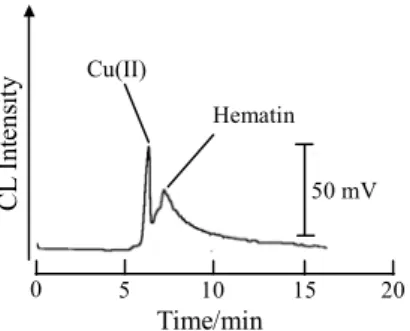
We tried to increase the hydrophobicity of hematin and hemoglobin by reducing the pH value of the aqueous component from pH 10.8 to 7.0 in the carrier solution; the mixture analytes were dissolved with the carrier solution prepared with 10 mM phosphate buffer (see the water-rich carrier solution, containing pH 7.0 phosphate buffer, above). Hematin was soluble in this carrier solution at 0.5 μM, but hemoglobin, with an isoelectric point of 6.8-7.0, did not dissolve in the carrier solution. The obtained Time/min
Time/min
a) b)
0 5 10 15 0 5 10 15
Hemoglobin
CLintensity
Fig. 2. Chromatograms of mixtures of a) hematin and Cu(II) and b) hemoglobin and Cu(II) obtained using the present TRDC system with the organic solvent-rich carrier solution (with 10 mM carborate buffer, pH 10.8). Conditions:
capillary tube, 70 cm of 75ȝm i.d. fused-silica; carrier, water (10 mM carborate buffer, pH 10.8, containing 25 mM luminol)–acetonitrile–ethyl acetate (2:7:4 volume ratio) mixture solution; sample injection, 25 cm height (gravity) u 10 s; carrier flow rate, 0.5 ȝL miní1; oxidant reagent flow rate, 10 ȝL miní1; analyte concentration, 0.1 ȝM hematin, 0.05ȝM hemoglobin, and 2 mM Cu(II).
10 mV Hematin
Cu(II)
CLintensity Cu(II)
10 mV
Kazuma YOSHIDA, Naoya JINNO, Masahiko HASHIMOTO and Kazuhiko TSUKAGOSHI 200
( )11 chromatogram of the mixture of hematin and Cu(II) with the carrier solution is shown in Fig. 3. They were eluted in the reverse order, although the hematin peak featured a little broadening. Cu(II) was eluted with near average linear velocity and hematin with the velocity slower than the average linear velocity.
The carboxyl groups of the hematin molecular structure might become protonated in such an aqueous–organic mixture solvent because of the lower pH value, leading to the increase in the hydrophobicity of hematin. Such hematin was easily dissolved in the organic solvent-rich phase or the minor solvent phase in the water-rich carrier solution, and delivered with the velocity slower than the average linear velocity. In Consideration of the separation behavior of Cu(II) and hematin, the chromatogram shown in Fig. 3 was consistent with the separation principle of the TRDC system with the water-rich carrier solution described previously.
5
5. Conclusions
Metal compounds, such as Cu(II), hematin, and hemoglobin, which are of interest as biocompounds, were analyzed through the TRDC system with a
chemiluminescence detector based on a luminal reaction.
Cu(II) is hydrophilic, and hematin and hemoglobin are comparatively hydrophobic. The mixtures were separated through a capillary tube with the help of the tube radial distribution of carrier solvents in the TRDC system and detected through their catalytic activity for the luminol chemiluminescence reaction. The data obtained in this study suggest a possibility to extend the application of the TRDC system to other analytes. The TRDC separation performance that we have proposed is supported by the results of this study.
This work was supported by a Grant-in-Aid for Scientific Research (C) from the Ministry of Education, Culture, Sports, Science, and Technology, Japan. It was also supported by the Academic Frontier Research Project on “New Frontiers of Biomedical Engineering Research” of the Ministry of Education, Culture, Sports, Science, and Technology, Japan.
References
1) H. J. Issaq, K. C. Chan, J. Blonder, X. Ye, and T. D.
Veenstra,J. Chromatogr. A, 2009,1216, 1825.
2) A. C. Otieno and S. M. Mwongela,Anal. Chim. Acta,2008, 624, 163.
3) S. K. Poole and C. F. Poole,J. Chromatogr. A,2008,1182, 1.
4) R. Koike, F. Kitagawa, and K. Otsuka,J. Sep. Sci., 2009,32, 399.
5) J. Urban and P. Jandera,J. Sep.Sci.,2008,31, 2521.
6) M. Tabata, Y. G. Wu, T. Charoenraks, and S. S.
Samaratunga,Bull. Chem. Soc. Jpn.2006,79, 1742.
7) T. Charoenraks, M. Tabata, and K. Fujii,Anal. Sci.,2008, 24, 1239.
8) N. Jinno, M. Hashimoto and K. Tsukagoshi,Anal. Sci., 2009,25, 145.
9) N. Jinno, M. Itano, M. Hashimoto, and K. Tsukagoshi, Talanta,2009,79, 1348.
10) M. Murakami, N. Jinno, M. Hashimoto, and K.
Tsukagoshi,Chem. Lett.,2010,39, 272.
11) K. Tsukagoshi, K. Sawanoi, and R. Nakajima, J.
Chromatogr. A,2007,1143, 288.
Fig. 3. Chromatogram of a mixture of hematin and Cu(II) obtained using the present TRDC system with a chemiluminescence detector (with 10 mM phosphate buffer, pH 7.0). Conditions: capillary tube, 70 cm of 75 ȝm i.d.
fused-silica; carrier, water (10 mM phosphate buffer, pH 7.0, containing 25 mM luminol)-acetonitrile-ethyl acetate (15:2:1 volume ratio) mixture solution; sample injection, 25 cm height (gravity) u 10 s; carrier flow rate, 0.5 PL miní1; oxidant reagent flow rate, 10PL miní1; analyte concentration, 0.5ȝM hematin and 1 mM Cu(II).
Hematin
50 mV CLIntensity Cu(II)
Time/min
0 5 10 15 20
Metal Compound Analysis by Capillary Chromatography Using an Untreated Capillary Tube and Water-Hydrophilic-Hydrophobic Solvent Mixture as a Carrier Solution 201