2470
IEICE TRANS. COMMUN., VOL.E99–B, NO.12 DECEMBER 2016
INVITED PAPER
Special Section on Information Centric Networking: Paradigms, Technologies, and ApplicationsGreenICN Project: Architecture and Applications of Green Information Centric Networking ∗
Atsushi TAGAMI†a),Member andMayutan ARUMAITHURAI††,Nonmember
SUMMARY As a research project supported jointly by the National In- stitute of Information and Communications Technology (NICT) in Japan and the European Commission under its 7th Framework Program, the GreenICN Project has been in operation from 2013 to 2016. The GreenICN project focused on two typical application scenarios, one a disaster scenario and the other a video delivery scenario. The disaster scenario assumed a situation of limited resources, and the video delivery scenario assumed a situation of large-scale content delivery. In both situations, the project challenged to provide “green”, i.e. energy-efficient, content delivery mech- anism. For this goal, we designed an energy consumption model to lay out energy reduction policies. For the achievement of the policies, we improved ICN architecture, for example a name-based publish/subscribe mechanism, an effective cache management policy,energy-efficient secu- rity scheme and a new energy API. This paper provides a summary of our achievements and descriptions of some outcome.
key words: information centric networking, GreenICN project
1. Introduction
The Internet, which began as a network joining computers, is currently becoming part of the indispensable infrastruc- ture of life. With the developments of the Internet, many issues have arisen in connection with numerous different re- quirements. Many research projects have explored the fu- ture network architecture that can address these issues[1].
One such study is Information Centric Networking (ICN), which has the potential to provide a network infrastructure service that is better suited to today’s use, in particular, con- tent distribution and mobility[2]. ICN focuses on named data objects, e.g., web pages, videos, documents, or other pieces of information, unlike the current networks focus on named hosts. These architectures leverage in-network stor- age for caching, multiparty communication through replica- tion, and interaction models that decouple senders and re- ceivers.
Since research on ICN is at an early stage, many key issues still remain, including scalability [3], cache man- agement [4] and security [5]. The GreenICN (Architec- ture and Applications of Green Information Centric Net-
Manuscript received May 25, 2016.
Manuscript revised July 21, 2016.
†The author is with KDDI R&D Laboratories, Inc., Fujimino- shi, 356-8502 Japan.
††The author is with Georg-August-Universit¨at G¨ottingen, G¨ottingen, Germany.
∗This research project is supported jointly by the European Commission under its 7th Framework Program (contract no.
608518) and the National Institute of Information and Communi- cations Technology (NICT) in Japan (contract no. 167).
a) E-mail: [email protected]
DOI: 10.1587/transcom.2016CNI0001
working) Project was launched in 2013 to deal with these issues, and to produce a functionally rich API [6]. This is a joint Japan-Europe research project, which consor- tium is comprised of six organizations from Japan (KDDI R&D Laboratories, NEC, Panasonic Advanced Technol- ogy Development, University of Tokyo, Osaka University, Waseda University) and six from Europe (Georg-August- Universit¨at G¨ottingen, NEC Europe, University College London, CEDEO, Consorzio Nazionale Interuniversitario per le Telecomunicazioni, Telekomunikacja Polska). For- tunately, this project benefited not only from the diversity of the participating countries, but also from the diversity of its member organizations, i.e., carriers, network vendors, service venders and universities. The diversity of this con- sortium produced a synergistic effect, yielding improved re- search, and stimulating the creation of this applications and services expected to motivate industries and consumers to adapt its product.
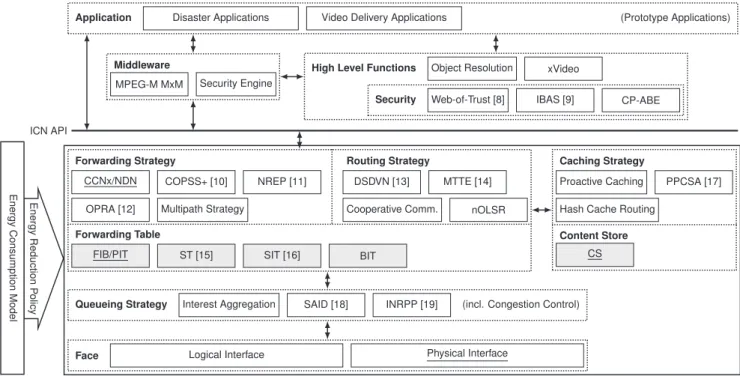
Figure 1 shows the functional modules proposed by the GreenICN project and the relationship between these mod- ules. To ensure the wide applicability of our end project, we in the GreenICN project, took two complementary ap- proaches to the project. One was an application driven ap- proach. First, we made two application use-case scenar- ios, a disaster scenario and a video delivery scenario. The disaster scenario, which is a feature of GreenICN project, represented a situation where resources, e.g., power supply and network infrastructure, were extremely limited. On the other hand, the video delivery scenario represented a “nor- mal” situation which means that resource are not much re- stricted. In the video delivery scenario, we focused on a video delivery because it generates most of the data traf- fic[7]. The details of the scenarios are discussed in Sects. 3 and 4. Each scenario brought out technical requirements and specific issues, and as we developed the specific solutions, we migrated them to the general solutions as GreenICN so- lutions. The other approach was to reduce energy demand with the help of an energy consumption model. This en- ergy reduction goal provided a direction to be followed in all projects. As the “Green” in the project name implies, low energy consumption is an important part of our project.
All other features have been developed with the Green goal in mind.
These two approaches clarified the requirements de- rived from specific applications and the solutions evaluated by a clear indication from the energy consumption model.
In the other words, the participants could share “what we Copyright c⃝2016 The Institute of Electronics, Information and Communication Engineers
Fig. 1 Relationship between GreenICN Project achievements. Shadow boxes mean the storage and other boxes mean processing module. Underline means the existing module, i.e., it is an outcome of outside the project.
should do” and “how we should do”. This helped to simul- taneously distribute the task, and to provide coherence to the consortium.
This paper presents a summary of GreenICN project achievements from three points of view. One is the energy consumption model, described in Sect. 2, and the others are the two application use-case scenarios described in Sects. 3 and 4.
2. Energy Effective Networking
2.1 Energy Reduction Policy
Energy-effective networking, i.e., green networking, is a key purpose of the GreenICN project. The energy consumption of a network is expected to increase with increasing data traffic. GeSI forecasts that the global GHG (greenhouse gas) emissions from end-user devices, networks and data centers will increase by 3.8% per year from 2011 to 2020[20]. Es- pecially in the disaster scenario that is one of the use-cases in our project, since all resources including energy are lim- ited, energy-effectiveness is an important value.
We considered that energy-effective networking cannot be achieved solely which a single technology or simple fix.
All efforts to find solutions require deep thought about all the ways that energy use might be reduces. Finally, we de- cided on the following three energy reduction policies as applicable to ICN[21].
Reduction in the number of hops: Caching is a feature of ICN, and permits an intermediate router to respond to
a request message instead of the data source. Reduc- ing the number of hops implies that fewer nodes are used to process both a request and the requested data, thereby reducing the overall energy consumption of the network at a basic level.
Halting of unnecessary ICN functions: An ICN router has some energy-hungry functions, such as longest- prefix search and per packet caching. These functions might not need to operate in all routers, and it is possi- ble to halt the functions on some routers by introducing extra cooperation in the entire network.
Halting of network equipments: Turning off an entire piece of equipment results in greater energy saving than just halting some of its functions [22]. The de- coupling of content and location facilitates to control the flows of traffic by a content replication and a name- based routing control for halting of links and/or nodes not required for flows.
These are not ICN-specific goals, but are appropriate for use in ICN. Our achievements were designed with these ends in mind, and can therefore provide energy-effective networking.
2.2 Energy Consumption Model
As mentioned in the previous subsection, an ICN router in- cludes more complex processing and more databases. Thus an ICN router will not necessarily reduce energy consump- tion even if it can reduce the number of hops. To clarify this trade-off, we modeled the energy consumption of an ICN
2472
IEICE TRANS. COMMUN., VOL.E99–B, NO.12 DECEMBER 2016
Fig. 2 Energy consumption in liner topology which consists of 3 routers, a information server and client. Routers are numbered in order of distance from client and “1st” means that only the first router has a caching function and the other (i.e., 2nd and 3rd) routers do not have it.
router[23]. This subsection shows a primary analysis using the model.
The analysis uses a simple liner topology of three routers in which the most upstream router is connected to an information server and the most downstream router is connected to a client that sends request packets. The in- formation server holds 160,000 information pieces which is the same number as the average number of web pages re- quired per day in a medium-size city[24]. The size of each information piece is 10 Mbytes, which is the same size as the average size of YouTube videos[25]. Each information piece is divided into chunks with the size of 1,024 bytes.
Clients request information pieces following a Zipf distri- bution with the parameterα=0.8[25].
Figure 2 shows the energy consumption as the number of routers with caching function varies. The labelsalland 1stmean that all routers or only the first router have caching functions. First, this figure shows that caching reduces the energy consumption compared to that without caching.
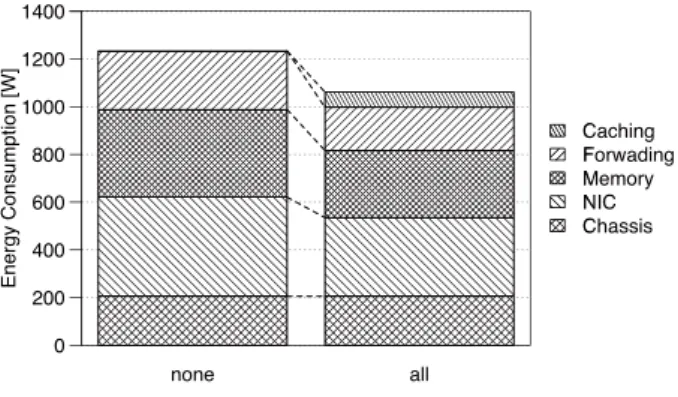
However, the reduction is not proportional to the number of routers with a caching function. For a more detailed analy- sis, we examine how the devices consume energy and how the functions of caching and forwarding consume CPU en- ergy. Figure 3 breaks down the power consumption by the devices and the functions for a cache size of 64 Gbytes. This figure helps us understand the tradeoffs. The positive effects are two-fold: First, the traffic reduction due to caching re- duces the energy consumed by the NIC and memory devices of upstream routers. Second, the energy consumed by the forwarding function is reduced because the number of re- quest packets is reduced. However, a negative effect is that all routers consume energy for caching. But it is clear that the energy reduction from the positive effects is larger than that of the energy increase from the negative effects.
This model helps us to design and evaluate caching functions as parts of the energy consumption of the entire network. Currently we are analyzing the caching strategy and its effectiveness in more complex and realistic network
Fig. 3 Breakdown of power consumption where the cache size is 64 Gbytes in Fig. 2. “Caching” and “Forwarding” are power consump- tions by each processing, i.e. on CPU, and others are power consumptions on each hardware device.
topologies.
3. Disaster Scenario
3.1 Name-Based Information Dissemination
The aftermath of an enormous natural disaster puts a high strain on available resources due to the growth in commu- nication demand in order to seek help, distributing criti- cal information, and confirming the safety of relatives and friends. The traffic on the network typically increases sub- stantially, and it is compounded further by disruptions due to damaged network infrastructure and the non-availability of power[26]. Networks are fragmented, and communica- tion is intermittent and prone to disruption. Human-induced disasters such as a terrorist attack also have the same fea- tures, except that the infrastructure damage was caused de- liberately and willfully, and it may occur suddenly with no advance warning.
Fragmented Network is a key concept to describe the disaster situations assumed by our project. A Frag- mented network is a network with the potential for limited communication capability within the fragment, but without infrastructure-based connectivity to others. Fragmented net- works are created not only by unexpected failures of the backhaul, metro-area network or connectivity to the back- bone, but also by newly or temporary created networks for refugees in emergency gathering points such as hospitals, schools or first-aid centers.
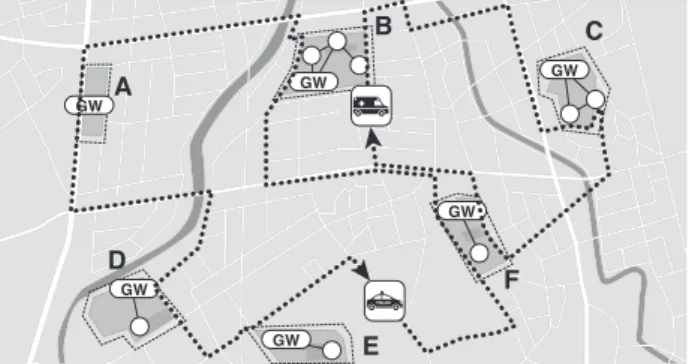
Figure 4 shows an example scenario in which the af- termath of a disaster results in the creation of fragmented networks. Each fragmented network consists of one or sev- eral nodes that are able to communicate among themselves.
We assumed that there is a gateway in each fragmented net- work and that it is an ICN router that forwards and stores messages from and to external networks.
A data mule [27]is a vehicle that physically carries storage to effectively create a data communication link.
Even in the disaster scenario, there are many data mules,
Fig. 4 Fragmented networks identified by letters A–F. Each fragmented network consists of one or several nodes that are able to communicate among themselves and has a gateway that is responsible for communica- tion with other networks.
such as ambulances, police cars, helicopters or people with smartphones. Since the ICN architecture decouples a data communication from the end-to-end connection, it should be able to successfully use these data mules. We intro- ducedLogical Interface(LIF)[10]to include the data-mule- specific forwarding and routing by building a logical topol- ogy on the fragmented networks. For example, fragmented networks A, C and F in Fig. 4 constitute a full-mesh logi- cal topology since a data mule circulates among them. An LIF covers DTN-like forwarding by data mules and ICN functions do not need to know whether networks are frag- mented or not. This transparency provides convenience to victims and ICN functions enable to disseminate informa- tion between fragmented networks without specific informa- tion about data mules.enables ICN functions to disseminate information between fragmented networks without specific information about data mules.
3.2 Multi Forwarding Strategies
In a disaster situation, the flexible and reliable communica- tion is required to maintain awareness of various conditions and their changes. For instance, an important notification may need to be delivered to all citizens, but they are not al- ways online due to battery problems or their position in a fragmented network. Publish/Subscribe can provide effec- tive information dissemination to millions of people on a real-time basis. However obtaining the needed information during limited periods of being online may be difficult for those whose time online is repeatedly interrupted.
The information-centric paradigm focuses on getting named messages and not how or from where it is obtained.
Using this feature, we developed an information dissemina- tion system that uses both pull (i.e., Query/Response) and push (i.e., Publish/Subscribe) strategies[28]. The key idea of this system is that a content store (CS) couples two trans- ferring methods. For instance, a published message is trans- ferred to the gateways of fragmented networks by push-type communication, and stored there. If a consumer is online at that time, he/she can get the pushed message then. A con- sumer who is offline then can later get the cached message
Fig. 5 Simulation results of the time until a message is transmitted to all consumers.
Fig. 6 Simulation results of the average number of messages per an in- teraction between data mule and gateway.
from the gateway with a pull. In this case, the message is transferred by a subscribe table (ST) to the gateway from the rendezvous point. But it is transferred by a forwarding information base (FIB) and a pending interest table (PIT) from the gateway to the consumer. This conjugation is real- ized by well-designed naming scheme[29]and a consumer and a router can select a suitable transferring strategy situa- tionally.
Figures 5 and 6 shows the simulation results of the stochastic model. Two data mules shuttle between the frag- mented network and the government office. The govern- ment office is a location of the information publisher and the rendezvous point of Publish/Subscribe communication.
The publisher sends messages with a Poisson distribution Po(0.1) and the round-trip time of a data mule follows a normal distribution N(30,2). The connection time and the disconnection time of each consumer follows a Gamma dis- tribution whose average means that a consumer is connected for 5 minutes of each 60 minutes. The x-axis and y-axis represent the number of consumers in the fragmented net- work, and the time between when the publisher sends a message and when all consumers receive it. “Integration”
means our developed system which uses both pull and push strategies. “Pull-type” a means general ICN communication
2474
IEICE TRANS. COMMUN., VOL.E99–B, NO.12 DECEMBER 2016
which sends an interest packet at every 0.1 minutes and gets the message from the government office or an intermediate cache.
In the case of pull-type communication, the Fig. 5 shows that many consumers experience a short delivery la- tency. This is because ICN behaves naturally like multicast, using the cache on the gateway of the fragmented network.
However, integration reduces the delivery latency, and the number of messages between a data mule and a gateway is small, as shown Fig. 6. In summary, the integrated scheme can provide flexible and reliable communication for the in- formation dissemination in a disaster situation.
4. Video Delivery Scenario
4.1 Background
According to Cisco’s white paper[7], the video streaming and downloads are the primary contributions to the world- wide network traffic growth, and will grow to more than 80 percent of all consumer Internet traffic by 2019. Mobile video traffic alone is expected to grow at an annual rate of 59% until 2019. Reducing the energy consumption of video delivery will play an important role in the green networking.
To promote efficient content delivery, in-network caching has been deployed in almost ICN architectures.
This allows the consumers to obtain the copies of transferred contents from the closer routers without visiting the original source. With in-network caching, ICN can facilitate mul- ticasting of content, and can shorten the content delivery distance between content copies and consumers, reducing unnecessary network traffic. In this way, appropriate cache management can reduce the energy consumption.
4.2 Popularity Proportional Cache Size Allocation Policy Cache replacement policy aims to carefully choose the ap- propriate content in CS to evict, in order to make room for the new incoming content. We devised a cache replacement policy that improves the cache performance of video de- livery on ICN, which we call the Popularity Proportional Cache Size Allocation Policy (PPCSA)[17]. PPCSA uses a video file’s popularity instead of a chunk’s one and evicts a prior chunk for keeping subsequent chunks.
In ICN, a video file is composed of a set of video segments called as chunks. Video viewers request video segments in the order of their content sequence number.
PPCSA is a cache replacement strategy considering this hi- erarchical structure corresponding with naming scheme and the time structure of requested video segments. Its model can be divided into two components: cache size allocation and evictee selection. The first component allocates the cache in proportional to a video file’s popularity. It enables the targeting of allocation by equalizing two rates, the re- quest ratio for each video file and the the occupancy rate for video files cached in CS. The second component deduces that the subsequent segments have a higher probability of
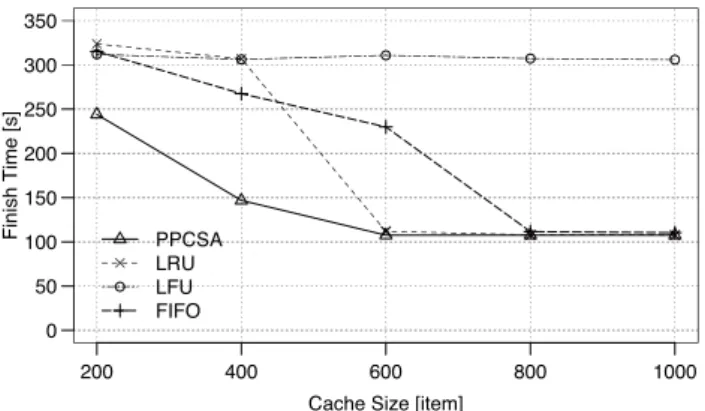
Fig. 7 Simulation results of the finish time which illustrates the total pro- cessing time for all consumers to receiver their requested videos.
being requested in the future. Therefore, the component keeps the subsequent segments in the CS for the expected future requests by selecting the segment with the smallest sequence number to be the evictee candidate.
We evaluated the performance of the replacement poli- cies using simple 4-level tree topology. Video producers and consumers were all connected to the edge of the topology.
There were 25 different producers, each providing a unique video file. Every video file consisted of 800 video segments, so the total number of segments was 20,000 items. Then, 100 video consumers requesting video files followed a Zipf distribution withα=1.2. These consumers requested video files at given intervals that ware assumed to follows an ex- ponential distribution withλ=1.
Figuer 7 shows the total processing time for all the 100 consumers to receive their requested videos files. PPCSA can deliver a video file faster than the usual policy even if there is insufficient cache space. This means that PPCSA enhances the utilization of cache space that consumers can get a video file from closer routers. More detailed evaluation shows that PPCSA can reduce amount of network traffic, and thus reduces the transmission energy consumption by more than 15% on average, compared to LRU and FIFO.
5. Exploitation
5.1 Events
To share our project’s research outcomes, an open workshop called “Research Activities and Future of EU/US/JP ICN Projects” was held on October 30, 2015 at Waseda Uni- versity, Japan [30]. The workshop featured not only lec- tures from our project, but also from the other ICN-related projects, such as CCNx [31], NDN[32]and POINT[33].
Trends in ICN-related standardization were also introduced.
About 70 participants were exposed to the latest ICN re- search and discussed the issues.
Our project provided keynote speeches and received in- vitations to talk not only at ICN-related research events, but also at more general events. These activities disseminated
information about the new Internet architecture, i.e., ICN itself, and about GreenICN project achievements.
5.2 Standardization
We inputted our outcomes into some standardizing bodies, such as ITU-T, IETF/IRTF and MPEG. The disaster sce- nario is a special use-case as the application of ICN, and the video user-cases were also discussed widely, as were the benefits of ICN. Thus we contributed these use-cases to ITU-T SG13[34]and IRTF ICNRG[35]with technical challenges. These activities helped to clarify the benefits of ICN and the remaining requirements.
The middleware for the green video delivering is one achievement of our project and its APIs were added to MPEG eXtensible Middleware (MXM) which is a core tech- nology of MPEG-M [36]. Also the specifications of the MPEG Publish/Subscribe application format were devel- oped based on GreenICN use-cases.
Standardization activities still continue, but these achievements of the GreenICN project are already having widespread impact.
6. Conclusion
This paper summarized the GreenICN project’s objectives, activities and achievements. We challenged the key issues of ICN, to improve ICN research activities. Because most of us had never had worked in this type of Japan-Europe joint research project, we were confronted with challenges such as cultural differences, different research project sys- tems, and language. But two distinct use-case scenarios and the “green” theme gave the direction to our project so that we could produce important results. Our achievements were published, and include 3 papers that won ‘best paper’
awards[16],[37],[38].[16]boosted the potential of the in- network caching to prolong content lifetime and serve inter- ests when fragmentation occurred and origin server was not reachable. [37]provided a new cache management scheme to avoid congestion and improve a user experience. These enhanced ICN architecture for an information resilience and an effective delivery. Additionally, Function Centric Service Chaining[38]showed how ICN can help in network man- agement, and enhanced an applicable scope of ICN.
This project went to completion in 2016. However, the research and development of ICN are still in progress. We believe that our results will help research and development improve the future Internet and, we hope, improve the qual- ity of life for European and Japanese people.
Acknowledgement
The authors wish to acknowledge all members of GreenICN project. Especially, Dr. T. Hasegawa, Professor of Osaka University, Dr. H. Nakazato, Professor of Waseda Uni- versity, Dr. T. Asami, Professor of the University of To- kyo, Dr. T. Yagyu, NEC Corporation, Dr. K. Nakamura,
Panasonic Corporation, Dr. J. Seedorf, NEC Europe Ltd, Dr. I. Psaras, UCL, Dr. N. Blefari-Melazzi, Professor of University of Rome, Dr. L. Chiariglione, CEDEO and Mr. D. Bursztynowski, Orange Labs give insightful com- ments and suggestions. Additionally we would like to ex- press the deepest appreciation to Dr. K.K. Ramakrishnan, Professor of UC Riverside, who gives us constructive com- ments and warm encouragement as the advisory board mem- ber or more.
References
[1] T. Hasegawa, “A survey of the research on future Internet and network architectures,” IEICE Trans. Commun., vol.E96-B, no.6, pp.1385–1401, June 2013.
[2] B. Ahlgren, C. Dannewitz, C. Imbrenda, D. Kutscher, and B.
Ohlman, “A survey of information-centric networking,” IEEE Com- mun. Mag., vol.50, no.7, pp.26–36, July 2012.
[3] C. Yi, J. Abraham, A. Afanasyev, L. Wang, B. Zhang, and L. Zhang,
“On the role of routing in named data networking,” Proc. 1st Inter- national Conference on Information-Centric Networking, INC’14, pp.27–36, 2014.
[4] G. Rossini and D. Rossi, “Coupling caching and forwarding,” Proc.
1st International Conference on Information-Centric Networking, INC’14, pp.127–136, 2014.
[5] P. Mahadevan, E. Uzun, S. Sevilla, and J.J. Garcia-Luna-Aceves,
“CCN-KRS: A key resolution service for CCN,” Proc. 1st Inter- national Conference on Information-Centric Networking, INC’14, pp.97–106, 2014.
[6] GreenICN Project, http://www.greenicn.org/
[7] Cisco Systems, “Cisco visual networking index: Forecast and methodology, 2014–2019,” White Paper, Document ID:
1465279499105137, May 2015.
[8] J. Seedorf, D. Kutscher, and F. Schneider, “Decentralised binding of self-certifying names to real-world identities for assessment of third-party messages in fragmented mobile networks,” 2014 IEEE Conference on Computer Communications Workshops (INFOCOM WKSHPS), pp.416–421, 2014.
[9] T. Asami, B. Namsraijav, Y. Kawahara, K. Sugiyama, A. Tagami, T. Yagyu, K. Nakamura, and T. Hasegawa, “Moderator-controlled information sharing by identity-based aggregate signatures for in- formation centric networking,” Proc. 2nd ACM Conference on Information-Centric Networking, ACM-ICN’15, pp.157–166, 2015.
[10] K. Sugiyama, A. Tagami, T. Yagyu, T. Hasegawa, M. Arumaithurai, and K.K. Ramakrishnan, “Name-based information dissemination for fragmented networks in disasters,” IEEE/ACM Conference on COMmunication Systems & NETworkS, COMSNETS, Bangalore, India, Jan. 2015.
[11] I. Psaras, L. Saino, M. Arumaithurai, K.K. Ramakrishnan, and G. Pavlou, “Name-based replication priorities in disaster cases,”
2014 IEEE Conference on Computer Communications Workshops (INFOCOM WKSHPS), pp.434–439, 2014.
[12] H. Nakazato, S. Zhang, Y.J. Park, A. Detti, D. Bursztynowski, Z.
Kopertowski, and I. Psaras, “On-path resolver architecture for mo- bility support in information centric networking,” 2015 IEEE Globe- com Workshops (GC Wkshps), pp.1–6, 2015.
[13] T. Yagyu and S. Maeda, “Demo overview: Reliable contents re- trieval in fragmented ICNs for disaster scenario,” Proc. 1st Inter- national Conference on Information-Centric Networking, INC’14, pp.193–194, 2014.
[14] L. Xu and T. Yagyu, “Multiple-tree based online traffic engineering for energy efficient content centric networking,” IEICE Technical Report, IA2013-78, Jan. 2014.
[15] J. Chen, M. Arumaithurai, L. Jiao, X. Fu, and K.K. Ramakrishnan,
“COPSS: An efficient content oriented publish/subscribe system,”
2476
IEICE TRANS. COMMUN., VOL.E99–B, NO.12 DECEMBER 2016
2011 ACM/IEEE 7th Symposium on Architectures for Networking and Communications Systems, pp.99–110, 2011.
[16] V. Sourlas, L. Tassiulas, I. Psaras, and G. Pavlou, “Information re- silience through user-assisted caching in disruptive content-centric networks,” 2015 IFIP Networking Conference (IFIP Networking), pp.1–9, 2015.
[17] H. Li, H. Nakazato, A. Detti, and N.B. Melazzi, “Popularity propor- tional cache size allocation policy for video delivery on CCN,” 2015 European Conference on Networks and Communications (EuCNC), pp.434–438, 2015.
[18] J. Chen, M. Arumaithurai, X. Fu, and K.K. Ramakrishnan, “SAID:
A control protocol for scalable and adaptive information dissemina- tion in ICN,” CoRR, vol.abs/1510.08530, 2015.
[19] I. Psaras, L. Saino, and G. Pavlou, “Revisiting resource pooling: The case for in-network resource sharing,” Proc. 13th ACM Workshop on Hot Topics in Networks, HotNets-XIII, pp.24:1–24:7, 2014.
[20] Global e-Sustainability Initiative, SMARTer 2020: The Role of ICT in Driving a Sustainable Future, Dec. 2012.
[21] T. Hasegawa, K. Sugiyama, A. Tagami, T. Yagyu, A. Uchiyama, and T. Asami, “Towards Green Information Centric Networking,” IEICE Trans. Commun. (Japanese Edition), vol.J97-B, no.10, pp.828–838, Oct. 2014.
[22] M. Zhang, C. Yi, B. Liu, and B. Zhang, “GreenTE: Power-aware traffic engineering,” 18th IEEE International Conference on Net- work Protocols, pp.21–30, 2010.
[23] T. Hasegawa, Y. Nakai, K. Ohsugi, J. Takemasa, Y. Koizumi, and I.
Psaras, “Empirically modeling how a multicore software ICN router and an ICN network consume power,” Proc. 1st International Con- ference on Information-Centric Networking, INC’14, pp.157–166, 2014.
[24] “IRCache project,” http://www.ircache.net/
[25] C. Fricker, P. Robert, J. Roberts, and N. Sbihi, “Impact of traf- fic mix on caching performance in a content-centric network,”
Proc. 2012 IEEE Conference on Computer Communications Work- shops (INFOCOM WKSHPS) Proc. IEEE INFOCOM Workshops, pp.310–315, 2012.
[26] ITU-T, Technical Report on Telecommunications and Disaster Mit- igation, std., ITU-T Focus Group on Disaster Relief Systems, Net- work Resilience and Recovery (FG-DR&NRR), June 2013.
[27] R.C. Shah, S. Roy, S. Jain, and W. Brunette, “Data MULEs: Mod- eling a three-tier architecture for sparse sensor networks,” Proc. 1st IEEE International Workshop on Sensor Network Protocols and Ap- plications, pp.30–41, 2003.
[28] T. Yagyu, K. Nakamura, T. Asami, K. Sugiyama, A. Tagami, T.
Hasegawa, and M. Arumaithurai, “Demo: Content-based push/pull message dissemination for disaster message board,” Proc. 2nd ACM Conference on Information-Centric Networking, ACM-ICN’15, pp.205–206, 2015.
[29] A. Tagami, T. Yagyu, K. Sugiyama, M. Arumaithurai, K. Nakamura, T. Hasegawa, T. Asami, and K.K. Ramakrishnan, “Name-based push/pull message dissemination for disaster message board,” 2016 IEEE International Symposium on Local and Metropolitan Area Networks (LANMAN), pp.1–6, 2016.
[30] GreenICN Project, “Research activities and future of EU/US/JP ICN projects workshop.” http://jp.greenicn.org/workshop.html [31] “CCNx: Parc’s implementation of content-centric networking,”
http://blogs.parc.com/ccnx/
[32] “Named Data Networking (NDN) — A Future Internet Architec- ture,” http://named-data.net/
[33] “The H2020 POINT Project,” http://www.point-h2020.eu/ [34] “Supplement to Y.3033 on scenarios and use cases of data aware
networking,” Recommendation Y.supFNDAN, ITU-T, April 2016.
[35] J. Seedorf, M. Arumaithurai, A. Tagami, K.K. Ramakrishnan, and N. Blefari, “Using ICN in disaster scenarios,” draft-seedorf-icn- disaster-05, Dec. 2015.
[36] “Multimedia Service Platform Technologies (MPEG-M),” Standard 23006, ISO/IEC.
[37] D. Nguyen, K. Sugiyama, and A. Tagami, “Congestion price for cache management in information-centric networking,” 2015 IEEE Conference on Computer Communications Workshops (INFOCOM WKSHPS), pp.287–292, 2015.
[38] M. Arumaithurai, J. Chen, E. Monticelli, X. Fu, and K.K.
Ramakrishnan, “Exploiting ICN for flexible management of software-defined networks,” Proc. 1st International Conference on Information-centric Networking, INC’14, pp.107–116, 2014.
Atsushi Tagami received the M.E. and Ph.D. degrees in Computer Science from Kyu- shu University, Japan in 1997 and 2010, respec- tively. He joined KDDI R&D Laboratories Inc.
in 1997, where he has been engaged in research and development on performance measurement of communication networks and overlay net- working. He is currently a senior manager at Future Communication Architecture Laboratory of KDDI R&D Laboratories, Inc.
Mayutan Arumaithurai is a Junior Re- search Group Leader in the Computer Networks Group at Institute of Computer Science, Uni- versity of G¨ottingen. He received his master’s and doctoral degrees from Technical University of Hamburg-Harburg in 2006 and the University of G¨ottingen in 2010, respectively. His research interests include congestion control, emergency services, and information centric networking.