Performance of Housing
著者 Misni Alamah, Baird George, Allan Penny journal or
publication title
International Review for Spatial Planning and Sustainable Development
volume 1
number 1
page range 31‑56
year 2013‑01‑01
URL http://hdl.handle.net/2297/33111
31
http://hdl.handle.net/2297/32453?locale=en
Copyright@SPSD Press from 2010, SPSD Press, Kanazawa
The Effect of Landscaping on the Thermal Performance of Housing
Alamah Misni
1 2*, George Baird
2and Penny Allan²
University of Technology Mara, Malaysia¹ Victoria University of Wellington, New Zealand²
* Corresponding Author, University of Technology Mara, Malaysia, Email:
Key words: Urban heat island, single-family house, thermal performance, landscaping, evapotranspiration
Abstract: The heat island effect influences most of the major cities around the world.
This urban phenomenon occurs because air temperatures in densely built urban areas are higher than the temperatures of the surrounding rural countryside. In tropical cities, the exterior environment is already extremely warm due to high air temperatures, especially during dry seasons. However careful planning and development of exterior spaces can reduce the adverse impact of these temperatures. This paper investigates the effect of landscaping on the thermal performance of housing in a hot-humid tropical climate. The climatic parameters, physical characteristics of building construction, and landscape design of three private houses in Shah Alam, Selangor, Malaysia were measured and surveyed. The study focuses on the potential impact of shade trees and different types of foliage on the thermal performance of houses of different ages. Sets of instrument were placed in several outdoor and indoor locations around the houses. Result show that the outdoor air temperatures of the well-landscaped houses were usually lower compared to the minimally- landscaped house. The main findings show that well-designed landscaping around single-family houses could potentially reduce heat build-up by shading, evapotranspiration, and wind channelling by as much as 3°C.
1. INTRODUCTION
The urban heat island effect, an influence in most major cities around the
world, is well documented as an urban phenomenon. Buildings and paved
surfaces in urban areas encourage the absorption of solar energy into
building structures, roads and other hard surfaces. The absorbed heat is subsequently re-radiated, creating an increase in the surface temperature of urban structures of up to 5.5–10°C (Akbari, Davis et al. 1992). As the urban surfaces become hotter, the overall ambient air temperature can increase by as much as 2–8°C. The larger the city, the more intense the summer heat island effect (Oke 1973) and the magnitude of discomfort and associated air conditioning load (Akbari, Taha et al. 1986).
Taha et al. (1988) state that residential building are particularly sensitive to high levels of heat since they are envelope-dominated structures.
On hot summer days, this urban phenomenon contributes significantly to the urban dweller’s discomfort.
Appropriate planning and design of residential buildings to take account of these concerns is becoming more important. Well-designed and strategic locations of landscaping around single-family houses could potentially reduce heat build-up by shading, evapotranspiration, and wind channelling by as much as 3°C during peak time of the day.
In tropical cities, the external environment is extremely warm due to the high air temperatures especially during dry seasons. The planning and development of exterior spaces can reduce the energy consumption of buildings by reducing the adverse impact of some climate factors. If the microclimatic condition around the building is very similar to the desired interior condition, little extra energy is required. Conversely, if the microclimate is significantly different from the desired interior conditions, large amounts of energy may be required for cooling
(Brown and Gillespie 1995).Solar heat passing through windows and absorbed through the walls and roofs is the major source of heat flow into buildings. Landscaping can have a particularly effective influence on microclimate and associated building thermal performance and is one of the simplest strategies to reduce solar heat gain (McPherson, Herrington et al. 1988). Strategically placed vegetation around a building has been recognised as a means of cooling. It reduces the amount of radiation falling on the building by shading, by moderating temperatures, by the evapotranspiration processes, and by controlling wind direction to assist in keeping the building cool. The appropriate amount, type and placement of vegetation can slow heat build-up on a hot summer day. However the effect of the immediately surrounding vegetation on the thermal performance of single-family houses in a tropical environment has not been widely recognized or quantified.
The study will focus on the potential impact of shade trees and different
types of foliage on the thermal performance of houses of different ages in
hot-humid tropical climates. It will present propose a methodology, state site
selection and climate characteristics, identify house selection and landscape
design, and clarify the results and discussion.
2. METHODOLOGY
Research methods in this study were divided into three parts: house selection, observation, and field measurement. The aims of the house selection were to identify and choose similar building constructions and site locations that were sufficiently different in their amount of landscape structures and design. The aim of the field measurement programme was to evaluate and compare the surrounding microclimate which would directly influence the interior thermal performance of the house. The local weather recording was carried out during daytime on 23, 24, and 28 February 2010.
Weather on these three days was very similar, where there was sunshine for the whole day, with rain starting softly at night time at 19.30 hours. The study measured climatic parameters and the physical characteristic of the four azimuths of the houses. Each measurement point represents an area of 90m² and an approximate 3–10m radius around the fixed/mobile weather station. The measurements were taken at 30-minute intervals in all locations at a metre above the ground and in the shade. The albedo data for every type of building envelope was also measured during the daytime.
2.1 Outdoor space
The field measurements were carried out on private single-family houses with permission to do surveys during the daytime. The weather measurements were not influenced by shadows or reflected solar radiation.
The surface area of the gardens was variously covered by planting including trees, shrubs, groundcover and turf. The basic measuring equipment used for the field measurements included:
i. Two sets of mobile TSI VelociCalc Plus Meters, model 8386, data loggers and sensors. This was to measure surface temperature, wetbulb temperature, drybulb temperature, humidity and wind velocity.
ii. Two sets of portable data acquisition devices, model Babuc A code BSA014, multi-datalogger and sensors to measure air temperature, global temperature, relative humidity and wind velocity.
iii. Two sets of Lux meters PCE-172 to take the albedo measurement.
iv. Two sets of compasses and measuring tapes to ensure and confirm the measurement of the house configurations.
v. A set of drawing equipment to draw and record the house configurations and landscape plans in scale and detail on site.
The same data recorded from two types of equipment at the same time
was to validate the data and to ensure all data was accurate.
Figure 1
2.2 I
Four set (Figure 1) w the building above the f ground floo
3. S
C
The thre Longitude) Shah Alam capital of Se sustainable the garden’
green space Sections 6, low density represents a 50 houses in
3.1 S
The study w the three se
1. Babuc A (lef
Indoor spa
ts of Electro were used to
gs. This equ floor near th or of the hous
SITE SELE CHARACT
ee houses ar at an eleva is best know elangor State developmen was to emph e. The specif
9 and 11, in y single-fam around 20–3 n each sectio
Site selecti
was carried o ections. The
ft), mobile TSI Mini Thermo
ace
onic Mini T measure air uipment was
he windows ses.
ECTION A TERISTIC
re located in tion of 27 t wn as one of e, and has ac nt. The imag hasize that e fic locations n the central mily housin
0% of the w on.
on
out on three three house
VelociCalc Plu ohygrograph (ri
Thermohygro temperature, set automat which face
AND CLIM CS
n Shah Alam to 47m in a f the well-pla ctively practi ge of Shah A
very develop for the three city. The si ng is more whole residen
single-famil s were chos
us Meters (midd ight)
ograph, mod , and air hum tically and p ed the four
MATE
m (3°N Lati hot-humid anned cities ised landscap Alam as an e
pment must b e single-fam ize of these than 0.5km ntial develop
ly residences en because o
dle), and Electro
del testo 175 midity data in placed at a m azimuths on
itude and 10 tropical clim in Malaysia ping as part o exclusive ‘cit be balanced mily houses a three section m
2each. T pment with u
s, one in eac of their diffe
onic
5-T2 nside metre n the
01°E mate.
a, the of its ty in with are at ns of They up to
ch of
erent
ages of construction and hence also different ages of the surrounding landscaping. These were termed ‘mature’, ‘ordinary’ and ‘new’. The mature landscape house was located in Section 6, and is 30 years old; the house with the ordinary landscape was 10 years old and is situated in Section 11; while new landscape house was located in Section 9 and is 5 years old.
The houses in each neighbourhood were surrounded by houses of similar age and landscaping.
3.2 Climatic setting
Two years of climate data (2008-2009) were obtained from the nearby Subang Airport Weather Station. The averages for the dry and rainy season are shown in Table 1. The common characteristics of a hot-humid tropical climate are clearly shown in the study areas where the temperature ranges are from 24–33°C and relative humidity is between 72 and 78%.
Precipitation was very heavy throughout the year, with an annual average of about 3100mm with 202 days of rain. The dry season occurs with the south- west monsoon which starts in the latter half of May and ends in September, and the prevailing wind flow is generally south-westerly and light, below 17.6m/s. The north-east monsoon in the rainy season commences in early November and ends in March with steady prevailing north-westerly winds of 14.5m/s. During the two shorter periods of inter-monsoon season in April and October, the winds are generally light and variable.
There is an abundance of solar radiation, with sunshine of about 6–8 hours per day typically between 8.00 and 18.00 hours. The mean daily global radiation is around 18.22MJ.m
-2with 7.1 Okta of cloud cover.
Hence, these uniformly high average temperatures and humidity levels, with low wind flow and high solar radiation can create an uncomfortable microclimate. Radiant heat gain is significant and a dominant factor as regards human comfort (Baker 1987). One of the most important microclimate modifications, therefore, will be to protect the building envelopes and exterior environment from solar heat gain.
3.3 Environmental condition
The environments around each of the three houses were different, reflecting the age and maturity of their landscaping. The mature landscape house was surrounded by neighbours with similar mature landscaping around their gardens as well as around roadsides and open spaces. The ordinary and new landscaped houses were surrounded by moderate landscaping where most of their shade trees were medium or small.
Therefore, the environment of mature landscape house appears to be greener.
In addition, the mature landscape house was surrounded by green spaces to
its east and south sides, the new landscape house to its south and west sides, while the ordinary landscape house was completely surrounded by other single-family houses without any green space. The open space on the east side of the mature landscape house was fully planted with mature shade trees of up to 10m in height and the open space on the south side had been planted with a few trees, shrubs and turf. Open spaces to the south and west sides of the new landscape house were moderately planted with mature trees, shrubs, grasses and turf. There were no water surfaces in these neighbourhoods.
The three houses received wind from the same direction. In the early morning until mid-noon most of the wind flow direction was from the south- east. Wind directions changed in the early afternoon into a south-westerly direction. Finally from afternoon towards the evening wind flow was from an easterly direction. One advantage of the mature and new landscape houses were that they faced an open space and were located at the end of a lot site, which was more exposed to prevailing wind.
4. HOUSE SELECTION AND LANDSCAPE DESIGN
There were some differences in the architecture of the three case study houses. Each house followed the trends at the time of construction.
However, in general their building construction was similar. Measurements taken in this study included house orientation and configuration, size, general construction and materials for floors, walls and roof. The colours of the building envelopes and their areas were also recorded including walls and roof areas, all windows and doors and their shading devices. An interior house setting includes interior spaces, ceiling heights and types.
The tropical landscape design around the gardens was personally inspired by the owners; characteristic of the time each garden was planted and designed. Each had been planted with tropical plants for multiple functions:
aesthetic, edible, to provide shade and to produce a pleasant, comfortable and healthy environment. The owners had employed a tropical landscape style by using every type of vegetation structure include trees, palms, bamboos, shrubs, vines, groundcovers and turf. Appropriate choice of vegetation and strategic location will potentially influence their shade, evapotranspiration, and wind channelling characteristics.
4.1 Building construction
These three medium sized single-family houses have employed a conventional tropical style of architecture in the local context of Malaysia.
The house configurations were different: the mature landscape house and the
ordinary landscape house were oriented in the east-west direction, while the
new landscape house was oriented north-south. All three of the two-storey medium size houses had a slightly different size of building footprint and garden area and were built using similar building materials and construction.
The main structure had been built on a reinforced concrete pad foundation (R-1.7m².°C/W); all had brick walls (R-1.3m².°C/W) and a pitched timber- framed roof covered by concrete tiles with an insulation layer of aluminium foil paper underneath (R-1.7m².°C/W). Table 2 shows the different amount of building footprint, floor, roof, and garden area, and albedo value in the building envelopes. Solid hardwood material was used for the doors (R- 0.34m².°C/W). Ceiling heights for the three houses were around 2.9m and finished with fibrous, cement plaster, and asbestos free fibre cement ceiling sheets. 3mm thick single layer glass with metal window frames (R- 0.13m².°C/W) was used for all casement windows, the sliding doors and a few of the doors.
Table 1. The total amounts of building footprint, floor, roof, albedo and garden areas House
type
Building Floor (m2)
Roof (m2)
Wall colour
Wall albedo
Roof colour
Roof albedo
Garden (m2)
Mature 210 350 225 white 0.30 brown 0.12 500
Ordinary 355 550 375 peach 0.42 Orange 0.33 350
New 285 400 300 creme 0.33 Grey 0.30 250
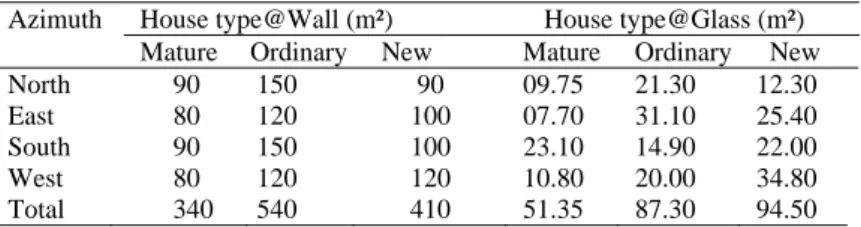
Table 2. The total area of brick walls and glazed surfaces
Shading devices had been built over almost all windows and doors to provide shade during the peak time of the day. At least 0.8m of overhanging gables or hips roof were provided, and a 2–3m width veranda was built facing sliding doors and back windows and doors for the three houses. A porch covering the entrance of the house also provided a shading device for the windows and doors facing this space. Table 2 shows that the total areas for glass and plastered bricks walls are different – where the mature and the ordinary landscape house have 15% and 16% of glass surface respectively, the new house has 24% of glass surface.
5. LANDSCAPE DESIGN
Azimuth House type@Wall (m²) House type@Glass (m²) Mature Ordinary New Mature Ordinary New
North 90 150 90 09.75 21.30 12.30
East 80 120 100 07.70 31.10 25.40
South 90 150 100 23.10 14.90 22.00
West 80 120 120 10.80 20.00 34.80
Total 340 540 410 51.35 87.30 94.50
Different configurations of landscaping were investigated for the three houses in four azimuths using different combinations of trees, shrubs, vines, groundcovers and turf. The mature landscape house had a large garden which was planted with a limited amount of vegetation. The majority of the space in the garden was lawn. A total of 22 trees were identified in the garden, 38 individual and groups of shrubs, a planting of vines and 2 groups of groundcover. The ordinary landscape house had a moderate amount of landscaping which was comprised of only 7 trees and 61 individual and groups of shrubs, 5 plantings of vines and 6 groups of groundcovers. The new landscape house has also been planted with a medium amount of landscaping which was still in immature. The 11 trees were planted surrounded by 63 individual and groups of shrubs, a planting of vines and 4 groups of groundcover. The rest of the soil surfaces for the three houses were covered by Axonopus compressus.
5.1 Trees
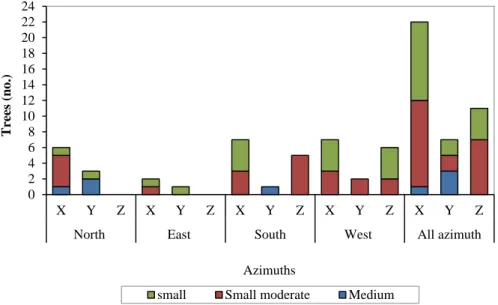
The main function of trees planted around houses is to provide extensive shade to the surrounding garden and house, and reduce heat gain to the building during the day. The 22 trees in the garden of the mature landscape house were planted within a distance of 3–19m from the house. They were planted individually and in groups, which were more concentrated on the north, south and west sides. Their canopies covered approximately 30% of the garden surface. The sizes of the tree canopies varied: most of the trees (50%) were small to moderate size, 41% were small in size, and 9% were medium. The size of canopies was maintained by pruning the branches to keep the trees at an appropriate size and in safe condition. Some of the garden trees were naturally small such as Juniperus chinensis. The most common category of tree was edible fruit trees at 36%, followed by garden trees (28%) and a small number of palms and roadside trees (18% each). The majority (60%) of trees were below 4m in height and the balance of 40% of trees was between 5–9m in height with an average trunk height of about 2m.
The shape of the trees varied, with round shapes representing 36%, followed by columnar shapes at 23%, and finally spreading and fountain shapes at 18% each. The amount of leaves for every tree has been divided into 3 classes; 50% of trees had a dense canopy of leaves, 36% a medium canopy and 14% trees had a sparse canopy with few leaves. Small sized leaves were dominant in this garden at 59%, and the balance was in medium sized leaves (41%). All trees were from evergreen tropical plant species with an age of approximately 30 years. Proper maintenance could keep all trees at appropriate sizes, forms and heights to survive very well in the dry and rainy seasons every year.
The ordinary landscape house had a minimum amount of trees where the
overall amount was less than one-third of those at the mature landscape
house. Most of the trees were situated within a distance of 4m from the building. They only covered around 10% of the garden’s earth surfaces and were more focused on the left elevation to the north side of the house.
Approximately 42% of the tree canopies were of medium size and 29% of them were small to moderate and small sized respectively. 43% of the overall heights were more than 10m with 6m trunk heights; while the rest (57%) were 4m in height with 1-2m trunk height. 70% of the trees were spreading in shape, and 15% were round and fountain shaped respectively.
There were generally medium amounts of leaves and medium sized leaves in the tree canopies. Even though all the garden trees and palms were individually placed, they were lush, fertile and could survive very well with shrubbery underneath.
Figure 2. Trees distribution compared over tree sizes and tree azimuth with respect to building for the three landscape houses: mature landscape house (X), ordinary landscape
house (Y) and new landscape house (Z)
The amount of planted species at the new landscape house was moderate and the overall amount of trees was around half of that in the mature landscape. Most of the trees were situated at within a distance of 5m from the building. They covered around 20% of garden’s earth surface and were more focused on the elevation to the west and south sides of the house. All of the garden tree canopies were small in size with an overall height of between 2 and 4m and a trunk height around 1–2m. There was only one round shaped tree of a small to moderate size planted as a roadside tree with an overall height of 6m and a 3.5m trunk height at the south side. This tree produced a sparse amount of medium sized leaves. 50% of the garden trees
0 2 4 6 8 10 12 14 16 18 20 22 24
X Y Z X Y Z X Y Z X Y Z X Y Z
North East South West All azimuth
Trees (no.)
Azimuths
small Small moderate Medium
were of spreading shape and 50% of fountain shape. The amount of leaves in each canopy was generally sparse, and the leaf-size was generally medium.
All the garden trees and palms were planted in small groups or individually placed and were still in a process of growing up, needing a few years to be mature and produce sufficient shade.
5.2 Shrubs, vines, and groundcover
The shrubs, vines and groundcover planted around the houses were a fundamental element of the landscape design. Furthermore, shrubs and vines planted close to the walls could produce shade and reduce heat gain to the building, especially during the morning and afternoon. The groundcover in the gardens was planted to create a transition between the shrubs and turf surfaces and to create balance, harmony and a lively landscape design.
A total of 38 individual and groups of shrubs, 1 group of vines, and 2 groups of groundcover were identified in the garden of the mature landscape house. The majority of shrub types was from the garden shrub category at 68%; followed by 27% of edible shrubs. Only 13% were palms shrubs.
Shrubs were spread on four sides of the house, where 34% of the shrubs
were located to the south side, 29% to the east, 21% to the west side and
16% to the north side. 80% of the shrubs were grown at a distance of within
5m from the building; 16% of the shrubs were positioned at 9m and 5% were
close to walls and at a distance of 14m respectively. Shrubs located within
9–14m were located underneath shade trees. A planting of vines was located
to the south side of the house. Quisqualis indica was climbing on a pergola
structure close to the building walls in a group of 5m
2with a medium
amount and size of leaves. Only 2 groups of groundcover were scattered in
the garden of the mature landscape house. Cuphea hyssopifolia and
Zephyranthes candida were located to the south and west side respectively
within a distance of 5m from the building. The two groups of groundcover
had been planted in groups of 5–9m². All of them have a medium amount of
small sized leaves. On average all shrubs, vines and groundcover were in
moderate size and conditions, but the total amount of them were small
compared to the total area of the garden.
Figure 3
Figure 4
Figure 5.
The tota landscape h There were
3. Location plan
4. Location plan
Location plan (
al amount of house were e 61 individu
n (left) and land
n (left) and land
(right) and land
f shrubs, vin almost doub ual and grou
dscape plan (rig
dscape plan (rig
dscape plan (rig
es and groun ble that of t ups of shrubs
ght) of the matu
ght) of the matu
ght) of the ordin
ndcover arou the mature l
s, 4 planting
ure landscape ho
ure landscape ho
nary landscape h
und the ordi landscape ho gs and group
ouse
ouse
house
inary ouse.
ps of
vines, and 6 groups of groundcover were identified. The majority of shrub types were from the garden shrubs category at 70%, followed by 20% of edible shrubs and finally only 7% and 3% were from bamboo and palms shrubs respectively. 36% of the shrubs were located to the north side, 30% to the east side, 19% and 15% to the east and south sides respectively. 67% of the shrubs were grown at within a distance of 5m distance from the building.
25% of the shrubs were positioned close to walls and windows, and finally 8% of the shrubs was scattered at a distance between 5 and 9m from the building. 5 groups of vines were climbing on the pergolas and in individual garden structures at the ordinary landscape house. Vines situated to the north and east sides were placed within 5m distance from the building. 3 groups of vines had been planted in groups below 5m², and another 2 groups of vines were in groups of 6–10m². All of them had a few leaves. The majority (60%) had medium sized leaves and the rest had small sized leaves. 6 groups of groundcover were scattered in the garden of the ordinary landscape house.
Groundcover was only planted to the west side at different distances from the building. 4 groups of groundcover were located in within 5m, 1 group was close to the walls and within 5–9m from the building respectively. All had a medium amount of small sized leaves.
Figure 6. Shrubs, vines and groundcover distributions in the three landscape houses
In comparison, the shrub population in the new landscape house was similar to that of the ordinary landscape house, but different in maturity and size of plant. 63 individual and groups of shrub had been planted around the house. They were categorised into 4 groups: 57% were garden shrubs, 21%
edible shrubs, 17% palm shrubs and 5% bamboo shrubs. 35% were located to the south of the garden at a distance of 5m, 24% were close to walls and 19% were in between a 6 and 9m distance from the building. A group of vines with a few small sized leaves was climbing on garden structures.
0 105 15 2025 30 3540 45 5055 60 6570
Mature Ordinary New
Vegetation (no.)
House landscape type Shrubs Vines Groundcovers
Tristellateia australasiae was situated to the west side, placed in within a 5m distance from the building in groups of below 5m². 2 groups of groundcover species, Hemigraphis alternate, with a medium amount and size of leaves, was located to the south and west side. All groups were within 5m from the building, each approximately 4m
2in area.
5.3 Other landscape elements
Every house had different, built, hard landscape structures to suit the soft landscape and the concept of landscape design. The ordinary landscape house has six hard landscape elements around the house including two pergolas, a fish pool, two gazebos and a swimming pool to suit with the tropical landscape design. A pergola with fish pool for Cyprinus carpio (Japanese Carp) with a small waterfall underneath was located to the north- west and was partly covered by Scindapsus aureus and surrounded by Phyllostachys sulphurea. The pool had been built in concrete with an approximate area of 10m², and 0.6m depth. Another pergola, partly covered by Vallaris glabra and Quisqualis indica, was located to the east side facing the swimming pool. Both of the pergolas were of similar size and constructed in hardwood with an area of 12m² and 2.5m in height. A 20m
2area and 2.5m high gazebo was situated at the west elevation, built in hardwood with a double layer pitch roof covered with slate tiles. The second gazebo with an approximate area of 16m
2was located to the east side, also built of hardwood with a hip roof covered by sago leave materials. A small sized (54m
2and 1.5m depth) swimming pool was located near the gazebo, built in concrete and finished with light blue mosaic tiles.
The mature landscape house had a pergola to the south side garden which was moderately covered by Bauhinia kockiana; and a fish pool for Cyprinus carpio (Japanese Carp) situated to the west side of the garden area. The pergola was constructed in hardwood with an area of 10m² and 2.5m in height. The pergola faced an open lawn paved partly with concrete blocks with a grass inlay for the family’s activities in the south garden of approximately 50m² in area. The fish pool was constructed in concrete with an approximate area of 5m², and 0.6m depth. It was also decorated with artificial stones and surrounded by palms and garden shrubs. Similarly, the new landscape house had a fish pool and artificial fountain decoration which were located at the south elevation of the house with an approximate area of 10m², and 0.6m depth.
6. RESULTS
The results of this study identified the climate parameters around three
houses that had significant effects on the thermal performance of the
buildings themselves. These climate data measurements were related to current ambient air conditions including solar radiation and cloud cover, air temperature, relative humidity, and wind speed. All the climate data was influenced by building construction and the distribution of vegetation around the house. The resulting of thermal performance will be affected by human factors to achieve comfort levels such as the operating of air conditioning system which subsequently lead to energy consumption.
6.1 Solar radiation and cloud cover
The current data on solar radiation and cloud cover were obtained from Subang Weather Station. In the case study areas, day length is the interval between sunrise and sunset from around 8.00–20.00 hours (12 hours). The solar radiation starts at 8.00 hours, when the reading was as low as 0.04MJ.m
-2. The solar radiation rises within 2 hours to 1.59MJ.m
-2at 10.00 hours, and continued until it hits the highest level of 3.69MJ.m
-2at 13.00 hours. After 13.00 hours the levels of solar radiation uniformly decreased until they reached the lowest radiation in 0.04MJ.m
-2at 20.00 hours. Overall solar radiation in the study area was active between 10.00–18.00 hours in total approximately 8 hours per day with radiation ranges of 1.34–
3.69MJ.m
-2. The ranges of solar radiation during the peak time of the day were 1.75–3.69MJ.m
-2. Cloud cover is relatively extensive in the study area as is typical of a tropical region. The cloud fraction throughout the day at the study areas was 7 Okta.
Figure 7. The intensity of surface solar radiation 0.00
0.50 1.00 1.50 2.00 2.50 3.00 3.50 4.00
5.00 6.00 7.00 8.00 9.00 10.00 11.00 12.00 13.00 14.00 15.00 16.00 17.00 18.00 19.00 20.00 21.00 22.00
Solar radiation (MJm-2)
Time of the day (LST)
6.2 Ambient conditions
In order to quantify and characterize the thermal effects of the vegetation in the garden and adjacent to the walls of the residences, a few experimental measurements were made on various combinations of trees, shrubs, vines, groundcover and turf. The procedure used involved the continuing recording of air temperature, humidity and wind speed at all azimuths outside and inside the buildings. According to Parker (1981), wall temperatures are usually obtained since they reflect the summation of the impact of direct and indirect solar radiation as well as the ambient temperature. Therefore, the difference between the exterior and interior wall temperatures determines the rate of heat transfer through the walls and windows.
6.2.1 Air temperature pattern
In order to provide an analytical comparison of air temperature between the three houses, average external and internal temperatures for each house were recorded at various points at regular intervals during the day. The reading of temperatures was at a metre above ground on four azimuths located adjacent to the walls and was recorded between 7.30 and 19.30 hours.
Figure 8. Outdoor and indoor air temperatures at adjacent south walls at the three landscape houses
24 25 26 27 28 29 30 31 32 33 34 35 36 37 38
7.30 8.00 8.30 9.00 9.30 10.00 10.30 11.00 11.30 12.00 12.30 13.00 13.30 14.00 14.30 15.00 15.30 16.00 16.30 17.00 17.30 18.00 18.30 19.00 19.30
Air temperature (°C)
Time of the day (LST)
Outdoor mature landscape house Outdoor ordinary landscape house Outdoor new landscape house Indoor mature landscape house Indoor ordinary landscape house Indoor new landscape house
The maximum cooling effect, of as much as 3.2°C at noon (12.00 hours) was at the exterior of the mature landscape house. The mature landscape house had reached an air temperature of 30°C, compared with 33.2°C at the new landscape house on adjacent south walls, as shown in Fig. 8. Overall the mature landscape house had the minimum outdoor temperature in the morning until noon. The three houses reached similar readings of air temperature during peak time at 14.00 hours, with the highest point being between 36 and 37°C. The air temperature readings declined by the afternoon towards evening, when the readings were about the same.
However, the ordinary landscape house appeared to have slightly lower readings compared to the two other houses, with a difference of up to 1.5°C.
Air temperature patterns in interior spaces of the three houses were similar in all four azimuths. Air temperatures gradually increased during the early morning at an average of 0.5ºC per hour until they reached a maximum point in the evening (18.00 hours) which represents a delay of around 3.5 hours compared to outdoor temperature. The gap between the three air temperatures was up to 0.5ºC during the peak time of the day, where the mature landscape house had the lowest level of temperature followed by the ordinary landscape house, with the new landscape house in last place. The mature landscape house had maintained the lowest temperature at the exterior and in the interior of the house with minor differences of temperature reading (up to 1ºC) compared to the other two houses. In comparison, the temperature at the airport area was maintained relatively lower by approximately 1.5–2.0°C compared with the three houses, during the peak time of the day until the evening (13.30–19.30 hours). However in the morning until mid-noon (8.00–13.00 hours), the temperature was much closer to that of the mature landscape house.
6.2.2 Humidity pattern
The relative humidity (RH) measures the partial pressure of water vapour actually in the air at the given temperature compared to the partial pressure of saturation air at the same temperature. The ambient RH pattern at the study areas was typical for the tropical region. The RH levels adjacent to the four exterior walls of each house were very similar. Each house received a stable reading of RH of about 80–98% in the early morning, gradually declined to 55–68% at noon and afternoon and rising to 70–82% in the evening. The three landscaping resulted in only minor differences in humidity levels in the noon and afternoon where the RH levels fluctuated between 55 and 70%. However, the difference of RH between the new landscape house and the two houses were clear at approximately 18–20%
higher. The mature landscape house recorded the lowest RH (70%) towards the evening compared to the two houses with differences of up to 10%.
Table 5 lists the average RH for the three houses. Overall, the ordinary
landscape house recorded the highest RH compared to the other two houses, with slight differences of between 2 and 10%.
Figure 9. Relative humidity at adjacent south walls of the three landscape houses
RH levels in the interior of each house had uniform and stable reading patterns averaging 70% on all four sides throughout the day. Although there were minor differences of RH level at the exterior of the three houses, these conditions did not affect the interior spaces. The RH in the airport area had a pattern similar to the three houses but it had a smoother form and was slightly lower at approximately 1–8%. However at the peak time of the day and towards the evening the RH of the mature landscape house fluctuated and was slightly lower (5–10%) compared to the RH at the airport, as shown in Figure 9. The absolute humidity is the vapour concentration in the air as grams per kilogram (g/kg). Overall, the results were similar with RH where the ordinary landscape house has higher absolute humidity at 22.94g/kg compared to the new landscape house and the mature landscape house with 22.02 and 21.03g/kg respectively.
6.2.3 Wind speed
The mature landscape house recorded light to moderate wind speeds on each azimuth, where the speeds actively fluctuated in the ranges of 0.04 to 1.2m/s. Wind speed adjacent to the north and east walls was lighter, below 0.5m/s during the afternoon while adjacent to the south walls wind speed was lighter in the morning until noon. For the rest of the time and locations, wind flow was of moderate speed (0.5–1.2m/s). However the highest wind
50 55 60 65 70 75 80 85 90 95 100 105
7.30 8.00 8.30 9.00 9.30 10.00 10.30 11.00 11.30 12.00 12.30 13.00 13.30 14.00 14.30 15.00 15.30 16.00 16.30 17.00 17.30 18.00 18.30 19.00 19.30
Relative humidity (%)
Time of the day (LST)
Mature landscape house Ordinary landscape house
speed of approximately 2.05m/s occurred at 18.30 hours adjacent to the south wall. The ordinary landscape house had different patterns of wind speed, which also fluctuated throughout the day. On the south and west sides the wind blew slowly in the morning until noon, while to the east and north sides a lighter wind speed was recorded in the afternoon, in the speed ranges of 0.04 to 1.75m/s. The winds on the other side were actively fluctuating in the higher ranges until they reached the highest level around the house of approximately 1.85m/s on the north walls at 18.00 hours. Wind in the new landscape house blew at a consistent speed on all sides of the house. Wind speeds were slow (below 1.4m/s) and fluctuated constantly through and around the north and east sides of the house at almost every hour of the day.
However to the south and west sides, a lighter wind blew (below 0.5m/s) in the late morning and noon. The highest level of wind speed around the house was 1.38m/s adjacent to the east wall at 13.00 hours.
Figure 10. Wind speeds adjacent to the south walls of the three houses
The average wind speeds for the three wind situations around the three houses were very close to each other, where the new landscape house recorded the highest (0.51m/s), followed by the ordinary landscape house, with the mature landscape house in last place. The gap between the three wind situations was up to 0.10m/s. The fluctuating patterns of wind speed in the study areas showed that even where the flow was light and slow, the wind actively kept the ambient air moving and refreshed throughout the day.
In comparison, the wind speed at the airport station was definitely higher than at the three houses. During the peak time of the day the wind speed was in the levels above 1.5m/s. The highest wind speed was 3.30m/s at 16.00
0.00 0.25 0.50 0.75 1.00 1.25 1.50 1.75 2.00 2.25 2.50 2.75 3.00 3.25 3.50
7.30 8.00 8.30 9.00 9.30 10.00 10.30 11.00 11.30 12.00 12.30 13.00 13.30 14.00 14.30 15.00 15.30 16.00 16.30 17.00 17.30 18.00 18.30 19.00 19.30
Wind speed (m/s)
Time of the day (LST)
Mature landscape house Ordinary landscape house New landscape house Airport
hours. Overall the wind blew in a consistent pattern throughout the day in ranges of 0.43–3.30m/s, as shown in Figure 10.
7. Discussion
The results from the three styles of landscaping around three single- family houses clearly illustrated that different ages or eras of landscaping could cause different effects on the surrounding ambient air and the thermal performance of the house. In addition, building construction and design, and living habits also have significant effects that influence the thermal performance of the house. The different levels of air temperature, RH and wind speeds among the three houses were minor because each house represented a modern and moderate style of landscaping. The sizes of shade trees were different, while the other plants such as shrubs, groundcover, and vines were of similar size. The different sizes of garden areas and other landscape elements also brought different effects to the ambient air. This study will discuss the effect of landscaping from different eras and styles on the ambient air and the thermal performance of houses.
7.1 Building construction
Three conventional tropical styles of house design from different eras of construction in the context of the country of Malaysia were identified in this study. The basic style of each house was similar: two storeys of medium size, built in a concrete structure, pitched timber-framed roof, glass windows, and in a square layout. The materials used and construction methods were similar but the design theme was different. The house orientation for the mature landscape house and the ordinary landscape house was east-west, while the new landscape house was north-south. According to Givoni (1994) the main consideration affecting the orientation of the main facades and windows of a building arise from the relative importance of solar and ventilation issues. The strategic location of glass windows could minimize solar penetration and allow natural cross-ventilation during the day and night, reducing air temperatures and relative RH levels. All shading devices for windows provided shade and protected the glass surfaces from direct sunlight at the peak time of the day. Glass windows were located on all facades, however most of the windows or the sliding doors faced the main areas of the garden in all three houses. In the mature landscape house they were mainly on the south side and only received indirect sunlight; in the ordinary landscape house they were on the east side, while in the new landscape house they were on the west side; both received direct sunlight.
This resulted in the indoor space temperature in the mature landscape house
being slightly lower by approximately 1ºC.
The roof and wall surfaces were the biggest areas exposed to solar radiation, receiving and storing heat gain throughout the day followed by ground floor areas, which were not exposed to direct solar radiation. In a hot-humid region, the building should be compact, with a minimum envelope surface area relative to the occupied space, in order to reduce heat gain and the resultant load on the cooling equipment (Givoni 1994). Table 2 indicates all wall areas in the four cardinal directions for the three landscape houses were in the medium size range. The ordinary landscape house had the biggest envelope with a total of 540m
2of walls, 375m
2roof and 355m
2ground floors areas. This situation also meant that at the peak time of day the temperatures at the adjacent east and west walls, where there was less vegetation, were slightly higher (0.5–1ºC) when compared to the other two houses. Glass surfaces usually allow solar radiation to penetrate directly into the interior spaces. Although every house has been built with a gable or hip roof as a shading device at the windows and doors, which can provide shade on the east and west sides from late morning until the afternoon, the solar radiation still could penetrate, for the walls do not have shrubs covering to a sufficient height during morning and late afternoon. Of the three houses the new landscape house has the highest proportion of glass surfaces (24%) resulting the interior temperatures of the house on the north, south and west sides being slightly higher by approximately 0.1–1.6ºC.
In a tropical region, the solar reflectance ratio at the surface of the walls and roof is very important; which is expressed by the albedo value. The albedo value is affected by the solar radiation reflectance capability on the building envelope. The colour of the external envelope surfaces has a tremendous effect on the impact of the sun on the building and on the indoor temperatures. The albedo values in the houses were in the ranges of 0.12 to 0.42, where all the buildings used light-coloured paint for the walls, and slightly different colours of roof covers. Each house for this study had been well insulated in the roof. All the houses had an application of aluminium foil underneath the roof covers and 2.9m height of proper ceiling construction. The insulation layer and higher albedo value were intended to reflect and reduce heat gain from the walls and roof surfaces. The indoor temperatures of the three houses were similar and lower than outdoor ambient air by approximately 3–6ºC at the peak time of the day.
7.3. Modifying ambient conditions
The results of the ambient conditions of the three study houses included
the fact that air temperature, relative humidity, and wind speed were
influenced by the surrounding vegetation. Vegetation was planted around
each house’s garden and also in the surrounding neighbourhood green
spaces. In addition, the intensity of the global solar radiation and cloud cover
also contributed to a microclimate effect in the case study areas. The
surrounding vegetation exerted an influence directly by shading and channelling wind, and indirectly by evapotranspiration.
7.3.1 Shading
One of the primary building envelope components of each house was the roof surface. Roof surfaces need to be properly shaded to reduce heat gain throughout the day. All the shade trees around the three gardens were in the ranges of small to medium sized, failing to provide extensive shading of the roof. Only Persia americana and Eugenia polyantha located within 5m of the north side of the ordinary landscape house with a height up to 10m, medium size with spreading shape could provide some shade for the roof during mid-day. The other shade trees in individual placements and of small size and located near the walls, could provide shade to the building’s lower envelopes. The other shade trees in each house provided shade to the garden areas. However, provision of quality shade would depend on the canopy size, the height and the amount of leaves. Most of the shade trees around the mature landscape house were located along the boundary of the house. The majority of them were of small size and could only provide shade to the garden area. The four shade trees located to the north were close to the house, of medium size and height, had a dense canopy, and would provide shade to the garden and a part of the walls during the morning. In the new landscape house, the majority of shade trees were also small in canopy size, less than 4m in height, and had a sparse amount of leaves; hence they could only provide an insignificant amount of shade to the garden and the building’s ground envelope. Too little shade was provided by the trees in the ordinary landscape house and the new landscape house; while trees around the mature landscape house were not in sufficiently strategic locations to provide enough shade to the building.
In the three landscape houses, attention should also be directed to the
second largest of building envelope surfaces: the walls. If these surfaces are
protected strategically by vegetation, building heat gain will be reduced and
lower surface temperatures in the entire adjacent walls will automatically be
maintained. Shrubs, vines and groundcover have to be considered as
significant types of vegetation to provide shade to the walls and floors of the
house. These fast-growing plant species will not harm the foundation of the
building because the roots are small and soft. Shrubs, vines and groundcover
planted immediately adjacent to the exterior walls can act as a thermal
barrier all day long. This type of vegetation can improve insulation
properties near the walls and windows, and underneath the house, if
strategically planted. Thus, hot air infiltration into the house will be
minimized. They also can be effective in all conditions of cooling, whether
the house is being mechanically air conditioned or cooled via natural
ventilation.
Lush shrubs, vines and groundcover that were planted immediately adjacent to the north-south walls of the ordinary landscape house were on average of sufficient height (1–1.5m) and had medium amounts and size of leaves. Many species planted together created shade for the adjacent walls, windows, and floors. In contrast, there were shrubs and groundcovers planted at the adjacent east-west walls orientation, but the majority of them were of small size and not well-located. The most strategic sides to place lush shrubs would be on the east and west facades, where direct solar radiation hits the building in the morning and late afternoon, compared to the north-south orientation which only receives indirect solar radiation. Shrubs must be plated continuously along the walls to create a natural insulation layer for the walls and floors, and priority should be given to the east-west side. If there is no continuity of shrubs, the high temperatures around the exposed walls will transmit heat to the wall areas, and finally both will have a similar heat gain. There were slightly different outdoor and indoor air temperature readings at the ordinary landscape house compared to the other two houses; even though it had a large amount of lush shrubs adjacent to the walls.
The new landscape house had planted shrubs to the east, south and west sides of the house. The north side of the house was paved with concrete for clothes drying purposes and a part was planted with edible plants. The east side was planted with two layers of shrubs of small size. The orientation of the house was to the south and west, where the garden was located. Shrubs were planted close to the walls and along the fence underneath small shade trees. Shrubs in the size range of small to mature were placed at intervals among the groundcover. Shrubs along the boundary and underneath the shade trees were of medium size. In general, the three sides of the house were planted with mixed sizes of shrubs and the north side was paved in concrete and could not provide continuous shade and insulation along the walls and floors. The mature landscape house had small amounts of shrubs and groundcover located close to its walls focused to the east, south and west sides, and was in small amounts and size and was sparsely planted. This situation would provide less quality of shade to the walls and floors. Shrubs were also planted underneath the shade trees along the fence areas to the east, south, and west directions, and were located very far from the building.
The situation of shade-providing vegetation around the three houses
brought slight differences in air temperature readings. In the morning, the
differences of air temperature were quite clear, while in the afternoon and
towards the evening the air temperature readings were similar, because the
positions of the vegetation were not strategically placed. However, the air
temperature was also influenced by the evapotranspiration process and wind
flow around the garden. The surrounding landscaping at three houses
delayed the indoor temperature by 3.5 hours to reach the highest point at
18.00 hours, compare to outdoor at 14.30 hours. On average, the mature
landscape house recorded the lowest outdoor and indoor air temperatures 31.8 and 28.9ºC respectively; this was followed by the air temperature readings at the ordinary landscape house and the new landscape house, with progressively higher temperatures of approximately 1ºC.
7.3.2 Channelling wind
In the hot temperatures and high humidities of a tropical climate, winds are needed to increase people’s sensation of thermal comfort. An appropriate size and placement of landscape together with appropriate building orientation, will allow wind flow to a building and its surrounding garden.
The mature landscape house was located in the centre of Section 6, Shah Alam, surrounded by green spaces to the east and south sides, while the north and west were surrounded by two-storey houses. The mature landscape house had been arranged so that the majority of trees were within 10–19m of the building to the south and west side where the majority of wind comes from throughout the day. A minority of them were located to the north and east sides of the house. The trunk height was up to 1.5m and therefore was suitable for channelling the prevailing wind to the garden area.
Some shade trees were planted as individual specimens and the others were in small groups with shrubbery underneath which would divert prevailing winds from the south-east and south-west sides then through to the garden area. The huge lawn in the middle of the garden could allow the wind to move freely to the building. Shrubs located along the walls were small, thus the wind could easily move straight to the building. However on the east side, the prevailing breeze was diverted by a mature small forest in an open space nearby. Therefore, the mature landscape house recorded a fluctuating pattern of wind speed. Moreover, the wind speed moved to the south when it reached the highest speed of approximately 2.05m/s at 18.30 hours. On average, wind speeds around the mature landscape house were approximately 0.32m/s in the four directions. With a minimum of landscaping adjacent to the walls, natural ventilation was moderately effective.
The ordinary landscape house was located in the middle of a housing
estate in Section 11, Shah Alam. The house was surrounded by two-storey
houses which caused changes of wind direction around the house. For
example, the local wind direction should be from the east; but northern areas
with shrubs of various sizes in the range of 0.5–2.5m in height and trees with
trunk heights up to 5m recorded the highest wind speed of approximately
1.85m/s at 18.00 hours. Each shade tree situated around this house had a
sufficient trunk height averaging 2.5m to allow breezes to pass through to
the building. Lush shrubs close to the adjacent south walls blocked some
breezes, diverting them to the north. Figure 10 reveals that wind speeds in
the southern area of the ordinary landscape house were higher, reading
approximately 1.62m/s at 15.30 hours. On average, wind speeds around the ordinary landscape house were approximately 0.40m/s in the four directions, with heavily and sparsely shrubs around and natural ventilation was effective.
The new landscape house was situated in the middle of Section 9, facing a huge green open space to the south and west sides. However, on the north and east sides it was surrounded by two-storey houses. In some spaces this house utilised natural ventilation during the day and night. The design of the house with vertical form doors-cum-windows was very practical for allowing wind to pass through the building. The size of all trees and shrubs around the house was small and could not block the wind from passing through to the building. The house was in a strategic location, facing an open space where the southerly wind comes from since morning until afternoon. On the other hand, the trunk height of trees at the new landscape house could channel wind effectively to the garden area and to the buildings, to release hot-humid ambient air especially during the peak time of the day.
However the east and northerly direction also worked well where wind speed was actively blowing in fluctuating patterns throughout the day. The fluctuating patterns of wind speed were in the ranges of 0.04–1.38m/s. On average, wind speeds around the new landscape house were approximately 0.50m/s, in the four directions, and with a moderate amount of landscaping, natural ventilation was effective.
7.3.3 Evapotranspiration
The measurements taken in and around the three case study houses reveal
that a slight difference of RH levels was due to the slight difference in
amount, placement and size of the existing landscaping, and other landscape
elements. The general RH pattern reached a higher level during the morning
and gradually fell in fluctuating patterns at noon and in the afternoon, and
increased towards the evening. The relatively fluctuating patterns between
the configurations occurred at the peak time of the day. Fluctuating patterns
of RH were caused by the fact that the landscaping around the house was not
strategically placed, resulting in different impacts of the amount of water
vapour in the ambient air around the four sides of the houses. For example,
the ordinary landscape house had lush and green shrubs and shade trees to
the north-south side but fewer shrubs in the east-west. This arrangement had
also been used in the gardens around the other two houses. If the vegetation
around the house was located in strategic places and arranged in an
organized way, the RH pattern would move smoothly and in stable readings
throughout the day. Thus the shortcomings of the landscaping resulted in
higher levels of RH around the house. The ordinary landscape house may
have produced a higher of average RH level of approximately 77%. The
average RH levels in mature and new landscape house were 71 and 72%
respectively and were influenced by surrounding landscaping and nearby green open spaces.
Each house had a water element in the garden. However the ordinary landscape house had a huge amount of water surfaces in its swimming pool and fish pool, which contributed to evaporation. The transpiration process was also influenced by the amount, placement and size of plants around the garden. This combination made the evapotranspiration process slightly higher than at the other two houses. The higher absolute humidity throughout the day at mature landscape house was because of high levels of evapotranspiration and furthermore the density of the water vapour in the ambient air was increased to reduce air temperatures. The average absolute humidity was hardly approximate 22.94g/kg, which slightly lower 1g/kg than at the other two houses. This suggests that medium size shade trees, lush shrubs, vines, groundcover and turf located close to the house together with water landscape elements will produce higher relative humidity and absolute humidity level.
8. Conclusion
In a hot-humid tropical climate, low vegetative planting around building was one of the main factors increasing daytime temperatures and creating heat island in residential area. Vegetation has a significant influence on the microclimate directly by shading surfaces and channelling wind, and indirectly by evapotranspiration of water. Proper house configuration, high albedo level and strategic locations of surrounding landscaping also can influence the thermal performance of the house by reduce air temperature and create a comfortable environment for buildings. Shading device for windows is very effective to provide shade during the peak time of the day, supported by well insulated in the roof and appropriate albedo value for building envelopes. Moreover, the strategic location of glass windows would minimize the solar penetration and allow natural cross-ventilation.
Vegetation reduces the ambient temperatures not only by shading but also
by reducing warm air infiltration and creating cool microclimates around
buildings by evapotranspiration. In addition, during the peak time of the
day, vegetation in urban housing areas can act as a wind channel and have a
substantial impact on a residential building’s thermal performance. By
combining of every type of vegetation and strategically placed around
residential buildings would produce a more comfortable house. The other
structures such as neighbour’s houses and open green space around the
houses also influence the quantity of prevailing wind and the quality of
evapotranspiration. A greater evapotranspiration combined with sufficient
shades from trees, shrubs, vines, groundcovers and turf to cover the building
envelopes and garden surfaces, and moderate wind flow might provide cool
and comfort ambient air. In addition, proper house configuration, and well
insulated and appropriate albedo value for building envelopes resulted in the indoor space temperature being slightly lower by approximately 1°C and can reduce outdoor air temperature as well as urban heat island effects to the surrounding city up to 3°C.
This study clearly demonstrates that the better way to create a favourable microclimate for a tropical residential landscape is by proper selection of amount, size, and arrangement of landscaping. Moreover, the environmental consequences of these designs can extend beyond the residential or development scale to the macroclimate or regional scale.
References
Akbari, H., S. Davis, et al. (1992). Cooling our Communities, A Guidebook on Tree Planting and Light-Colored Surfacing, Washington, Lawrence Berkeley Laboratory
Akbari, H., H. Taha, et al. (1986). Undoing uncomfortable summer heat islands can save gigawatts of peak power, The Panel on Small Building Technologies, Washington, DC, American Council for an Energy-Efficient Economy.
Baker, N. V. (1987). Passive and Low Energy Building Design for Tropical Island Climate,.
London The Commonwealth Secretariat.
Brown, R. D. and T. J. Gillespie (1995). Microclimatic Landscape Design Creating Thermal Comfort and Energy Efficiency, New York, John Wiley & Sons, Inc.
Givoni, B. (1994). Passive and low energy cooling of buildings New York Van Nostrand Reinhold.
McPherson, E. G., L. P. Herrington, et al. (1988). "Impacts of vegetation on residential heating and cooling " , Energy and Buildings p. 41-51.
Oke, T. R. (1973). "City size and the urban heat island", Atmospheric Environment (1967) p.
769-779.
Parker, J. H. (1981), Uses of Landscaping for Energy Conservation, Florida, Florida State University System
Taha, H., H. Akbari, et al. (1988), Residential Cooling Loads and the Urban Heat Island - the effects of Albedo, Building and Environment, p. 271-283.