熊本大学学術リポジトリ
Subgap optical absorption induced by quantum lattice fluctuations at the Peierls edge in PtCl‑chain complexes
journal or
publication title
Physical Review B
volume 54
number 4
page range 2390‑2396 year 1996‑07‑15 その他の言語のタイ
トル
Pt‑Cl鎖錯体において量子格子揺らぎで誘起された パイエルス端のサブギャップ光吸収
URL http://hdl.handle.net/2298/9620
doi: 10.1103/PhysRevB.54.2390
Reprintedfrom
Physical Review
B
CONDENSED MATTER
15 JULY 1996 II
Subgap optical absorption induced by quantum lattice fluctuations at the Peierls edge in PtCl chain complexes
Noritaka Kuroda and Masato Nishida
Institute for Materials Research, Tohoku University, Sendai 980-77, Japan
Masahiro Yamashita
Graduate School for Human Informatics, Nagoya University, Nagoya 464-01, Japan pp. 2390-2396
Published by
THE AMERICAN PHYSICAL SOCIETY through the
American Institute of Physics
Volume 54 Third Series Number 4
PHYSICAL REVIEW B VOLUME 54, NUMBER 4 15 JULY 1996-H
Subgap optical absorption induced by quantum lattice fluctuations at the Peierls edge in PtCl chain complexes
Noritaka Kuroda and Masato Nishida
Institute for Materials Research, Tohoku University, Sendai 980-77, Japan
Masahiro Yamashita
Graduate School for Human Informatics, Nagoya University, Nagoya 464-01, Japan (Received 19 October 1995; revised manuscript received 29 January 1996)
The temperature dependence of the low-energy tail of the interband optical absorption band at the Peierls edge has been studied in halogen-bridged linear-chain complexes, [Pt(en)2][Pt(en)2Cl2](C104)4 and [Pt(en)2][Pt(en)2Cl2](BF4)4, en being ethylenediamine. The absorption spectrum and its temperature depen dence are explained well in terms of the subgap density of states of the one-dimensional electronic bands induced by the quantum vibration of Cl ions of the breathing mode. Both substances are found to have a dimensionless electron-phonon coupling constant of \«*1.2, the zero-temperature gap parameter of A0«1.45 eV, and the transfer integral of to**OA eV. Because of the strong electron-phonon coupling the temperature dependence of the energy gap is dominated by the self-energy effect; even at 0 K the self-energy amounts to 0.07-0.08 eV, being considerably greater than the self-energies in usual semiconductors. The role of the anharmonicity of the chainlike Pt-Cl bonds is discussed in relation to the origin of the large gap parameter. [SO163-1829(96)05627-5]
I. INTRODUCTION
Halogen-bridged transition-metal chain complexes, so- called MX chain complexes, have emerged as an important class of one-dimensional (ID) electronic materials with strong electron-phonon coupling and electron correlation. In
light of one-band1"3 and two-band4"6 extended Peierls-
Hubbard models and the recently developed Su-Schrieffer-
Heeger-type models7"9 quantitative knowledge of the
electron-phonon coupling involved in the valence-alternating chainlike bonds, that is, the charge-density-wave (CDW) state, is essential for understanding the electronic properties of the MX chain complexes. However, the extreme anhar monicity of the chain lattice, as well as a significant hybrid ization between the transition-metal dzi and low-lying halo gen pz orbits, makes the electronic processes quite complicated in comparison to the case of conjugated poly mers such as frarw-polyacetylene.
It has been widely recognized that the energy gap of the CDW phase of an MX chain complex is determined by the coupling of valence electrons of the constituent metal ions (platinum or palladium) with the in-chain displacement of halogen ions. Optical transition at this Peierls gap manifests itself as a prominent feature in the reflection spectrum in the near-infrared or visible region depending on the
substances.10"14 If one attempts to measure the absorption
spectrum of this interband transition by the transmission method it is difficult to gain access to the peak position be cause the absorbance rises up steeply from a region of pho
ton energy far below the peak position.4'10'15"25 On account
of its large bandwidth and large oscillator strength the ob served absorption edge has been conceived as the tail end of
the absorption band.4'15'21"25 Interestingly the spectral posi
tion of this absorption edge has a pronounced temperature
dependence;10'19'21 besides, the temperature dependence is
significantly greater than that of the energy gap in usual semiconductors. Although this phenomenon seems to reveal unique properties of the electron-phonon coupling in the MX chain complexes, to our knowledge, the details have not been studied to date.
It has turned out recently that the quantum fluctuations of
lattice26"28 and kinks24'29 strongly influence the line shape of
the interband and Tnidgap absorption bands, respectively, in ID Peierls systems including MX chain complexes. McKen-
zie and Wilkins26 have argued the roles of the quantum and
thermal lattice fluctuations due to a homopolar optical pho- non with wave vector of 2kF. They have shown that the lattice fluctuations induce a nonvanishing density of states inside the forbidden gap, and thus the interband optical ab sorption band extends widely below the fundamental absorp
tion edge. Subsequently Kim, McKenzie, and Wilkins27 have
developed a method for numerically calculating the optical conductivity spectrum under the influence of the lattice dis order including lattice vibrations. According to their calcula tion the spectrum of the "subgap" optical conductivity has a universal scaling form. In fact it has successfully explained the temperature-dependent line shape of the broad interband absorption spectra in a variety of ID Peierls systems such as
KCP(Br), fra/w-polyacetylene, and blue-bronze,27*28 which
belong to the strong, intermediate, and weak regimes, respec tively, of the electron-lattice coupling strength. The theory has been applied further to the excitation spectrum for the exciton photoluminescence in an MX chain complex [Pt(en) o][Pt(en) 2C12](C1O 4) 4, en denotes ethylenedi amine. *31 The result clearly proves the presence of the sub gap tail of the density of states in the MX chain complex as well. Since the excitation spectrum, however, does not give the absorption spectrum itself there remain considerable un-
0163-1829/96/54(4)/2390(7)/$10.00 54 2390 © 1996 The American Physical Society
54 SUBGAP OPTICAL ABSORPTION INDUCED BY QUANTUM ... 2391
certainties in the important issues such as the identification of the phonon mode responsible for the electron-phonon cou pling.
In the present paper, we perform a direct measure ment of die subgap optical absorption in two PtCl- chain complexes [Pt(en) 2][Pt(en) 2C12](C1O 4) 4 and [Pt(en)2][Pt(en)2Cl2](BF4)4 in a temperature range of 10- 300 K. The former (hereafter referred to as C1O4 salt) has been studied extensively so far and is known to have the
strongest CDW of many MX chain complexes,9*32 while at room temperature the latter (hereafter referred to as BF4 salt) is isomorphous with the orthorhombic phase of the C1O4 salt14 and has recently been found to resemble the C1O4 salt well in various aspects of optical properties.14'25'33 The ex
perimental results are quantitatively analyzed in terms of the above-mentioned Kim-McKenzie-Wilkins theory to investi gate what kind of phonon mode dominates how strongly the electron-phonon coupling in the two substances. Basic prop erties of the CDW state of the Pt-Cl chain bonds are dis cussed on the basis of the knowledge obtained from this analysis.
n. EXPERIMENT
Single crystals are grown by the evaporation method from the aqueous solution of chemically synthesized materials.
The 50-80-yitm-thick crystals are used as the samples. The temperature of the sample is controlled with a continuous flow cryostat (Oxford Instruments CF1204) and a tempera ture controller (Oxford Instruments ITC4). The optical ab sorption spectrum is measured using an optical multichannel system. A tungsten-halogen lamp is used as the light source.
Light of wavelength longer than 520 nm is obtainefl with a glass filter and is polarized parallel to the Pt-Cl chain axis of the crystal with a Glan-Thompson prism. The light transmit ted by the sample is dispersed with a polychromator (Ritu Applied Optic MC-30ND). The dispersed light is detected by a charge-coupled-device (CCD) camera (Photometries PM512). The shutter of the CCD camera is synchronized with the shutter of the light source. The intensity of the light source and the exposure time are set as low as possible. The typical exposure time chosen to take an absorption spectrum is 0.2 s.
m. RESULTS AND ANALYSIS
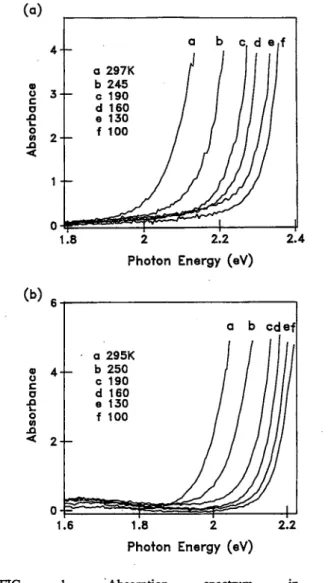
Figures l(a) and l(b) show the absorption spectra of the C1O4 and BF4 salts, respectively, at several temperatures between 100 and 300 K. The thickness of the sample of the C1O4 and BF4 salt is 80 and 70 ^tm, respectively. The fun damental optical transition is known to take place around 2.8 eV in the reflection spectrum in both BF4 and C1O4 salts.10"14 Nevertheless in the present transmission measure ment the intrinsic absorption starts to rise around 2.0 eV, and rapidly attains the instrumental limit, which is determined by the degree of the linear polarization of the light source; the weak absorption band seen around 1.6 eV in Fig. l(b) is due to the extrinsic midgap states.25'33 In Fig. 2 is plotted, as a function of temperature, the photon energy, say h(o0, at which the absorbance equals 2.0. The absorption band shifts continuously toward higher energy as temperature decreases.
1.8 2 2.2
Photon Energy (eV)
a 295K b 250 c 190 d 160 e 130 f 100
1.8 2
Photon Energy (eV)
FIG. 1. Absorption spectrum in (a)
[Pt(en)2][Pt(en)2Cl2](C104)4 and (b) [Pt(en)2][Pt(en)2Cl2](BF4)4 at several temperatures. The electric field of light is polarized par allel to the chain axis.
In the BF4 salt a discontinuous increase of hcd0 by about 30 meV takes place around 255 K with a hysteresis of about 3 K, indicating the occurrence of a structural modification
similar to the case of the C1O4 salt.21 The present study deals
with the low-temperature phase. In both salts the shift almost levels off below 100 K, showing that optical phonons with energies appreciably higher than 10 meV play a major role in determining the temperature dependence of the absorption tail.
It has been demonstrated by the studies on the resonance
Raman scattering34*35 that the breathing mode of Cl ions
couples very strongly with electrons of the conduction and valence bands. The Kim-McKenzie-Wilkins theory cited in Sec. I argues that if such a homopolar and dispersionless optical phonon of frequency cop dominates the electron- phonon coupling in a ID system the properties of the subgap states are determined by the disorder parameter
ha). (1)
where \ is the dimensionless electron-phonon coupling con stant, A is the gap parameter, k is the Boltzmann constant,
2392 KURODA, NISJHDA, AND YAMASHTTA 54
1.0
2.1
2.0
100 200
Temperature (K)
300
FIG. 2. Temperature dependence of the spectral position of the absorption edge in (O) [Pt(en)2][Pt(en)2Cl2](C104)4 and (0) [Pt(en)2][Pt(en)2Cl2](BF4)4. The solid lines are the least-squares fits of Eq. (6) to the experimental data.
and T is temperature. In the following the present results are analyzed on the basis of this Kim-McKenzie-Wilkins theory.
The lattice disorder due to the quantum and thermal lat tice motions eliminates the inverse-square-root singularity of the joint density of states, which occurs in ideal ID systems, to induce the subgap states. The important point of the work of Kim, McKenzie, and Wilkins is the finding that the result ant optical-conductivity spectrum a((o) below the peak po sition ft>Peak has a universal form, which is fitted with the function
-0.49 ''peak— O) -0.20 "peak— (O
(2) where T is the half width for the low-energy side of the peak; furthermore, the ratio I7a>peak scales with rj as
L62+0.077 771.62 (3)
Wada and Yamashita13 have evaluated the real and imagi nary parts of the dielectric function in the C1O4 salt by the Kramers-Kronig analysis of the reflectivity spectrum mea sured at 77 K. In Fig. 3 the conductivity spectrum o-(ft>) = a>e"(a>)/47r, where e"(a>) is the imaginary part of the dielectric function, obtained from their data is compared with the conductivity spectrum at 80 K obtained from the present transmission experiment.36 It appears that the present transmission experiment deals with the spectral region where
<r(o>) is 3 orders of magnitude smaller than that around the peak. In Fig. 3 is also shown a theoretical curve calculated from Eq. (2) with fto>peak=2.78 eV and hr = 0.155 eV. Note that for o^Wpeak the single theoretical curve reproduces the two contrasting and independent data very well. It may be
0.5
• Present work o Wada-Yamashita
2.0 2.2 2.4 2.6 2.8
Photon Energy (eV)
3.0
FIG. 3. Optical conductivity spectrum obtained from (•) the present transmission experiment and (0) the reflection experiment (Ref. 13) in [Pt(en)2][Pt(en)2Cl2](C104)4 at 80 and 77 K, respec tively. The numerical label of the ordinate corresponds approxi mately to the absorption coefficient in the unit of 106 cm"1. The solid line is the theoretical curve calculated from Eq. (2). Note that for photon energies below 2.4 eV the scale of the ordinate is mag nified by 103 times relative to the scale above 2.4 eV.
concluded, therefore, that Eq. (2) is appropriate to describe the fundamental absorption band over a wide spectral region below CDpeak.
The photon energy ho)0 plotted in Fig. 2 is the spectral position at which the absorption coefficient takes a constant value of —3X102 cm"1. Its thermal shift arises from the thermal changes in Wp^ and I\ Since, as 77 changes, the exponential term on the right-hand side of Eq. (2) varies much faster than crpeak, the frequency &>0 is expected to fol low the changes in a)^ and T while satisfying the relation ship
==*==const (4)
We have hcoQ=234 eV for the C1O4 salt at 80 K. Then from the above-mentioned values of a> peak and T at 77-80 K the constant x should be —2.8. The analytical formula for fcJpeak *s unavailable as a function of 97. However, the nu
merical calculation of Kim, McKenzie, and Wilkins27 sug
gests that ftwpeak decreases almost linearly with increasing 77 at a rate of —0.277A. In addition Abrikosov and Dorotheyev37 have shown that the gap parameter A itself decreases with increasing lattice disorder at a rate of
~7T77A/8«O.4t7A. Consequently within the framework of the Kim-McKenzie-Wilkins theory it may be reasonable to write
(5) with the zero-temperature gap parameter Ao. Then substitu tion of Eqs. (3) and (5) into Eq. (4) yields
} (6)
54 SUBGAP OPTICAL ABSORPTION INDUCED BY QUANTUM ... 2393
TABLE I. The zero-temperature gap parameter 2A0, the pho- non energy h(opi the zero-temperature dimensionless disorder pa rameter 7}Q, the spectral position parameter #, and the dimension- less electron-phonon coupling constant X in the C1O4 and BF4 salts.
Substance 2A0 (eV) hcop (meV) Vo ClO4 salt
BF4 salt
2.90 2.89
35.8 43.2
0.048 0.056
2.7 3.1
1.21 1.16
Now let us attempt to evaluate the parameters 2A0, Vo»
X, and (op by the least-squares fit of Eq. (6) to the experi mental data shown in Fig. 2. As shown in Fig. 2, the experi mental results can be reproduced very well by Eq. (6). Table I lists the values of the parameters thus obtained for two substances. It is found from this analysis that upon an in crease of temperature from 0 to 250 K the disorder parameter 7) changes from 0.048 to 0.071 in the C1O4 salt and from 0.056 to 0.073 in the BF4 salt. According to the numerical
calculation by Kim, McKenzie, and Wilkins27 an increase in
7} leads to a decrease in cr^. In the present case the amount of decrease in 0*^ due to the increase in rj can be estimated to be only about 5% or less, justifying the assumption that the dependence of 0%^ on tj is negligible in deriving Eq.
The parameters 2A0 and 970 give ft<wpeak
= 2Ao( 1 - 0.5 970) = 2.83 eV for the C1O 4 salt at 0 K, in good agreement with the result of the reflecdvity experiment by Wada and Yamashita at 77 K despite that the least-squares- fit analysis has been made by using only the transmission data. The values of x of 2.7(3.1) for the C1O4(BF4) salt are also quite reasonable. In the BF4 salt, therefore, the absorption band is expected to have its peak around 2.8 eV as well.
Another quantity that should be tested by the independent experiment is the phonon energy h<op: The energies 35.8 (43.2) meV obtained for the C1O4 (BF4) salt agree with the Raman energy 38.5 meV of the breathing mode of Cl ions within the error ±5 meV of the least-squares fit. This result proves that the breathing mode of Cl ions plays a dominant role in the electron-phonon coupling processes in the CDW phase, as expected from the resonance Raman data.
Long et a/.30'31 have obtained the values of 2Ao, 770, and ft (op for the C1O4 salt, which differ significantly from the J
values obtained by the present study. The discrepancies may be ascribed to their use of the excitation spectrum of photo- luminescence instead of the absorption spectrum itself.
IV. DISCUSSION
Results of the present absorption experiment are summa rized in the following two matters: First, the Kim-McKenzie- Wilkins theory has enabled us to separate the observed ther mal shift of the absorption band into two components arising from a>peak and T. We have v&o=0.070 (0.081) eV at 0 K and 0.104(0.107) eV at 250 K for the C1O4 (BF4) salt.
[Hereafter the terms "C1O4 (BF4) salt" specifying the sub stances for the numerical factors quoted are abbreviated un less otherwise noted.] This means that at 250 K, for instance, about 20% of the observed shift of (o0 comes from the tem perature dependence of a>peak, and the rest comes from T.
Secondly, a reliable value of the dimensionless electron- phonon coupling constant A. can be derived, as shown in Table I, in the MX chain complexes. Here the basic proper ties of the CDW state of the C1O4 and BF4 salts are dis cussed on the basis of these results.
A. Temperature dependence of energy gap
The mechanism of the temperature dependence of the en
ergy gap is an important subject of semiconductor physics.38
The present results suggest strongly that the thermal shift of the Peierls gap in the PtCl-chain complexes is dominated by the self-energy effect. In this context it may be worth recall ing that the thermal shift of the energy gap in layered HI-VI semiconductors is induced by the self-energy effect due to a
homopolar optical phonon.38'39 The key to this phenomenon
is the presence of a highly symmetric phonon mode in addi
tion to an extreme anisotropy of chemical bond.40 The ho
mopolar optical phonon responsible for the self-energy in those layered semiconductors is the fully symmetric normal mode, which modulates the thickness of layers while keeping the bisectric planes of all layers at rest. The deformation potential of the energy gap due to this mode is essentially large because only a little energetic cancellation occurs be tween the expansion (compression) of the interlayer van der Waals bond and the concomitant compression (expansion) of the intralayer covalent bond.
Low dimensionality is more distinctive in MX chain com plexes. Each chain of a PtCl complex consists of valence alternating bonds, which can be depicted as
—Cl—Pt(3~p)+—Cl—Pt(3+P)+—Cl—Pt(3"p)+—Cl ,
with p<l. The intervening Cl ions are symmetrically dis placed toward Pt(3+p)+ ions by about 0.4 A from the central position between Pt(3~p)+ and Pt(3+p)+. This structure re sults from the Peierls instability of the metallic chain41
—Pt3+—Cl—Pt3+—Cl—Pt3+—Cl .
Clearly, the instability is driven by the 2kF phonon mode of Cl ions, in which every Cl ion vibrates out of phase against the Cl ion on the next site. The dimerization of Cl ions ac companies the transfer of a charge pe between adjacent Pt3+ ions to induce a wide energy gap of 2A0~3 eV be tween the dz2-like orbitals of the resultant Pt(3""p)+ and
Pt(3+p)+ ^ns since the breathing mode of the CDW state
2394 KURODA, NISHIDA, AND YAMASHTTA 54
corresponds in symmetry to the 2kF mode of the metallic phase, it would directly modulate the charge pe and thus would exert a strong perturbation on the energies of the va lence and conduction bands. This situation is manifested by the above-mentioned large values of tjA0=0.070(0.081) eV at 0 K, which are the self-energies at 0 K of the renormal- ization of the energy gap by the electron-breathing-mode coupling. In fact they are considerably greater than the self-
energy, 0.03 eV, at 0 K in layered HI-VI semiconductors.38
B. Dimensionless electron-phonon coupling constant and gap parameter
The subgap absorption, as well as the self-energy of the gap, reflects the strength of the electron-breathing-mode cou pling. Substitution of the values of 770, fi><op9 and Ao into Eq. (1) yields \= 1.21(1.16), confirming that the present substances belong to the strong-coupling regime. The values
of X are comparable to the case, X = 0.96,27 of KCP(Br) and
are greater by a factor of 2-3 than the value in fra/w-polyacetylene.27'42
In the strong-coupling regime, X can be connected ap proximately to the transfer integral t0 between Pt ions by a relationship \~l = TrtolkQ.A3M It follows from the values of X that to/Ao~l/(7T\) = 0.26(0.28) and thus
^^0.38(0.40) eV. This result is compared to to=O3 eV obtained from a tight-binding band calculation by Whangbo and Foshee45 and 0.67 eV estimated by Baeriswyl and Bishop46 on the basis of the interband oscillator strength. The
value of to/Ao is a measure of the strength of CDW. In the strong-coupling regime the disproportionation p of Pt ions is
related to fo/Ao by p« 1 -(ro/Ao)2 well.1 Consequently for
the present substances one finds p« 0.93(0.92), in good ac
cord with previous x-ray photoemission spectroscopy47 and x-ray absorption near edge structure41 experiments. Further
more, the quantity to/ko *$ a tey parameter for characteriz ing the self-localized excitations such as solitons and po-
larons. Viewed from a perturbation approach48 the present
result is reconciled with the experimental observations that
the photoinduced neutral solitons are thermally mobile49'50
despite that they are self-localized to have a very small size
of subnanometer scale.51
The gap parameter Ao is closely related to the properties of Pt-Cl bonds. Within the framework of the site-diagonal
electron-lattice coupling scheme for the Peierls transition1"3
the total energy of the ground state is minimized by balanc ing of the energy gain due to the electron-lattice coupling with the elastic energy needed to displace Cl ions. Provided the Pt-Cl bonds are harmonic, this condition is expressed by a relationship Pp^Kuq/2,44 which is equal to 2.5(2.3) eV/
A, between the coefficient ft of the linear coupling of the valence electrons with the static displacement mo=0.39(0.37) A of Cl ions and the force constant K=2M<o2p= 12.6(12.6) eV/A2 for the breathing mode, where M is the mass of a Cl ion. In the one-band model1"3 Ao is the energy that an electron of a Pt(3+p)+ ion gains when two adjacent Cl ions go away by u0 toward Pt(3~p)+
ions, and thereby the harmonic approximation gives A0=2^0=^/p=2.1(1.9) eV.
These values of Ao are significantly greater than Ao= 1.45(1.45) eV obtained from the present experiment. It
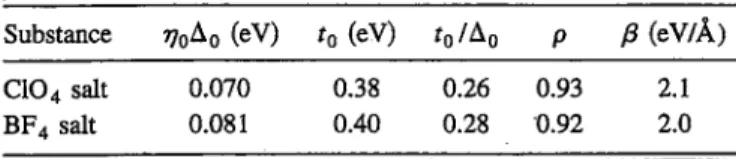
TABLE EL The zero-temperature self-energy tj0Ao , transfer in tegral 10, the ratio t0 /Ao, the disproportionation p of Pt ions, and the empirical electron-lattice coupling constant p in the C1O4 and BF4 salts.
Substance 7j0A0 (eV) t0 (eV) fo/Ao (eV/A)
CIO4 salt BF4 salt
0.070 0.081
0.38 0.40
0.26 0.93 0.28 0.92
2.1 2.0
is noteworthy that in the harmonic approximation K is as sumed to be independent of w0- I*1 general, however, the restoring force of a chemical bond depends on its valence state. In the present case, because of a large disproportion ation of Pt ions, the Pt-Cl bonds must have a significant volume anharmonicity, that is, K must depend on u0 and bond lengths, although the equilibrium potential for a Cl ion in the vicinity of its minimum would be parabolic. This is evidenced by the fact that the breathing mode is softened by
hydrostatic pressure.21'22'25'52"54 The volume anharmonicity
is manifested also by the fact that the force constant of the pt(3+p)+_Q bon(j js n^h greater than that of the pt(3-P)+_cl bond.55 If the dependence of K on the valence states of Pt-Cl bonds is treated empirically in terms of the Morse potential, the above-mentioned energy-minimum con
dition yields pp= 1.94 eV/A for the C1O4 salt.21 In the same way, for the BF4 salt the Pt-Pt distance of 5.37 A and the parameters u0 and K give /3p= 1.87 eV/A. These empirical
values of /3p give A0 = 2/3u0=1.63(1.48) eV, in good agreement with the spectroscopic gap parameters obtained from the present experiment.
Actually, the Coulomb interactions would influence the interband optical transition. In the Hubbard model, letting the effective on-site and intersite Coulomb energies be U and V, respectively, the Coulomb interactions cause a shift of
ftcupeak by 3 V— C/.1"3 In view of the results of the present study the value of |3V— C/| is likely to be significantly smaller than 1 eV in both substances, although U and V
could each be greater than or of the order of 1 eV.56
The values of basic quantities derived from the discussion in this section are summarized in Table n.
V. CONCLUSIONS
The temperature dependence of the subgap optical ab sorption band associated with the fundamental Peierls gap in the low-temperature phase of the halogen-bridged linear- chain complexes [Pt(en) 2][Pt(en) 2C12](C1O 4) 4 and [Pt(en)2][Pt(en)2Cl2](BF4)4 has been studied in the tem perature range of 10-270 K. The results are found to be explained well in terms of the Kim-McKenzie-Wilkins theory which has formulated the smearing effect of the inverse-square-root singularity of the joint density of states due to the quantum and thermal lattice fluctuations. In par ticular, the observed thermal shift of the tail end of the ab sorption band has been successfully separated into the com ponents arising from the Peierls gap and the fluctuation- induced subgap states.
It has been confirmed that the electron-phonon coupling is dominated by the breathing mode of Cl ions. Because of the one dimensionality of electronic bands and the high symme-
54 SUBGAP OPTICAL ABSORPTION INDUCED BY QUANTUM ... 2395
try of the breathing mode, the coupling is very strong. Con sequently the thermal shift of the Peierls gap is induced by the self-energy effect due to the breathing mode: The self- energy of the renormalization of the Peierls gap amounts to 0.07-0.08 eV at 0 K. Correspondingly both substances have a large dimensionless electron-phonon coupling constant of A^ 1.2. The coupling of electrons with the 2kF mode is also so strong that a large Peierls gap of 2A0^2.9 eV opens in both salts. These findings give the transfer integral to be to***OA eV and quantitatively explain the disproportionation
p^0.9 of Pt ions. It is suggested that the volume anharmo- nicity of the Pt-Cl bonds plays an important role in the electron-lattice coupling.
ACKNOWLEDGMENTS
The authors are grateful to Dr. N. Matsushita of The Uni versity of Tokyo for valuable advice concerning the crystal growth of the BF4 salt.
*Present address: Sony Co., Kitashinagawa 6-7-35, Shinagawa, To
kyo 141, Japan.
JK. Nasu, J. Phys. Soc. Jpn. 52, 3865 (1983).
2D. Baeriswyl and A. R. Bishop, J. Phys. C 21, 339 (1988).
3M. Suzuki and K. Nasu, Phys. Rev. B 45, 1605 (1992).
4J. Gammel, R. J. Donohoe, A. R. Bishop, and B. I. Swanson,
Phys. Rev. B 42, 10 566 (1990).
5 J. Gammel, A. Saxena, I. Batistic, and A. R. Bishop, Phys. Rev. B 45, 6408 (1992).
6S. M. Milbrodt, J. Gammel, A. R. Bishop, and E. Y. Loh, Jr., Phys. Rev. B 45, 6435 (1992).
71. Batistic, X. Z. Huang, A. R. Bishop, and A. Saxena, Phys. Rev.
B 48, 6065 (1993).
8M. Alouani, R. C. Albers, J. M. Wills, and M. Springborg, Phys.
Rev. Lett 69, 3104 (1992).
9M. Alouani, J. W. Wilkins, R. C. Albers, and J. M. Wills, Phys.
Rev. Lett. 71, 1415 (1993).
10M. Tanaka, S. Kurita, T. Kojima, and Y. Yamada, Chem. Phys.
91, 257 (1984).
11M. Tanaka, S. Kurita, M. Fujisawa, and S. Matsumoto, J. Phys.
Soc. Jpn. 54, 3632 (1985).
12 Y. Wada, T. Mitani, M. Yamashita, and T. Koda, J: Phys. Soc.
Jpn. 54, 3143 (1985).
*3 Y. Wada and M. Yamashita, Phys. Rev. B 42, 7398 (1990).
14N. Matsushita, H. Kitagawa, and T. Mitani, Synth. Met. 71, 1933 (1995).
15 N. Kuroda, M. Sakai, Y. Nishina, M. Tanaka, and S. Kurita, Phys.
Rev. Lett. 58, 2212 (1987).
16N. Matsushita, N. Kojima, T. Ban, and I. Tsujikawa, J. Phys. Soc.
Jpn. 56, 3808 (1987).
i7N. Matsushita, N. Kojima, N. Watanabe, and T. Ban, Solid State
Commun. 71, 253 (1989).
18 N. Matsushita, N. Kojima, T. Ban, and I. Tsujikawa, Bull. Chem.
Soc. Jpn. 62, 1785 (1989).
19N. Matsushita, N. Kojima, T. Ban, and I. Tsujikawa, Bull. Chem.
Soc. Jpn. 62, 3906 (1989).
20 S. Kurita, M. Haruki, and K. Miyagawa, J. Phys. Soc. Jpn. 57, 1789 (1988).
21M. Sakai, N. Kuroda, and Y. Nishina, Phys. Rev. B 40, 3066 (1989).
22N. Kuroda, M. Sakai, Y. Nishina, and K. Sasaki, Phys. Rev. Lett.
68, 3056 (1992).
23 N. Kuroda, M. Ito, Y. Nishina, and M. Yamashita, J. Phys. Soc.
Jpn. 62, 2237 (1993).
24N. Kuroda, M. Ito, and M. Yamashita, Phys. Rev. B 50, 8063 (1994).
25 N. Kuroda, M. Nishida, N. Matsushita, and M. Yamashita, Synth.
Met. 71, 1921 (1995).
33
26R. H. McKenzie and J. W. Wilkins, Phys. Rev. Lett. 69, 1085 (1992).
27 K. Kim, R. H. McKenzie, and J. W. Wilkins, Phys. Rev. Lett. 71, 4015 (1993).
28 L. Degiorgi, G. Gruner, K. Kim, R. H. McKenzie, and P.
Wachter, Phys. Rev. B 49, 14 745 (1994).
29N. Kuroda, M. Ito, Y. Nishina, and M. Yamashita, Mol. Cryst
Liq. Cryst. 256, 885 (1994).
30F. H. Long, S. P. Love, B. I. Swanson, and R. H. McKenzie, Phys. Rev. Lett. 71, 762 (1993).
31F. H. Long, S. P. Love, B. I. Swanson, and R. H. McKenzie, Mol.
Cryst. Liq. Cryst. 256, 861 (1994).
32H. Okamoto, T. Mitani, K. Toriumi, and M. Yamashita, Mater.
Sci. Eng. B 13, L9 (1992).
N. Kuroda, M. Nishida, and M. Yamashita, Phys. Rev. B 52, 17 084 (1995).
34H. Tanino and K. Kobayashi, J. Phys. Soc. Jpn. 52, 1446 (1983).
35M. Tanaka, S. Kurita, Y. Okada, T. Kojima, and Y. Yamada,
Chem. Phys. 96, 343 (1985).
36<t((o) is related to the absorption coefficient a(a)) by
a((o)=n(a))ca(a))/(4ir)i where n((o) and c are the refractive index and the velocity of light, respectively. In the present work the spectrum of o-(eo) in the subgap region is evaluated from the experimental absorption spectrum a(co) assuming n(eu) = 2.0 since n(o)) is almost constant in this subgap region.
37 A. A. Abrikosov and E. A. Dorotheyev, J. Low Temp. Phys. 46, 53 (1982).
See, for instance, J. Cammasel, P. Merle, and H. Mathieu, Phys.
Rev. B 17, 4718 (1978), and references therein.
39PH. Schmid and J. P. Voitchovsky, Phys. Status Solidi B 65, 249 (1974).
40PH. Schmid, Nuovo Cimento 21, 258 (1974).
41H. Tanino, H. Oyanagi, M. Yamashita, and K. Kobayashi, Solid State Commun. 53, 953 (1985).
42H. Takayama, Y. R. Lin-Liu, and K. Maki, Phys. Rev. B 21,2388 (1980).
43 Y. Onodera, J. Phys. Soc. Jpn. 56, 250 (1987).
^T. Nishimura, M. S. thesis, Tokyo Metropolitan University, To kyo, 1989.
45M. H. Whangbo and M. J. Foshee, Inorg. Chem. 20, 113 (1981).
46D. Baeriwyl and A. R. Bishop, Phy. Scr. T 19, 239 (1987).
47M. Yamashita, N. Matsumoto, and S. Kida, Inorg. Chim. Acta 31, L381 (1978).
48N. Kuroda, M. Kataoka, and Y. Nishina, Phys. Rev. B 44,13 260 (1991).
49 N. Kuroda, N. Sakai, M. Suezawa, Y. Nishina, and K. Sumino, J.
Phys. Soc. Jpn. 59, 3049 (1990).
50R. Ikeda, A. Ghosh, L. S. Prabhumirashi, D. Nakamura, and M.
Yamashita, Mol. Cryst. Liq. Cryst. 216, 181 (1992).
38
2396 KURODA, NISHIDA, AND YAMASHTTA 54
51N. Kuroda, M. Ito, Y. Nishina, A. Kawamori, Y. Kodera, and T. 54R. J. Donohoe, S. P. Love, M. A. Garcia, and B. I. Swanson, in
Matsukawa, Phys. Rev. B 48, 4245 (1993). Frontiers of High Pressure Research, edited by H. D. Hoch- 52H. Tanino, N. Koshizuka, K. Kobayashi, M. Yamashita, and K. heimer and R. D. Etters (Plenum, New York, 1991), p. 73.
Hoh, Proceedings of the 9th International Conference on Raman 55s. P. Love, D. A. Worl, R. J. Donohoe, S. C. Huckett, and B. L.
Spectroscopy, Tokyo, 1984 (Chemical Society of Japan, Tokyo, Swanson, Phys. Rev. B 46, 813 (1992).
1984), p. 792. 56s D Conradson> M. A. stroud, M. H. Zietlow, B. I. Swanson, D.
53H. Tanino, N. Koshizuka, K. Kobayashi, and M. Yamashita, in Baeriswyl, and A. R. Bishop, Solid State Commun. 65, 723 Solid State Physics under Pressure, edited by S. Minomura (1988).
(Terra Scientific, Singapore, 1985), p. 115.
![FIG. 2. Temperature dependence of the spectral position of the absorption edge in (O) [Pt(en)2][Pt(en)2Cl2](C104)4 and (0) [Pt(en)2][Pt(en)2Cl2](BF4)4](https://thumb-ap.123doks.com/thumbv2/123deta/5662914.2007686/5.888.476.802.97.354/fig-temperature-dependence-spectral-position-absorption-edge-pt.webp)