• 検索結果がありません。

Taxis in Cosmos:Global Environmental Taxes in Regime Complex Governance

N/A
N/A
Protected

Academic year: 2021

シェア "Taxis in Cosmos:Global Environmental Taxes in Regime Complex Governance"

Copied!
27
0
0

読み込み中.... (全文を見る)

全文

(1)

I. Changing Financial Climate for Climate Change Finance

How can the global environmental order, especially for climate change, be streamlined and sustained? Cooperative actions for global environmental taxes can serve as an effective policy tool for this purpose. Proposals for new and increased taxes are never popular, even politically taboo, especially in the midst of the current fi nancial crisis, and environmental taxes are often perceived parochially and shortsightedly. It is erroneous to consider the present crisis simply as a fi nancial crisis. Rather, it is a crisis of global governance in the regime complex of fi nancial, environmental, and social issues. The existing literature tends to regard the regime complex as a constraint, but it can also provide us with a chance to improve global governance by linking overarching and crosscutting norms and rules. The regime complex should also be understood as a dynamic open system, rather than as static closed structures. Thus, the current regime complex crisis opens a window of opportunity for dynamically transforming anarchical international society into a low-carbon global community with invention and innovation in climate fi nance.

The scenarios for determining “dangerous anthropocentric interference with the climate system” made by the Fourth Assessment Report of the Intergovernmental Panel on Climate Change (IPCC) stimulated negotiations at the 2007 United Nations Framework Convention on Climate Change (UNFCCC) conference in Bali, where a road map to Copenhagen was agreed

5-31

Taxis in Cosmos:

G l o b a l E n v i ro n m e n t a l Ta x e s i n Regime Complex Governance

Katsuhiko Mori **

(2)

on.

(1)

The Kyoto Protocol has not been working effectively, especially for the two largest emitters, the United States and China, which accounted for about 20% of global emissions respectively in 2006, and other Annex I countries, which accounted for 30% of emissions as a whole. The IPCC scenario for CO

2

stabilization at 450 ppm requires all Annex I countries to reduce emissions by between 25% and 40% by 2020 and by between 80% and 95% by 2050, compared with the base year of 1990. Some negotiation proposals in the negotiation text (UNFCCC, 2009, p. 43) estimated that fi nancial resources should amount to about US$200 billion for mitigation actions and at least US$67 billion for adaptation actions per year by 2020. For the main emitters to meaningfully join a post-2012 regime, the negotiation puzzles of mitigation, adaptation, and fi nancing must be solved effi ciently and effectively.

It should be noted that the political and social responses to the current fi nancial crisis since the G8 Hokkaido Toyako Summit have led to the emerging idea of “a green new deal,” (Andrew Simms, et al., 2008) both nationally and globally, under which economic recovery and sustainable development should be facilitated by reregulation of greenhouse gas emissions and capital movement. With the International Labour Organization’s Green Job Initiative and the United Nations Environment Programme’s Green Economy Initiative, UN Secretary-General Ban Ki-moon called for a global Green New Deal at the World Economic Forum in Davos. US President Barack Obama and other G20 leaders pledged to “build an inclusive, green, and sustainable recovery,”

and agreed to “take action against noncooperative jurisdictions, including tax havens” (Communiqué from the G20 London Summit 2009). The G8 Environmental Ministers (Siracusa Environment Ministerial Meeting, 2009) showed a strong willingness to reach “an ambitious agreement” in Copenhagen, by acknowledging that “private sector representatives recalled the importance of having a clear long-term regulatory framework to create an enabling

According to the IPCC, the danger threshold could be a rise in the average surface temperature of two degrees Celsius by 2100.

(1)

(3)

environment for high capital investment.” The G8 Energy Ministers stressed the role of public–private partnership in a new energy order, which supports energy investment, eradicates energy poverty, and combats climate change (Joint Statement, 2009). The G8 L’Aquila Summit (Chair’s summary, 2009) agreed on

“a global long-term goal of reducing global emissions by at least 50% by 2050 and, as part of this, on an 80% or more reduction goal for developed countries by 2050” and “a need to scale-up climate fi nancing” with particular attention to Mexico’s proposal for Green Fund. The Major Economies Forum (MEF) on Energy and Climate shared the view that fi nancing should derive from multiple sources, public and private, national and international. As such, in the changing fi nancial climate for climate change fi nance, carbon taxes or levies can be an effective game-changer for national and international actions.

The purpose of this paper is not to repeat the old debate on which policy instrument is economically best, but to argue that the advantages of global environmental taxes are greater than their disadvantages under the foreseeable conditions in the context of transforming the regime complex. By global environmental taxes, I mean environmentally related taxes defi ned as “any compulsory, unrequited payment to general government levied on tax bases deemed to be of particular environmental relevance” (OECD, 2006) in the global context. Following Raustiala and Victor (2004), the regime complex is defi ned as “an array of partially overlapping and nonhierarchical institutions governing a particular issue area.” Regime dynamics or transformation refers to

“signifi cant alterations in a regime’s structures of rights and rules, the character of its social choice mechanisms, and the nature of its compliance mechanisms”

(Young, 1982).

In the following sections, fi rst, theoretical issues of global environmental

taxes in the regime complex will be briefl y discussed with reference to a series

of proposals submitted to the negotiation table for Copenhagen. Then, the issue

of how carbon taxes can benefi t global governance of the regime complex and

regime transformation will be presented.

(4)

II. Taxis in Cosmos: Taxonomy of Carbon Taxes in the Regime Complex

1. Climate Finance

In the domestic context, environmental taxes, subsidies, and emissions trading are regarded as mixed measures somewhere between a command-and- control type of direct regulation by the public sector and nonbinding voluntary efforts by the private sector. In the international context, these measures can be implemented unilaterally, jointly, collectively, or cooperatively, although there are few precedents for environmental taxes in an internationally coordinated way. In accounting for regime dynamics, Young (1982) conceptualized three types of orders: imposed, negotiated, and spontaneous. If global environmental taxes are imposed unilaterally or jointly by one or more dominant powers, they could be a refl ection of hegemonic power. If each state adopts environmental taxes voluntarily even without any international agreements, or if businesses and individuals restrain themselves and act to reduce emissions of greenhouse gases (GHGs), then there could be a spontaneous order at the global level.

A number of proposals submitted to the climate fi nance negotiation table are regarded as negotiated orders, somewhere between what Hayek (1973) called taxis, conscious orders, and cosmos, unconscious orders, although a negotiated outcome may become an unintended resultant with or without global environmental taxes.

The draft negotiation text (UNFCCC, 2009, pp. 15, 23, 42–43) for Copenhagen enumerated several proposals for new and additional fi nancial resources: (1) assessed contributions; (2) auctioning of assigned amounts and/or emission allowances; (3) levies on CO

2

emissions; (4) levies on emissions from international aviation and maritime transport; (5) an international air passenger adaptation levy on airfares; (6) shares of proceeds on the clean development mechanism (CDM), joint implementation, and emissions trading; (7) levies on international monetary transactions; (8) fi nes on noncompliance of developed countries with their emissions reduction and fi nancial resources commitments;

and (9) additional offi cial development assistance (ODA) and bilateral, regional,

(5)

and other multilateral channels. Broadly defi ned, all of these options may be called global environmental taxes or their equivalents. Assessed contributions for all or some member countries may be designed based on internationally agreed or to-be-agreed principles, such as equity, common but differentiated responsibility, ability to pay, the polluter pays, and historical responsibility.

Emissions trading and carbon taxes have theoretically the same environmental effectiveness, but the former cannot generate public revenues unless emission allowances are auctioned (Norway’s submission, 2008).

In a narrow sense, global carbon taxes refer to global levies on CO

2

emissions. There can be diverse variations of global carbon taxes in terms of substance, such as CO

2

emissions or carbon-intensive products and services, and in terms of process, such as being implemented collectively or cooperatively.

The Swiss proposal (2008) constitutes a uniform global carbon levy on all fossil fuel emissions, and revenues are used partially for national measures and partially transferred to severely affected countries, through a multilateral regime, especially to fi nance adaptation activities.

The issue of equity between industrial sectors entails the proposals

for taxes on some specifi c sectors. Emissions from international air and sea

transport, which were not covered by the Kyoto Protocol, are growing at a

high ratio. The European Community called for action within the frameworks

of the International Civil Aviation Organization (ICAO) and the International

Maritime Organization (IMO), and proposed that international aviation and

maritime transport be included in an emissions trading scheme in a post-2012

agreement (Submission by Slovenia, 2008, pp.61-63). Denmark (2007)

submitted a proposal to the IMO on a global levy on marine bunkers. Following

the experience of the French-led solidarity levy to combat HIV/AIDS, the Least

Developed Countries (LDC) group proposed a solidarity levy on international air

passengers (Maldives, 2008). The proposed levy is designed to benefi t the Kyoto

Protocol Adaptation Fund, which is currently replenished by a 2% solidarity

levy on the share of proceeds from the CDM. In a manner similar to the Tobin

Tax for fi nancial stability, Madagascar (2008) proposed “an international tax on

(6)

global monetary transactions or on fossil fuels.”

Additional ODA from developed countries, and penalties or fi nes on noncompliance with emissions reduction and fi nancial resources commitments by developed members can also be tabled as potential sources of new and additional fi nancial support for mitigation and/or adaptation, although these may not be called global environmental taxes.

2. Structure of the Regime Complex

The various proposals on climate fi nance are to be assessed in relation to institutional arrangements, which can facilitate or constrain agent behavior.

Following the Lotka-Volterra model on predator–prey interactions, several structural relationships between two regimes can be summarized as in Table 1 (Mori, 2006). The fi rst is mutualism, where benefi ts can be received by both interacting regimes (plus, plus). The second is commensalism, which is a relationship that directly helps one regime but does not benefi t or affect the other much (plus, null). The third category is divided into parasitism and predation. Parasitism occurs when one small regime benefi ts at the expense of the other large regime (plus, minus). A similar relationship can be seen in predation, although the predator regime may destroy the prey regime.

Mutualism, commensalism, and parasitism all demonstrate the ecological

concept of symbiosis. Predation and the three categories following are not cases

of symbiosis. Fourth, in a neutral relationship, two regimes are linked only

indirectly without any direct effect on each other (null, null). The fi fth category

is amensalism, which is detrimental to one regime and neutral to the other (minus,

null). The sixth is competition, in which two-way negative effects fl ow to both

regimes.

(7)

Table 1: Synchronic Relationships of the Regime Complex Structure

Mutualism Commensalism Parasitism/ Predation Neutralism Amensalism Competition

Regime A + + + 0 – –

Regime B + 0 – 0 0 –

The relationship between economic and environmental regimes can fall into any of the above categories. Both the fi nancial crisis and climate change, which are genuinely global issues, put denationalization pressures on nation- state actors as agents, as well as on the interstate system as a structure. Actions and reactions of the state actors in climate fi nance negotiations can cause both symbiotic integration and nonsymbiotic fragmentation of spatial dimensions of the regime complex. It is important to consider the spatial dimension of climate fi nance in the regime complex in terms of at least three conceptions of space:

geographical areas, issue areas, and policy space.

The formal negotiation parties, which represent the interests of territorial states, formed groups with similar geopolitical interests and submitted their proposals. The levels of GHG emissions in the Northern Hemisphere with more developed countries have been higher than those in the Southern Hemisphere.

The GHG concentrations in the Northern Hemisphere with its greater landmass will increase more rapidly than in the Southern Hemisphere, dispersed emissions will soon cause the environmental and economic effects of global warming in both Hemispheres. Among others, the European Union (EU), established to foster regional integration as a reaction to the demise of the Bretton Woods system, shares common geopolitical interests in leading climate negotiation.

Although the United States withdrew from ratifying the Kyoto Protocol, in

sharing similar interests with other non-EU Annex I countries it sought fl exible

mechanisms and formed the umbrella group for the Kyoto Protocol. The Group

of 77, the group of developing countries in the UN system, and China share

development concerns in general; however, developing countries have divergent

interests. China became one of the current largest emitting countries, whereas

(8)

the Alliance of Small Island States shares similar development challenges and adaptation needs, in particular vulnerability related to sea level rise. The Organization of Petroleum Exporting Countries (OPEC) opposes plans to reduce oil consumption and carbon taxes on energy-intensive commodities, and advocates “adaptation” with “response measures” by carbon capture and storage, using possible tax revenues in industrialized oil consuming countries.

(2)

The Coalition for Rainforest Nations seeks to reform the current international regulatory and economic frameworks to reconcile forest stewardship with economic development by linking their tropical forest conservation efforts to fi nancial incentives, such as tax credits. Informal consultation forums, such as G20 and MEF, are becoming important places to reach a consensus on fi nance, climate, and climate fi nance.

The degree of globalization or denationalization varies not only across geographical areas, but also across issue areas. Because mutually supportive symbiotic institutional arrangements should be economically effi cient, socially fair, and environmentally effective, it is important to focus on at least three different issue areas, or the three pillars of sustainable development, namely, economic, social, and environmental aspects. Economically, environmental taxes can be conducive to or compete with both macroeconomic and microeconomic policies. Socially, climate fi nance can be considered in relation to employment, poverty, health, and education, as seen in the Millennium Development Goals (MDGs). It is also important for climate fi nance to take account of different environmental issues relating to the atmosphere, biosphere, geosphere, and hydrosphere. Even on the issue of climate change, institutional linkages between UNFCCC, the Kyoto Protocol, and a post-2012 arrangement are a matter of debate.

As for policy space, climate fi nance would limit or expand policy space for both developed and developing states as well as for nonstate actors.

Cooperative actions on globally standardized environmental taxes may lead to a

The EU suggests that response measures should be discussed as mitigation.

(2)

(9)

deterioration of the national autonomy of the state. Cooperative actions may be taken within a supranational entity, as exemplifi ed by the EU Emission Trading System (EU ETS). Decentralization pressures also facilitate local tax and levy systems at the subnational level of provinces and cities. Transnational actions include a solidarity tax proposal from civil society and sectoral approaches by multinationals. These relationships between stakeholders can be symbiotic, if their policy spaces are positively secured.

3. Transformation of the Regime Complex

In addition to the synchronic concept of regime complex governance, the diachronic concept of sustainability calls for theoretical refi nement of regime transformation across past, present, and future generations. In the natural sciences, closed and open systems can be distinguished by energy and mass.

According to physics, neither energy nor matter can be exchanged in an isolated system. A closed system can exchange energy but not matter. By contrast, open systems continuously interact with the environment. An open equilibrium system is stabilized within a short-term period, whereas an open nonequilibrium system is not stabilized for a long-term period. Between these two open systems, one may posit an open system in which a dynamic evolution without equilibrium can be seen in a mid-term period but equilibrium may be achieved in the long run.

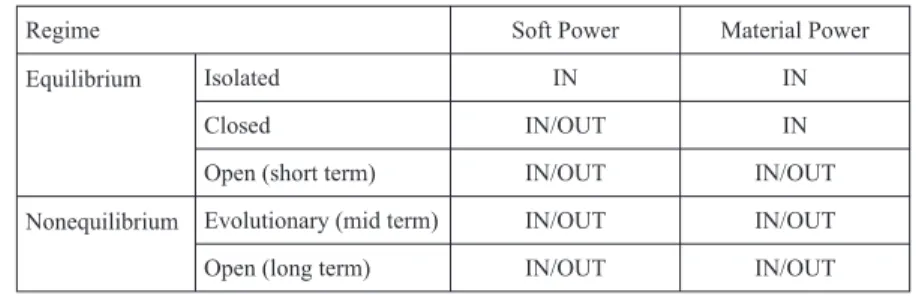
Using this metaphor, Table 2 shows that the international regime complex can be conceptualized as an equilibrium or nonequilibrium system, with or without involving the input and output of soft power (principles, norms, rules, and decision-making procedures) and material power (capital, labor, and nature).

The military security regime seems to be isolated from the climate regime, although the environmental security concept has been widely discussed and a proposal for a global tax on the arms trade has also been studied.

(3)

Most previous and currently existing international regimes are closed regimes within specifi c issue areas and geographical boundaries, in which the state actors are primary

For instance, see The Landau Report (2004). The Landau Report (2004). The Landau Report

(3)

(10)

decision makers. The international monetary and fi nancial regime has evolved within central banks and international fi nancial institutions with a variety of currencies: national, international (gold standard), and key (gold-exchange standard). The post-Bretton Woods fl oating regime is called a “non-system,”

in which a de facto fi xed-exchange regime with the euro currency emerged.

European economic and monetary integration has evolved from regional integration of coal, steel, and other tradable goods and services, including labor forces. Thus, the deepening and broadening of European integration can be regarded as an evolutionary regime.

Table 2: Dynamic Equilibrium and Nonequilibrium of the Regime Complex

Regime Soft Power Material Power

Equilibrium Isolated IN IN

Closed IN/OUT IN

Open (short term) IN/OUT IN/OUT

Nonequilibrium Evolutionary (mid term) IN/OUT IN/OUT

Open (long term) IN/OUT IN/OUT

International environmental regimes started being formed in the 1970s and evolved rapidly by interacting with development regimes, which also began developing in the post-World War II context. The principle of the “polluter pays” was originally established in the domestic context of developed countries, and recognized internationally later, and yet the current UNFCCC does not explicitly mention this principle. The UNFCCC explicitly mentions the principle of common but differentiated responsibility, and yet developed countries do not apply this principle to development issues. Financial and technological fl ows go beyond the fi nancial regime and infl uence environmental and social issues.

Thus, the current stage of the regime complex on fi nance, climate change, and development constitutes a partially open system, in which norms and material power are limitedly circulated across these issue areas.

Fiscal policy, including taxation, at the national level is normally

(11)

determined by “muddling through” based on the past record. Market forecasting, the target of fi nancial policy, is often determined by short-term profi ts. To overcome government failure and market failure, the international regimes for development and environment have recently introduced the backcasting approach, which sets mid-term and long-term targets. The development community set out and has been monitoring mid-term MDGs mainly by 2015.

The climate community is now negotiating to establish mid-term targets at around 2020, and a long-term goal at around 2050. The self-imposed time frameworks in international negotiations have often caused delays and thus the international regimes only slowly evolve or devolve, as shown in the World Trade Organization (WTO) Doha Development Agenda negotiations. The mid- term and long-term goal-setting practices across different regions, different issue areas, and different stakeholders may make the regimes open-ended and further dynamically complex.

III. Synchronic Governance of the Regime Complex Structure 1. Geographical Areas

The integration of political spaces can be operationalized as transaction cost or convergent prices of carbon across geographical areas in economic terms. The proposal for a uniform global carbon levy, taking into account the principles of common but differentiated responsibility and the polluter pays by differentiated revenue collection based on per capita GDP and differentiated share of revenue allocation to a global Multilateral Adaptation Fund, would address demands from developing countries if their representation in decision making were democratically secured. However, creating a new global institution with a compliance mechanism, including a solution to tax havens, must be solved adequately. Creating a global tax arrangement is not independent of the existing arrangements and needs political support from the main taxpayers:

the US and other OECD and OPEC members. It should be noted that this

uniform global climate fi nance regime was proposed by Switzerland, and

similar multilateral arrangements shared by other Environment Integrity

(12)

Group members have been proposed: Mexico’s proposal for a World Climate Change Fund and Korea’s proposal for carbon crediting nationally appropriate mitigation actions (NAMAs). Switzerland, as a non-EU Annex I country, has a strong preference for global standardization without becoming a member of the EU. Mexico’s proposed fund is to receive contributions from all countries based on assessed criteria and administered by the World Bank or other multilateral institutions. Korea’s proposal for crediting NAMAs assumes carbon credits are to be given for mitigation arising from NAMAs. Mexico and Korea, as new OECD members graduating from developing country groups in Latin America and East Asia, respectively, have incentives to form multilaterally standardized arrangements while retaining their non-Annex I country status.

Another possibility is the option of region-wide carbon tax arrangements.

Among others, the seemingly most feasible region for a common environmental tax in the post-2012 period will be Europe, where 25 of the 27 EU members are Annex I countries. In fact, several attempts have been made by early introducers such as Sweden for a unitary EU carbon tax. Such a tax has not materialized so far, however, because other developed countries feared losing fi scal autonomy and less prosperous crisis economies were worried about the additional tax burden (EurActiv, 2009). Instead of a region-wide tax, Europe has developed the EU ETS, which requires large, energy-intensive power plants to sell and buy permits to release CO

2

and other GHGs into the atmosphere. Revisions were also proposed, such as the auctioning of initial allowances. However, revenue from auctioning is less predictable than revenue by taxation, and prices in carbon markets can fl uctuate for participants. In practice, it will not be possible for a government to increase initial allowances under the cap and trade scheme, although a government can easily increase a tax level if the initial level does not achieve goals for emission cuts.

Another possibility is the option of concerted unilateral actions on

national environmental taxes with a fl at rate without creating global or regional

institutional arrangements, thus with a lower administrative cost. A carbon

tax is an important option for Annex I countries, which agreed to reduce

(13)

emissions within their borders, and Annex II countries, which pay the cost for developing countries. Annex I countries adopting carbon taxes may make border adjustments, if necessary, to keep their industrial competitiveness. Annex II countries may make fi nancial contributions by issuing defi cit-fi nancing national bonds, but overdependence on this measure is problematic in terms of intergenerational justice. Therefore, a carbon tax will adequately function to raise funds while mitigating emissions and restoring government autonomy.

2. Issue Areas

Environmental taxes can potentially confl ict with or generate synergic effects on other issue areas. The structural relationships between and within the three pillars of sustainable development, namely, economic, social, and environmental aspects, need to be considered. It is important to consider a balance of revenue share between different factors of production. Many countries have a higher dependence on labor and capital as revenue sources.

(4)

Carbon taxes can reform the regime complex structure across issue areas by designing a strong double dividend of mitigation effects and tax distortion reduction across factors and sectors.

The proposal for levies on international monetary transactions was originally intended to stabilize the international fi nancial system based on the fi nancial version of the “polluter pays” principle in macroeconomic policies.

Among others, this is the only proposal that explicitly focuses on fi nancial stability. It could start from a plurilateral form as currently seen in the Leading Group on Innovative Financing for Development, but a global application is needed for effective and fair treatment. The Draft Treaty on Global Currency Transaction Tax (CTT) gives the diagnosis that the current system of global fi nance is both unstable and undemocratic. The CTT is expected to stabilize fi nance and democratize the multilateral decision-making system for social

For instance, the ratios of environmental tax bases and labor tax bases were 6.2% and 47.6%

in Japan (2000) and 8.5% and 63.8% in Germany (2005). See Park Seung-Joon (2007).

(4)

(14)

development needs. The currency exchange regime is not directly related to carbon emissions, and yet if a globally democratized body decides to allocate tax revenues for climate change actions, they can do so (Patomaki, 2001).

Emissions trading and environmental taxes can be closely connected to microeconomic policies. GHG emission units in a market created by emissions trading may be called a new “currency” or “commodity.” Although a carbon market has so far no confl ict with the international trading regime, if GHG emission units are truly tradable products or services, emissions trading may potentially confl ict with the nondiscrimination and other rules of the regime of the WTO (Voigt, 2008). Carbon taxes and levies on domestic and imported products and domestic production processes are WTO-consistent, and yet if tax border adjustments are applied only because of the environmentally unfriendly production methods abroad, they will confl ict with the nondiscrimination principle for like products (Sapmson, 2001). It is consistent with the WTO Subsidies Agreement for a country to subsidize the production process of a fi rm to facilitate low-carbon technology adoption (nonactionable subsidies). It is not always clear, however, whether or not emissions trading and carbon taxes fall into general exceptions, such as the necessary protection of “human, animal, or plant life or health,” as spelled out by Article XX of the GATT.

Another issue on climate change and trade is the relationship between

technology transfer and the WTO TRIPS agreement. While liberalizing

environmental goods and services can result in mutualism between climate

change, trade, and development, there will be potential competition between

TRIPS and transfer of patented technology. Developing countries call for

compulsory licensing of patented technology or the exemption of LDCs from

patent protection, whereas many developed countries want to retain the current

regime on intellectual property. For developing countries to apply compulsory

licensing to patented mitigation and adaptation technologies, it will be necessary

to redefi ne and agree to a conceptual defi nition of “protectionisms” of three

issue areas: protection of intellectual property rights, human rights protection,

and environmental protection.

(15)

Global trade has also been facilitated by the growth of the international transportation sector. Because emissions from domestic fl ights are covered by the Kyoto Protocol targets, emissions from international fl ights involving Annex I countries are also to be covered. Opponents argue that such a proposal contradicts the ICAO Council Resolution on Taxation of International Air Transport (ICAO, 2000), which regarded taxation of international air transport as a major obstacle to the development of the sector and sought the elimination of “all forms of taxation on the sale or use of international transport by air, including taxes on gross receipts of operators and taxes levied directly on passengers or shippers.” The resolution was made before the Kyoto Protocol entered into force, and the international transport sector will be sustainably developed if such taxes are collected and used for sustainable aviation programs.

With regard to social aspects, a typical criticism is that carbon taxes might be regressive and people on lower incomes will suffer most. However, there are many methods to reduce regressiveness. One idea for easing a regressive carbon tax is a tax deduction or a tax credit for lower income taxpayers. Equally important, excessive reliance on labor as a tax base should be corrected in an aging society where the proportion of the working population is declining. The distortion as such can be effectively reduced by a shift to taxation on unearned income and environmental pollution. Al Gore’s proposal (2008) for a revenue- neutral carbon tax replaces payroll taxes: “We should tax what we burn, not what we earn. This is the single most important policy change we can make.”

An effective carbon tax should also be designed in relation to other

environmental regimes. For instance, taxation on ozone-depleting substances

and subsidies for chlorofl uorocarbon (CFC) substitutes have mixed implications

for climate fi nance and alternative technology. Since hydrochlorofl uorocarbons

(HCFCs) have a lower power to delete the ozone layer, and hydrofl uorocarbons

(HFCs) have no such power, both HCFCs and HFCs were used as CFC

replacements in the ozone regime. However, these CFC replacements are all

GHGs with extreme global warming potential per unit. Therefore, taxation

on CFCs and HCFCs would benefi t both the ozone regime and the climate

(16)

regime, and yet subsidization of HCFCs and HFCs is ozone friendly but not climate friendly. Thus, it is important to design mutually supportive taxation and funding mechanisms. Now that the ozone regime has established a plan to reduce HCFC emissions and the Kyoto regime covers HFCs as a targeted GHG, similar coordination is to be made between climate fi nance mechanisms and the Multilateral Fund for the Implementation of the Montreal Protocol.

Coordination between the Kyoto Protocol and a post-2012 regime is also needed. The rationale of the proposals for shares of proceeds in the fl exible Kyoto mechanism is understandable, and yet it will be diffi cult to determine an appropriate level of the proceeds of the CDM, joint implementation, and emissions trading. Experience shows that CDM projects have been concentrated on a selected number of developing countries. The question regarding which countries, Annex I or non-Annex I, should have the obligation to pay the CDM proceeds is also a matter of debate. Excessive shares of proceeds of the CDM might affect incentives for both developed and developing countries to employ the CDM option.

3. Policy Space

It is often argued that atmospheric and development spaces for developing countries have been narrowed. Such a predator-prey relationship between developed and developing countries can be transformed into a situation where the policy space of developing countries can be restored. When developed countries shift themselves into zero-carbon societies and developing countries seek to become low-carbon societies, the capacity of the developing state for social and environmental policies is improved by tax revenues. Poor people in developing countries who spend a higher proportion of their income on fossil fuel energy costs may not be affected by environmental taxes if cheaper renewable energies are provided.

(5)

In doing so, assessed contributions or other

For instance, a solar lantern campaign has been promoted by Tata Energy and Resource Institute, India. http://labl.teriin.org/

(5)

(17)

funds, raised through environmental taxes or other means in developed countries, should be provided for NAMAs and national adaptation programs for actions (NAPAs) for developing countries.

(6)

Major developing countries may consider carbon taxes at lower rates as part of unilateral NAMAs, or coordinated NAMAs with no-lose targets by linking them with fi nancial and technological support from developed countries. Financial assistance for tropical forest countries can also be linked to their conservation efforts in reducing emissions, deforestation, and degradation in developing countries (REDD+), which will mitigate about 20% of global GHG emissions stemming from tropical deforestation. While timbers from sustainable forestry can be duty-free, taxes and penalties should be placed on unsustainable products and deforestation.

Carbon taxes can also expand the policy space for local governments.

A nationally standardized global carbon tax can be collected and used by local governments, so that tax revenues can be used for local needs more effectively. A report by a Japanese prefectural government (Kanagawa Prefecture Study Group, 2009) points out advantages of feasible downstream taxation and the “frontrunner” model function for a local government. Carbon taxes in local communities, as seen in Canada’s British Columbia and the City of Boulder, Colorado, are easily understood by businesses and individuals, and can capture emissions on a production or consumption basis. Even if the forming of a national consensus on a carbon tax is delayed, local practices can provide a feasible model to be nationalized later, as shown in President Obama’s attempt to nationalize California’s standards of emissions and fuel economy.

Local environmental taxation can also expand policy space for the business sector through the “race to the top.” An example is the partnership between the Renault-Nissan alliance and two local governments in Japan, Kanagawa Prefecture and Yokohama City, where Nissan is headquartered

The IISD proposal for a phased approach suggests that advanced developing countries set sectoral or subnational no-lose targets with a base year of 2005. See ENB on the side (2009).

(6)

(18)

and their factories that manufacture electric vehicles (EVs) are located. These local governments announced the provision of subsidies and tax credits for purchasing a zero-emissions EV, while considering investing subsidized parking lot use with charging facilities and introducing a local carbon tax system. With a green vehicle tax system introduced by the Japanese central government, local consumers can purchase a Nissan EV at a similar price to the hybrid cars manufactured by Nissan’s business competitors, Toyota and Honda. For Renault- Nissan, a late developer of green cars, this partnership can create competitive advantages over their competitors. For the local governments, it can contribute to the development of a pollution-reduced transportation system, as well as facilitate local employment. Taken together, it can be the forerunner of green recovery both domestically and internationally.

Thus, state power and business interests, as well as norms and scientifi c knowledge, can transform the regime complex for environmental taxes. In particular, local governments and the private sector can play a role in forming and transforming the climate fi nance regime complex.

(7)

IV. Diachronic Governance of Regime Dynamics Transformation 1. Evaluating Past Records

The issues on past records of emissions revolve around the debate on historical responsibility. Developing countries stress the importance of historical responsibility, because past emissions from developed countries limit developmental space and potential mitigation actions add an extra burden to developing countries, and because historically, accumulated emissions continue to affect the climate crisis. Many developed countries argue that historical responsibility is not mentioned in the current Convention and there is the legal issue of an ex post facto law. That is, newly created law should not be applied retroactively to the problems made by the previous generation that has already

(7) It has also been noted that private authorities, both business and NGO actors, played an

important role in forming and transforming the emissions trading regime complex. See Green

(2008).

(19)

disappeared, and it is morally problematic to accuse the previous generation, which was uninformed about the GHG problem and fi ndings in climate change science.

It is also argued that it is diffi cult to collect data on all six GHGs to measure historical responsibility for all countries — political boundaries have also changed — since the Industrial Revolution. However, it is possible to integrate the historical responsibility debate into climate fi nance by limiting past records to 1990, which the UNFCCC defi ned as the historical base year for most Annex I countries.

(8)

Both the Convention Annex I countries and the Kyoto Protocol Annex B countries are legally responsible for historical emissions since then, when the Convention parties agreed to establish it as a baseline. In the case of noncompliance with the Kyoto Protocol emission reduction targets, the Annex B countries in noncompliance might be enforced to commit to an additional 30% reduction during the second commitment period (Kyoto Protocol, 2005).

Therefore, it should be reconfi rmed that the base year of 1990 is built into the Copenhagen negotiation, although Japan and others point out that 1990 as a base year favors certain countries. A complex base-year system of F-gas emissions is also a refl ection of the diffi cult regulation of past emissions. One way of avoiding the base year question is to introduce carbon taxes. “It is not necessary to construct a historical base year of emissions,” according to Nordhaus (2007).

“A natural baseline for the post-2012 period would be no-controls level of emissions.”

Another dimension of past records in the isolated system is agedness associated with indigenous peoples. For indigenous peoples, the concepts of Mother Earth and traditional ways of consultation with elders have not only spiritual and ethical but also policy implications. They call for adequate funding from the Annex I countries to pay for their “historical and ecological debt” and effective participation of indigenous peoples in decision making and implementation of mitigation and adaptation activities. They call for the

(8) For the historical responsibility debate, see Müller, et al. (2007).

(20)

appointment of representatives from indigenous peoples in funding mechanisms, so that they can express their collective rights and concerns about the negative effects of both fossil fuel development and alternative energy options and mechanisms, especially nuclear energy, large-scale dams, geoengineering, “clean coal”, agro-fuel, plantations, carbon trading, the CDM, and reducing REDD activities (Anchorage Declaration, 2009).

2. Monitoring Present Performance

“Developed countries,” “economies in transition,” and “developing countries” are all political labels for economies in historical or present progressive form. Although establishing new subcategories of “advanced developing countries” and “poor developing countries” is diplomatically diffi cult, environmental categorizations, such as “major emitting countries”

and “environmentally vulnerable countries,” are important to monitor the present performance of emissions as well as socioeconomic adaptation needs in temporal dimensions of regime complex governance.

It is important to assess fi nancial contributions by taking into account the

current trends in emissions growth, economic growth, and population growth

(or the human development index). Since today’s emissions become tomorrow’s

historical responsibility, today’s economic growth becomes tomorrow’s ability

to pay. Monitoring of environmental effectiveness and climate fi nance should

be done for both historical and current performance. More complicatedly,

the regime complex calls for environmental indexes to be divided by current

indicators of social and economic conditions. When emissions are regarded

as a sort of human right, emissions per capita might be suggested. When

socioeconomic ability to pay is taken into account, emission indexes may be

divided by GDP or the human development index. Available statistics for these

indicators will actually be past records, rather than current ones. However, these

recent past data can be used to monitor current performance. Uncertainty will

be involved in reduction potentials of energy use, with possible technological

development and educational innovation, and the marginal cost of reduction may

(21)

overevaluate past reduction efforts. National emission reduction objectives and assessed contributions may be decided on some combinations of these indicators for present performance. How to combine which indicators will be a parameter for future openness of a climate fi nance regime.

Compared with emissions trading, carbon taxes impose more directly courses on current emitting performance. Carbon taxes are imposed on current emitters to pay the current price for carbons set by the government and encourage their future efforts for reduction, whereas emissions trading permits current emitters to buy carbons at the current market price and rewards the past efforts of other emitters. Fluctuation of the carbon market price may not reward the past efforts of emission reduction. To allow a current emitter’s purchase of another emitter’s efforts may not lead to behavioral change in the future efforts of current emitters.

Another issue in the debate on current performance is the question of which is cheaper — current or future payments? The “cheaper in the future”

argument is based on the assumption that new abatement methods and new technology will be developed, sooner or later. However, later responses would worsen the negative effects of climate change and therefore cost more. The 2006 Stern Review (2007) estimated that 1% (later modifi ed as 2%) of global gross domestic product (GDP) per year is required to be invested to maintain CO

2

concentration levels at 450 – 550 ppm, while the cost of damage due to inaction will be 5 – 20% of global GDP per year (Guardian, 2008). Although critics argue that the Stern Review underestimated the cost of mitigation and overestimated the cost of inaction, it is not an exaggeration to say that the cost of inaction will be larger than the cost of appropriate actions now. Rather, technological advancement in the future is more possible, when economic incentives, such as environmental taxes, are adequately provided.

3. Assessing Future Pathways

IPCC modeling shows that global warming and sea level rise will

continue even if GHG concentrations are stabilized. Thus, no policies or

(22)

measures may be able to stop global warming quickly, and yet swift actions for quick effects on emission reductions and fund-raising for adaptation and technology transfer are urgently needed. Achieving and sustaining stabilization targets requires predictable and sustainable revenues, as well as speedy disbursements of adaptation funds and rapid diffusion of low-emission technologies.

To facilitate these purposes, backcasting approaches to policy selection with both long-term and mid-term targets for emission reductions are needed.

The advantages of setting mid-term targets include that they could provide an opportunity to review the effectiveness of policy tools and further regime complex transformation. Even though the limitation and reduction targets are the same, the pathways of rapid emission reduction and stability, slow reduction and later rapid reduction, or linear reduction toward mid-term and long-term goals will make a difference. Social behavior resulting from carbon taxes and their raised fund use may facilitate technological development, rather than late responses.

An ideal type of long-term cooperative action for climate change seeks a dynamic equilibrium system, in which climate stability, fi nancial stability, and social stability are achieved with dynamic transfers of fi nance and technology.

However, different proposals implicitly or explicitly assume different pathways.

All the submitted proposals, except the currency transaction levy, are not directly intended to lead to fi nancial stability in the long run. This is the pathway to fi nancial stability fi rst, and development and climate stability later. Increased shares of the proceeds from the CDM and additional ODA assume a pathway of development fi rst, and the environment later. No explicit link has yet been developed between a post-2012 regime and development efforts to achieve 2015 MDG targets. Mid-term and long-term targets for climate change and climate fi nance will improve the reviewability of not only environmental but also social and fi nancial architectures.

The role of environmental taxes for social behavioral change should not

be undervalued. The function of caring for future generations is what is called

(23)

“generativity.”

(9)

By showing changes in sustainable consumption patterns by choosing goods and services with environmental taxes and fi nancial incentives, adult consumers can demonstrate their sustainable consumption behaviors and lifestyle models to younger generations, who will then internalize those patterns for successive generations. This kind of environmental education and training function can be accompanied effi ciently and effectively by the option of environmental taxes and fi nancial incentives.

V. Conclusion

Climate change is a relatively recently recognized global issue that affects widespread areas synchronically, and it is a complexly changing intergenerational issue that is to be diachronically restored and prevented across generations. The international monetary and fi nancial system has a long history across centuries. Climate fi nance is emerging at the crossroad of these evolving regimes of climate, fi nance, and others. The current global crisis stems from this shaky disjuncture. The real source of the crisis is the lack of effective governance of the regime complex and regime transformation. The idea of environmental taxes was narrowly recognized by shortsighted negotiators only in terms of international competitiveness, and was not fully integrated into policies and measures in the Kyoto Protocol negotiations until the midst of the 1997 Asian fi nancial crisis. The world has achieved little in terms of global reforms of either climate or fi nancial architectures since then. Mistakes of the past could be repeated if the multiple and long-term advantages of environmental taxes are overlooked. Those symbiotic and coevolutionary advantages include:

autonomous, distributed, and cooperative integration; issue linkage function;

restoration and expansion of policy space; historical restoration; current reformation; and future reconstruction. There are also shortcomings — the political cost and potential bureaucratic machinery. These shortcomings can

The concept of generativity that was proposed by Erik H. Erikson (1993) has been discussed in the context of intergenerational justice. See Kotaro Suzumura, et al. (2006).

(9)

(24)

be minimized but are not avoidable, because individuals can make choices by themselves but a nation-state requires an institutional mechanism to make a collective decision. International decisions can be made unilaterally or jointly, but collective or coordinated choices require effective governance mechanisms for the regime complex. The most serious disadvantage is overconfi dence in the managed order of taxes without taking into consideration the dynamic power of spontaneous orders. Taken together, however, advantages will outweigh disadvantages.

These advantages of governance constitute a set of rules derived from the

coevolution of norms and procedures of the regime complex. First, the nationally

managed order for environmental taxes is based on corrective justice and this can

be implemented unilaterally. Second, the internationally emerged spontaneous

order of emissions trading is based on exchange justice and implemented

jointly. Third, the collectively managed order of a global environmental tax is

based on distributive justice and is conducted multilaterally. Fourth, concerted

spontaneous orders of solidarity taxes and levies can deconstruct existing ideas

of levies and widen possibilities for new climate fi nancial mechanisms. Policy

makers and negotiators should adequately recognize multifaceted dimensions

of global environmental taxes as a policy tool, which evokes linkage across

space and transformation across time. Shortsighted responses and inaction

on environmental taxes without an understanding of the breadth of and the

prospects for such complexity have often resulted in the repetition of policy

mistakes.

(25)

References

The Anchorage Declaration. (2009, April 24). Indigenous Peoples’ Global Summit on Climate Change.

Chair’s Summary. (2009, July 10). L’Aquila.

Chair’s Summary Siracusa Environment Ministerial Meeting. (2009, April 24).

Denmark. (2007). A global levy on marine bunkers, primarily to be applied for the acquisition of CO

2

emission quotas through the purchase of CO

2

credits, submitted by Denmark MEPC 58/4/4.

ENB on the side. (2009, June 11). Issue #9.

Erikson, E. H. (1993). Childhood and Society. New York: Norton.

EurActiv. (2009, May 12). Swedes to push for CO

2

tax at EU helm. Retrieved June 20, 2009, from http://www.euractiv.com/en/climate-change/swedes-push-co2-tax-eu-helm/article-182201 The Global Plan for Recovery and Reform. (2009, April 2). Communiqué from the G20 London

Summit 2009.

Gore, A. (2008, July 17). A Generational Challenge to Repower America. Retrieved June 20, 2009, from http://blog.algore.com/2008/07/

Green, J. F. (2008, March 25). The Regime Complex for Emissions Trading. Paper presented at the ISA, San Francisco.

The Guardian. (2008, June 26). p. 2.

Hayek, F. A. (1973). Law, Legislation and Liberty, Vol. I, Rules and Order. London: Routledge &

Kegan Paul.

ICAO. (2000). ICAO’s Policies on Taxation in the Field of International Air Transport. Doc 8632, 2000.

Joint Statement by the G8 Energy Ministers, the European Commissioner and the Energy Ministers of Algeria, Australia, Brazil, China, Egypt, India, Indonesia, Korea, Libya, Mexico, Nigeria, Rwanda, Saudi Arabia, South Africa, and Turkey. (2009).

Kanagawa Prefecture Study Group on Local Taxation System. (2009, March). Report on Kanagawa Prefecture’s Unique Taxation Contributing to the Realization of a Low Carbon Society.

Kyoto Protocol. (2005, December 9 – 10). Procedures and mechanisms relating to compliance under the Kyoto Protocol, 27/CMP.1.

The Landau Report: New International Financial Contributions. (2004). Commissioned by French President Jacques Chirac.

Madagascar. (2008). Submission for a Shared Vision on Long-term Cooperative Action. FCCC/

AWGLCA/2008/MISC.5/Add.2 (Part II), 26 – 28.

Maldives. (2008). International Air Passenger Adaptation Levy, a proposal by the Maldives on behalf of the group of Least Developed Countries (LDCs).

Mori, K. (2006). Contesting Global Governance: The Doha Negotiations on the WTO – MEA Relationship. Journal of Social Science, (58), 71 – 93.

Müller, B., Ellermann, Ch.. Friman, M., Höhne, N., & Verheyen, R. (2007). Differentiating (Historic)

Responsibility for Climate Change, 1-24. Retrieved June 20, 2009, from

(26)

Acknowledgment

This work was supported by Grant-in-Aid for Scientifi c Research (C) No.

19610009.

http://www.oxfordclimatepolicy.org/publications/DifferentiatingResponsibility.pdf

Nordhaus, W. D. (2007). To Tax or Not to Tax: Alternative Approaches to Slowing Global Warming.

Review of Environmental Economics and Policy, 1 (1), p. 36.

Norway’s submission on auctioning allowances. (2008). Retrieved June 20, 2009, from http://unfccc.int/fi les/kyoto_protocol/application/pdf/norway_auctioning_allowances.pdf Organisation for Economic Co-operation and Development. (2006). The Political Economy of

Environmentally Related Taxes. Paris: OECD. Box 1.

Park, S. (2007). A Carbon Tax or an Environmental Tax Reform: Diffi cult Decision for Japan. Paper presented at the Eighth Global Conference on Environmental Taxation, Munich. Retrieved June 20, 2009, from http://www.worldecotax.org/downloads/Presentations/SeungJoonPark.pdf Patomaki, H. (2001). Democratizing Globalization: The Leverage of the Tobin Tax. London: Zed

Books.

Raustiala, K., & Victor, D. G. (2004). The Regime Complex for Plant Genetic Resources.

International Organization, 58(2), 277-309.

Sampson, G. (2001). WTO Rules and Climate Change: The Need for Policy Coherence. In B.

W. Chambers (eds.), Inter-Linkages: The Kyoto Protocol and the International Trade and Investment Regimes (pp. 29 – 38). Tokyo: United Nations University Press.

Simms, A., Elliot, L., Hines, C., Juniper, T., Leggett, J., Lucas, C., et al. (2008). A Green New Deal.

nef on behalf of the Green New Deal Group.

Stern, N. (2007). The Economics of Climate Change: The Stern Review. Cambridge, UK: Cambridge University Press.

Submission by Slovenia on behalf of the European Community and its member states. (2008).

FCCC/KP/AWG/2008/MISC.1, 61– 63.

Suzumura, K., Kim, T., & Usami, M. (Eds.). (2006). Publicness from the Perspective of Intergenerational Justice. Tokyo: University of Tokyo Press.

A Swiss proposal for global solidarity in fi nancing adaptation. (2008). Retrieved June 20, 2009, from http://unfccc.int/fi les/kyoto_protocol/application/pdf/switzerlandfi nancebap091008.pdf United Nations Framework Convention on Climate Change (2009, May 19). FCCC/

AWGLCA/2009/8.

Voigt, C. (2008). WTO Law and International Emissions Trading: Is There Potential for Confl ict?

Carbon and Climate Law Review, 1(2), 54 – 66.

Young, O. (1983[1982]). Regime Dynamics: The Rise and Fall of International Regimes.

International Organization, 36 (2). Reprinted in S. Krasner (ed.), International Regime (pp.

93-113). Ithaca: Cornell University Press.

(27)

Taxis in Cosmos:

Global Environmental Taxes in Regime Complex Governance

<Summary>

Katsuhiko Mori

Climate fi nance is one of the key agendas for international negotiations

for a post-2012 climate change regime. Among several proposals for climate

fi nance, the advantages of global environmental taxes should be reconsidered

in relation to regime complex governance. Synchronically, the introduction of

a price mechanism for carbon taxes at the national, regional, or global level

is a step leading to further geographical integration, while restoring state

capacities for fi scal autonomy. It can also contribute to forming a politically

spacious, environmentally effective, socially fair, and economically effi cient

climate fi nance mechanism across different issue areas, if there is a synergistic

combination of multiple stakeholders with a variety of factors, such as power,

interest, norms, and scientifi c knowledge. Diachronically, assessed contributions

as well as carbon taxes imposed on developed countries can address partially

the issue of historical responsibility. The introduction of carbon taxes as part of

national mitigation actions with reduction targets in developed countries, and

with no-lose targets in developing countries by linking fi nancial fl ows from

developed countries, could address current and future responsibility. Climate

stability and fi nancial stability in the long run should be achieved by dynamic

emission limitation and fi nancial reform. Shortsighted responses without an

understanding of the breadth of and the prospects for such complexity have

often resulted in the repetition of policy mistakes.

Table 2: Dynamic Equilibrium and Nonequilibrium of the Regime Complex

参照

関連したドキュメント

The first result concerning a lower bound for the nth prime number is due to Rosser [15, Theorem 1].. He showed that the inequality (1.3) holds for every positive

In case the reader is encountering polymer models with boundaries for the first time but can appreciate an analogy with the totally asymmetric simple exclusion process (TASEP), then

[Mag3] , Painlev´ e-type differential equations for the recurrence coefficients of semi- classical orthogonal polynomials, J. Zaslavsky , Asymptotic expansions of ratios of

Two distinct systems of complex numbers in n dimensions are described in this paper, for which the multiplication is associative and commutative, and which are rich enough in

When making early preplant surface applications (15 to 45 days prior to planting), use a tank mix of Satellite HydroCap herbicide with other herbicides registered for use in a

• Application Method: Apply specified dosage in sufficient water volume to ensure uniform application and incorporation into the soil using one of the following methods:..

Zaltus SX, applied as part of a burndown program, may be used for residual weed control, as well as to assist in postemergence burndown of many weeds where field corn will be

(C6.10) Describe your gross global combined Scope 1 and 2 emissions for the reporting year in metric tons CO2e per unit currency total revenue and provide any additional