Environmental Shift : Contemporary Amis Ritual Practices as Cultural Heritage
著者(英) Yi‑tze Lee
journal or
publication title
Senri Ethnological Studies
volume 103
page range 167‑184
year 2020‑11‑24
URL http://doi.org/10.15021/00009628
167
Edited by Atsushi Nobayashi and Scott Simon
Ritual Landscapes, Human-Species Networks, and Environmental Shift:
Contemporary Amis’ Ritual Practices as Cultural Heritage
Yi-tze Lee
National Dong Hwa University, Taiwan
Abstract
Nangshi Amis, or ‘Pangcah’ people who live in the northern tip of East Rift Valley, have developed their practice of ritual worship led by ‘Sikawasai’ shaman groups. Rituals reanimate historical memories and facilitate human-animal relationships, helping to preserve culture even as local subsistence strategies change. Traditionally, rituals followed the seasonal cycle of planting millet, controlling pests, weeding, and harvesting.
However, during the Japanese colonial period, new practices like planting wet rice and raising domestic pigs resulted in the adaptation of ritual activities. ‘Environmental shift’
of the traditional territory has necessitated a change in ritual venues, as well as alternative means of acquiring particular animals and plants for worship. These changes to ritual practice alter the contents of historical memories and ritual landscape. Urbanisation development accelerates these changes and creates a new context for ritual materials as commodities.
This article aims to discuss the transition of ritual landscape and multispecies networks in the face of ritual and subsistence adaptation. On the one hand, the discussion addresses changes in human-animal relationships during the ritual cycle, focusing on the use of three kinds of animals: birds (symbolically caught by shamans in the field- cleaning ritual), fish (caught by male age-grade groups during the sacred boat ritual), and pigs (offered as ‘pigs for the ancestors’ during family funeral ritual practice). On the other hand, this research identifies a relationship between ‘environmental shift’–which refers to and reflects on the impact of environmental change and urbanisation on local habitats–for memory loss. Based on this discussion about religious, social and environmental transitions, this article defines ritual as a process that creates cultural heritage.
I. Introduction
Amis constitute the largest group of indigenous peoples in Taiwan, with about 250,000
individuals living mostly in the eastern part of the island. The Amis are famous for their
seasonal rituals, which revolve around agricultural practices like sowing millet, weeding, cleaning the field, controlling pests, harvesting, storing, and finally (at the end of the agricultural cycle) fishing (Table 1). While ritual activities characterize the meaning of Amis people’s daily lives, these rituals have had to be adapted over time because of (1) the relocation of animals related to ritual activities; (2) changing Amis’ subsistence strategies; and (3) urbanisation, which limit ritual and agricultural access to traditional territories. The interconnection of these three factors results in the ‘deterritorialisation’ of Nangshi Amis
1)in their own land, and it reshapes the Amis’ ritual landscape.
Table 1 Yearly Ritual Cycle of the Nangshi Amis
2)Dec Jan Feb Mar Apr May Jun Jul Aug Sep Oct Nov
Season Kasi’nawan (Cold season)
Kafalawfawan (Windy time)
Kacidalan (Dry and Sunny)
Kabaliusan (Typhoon)
Kafalian (Windy)
Event Midiwai Misatuligun Mivahvah Misalilio Miladis Miadop Malalikid Mirecuk
Activity Millet seeding
Weeding and growing yams
Dispel pests and ghosts
Harvest millet and restore farming tools
Fishing
ritual3) Hunting Harvest festival
Shamanic rituals
The most prominent rituals of the year include Midiwai (ritual for the millet-sowing announcement) at the end of December, Misatuligun (field-cleaning ritual) in March, Mivahvah (pest-control ritual) in April, Misalilio (bird-catching-and-eating ritual) in May–though, owing to the transition to rice cultivation, the ritual is now held in November–and Miladis (fishing ritual, which marks the end of the planting cycle) in June. These rituals reveal the significant relationships between people and non-human animals within a particular landscape. However, contemporary ritual activities have formed a new arena for cultural revitalisation. The form of ritual still follows traditional cycles, but its contents have been amalgamated with government-sponsored cultural festivals, political mobilisation, and new ways of promoting community solidarity. My argument is that, through repeated ritual practice, the cultural landscape is constantly reshaped and reconstructed with new meanings and active components. While the traditional Amis lifestyle is irretrievable, changes in Amis human-animal relationships can shed light on how landscapes are constructed not only by indigenous memories (as conjured through ritual), but also by the animals and plants found in the area. Lastly, contemporary transitions in ritual landscape are the consequence of capitalist infrastructural expansion, which operates within the colonial legacy of human-animal relationships that characterise the Anthropocene.
II. Amis Migration Routes and Livelihood Transition
According to traditional oral narratives, Amis ancestors sailed from the other side of the
ocean and settled in the different regions of Taiwan thousands of years ago. Regardless
of the migration routes the oral traditions delineate, the first group of pioneers are said to
have explored the island several times before they actually settled, eventually swayed by
its beauty and abundant natural resources (such as numerous plants and lower hill
inhabiting animals). The impact of this new environment and the interactions/
intermarriages with other people that it enabled were bound to affect Amis culture by introducing diversity. For a long period of time, the Amis sustained themselves by hunting, fishing, picking wild vegetables, and cultivating millet. In this time, they developed a sophisticated cycle of ritual practices in harmony with the seasonal rhythms.
This traditional lifestyle changed during the Japanese colonial period (1895−1945) when the Amis were forced to cultivate rice in paddy fields. The introduction of Japonica rice and other economical crops provided the Amis with an additional harvest cycle, which conflicted with local rituals but–alongside the millet cycle–better supported the community’s dietary needs. Moreover, Amis were mobilised into the wartime supply system, which demanded plantation efficiency, forced labour to build railways and harbours, and heavy taxation (Ka 1995; Tsurumi 1977). In addition to these changes in subsistence strategy and labour, the Amis also faced conflicts relating to religion and the modern education system. Amis’ traditional life based on natural resources began dissolving as nature was gradually being replaced with modern urban structures. Now, new generations of Amis are increasingly alienated from their forefathers’ knowledge about nature. Fortunately, some rituals and elders still remain, enabling us to explore this changing culture and its adaptations to the environment.
III. From Ritual to Landscape: Environmental Shift in Contemporary Settings In the literature on ritual activities and landscapes, landscapes are taken as historical discourses or references for collective actions (Bell 1992; Palka 2014; Turner and Turner 1978); second, ritual activities are used to define boundaries between different ethnicities, and therefore to symbolically represent identities and reconstitute collective memories (Clifford 1997; Stewart and Strathern 2003). As such, landscapes can be understood as products of ritual engagement with the world. Nevertheless, there is a third aspect of cultural landscape that has not been clearly explained in previous discussions, and that is the ritual landscape as constituted by networks of human-species interaction. Although different animals and plants used in rituals have been studied by anthropologists, there has been little to no discussion about the relationship between these species and the people using them, or the way that these species participate in the construction of cultural landscapes. In his classic discussion of the ecological implications of religious practice, anthropologist Roy Rappaport pointed out the important relationship between ecological pressure and ritual warfare, as mediated through species networks like that between the symbolic ‘Rumbim’ tree and domestic pigs whose interrelations complete the ritual cycle of sustainability (Rappaport 1968). Species are not only the objects of ritual actions but also the agents that invest meaning in ritual actions.
In the case of Taiwan’s indigenous people, there are ongoing discussions about the relationship between rituals and species and their joint construction of cultural meaning.
Liu Pi-Chen discussed the relationship between rice and wild deer, which, for the
Kavalan people, represent gender division and the ritual compensation for reproduction
dynamics–where men are represented by deer and women by rice (Liu 2007). However,
this species pair has been displaced due to the extinction of lowland deer following
commercial hunting for their fur, with roosters now taking the place of deer. As I will discuss later in my argument, the commodification of species–for example, by commercial farming or animal trading–is a significant cause of ‘environmental shift’, in addition to changes in subsistence strategies, urbanisation, and government investments.
For example, Hu Cheng-heng discussed the commercialisation of the ‘Troides magellanus’ (a giant butterfly) of Orchid Island, which changed its traditional meaning as demon‘s incarnation after becoming a trophy in the fetish economy (Hu 2007). In a different vein, Lo Su-Mei showed how Atolan women repurposed their traditional practice of collecting clams as a form of protest against the illegal construction of tourist resorts in their traditional territory (Lo 2010). In all these cases, traditional actions that were originally undertaken to produce ritual meaning were modified to respond to contemporary needs and species networks. We see, then, that relationships between species and ritual landscapes are formulated through historical discourses, symbolic boundaries, and action networks.
In the following sections, I will introduce three aspects of human-animal relationships in different ritual settings, showing both the traditional symbolic meanings of these practices and the contemporary changes these have undergone. Through the case studies of male age-grade groups and fish, shamans and birds, and ancestors and pigs, I intend to demonstrate how vital the notions of ‘border-making’ and ‘infrastructure- renewal’ are in Amis multispecies ethnography. This article shows how ritual and material adaptation constitute contemporary cultural heritage by sustaining essential cultural meanings even when physical and material resources become unavailable. While rituals can support to sustain essential cultural meanings for an ethnic group in the construction of cohort effect as important life events, the impact of environmental shift and change of infrastructure will usually result in memory loss for a certain age-group in the village. In the following section, I introduce the relationship between male age-group and fish.
IV. Male Age-group and Fish: Traditional Territory without Boundaries Amis society is organised according to several parameters, the most fundamental being hierarchical age-grade groups (forming a gerontocracy). The Amis’ concepts of private and public space can be divided into tamtaw (individual), loma (house), and niyaro (tribe).
Niyaro is the representative unit used by neighbouring tribes to negotiate the arrangement
of hunting territories, water resources, and other issues pertaining to extra-tribal
relationships. Between household and tribe, there are several different kinship groups
acknowledged by Amis people, including naloma´an (from the same household),
malinaay (kin), and ngangasawan (clan) (Furuno 2003). Clan members are distant
relatives who can still trace their connection after generations of migration due to
plantation or post-disaster relocation. Clan members can still trace the common origin of
ancestral legends. In In larger tribes, there are sometimes a few clans that distinguish
themselves from the overall kinship group. Nevertheless, all members of the tribe are
connected by blood. Amis tribes have historically experienced tension with other
indigenous groups, and even with other Amis tribes on the basis of hunting territory
conflicts. Intermittent periods of war required males to actively participate in activities for their age-group, through which they received training to fulfil their duties. Their duties to the gathering place ended when they got married.
During the Japanese colonial period, the headhunting activity was abolished by force, and inter-tribal relationships were regulated according to the laws of the nation- state. Under the new law and order imposed by the Japanese sovereignty, the traditional educational and military functions performed by the age-group were obviated, and the age-group as a social unit diminished in significance. Today, the Lidaw still maintains a coming-of-age ritual in the form of Misamalataw–held every eight years–wherein young males between the ages of 10 and 17 re-enact the landing route of the Amis ancestors.
From that point, with the blessing of their family members, the boys start their training to live as a group or community. Fish is the animal that symbolize male spirits, whereas millet is the symbol for female. In Amis concept, fish dwells in the realm that require courage and collective work to reach, and young males are encouraged to be “like fish.”
Any ritual activities held in Amis daily life are all conclude by fish catching by male and share with the villagers. Comparing to mountain, sea/river is more like the playground of males and fish represents male’s company in the wild.
The Nangshi Amis group consists of three major communities: Nataolan, Pokpok, and Lidaw. Among them, Lidaw is the only one located near the seashore, and thus the only community with a coming-of-age ceremony involving ritual boats. Oral legend recounts that ancestors of the Lidaw tribe came to their land from far away via five sacred boats. The ongoing age-group ritual involving sacred boats is designed to re-enact this landing process so that young people can ‘follow the ancestors’ on their route. The story goes that an Amis male Maciuciu drifted to a place ruled by an alien female group.
There, he was treated as a pig and confined for a long time. Eventually he managed to escape, but found no vehicle by the sea. Feeling defeated, the man cried helplessly, at which point the sea deity, Kafid, turned into a whale and carried the man home. Fish thus represents the magic power the sea provides and the companion of male group, and Kafid the guardian of male group was promised with worship and offerings in the ritual of Miladis. Since then, the Miladis ritual has been performed to show respect to the sea, and the Palunan ritual of the sacred boat has been carried out alongside the Misamalataw coming-of-age initiation for male age-groups.
In interviews conducted with elders from the various Nangshi Amis groups, the elders talked about the general rules of house construction. First, houses should face the sea and against the mountains, meaning that Amis houses generally face the east. There is always a potal (little court) in front of the household. Males are engaged with hunting and fishing activities, whereas females are engaged with farming, weaving, and cooking activities. Such arrangements are embodied in the living space of the Amis household, where different appliances are arranged in their respective spaces. The north-eastern corner is called ‘talofoan’, and this is where pottery, cooking utensils, and, especially, the female ritual bottle sifanohay are placed.
4)This corner is designed to be a female space.
Diagonal to the talofoan is the ‘cacara’an’ corner at the south-western side. ‘Cara’ means
animal mandibles, and in this case it designates the corner where males in the household
display their glorious hunting trophies. It is also the corner where males hang their hunting tools and the male ritual bottle ‘diwas’. The north-western corner is called pafotingan, and this is where the fishnet and fishing tools are placed (also a male corner).
The south-eastern corner is called ‘pasaasikan’, and this is where the farming tools are stored (a female corner) (Figure 1).
From this household geomancy, we see that latent rules are observed to distinguish males and females, extending even to designated corners for males and females. Male is at the west and south corner, while female is at the east and north corner. Some rituals are for the male spirit, Malataw (who is in charge of fields and the wild), and some are for the female spirit, Dongi (who is in charge of family ‘loma’ and life continuity).
Sacred places and daily routines are thus delineated by sex differences as well as by generational differences.
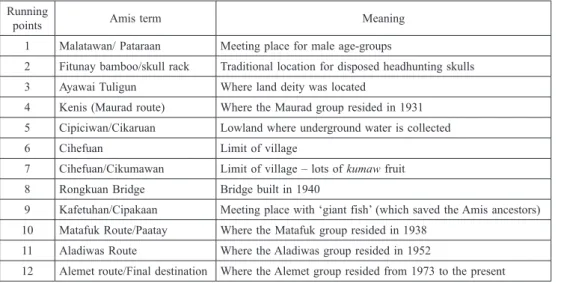
Amis males who live close to the reef coast are able to access the tidal flats, and are expected to have good swimming skills in order to retrieve food from the sea. Traditional fishing skills, such as patnod (fishing with a pole), mipacing (shooting fish), mitafokod (fishing by net), nisalil (netting by night), and nitaroh (dragging a net by the coast), require repetitive practice and cooperation between partners. Females are mostly responsible for gathering seaweed and algae from rock surfaces and conches or creatures from tidal pools–tasks that are relatively safer and can be performed independently. Not only the subsistence strategies related to river and ocean have been due to modernized lifeways; due to changes in land use caused by rice paddy cultivation, the racing route of the Palunan ritual for male age-group has been constantly changing since the Japanese colonisation. This shows how urbanisation, the construction of infrastructure, and seashore erosion change the way Amis people practise their sacred boat ritual. Figure 2
Figure 1 Household geomancy for Nangshi Amis materials and species (Chung 2014: 72, with English caption by the author)
pafotingan no karimoco’
[Fishing/River, Sea Fishing net, Fishing basket]
捕魚 / 河海
漁網、魚籠
+ - -
-
+
- -
++ + + -
女性 / 社內(屋 / 田)
男性 / 社外(山 / 海)
pasaasikan no karimoco’
malataw diwas
sifanohay
[Farming tools/Rice fields A place for offering rice ears]
農具 / 田(穀物)
供奉稻穗的場所 talofoan no karimoco’
[A place for mourning the dead/House]
[Female/Inside (House/Rice Fields)]
[Male/Outside village (Mountain/Sea)]
[Male]
[Female]
sifanohay、podok、kariyas等 tu'as/kawas 祭祀過世者之地 / 房子
/diwas
[Hunting/Mandibles of wild boar, Hunting tools]
cacara’an no karimoco’
狩獵 / 山 豬的下顎骨、狩獵器具
N 圖例
+ 男性- 女性
Figure 2 Historical transition of male racing routes for ‘Palunan’ ritual activity
shows how routes changed between 1931 and 1973; traditionally, male novices carrying boats would run the shorter routes, though these gradually shifted to lengthier routes due to seashore military construction at the end of WWII and post-war restrictions to sea resources (Table 2). This is a concrete example of environmental shift and the making/
remaking of ritual landscape.
V. Shaman and Birds: Multispecies Relations in the Rice Field
Generally, Amis people believe in animism. According to them, various kawas (spirits) reside in nature, and, once a person dies, they go to the territory of duas (ancestral spirits); however, they can regularly return to visit the living. A shaman group called
‘Sikawasay’ acts as a mediator between the living and spirit worlds, and they are responsible for calling duas back for ritual worship and offerings. The prefix ‘si-’ means
‘owning something’, and si-kawas-ay means people with the capacity to be with spirits or call the spirits. It is generally understood as shaman.
The Lidaw village has the most complete traditional ritual practice among Amis tribes. There are about 200 days in a year classed under the condition of ‘paising’ (taboo).
In addition to the specific ritual periods beginning in September, every household also intermittently needs Sikawasay for dealing with illness, giving offerings to the ancestors, cleaning up newly built houses, or facilitating funeral rituals. Before a ritual is carried out, villagers need to prepare standard offerings: toron (sticky rice or millet cake), icep (betelnut), fila (betel pepper), and epa’ (rice wine). Based on the specific purpose of the ritual, there are also ‘assistant plants’ that need to be prepared (shamans sometimes even specify the location or the direction of the plant). When everything is prepared, Sikawasay will appropriate the power of these plants to ensure the effectiveness of the ritual. The most important subsistence for traditional living and ritual cycle is millet,
Table 2 ‘Palunan’ sacred boat ritual running points Running
points Amis term Meaning
1 Malatawan/ Pataraan Meeting place for male age-groups
2 Fitunay bamboo/skull rack Traditional location for disposed headhunting skulls 3 Ayawai Tuligun Where land deity was located
4 Kenis (Maurad route) Where the Maurad group resided in 1931 5 Cipiciwan/Cikaruan Lowland where underground water is collected
6 Cihefuan Limit of village
7 Cihefuan/Cikumawan Limit of village – lots of kumaw fruit 8 Rongkuan Bridge Bridge built in 1940
9 Kafetuhan/Cipakaan Meeting place with ‘giant fish’ (which saved the Amis ancestors) 10 Matafuk Route/Paatay Where the Matafuk group resided in 1938
11 Aladiwas Route Where the Aladiwas group resided in 1952
12 Alemet route/Final destination Where the Alemet group resided from 1973 to the present
therefore the traditional calendar of Amis was starting with millet sowing announcement.
The following is the activities that Sikawasay shaman needs to lead the village following the announcement of millet sowing process (The prefix ‘misa’ in Amis means ‘to prepare for worship’ or to ‘become’):
1. midiway: wherein Sikawasay greet the ancestral spirits and agricultural-related kawas and announce the start of the year’s millet plantation season;
2. misaoma: which involves hoeing up and burning weeds for fertility before seeding;
3. misalalal: referring to the act of bending down and using a little hoe to plough and plant millet seeds into the earth;
4. mipipi: wherein weak seedlings are removed after the millet starts to shoot, so as to provide stronger ones with more space to grow. ‘Mipipi’ is the time to gather tribal males for a ritual circle dance, which may symbolise removing bad seedlings and ploughing up the earth. The males step firmly during the dance to stimulate later growth.
The most important public ritual led by Sikawasay in Lidaw is ‘Misatuligun’, which involves cleaning up the field for rice cultivation. In the past, wild fields were prepared by village females after the ritual announcing the sowing of millet or rice. Misatuligun is the ritual wherein Sikawasay pray to the land deity, asking him to cover the field with spiritual power and to chase away the pest insects and birds. Since Sikawasay are shamans who can appropriate and control animals’ power in the field, they are recruited in Misatuligun to chase away birds in order to protect the rice seedlings. Leaders of Sikawasay take a bunch of ‘teker’ from a linen bag and bundle them together. Teker is a holding trap prepared for ‘bird-catching’, made with a bamboo stick and a long linen net.
The Sikawasay then tie ginger leaves to each teker and line them up on a banana leaf.
After making these arrangements, Sikawasay walk to the east side of the field and stick teker to the southern ridge of the field. After a while, the shamans go to retrieve the teker and worship them with rice liquor. The use of teker is clearer now: while chanting in the field, the shamans caught the kawas of wild birds in the ginger leaves.
After the period of worship, each Sikawasay takes a piece of ginger leaf to ‘release the captured spirits’. They walk to the east side of the field ridge and make the stand still, then throw the leaf into the air while nominating possible wild birds: cirociro (sparrow), tatacio (drongo), trok (ring-necked pheasant), koakoa (duck), or cicale (brown shrike), etc. What Sikawasay have performed here in the ‘Misaayam’ ritual is a transition from household (loma) to field (omah), and a transformation of ginger leaves into birds so as to catch them before the rice seedlings shoot into grains. The female shamans, by throwing leaves into a male (wild) space, transform the whole ritual space. This is also the time when migrant birds flying south for the winter arrive in eastern Taiwan’s coast valley. The ritual marks the end of the farming season, at which point males have free time to catch birds in the field. This single ‘Talaomah’ beautifully connects various dyads of transition: from inner to outer space, from plant to animal, and from female to male.
The exchange of environmental resources is embodied in the ritual meaning (Table 3).
Literally, misa-lilio means the ritual exchange of labour. Amis elders explained that villagers often compensate those who help them to harvest and store grains in the winter by treating them to an elaborate meal (‘exchanging labour’). The elders treated this as a family affair, as it was held at the potal (small court for drying grains) in front of the house. As such, the event resembles a group feast more so than a ritual practice, and should be called ‘malaho to lilio’ (the lunch for exchanged labours). Since the 60s, the cultivation and harvest of rice and cash crops has been outsourced to machines, and house construction has changed from straws and woods to concrete and steel. Traditional labour exchange for communal work has thus been replaced with monetary donations.
Members of lilio (a unit of labour exchange) were once relatives, but later became merely close friends (‘sworn brothers’), and eventually the unit faded entirely. Even so, every fall after the harvest, Amis males still participate in wild bird hunting in order to host meals to show their hospitality: the birds are free to be caught and feathers of the pheasants are decorated at the crown of male ritual dress, which refers to the moral of male endurance and chastity. Due to unexpected consequences of the Wildlife Conservation Law, local people are turning the casual treats of malaho to lilio into official misa-lilio every fall. One elderly, responsible for public cooking event at a misa- lilio event, divulged how to cook in a skilled fashion:
At the time of the field ritual, every collected game or plant is designed for best combination. This is the wisdom from old times. Grilled ayam (birds) are accompanied with lala (long beans); beef from the harvest festival night is accompanied with rokec (pith of rattan); if cooking at home, it can be more flexible–ayam can be cooked with lokot (bird’s nest fern) or rokec, but the best is with sama’o (rabbit milk weed). […] But the most important thing is that the food is fairly distributed. It doesn’t matter how much you catch; the thing that really matters is to be fair. This is also the art of a person doing milikilac
5).
In misa-lilio, focus is placed on fair distribution of different-sized game rather than hunting skill. The emphasis on makomod (cooking together in a united fashion) means that the strong take care of the weak, who are united as common eaters. Some may
Table 3 Comparisons of Items in Family and Tribal Rituals
Item Family rituals (private) Tribal rituals (public)
Plants as ritual platform Banana leaves Silver tail Miscanthus Ritual vessels Sifanohay (female ritual bottle) Diwas (male ritual bottle) Ritual offerings Betel nut, betel pepper, rice liquor, sticky
rice cake All the elements used in a family ritual, plus a rooster
Spiritual protector Sikawasay ask Dongi (female deity) for help in rituals
Male age-group worships Malataw in the mountain and wild, and Kafid at the river or sea
Ancestors in rituals Duas (ancestor spirits) of the household Famous tribal leaders, chiefs, and shamans
question the non-traditional origin of contemporary misa-lilio, which differs from the longer-established malaho to lilio. However, from the perspective of cultural invention, it is a collective activity agreed to and shared by the community’s members. It is an extension of cultural tradition that creatively rearranges the existing order of activities.
Changing subsistence strategies mean that not many Amis villagers are dependent on rice cultivation, and decreasing numbers of migrant birds mean that gratitude and hospitality must be expressed in novel ways. As such, the ritual has changed from ‘catching and eating pest-birds together’ to worshiping the land deity. Ritual contents reflect the transition of species dynamics and give way to new symbolic representations.
VI. Pigs for the Ancestors: Domesticated Species and Memorial Space
Every year in late September, Sikawasay hold a series of rituals called Mirecuk to provide shamans with the opportunity to worship the kawas associated with themselves or their families, and thereby to renew their own spiritual power. Shamans in Lidaw still preserve very detailed knowledge about deity names and directions for worship. Every Sikawasay, based on his/her own lineage and family, ‘inherits’ a different kawa. The purpose of the whole-day ritual of Mirecuk is to sustain the history-laden and life- creating ‘road’ to the realm of kawas. According to Sikawasay, ‘calay’ is an invisible, transparent, and sticky string that feels like silk produced by spiders. In order to go to the realm of kawas, Sikawasay must ask the female spirit, Dongi, for calay to use as their lalan (which literally means road), as this will guarantee the correct route to the spiritual world. Beyond the Sikawasay, most Amis elders also apply this concept in their daily lives, using such expressions as ‘i cowa ko lalan?’ or ‘o’lalan ko epah’ (rice wine is our road). Only by repeatedly stepping on the correct road to the ancestral path can Sikawasay and villagers re-member (in the sense of a collective religious ‘way’) their cultural heritance together.
Funerals are a time when pigs are gathered for ancestors, and a time when ritual landscape is substantially visualised. The memorial walk performed by the bereaved family after the funeral is called ‘Tala-Omah’. Omah is the ‘field’, and tala means ‘to go’. This activity after the funeral is literally to ‘go to the field’ and remember what the deceased elder has lived through during their life. The process also entails bringing cooked pork soup to the field in order to sustain the power of the accompanying ancestors.
In Nangshi Amis funerals, pigs are prepared by the bereaved family members (especially female descendants) in order to invite all the family ancestors back to the house, as the ancestors must bring the newly deceased to the spiritual world with them.
Traditionally, pigs were provided by male hunters who acquired them from the nearby
low-hill forests. However, due to the installation of pig-raising businesses and consequent
domestication of wild pigs during the Japanese colonial period, the provision of pigs now
depends on a male who can get a pig from the pigpen, slaughter it properly, and
distribute its meat to all the family members. The ‘wild’ part of the funeral ritual has
been rearticulated as catching fish after the funeral is done. Despite the commercialisation
of pig acquisition for funerals, there are two aspects of the ritual that cannot be
‘domesticated’: first, the symbolic act of hoeing in nearby farms after the funeral, and second, catching fish from the rivers that demarcate the border of the village.
The following map (Figure 3), which delineates one Tala-Omah event from the Lidaw village, shows that there are three stages of ‘going to the field’. The first is delineated by line A, wherein family members walk a short distance (usually one week after the funeral) from the deceased household to the nearby field where the elder used to feed cattle or catch fish. The second is delineated by line B, wherein the family goes to places the deceased elder had visited during their life–in this case, the local Tzu-chi hospital (B1), Mennonite hospital (B2), a river fish-catching outlet (B3), and the rice field where the elder used to work (B4). Finally, about one month later, the bereaved family completes the third phase of Tala-Omah, delineated in this case by line C, in which bereaved members go to the location where elders used to keep their fishing boat and prepare their fishing net (C1), and to the nearby field where the elder used to catch birds (C2).
The whole route serves as a mental map whereby the bereaved family can visualise the living space of the deceased and re-engage with the activities that he/she used to do.
As family members relive the elder’s life environment, the funeral ritual landscape becomes substantiated in embodied experiences (Csordas 2002). Despite the different
Figure 3 The memorial walk of a bereaved family after an elder’s funeral (Chung 2014: 65, with English captions by the author)
The first talaomah T. faki Tuni’s house A1. omah in the east
side of the village
The third talaomah T. faki Tuni’s house C1. luna of faki Tuni C2. Huaren elementary school The second talaomah
T. faki Tuni’s house B1. Ciji hospital B2. Menuo hospital B3. Meilunxi estuary B4. omah of faki Tuni’s
house
The main parts of Dongchang village The present omah of Dongchang village The main fishing area of Dongchang village men