34
Published by Research Institute for Humanity and Nature Proceedings of the Online International Symposium on the Sanitation Value Chain 2020 (SVC2020)
https://doi.org/10.34416/svc.00040
Sanitation Value Chain Vol. 5 (1) pp.034–035, 2021
* Correspondence
Oral presentation
Determine the Benefits of Changes in Community Attitudes and Their Participation in the Community-
Based Water Supply and Sanitation Program (PAMSIMAS) in Landak Regency, Indonesia
Arip Ambulan PANJAITAN1*, Charlyna S. PURBA2
1 Doctoral Program in Public Health, Diponegoro University, Indonesia
2 Doctoral Program in Law, Diponegoro University, Indonesia
Keywords: attitude, participation, PAMSIMAS
The provision of water supply and sanitation is still a problem. The government has made efforts to create a clean and healthy environment by developing easy and sustainable access to drinking water and sanitation.
The community was active in this development program in building indoor wells, implementing clean and healthy behaviour, and establishing a committee to maintain and manage the facilities as an integrated program sustainable towards universal access. The central government, represented by the Minister for Public Works and Human Settlements Republic Indonesia, has run the Community-Based Water Supply and Sanitation (PAMSIMAS) program. This study aims to determine the benefits of implementing the PAMSIMAS program in Landak Regency.
The method used is a quantitative method with data collection techniques through questionnaires to all PAMSIMAS communities in the village, as many as 125 respondents. Besides, this research was conducted using a qualitative approach. The content analysis was done through in-depth interviews, documentary review, and observation. The subjects of this study were regency work unit, partnership committee, district coordinator (DC), co-DC, data entry and administration officer, community facilitator, community self-help group, implementing unit, drinking water facility management group, village government, the village head, sanitarian, and the water using community in a village, Landak Regency (total 35 people). The data were collected by questionnaires.
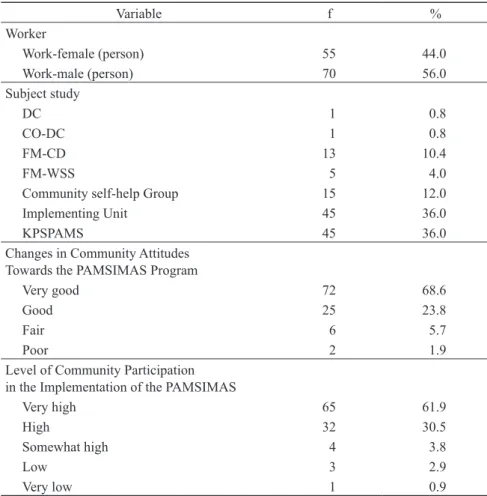
The results showed that the process of planning, implementing, and maintaining the PAMSIMAS program in Landak Regency were carried out by the community through deliberations. Besides, there had been a change in community behaviour. The effect is in the form of increasing community participation, improving public health figures and managing the program in an organized manner. The community’s awareness of healthy and clean living and their participation level in overseeing the program at all the stages can be seen from the maintenance of the PAMSIMAS III program since it was launched in 2017. Therefore, it can be concluded that the PAMSIMAS program has a positive impact on the community: the community can easily access clean water at Rp.10.000/m³ and stop doing open defecation. Changes in the community behaviour and attitudes and their participation level as a form of their sense of belonging to the facilities built in Landak Regency have occurred.
35
Proceedings of the Online International Symposium on the Sanitation Value Chain 2020 (SVC2020)
Sanitation Value Chain Vol. 5 (1) pp.034–035, 2021
Variable f %
Worker
Work-female (person) 55 44.0
Work-male (person) 70 56.0
Subject study
DC 1 0.8
CO-DC 1 0.8
FM-CD 13 10.4
FM-WSS 5 4.0
Community self-help Group 15 12.0
Implementing Unit 45 36.0
KPSPAMS 45 36.0
Changes in Community Attitudes Towards the PAMSIMAS Program
Very good 72 68.6
Good 25 23.8
Fair 6 5.7
Poor 2 1.9
Level of Community Participation in the Implementation of the PAMSIMAS
Very high 65 61.9
High 32 30.5
Somewhat high 4 3.8
Low 3 2.9
Very low 1 0.9
Table 1. Sample of table.
References
Arsyam, M., Nurfatimah, N., Sainuddin, I. H., S, Jusmiana, A. and Alam, S. 2020. Changes in Community Attitudes and Their Participation in the Community-Based Water Supply and Sanitation Program (PAMSIMAS) in Gowa Regency. (preprint) https://doi.org/10.31219/osf.io/gk569
Komala, P. S., Nur, A. and Septanisa, S. 2020. Real demand survey of the water supply system in Padang city.
Proceedings of the AIP Conference (Vol. 2230, No. 1); 040005.
Muniah, M., Soemarno, S. and Harahab, N. 2019. The Role of Community Participation In Sustainability Water Resources Management in Malang District. The Indonesian Green Technology Journal 8(2).
Susilo, A., Vidyattama, Y. and Wishanti, D. A. P. E. 2020. Water and sanitation program in decentralised eastern Indonesia: The roles of community and social dynamics. Australasian Journal of Regional Studies 26(1): 77–
106. https://www.anzrsai.org/assets/Uploads/PublicationChapter/AJRS-26.1-pages-077-to-106.pdf
Yasmine, K. and Rahdriawan, M. 2020. Kajian Manfaat Implementasi Program Pamsimas di Desa Pekuncen, Kecamatan Pegandon, Kabupaten Kendal (Study of the Benefits of Implementing the Pamsimas Program in Pekuncen Village, Pegandon District, Kendal Regency). Teknik PWK (Perencanaan Wilayah Kota) 9(3): 187–
197. https://ejournal3.undip.ac.id/index.php/pwk