• 検索結果がありません。

stromal tumor was introduced

N/A
N/A
Protected

Academic year: 2021

シェア "stromal tumor was introduced"

Copied!
11
0
0

読み込み中.... (全文を見る)

全文

(1)

Introduction

Gastrointestinal stromal tumors (GISTs) are the most common mesenchymal tumors of the gastrointestinal tract. It is generally thought that GISTs originate in smooth muscles and they are referred to as leiomyomas and leiomyo- sarcomas. However, electron microscopic and immunohistochemical studies related to smooth muscle differentiation have revealed inconsisten- cies in the above assumption. Thus, the term

stromal tumor was introduced

1)

. At present, GISTs are thought to originate from interstitial cells of Cajal (ICCs) or from stem cells that dif- ferentiate towards ICCs. In 1998, Hirota and Iso- zaki et al. reported that KIT is expressed in GISTs and that most of these tumors harbor ac- tivating mutations of KIT

2)

. This discovery led to the development of therapies targeting KIT in the treatment of GISTs. This review outlines the biology and advances in the targeted Yasuhisa Shinomura,Hiroyuki Yamamoto,Katsuhiko Nosho,Masafumi Mikami,

Kentaro Yamashita,Akira Goto,Yoshiaki Arimura,Takao Endo

First Department of Internal Medicine, Sapporo Medical University School of Medicine, S ! 1, W ! 16, Chuo ! ku, Sapporo 060 ! 8543, Japan

ABSTRACT Gastrointestinal stromal tumors (GISTs) are

the most common mesenchymal tumors of the gastrointestinal tract. Activating mutations of KIT or PDGF receptor alpha (PDGFRA) have been identified in the vast majority of GISTs.

Most GISTs are sporadic and some kindred of familiar GIST with a germline mutation in KIT or PDGFRA have been reported. The inhibition of KIT or PDGFRA activity by the kinase in- hibitor imatinib frequently results in dramatic clinical responses in advanced cases of GIST.

The clinical response to imatinib therapy is cor-

related with the type of mutation in KIT and PDGFRA . Resistance to imatinib after an initial response has been reported and secondary point mutations in KIT or PDGFRA that confer imatinib resistance are the most common mechanisms responsible for an acquired resis- tance to imatinib. The determination of KIT and PDGFRA mutations would be useful in pre- dicting the effect of imatinib. GISTs are the first solid tumors to respond well to targeted small molecular therapy. This review outlines the biol- ogy and targeted therapy of GISTs.

Key words : KIT, PDGFR, NF1, Tyrosine kinase inhibitor, Imatinib

Address correspondence and reprint requents to Yasuhsisa Shinomura,M. D. ,Ph. D. , First Department of Internal Medicine,Sapporo Medical University School of

Medicine,S ! 1,W ! 1 6,Chuo ! ku,Sapporo 0 6 0 ! 8 5 4 3,Japan,

Tel:+8 1 ! 1 1 ! 2 1 1 ! 6 1 1 1 (3 2 1 0) ; Fax:+8 1 ! 1 1 ! 6 1 3 ! 1 2 4 1

Biology and targeted therapy of gastrointestinal stromal tumors

<Review>

Tumor Res . 4 0 ,1−11(2 0 0 5)

(2)

therapy of GIST.

KIT or PDGFRA mutations in GIST

Approximately 80 ! 85% of GISTs have acti- vating mutations of KIT

3)

. The proto ! oncogene KIT was first identified as the cellular homo- logue of the oncogene v ! KIT , isolated from the Hardy ! Zuckerman 4 feline sarcoma virus

4)

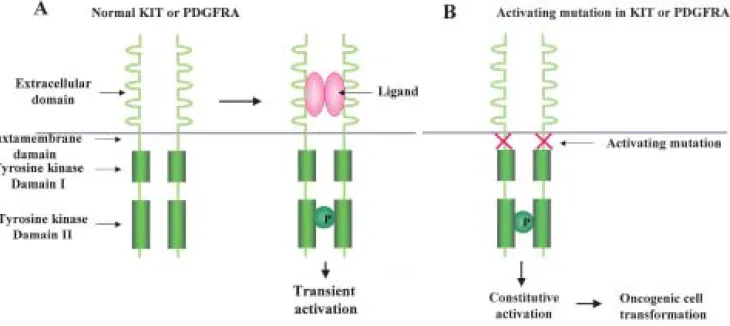
. The KIT protein is a transmembrane type III recep- tor tyrosine kinase, the ligand of which is stem cell factor (SCF). KIT consists of an extracellular region, containing five immunoglobulin ! like mo- tifs, and a cytoplasmic region, containing a jux- tamembrane domain and two kinase domains (Fig. 1). A kinase insert sequence divides the kinase domain into an ATP binding region and a phosphotransferase region. KIT plays a crucial role in the development of melanocytes, erythro- cytes, germ cells, mast cells and ICCs. ICCs that regulate gastrointestinal motor function are lo- cated in and near the circular muscle layer of the gastrointestinal tract. GISTs are thought to arise from ICCs or stem cells that differentiate towards ICCs.

The mutant KIT proteins in GISTs are con- stitutively activated in the absence of the KIT

ligand, SCF (Fig. 1)

2)

. Signal transduction path- ways such as the PI3K/Akt and mitogen ! acti- vated protein kinase pathways have been impli- cated in the mediation of KIT ! induced mito- genesis and its differentiated function

5, 6)

. KIT mutations in GISTs in exons 9, 11, 13, and 17 of the gene have been reported, with the majority in the juxtamembrane domain (exon 11) (Fig.

2)

2, 3, 7!14)

. KIT mutations in the extramembrane

region (exon 9) were found in 13% of GISTs, while mutations (exons 13 and 17) in the two kinase domains are rare

3)

.

Approximately 30% of GISTs lacking KIT mutations have activating mutations in PDGFRA (Fig. 2)

15!17)

. PDGFRA is a member of the same family of type III receptor tyrosine kinase as KIT and a high amino acid homology exists between PDGFRA and KIT. PDGFRA mutations were found in the juxtamembrane do- main (exon 12), the kinase I domain (exon 14) and the kinase II domain (exon 18). KIT and PDGFRA mutations have been suggested to be alternative and mutually exclusive oncogenic mechanisms in GISTs and it has also been sug- gested that mutations in KIT and PDGFRA modulate the differential activation and expres-

Fig. 1 Normal and abnormal KIT or PDGFRA signaling A:Normal KIT or PDGFRA signaling

B:Constitutive activation of KIT or PDGFRA signaling in GISTs.Gain ! of ! function mu- tations result in ligand ! independent KIT/PDGFRA activation of the kinase domain.

Y.SHINOMURA et al.

(3)

sion of some types of genes

18)

.

Patients with NF1 (von Recklinghausen's neurofibromatosis type 1) are at increased risk of developing GISTs. Based on a Swedish study involving 70 NF1 patients, the incidence of GISTs in this population is approximately 7%

19)

. Mutations in the KIT gene or the PDGFRA gene appear to be rare in GISTs from NF1 pa- tients

20!23)

. Interestingly, in NF1 patients, GISTs develop in the small intestine more frequently than the stomach, while GISTs of non ! NF1 pa- tients are most commonly found in the stomach.

It is possible that the underlying mechanism of GIST carcinogenesis in NF1 patients is different from that in non ! NF1 patients.

Familiar GISTs

Familial GISTs are rare autosomal domi- nant genetic disorders. Twelve kindred of famil- ial GISTs with germline mutations in the KIT and PDGFRA genes have been reported

24!35)

(Table 1), including 11 with KIT mutations and one with a PDGFRA mutation. Among 11 kin- dred with germline mutations of KIT , 7 had a KIT mutation in the juxtamembrane domain and the other kindred had KIT mutations in the extracellular domain, kinase domain I or II.

Most mutations in kindred of the GIST family

are identical to those found in sporadic GISTs.

Skin hyperpigmentation, dyphagia, and mastocy- tosis were observed in some kindred of familial GISTs with germline mutations in the KIT gene. Diffuse hyperplasia of ICCs was detected in the myenteric plexus region of the gastroin- testinal tract in some kindred with germline mutations in KIT

24!26, 33)

. The diffuse ICC prolif- eration was found to be polyclonal, although the GISTs were monoclonal

36)

. Recent data based on a knock ! in mouse model suggests that germline KIT activation results in hyperplasia of ICCs

37)

. A germline mutation of KIT may cause non ! neoplastic hyperplasia of ICCs and a transition from hyperplasia to neoplasia. A case of familial GIST with dysphagia showed abnormal esopha- geal peristaltic movement, suggesting that hy- perplasia of ICCs may be associated with esophageal motor disturbances

33)

. Urticaria pig- mentosa is the most common form of cutaneous mastocytosis. Urticaria pigmentosa or mastocy- tosis have been observed in 3 kindred of familial GISTs with a germline mutation in KIT

24, 29, 30)

. In sporadic cases of systemic mastocytosis, a D 816V mutation in KIT is common

38)

, which has not been reported in GISTs. A germline muta- tion in KIT (A553D) was reported in a kindred of familial diffuse cutaneous mastocytosis

39)

. Fig. 2 Site of KIT and PDGFRA mutations in GISTs

*: Based on data reported by Corrless et al .

3,17)

40(2 0 0 5) Biology and targeted therapy of gastrointestinal stromal tumors

(4)

Prognostic factors of GIST

It is often difficult to predict the level of malignancy of GISTs. The presence of distant metastasis and/or direct invasion of adjacent or- gans, a large tumor size, and a high mitotic rate have been identified as unfavorable predictors for survival. The NIH consensus conference pro- posed a risk classification based on tumor size and histopathological mitotic count (Table 2)

40)

. If the tumor is less than 5 cm in size and the mi- totic count is below a 5/50 high power field, the risk of metastasis can be considered to be low.

Several studies have indicated that molecu-

lar alterations may serve as predictors of the clinical outcome in GISTs. Loss of the p16 pro- tein

41)

, the KIT mutation type

42!45)

, telomerase ac- tivity

46)

, hypermethylation of the E ! cadherin pro- moter

47)

, and the expression of a set of six genes:

CCNB1, CENP ! F, FAK, HMG2, TSG101 , and ezrin

48)

have been reported to be molecular markers that are indicative of a poorer progno- sis for GISTs. The location of the KIT and PDGFRA mutations in GISTs has been re- ported to be associated with both the site of ori- gin and the prognosis

45)

. A significant association between KIT exon 9 mutations and an intesti- Table 1 Associated symptoms in familial gastrointestinal stromal tumors with a germline

mutation in KIT and PDGFRA Family

no. Author (ref. no.) Mutated

gene Site of mutation Associated symptoms 1 Hartmann K (24) KIT Del419 (EC) Mastocytosis, Dysphagia

2 Hirota S (25) KIT W557R (JM) !

3 Robson ME(26) KIT W557R (JM) Hyperpigmentation, Dysphagia 4 Nishida T (27) KIT Del559 ! 560 (JM) Hyperpigmentation

5 Maeyama H (28) KIT V559A (JM) Hyperpigmentation

6 Beghini A (29) KIT V559A (JM) Hyperpigmentation, Urticaria pigmentosa 7 Li FP (30) KIT V559A (JM) Hyperpigmentation, Urticaria pigmentosa

8 Carballo M (31) KIT InsQL576 ! 577 (JM) !

9 Isozaki K (32) KIT K642E (TKI) !

10 Hirota S (33) KIT D820Y (TKII) Dysphagia

11 O'Riain C(34) KIT D820Y (TKII) Dysphagia

12 Chompret A (35) PDGFRA D846Y (TKII) !

EC: extracellular domain, JM: juxtamembrane domain, TKI: tyrosine kinase I domain, TKII: tyrosine kinase II domain

Table2 Proposed guidelines for defining the risk of aggressive behavior in gastrointestinal stromal tumors

Risk Size(cm) Mitotic index(per 5 0 HPF)

Very low <2 <5

Low 2 ! 5 <5

Intermediate <5 6 ! 1 0

5 ! 1 0 <5

High >5 >5

>1 0 Any mitotic rate

Any size >1 0

HPF: High ! power field.

From Fletcher et al

7)

.

Y.SHINOMURA et al.

(5)

nal origin of GISTs, and between PDGFRA mu- tations and gastric GISTs has been reported.

The 6 bp insertion mutation in KIT exon 9, re- sulting in the tandem duplication of amino acids Ala 502 and Tyr 503, was shown to define GISTs of intestinal origin with a more aggres- sive potential

43)

. Internal tandem duplication in the 3' end of KIT exon 11 was reported to be associated with gastric GISTs with a more fa- vorable outcome

44)

, while deletions that affect co- dons 557 ! 558 of KIT exon 11 indicated a poor prognosis

45)

.

Molecularly targeted therapy of GIST with imatinib

Imatinib (imatinib mesylate, commercially available as Gleevec or Glivec, Novartis, Basel, Switzerland), formerly known as STI571, is a ty- rosine kinase inhibitor developed for the treat- ment of chronic myeloid leukemia by targeting the BCR ! ABL fusion protein responsible for leu- kemic transformations. Imatinib inhibits the kinase activities of KIT and the PDGF recep-

tor

49, 50)

, by blocking the binding of ATP to these

tyrosine kinases. Imatinib blocks the in vitro kinase activity of both wild ! type KIT and a mu- tant KIT isoform commonly found in GISTs

51)

. Conventional chemotherapy and radiation ther- apy is ineffective in the treatment of GIST. A patient with GIST metastatic to the liver was successfully treated with imatinib

52)

. The success in treating the first GIST patient with imatinib quickly led to initial phase I/II studies, followed by phase III randomized trials with imatinib in patients with metastatic or unresectable GISTs

53!56)

. The US ! Finland multicenter trial (CSTI571B 2222) showed that the partial re- sponse rate (PR) and the stable disease rate (SD) were 54% and 28%, respectively, in patients with advanced GIST

54)

. Other clinical studies also showed a high overall response rate and the phase III studies suggested an increase in progression ! free and overall survival rates

55, 56)

. Although the use of imatinib frequently results in long ! term tumor shrinkage in metastatic GISTs, complete remission after imatinib treat-

ment is rare. The 1 ! year results of a French phase III study of continuous versus intermit- tent imatinib treatment showed a rapid and fre- quent progression at 3 months in patients on the intermittent regimen

57)

. The continuous imatinib regimen is therefore the recommended standard approach. Trials of adjuvant and neoadjuvant treatment of GISTs with imatinib are currently underway.

Treatment with imatinib is generally safe and well tolerated, although most patients expe- riance some mild to moderate adverse events

54!56)

. The most common adverse events include ane- mia, edema, nausea, diarrhea, myalgia, fatigue, and skin rash

54!56)

. Overall, the adverse effects of imatinib are similar to those reported for a large population of patients with chronic myeloid leu- kemia. Less than 2% of the patients were taken off treatment due side effects. Toxicity ! related deaths occurred in 0.5% to 2% of the patients, mainly due to hemorrhage or hepatotoxicity.

Gastrointestinal or intra ! abdominal hemor- rhages are generally thought to be related to tu- mor regeneration induced by imatinib.

Clinical response to imatinib based on the type of KIT and PDGFRA mutation

Correlative studies associated with one of the multicenter trials (CBTI571B 2222) showed that the clinical response to imatinib was corre- lated with the type of mutation of KIT and PDGFRA

8)

. Patients with GIST harboring exon 11 KIT mutations had a significantly better re- sponse to imatinib (83.5%) than those with exon 9 KIT mutations (48.7%), and those without KIT or PDGFRA mutations (0%). Patients with a D842V mutation in PDGFRA , the most com- mon activating PDGFRA mutation in GISTs, failed to respond to imatinib therapy. The PDGFRA ! D842V mutation is confirmed to be an activation mutation with an attenuated sensi- tivity to imatinib

58)

. These results indicate that the determination of PDGFRA mutations, in ad- dition to KIT mutations, would be useful for predicting the effect of imatinib.

40(2 0 0 5) Biology and targeted therapy of gastrointestinal stromal tumors

(6)

Mechanisms of imatinib resistance

Although most patients with GIST achieve a response to imatinib, many patients with GISTs develop imatinib resistance during a long

! term treatment. The median time to progres- sion has been reported to be about 24 months

56)

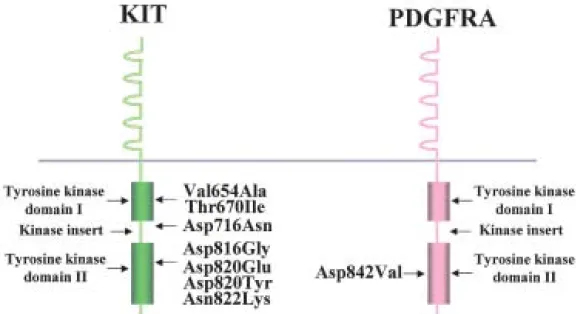
. In patients with GIST who developed imatinib resistance, secondary mutations are often de- tectable in KIT or PDGFRA that are resistant to imatinib. These include V654A, D670I, D716N, D816G, D820E, D820Y, and N822K mutations in KIT and D842V mutation in PDGFRA (Fig. 3)

59!62)

. D820Y and N822K mutations in KIT and a D 842V mutation in PDGFRA have been reported in GISTs that had not been treated with imatinib

8, 15, 16, 33)

, while the other mutations have not been reported previously in primary GISTs.

Most of the secondary mutations are in KIT ex- ons 17 and 13. This suggests that the acquisition of a secondary point mutation in KIT or PDGFRA results in the substitution of some residues at critical binding sites for imatinib. A secondary mutation in BCR ! ABL is the most common mechanism of imatinib resistance in the treatment of chronic myeloid leukemia.

Imatinib resistance is a clinically crucial problem in the treatment of GIST. New molecu- larly targeted therapies are currently under de- velopment for GIST patients who are refractory

to imatinib. SU11248 is a multi ! targeted tyro- sine kinase inhibitor of KIT, FLT3, PDGFR, and vascular endothelial growth factor receptor

63)

. The use of SU11248 results in clinical benefits in a majority of patients with GIST who are re- fractory to imatinib

64)

. A phase III randomized trial comparing SU11248 versus a placebo in these patients is currently underway. Other drugs that are being evaluated in imatinib ! re- fractory patients include rapamycin analogue in- hibitors, antisense oligonucleotides to bcl ! 2 mRNA, protein kinase C inhibitors, neutralizing antibodies against vascular endothelial growth factor, and several multikinase inhibitors

53)

.

REFERENCES

1.Mazur MT, Clark HB. Gastric stromal tu- mors. Reappraisal of histogenesis. Am J Surg Pathol 1983; 7:507 ! 519.

2.Hirota S, Isozaki K, Moriyama Y, Hashimoto K, Nishida T, Ishiguro S, Kawano K, Hanada M, Kurata A, Takeda M, Turio GM, Matsuzawa Y, Kanakura Y, Shinomura Y, Kitamura Y. Gain ! of ! function mutations of c ! kit in human gastrointestinal stromal tu- mors. Science 1998; 279: 577 ! 580.

3.Corless CL, Fletcher JA, Heinrich MC. Biol- ogy of gastrointestinal stromal tumors. J Clin Oncol 2004; 22:3813 ! 3825.

Fig. 3 Secondary mutations in KIT and PDGFRA that confer imatinib resistance

!2)

Y.SHINOMURA et al.

(7)

4.Besmer P, Murphy JE, George PC, Qiu FH, Bergold PJ, Lederman L, Synder HW, Brodeur D, Zuckerman EE, Hardy WD. A new acute transforming feline retrovirus and relationship of its oncogene v ! kit with the protein kinase gene family. Nature 1986;

320: 415 ! 421.

5.Heinrich MC, Rubin BP, Longley BJ, Fletcher JA. Biology and genetic aspects of gastrointestinal stromal tumors: KIT activa- tion and cytogenetic alterations. Hum Pathol 2002; 33: 484 ! 495.

6.Duensing A, Medeiros F, McConarty B, Joseph NE, Panigrahy D, Singer S, Fletcher CDM, Demetri GD, Fletcher JA. Mecha- nisms of oncogenic KIT signal transduction in primary gastrointestinal stromal tumors (GISTs). Oncogene 2004; 23: 3999 ! 4006.

7.Nakahara M, Isozaki K, Hirota S, Miyagawa J, Hase ! Sawada N, Taniguchi M, Nishida T, Kanayama S, Kitamura Y, Shinomura Y, Matsuzawa Y. A novel gain ! of ! function mutation of c ! kit gene in gastrointestinal stromal tumors. Gastroenterology 1998; 115:

1090 ! 1095.

8.Heinrich MC, Corless CL, Demetri GD, Blanke CD, von Mehren M, Joensuu H, McGreevey LS, Chen CJ, Van den Abbeele AD, Druker BJ, Kiese B, Eisenberg B, Roberts PJ, Singer S, Fletcher CDM, Silberman S, Dimitrijevic S, Fletcher JA.

Kinase mutations and imatinib response in patients with metastatic gastrointestinal stromal tumor. J Clin Oncol 2003; 21: 4342 ! 4349.

9.Lux ML, Rubin BP, Biase TL, Chen CJ, Maclure T, Demetri G, Xiao S, Singer S, Fletcher CDM, Fletcher JA. KIT extracellu- lar and kinase domain mutations in gastro- intestinal stromal tumors. Am J Pathol 2000; 156:791 ! 795.

10.Lasota J, Wozniak A, Sarlomo ! Rikala M, Rys J, Kordek R, Nassar A, Sobin LH, Miettinen M. Mutations in exons 9 and 13 of KIT gene are rare events in gastrointes- tinal stromal tumors. A study of 200 cases.

Am J Pathol 2000; 157: 1091 ! 1095.

11.Hirota S, Nishida T, Isozaki K, Taniguchi M, Nakamura J, Okazaki T, Kitamura Y. Gain ! of ! function mutation at the extracellular do- main of KIT in gastrointestinal stromal tu- mors. J Pathol 2001; 193: 505 ! 510.

12.Sakurai S, Oguni S, Hironaka M, Fukayama M, Morinaga S, Saito K. Mutations in c ! kit gene exons 9 and 13 in gastrointestinal stro- mal tumors among Japanese. Jpn J Cancer Res 2001; 92: 494 ! 498.

13.Rubin BP, Singer S, Tsao C, Duensing A, Lux ML, Ruiz R, Hibbard MK, Chen CJ, Xiao S, Tuveson DA, Demetri GD, Fletcher CDM, Fletcher JA. KIT activation is a ubiquitous feature of gastrointestinal stro- mal tumors. Cancer Res 2001; 61: 8118 ! 8121.

14.Kinoshita K, Isozaki K, Hirota S, Nishida T, Chen H, Nakahara M, Nagasawa U, Ohashi A, Shinomura Y, Kitamura Y, Matsuzawa Y. c ! kit gene mutation at exon 17 or 13 is very rare in sporadic gastrointestinal stro- mal tumors. J Gastroenterol Hepatol 2003;

18: 147 ! 151.

15.Heinrich MC, Corless CL, Duensing A, McGreevey L, Chen CJ, Joseph N, Singer S, Griffith DJ, Haley A, Town A, Demetri GD, Fletcher CDM, Fletcher JA. PDGFRA acti- vating mutations in gastrointestinal stromal tumors. Science 2003; 299: 708 ! 710.

16.Hirota S, Ohashi A, Nishida T, Isozaki K, Kinoshita K, Shinomura Y, Kitamura Y.

Gain ! of ! function mutations of platelet ! derived growth factor receptor alpha gene in gastrointestinal stromal tumors.

Gastroenterology 2003; 125: 660 ! 667.

17.Corless CL, Schroeder A, Griffith D, Town A, McGreevey L, Harrell P, Shiraga S, Morich J, Heinrich MC. PDGFRA mutations in gastrointestinal stromal tumors: Fre- quency, spectrum and in vitro sensitivity to imatinib. J Clin Oncol 2005; 23: 5357 ! 5364.

18.Kang HJ, Nam SW, Kim H, Rhee H, Kim NG, Kim H, Hyung WJ, Noh SH, Kim JH, Yun CO, Liu ET, Kim H. Correlation of KIT and platelet ! derived growth factor receptor

40(2 0 0 5) Biology and targeted therapy of gastrointestinal stromal tumors

(8)

alpha mutations with gene activation and expression profiles in gastrointestinal stro- mal tumors. Oncogene 2005; 24: 1066 ! 1074.

19 . Zoller ME , Rembeck B , Oden A , Samuelsson M, Angervall L. Malignant and benign tumors in patients with neurofibro- matosis type 1 in a defined Swedish popula- tion. Cancer. 1997; 79: 2125 ! 2131.

20.Kinoshita K, Hirota S, Isozaki K, Ohashi A, Nishida T, Kitamura Y, Hirota S, Watabe K, Nakahara M, Nagasawa Y, Kiyohara T, Miyazaki Y, Hirota S, Nishida T, Shinomura Y, Matsuzawa Y. Absence of c ! kit gene mutations in gastrointestinal stromal tu- mors from neurofibromatosis type 1 pa- tients. J Pathol 2004; 202: 80 ! 85.

21.Takazawa Y, Sakurai S, Sakuma Y, Ikeda T, Yamaguchi J, Hashizume Y, Yokoyama S, Motegi A, Fukayama M. Gastrointestinal Stromal Tumors of Neurofibromatosis Type I (von Recklinghausen's Disease). Am J Surg Pathol 2005; 29: 755 ! 763.

22.Yantiss RK, Rosenberg AE, Sarran L, Besmer P, Antonescu CR. Multiple gastroin- testinal stromal tumors in type 1 neurofi- bromatosis: a pathologic and molecular study. Mod Pathol 2005; 18: 475 ! 484.

23.Andersson J, Sihto H, Meis ! Kindblom JM, Joensuu H, Nupponen N, Kindblom LG. NF1

! associated gastrointestinal stromal tumors have unique clinical, phenotypic, and geno- typic characteristics.Am J Surg Pathol 2005;

29: 1170 ! 1176.

24.Hartmann K, Wardelmann E, Ma Y, Merkelbach ! Bruse S , Preussner LM , Woolery C, Baldus SE, Heinicke T, Thiele J, Buettner R, Longley BJ. Novel germline mutation of KIT associated with familial gastrointestinal stromal tumors and masto- cytosis. Gastroenterology 2005; 129: 1042 ! 1046.

25.Hirota S, Okazaki T, Kitamura Y. Cause of familial and multiple gastrointestinal auto- nomic nerve tumors with hyperplasia of in- terstitial cells of Cajal is germline mutation of the c ! kit gene. Am J Surg Pathol 2000;

24:326 ! 327.

26.Robson ME, Glogowski E, Sommer G, Antonescu CR, Nafa K, Maki RG, Ellis N, Besmer P, Brennan, Offit K. Pleomorphic characteristics of a germ ! line KIT mutation in a large kindred with gastrointestinal stromal tumors, hyperpigmentation, and dysphagia. Clin Cancer Res 2004; 10: 1250 ! 1254.

27.Nishida T, Hirota S , Taniguchi M , Hashimoto K, Isozaki K, Nakamura H, Kanakura Y, Tanaka T, Takabayashi A, Matsuda H, Kitamura Y. Familial gastroin- testinal stromal tumors with germline mu- tation of the KIT gene. Nat Genet 1998; 19:

323 ! 324.

28.Maeyama H, Hidaka E, Ota H, Minami S, Kajiyama M, Kuraishi A, Mori H, Matsuda Y, Wada S, Sodeyama H, Nakata S, Kawamura N, Hata S, Watanabe M, IIjima Y, Katsuyama T. Familial gastrointestinal stromal tumor with hyperpigmentation: As- sociation with a germline mutation of the c ! kit gene. Gastroenterology 2001; 120: 210 ! 215.

29. Beghini A , Tibiletti M , Roversi G , Chiaravalli A, Serio G, Capella C, Larizza L.

Germline mutation in the juxtamembrane domain of the kit gene in a family urticaria pigmentosa. Cancer 2001; 92: 658 ! 662.

30.Li FP, Fletcher JA, Heinrich MC, Garber JE, Sallan SE, Curiel ! Lawandrowski C, Duensing A, van de Rijn M, Schripper LE, Demetri GD : Familial gastrointestinal stro- mal tumor syndrome: Phenotypic and mo- lecular features in a kindred. J Clin Oncol 2005; 23:2735 ! 2743.

31.Carballo M, Roig I, Aguilar F, Pol MA, Gamundi MJ, Hernan I, Martinez ! Gimeno M. Novel c ! KIT germline mutation in a family with gastrointestinal stromal tumors and cutaneous hyperpigmentation. Am J Med Genet 2005; 132: 361 ! 364.

32.Isozaki K, Terris B, Belgiti J, Schiffmann S, Hirota S, Vanderwinden JM: Germline ! acti- vating mutation in the kinase domain of

Y.SHINOMURA et al.

(9)

KIT gene in familial gastrointestinal stro- mal tumors. Am J Pathol 2000; 157: 1581 ! 1585

33.Hirota S, Nishida T, Isozaki K, Taniguchi M, Nishikawa K, Ohashi A, Takabayashi A, Obayashi T, Okuno T, Kinoshita K, Chen H, Shinomura Y, Kitamura Y: Familial gastro- intestinal stromal tumors associated with dysphasia and novel type germline muta- tion of KIT gene. Gastroenterology 2002;

122: 1493 ! 1499.

34.O'Raian C, Corless CL, Heinrich MC, Keegan D, Vioreanu M, Maguire D, Sheahan K. Gastrointestinal stromal tumors.

Insight from a new familial GIST kindred with unusual genetic and pathologic fea- tures. Am J Surg Pathol 2005; 29: 1680 ! 1683.

35.Chompret A, Kannengiesser C, Barrois M, Terrier P, Dahan P, Tursz T, Lenoir GM, Paillerets BB. PDGFRA germline mutation in a family with multiple cases of gastroin- testinal stromal tumor . Gastroenterology 2004; 126: 318 ! 321.

36.Chen H, Hirota S, Isozaki K, Sun H, Ohashi A, Kinoshita K, O'Brien P, Kapusta L, Dardick I, Obayashi T, Okazaki T, Shinomura Y, Matsuzawa Y, Kitamura Y.

Interstitial cells of Cajal in patients with fa- milial and multiple gastrointestinal stromal tumours. Gut 2002; 51: 793 ! 796.

37.Sommer G, Agosti V, Ehlers I, Rossi F, Corbacioglu S, Farkas J, Moore M, Manova K, Antonescu CR, Besmer P. Gastrointesti- nal stromal tumors in a mouse model by targeted mutation of the Kit receptor tyro- sine kinase. Proc Natl Acad Sci USA 2003;

100: 6706 ! 6711.

38.Longley BJ, Metcalfe DD, Tharp M, Wang X, Tyrrell L, Lu SZ, Heitjan D, Ma Y. Acti- vating and dominant inactivating c ! KIT catalytic domain mutations in distinct clini- cal forms of human mastocytosis. Proc Natl Acad Sci U S A 1999; 96: 1609 ! 1614.

39.Tang X, Boxer M, Dummond A, Ogston P, Hodgins M, Burden AD. A germline muta-

tion in KIT in familial diffuse cutaneous mastocytosis. J Med Genet 2004; 41: e88.

40.Fletcher CD, Berman JJ, Coreless C, Gorstein F, Lasota J, Longley BJ, Miettinen, O'Leary TJ, Remotti H, Rubin BP, Shmook- ler B, Sobin LH, Weiss SW. Diagnosis of gastrointestinal stromal tumors: a consen- sus approach. Hum Pathol 2002; 33: 459 ! 465.

41.Schneider ! Stock R, Boltze C, Lasota J, Peters B, Corless CL, Ruemmele P, Terrac- ciano L, Pross M, Insabato L, Vizio DD, Iesalnieks I, Dirnhofer S, Hartmann A, Heinrich M, Mietinen M, Roessner A, Tornillo L. Loss of p16 protein difines high ! risk patients with gastrointestinal stromal tumors: a tissue microarray study. Clin Cancer Res 2005; 11: 638 ! 645.

42 . Penzel R , Aulmann S , Moock M , Schwarzbach M, Rieker RJ, Mechter- sheimer G. The location of KIT and PDGFRA gene mutations in gastrointestinal stromal tumors is site and phenotype asso- ciated. J Clin Pathol 2005; 58: 634 ! 639.

43 . Lasota J , Dansonka ! Mieszkowska A , Stachura T, Schneider ! Stock R, Kallajoki M, Steigen SE, Sarlomo ! Rikala M, Boltze C, Kordek R, Roessner A, Stachura J, Miettinen M. Gastrointestinal stromal tu- mors with internal tandem duplications in 3' end of KIT juxtamembrane domain occur predominantly in stomach and generally seem to have a favorable course. Mod Pathol 2003; 16: 1257 ! 1264.

44.Lasota J, Kopczynski J, Sarlomo ! Rikela M, Schneider ! Stock R, Stachura T, Kordek R, Michal M, Boltze C, Roessner A, Stachura J, Miettinen M. KIT 1530ins6 mutation defines a subset of predominantly malignant gastro- intestinal stromal tumors of intestinal ori- gin. Hum Pathol 2003; 34:1306 ! 1312.

45.Martin J, Poveda A, Llombart ! Bosch A, Ramos R, Lopez ! Guerrero JA, Garcia del Muro J, Maurel J, Calabuig S, Gutierrez A, Gonzalez de Sande JL, Martinez J, De Juan A, Lainez N, Losa F, Alija V, Escudero P, Casado A, Garcia P, Blanco R, Buesa JM.

40(2 0 0 5) Biology and targeted therapy of gastrointestinal stromal tumors

(10)

Deletions affecting codons 557 ! 558 of the c ! KIT gene indicate a poor prognosis in pa- tient with completely resected gastrointesti- nal stromal tumors: A study by the Spanish group for sarcoma research (GEIS). J Clin Oncol 2005; 23: 6190 ! 6198.

46.Sakurai S, Fukayama M, Kaizaki Y, Saito K, Kanazawa K, Kitamura M, Iwasaki Y, Hishima Y, Hayashi Y, Koike M. Telom- erase activity in gastrointestinal stromal tu- mors. Cancer 1998; 83: 2060 ! 2066.

47.House MG, Guo M, Efron DT, Lillmoe KD, Cameron JL, Syphard JE, Hooker CM, Abraham SC, Montgomery EA, Herman JG, Brock MV. Tumor suppressor gene hyper- methylation as a predictor of gastric stro- mal tumor behavior. J Gastrointest Surg 2003; 7: 1004 ! 1014.

48.Koon N, Schneider ! Stock R, Sarlomo ! Rikela M, Lasota J, Smolkin M, Petroni G, Zaika A, Blotze C, Meyer F, Andersson L, Knuutila S, Miettinen M, El ! Rifai W. Molecular tar- gets for tumor progression in gastrointesti- nal stromal tumors. Gut 2004; 53:235 ! 240.

49.Buchdunger E, Zimmermann J, Mett H, Meyer T, Muller M, Druker BJ, Lydon NB.

Inhibition of the Abl protein ! tyrosine kinase in vitro and in vivo by a 2 ! phen- ylaminopyrimidine derivative. Cancer Res 1996; 56: 100 ! 104.

50 . Krystal GW , Honsawek S , Litz J , Buchdunger E. The selective tyrosine kinase inhibitor STI571 inhibits small cell lung cancer growth. Clin Cancer Res 2000;

6: 3319 ! 3326.

51.Tuveson DA, Willis NA, Jacks T Griffin JD, Singer S, Fletcher CD, Fletcher JA, Demetri GD. STI571 inactivation of the gas- trointestinal stromal tumor c ! KIT oncopro- tein: biological and clinicalimplications . Oncogene 2001; 20: 5054 ! 5058.

52.Joensuu H, Roberts PJ, Sarlomo ! Rikala M, Andersson LC, Tervahartiala P, Tuveson D, Silberman SL, Capdeville R, Dimitrijevic S, Druker B, Demetri GD. Effect of the tyro- sine kinase inhibitor STI571 in a patient

with a metastatic gastrointestinal stromal tumor. N Engl J Med 2001; 344: 1052 ! 1056.

53.DeGiorgi U, Verweij J. Imatinib and gastro- intestinal stromal tumors: Where do we go from here? Mol Cancer Ther 2005; 4: 495 ! 501.

54.Demetri GD, von Mehren M, Blanke CD, Van den Abbeele AD, Eisenberg B, Roberts PJ, Heinrich MC, Tuvenson DA, Singer S, Janicek M, Fletcher JA, Silverman SG, Silberman SL, Capdeville R, Kiese B, Peng B, Dimitrijevic S, Drucker BJ, Corless C, Fletcher CDM, Joensuu H. Efficacy and safety of imatinib mesylate in advanced gastrointestinal stromal tumors. N Engl J Med 2002; 347: 472 ! 480.

55.Verweij J, van Oosterom A, Blay J ! Y, Judson I, Rodenhuis S, van der Graaf W, Radford J, Le Cesne A, Hogendoorn PC, di Paola ED, Brown M, Nielsen OS. Imatinib mesylate (STI ! 571 Glivec, Gleevec) is an ac- tive agent for gastrointestinal stromal tu- mours, but does not yield responses in other soft ! tissue sarcomas that are unse- lected for a molecular target. Results from an EORTC Soft Tissue and Bone Sarcoma Group phase II study. Eur J Cancer 2003;

39: 2006 ! 2011.

56.Verweij J, Casali PG Zalcberg J, LeCesne A, Reichardt P, Blay JY, Issels R, van Oosterom A , Hogendoorn PC , Van Glabbeke M, Bertulli R, Judson I. Progres- sion ! free survival in gastrointestinal stro- mal tumours with high ! dose imatinib: ran- domised trial. Lancet 2004; 364: 1127 ! 1134.

57.Blay JY, Berthaud D, Ray ! Coquard PI, Duffaud BF, Brand AC, Ducimetiere RF, Le Cesne A, Herriot HE, Berard CL. Continu- ous vs intermittent imatinib treatment in advanced GIST after one year: A prospec- tive radomized phase III trial of the French Sarcoma Group. Proc Am Soc Clin Oncol 2004; 23: 815 (abstr 9006).

58.Ohashi A, Kinoshita K, Isozaki K, Nishida T, Shinomura Y, Kitamura Y, Hirota S. Differ- ent inhibitory effect of imatinib on phospho-

Y.SHINOMURA et al.

(11)

rylation of mitogen ! activated protein kinase and Akt and on proliferation in cells ex- pressing different types of mutant platelet ! derived growth factor receptor ! a. Int J Cancer 2004; 111: 317 ! 321.

59.Tamborini E, Bonadiman L, Greco A, Albertini V, Negri T, Gronchi A, Bertulli R, Colecchia M, Casali PG, Pierotti MA, Pilotti S. A new mutation in the KIT ATP pocket causes acquired resistance to imatinib in a gastrointestinal stromal tumor patient.

Gastroenterology 2004; 127: 294 ! 299.

60.Chen LL, Trent JC, Wu EF, Fuller GN, Ramda L, Zhang W, Raymond AK, Prieto VG, Oyedeji CO, Hunt KK, Pollock RE, Feig BW, Hayes KJ, Choi H, Macaponlac HA, Hittelman W, Velasco MA, Patel S, Burgess MA, Benjamin RS, Frazier ML. A missense mutation in KIT kinase domain 1 correlates with imatinib resistance in gastrointestinal stromal tumors. Cancer Res 2004; 64: 5913 ! 5919.

61.Debiec ! Rychter M, Cools J, Dumez H, Sciot R, Stul M, Mentens N, Vranckx H, Wasag B, Prenen H, Roesel J, Hagemeuer A, van Oosterom A, Marynen P. Mechanisms of re- sistance to imatinib mesylate in gastrointes- tinal stromal tumors and activity of the PKC412 inhibitor against imatinib ! resistant mutants. Gastroenterology 2005; 128: 270 ! 279.

62.Antonescu CR, Besmer P, Guo T, Arkun K, Hom G, Koryotowski, Leversha MA, Jeffrey PD, Desantis D, Singer S, Brennan MF, Maki RG, DeMatteo RP. Acquired resis- tance to imatinib in gastrointestinal stromal tumor occurs through secondary gene mu- tation. Clin Cancer Res 2005; 11: 4182 ! 4190.

63.Mendel DB, Laird AD, Xin X, Louie SG, Christensen JG, Li Guangmin, Schreck RE, Abrams TJ, Ngai TJ, Lee LB, Murray LJ, Carver J, Chan E, Moss KG, Haznedar JO, Sukbuntherng J, Blake RA, Sun L, Tang C, Miller T, Shirazian S, McMahon G, Cherrington JM. In vivo antitumor activity of SU11248, a novel tyrosine kinase inhibi-

tor targeting vascular endothelial growth factor and platelet ! derived growth factor receptors: Determination of a pharmacoki- netic/pharmacodynamic relationship. Clin Cancer Res 2003; 9: 327 ! 337.

64.Maki RG, Fletcher JA, Heinrich MC, Morgan JA, George S, Scheu DK, Fletcher CD, Baum C, Demetri GD. Results from a continuation trial of SU11248 in patients with imatinib ! resistant gastrointestinal stro- mal tumor. Proc Am Soc Clin Oncol 2005;

24 (abstr 9011).

(Accepted for publication, Jan. 31, 2006)

40(2 0 0 5) Biology and targeted therapy of gastrointestinal stromal tumors

Fig. 1 Normal and abnormal KIT or PDGFRA signaling A:Normal KIT or PDGFRA signaling
Fig. 3 Secondary mutations in KIT and PDGFRA that confer imatinib resistance 5 9 ! 6 2)

参照

関連したドキュメント

The mGoI framework provides token machine semantics of effectful computations, namely computations with algebraic effects, in which effectful λ-terms are translated to transducers..

We have found that the model can account for (1) antigen recognition, (2) an innate immune response (neutrophils and macrophages), (3) an adaptive immune response (T cells), 4)

All (4 × 4) rank one solutions of the Yang equation with rational vacuum curve with ordinary double point are gauge equivalent to the Cherednik solution.. The Cherednik and the

A lemma of considerable generality is proved from which one can obtain inequali- ties of Popoviciu’s type involving norms in a Banach space and Gram determinants.. Key words

discrete ill-posed problems, Krylov projection methods, Tikhonov regularization, Lanczos bidiago- nalization, nonsymmetric Lanczos process, Arnoldi algorithm, discrepancy

[Mag3] , Painlev´ e-type differential equations for the recurrence coefficients of semi- classical orthogonal polynomials, J. Zaslavsky , Asymptotic expansions of ratios of

As already mentioned, the above selection has to be regarded as a way to reduce complexity, however, pursuing the objective of designing models suitable to provide a

Jin [21] proved by nonstandard methods the following beautiful property: If A and B are sets of natural numbers with positive upper Banach density, then the corresponding sumset A +