奈良教育大学学術リポジトリNEAR
Mutual Effect of TIBA and NAA on the
Development of Xylem in Ricinus communis
著者 HIGASHIMURA Takako
journal or
publication title
奈良教育大学紀要. 自然科学
volume 20
number 2
page range 29‑44
year 1971‑10‑30
URL http://hdl.handle.net/10105/2857
Mutual Effect of TIBA and NAA on the Development of Xylem in Ricinus communis
Takako HlGASHIMURA
(Biological Laboratory, Nara University of Education, Nara, Japan) (Received June 10, 1971)
Summary
The mutual effect of TIBA and NAA exogeneously applied to the hori-
zontally placed hypocotyles of Ricinus communis, which were in a stage of
growth in thickness, was studied on the basis of anatomical observations.
A lot of tracheary elements developed in a definite area in xylem
depending on the site applied by TIBA, such as (1) in an area along both
lateral portions contiguous to the applied part and in that at the edge of
the applied part in case in which the application was made to the lower
side alone, (2) in an area at the top edge of the applied part in case in
which it was made to the upper side alone, and (3) in areas at the top and
basal edges of the applied part in case in which it was separately made to
both upper and lower sides simultaneously. All the evidence points to the
fact that the development of tracheary elements is a response to high levels of auxin concentrations induced through blockade of basipetal transport due to the effect of TIBA
Xylem formed on the upper side in case in which the application of
TIBA was separately made to the upper side and that of NAA to the lower
side of the same horizontal hypocotyles simultaneously is composed of
somewhat enlarged cells with thick and highly lignified walls, relative to
that formed on the upper side of the horizontal hypocotyles in which TIBA
was applied to the upper side alone or that formed on the upper side of
those in which NAA was applied to the lower side alone. On the other
hand, xylem formed on the lower side of the horizontal hypocotyles in
which the application of TIBA and NAA was reversely made to the
29
30 Takako Higashimura
respective sides is identical to that formed on the lower side of the
horizontal hypocotyles in which TIBA was applied to the lower side alone, in points of the shape of cells and the degree of lignification, but differs from
that formed on the lower side of those in which NAA was applied to the
upper side alone, in points of the shape of cells, the degree of lignification and the formation of tracheary elements.
These observations suggest that lateral transport of auxins occurred with the force of gravity is inhibited by TIBA, but the diffusional one against
it is not, and that TIBA and NAA have a counteracting effect mutually on
development of xylem.
The fact that xylem cells formed under the effect of TIBA contained a
lot of starch grains may suggest that TIBA involves carbohydrate metabolism by some means still unknown.
Introduction
When axes in a stage of growth in thickness are forcibly placed to a
horizontal position, they show an eccentrical growth in thickness as the
result of an alternation of the mode of development in tissues, especially in
xylem (Onaka 1949, Sato 1956)- The writer has attributed the cause to an
unequal distribution of auxins due to an alternation of relative orientation of stems to gravitational pull (1969)- This postulate is consistent with those
of Brauner and Appel (I960), Goldsmith and Wilkins (1964) and Hestel and
Leopold (1963). It is also known about lateral movement of auxins that
the passive transport which is carried on in accordance with an auxin
gradient is not inhibited by application of TIBA while the positive transport
which is reversely taking place to the gradient of auxin concentrations is
inhibited by TIBA (Fuente and Leopold 1968). On the basis of anatomical observations of xylem, the writer has taken the view that in horizontally fixed stems auxins exogeneously applied to their lower side may be possible
to move against the force of gravity toward the upper side through
diffusion (1970).
The experiments reported here were undertaken in an attempt to explain
the matter concerning the mutual effect of TIBA and NAA on the transport
of auxins on the basis of histological observations of developmental changes
in xylem induced by NAA and / or TIBA applied to the horizontally placed hypocotyles of Ricinus communis seedlings.
Experimental Materials and Methods
Seedlings of Ricinus communis were transplanted in a narrow rectangular
wooden box and exactly kept in a vertical position. When the seedlings
began to grow in thickness after completion of growth in length, they were horizontally oriented through inclining the box together with them at right
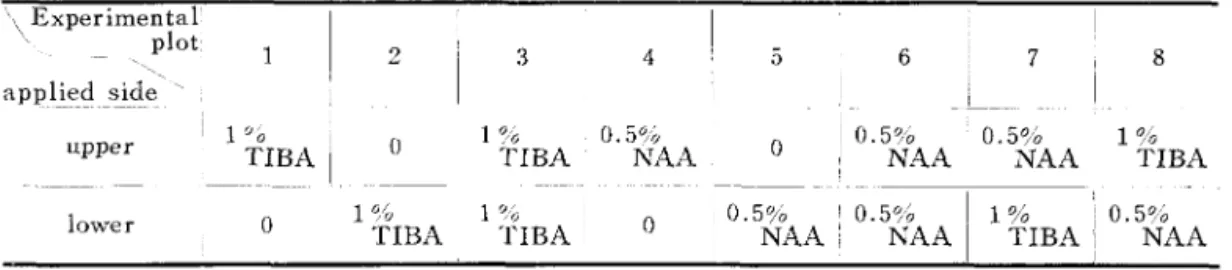
angles. And then, NAA or TIBA were applied as a dispersion in lanolin to
the middle portion of hypocotyles in length of about 2cm, followed out the
scheme indicated in the following table.
Table 1. Scheme of application of plant growth substances to the horizontally placed hypocotyles of Ricinus communis seedlings.
x Experimental' plot:
applied side upper lowe r
For the histological observation transections were obtained from three
points of the applied part, that is, the midpoint, the top edge and the
basal, and were stained with a combination of haematoxylin and safranin.
In addition sections from the mid-point of the horizontal hypocotyles non-
applied were observed as a control.
1 2 3 4 ; i 5 ! 6 j I 7 , 8
1 ‑ 'oT IB A
0 1 % T I B A 0 .5 % N A A ‑ │ 0 .5 % I N A A 0 .5 % N A A 1 %T I B A
0 1 % T IB A
r i B A 0 .5 %N A A 0 .5 %N A A l % T I B A I │ 0 .5 %N A A
Experimental Results
Observations on the intact hypocotyles horizontally fixed.
With the horizontal treatment, cambial activities are accelerated on the
upper side to form tension wood which is remarkably thickened and grows
epitrophically. Anatomically, xylem cells of the upper side are small, thin-
walled, weakly lignified and form mucilaginous layers all over the secondary
walls (Fig. 1-1.M), whereas those of the lower side are somewhat enlarged,
angular, thick-walled and heavily lignifed, lacking the formation of muci- laginous layers (Fig. 1-2. X2).
Observation on the horizontally placed hypocotyles treated -with a
mixture of lanolin and TIBA.
a) The case in which the application was made to the upper sidealone.
On the upper side, the number of layers of xylem cells is conspicuously reduced relative to that in the control, and thus slightly numerous relative
to that on the lower side, showing a retardation of cambial activities on
the applied upper side. The cells extending from one to two layers just
differentiated from cambium at the time of the application are roundish, thin-walled and weakly lignified (Fig. 2-1. r). The cells formed during the application are radially elongated and angular in appearance (Fig. 2-1. X2).
Xylem cells on the lower side are not only small in size but also few in
the number of layers, and are thick-walled compared with the corresponding
ones on the upper side. Therefore, the state of transition from the part
formed before the application to that formed after is not sharply distin- guishable.
At the top edge of the applied part, xylem cells extending from four to five layers, which were differentiated during the application, are densely pitted and angular (Fig. 2-2- t), showing to develop into tracheary elements, whereas those just differentiated at the time of the application are thin-
walled and roundish. On the other hand, in xylem formed at the basal
edge of the applied part, the cells extending from five to seven layers
differentiated after the application are the same in appearance as those
already differentiated before the application and those extending from eight
to nine layers differentiated in succession are thin-walled, enlarged and
radially elongated. Vessel elements are densely distributed in this portion.
Xylem on the lower side corresponding to that formed at the basal edge on
the upper side just mentioned consists of cells which are thin-walled and
radially elongated.
b) The case in which the application was made to the lower side alone.
Xylem formed on the upper side is similar to that of the control in
anatomical features, such as the shape of cells, the number of cell-layers
and the formation of mucilaginous layers, with exception of the reduced
size of cells. On the lower side xylem is composed of conspicuously small
cells, though the number of cell-layers is not different from that of the
control (Fig. 1-2. X2), and thusit is thinner in width than that of the
latter. In xylem formed on the lower side, the cells extending from two
to three layers just differentiated from cambium at the time of the appli- cation are thin-walled, weakly lignified and roundish (Fig. 3-3- r), showing a lot of intercellular spaces among them. These cells as well as ray cells have a lot of srarch grains. The cells differentiated during application are of angular shapes, of various sizes and densely arranged without intercellular
spaces left. Their walls are relatively thick and heavily lignified. A lot of tracheary elements are developed in xylem contiguous to the lateral edges
of the applied part (Fig. 3-4- t) and in xylem formed at the basal edge of
the applied part but not in xylem at the top edge.
c) The case in which the application was made to both upper and lower
sides simultaneously.
Xylem formed on the upper side resembles in general features that on
the upper side of the horizontally placed hypocotyles in which the application of TIBA was made to the same upper side alone, presenting a more remarkable effect of TIBA. Namely, the cells extending from three to four layers just differentiated at the time of application are thin-walled, unlignified and of
round shape with a lot of intercellular spaces left (Fig. 4-1. r). It is
worthy of mention that these cells have a lot of starch grains while the
comparable cells have none in the horizontally placed hypocotyles to which the application of TIBA is made on the upper side alone. The cells succes- sively differentiated during the application are polygonal in appearance and
various in size, being densely arranged without intercellular spaces left
(Fig. 4-1. X2). Xylem formed on the lower side is similar to that on the
corresponding side of the horizontally placed hypocotyles to which TIBA
was applied along the same lower side alone in appearance as well as in
the presence of starch grains.
In xylem laid at the top edge of the applied part on the upper side,
the cells extending from three to four layers contiguous to the area composed of the cells already differentiated before the application are mostly trans-
formed to tracheary elements with heavily thickened and densely pitted
walls (Fig. 4'2. t). The cells successively differentiated form mucilaginous
layers over the secondary walls. At the top edge of the applied part on
the lower side, xylem cells extending from two to three layers, which were
just differentiated from cambium at the time of application, are thin-
walled and roundish, containing a lot of starch grains (Fig. 4-3 or-6. r).
All cells differentiated during the application with the exception of ray
cells, are thick-walled and densely pitted tracheary elements (Fig. 4-3 or-6- t).
In xylem formed at the basal edge of the applied part on the upper
side, the cells extending from three to four layers just differentiated from
cambium at the time of application are not different from those already
differentiated before the application in general situations, but those differ- entiated during the application are radially elongated and enlarged, developing
for the most part into tracheary elements with thickened and densely
pitted walls (Fig. 4-4- t).
In xylem produced at the basal edge of the applied part on the lower
side, the cells extending from two to three layers just differentiated from
cambium at the time of the application are mostly thin-walled, weakly
lignified and have a lot of starch grains, whereas the cells differentiated during the application are thick-walled and polygonal, lacking starch grains.
In this area, moreoover, there are many tracheary elements with densely
pitted walls (Fig. 4-5- t).
Observations on the horizontally placed hypocotyles treated -with a
mixture of lanolin and NAA.
a) The case in which the application was made to the upper side alone.
Compared with the control, xylem is strikingly reduced in the number
of cell-layers on the upper side, suggesting that the cambial activities are
remarkably suppressed through NAA application. Thus, neither the epi-
trophical growth nor the formation of mucilaginous layers occurs. The xylem
cells just differentiated from cambium at the time of application are mostly
thin-walled, unlignified and oblong ovate (Fig. 5-1. r). The cells except
those mentioned above as well as the cells differentiated during the application
are mostly thick-walled and densely pitted tracheary elements (Fig. 5-1. t).
Xylem formed on the lower side is hardly different from that of the
control in the number of cell-layers and in the thickness of walls, apart
;. 4. Transverse section of the stem of Ricinus communis horizontally kept and applied by 1% TIBA to both upper and lower sides.
4-1. Xylem at the mid-point on the applied upper side. Xca.375 4-2. Xylem at the top edge of the applied upper part. Xca.180 4-3. Xylem at the top edge of the applied lower part. Xca.180 4-4- Xylem at the basal edge of the applied upper part. Xca.180 4-5. Xylem at the basal edge of the applied lower part. Xca.180
4-6. Magnification of Fig. 4-3. Xca.375 Other abbreviations as in Figs. 1 and 2.
from dense distribution of vessel elements(Fig. 5-2- X2).
b) The case in which the application was made to the lower side alone.
The number of the cell-layers in xylem is nearly the same on both
upper and lower sides, and is only one half, compared with that of the
control, thus showing that the differentiation of cells is remarkably
inhibited. On the upper side, xylem cells differentiated during the
application are small, thin-walled and weakly lignified, and among them a
large number of vessels are present (Fig. 6-3. X2). On the lower side,
xylem cells extending from one to two layers just differentiated at the time
of application are radially elongated and comparatively thin-walled.
Those differentiated during the application are also radially elongated, but
they have thickened and densely pitted walls, suggesting that they will be
transformed into tracheary elements (Fig. 6-4- t).
c) The case in which the application was made to both upper and lower
sides simultaneously.
Xylem formed on the upper side is composed of a fairly large number
of cell-layers, but the cell-walls are comparatively thin and reduced in
lignification, compared with the xylem on the upper side of the horizontally
placed hypocotyles applied by NAA to the same upper side alone. Vessels
are sparsely distributed.
Xylem formed on the lower side, compared with that on the lower side
to which the application of NAA was made, is composed of nearly the same
number of cell-layers, but surpasses in width, because the cells elongate remarkably in a radial direction. Moreover, the cells differentiated after the
application are for the most part tracheary elements with thickened and
pitted walls, though the cells extending from one to two layers just
differentiated from cambium at the time of application are thin-walled.
Observations on the horizontally placed hypocotyles separately applied
by a mixture of lanolin and NAA and a mixture of lanolin and TIBA
to the opposite sides simultaneously.
a) The case in which NAA was applied to the upper side and TIBA to
the lower side.
Xylem formed on the upper side is nearly the same in the number of
cell-layers as that formed on the upper side of the horizontally placed
hypocotyles to which NAA was applied on the upper side alone, but is
remarkably thickened as a whole. This is due to the fact that the cells
40 Takako Higashimura
extending from four to five layers, which were differentiated at the time
of application, are remarkably elongated in a radial direction. These cells are thin-walled and unlignified, showing a large number of intercellular spaces among them (Fig. 7-1. X2). It is noticeable that they are separated
into groups by intervention of several groups of tracheary elements with
thickened, pitted and lignified walls, and thus the xylem shows alternate
arrangement of two different masses of cells in appearance. The cells
successively differentiated during the application are gradually reduced in
size, with various shapes, and lignified to a very slight extent. Xylem
formed on the lower side is few in the number of cell layers, relative to the
xylem formed on the lower side of the horizontally placed hypocotyles in
which TIBA was applied to the same lower side alone, but is hardly different in thickness from the latter, as a result of radial elongation of cells. The cells from two to three- layers just differentiated from cambium at the time
of application are thin-walled and roundish, and contain no starch
grain. The cells differentiated during the application are various shape and
somewhat radially elongated. Their walls are thickened and heavily
lignified (Fig. 7-2. X2).
b) The case in which TIBA was applied to the upper side and NAA to
the lower side.
Xylem formed on the upper side is not appreciably different in the
number of cell-layers from xylem formed on the upper side of the hori-
zontally placed hypocotyles in which the application of TIBA was made to
the same upper side alone, but is different from the latter in point of
enlargement of cells, and heavy lignification of walls (Fig. 8-3. X2). On
the lower side, xylem is composed of cells markedly elongated in radial
direction in general. Thus the hypocotyles show a hypotrophical growth,
although the layers of xylem cells are fewer in number on the lower side
than on the upper, and grow to the greatest thickness, compared with those
7-1. Transverse section of the stem of Ricinus communis horizontally kept and applied by 0.5% NAA to the upper side and \%TIBA to the lower side
separately, showing xylem on the upper side.
7-2. The same as above, showing xylem on the lower side.
8-3. Transverse section of the stem of Ricinus communis horizontally kept and applied by 1% TIBA to the upper side and 0.5% NAA to the lower side
separately, showing xylem on the upper side.
8-4. The same as above, showing xylem on the lower side.
Other abbreviations as in Figs. 1 and 2. Xca.180
42 Takako Higashimura
in any other case. Xylem formed during the application resembles that
formed on the upper side of the horizontally placed hypocotyles in which
NAA was applied to the upper side and TIBA to the lower side, and most
of the cells extending from three to four layers are oblong ovate, thin-walled and weakly lignified. Other cells than those and the cells differentiated during the application develop into tracheary elements with densely pitted and highly lignified thick walls (Fig. 8-4. X2).
Consideration
In the present experiment, it was observed that the application of NAA
to either the upper side or the lower side of the horizontally placed
hypocotyles had an effect to bring about an increase of tracheary elements
on the applied side. The writer has also found the fact in her earlier
experiment that if NAA was applied at high concentrations to the upper
side of jute axes horizontally placed, the formation of groups of vessel
elements was considerably accelerated on that side (1969). These are facts
consistent with the assumption of Morey and Cronshow (1968) that the
increased formation of tracheary elements is due to the effect of high
concentrations of auxins. It was also observed that almost all cells were
transformed into tracheary elements with thickened and pitted walls in
xylem formed at the boundary between the applied part and the non-applied
on both lateral sides, that is, both lateral portions contiguous along the
applied part, when the application of TIBA was made to the lower side.
The formation of tracheary elements was likewise accelerated in xylem formed
atthe basal edge of the applied part when the application of TIBA was made
to the lower side alone,and at the top edge when it was made to the upper side alone.
The cause may be attributable to an inhibiting effect of TIBA upon
polar movement of auxins, as Niedergang-Kamien and Skoog (1956) have
reported. Namely, it may be considered that as a result of inhibition of
polar movement of auxins by TIBA, auxins become to attain a high level
of concentrations in those areas where the formation of tracheary elements was promoted.
Considered from such a standpoint, the results observed in the case in
which the application of TIBA was made to both upper and lower sides of the horizontal axes, for example, may be interpreted as follows for the time being. Basipetal transport of auxins is in the first place checked by TIBA at each top edge of the applied parts on the upper side and the lower, and thus a level of auxin concentrations is raised up on the upper side as well
as on the lower side, though auxins prevented from, basipetal transport on
the upper side move in part toward the lower side laterally with the force
of gravity. On both lateral sides between the applied upper and lower
sides, on the other hand, auxins are prevented from lateral transport by
TIBA and basipetally transported. At the basal edges of the applied parts on both upper and lower sides, a level of auxin concentrations may be elevated
as the auxins passing over the blockade by TIBA are again prevented in
part from basipetal movement, and thus the development of tracheary
elements may be brought about under the effect of the stagnant auxins.
In connection with the inhibiting effect of TIBA to lateral transport
of auxins, it is known that TIBA has an effect to hinder auxins from
positve transport, but not from diffusional, passive one, and that it counteracts
the effects of auxins (Fuente and Leopold 1968). Therefore, in the hori-
zontally placed hypocotyles in which the upper side was treated with TIBA
and the lower side with NAA, NAA may diffusionally move in part toward
the upper against the force of gravity, but its effect upon xylem tissue
developing on the upper side will be of no valid in consequence of
competition with TIBA.
In the horizontally placed hypocotyles in which TIBA and NAA were just
reversely applied, active transport of auxins along gravitational pull may be
checked through the effect of TIBA applied to the lower side with the
result of an accumulation of auxins on the upper side.
In the present experiment, in cases in which the application of TIBA
alone was made, especially to both upper and lower sides or to the lower
side, it was observed that xylem cells just differentiated from cambium
on the upper side or on the lower side at the time of application contained
a lot of starch grains. This fact seems to suggest that TIBA has a certain
effect on carbohydrate metabolism.
44 Takako Higashimura
References
Brauner, L. and E. Appel. 1960. Zum Problem der Wuchsstoff-Querverschiebung bei der
geotropischen Induktion. Planta 55. 226-234.
Cronshaw, J., and P. R. Morey, 1968- The effect of plant growth substances on the develop- ment of tension wood in horizontally inclined stems of Acer rubrum seedlings. Protoplasma 65,375-391.
Fuente, R. K. de la and A. C. Leopold. 1968. Geotropism and the lateral movement of auxin.
Biochemistry and physiology of plant growth substances. 1129-1143.
Goldsmith, M. H. M. and M. B. Wilkins. 1964. Movement of auxin incoleoptiles of Zea mays during geotropic stimulation. Plant physiol. 39. 151-162.
Hertel, R. and A. C. Leopold. 1963. Auxin relations in geotropism of corn coleoptiles.
Naturwiss. 22. 695-696.
Higashimura, T., 1969. The effect of naphthaleneacetic acid on the epitrophical growJh in horizontally positioned stem of Boehmeria. Bull. Nara Univ. Education 18 No. 2, 45-58.
, 1970. Mutual effect of auxins and 2,3,5-tri-iodobenzoic acid on the development of tension wood in the herbaceous stems horizontally kept. Bull. Nara Univ. Education 19 No. 2, 83-92.
Niedergang-Kamien, E., and F. Skoog, 1956. Studies on polarity and auxin transport in plants 1. Modification of polarity and auxin transport by triiodobenzoic acid. Physiol. Plant. 9, 60-73.
Onaka, F., 1949. Studies on compression and tension wood. Bull. No. 1, Wood Research
Institute, Kyoto Univ., 1-88.
Sato, I., 1956. Studies on the georeaction shown in the axes of some herbaceous plants. Jap.
J. Bot. 15. 249-269.