COVER SHEET
This is the author-version of article published as:
Subrata Mowlick, Takashi Inoue, Toshiaki Takehara, Akiko Tonouchi, Nobuo Kaku, Katsuji Ueki and Atsuko Ueki (2014) Usefulness of Japanese-radish residue in biological soil disinfestation to suppress spinach wilt disease accompanying with proliferation of soil bacteria in the Firmicutes. Crop Protection 61: pp. 64-73.
Accessed from http://repo.lib.yamagata-u.ac.jp/
・YOU Campus Repository System is built to collect, archive and offer electronically academic documents produced by University Consortium Yamagata.
・The copyright and related rights of the article are held by authors or publishers.
・You must require the permission of the copyright owner if you want to use over the curtailment of copyrights.
・Author-version manuscripts may have some differences in layouts and wordings from publisher version.
・ゆうキャンパスリポジトリは、大学コンソーシアムやまがた参加機関で生産された学術文献を電 子的に収集・保存・発信するシステムです。
・論文の著作権は、著者または出版社が保持しています。著作権法で定める権利制限規定を超える 利用については、著作権者に許諾を得てください。
・著者版原稿(Author-version)は出版社版(Publisher-version)との間に、レイアウト、字句校正レベル の異同がある場合があります。予めご了承下さい。
Usefulness of Japanese radish residue in biological soil disinfestation to suppress spinach
wilt disease accompanying with proliferation of soil bacteria in the Firmicutes
Subrata Mowlicka, Takashi Inoueb, Toshiaki Takeharac, Akio Tonouchid, Nobuo Kakua, Katsuji
Uekia, and Atsuko Uekia*
aFaculty of Agriculture, Yamagata University, Yamagata, 997-8555, Japan
bYamaguchi Prefectural Technology Center for Agriculture and Forestry, Yamaguchi, 753-0214,
Japan
cNARO Western Region Agricultural Research Center, Hiroshima, 721-8514, Japan
dFaculty of Agriculture and Life Science, Hirosaki University, Aomori, 036-8561, Japan
*Corresponding author:
Dr. Atsuko Ueki
Faculty of Agriculture, Yamagata University, 1-23, Wakaba-machi, Tsuruoka, Yamagata,
997-8555, Japan. Tel.: +81235282846; Fax: +81235282846
E-mail address: [email protected]
………
Abstract
Biological soil disinfestation (BSD) is an effective method to suppress soil-borne plant diseases
by incorporation of plant biomass into soil under reduced, anoxic condition. Usefulness of
Japanese radish (daikon) residue as plant biomass for BSD was investigated by both model and
field experiments in comparison with the effects of Brassica juncea plants or wheat bran.
Considerable amounts of acetate together with minor amounts of propionate and butyrate were
detected from the radish-treated soils at similar levels with those in soils treated with B. juncea
plants or wheat bran. BSD treatments with radish residue reduced spinach wilt disease incidence
in both model and field experiments. When the BSD-treated soil was treated again with
irrigation and covering without biomass before next cropping, however, wilt disease was hardly
suppressed. Clone library analysis based on 16S rRNA gene sequences was carried out to
determine the changes in the bacterial community compositions in the treated soil samples. The
analyses showed that the bacterial communities in the radish-treated soils were dominated by
members of the classes Clostridia and Bacilli of the phylum Firmicutes in both experiments.
The clostridial groups detected were diverse and the major operational taxonomic units (OTUs)
were closely related to Clostridium saccharobutylicum, Clostridium sufflavum, Clostridium
xylanovorans, and Oxobacter pfennigii, which had been commonly detected as the dominant
groups in BSD-soils treated with B. juncea plants or wheat bran in our previous studies. The
dominant clone groups belonging to the Bacilli class were closely related to several species such
as Bacillus niacini, Bacillus circulans, and Bacillus pycnus. Dominancy of the Bacilli groups
seemed to increase when radish residue was repeatedly applied as BSD material.
Keywords
Anaerobic bacteria; Biological soil disinfestation (BSD); Japanese radish (Daikon); Firmicutes
group; Fusarium oxysporum, Spinach wilt
Abbreviations
BSD, biological soil disinfestation; ITC, isothiocyanate; OTU, operational taxonomic unit;
PCR-DGGE, polymerase chain reaction-denaturing gradient gel electrophoresis; VFAs, volatile
fatty acids.
1. Introduction
Public demands to protect the global environment have stimulated research to reduce the use
of pesticides and to find environmentally friendly and cost effective alternatives for controlling
plant diseases. In this context, biological methods without using chemicals offer attractive ways
to suppress plant pathogens. Biological soil disinfestation (BSD) is a method developed mainly
in the Netherlands (Blok et al., 2000; Messiha et al., 2007) and Japan (Shinmura, 2004; Momma,
2008) as an ecological alternative to chemical fumigation. BSD requires incorporation of plant
biomass into field soil together with excess irrigation water before the start of cropping. The soil
surface is then tightly covered with polythene sheets to maintain anoxic soil condition for about
three weeks (Shinmura, 2000, 2004). Crops can be cultivated after this period upon removal of
the sheets and plowing of soil. It has generally been thought that bioactive substances released
from plant biomass incorporated into soil as well as various compounds produced by microbes
in soil during decomposition of plants synergistically suppress soilborne plant pathogens.
Among plant biomass sources, the Brassicaceae plants have been used as promising BSD
materials or biofumigants (Sarwar and Kirkegaard, 1998; Goud et al., 2004). Most of the
Brassicaceae plants may release isothiocyanates (ITCs), substances that are toxic to soilborne
pests and pathogens, by the myrosinase activity to hydrolyse glucosinolates commonly present
in the Brassicaceae plant tissues (Sawar and Kirkegaard, 1998; Fahey et al., 2001).
Spinach (Spinacia oleracea L.) is an important vegetable crop in many countries that is
mainly cultivated from seed sowing. In case of direct seed sowing, BSD seems to be more
advantageous as seeds sown in the field may often be prone to attack by a number of soilborne
diseases during their establishment. Spinach cultivation is greatly hampered by many fungal
soilborne diseases. Fusarium wilt caused by Fusarium oxysporum f. sp. spinaciae has been
reported as the most serious disease of spinach in Japan (Muslim et al., 2003; Horinouchi et al.,
2010). The disease causes damping-off, wilting, root rot, vascular discoloration, and death of
seedlings as well as mature spinach plants (Hungerford, 1923; Larsson and Gerhardson, 1992).
In our previous studies with BSD treatments using model experiments (Mowlick et al.,
2012; 2013a), Brassica juncea plants, a species of the Brassicaceae, as well as wheat bran and
Avena sativa plants were incorporated into soil to determine the effects on pathogenic
suppression and soil bacterial community development. The BSD treatments successfully
controlled populations of the pathogens F. oxysporum f. sp. lycopersici (wilt pathogen of
tomato) and F. oxysporum f. sp. spinaciae (wilt pathogen of spinach). Furthermore, B. juncea
plants were effectively used in field experiments as BSD material to combat spinach wilt
(Mowlick et al., 2013c). Using molecular analyses such as polymerase chain
reaction-denaturing gradient gel electrophoresis (PCR-DGGE) and clone library methods based
on 16S rRNA gene sequences, we observed that bacterial communities in these BSD-treated soil
samples were greatly changed and anaerobic groups, especially in the class Clostridia of the
phylum Firmicutes, became major bacterial groups in the communities together with some other
aerobic or facultatively anaerobic bacteria in the classes Bacilli and Gammaproteobacteria. It
seemed that the activities of these bacterial groups that proliferated in BSD-treated soil strongly
affected the survival and growth of pathogens in the soil.
In this study, we intended to determine the efficacy of plant biomass from the family
Brassicaceae when incorporated into soil as BSD material. Radish (Raphanus sativus L.),
belonging to the family Brassicaceae, is an important vegetable crop in the world that is
consumed in China, India, Japan, Korea, the European countries, and America as raw (salad),
cooked, brined and fermented (pickled), and dried forms. In Japan, many varieties of R. sativus
have been widely cultivated. Especially, Japanese radish (R. sativus var. longipinnatus),
commonly known as “daikon” in Japanese (that is, “large root”) is cultivated all over Japan as
one of the most popular vegetables with high production. A daikon plant develops a white thick
root (composed of a hypocotyl and a main root, 20-35 cm long and about 7-8 cm in diameter)
and radical leaves (about 20 pinnate compound leaves with more than 50 cm long rachis).
Young leaves of daikon are also cooked as a brightly-colored, nourishing vegetable however,
the roots are mainly used in various popular foods (Morgan and Midmore, 2003). As a
Brassicaceous crop, daikon plants or their products also contain glucosinolates or ITCs (Diana
et al., 1985; Okano et al., 1990). In fact, grated raw roots of daikon, called “hot daikon” in Japan,
have a very hot or pungent taste. Due to larger size of the roots and leaves, a vast amount of
radish products can be obtained every year in Japan. Thus, a lot of radish residue is wasted after
collecting marketable plants from the fields. Furthermore, most of the leaves of grown daikon
are usually discarded during harvesting and transportation. Hence, the radish plants seem to be
very promising as material for BSD treatments and may have greater possibilities to be used in
controlling soilborne diseases. Besides, the availability of radish seeds in the market, the ease of
growing radish, and the rapid growth of radish plants may increase the potential of using radish
biomass as BSD material.
The objective of this research was to determine the usefulness of Japanese-radish (daikon)
residues as BSD treatments in suppressing spinach wilt disease in model and field experiments.
Changes in soil bacterial community composition due to radish incorporation were also
investigated by clone library analysis. Furthermore, repetition of BSD treatment in the same
fields was also investigated to evaluate the persistence of BSD effects on spinach wilt and soil
bacterial community structures.
2. Materials and methods
2.1. A model experiment of BSD using pots and plastic bags
A model experiment of BSD using both pots and closed plastic bags was conducted in
Agricultural Research Centre, Yamaguchi, Japan (34.9oN, 131.3oE) during 2010. A total of five
treatments were assigned in this experiment using a completely randomized design with four
replications. Soil group was gray lowland (sandy loam). Roots of daikon (cv. Yakushakoiki), as
well as B. juncea plants and wheat bran were used as BSD material, and the effects on
suppression of wilt disease of spinach were compared. Fresh daikon (radish) roots were broken
into pieces (about 1 cm3) with a food processor and B. juncea plants harvested before the
flowering stage were cut into pieces (about 1 cm) with a cutter before application. Radish roots,
B. juncea plants, and wheat bran were applied to soil at the rates of 10, 5, and 2 kg/m2,
respectively. For control treatment, no plant biomass was incorporated into soil. F. oxysporum f.
sp spinaciae YSF-1 (wilt pathogen of spinach) cultivated in Komada’s Fusarium-selective
medium (Komada, 1975) was incorporated into soil at about 104 CFU/g of dry soil.
Pots (16.0-17.5 cm in diameter or 0.02 m2 with 19.8 cm in height, four pots for each
treatment) were filled with each treated soil (working volume 3.3 L) prepared as described
above and the soil was irrigated. The amount of water for irrigation (the ratio of soil and water,
4.3:1.2) was determined based on our previous BSD field experiments (Mowlick et al., 2013c).
Each pot was kept airtight throughout the treatment by covering with a double layer of
transparent sheets with low gas permeability (Barrier Star film, TOKANKOUSAN Co. LTD;
Sky Coat film, C.I. KASEI Co. LTD). The pots were placed in a greenhouse (2 June) without
disturbance during the treatment in ambient temperature. The sheets were removed after three
weeks and the pots were kept open to dry the soil. Thereafter, the pots were prepared for
cropping and spinach (cv. Summer Top) was seeded (9 July) in all pots (15 seeds/pot) placed in
the same greenhouse. Spinach was also seeded in pots filled with original soil, without any
treatment but inoculated with the pathogen. After seedlings emergence, the pots were inspected
regularly and intercultural operations such as watering, weeding and insect control were done
when necessary following common agricultural practices in the area. Wilt disease incidence was
recorded in all pots after a month (6 August). Temperature in pot soil was recorded by a data
logger (Ondotori, T&D Corp.) during the soil treatment.
Plastic bags (17 cm × 11 cm × 3.3 cm) were used for sampling of soil during the BSD
treatments under the same conditions. Each bag was filled with soil (430 g), treated in the same
way as for pot soil as described above, watered (120 mL), and sealed tightly to create anoxic
conditions in the bag. The treated bags were placed in the same greenhouse at the same time as
the pots (2 June). The bags were opened (one for each condition) and soil was sampled at
weekly intervals for four weeks in all treatments. Soil samples collected were kept in a freezer
(-20oC) immediately after the sampling and preserved there until use. The bags once opened and
used for soil sampling were discarded and other bags incubated under the same treatment
conditions without opening were used for the next sampling.
2.2. A BSD experiment in a field greenhouse using radish residue
A BSD experiment using radish residue was carried out in a greenhouse located in a
research field at the Agricultural Research Centre, Yamaguchi, Japan. The soil was gray lowland
soil (sandy loam) and the size of each treatment plot was 1.5 × 5.5 m2 distributed in a
randomized complete block design with three replications. Spinach had been continuously
cultivated in the greenhouse and natural infection of spinach by Fusarium wilt disease had
occurred. Nonmarketable roots of daikon (cv. Natsutsukasa) were collected from a vegetable
sorting house before shipping. Most of the above ground parts (leaves) were usually removed
and discarded before collection of radish roots from fields. But the bottom (about 20 cm) of
rachises of compound leaves was left on each root. Therefore, the above ground parts were also
used as BSD material. The radish residue collected was broken into pieces by a hammer knife
mower and incorporated into soil (about 15-20 cm depth) by a rotary tractor at a rate of 20
kg/m2. The soil in the greenhouse was treated three times by BSD and spinach was cultivated
after each treatment during 2009-2010 as described below. The plot names were designated
according to the name of the place (Yamaguchi), control or types of biomass (C, Control; R,
Radish; B, Brassica/Mustard; Ba, Brassica/Azamina).
1) The first treatment: For the first BSD treatment and cropping of spinach, radish residue
was applied as described above together with enough irrigation water (more than 80-100 L/m2)
and the soil surface was covered with sheets (16 September 2009) (YR plot). As the control
treatment (Control 1), soil was irrigated with the same amount of water and covered with sheets
without biomass incorporation. The greenhouse was closed during the treatment to maintain
ambient temperature and humidity. After three weeks (7 October 2009), the sheets were
removed and the treated plots were dried and plowed. Spinach (cv. Trad) was seeded using a
seeding machine (Gonbe, Mukai Kogyo Inc.) with an inter-row spacing of 10 cm and intra-row
spacing of 16 cm resulting in 63 plants/m2 (14 October 2009). Plants were watered as needed
(about 10 minutes in the morning). Weeds were pulled by hand until two weeks after seeding
and insect pests were mainly controlled using insect screens (4-mm mesh size) set at all
openings of the greenhouse. Insecticides were used when need arose. Occurrence of wilt disease
was monitored during growth of the plants and yields were recorded after about a month (17
November).
2) The second treatment: The YR plot in the first treatment was divided into four plots for
the second treatment. Since production of daikon in this district is generally decreased from
January to May, it was difficult to obtain enough amounts of radish residue for the next BSD
treatments. Therefore, two different varieties of B. juncea, that is, B. juncea var. cernua
(Mustard greens) and B. juncea var. crispifolia (Azamina, one of the green vegetables
commonly cultivated in this district) were cultivated after the first cropping of spinach (from 30
November 2009). After about four months of cultivation (8 April 2010), the Brassica plants
were used as BSD material in the second treatment. Both Brassica plants harvested were cut
into pieces by a hammer knife mower and immediately incorporated into the plots (YRB for
Mustard greens and YRBa for Azamina, respectively) with a rotary tractor at the rate of 9.6
kg/m2. After irrigation, the soil surface was covered with sheets as described above. For YRC
plots, both cultivated Brassica plants were removed after harvest without incorporation into soil
(YRC-B for Mustard greens cultivated plot and YRC-Ba for Azamina cultivated plot). Control 1
plot of the first treatment was used for the second control treatment (Control 2) and Brassica
plants were also cultivated after spinach cultivation, but the plants were removed in the same
way as those for YRC plots. Soil samples were collected from all plots after 3 weeks (30 April
2010). For each soil sample, 100 g of soil was obtained from the upper 10 cm soil depth in
triplicate and preserved in a similar way as described for the model experiment. Spinach (cv.
Active) was seeded and cultivated (10 May-17 June) in the treated plots in a similar way as
mentioned above.
3) The third treatment: After spinach cultivation in the YRB and YRBa plots, soil was again
treated with radish residue and sheet-covering as the third treatment (YRBR and YRBaR),
respectively (25 June). In case of other treatments (Control 3, YRCC-B, and YRCC-Ba), the soil
was irrigated without biomass incorporation and covered. Soil samples were also collected from
the plots after three weeks of treatment (16 July). Spinach (cv. Summer Top) was cultivated (22
July-9 September) in these treated plots. The second and third treatments as well as cropping of
spinach were carried out in parallel with the field experiment (Exp. 2) described previously
(Mowlick et al., 2013c).
Pellet-type organic fertilizer containing fish meal (Kumiai Ube Yuki 100: N, 70 g/kg; P2O5,
40 g/kg; K2O, 10 g/kg) (MC FERTICOM, Co., LTD) was used as preplanting fertilizer to supply
nitrogen (20 g/m2) in each plot. The amounts of fertilizer applied were determined based on the
nitrogen content measured by the microdiffusion method using samples extracted from each plot
with 2 M KCl. Additional fertilizer was not applied throughout the cultivation. The soil and air
temperatures inside the greenhouse during the treatments were recorded by data loggers. For all
plots, natural wilt disease incidence was recorded based on the observation of plants in 10
different locations (each measuring 0.1 × 1 m2) in each plot during the cultivation and fresh
marketable yields (g/m2) were determined by the weights of plants harvested at the end of
cultivation for the same area.
2.3. Determination of volatile fatty acids (VFAs) concentrations in soil
The concentrations of volatile fatty acids (VFAs) in the soil samples collected were
measured by gas chromatography (Hitachi G-3900) as described previously (Mowlick et al.,
2012; 2013c).
2.4. DNA extraction, PCR amplification, and clone library analysis
All procedures were conducted as described previously (Mowlick et al., 2013c). For soil
DNA extraction, each composite sample (3 g) from triplicate soil samples was used following
the instruction of ‘Ultra CleanTM Soil DNA Isolation Kit’. PCR amplification of bacterial 16S rRNA genes was done using a primer set B27f (5'-AGA GTT TGA TYM TGG CTC AG-3') and
U1492r (5'-GGY TAC CTT GTT ACG ACT T -3').
Molecular clone library analyses (Maidak et al., 1999) based on 16S rRNA gene sequences
were carried out to determine the bacterial community compositions in the soil samples as
described previously (Mowlick et al., 2013a). Nucleotide sequencing (about 600 bp) was carried
out for a total of 96 clones using a sequence primer U515f (5' GTG YCA GCM GCC GCG
GTAA-3') according to the Dye Terminator method (capillary sequencer at Takara Co. Ltd.).
2.5. Data analysis
Disease incidence and yield data were analyzed using MSTAT-C statistical software (Nissen,
1983) and mean separation was conducted according to Duncan’s multiple range test (DMRT).
Database searches for related 16S rRNA gene sequences were carried out with the BLAST
program and GenBank database (Altschul et al., 1997). The ClustalW program of DDBJ was
used to align the nucleotide sequences of the clone libraries. Phylogenetic trees were made
using the neighbor-joining method (Saitou and Nei, 1987) with the Njplot program in the
ClustalW package (Thompson et al., 1994). Construction of OTUs (operational taxonomic unit
at 97% similarity level), bootstrap resampling analysis, chimera checking, and rarefaction
analysis were carried out as described previously (Mowlick et al., 2013c). Coverage of the clone
libraries including the diversity indexes was calculated using an online biodiversity calculator
(http://www.alyoung.com/labs/biodiversity_calculator.html).
2.6. Accession numbers of nucleotide sequence
The nucleotide sequences obtained from the clone library analyses have been deposited in
DDBJ/GenBank under the accession numbers AB745762-AB746033 (271 entries) for the model
experiment and AB744468-AB744648 (180 entries) for the greenhouse experiment.
3. Results
3.1. The model experiment
3.1.1. Soil status during treatment
Soil temperature in the pots changed with large diurnal changes, and the average, maximum,
and minimum temperatures during the treatments were 27.3oC, 39.4oC (in the daytime), and
19.7oC (in the night), respectively. The cumulative soil temperature was 573oC. Changes in
concentrations of VFAs in the treated soil were determined by using the soil samples collected
from the closed bags (Fig. 1). No VFAs were detected from the original soil as well as the
control soil throughout the treatment. Considerable amounts of VFAs were detected from all
BSD-treated soil samples. Acetate was the major component followed by butyrate and
propionate for most of the treated soils, and the amounts detected were comparatively higher
during the three weeks of treatments than other incubation periods. The changes in the
concentrations of VFAs in the radish-treated soil showed a similar pattern as those in the
Brassica-treated soil with the highest concentrations of acetate at about 13-14 mmolL-1.
Butyrate was detected at a higher concentration in case of wheat bran-treated soil (up to 22
mmolL-1).
3.1.2. Effects on spinach wilt disease of BSD using radish in pot soil
Spinach was cultivated in the treated pot soil and wilt disease incidence was determined. All
spinach plants were affected by the disease (100% incidence) in both original and control pots,
whereas all BSD-treatments reduced the incidence to 15-32% (Table 1). Radish biomass was
determined to be as effective BSD material for suppression of spinach wilt as Brassica- and
wheat bran-treatments.
3.1.3. Bacterial community structures based on clone library analysis
The bacterial community compositions in soil during the treatments were subjected to clone
library analysis using the soil samples collected from the closed bags at one week of the
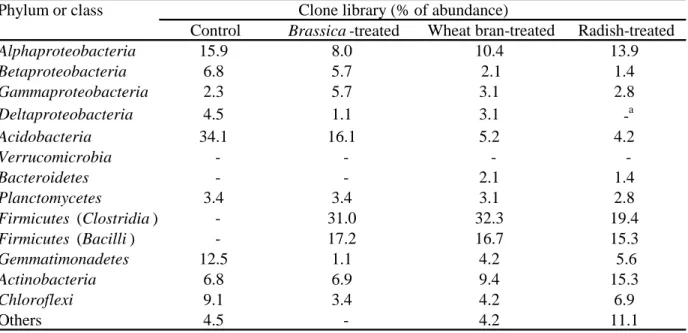
treatments. Table 2 shows the phylogenetic affiliations of the clones from these soil samples
based on percentages of abundance. The clone library for the control soil (without biomass
incorporation) consisted of diverse bacterial groups allocated mainly to the phyla Acidobacteria
(about 34% of the total number of clones) and Proteobacteria (30%). On the other hand, the
library of radish-treated soil sample showed substantial differences as compared with the control
library and contained members of the Firmicutes phylum (at similar ratios of those in the
Clostridia and Bacilli) as the dominant and major groups in the community. The most dominant
clone groups belonging to the Firmicutes phylum from this BSD library were closely related to
Clostridium saccharobutylicum (8 clones, 95-99% sequence similarity with the closest one) and
Bacillus niacini (10 clones, 99-100%). Other phylogenetic groups of this library detected were
from the phyla Proteobacteria, Actinobacteria, and Chloroflexi. For other two BSD libraries
(Brassica- and wheat bran-treated soil), members of the Firmicutes phylum including both the
classes Clostridia and Bacilli were also dominant groups in the communities in consistence with
our previous studies using these BSD materials (Mowlick et al., 2012, 2013a,b,c). Thus, it was
shown that radish residue brought about similar changes in the soil bacterial community as those
brought about by Brassica plants or wheat bran biomass.
3.2. The field experiment
3.2.1. Temperature and soil status
For the first treatment, air temperature in the greenhouse was monitored. The average,
minimum, and maximum temperatures were 33.1, 21.4, and 44.8oC, respectively. The average
air (in the greenhouse) and soil (10 cm depth) temperatures during the second treatment were
18.1 and 21.7oC, respectively, with great daily fluctuations (the cumulative soil temperature,
442oC). For the third treatment, the average air temperature was 30.7 and the soil temperature
(10 cm depth) was 35.7oC (the cumulative soil temperature, 750oC). VFAs concentrations were
determined for the soil samples obtained at the ends of the second and the third treatments
(Table 3). No VFAs were detected in Control 2 and 3 plots. All BSD-treated soils contained
considerable amounts of VFAs (acetate as the major VFA followed by butyrate and propionate
as minor components). Almost the same concentrations of VFAs were detected from both soil
samples of YRB and YRBa as well as YRBR and YRBaR. The amounts of acetate and butyrate
were almost more than double in the third BSD treatments by radish incorporation as compared
with those in the second treatments using Brassica plants. When the nitrogen contents in field
soil immediately after the radish-treatments were measured to determine the application amount
of fertilizer, it appeared that the soil contained more than 15 g/m2 of nitrogen (mainly
ammonium nitrogen) (data not shown), which was enough for the next spinach cropping without
application of the fertilizer.
3.2.2. Wilt disease incidence and yield of spinach
For the first treatment, severe spinach wilt disease did not occur even in the control plot, but
radish-BSD resulted in complete suppression of the disease (Table 4). For the second cropping,
the incidence of wilt in the control plot increased significantly (44.5%) and it was also rather
high for YRC plots (YRC-B and YRC-Ba), although the levels were lower than that of Control 2
plot. BSD treatments with incorporation of B. juncea plants (YRB and YRBa) remarkably
reduced spinach wilt (3-6% incidence) and large amounts of marketable products (4000-4800
g/m2 yield) were obtained from these plots. As for the third cropping, severe wilt disease broke
out in the three plots without biomass incorporation (Control 3, YRCC-B, and YRCC-Ba). In
the case of BSD-treated soil using radish residue, wilt incidence was rather low, especially for
the YRBR plot. Spinach yields were higher in both BSD plots (YRBR and YRBaR) as
compared with those of the three plots without biomass incorporation. Thus, the BSD plots
without biomass incorporation hardly suppressed the outbreak of spinach wilt in the next
cropping. It was also shown that repetition of irrigation without biomass incorporation (Control
2 and Control 3) had no effect on disease suppression.
3.2.3. Clone library analysis for the radish biomass-treated soil samples
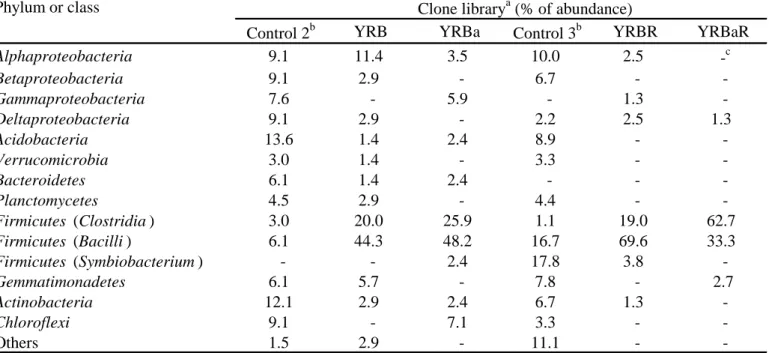
Out of the soil samples obtained, six samples were used for analysis of bacterial community
compositions (Table 5). The clone library Control 2 showed much diversified populations of
various phylogenetic groups from the phyla Proteobacteria, Acidobacteria, Actinobacteria,
Chloroflexi, and others. For the BSD clone library YRB, members of the phylum Firmicutes
especially from the class Bacilli (44%) were exceedingly dominant with 20% from the
Clostridia. Besides, the clone library YRBa showed the clones belonging to the Bacilli (48%)
and Clostridia (26%) almost at a similar ratio as detected in the library YRB. The phylogenetic
trees for the YRB and YRBa clone libraries (Fig. 2A, B) showed a similar type of closely related
species of the dominant clone groups from the Clostridia and Bacilli with some exceptions. The
dominant clostridial groups were closely related to C. saccharobutylicum, Clostridium
xylanovorans, and Oxobacter pfennigii, whereas those related to B. niacini, Bacillus circulans,
and Bacillus pycnus were from the class Bacilli.
In the clone library Control 3, diversified bacterial populations were also detected, but some
changes were observed in the “Symbiobacterium” clade and the Bacilli class in the Firmicutes
as well as in the phyla Acidobacteria or Bacteroidetes in comparison with those in Control 2.
When BSD was repeated by radish incorporation (the clone library YRBR), the ratio of clones
from the Bacilli was much higher (70%) as compared with that of the Clostridia (19%). The
phylogenetic tree for the clone library YRBR (Fig. 3A) demonstrated that dominant clone
clusters were related with B. pycnus, B. niacini, and Paenibacillus ruminocola from the class
Bacilli as well as C. saccharobutylicum, C. xylanovorans, and Clostridium sufflavum from the
Clostridia. For the clone library YRBaR, almost all members in the library were from the
classes Clostridia (63%) and Bacilli (33%). The phylogenetic tree for the YRBaR clone library
(Fig. 3B) showed an exceeding proliferation of clone groups related to C. saccharobutylicum, C.
xylanovorans, and Thermoanaerobacterium saccharolyticum from the Clostidia as well as B.
niacini, B. circulans, and B. pycnus from the Bacilli.
3.2.4. Bacterial diversity of the clone libraries
Rarefaction analysis based on OTU clustering (Fig. 4) showed that the curves for the control
soils (Control 2 and 3) were far from saturation with lower coverage values. The curves for
YRB and YRBa overlapped, whereas those for the YRBR and YRBaR libraries seemed to reach
near the plateau. The number of OTUs (at 97% similarity) declined greatly for the clone
libraries YRBR and YRBaR as compared with those of the YRB and YRBa libraries (Table 6).
The estimates of diversity in the communities demonstrated that radish biomass incorporation in
the repeated BSD decreased bacterial diversity in soil.
4. Discussion
Addition of various radish biomass in soil has been reported to reduce soilborne diseases of
onion, potato, celery, and other solanaceous vegetables together with increase in crop yields
(Larkin and Griffin, 2007; Justo et al., 2008, Anita, 2012). In this study radish biomass
incorporation greatly suppressed spinach wilt in both model and greenhouse experiments
indicating that Japanese radish was an effective biomass in suppressing the disease. Harmful
effects of radish incorporation on growth of spinach were not observed throughout the
experiments from every possible aspect. Furthermore, it was shown that incorporation of radish
into soil also input nutrients necessary for growth of plants at least in the next cropping.
In addition to the experiments presented here, we have carried out many BSD experiments
in greenhouses. The results obtained suggested that if the cumulative time of soil temperature
(10 cm depth) at higher than 30oC reached more than 250-280 hours during the treatments, it
was very promising to succeed in suppression of soil pathogens. It was also indicated that soil
temperature higher than 40oC (200 hours of cumulative time) by solarization effects should
enhance suppression of pathogens. Concerning the field experiments in this study, soil
temperature for the third cropping kept higher than 30oC for most of the period of treatment
(cumulative time of more than 350 hours). For the first cropping, soil temperature might be
changed similarly judging from the air temperature. Meanwhile, for the second cropping,
although the soil temperature was lower than 30oC for most of the period and the cumulative
soil temperature was much lower than that of the third cropping, the BSD treatment suppressed
wilt disease effectively. The results indicate that although it is desirable to keep high soil
temperature to succeed in BSD, the method is also applicable even during colder periods with
appropriate treatments to establish sufficient reduced condition in soil.
Goud et al. (2004) found that the suppressive effect of BSD was maintained for several years
to control verticillium wilt disease of perennial crops. However, most plants may be more
sensitive to soilborne pathogens at the seedling stage. When radish-treated field was again
irrigated without biomass incorporation, the plots showed higher disease incidence in a similar
way as observed in the control plots indicating that radish biomass should be incorporated
before every spinach cropping for effective suppression of wilt disease. Our study showed that
yield of spinach was also increased by radish incorporation in soil probably due to effective
suppression of wilt disease in consistence with our previous research (Mowlick et al., 2013c)
where yields of spinach were increased markedly by BSD treatments. High temperature during
the third cropping season might increase the disease incidence as a whole.
Radish residue incorporation resulted in accumulation of considerable amounts of VFAs in
soil, especially of acetate in all conditions. Production of VFAs such as acetate and butyrate in
soil are reported as an important aspect of BSD (Momma et al., 2006; Katase et al., 2009),
which is associated with proliferation of anaerobic fermentative bacteria in soil. Actually, a
number of anaerobic bacterial species including clostridial groups were detected as the closest
relatives for the clones from the radish-treated soils in both experiments. These results agreed
well with our previous reports mentioned above where high concentrations of VFAs in various
BSD-treated soils were detected in both model and field experiments.
All control libraries so far examined by us were shown to harbor diversified bacterial
communities of various phylogenetic taxa, whereas the radish-treated as well as other BSD
libraries showed an extraordinary development of clones belonging to the phylum Firmicutes.
Bacterial groups under the class Bacilli of the phylum Firmicutes were detected as the dominant
groups for all clone libraries of BSD with radish incorporation. As compared with the ratios of
the Bacilli groups in the Brassica plants-treated soil (Mowlick et al., 2013c), it was revealed that
these groups were proliferated by the repeated incorporation of radish biomass. Especially for
YRBR, repetition of radish incorporation to the YRB soils seemed to enhance remarkable
proliferation of the Bacilli groups, and closely related to B. niacini, B. circulans, B. pycnus, and
P. ruminocola. Bacillus species are recognized as biocontrol agents that kill soilborne pathogens
by synthesizing different kinds of antibiotics and enzymes, as well as by their longer survival due
to their ability to form endospores (Emmert et al., 1999; Wang et al., 2002; Lee et al., 2006;
Hariprasad et al., 2011). Bacillus species have also been reported to reduce plant disease
incidence by competition, growth promotion and induction of resistance (Cawoy et al., 2011).
Therefore, although they are basically aerobic or facultatively anaerobic, proliferation of Bacilli
groups might play some roles in the suppression of spinach wilt during BSD treatments.
Although clostridial groups were relatively lower in percentages in radish-treated soils
(except YRBaR), similar types of clostridial species were also found as the closest relatives in
radish-treated soil, especially for the library YRBaR, as those detected in the Brassica- or wheat
bran-treated soils in the present study as well as in our previous research (Mowlick et al., 2012,
2013a,c). Clone groups related to C. saccharobutylicum, C. sufflavum, and C. xylanovorans
recognized in most of the BSD-treated soils in our previous work were also detected as major
groups in the radish-treated clone libraries. These clostridial species are known to form various
products including VFAs, alcohols or other compounds such as indole or skatole during
decomposition of biomass (Macfarlane and Macfarlane, 1995; Rainey et al., 2009; Wiegel,
2009). The high concentrations of VFAs detected in these soils also indicated proliferation of
clostridial groups in these field soils, suggesting their important roles in disease suppression in
radish-treated soil in practice.
The estimates of diversity indicated a high diversity in the soil bacterial communities after
BSD with Brassica incorporation in our previous study (Mowlick et al., 2013c), whereas radish
incorporation decreased the diversity in this study probably due to proliferation of less diverse
Bacilli groups. Especially for YRBR, bacterial diversity decreased remarkably as the ratios of
the Bacilli increased. The results indicated that the Bacilli rather than the Clostridia reduced the
overall diversity in radish-treated soil.
In this study, usefulness of radish residue for BSD treatment was observed clearly as spinach
wilt was suppressed both in the pots and field greenhouse. Thus, radish residue can be used as
BSD material for the suppression of plant pathogens in a similar manner as for other plant
biomass sources like B. juncea or wheat bran. The exact mechanism of suppression of soil
pathogens by BSD has not been elucidated. As a further study, it may be necessary to compare
the type and content of glucosinolates in radish residue used in this study with those of B. juncea
plants. The abundance of populations in the Firmicutes, especially in the Bacilli, was greatly
increased by radish biomass incorporation. Bacterial groups from both the Bacilli and Clostridia
might have important roles in suppressing spinach wilt. We have isolated many strains in the
Clostridia and the Bacilli from BSD-treated soil. We are now examining their physiological
characteristics to clarify the effects of these bacteria on survival or growth of spinach wilt
pathogen and to determine their functions in suppression of soilborne plant diseases.
Furthermore, changes in fungal communities in soil after BSD treatments should be examined in
future to determine the comprehensive effects of BSD on soil microbial communities.
Acknowledgments
A portion of this investigation was supported by a grant from the Ministry of Agriculture,
Forestry and Fisheries of Japan (Development of mitigation and adaptation techniques to global
warming in the sectors of agriculture, forestry, and fisheries, No. 34200). The authors wish to
thank Ms Y. Ohtaki for her technical assistance.
References
Altschul, S.F., Madden, T.L., Schäffer, A.A., Zhang, J., Zhang, Z., Miller, W., Lipman, D.J.,
1997. Gapped BLAST and PSI-BLAST: a new generation of protein database search
programs. Nucleic Acids Res. 25, 3389-3402.
Anita, B., 2012. Crucifer vegetable leaf wastes as biofumigants for the management of root knot
nematode (Meloidogyne hapla) in celery (Apium graveolens L.). J. Biopest 5, 111-114.
Blok, W.J., Lamers, J.G., Termorshuizen, A.J., Bollen, G.J., 2000. Control of soil-borne plant
pathogens by incorporating fresh organic amendments followed by tarping. Phytopathology
90, 253-259.
Cawoy, H., Bettiol, W., Fickers P., Ongena, M., 2011. Bacillus-Based Biological Control of Plant
Diseases, Pesticides in the Modern World -Pesticides Use and Management, Dr. Margarita
(Ed.), ISBN: 978-953-307-459-7 (http://www.intechopen.com/books/pesticides).
Diana, G.C., Daxenbichler, M.E., and VanEtten, C.H., 1985. Glucosinolates in Radish
Cultivars.
J. Amer. Soc. Hart. Sci. 110, 634-638.
Emmert, E.A.B., Handelsman, J., 1999. Biocontrol of plant disease: A (Gram-) positive
perspective. FEMS Microbiol. Lett. 171, 1-9.
Fahey, J.W., Zalcmann, A.T., Talalay, P., 2001. The chemical diversity and distribution of
glucosinolates and isothiocyanates among plants. Phytochemistry 56, 5-51.
Goud, J.K.C., Termorshuizen, A.J., Blok, W.J., van Bruggen, A.H.C., 2004. Long-term effect of
biological soil disinfestation on Verticillium wilt. Plant Dis. 88, 688-694.
Hariprasad, P., Divakara, S.R., Niranjana, S.R., 2011. Isolation and characterization of
chitinolytic rhizobacteria for the management of Fusarium wilt in tomato. Crop Prot. 30,
1606-1612.
Horinouchi, H., Muslim, A., Hyakumachi, M., 2010. Biocontrol of fusarium wilt of spinach by
the plant growth promoting fungus Fusarium equiseti gf183. J. Plant Pathol. 92, 249-254.
Hungerford, C.W., 1923. A Fusarium wilt of spinach. Phytopathology 13, 205-209.
Justo, V.P., Kirkegaard, J., Akiew, S., Bayot, R, Zorilla, R., Lando, L.A., Abragan, F., Dangan,
J.J.G., 2008. Farmers experiences on biofumigation for bacterial wilt management in
solanaceous crops in southern Philippines. Paper presented at the 3rd international
biofumigation symposium at CSIRO discovery centre, Canberra on 21-25 July.
Katase, M., Kubo, C., Ushio, S., Ootsuka, E., Takeuchi, T., Mizukubo, T., 2009. Nematicidal
activity of volatile fatty acids generated from wheat bran in reductive soil disinfestation.
Nematol. Res. 39, 53-62.
Komada, H., 1975. Development of a selective medium for quantitative isolation of Fusarium
oxysporum from natural soil. Rev. Plant Prot. Res. 8, 114-125.
Larkin, R.P., Griffin, T.S., 2007. Control of soil-borne potato diseases using Brassica green
manures. Crop Prot. 26, 1067-1077.
Larsson, M., and Gerhardson, B., 1992. Disease progression and yield losses from roots diseases
caused by soilborne pathogens of spinach. Phytopathology 82, 403-406.
Lee, J.P., Lee, S.W., Kim, C.S., Son, J.H., Song, J.H., Lee, K.Y., Kim, H.J., Jung, S.J.,
Moon, B.J., 2006. Evaluation of formulations of Bacillus licheniformis for the
biological control of tomato gray mold caused by Botrytis cinerea. Biol. Control 37,
329-337.
Macfarlane, J., Macfarlane, G.T., 1995. Proteolysis and amino acid fermentation, in: Gibson, .R.,
Macfarlane, G.T., (Eds.), Human colonic bacteria. CRC Press, New York, pp. 75-100.
Maidak, B.L., Cole, J.R., Parker, C.T.Jr., Garrity, G.M., Larsen, N., Li, B., Lilbum, T.G.,
McCaughey, M.J., Olsen, G.J., Overbeek, R., Pramanik, S., Schmidt, T.M., Tiedje, J.M.,
Woese, C.R., 1999. A new version of the RDP (Ribosomal Database Project). Nucleic Acids
Res. 27, 171-173.
Messiha, N.A.S., van Diepeningen, A.D., Wenneker, M., van Beuningen, A.R., Janse, J.D.,
Coenen, T.G.C., Termorshuizen, A.J., van Bruggen, A.H.C., Blok, W.J., 2007. Biological soil
disinfestation (BSD), a new control method for potato brown rot, caused by Ralstonia
solanacearum race 3 biovar 2. Eur. J. Plant Pathol. 117, 403-415.
Momma, N., 2008. Biological soil disinfestation (BSD) of soil-borne pathogens and its possible
mechanisms. JARQ 42, 7-12.
Momma, N., Yamamoto, K., Simandi, P., Shishido, M., 2006. Role of organic acids in the
mechanisms of biological soil disinfestation (BSD). J. Gen. Plant Pathol. 72, 247-252.
Morgan, W., Midmore, D., 2003. Daikon in Australia: A report for the Rural Industries Research
and Development Corporation, Central Queensland University, Union Offset, pp 1-3.
Mowlick, S., Hirota, K., Takehara, T., Kaku, N., Ueki, K., Ueki, A., 2012. Development of
anaerobic bacterial community consisted of diverse clostridial species during biological soil
disinfestation amended with plant biomass. Soil Sci. Plant Nutr. 58, 273-287.
Mowlick, S., Takehara, T., Kaku, N., Ueki, K., Ueki, A., 2013a. Proliferation of diversified
clostridial species during biological soil disinfestation incorporated with plant biomass
under
various conditions. Appl. Microbiol. Biotechnol. 97, 8365-8379.
Mowlick, S., Inoue, T., Takehara, T., Kaku, N., Ueki, K., Ueki, A., 2013b. Changes and
recovery of soil bacterial communities influenced by biological soil disinfestation as
compared with chloropicrin-treatment. AMB Express 3:46 (doi: 10.1186/2191-0855-3-46)
Mowlick, S., Yasukawa, H., Inoue, T., Takehara, T., Kaku, N., Ueki, K., Ueki, A., 2013c.
Suppression of spinach wilt disease by biological soil disinfestation incorporated with
Brassica juncea plants in association with changes in soil bacterial communities. Crop
Prot. 54, 185-193.
Muslim, A., Horinouchi, H., Hyakumachi, M., 2003. Suppression of Fusarium wilt of spinach
hypovirulent binucleate Rhizoctonia. J. Gen. Plant Pathol. 69, 143-150.
Nissen, O., 1983. MSTAT-C: A microcomputer program for the design, management, and
analysis of agronomic research experiments. Version I author/program. Agricultural
University of Norway.
Okano, K., Asano, J., Ishii, G., 1990. Contents of pungent principle in roots of Japanese radish
(Raphanus sativus L.) cultivars. J. Jpn. Soc. Hortic. Sci. 59, 551-558.
Rainey, F.A., Hollen, B.J., Small, A., 2009. Genus I. Clostridium Prazmowski 1880, 23AL, in:
Whitman, W.B., Parte, A.C. (Eds.), Bergey’s manual of systematic bacteriology. Vol. 3, Springer, New York, pp. 738-828.
Saitou, N., Nei, M., 1987. The neighbor-joining method: a new method for reconstructing
phylogenetic trees. Mol. Biol. Evol. 4, 406-425.
Sarwar, M., Kirkegaard, J.A., 1998. Biofumigation potential of brassicas. Plant Soil 201,
91-101.
Shinmura, A., 2000. Causal agent and control of root rot of welsh onion. PSJ soil-borne disease
workshop report 20, 133-143(in Japanese with English Summary).
Shinmura, A., 2004. Principle and effect of soil sterilization method by reducing redox potential
of soil. PSJ soil-borne disease workshop report 22, 2-12 (in Japanese with English
Summary).
Thompson, J.D, Higgins, D.G., Gibson, T.J., 1994. CLUSTAL W: improving the sensitivity of
progressive multiple sequence alignment through sequence weighting, position-specific gap
penalties and weight matrix choice. Nucleic Acids Res. 22, 4673-4680.
Wang, S.L., Shih, I.L., Wang, C.H., Tzeng, G.C., Chang, W.T., Twu, Y.K., Ro, J.J., Wang, C.L.,
2002. Purification of antifungal compounds from chitin by Bacillus subtilis. Enzyme
Microb. Technol. 31, 321-328.
Wiegel, J., 2009. Family I. Clostridiaceae Pribram 1933, 90AL, in: Whitman, W.B., Parte, A.C.
(Eds.), Bergey’s manual of systematic bacteriology. Vol. 3, Springer, New York, p 737.
FIGURE CAPTIONS
Fig. 1. Changes in concentrations of volatile fatty acids in (A) Brassica- (B) Wheat bran-, and
(C) radish-treated soil. Symbols: ∆, acetate; ■, propionate;▲, butyrate.
Fig. 2. Neighbor-joining trees showing the phylogenetic relationships of all operational
taxonomic units (OTUs) derived from the libraries YRB (BSD-treated soil with radish and
Mustard greens, subsequently) (A) and YRBa (BSD-treated soil with radish and Azamina,
subsequently) (B) based on 16S rRNA gene sequences. The name of each clone starts with the
clone library designation of both YRB and YRBa. Abbreviations: C., Clostridium; α-, β-, and γ-
Prot, Alpha-, Beta-, and Gammaproteobacteria, respectively; Actino, Actinobacteria; Acido,
Acidobacteria; Gemma, Gemmatimonadetes, Symbio, Symbiobacterium; Bacter, Bacteroidetes;
Plancto, Planctomycetes; Verruco, Verrucomicrobia, Chlo, Chloroflexi. Bootstrap values (n =
1,000) above 70% are indicated at branch nodes. The scale bar represents 2% estimated
difference in nucleotide sequence position. As the outgroup, Sulfolobus acidocaldarius
(D14053) (the domain Archaea) 16S rRNA gene sequence was used. Accession numbers of the
species are shown in parentheses. Numbers in parentheses aside each clone name denote the
number of clones assigned to the OTU. Each clone name without parenthesis represents one
OTU with one clone.
Fig. 3. Neighbor-joining trees showing the phylogenetic relationships of all operational
taxonomic units (OTUs) derived from the libraries YRBR (BSD-treated soil with radish,
Mustard greens, and radish, subsequently) (A) and YRBaR (BSD-treated soil with radish,
Azamina, and radish, subsequently) (B). The name of each clone starts with the clone library
designation of both YRBR and YRBaR. Abbreviations: C., Clostridium; α- and δ-Prot, Alpha-
and Deltaproteobacteria, respectively; Gemma, Gemmatimonadetes, Symbio, Symbiobacterium.
Tree construction and other notifications are similar as described in Fig. 2.
Fig. 4. Rarefaction curves for the 16S rRNA gene sequences from all clone libraries. Refer to
Tables 3 and 4 for the clone library names.
(A)
(B)
(C)
Fig. 1
0 5 10 15 20
0 10 20 30 40
0 5 10 15 20
0 1 2 3 4 5
Time (Weeks) VFAs (mmol L-1)