コンピュータ支援立体内視鏡によって生成できる 外科手術の3D多視点動画のための4Dメディアンフィルタ 4D Median Filter for the Multi-Viewable 3D Moving Images of Surgery
Generatable by a Computer-Aided Stereoscopic Endoscope
情報工学専攻 大塚 武
Information and System Engineering, OHTSUKA Takeshi
Abstract
A stereoscopic endoscope in a usual architecture transmits simply a left/right image into the left/right eye of a user to provide a 3D perception. In contrast to the usual architecture, a computer- aided stereoscopic endoscope in a sophisticated architecture reconstructs a sequence of 3D spatial data from a stereo moving image and renders a multi-viewable 3D moving image. An inherent problem is that the 3D spatial data reconstructed by using any DP algorithms include occasional errors in stereo matching for depth estimation that are caused by lack of moderate textures on original left and right images. This paper reports success of generating some drastically enhanced multi-viewable 3D moving images of surgery by applying a time-space, that is, 4D median filter for efficiently reducing such inherent errors in depth estimation.
Keyword: computer-aided, stereoscopic, endoscope, 3D-perception, glasses-free, multi-viewable, 3D-enhancement, lenticular.
1 Introduction
A stereoscopic endoscope in a usual architec- ture transmits simply a left/right image into the left/right eye of a user to provide a 3D perception.
In contrast to the usual architecture, a computer- aided stereoscopic endoscope in a sophisticated ar- chitecture reconstructs a sequence of 3D spatial data in realtime of approximately 30 fps from an HVGA- resolution stereo moving image; processes the se- quence of 3D spatial data in space and time dimen- sions; and renders a multi-viewable 3D moving im- age so that we can display on any multi-viewable lenticular displays without glasses[2].
Although the core of the computer-aided stereo- scopic endoscope is a dynamic programming (DP) algorithm for high-precision stereo matching[3], an inherent problem is that the 3D spatial data recon-
structed by using any DP algorithms include occa- sional errors in stereo matching for depth estima- tion that are caused by lack of moderate textures on original left and right images.
Therefore, this problem is an imperative duty to be solved. This paper reports success of generating some drastically enhanced multi-viewable 3D mov- ing images of surgery by applying a time-space, that is, 4D median filter for efficiently reducing such in- herent errors in depth estimation.
2 Computer-Aided Stereoscopic Endoscope
A computer-aided stereoscopic endoscope consists of three interchangeable modules:
1. Stereo endoscope module.
2. 3D reconstruction and enhancement.
3. 3D display module.
2.1 Stereo Endoscope Module
A newly developed DP algorithm for high- precision stereo matching can reconstruct a se- quence of 3D spatial data in realtime of approxi- mately 30 fps from an HVGA-resolution stereo mov- ing image. The rate of correct matching achieves 94.2% in average for the typical images called Tsukuba, Venus, Teddy, Map, and Sawtooth in Mid- dlebury Stereo Datasets.
2.2 3D Reconstruction and Enhancement
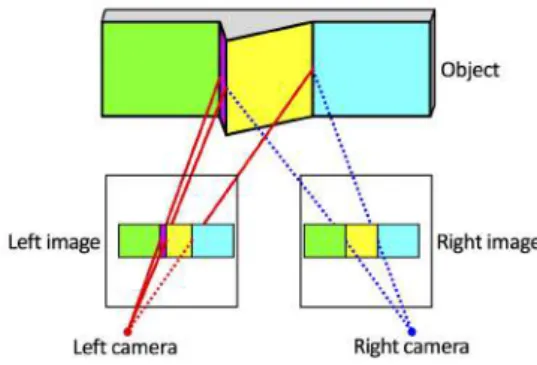
The core of the computer-aided stereoscopic en- doscope is a DP algorithm for high-precision stereo matching (cf. Fig. 1). This algorithm reconstructs in realtime a sequence of the 3D spatial data com- posed of depth data and surface data from a stereo moving image of live body; processes the sequence of 3D spatial data in space and time dimensions; and renders a multi viewable 3D moving image so that we can display on any multi-viewable 3D displays without glasses.
In addition to eliminating the need for glasses, a decisive advantage of once reconstructing 3D spatial data is that we become possible to introduce vari- ous CG techniques for 3D enhancement. For exam- ple, each user can look into a same multi-viewable 3D display from arbitrary directions independently of an endoscope (in other words, multi-views inher- ently can absorb individualities of binocular dispar- ity for lenticular stereo-viewing), which resolves VR sickness that is a risk factor in surgeries. For an- other example, a user can arbitrarily emphasize the concavity and convexity in 3D perception, which will make visual detection of cancer easy. Thus, there is an enormous potential of introducing CG techniques for 3D enhancement.
3 4D Filtering
4D filtering is inspired by researches in noise re- moval of image sequences [1] introducing time-space filtering to remove spatial and temporal noise, which
Fig. 1: Stereo matching.
are observed as intensive changes of the pixel val- ues on the same location through different frames.
The errors of the 3D moving images also can be de- pressed by the filtering. Because 3D moving images are consisted of a sequence of 3D spatial data recon- structed by stereo matching, there are 4 directions to be considered. (3 spatial directions plus 1 tem- poral direction equals 4 directions.) Therefore, 4D filters take advantages of the correlations between temporal and spatial dimensions.
3.1 4D Median Filter
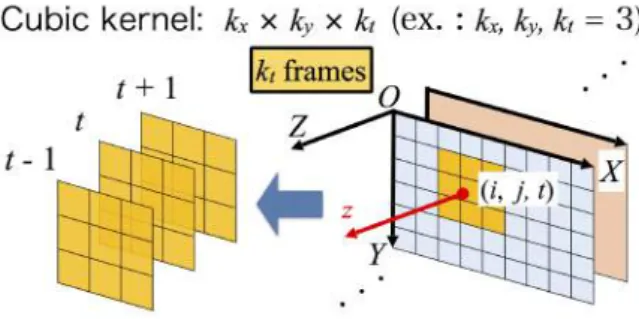
A 4D median filter is one of the most basic filters, which is easily constructed by extending a median filter to temporal dimension. Fig. 2 shows the con- struction of the 4D median filter. It has a cubic kernel the size ofkx×ky×kt, wherekxandky are horizontal and vertical length; and kt is temporal length how many inter-frames are included. Inputs are a set of the cubic neighborhood of their depth information and they are sorted; it takes more time than conventional 2D imagery. Therefore, an out- put is a median value of them.
Now suppose that given a 3D spatial data set comprisingT temporal length images, whose coor- dinate is represented asz(i, j, t) (i= 0,· · · , W−1;
j = 0,· · ·, H−1;t = 0,· · ·, T −1), where W and H are common width and height of images. And then, an output of the 4D median filter ˆz(i, j, t) is a nonlinear processing of cubic neighborhood around
Fig. 2: 4D median filter.
(i, j, t), wherez(i, j, t) is a z-dimensional function at (i, j, t).
The 4D median filter has a variety of configura- tions of the 3D kernel, that is, we can arbitrary change weights of spatial and temporal dimensions.
3.1.1 Apply to 3D Moving Images of Surgery For the first step of the realization of a computer- aided stereoscopic endoscope, let generate a 3D moving image of biological tissues of surgical scenes.
Because depth estimation is applied to the stereo moving images on a frame-by-frame basis, depth in- formation of each frame includes impulsive noise of stereo matching. Hence, 4D median filter is neces- sary to remove the errors of the 3D moving images.
Fig. 3 shows 3D reconstructed data and its 4D median filtered images that are visually compared by rendering at 3D virtual space; which shows the obvious removal of its impulsive noise. Frame in- tervals are connected smoothly by the filtering. Ac- cordingly, the multi-viewable 3D moving image of surgery is drastically enhanced by applying the 4D medial filter for efficiently reducing such errors in depth estimation.
The DP algorithm of the stereo matching works on the surgical images because the biological tissues have rich textures, that is, high frequency compo- nents of the images. Whereas, they include occa- sional errors in stereo matching. This is caused by the lack of moderate textures on the objects such as the hook and the tweezers, which include low fre-
quency components. In addition, depth estimation does not work for the objects which move fast.
3.2 Evaluation
Unfortunately, evaluation scheme for noise reduc- tion cannot be used directly for 3D moving images because there is no correct stereo matching data.
Hence, it is uncertain whether errors are removed by applying original 3D spatial data and filtered data to MSE (Mean Squared Errors). Otherwise, we should define stereo matching errors so as to re- construct correct data.
A proposal evaluation method is measurement of spatial and temporal MSE. Spatial MSE (SMSE) calculates contribution of applied filtering for a 3D moving image compared with original one. On the other hand, temporal MSE (TMSE) is a value es- timated against each 3D moving image. Therefore, SMSE needs two 3D moving images whereas TMSE only does just one.
3.2.1 Spatial MSE
Spatial MSE is calculated for original 3D data and filtered data. SMSE is defined as follows:
SMSE = 1 T W H
T!−1
t=0 W!−1
i=0 H!−1
j=0
{ˆz(i, j, t)−z(i, j, t)}2. (1) SMSE calculates differences between original and filtered data among a 3D moving image on same frame. Note that SMSE does not imply the amount of noise reduction.
3.2.2 Temporal MSE
Temporal MSE calculates differences between t and t+ 1 frames. Because TMSE is dependent on time, it is calculated through a 3D moving image.
Therefore, TMSEs are estimated for each filtering;
reduction of TMSE does not indicates noise reduc- tion but just motion reduction. TMSE is defined as follows:
TMSE = 1
T W H
T−1!
t=0 W!−1
i=0 H−1!
j=0
{z(i, j, t)ˆ −z(i, j, t+1)ˆ }2. (2)
(a) Original reconstructed. (b) 4D median filtered.
Fig. 3: Comparison of the reconstructed data.
TMSE is considered when a target is a movie.
3.3 Experiment
Let examine SMSE and TMSE to a 3D moving image of surgery (50 fps), whereT=150, W=1920, H=1080. Three configurations listed below were tested. They are defined as follows:
1. Med331: 3×3×1 median filter.
2. Med113: 1×1×3 median filter.
3. Med333: 3×3×3 median filter.
Results shown in Table 1 imply that time and space filters work independently. Hence, time and space dimensions can be independent. If this hypothesis is right, space and time filters should be indepen- dently constructed. In other words, edge filters will be suitable as a space filter. On the other hand, mo- tion filters will be as a time filter. Their combination is much more important to improve the quality.
Note that the variation of both SMSE and TMSE does not imply truly error reduction because stereo matching errors are not defined. If the MSE varia- tions mean error reduction, the time-space median (4D median) filter works the best of the three.
4 Conclusion
Development of a computer-aided stereoscopic en- doscope introduces the generation of multi-viewable 3D moving images of surgery. The 3D moving image includes occasional stereo matching errors, which
Table 1: Evaluation of 4D median filtering.
Configuration SMSE TMSE
Original - 322.85
Med331 4.36 323.41
Med113 3.96 309.46
Med333 4.34 309.45
degrades the visual quality. It includes temporal er- rors caused by frame independence. To solve these problems, this paper introduced time-space, that is, the 4D median filter for efficiently reducing stereo matching errors in depth estimation. The concept of 4D filtering is to process errors of stereo matching at the same time while keeping relations between frames. A problem is to quantitatively evaluate the 4D filtering.
References
[1] I. Peters, R.A and J. Nichols, “Rocket plume im- age sequence enhancement using 3d operators,”
Aerospace and Electronic Systems, IEEE Transac- tions on, vol. 33, no. 2, pp. 485–498, Apr. 1997.
[2] H. Suzuki, S. Utsugi, and H. Katai, “Multi-view auto-stereoscopic endoscopy system,” Patent JP 2012-065 851 A, Apr., 2012.
[3] S. Utsugi and H. Suzuki, “Stereo camera range finder with a slit-like window for visual aid,” Abstracts of Collaborative Conference on 3D and Materials Re- search (CC3DMR) 2013, pp. 7–8, Jun. 2013.