ANALYTICAL SCIENCES APRIL 1987, VOL. 3 151
Complexation Equilibria of as Studied by Cadmium Ion
Cadmium Selective
Ions with Electrode
Xylenol Orange
Akio YucHI, Tomoaki OKUBO, Department of Applied Chemistry, Gokiso, Showa, Nagoya 466
Hiroko WADA and Genkichi NAKAGAWA Nagoya Institute of Technology,
The complexation equilibria of cadmium ion(M) with Xylenol Orange(H6l) were studied by potentiometry with a cadmium ion selective electrode. The stability constants for MH3l, MH2l, MHI, Ml, M2Hl and M2l were ob- tained. These constants were consistent with the results of potentiometry with only a glass electrode and with those of spectrophotometry. The structure of each species is discussed.
Keywords Xylenol Orange, cadmium ion selective electrode, stability constant, metal b uffer
Xylenol Orange(3,3'-bis[N, Nbis(carboxymethyl)am- inomethyl]-o-cresolsulfonphthalein, X0, H6L) forms colored complexes with various metal ions, and has been widely used as a metallochromic indicator or a spectrophotometric reagent.' In general, knowledge about the reaction equilibria of a reagent with hydrogen and metal ions is essential for its effective use. Although there have been many papers dealing with this aspect on Xylenol Orange, the results are still unreliable. In earlier studies XO used was not pure enough as has already been pointed out and fully discussed.2'3 Moreover, analysis of the equilibria only by spectrophotometry is not suitable for such a complicated system. Taking these two points into account, potentiometry with a glass electrode has recently been examined by use of "pure" X0.4.8 Important results were obtained in systems containing some metal ions such as alkaline earth metals.4 For the other metals, however, there are large discrepancies between the formation constants reported by different authors. For example, log KML is 13.41 and 15.41 for znic, and 13.68 and 15.24 for lead.6'8 In the cases of these complexes, this method is not suitable because their stabilities are high and thus they are stable even in acidic medium.
We have shown that ion selective electrodes are useful for the determination of the stability constants of metal complexes.9-'3 In this paper, we study the equilibria between cadmium ions and Xylenol Orange in detail with Cd ion selective electrode.
Experimental
Reagents
A 10-2 mol dm -3 cadmium solution was prepared
from the nitrate tetrahydrate recrystallized twice, and was standardized against a Na2H2edta solution with Eriochrome Black T as an indicator. Potassium nitrate was recrystallized twice. Carbonate-free potassium hydroxide solution was prepared as described previous- ly 14
Xylenol Orange was prepared and purified as described previously.2'3 No colored impurity was found by paper chromatography and liquid chromatography with a silica-ODS column. The purity was determined to be more than 99% as H6L•2H2O by potentiometry with a glass electrode.
Measurements
All solutions for measurements were placed in an air bath thermostated at 25±0.1 ° C. The ionic strength was maintained at 0.10 mol dm-3 with potassium nitrate. The cell arrangement for measuring the cadmium ion concentration was:
Cd ion selective electrode
Test solution
0.1 mol dm-3
KNO3
3.33 mol dm' 3 KC1 calomel
electrode
The cadmium ion selective electrode(Denki Kagaku
Keiki Co., DKK type 7120) was conditioned as
described elsewhere.9-'3 The e.m.f. was read with a
DKK ion-meter IOC-10 accurate to 0.1 mV. Hydrogen
ion concentration was determined with a Radiometer
PHM-64 pH meter equipped with a Radiometer glass
electrode(G 202C) and a calomel electrode(K 401). A
1.OOX 10-2 mol dm-3 nitric acid solution and a 1.OOX 10-3
mol dm 3 cadmium ion solution of ionic strength 0.1
mol dm 3 (KNO3) were used as the standards for
hydrogen and cadmium ion concentrations, and the
change in liquid junction potential was taken as a
linear function of hydrogen ion concentration, -410[H+] .15 The test solution was stirred at a constant speed. Nitrogen was bubbled through the test solution during the measurement. Cadmium ion con- centration was monitored as a function of hydrogen ion concentration by titrating the test solution with a potassium hydroxide solution.
Visible spectra were recorded on a Union High-Sens spectrophotometer SM-401 with a thermostated cell compartment.
Results
Protonation constants
The solutions containing 2 - 3 mmol dm 3 of H6L were titrated with a potassium hydroxide solution. The formation function, n, was calculated by
- 6CL-Cox-[H+]+ [OH-]
nobsd = C
L
where CL and COH are the analytical concentrations of Xylenol Orange and hydroxide ion. One of several series of data are shown as a function of -log[H] by the open circles in Fig. 1. Irrespective of the total concentration of H6L, all the experimental points of every series lay on a single curve, which has an inflection point at -log[H] around 4.5.
Below -log[H] 4.5, only H3L, H4L, H5L and H6L (charges are omitted) are in the solution, and n is given by
- 3[H3L] + 4[H4L] + 5[HSL] + 6[H6L]
ncald = C
L •
The stepwise protonation constants K4, K5 and K6 were refined to give the minimum error square sum, U (nobsd ncald)2.
The value of K3 was obtained by a similar calculation, using the data between -log[H+] 4.5 and 8.0, and also by spectrophotometric measurement. All the constants are summarized in Table 1 together with literature values.
Potential response of Cd ion selective electrode
The solutions containing cadmium ions and H6L, as shown in Table 2, were titrated with a potassim hydroxide solution. Potential response of the ion
selective electrode was rapid, and the potential became constant within 3 min for -log[H]<8. In Fig. 2, -log[Cd2+] was plotted against -log[H+] .
Detection limit in the metal buffer was also determined with a solution containing only H6L (open circles in Fig. 2). When ion selective electrodes are used for the determination of stability constants of metal complexes, this limit is important as described previously.9-13 Since the potentials in the metal buffers came close to this limit at -log[H] around 8, the ion selective electrode potentials would not correctly reflect
Fig. 1 n ditions.
Table 3.
vs. -log[W]. See Table 2 for The solid lines are calculated
experimental con- with constants in
Table 2 Experimental conditions for potentiometry of complexation equilibria between cadmium ion and Xylenol Orange(25°C; 0.1 mol dm-3 KNO3)
Table 1 Logarithmic
protonation constantsof Xylenol
Orange(25°C; 0.1
mol dm_3KNO3)
a. U, potentiometry with a glass electrode; S, spectrophotometry. b. at 20°C.
ANALYTICAL SCIENCES APRIL 1987, VOL. 3 153
the free cadmium ion concentration at -log[H]>8.
Mononuclear species
The formation of a cadmium complex with Xylenol Orange is generally expressed as
pM+ (q-3)H+ +H3L ± MpHgL: Kpq.
Only mononuclear species, M HqL, are formed when the total concentration of H6L is larger than that of cadmium ion. These total concentrations are expressed as
CM = [M] + E [MHgL]
CL = a[H3L] + >j [MHQL]
where a is the side reaction coefficient of H3L taking into account the protonation of X0, and is given by (K4K5K6[H+]3+K4K5[H+]2+K4[Hi+1+1 / K3[H+]). When
Y=K19[H+]19-2~, the value can be calculated by Y = [M](C (CM-[M])a[H+]
L-CM+ [M])
If only MHgL is formed, the plot of log Y vs. -log[W]
would yield a straight line with a slope of (2-q).
The results are shown in Fig. 3. All the experimental points lay on a single curve, whose slope changes from
-1 through 0 to 1. These suggest the presence of MH3L, MH2L and MHL, respectively. From the intercepts of the tangents, the stability constants for each species were obtained.
At -log[H]>8, MHL further deprotonates to form ML. Since the ion selective electrode does not work properly under these conditions as described above, the protonation constant of the complex, KMHL was determined by the data obtained with only a glass electrode. The stability constant for this species was calculated with the relation: K1o=K11 / KMHL.
Binuclear species
When 2CL>CM>CL, binuclear species M2HQL pre- dominate in the solution. Similar numerical treatment showed the presence of M2HL and M2L. Their stability constants were obtained.
Refinement of the stability constants
With all the data, these stability constants were refined to give a minimum error square sum about -log[Cd2+] . The constants thus obtained are sum- marized in Table 3. The solid lines in Fig. 2 were calculated with these constants. Distribution of each Fig. 2 -log[Cd2+] vs. -log[H+]. See Table 2 for experi.
mental conditions. Open circles show the detection limit in the Xylenol Orange solution. The solid lines are calculated with the constants in Table 3.
Fig. 3 log conditions.
Y vs. -log[ H+]. See Table
2 for experimentalTable 3 Stability complexes(25°C;
constants of cadmium Xylenol Orange
0.1 mol dm' 3 KNO3)
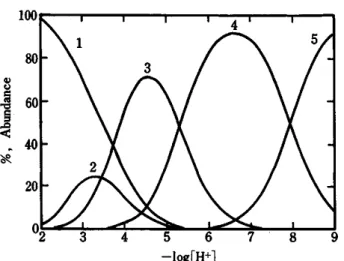
species about cadmium ion is shown for CM=0.3 and CL=3 mmol dm-3 in Fig. 4.
Further evidence
When stability constants of metal complexes are determined by potentiometry with only a glass electrode, the average number of proton attached to the ligand, n is utilized for the numerical analysis. The n value could be obtained also in this study and is shown as a function of -log[H] by various symbols in Fig. 1.
On the other hand, when all the equilibrium constants are known, n can be calculated by
- ~~q[MpHgL]
ncalc = C L
The n calculated with the constants obtained above well reproduces the experimental points, as shown in
Fig. 1.
The absorption spectra of the solutions containing 10.5 mol dm-3 cadmium and XO were recorded at various -log[H+] values as shown in Fig. 5A. The solution became colored above -log[H+] 5, but a clear isosbestic point was not observed.
Distribution of the various species of XO is calculated under the same conditions and is shown as a function of -log[H] in Fig. 5B. As total concentra- tions of cadmium and Xylenol Orange are far lower than those in Fig. 4, all the complexes are more dissociated. Among these species, H2L, HL, L, MHL, ML and M2L are deeply colored, because the phenolic proton is dissociated. The main reaction between -log[H] 5 and 7 is that between M and H3L , which forms colored MHL as described previously', but H2L, MH2L, ML and M2L also exist as minor species. The change of the absorption spectra is just as expected
from the distribution diagram. These two findings confirm that our constants are reasonable.
Discussion
For comparison, the stability constants obtained in this study were recalculated so as to refer to the reac- tion of M with H,L to form MH;L(Table 4). For this recalculation, K1=1012.23, K2=1010.56 and K3=106.6' were used.3 Murakami et al. have studied this system6, and found only three species, MHL, ML and M2L under almost the same experimental conditions.
Although there was inconsistency that KIKMHL is not equal to KML KMHL, these values are also listed in Table 4 as they are.
Each species is estimated to have the structure proposed previously.6 KMH,L is almost the same as KMidd (5.3); this suggests the coordination by only an iminodiacetate moiety in this species, although transfer of proton from nitrogen to phenolate is necessary
Fig. 4 Distribution of Xylenol Orange system.
10-3 mol dm-3. Species:
MHL (5) ML.
cadmium species in cadmium- CM=0.3X 10⁻³ mol dm-3; CL=3X
(1) M2+ (2) MH3L (3) MH2L (4)
Fig. 5A Absorption spectra of solutions containing cadmium ion and Xylenol Orange. CM=1X 10.5 mol dm-3;
CL=1X10⁵ mol dm-3. -log[H+]: (1) 6.62 (2) 6.42 (3) 6.12 (4) 5.94 (5) 5.81 (6) 5.53 (7) 4.94.
Fig. SB Distribution of Xylenol Orange species in cadmium- Xylenol Orange system. CM 1X 10⁻⁵ mol dm-3; CL =1X 10⁻⁵ mol dm-3. Species: (1) H6L (2) H5L (3) H4L (4) H3L (5) H2L
(6) MH2L (7) MHL (8) ML (9) M2L. Species given by the
numbers with * are deeply colored.
ANALYTICAL SCIENCES APRIL 1987, VOL. 3 155
before coordination. MH3L and M2HL also have the coordination by the same moiety, but they have smaller constants than KMida, because the transfer of proton is very disadvantageous in these cases. On the other
hand, the larger constants for KMHL, KML and KM2L imply the coordination of or the interaction with phenolate or ketone group in these species. The literature values for KMHL (7.84) and KML (9.67) are too small.
Protonation constant of phenol proton is decreased from 6.67 to 5.20 and that of the second nitrogen proton from 10.56 to 8.08 by replacement of hydrogen with cadmium ion on the other moiety. These imply that donor atoms attached to two phenol rings are not independent and influence each other through a triphenyl methane group.
Formation of binuclear species is characteristic of this lignad. Coordination of the second metal is expected to be less favorable than that of the first one because of the influence discussed above. Actually we found a large difference between KML and KM2L (8.4) or between KMHL and KM2HL (7.5). The difference in the literature values, 1.1 between KML and KM2L is too small.6
Thus the relation between our equilibrium constants is consistent with the proposed structure. Similar studies on copper(II) and lead complexes with XO will be published elsewhere.
References
1. K. L. Cheng, K. Ueno and T. Imamura, "Handbook of Organic Analytical Reagents", CRC Press, Boca Raton,
Florida (1982) and references therein.
2. D. C. Olson and D. W. Margerum, Anal. Chem., 34, 1299 (1962).
3. M. Murakami, T. Yoshino and S. Harasawa, Talanta, 14, 1293 (1967).
4. T. Yoshino, H. Okazaki, S, Murakami and M. Kagawa, Talanta, 21, 676 (1974).
5. T. Yoshino, S. Murakami and K. Ogura, J. Inorg. Nucl.
Chem., 41, 1011(1979).
6. S. Murakami, K. Ogura and T. Yoshino, Bull. Chem.
Soc. Jpn., 53, 2228 (1980).
7. S. Murakami and T. Yoshino, Bull. Chem. Soc. Jpn., 54, 619 (1981).
8. H. Sato, Y. Yokoyama and K. Momoki, Anal. Chim.
Acta, 94, 217 (1977).
9. G. Nakagawa, H. Wada and T. Hayakawa, Bull. Chem.
Soc. Jpn., 48, 424 (1975).
10. G. Nakagawa, H. Wada and T. Sako, Bull. Chem. Soc.
Jpn., 53, 1303 (1980).
11. A. Yuchi, H. Wada and G. Nakagawa, Anal. Chim. Acta, 149, 209 (1983).
12. A. Yuchi, H. Wada and G. Nakagawa, Anal. Sci., 1, 19 (1985).
13. A. Yuchi, H. Wada and G. Nakagawa, Anal. Sci., 1, 409 (1985).
14. J. E. Powell and M. A. Hiller, J. Chem. Educ., 34, 330 (1957).
15. H. Kakihana, M. Maeda and T. Amaya, Bull. Chem. Soc.
Jpn., 43, 1377 (1970).
16. V. Michaylova, L. Sucha and M. Suchanek, Talanta, 31, 645 (1984).
(Received November 28, (Accepted January 9,
1986) 1987)
Table 4 Logarithmic stability constants of cadmium Xylenol Orangecomplexes (25 °C; 0.1
mol dm-3KNO3) a
a. See text for details.