Hawking radiation of Black Holes
Hirosuke Kuwabara
2014/2/1
Content
1 Introduction 2
2 Black Holes 4
2.1 Schwarzschild black hole . . . . 5 2.1.1 Kruskal-Szekeres Coordinates . . . . 7 2.1.2 Carter-Penrose diagram in the Schwarzschild metric . . 12
3 QFT in flat and curved spacetimes 13
3.1 Free Scalar QFT in curved spacetime . . . . 13
4 Bogoliubov transformation 14
5 Hawking radiation 16
5.1 Particle creation in the Sandwich spacetime . . . . 16 5.2 Particle creation in the Schwarzschild spacetime . . . . 19
6 Phenomenology of Black Holes 23
6.1 Black Hole lifetimes . . . . 23 6.2 Mini Black Holes . . . . 24
7 Conclusion 25
8 Outlook 26
8.1 Black Hole information paradox . . . . 26 8.2 Bekenstein-Hawking Entropy . . . . 27
References 28
1 Introduction
In this paper I review the Hawking radiation of Black Holes.
According to Einstein’s general relativity, a black hole exists and it ab- sorbs everything. But, this property is just its classical aspect. In quantum theory a black hole would also emit. Hawking considered a quantum field in the classical spacetime background of a dust cloud that collapses to form a black hole[1]. He found that if no particles of the quantum field are present at early times, a distant observer at late times will detect an outgoing flux of particles having thermal spectrum. The flux of energy emitted by the black hole implies that its mass will decrease. Thus black holes are said to evaporate.
I describe the contents of my Thesis below.
In Section 2, I reviewed the Schwarzschild black hole and its geometrical properties. In Section 3, I explained Quantum Field Theory in Curved Space- time(QFTCS) which Hawking used to reach his conclusion. In this theory the quantum fields satisfy their equations of motion, though not with the Minkowski metric but with the classical metric of a curved spacetime. The gravitational field is not quantized in the QFTCS. Another difference between the QFT and QFTCS is asymptotic completeness. The assumption that the Fock spaces of in-states, intermediate states and out-states are equal, is not correct. Thus, it is necessary to introduce the Bogoliubov transformation, in order to interpret particle creation in the out-states. I described them in Section 4. In Section 5 I derived the Hawking formula and described the physical interpretation of the Hawking radiation in the Schwarzschild black hole. The Hawking formula is [1]
T = ℏ c
38πk
BGM , (1)
where T, ℏ , c, k
B, G, M are the temperature of a black hole, the Planck con-
stant, the speed of light, the Boltzmann constant, the Newton constant, and
the mass of the black hole. This formula shows that the Schwarzschild black
hole is a gray body of that temperature. The ℏ in (1) implies that the Hawk-
ing radiation is caused by the quantum effect. Taking a classical limit, ℏ → 0
yields T → 0. This means that the classical temperature of a black hole is
zero, and, therefore, there is no radiation classically, which is consistent with
general relativity. It is important to confirm the Hawking radiation observa-
tionally. If the mass of a black hole is 10
15[g]( ≤ stellarmass), the lifetime,
the time for a black hole to disappear, is about the age of the Universe. So it is very hard to find an evaporating black hole in the Universe. It is suggested that the some black holes may have a short lifetime. They are called ”mini”
black holes. I briefly explained the lifetime of black holes and mini black holes in Section 6. Section 7 is the conclusion, and Section 8 is the outline where I shortly introduced the unsolved problems, especially, the black hole information paradox and Bekenstein-Hawking entropy.
In this Thesis I choose the natural units G = 1, c = 1, ℏ = 1.
2 Black Holes
In this section I describe ”classical” aspects of black holes. The term ”clas- sical” means that a particle which travels in spacetime is not quantized and gravity is also not quantized.
Black holes are astronomical objects, which absorb everything. A black hole is an important object because it is as a prediction of general relativity.
If it becomes clear that a black hole exists, that observation would make general relativity even more exciting.
Let us consider an isolated body which is widely dispersed and has suffi- ciently low density at early times collapses, and the entire spacetime is nearly flat. When the radius of this body becomes less than its Schwarzschild radius R
SRdefined by
R
SR= 2GM
c
2, (2)
the isolated body is called a black hole. Here c, G, M are the speed of light, the Newton constant and the mass of the body. The Schwarzschild radius of the sun is R
SR sun≈ 3 [km]. The radius of the sun is R
⊙≈ 7.0 × 10
5[km], so R
SR sun/R
⊙∼ 4 × 10
−6. How small the Schwarzschild radius is! This lets us wonder that a black hole is a rare astronomical object and, maybe, doesn’t exist. However, some indirect evidence has been submitted[12]. For instance, it is believed that the center of the Virgo galaxies M84 and M87(see Fig.1), about 50 million light years from the Earth, is a black hole. By looking at the central region of the galaxies with a spectrograph onboard the Hubble Space Telescope, a rapid rotation of gas, v
r∼ 550 [km/s], has been observed 60 light years from the core. Observational evidence for stellar mass black holes is sought for by searching for collapsed stars in binary systems. It would appear as the visible star orbits a compact, invisible, object with a mass larger than the maximum mass for a neutron star. Candidates for such a system exist: for example, the X-ray source Cygnus X-1(see Fig.2). According to the No-hair theorem[4], a black hole at late time is only characterized by its mass, angular momentum, and charge. When the angular momentum and charge are zero, we have a spherically symmetric black hole, which is called a Schwarzschild black hole. In the following discussion, I consider the geometries of Schwarzschild black holes only, for simplicity.
This section is based on [2], [5].
Fig. 1: M87 by 2MASS [13]
Fig. 2: Cygnus X-1 by CHANDRA [14]
2.1 Schwarzschild black hole
From [2] and [5], the Schwarzshild metric is ds
2=
(
1 − 2M r
) dt
2−
(
1 − 2M r
)
−1dr
2− r
2dΩ
2, (3) with dΩ
2= dθ
2+ sin
2θdϕ
2.
On radial null geodesics in Schwarzschild metric dt
2= 1
( 1 −
2Mr)
2dr
2=: dR
2, (4) where
R = r + 2M ln
r − 2M M
(5)
is the Regge-Wheeler radial coordinate. As r ranges from 2M to + ∞ , R ranges from −∞ to + ∞ (Fig.3). For r > 2M, this mapping is monotonic.
Using this coordinate, (4) becomes
d(t ± R) = 0 (6)
on radial geodesics. Defining the incoming radial null coordinate v by
v = t + R, −∞ < v < + ∞ (7)
r R
O
2M
Fig. 3: the relation of R and r
and rewriting the Schwarzschild metric in the incoming Eddington-Finkelstein(EF) coordinates (v, r, θ, ϕ), we get
ds
2= (
1 − 2M r
)
(dt
2− dR
2) − r
2dΩ
2(8)
= (
1 − 2M r
)
dv
2− 2drdv − r
2dΩ
2. (9) The Schwarzschild metric (3) has a singular point at r = 2M , but the metric (9) has no singularity. This means that the point r = 2M is not a real singular point in Schwarzschild spacetime, it is just a coordinate singularity.
How about the outgoing EF coordinates? Defining the outgoing radial null coordinate u by
u = t − R, −∞ < u < + ∞ (10) and rewriting the Schwarzschild metric in outgoing Eddington-Finkelstein(EF) coordinates (u, r, θ, ϕ), we have
ds
2= (
1 − 2M r
)
du
2+ 2drdu − r
2dΩ
2. (11)
The Schwarzschild metric in the ingoing and outgoing EF coordinates is ini- tially defined only for r > 2M , but it can be analytically continued to all r > 0, because there is no singular point in this spacetime for r > 0. How- ever, the r < 2M region in the outgoing EF coordinates is not the same as the r < 2M region in the incoming EF coordinates. To see this, note that for r ≤ 2M and the incoming EF coordinates, we have
2drdv = − [
ds
2+ ( 2M
r − 1 )
dv
2+ r
2dΩ
2]
≤ 0, when ds
2≥ 0. (12)
For the outgoing EF coordinates, 2drdu = ds
2+
( 2M r − 1
)
du
2+ r
2dΩ
2≥ 0, when ds
2≥ 0. (13)
Therefore, drdv ≤ 0 on timelike or null worldlines for the incoming EF coordinates, and dv > 0 for future-directed worldlines, so dr ≤ 0. This shows that a star with a radius shorter than 2M must collapse. This is consistent with forming a black hole. In contrast, for the outgoing EF coordinates, dr ≥ 0. This means that a star with a radius shorter than 2M must expand. This is a white hole, the time reverse of a black hole. Both black and white holes are allowed by general relativity because of the time reversibility of Einstein’s equations. But white holes require very special initial conditions near the sigularity, so that only black holes can occur in Nature(cf. irreversibility in thermodynamics).
2.1.1 Kruskal-Szekeres Coordinates
The r > 2M region is covered by both the incoming and outgoing EF coodi- nates. We write the Schwarzschild metric in terms of (u, v, θ, ϕ) as
ds
2= (
1 − 2M r
)
dudv − r
2dΩ
2. (14)
We now introduce the new coordinates (U, V ) defined (for r > 2M ) by
U = − e
−u/4M, V = e
v/4M, (15)
in terms of which the metric is ds
2= 32M
3r e
−r/2MdU dV − r
2dΩ
2. (16) The r(U, V ) is given implicitly by
U V = − e
R/2M⇐⇒ U V = −
( r − 2M 2M
)
e
r/2M. (17) These are the Kruskal-Szekeres(KS) coordinates (U, V, θ, ϕ). Initially the metric is defined for U < 0 and V > 0, but it can be analytically continued to the U > 0 and V < 0 region. Now r = 2M corresponds to U V = 0, and the singularity at r = 0 corresponds to U V = 1.
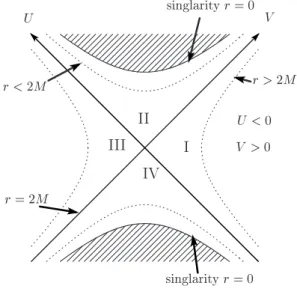
It is convenient to plot the lines of U = const. and V = const.(the outgoing and incoming radial null geodesics) at π/4 radian. The spacetime diagram looks like Fig.4. There are four regions of KS spacetime, depending
U
V
I II
III
IV
U<0
V >0 singlarityr=0
singlarityr=0 r>2M
r=2M r<2M
Fig. 4: the spacetime diagram in KS coordinates
on the signs of U and V . The regions I and II are covered by the incoming
EF coordinates. These are the only regions relevant to gravitational collapse
because the regions III and IV represent a white hole.
Let’s derive the radial null geodesic x
µ(λ). The geodesics x
µ(λ) can be affinely parameterized. In general, geodesics are defined by
D dλ
( dx
µdλ
)
= 0, (18)
where D/dλ is the covariant derivative along the geodesic with respect to λ.
The action S
pof a particle is
S
p=
∫
b aL dλ, (19)
where
L = 1
2 g
µνdx
µdλ
dx
νdλ . (20)
If g
µνand, hence, L are independent of some x
µ, then the conjugated momentum
p
µ:= ∂ L
∂ (dx
µ/dλ) = g
µνdx
νdλ , (21)
is constant along the geodesics.
One finds that in the Schwarzschild metric, with the plane containing the geodesic taken at θ = π/2, the constant momenta p
tand p
ϕare
(
1 − 2M r
) dt
dλ = E, (22)
r
2dϕ
dλ = L. (23)
This expression is in terms fo (t, r, θ, ϕ) coordinates, E and L are energy and angular momentum, respectively. Because of on-shell condition, we have
( dr dλ
)
2+ L
2r
2(
1 − 2M r
)
= E
2. (24)
The radial null geodesics are those with L = 0. They are characterized by (22) and
dr
dλ = ± E, (25)
dϕ
dλ = 0. (26)
From these equations, we get dt dλ ∓
(
1 − 2M r
)
−1dr
dλ = 0 (27)
or
d
dλ (t ∓ R) = 0, (28)
where R is defined by dR
dr = (
1 − 2M r
)
−1. (29)
As r → 2M from above, R → −∞ . Along any out going radial null geodesic the null coordinate
u := t − R (30)
is constant. Along any incoming radial null geodesic the null coordinate
v := t + R (31)
is constant. These are the outgoing and incoming EF coordinates again.
Let C be an incoming radial null geodesic defined by v = v
1for some v
1, that passes through the event horizon of the Schwarzshild black hole. Along the null geodesic C ,
du dλ = dt
dλ − dR dλ = 2
(
1 − 2M r
)
−1E. (32)
From (25), dr/dλ = − E along C, so
r − 2M = − Eλ, (33)
where λ is taken to be zero at the event horizon r = 2M . For r > 2M, the affine parameter λ is negative. It follows that
(
1 − 2M r
)
−1= 1 − 2M
Eλ , (34)
du
dλ = 2E − 4M
λ . (35)
Therefore, we get an expression of the incoming null geodesic C, u = 2Eλ − 4M ln λ
K
1, (36)
where K
1is a negative constant. Far away from the event horizon,
u ≈ 2Eλ, (37)
while near the event horizon(λ = 0),
u ≈ − 4M ln λ K
1. (38)
So the incoming EF coordinate u → −∞ at the past null infinity and u → + ∞ at the event horizon. In the EF coordinates (u, v, θ, ϕ), when λ >> 1, v becomes an affine parameter because of (37). Therefore, v − v
0must be related to the separation λ between u(v) and u(v
0) at the past null infinity by
v
0− v = K
2λ, (39)
where K
2is a negative constant. Hence, near the event horizon, u ≈ − 4M ln
( v
0− v K
1K
2)
. (40)
This geodesic curve contributes to particle creation at most. Here the product
K
1K
2is a positive constant parameter.
2.1.2 Carter-Penrose diagram in the Schwarzschild metric
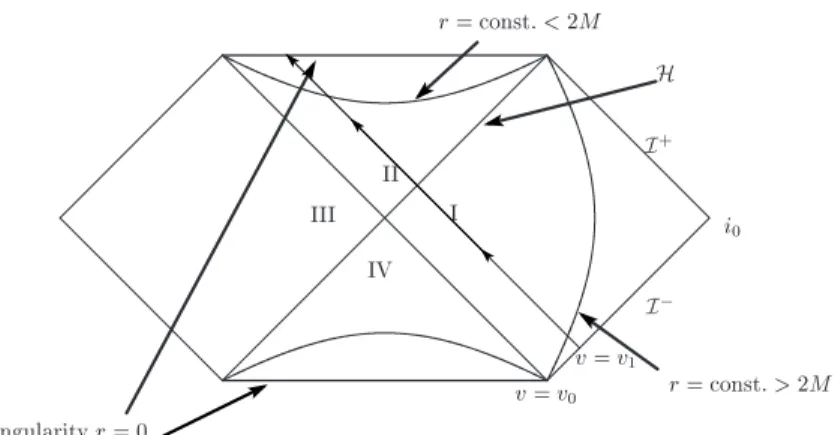
It is convenient to use a Carter-Penrose(CP) diagram[5], [7], [9]. In the Schwarzschild metric, the CP diagram is like Fig.5, where radial null geodesics are represented by lines at ± 45
◦angles. A conformal transformation was made, so infinity can be represented on a CP diagram also.
singularityr=0
r=onst:<2M
r=onst:>2M H
I +
I i0 I
II
III
IV
v=v
0 v=v
1
Fig. 5: Carter-Penrose diagram in the Schwarzshild spacetime
I
−in the Figure represents the past null infinity, from which incoming
null geodesics originate. It is labeled by the arrow showing the direction
in which the null coordinate v increases along I
−. the future null infinity,
I
+, where outgoing null geodesics terminate, is labeled by the arrow showing
the direction in which the null coordinate u increases along I
+. The spatial
infinity is, i
0, where t = finite and r → ∞ . The ray C is an incoming null
geodesic when v = v
1, that enters the black hole through the event horizon,
H , which is the labeled null ray running from r = 0 to the point at which
the singularity and I
+intersect in Fig.5. The incoming ray with v = v
0is
the last one that passes through the center of the body and reaches I
+. The
incoming null rays with v > v
0enter the black hole through H , and run into
the singularity.
3 QFT in flat and curved spacetimes
In this section, I introduce QFTCS according to [7], [8], [9]. As was men- tioned in Introduction, only matter fields are quantized in QFTCS, and the gravitational field is not quantized. Basically, the QFTCS is obtained by replacing the Minkowski metric η
µνin QFT with a curved spacetime metric g
µν. Here I only use a free quantized scalar field for simplicity because it becomes essentially the same discussion for fermions and gauge fields.
3.1 Free Scalar QFT in curved spacetime
The invariant line element is
ds
2= g
µν(x)dx
µdx
ν,
where the signature is (+, − , − , − ) but the metric g
µνis not flat. The action S is constructed from a scalar field ϕ as
S =
∫
d
4x L (41)
with
L = 1
2 | g |
1/2(g
µν∂
µϕ∂
νϕ − m
2ϕ
2), (42) where g = detg
µν, g
µν= (g
µν)
−1and m is a mass of the scalar field. The equation of motion is
( □ + m
2)ϕ = 0, (43)
where □ = g
µν∇
µ∇
νand ∇
µis a covariant derivative. Because of (43), ϕ can be expanded by solutions of (43),
ϕ(x) =
∫
d
3k(A
kf
k(x) + A
†kf
k∗(x)), (44) where f
k(x) is a solution to (43). The inner product in the solution space of the Klein-Gordon equation is defined by
(ϕ
1, ϕ
2) = i
∫
Σ
d
3x | g |
1/2g
0ν(ϕ
∗1∂
νϕ
2− ϕ
∗2∂
νϕ
1), (45)
where Σ is a t = const. hypersurface. If ϕ
1and ϕ
2are solutions of EOM(43) which vanish at spatial infinity, (ϕ
1, ϕ
2) is conserved. So f
kand f
k′satisfy
d
dt (f
k, f
k′) = 0, (46)
and also
(f
k, f
k′) = δ(k − k
′), (f
k∗, f
k∗′) = − δ(k − k
′), (f
k, f
k∗′) = 0. (47) The (f
k)
k∈is the orthonormal basis in the solution space. This basis is non-unique and after canonical quantization of fields, there will be different notions of vacuum, according to each different orthonomal basis. So QFTCS has many vacua. It is the difference between QFT in flat space and QFTCS.
This is because there is no preferred time coordinate in curved spacetime.
By (44) and (47), we have A
k= (f
k, ϕ) = i
∫
Σ
d
3x | g |
1/2g
0ν(f
k∗∂
νϕ − ϕ
∗∂
νf
k). (48) A canonical commutation relation(CCR) to be imposed to quantize the scalar field, [
A
k, A
†k′]
= δ(k − k
′), [A
k, A
k′] = 0. (49) From this and (43), ϕ and π := ∂ L /∂ ϕ ˙ satisfy the CCR:
[ϕ(x, t), π(x
′, t)] = iδ(x − x
′), [ϕ(x, t), ϕ(x
′, t)] = 0, [π(x, t), π(x
′, t)] = 0.
(50)
4 Bogoliubov transformation
When an operator a
k, k ∈
3satisfies [
a
k, a
†k′]
= δ(k − k
′) and [a
k, a
k′] = 0, we can consider a new operator b
kdefined as b
k:= α
ka
k+ β
k∗a
†−k. If α
kand β
ksatisfy | α
k|
2− | β
k|
2= 1, the transformation a
k7→ b
kis called the Bogoliubov transformation[11].
Because of | α
k|
2− | β
k|
2= 1, the commutation relation of b
kbecomes [
b
k, b
†k′]
= ( | α
k|
2− | β
k|
2)δ(k − k
′) = δ(k − k
′).
So the Bogoliubov transformation preserves the CCR. This transformation is
used to diagonalize Hamiltonian. When a physical system has finite number
of degrees of freedom, the Bogoliubov transformation is unitary. However, if
the number of dof is infinite, the transformation is not unitary. This means
that the Hamiltonian written by a
kis a different system from that with the
Hamiltonian in terms of b
k.
5 Hawking radiation
In this section, I describe the Hawking radiation. First, I introduce the sandwich spacetime where particle creation occurs. It is the simplest example of the Hawking radiation. Next, I describe the Hawking radiation of the Schwarzschild black hole.
This section is based on [6], [7], [8].
5.1 Particle creation in the Sandwich spacetime
The sandwich spacetime metric is spatially flat and isotropically changing, ds
2= dt
2− a(t)
2( ∑
i
(dx
i)
2)
. (51)
This metric is asymptotically static, a(t) ∼
{
a
1(t → −∞ )
a
2(t → + ∞ ). (52)
With this metric, EOM of a scalar field becomes a
−3∂
t(a
3∂
tϕ) − a
−2∑
i
∂
i2ϕ = 0, (53)
where I took m = 0 for simplicity. Imposing the periodic boundary conditions, ϕ(x
i+ L, t) = ϕ(x
i, t), we can expand ϕ in the form
ϕ(x) = ∑
k
(A
kf
k(x) + A
†kf
k∗(x)). (54) Here
f
k(x) = V
−1/2e
ik·xψ
k(τ), (55) V = L
3, k
i= 2πn
i/L, n
i∈ , k = | k | and
τ =
∫
ta(t
′)
−3dt
′. (56)
It follows from (53) that
d
2ψ
kdτ
2+ k
2a
4ψ
k= 0. (57)
By imposing the initial condition given by (52),when t → −∞ ,
f
k(x) ∼ (V a
13)
−1/2(2ω
1k)
−1/2e
i(k·x−ω1kt)(58) with ω
1k= k/a
1. From this and (55),
ψ
k(τ) ∼ (2a
13ω
1k)
−1/2e
−iω1ka13τ(59) as t → −∞ .
Now I impose a canonical commutation relation(CCR) to quantize this scalar field, [
A
k, A
†k′]
= δ(k − k
′), [A
k, A
k′] = 0. (60) From this and (53), ϕ and π := ∂ L /∂ ϕ ˙ = a3∂
tϕ = ∂
τϕ satisfy CCR,
[ϕ(x, t), π(x
′, t)] = iδ(x − x
′), [ϕ(x, t), ϕ(x
′, t)] = 0, [π(x, t), π(x
′, t)] = 0.
(61) Now let’s construct a Fock space of states. There is a Fock space on each t = const. hyperplane, so we must distinguish all vaccua on hyperplanes. I call the vaccum on the initial condition | 0 ⟩ as
A
k| 0 ⟩ = 0,
∀k. (62)
The time development of ψ
kis governed by the ordinary second-order differential equation (57). It has two linearly independent solutions ψ
k(±)such that as t → + ∞
ψ
k(±)(τ ) ∼ (2a
23ω
2k)
−1/2e
∓iω2ka23τ, (63) where ω
2k:= k/a
2. Therefore, ψ
kcan be represented by
ψ
k(τ ) = α
kψ
k(+)(τ) + β
kψ
k(−)(τ ) (64) ψ
k(τ ) ∼ (2a
23ω
2k)
−1/2[
α
ke
−iω2ka23τ+ β
ke
iω2ka23τ]
, (t → + ∞ ). (65)
The Wronskian of (57) gives the conserved quantity
ψ
k∂
τψ
k∗− ψ
k∗∂
τψ
k= i, (66) It requires that
| α
k|
2− | β
k|
2= 1. (67) From (55),(65), it follows that at late times
f
k(x) ∼ (V a
23)
−1/2(2ω
2k)
−1/2e
ik·x[
α
ke
−iω2kt+ β
ke
iω2kt]
. (68)
On the other hand, ϕ can also be written as ϕ(x) = ∑
k
(a
kg
k(x) + a
†kg
k∗(x)) (69) with g
kbeing a solution of the field equation with a positive frequency at late times,
g
k(x) ∼ (V a
23)
−1/2(2ω
2k)
−1/2e
i(k·x−ω2kt)(70) and
a
k:= α
kA
k+ β
k∗A
†−k. (71) This yields
[ a
k, a
†k′]
= ( | α
k|
2− | β
k|
2)δ(k − k
′) = δ(k − k
′). (72) Therefore, A
k7→ a
kis a Bogoliubov transformation.
Using the a
kand | 0 ⟩ we can calculate the expectation value of number of particles present at late times in mode k:
⟨ N
k⟩
t→+∞= ⟨ 0 | a
†ka
k| 0 ⟩ = | β
k|
2. (73) On the other hand, at early times
⟨ N
k⟩
t→−∞= ⟨ 0 | A
†kA
k| 0 ⟩ = 0. (74)
Thus, if a(t) is such that | β
k|
2is non-zero, as is generally the case, particles
are created by the changing scale factor of the universe! This is the simplest
example of the Hawking radiation. An exact solution for a specific a(t) is
discussed in Section 2.8 of [7].
5.2 Particle creation in the Schwarzschild spacetime
A general QFTCS has many vacua, but we need only two vacua to calculate:
the vacuum at the early time( I
−in Fig. 5) and the vacuum at the late time( I
+in Fig. 5). It is the same as a calculation of the S matrix in QFT in flat space.
We work in the Heisenberg picture. Let the state vector | 0 ⟩ be chosen to have no particles of the field incoming from I
−. Thus, | 0 ⟩ is annihilated by the A
ωcorresponding to particles incoming from I
−:
A
ω| 0 ⟩ = 0. (75)
As in the sandwich spacetime, the spectrum of outgoing particles is deter- mined by the coefficients of the Bogoliubov transformation relating a
ωto A
ωand A
†ω. I assume f
ωand g
ωare a complete set at I
−and at I
+, respectively.
We have
g
ω=
∫
dω
′(α
ωω′f
ω′+ β
ωω′f
ω∗′), (76) where the α
ωω′and β
ωω′are complex numbers, independent of the coordi- nates. From (47), they can be expressed as
α
ωω′= (f
ω′, g
ω), (77) β
ωω′= − (f
ω∗′, g
ω). (78) Furthermore, using (47) and (76) it follows that
(g
ω1, g
ω2) =
∫
dω
′(α
∗ω1ω′α
ω2ω′− β
ω∗1ω′β
ω2ω′). (79) In the Schwarzschild metric, f
ωis
f
ω∼ ω
−1/2r
−1e
−iωvS(θ, ϕ), (80) where S(θ, ϕ) is the spherical harmonics and discrete quantum numbers (l, n) have been suppressed, and v = t + r is the incoming null coordinate at I
−. The factor of ω
−1/2is required by the normalization of the scalar product.
On the other hand, g
ωis
g
ω∼ ω
−1/2r
−1e
−iωu(v)S(θ, ϕ), (81)
where again quantum numbers (l, m) have been suppressed, and u = t − r is the outgoing null coordinate at I
+. The value of v is related to the value of u by (40),
u(v) = − 4M ln
( v
0− v K
1K
2)
, (v < v
0). (82) Because the geodesics passes through the center of the collapsing body just before the event horizon has formed, and emerges as an incoming geodesic characterized by a value of v ↗ v
0.
Using these asymptotic forms, α
ωω′and β
ωω′can be expressed as α
ωω′= C
∫
v0−∞
dv ( ω
′ω )
1/2e
iω′ve
−iωu(v), (83) β
ωω′= C
∫
v0−∞
dv ( ω
′ω )
1/2e
−iω′ve
−iωu(v). (84) Here C is a constant. Let us substitute (82), and let s := v
0− v in (83), s := v − v
0in (84) and K := K
1K
2. Then we have
α
ωω′= − C
∫
0∞
ds ( ω
′ω )
1/2e
−iω′se
iω′v0exp [
iω4M ln ( s
K )]
, (85) β
ωω′= C
∫
0−∞
ds ( ω
′ω )
1/2e
−iω′se
−iω′v0exp [
iω4M ln ( − s
K )]
. (86) In (85) the contour of integration along the real axis from 0 to ∞ in the complex s-plane can be joined by a quarter circle at infinity to the contour along the imaginary axis from − i ∞ to 0. Because there are no poles of the integrand in the quadrant enclosed by the contour, and the integrand vanishes on the boundary at infinity, the integral from 0 to ∞ along the real s-axis equals to the integral from − i ∞ to 0 along the imaginary s-axis. Thus, putting s := is
′, (85) becomes
α
ωω′= − iC
∫
0−∞
ds
′( ω
′ω )
1/2e
ω′s′e
iω′v0exp [
iω4M ln ( is
′K )]
. (87)
Similarly, in (86), the integral along the real axis in the complex s-plane
from −∞ to 0 can be joined by a quarter circle at infinity to the contour
along the imaginary s-axis from − i ∞ to 0. As before, the integrals are equal.
Therefore, putting s := is
′, we have β
ωω′= iC
∫
0−∞
ds
′( ω
′ω )
1/2e
ω′s′e
−iω′v0exp [
iω4M ln ( − is
′K )]
. (88) Taking the cut in the complex plane along the negative real axis to define a single-valued natural logarithm function, we find that for s
′< 0 (as in these integrands),
ln(is
′/K) = ln( − i | s
′| /K) = − i(π/2) + ln( | s
′| /K), (89) ln( − is
′/K) = ln(i | s
′| /K) = i(π/2) + ln( | s
′| /K). (90) Then
α
ωω′= − iCe
iω′v0e
2πωM∫
0−∞
ds
′( ω
′ω )
1/2e
ω′s′exp [
iω4M ln ( | s
′|
K )]
, (91) and
β
ωω′= iCe
−iω′v0e
−2πωM∫
0−∞
ds
′( ω
′ω )
1/2e
ω′s′exp [
iω4M ln ( | s
′|
K )]
. (92) Hence, it follows that
| α
ωω′|
2= exp(8πM ω) | β
ωω′|
2. (93) For the components g
ωof this part of the wave packet, we have the scalar product
(g
ω1, g
ω2) = Γ(ω
1)δ(ω
1− ω
2), (94) where Γ(ω
1) is the fraction of an out going packet of frequency ω
1at I
+that would propagate backward in time through the collapsing body to I
−. It follows from (79) and (94) that
Γ(ω
1)δ(ω
1− ω
2) =
∫
dω
′(α
∗ω1ω′
α
ω2ω′− β
ω∗1ω′
β
ω2ω′). (95) The a
ω:= (g
ω, ϕ) is of interest to us, because
⟨ 0 | a
†ωa
ω| 0 ⟩ =
∫
dω
′| β
ωω′|
2(96)
is the number of particles(with a frequency ω) created from the black hole.
However, we encounter an infinity if we try to evaluate this quantity. The infinity is a consequence of the δ(ω
1− ω
2) that appears in (94). We expect that ⟨ 0 | a
†ωa
ω| 0 ⟩ is the total number of created particles per unit frequency that reach I
+at late times in the wave g
ω(2). This total number is infinite because there is a steady flux of particles reaching I
+. One heuristic way to see this is to replace δ(ω
1− ω
2) in (95) by
δ(ω
1− ω
2) = lim
τ→∞
∫
τ /2τ /2
dt exp[i(ω
1− ω
2)]. (97) Then, formally, we can write (95) when ω
1= ω
2= ω, as
τ
lim
→∞Γ(ω)(τ /2π) =
∫
dω
′( | α
ωω′|
2− | β
ωω′|
2)
= [exp(8πM ω) − 1]
∫
dω
′| β
ω|
2, (98) where we have used (93). Hence, ⟨ N
ω⟩
t→∞:= ⟨ 0 | a
†ωa
ω| 0 ⟩ is given by
⟨ N
ω⟩
t→∞= lim
τ→∞
τ 2π
Γ(ω)
e
8πM ω− 1 . (99)
The physical interpretation of this is that at late times, the number of created particles per unit angular frequency and per unit time that pass through a surface r = R(where R is much larger than the circumference of the black hole event horizon) is
1 2π
Γ(ω)
e
8πM ω− 1 . (100)
It implies that a Schwarzshild black hole emits and absorbs radiation exactly like a gray body of absorptivity Γ(ω) and temperature T given by
k
BT = (8πM)
−1= (2π)
−1κ, (101) where k
Bis a Boltzmann’s constant, and κ = (4M )
−1is the surface gravity of the Schwarzshild black hole. Restoring c, G, ℏ , we have
T = ℏ c
38πk
BGM ≈ 6 × 10
−7M
sunM [K]. (102)
Eq.(101) is the main result of Hawking[1]. So, why does a black hole emit
particles? The answer is that the Hawking radiation is a quantum effect.
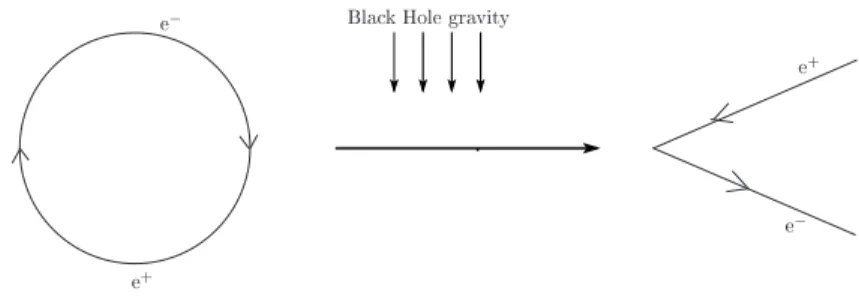
In other words, because vacuum bubbles of Feynman diagrams are no more bubbles(see Fig.6).
e +
e
BlakHolegravity
e +
e
Fig. 6: A vacuum bubble diagram is breaking
In QFT in Minkowski spacetime, vacuum bubbles represent virtual par- ticles that keep producing and annihilating. However, if there is a strong force, like a black hole gravity, vacuum bubbles break into a diagram which corresponds to a creation diagram. So pair-particles come from the vacuum!
This diagram breaking occurs not only by black hole gravity but also by other strong force. For example, the Schwinger effect is one of the famous pair- particle production phenomena. This effect is caused by a strong electrical field E ∼ 10
18V/m[15].
6 Phenomenology of Black Holes
In this Section I briefly describe phenomenology of black holes according to [12]. The Hawking formula (101) was derived in the previous Section. It is of great interest to study its consequences for physical and astronomical observations.
6.1 Black Hole lifetimes
In the previous Section, I derived the Hawking radiation. Once quantum ef-
fects are taken into account, black holes do radiate, therefore, black holes have
finite lifetimes. According to quantum mechanics, pair production of virtual
particles (∆E = 2mc
2)may take place in the vacuum, provided that they
annihilate within the short time allowed by the uncertanity principle:∆t ∼
ℏ /2mc
2. Such vacuum fluctuations will also take place in the neighbourhood
of black holes. As was shown in the previous Section, one of pair-particles falls beyond the event horizon and the other becomes a ”real” particle. In this process gravitational energy from the black hole is converted into the rest energy and the kinetic energy of the produced particle, so that energy of the order of ∆E is transferred from the black hole to the outside world.
Thus, the time which a black hole evaporates, in other words, the lifetime τ of the black hole, is given by [12]
τ ≈ 10
10( M 10
15[g]
)
3[years]. (103)
If M ≈ 10
15[g], τ is about 10 billion years. This is nearly the same value as the age of the Universe, so that heavy black holes are expected to have a very long lifetime.
6.2 Mini Black Holes
It is conceivable that ”mini” black holes(with r
s≈ 10
−15[m]) could have been formed during the Big Bang. Substituting this radius to the Schwarzschild radius formula, the upper limit mass of mini black holes is 10
15[g]. This is the reason I made a ratio in (103). The lower limit mass of mini black holes is also defined. It is the Planck mass ∼ 10
−5[g]. Because the Planck mass is the energy scale in which the gravitational and quantum effect are samely important, and the QFTCS is the low energy effective theory of the quantum gravity. For the Planck mass, the lifetime is 10
−43[sec] ∼ the Planck time.
This is the shortest possible time in physics, it is consistent with what I said above. From (103), black holes with masses much below 10
15[g] have a lifetime shorter than the present age of the Universe and should, therefore, have already been evaporated. Let us estimate the energy E of the gamma- rays radiated from a mini black hole. According to [12], it follows from (102) that
E ∼ k
BT ∼ ℏ c
3/GM ∼ 100
( 10
15[g]
M )
[MeV]. (104)
Therefore, cosmic rays with energies around ∼ 100 [MeV] are good candidates
for the gamma-rays from mini black holes. There are some attempts to find
mini black holes at the LHC or future colliders[16], [17]. It is not clear
whether this interesting object, which includes elements of special and general
relativity, quantum mechanics and thermodynamics, can be confirmed. Black
Holes and their Hawking evaporation are the theoretical laboratories where current ideas of quantum gravity are being tested.
7 Conclusion
I reviewed the Hawking radiation in this Thesis. First, I described the def- inition of a Schwarzschild black hole and its geometrical properties, and I showed some candidates for black holes. Second, I introduced quantum field theory in curved space is the main tool to analyze the Hawking radiation.
Basically, QFTCS is obtained by replacing the flat metric with a curved met- ric. The existence of many vacua in QFTCS causes the particle creation in curved space. Third, I explained the Bogoliubov transformation needed to interpret a number of particles. Next, I described the Hawking radiation in the Sandwich spacetime and in the Schwarzschild black hole. For the Schwarzschild black hole, the number of created particles per unit angular frequency and per unit time that pass through a surface is given by
1 2π
Γ(ω) e
8πGM ω/ℏc3− 1 . Therefore, the Hawking temperature is
T = ℏ c
38πk
BGM .
Finally, I briefly considered phenomenology of black holes including lifetimes of black holes and mini black holes. The lifetime of black holes is
τ ≈ 10
10( M
10
15)
3[years].
The energy of the gamma-rays radiated from a mini black hole is E ∼ 100 [MeV],
therefore, cosmic rays with energies around 100 [MeV] are good candidates
for the gamma-rays from mini black holes. And there are attempts to find
mini black holes at the LHC or in cosmic rays.
8 Outlook
In this section, I shortly introduce some fundamental unsolved problems, namely, the black hole information paradox and the Bekenstein-Hawking entropy. The following discussion is based on [4], [5] and [9].
8.1 Black Hole information paradox
When taking the Hawking radiation into account, a black hole will eventually evaporate, after which the spacetime has no event horizon. This is expressed by the following CP diagram:
singularityr=0
r=onst:<2M
r=onst:>2M H
I +
I i0 I
II
III
IV
v=v
0 v=v
1
Fig. 7: Information loss paradox
Here H represents a new horizon. Σ
1is a Cauchy surface
1for this space- time, but Σ
2is not, because its past domain of dependence does not include the black hole region. Information from Σ
1can propagate into the black hole region instead of Σ
2. Thus it appears that information is ”lost” into the black hole. This implies a non-unitary evolution from Σ
1to Σ
2, and, hence, the QFTCS is in conflict with the basic principle of quantum mechanics. To re- solve this problem, the black hole complementarity is suggested in [18]. The idea is that the information is both reflected at the horizon H and passes through it without being able to escape, then no observer is able to confirm both pieces of information simultaneously. The authors of [18] assumed a
1
![Fig. 1: M87 by 2MASS [13]](https://thumb-ap.123doks.com/thumbv2/123deta/10115455.1949438/6.892.215.410.187.409/fig-m-by-mass.webp)