Easy Credit Policy, Banking Crises, and Recapitalization Policy of a Central Bank
Ichiro TAKAHASHI
*and Isamu OKADA
†Abstract: This paper explores whether easy credit policy on the part of commercial banks
or unfavorable macroeconomic condition is more responsible for a systemic failure in a banking system. It also pursues the question of how promptly a central bank should inject capital into a commercial bank that faces a default crisis. To address these questions, we construct an agent- based model of asset and financial markets that consist of asset traders, commercial banks and a central bank. Our simulation results show that microeconomic factors, e.g., easy credit policy of individual banks, are more responsible than negative macroeconomic shocks in inducing a systemic banking crisis. We also find the commercial banks have an incentive to loosen their credit policies, which will lead to rapid credit expansion, and eventually to a systemic crisis through asset bubble.
This result suggests the need for prudential regulation of commercial banks.
1. Introduction
There has been a surge of bank insolvencies since the late 1970s. Capiro and Klingebiel (1997) note that (banking crises are) in many cases widespread enough to qualify as systemic
1. In fact, Caprio and Klingebiel (2003) reveal that 117 systemic banking crises have occurred in 93 countries, in a variety of industrial and developing countries during 1975-99. If the worst happens, a series of banking failures may trigger deflation. The Great Depression and Japan’s recent deflation teach us a lesson that deflation is not only devastating to the economy but also interminable once it starts.
Japan, was ailed by vicious deflationary spiral: Bad loans caused deflation and the deflation generated further bad loans
2. Although banking crises may not cause deflation, they certainly
* Faculty of International Liberal Arts, Soka University, 1-236 Tangi, Hachioji City, Tokyo, 192-8577, Japan, [email protected]
† Faculty of Business Administration, Soka University, [email protected]
1 Caprio and Klingebiel (1997) define bank insolvency as systemic if loan losses are sufficient to wipe out the system’s capital.
2 Zero interest rate policy boosts the demand for cash holding, which urges firms with excessive debts to make debt repayment. In order to prepare sufficient cash for repayment, these firms are forced to sell off their real assets, and to reduce investment spending. These decisions may be rational from an individual firm’s point of view because the values of real assets and the return on investment are falling,
make it worse. In fact, in single crisis countries, inflation usually falls once a banking crisis starts.
Inflation almost always falls further when a banking crisis ends
3.
Caprio and Klingebiel (1996) find the resolution of bank insolvency to be very expensive, placing a heavy burden on the country and on the government’s budget. When systemic banking failures break out, they can drain a country’s financial, institutional, and policy resources-resulting in large losses, misallocated resources, and slower growth
4. During 1992-2002, the total cost that Japanese banks spent to write off their bad loans amounted to 88 billion yen, or 16 percent of GDP.
5Caprio and Klingebiel (1997) also note that Argentina in the early 1980s likely saw the largest relative loss (estimated variously at 20-55 percent of GDP), with Chile not far behind (1302 percent of GDP).
The bursting of asset price bubbles often triggers banking failures. Before it is publicly acknowledged that banks are insolvent, there is a phase in which the banks sharply accumulate a large number of non-performing loans on their balance sheets, as pointed out by Claessens, Djankov and Mody (2001), Claessens, Klingebiel and Laeven (2001) and Beim (2001). Claessens, Djankov and Mody (2001) further notes that this situation is often accompanied by generally depressed asset prices, such as equity and real estate prices, following typical run ups before the crisis, sharp real interest rate increases, and a slowdown of or reversal in capital flows.
Typically, money, created by banks flows into stock and property markets, drives up asset prices and stimulates an economy. Autonomous reversal of trend or a change in monetary policy causes the bubble to burst, thus precipitating stock and real estate prices. As a result, the balance sheets of companies, individuals, and commercial banks, are substantially damaged. This means that there are serious shortages of capital for banks. Since banks are major providers of risk money for businesses, this will result in considerable decline in investment
6. One of the insightful papers by Kobayashi (2003b) points out assuming that the banks need to hold liquid assets to produce transaction services associated with the deposits, the growth of unbacked deposits forces banks to increase their holdings of liquid assets and to decrease loans to firms. Such a situation is seriously detrimental to an economy as a whole. Thus, preventing or alleviating financial distress is crucially important for the health of an economy.
but only worsening deation. Facing the surge in defaults and bad loans, the monetary authority decides to adopt zero interest policy to help banks, burdened with enormous non-performing loans. For more detailed explanation about debt deation and a systemic banking crisis in Japan, see (Kobayashi (2003a) and (2003b))
3 Boyd, et.al. (2001)
4 Capirio and Klingebiel (1997)
5 For more details, refer to the official home page of Financial Services Agency, http://www.fsa.go.jp/.
6 For more detailed argument, see for example, Stiglitz and Greenwald (2003).
Effort has been made to identify a single cause of banking crises. Economy-wide factors, including recessions, certainly place tension on weak banks. As other causes of bank insolvency, Caprio and Kliengebiel (1997) list general uncertainty, asymmetric information, speculative bubbles, and financial liberalization. The paper also cites a variety of regulatory and bank-specific management factors and emphasizes that the evidence both undermines single-cause theories of insolvency and finds a more important role for microeconomic factors than is commonly conceded.
Macroeconomic factors we will focus on in this paper are liquidation and credit standards. Since liquidating borrowers with non-performing loans is difficult and costly, banks that are in trouble have incentive to delay liquidation, and thereby continuously loan out even when the interest payments from the distressed debtors are unpaid. The resulting tendency for the insolvent banks to forbear from liquidation would increase their losses. Risky incentive may exist even in the good time. For example, a strong macroeconomic climate can easily erode prudent banking discipline by weakening necessity for strict credit standard.
By building an agent-based simulation model with asset traders and a single commercial bank, and a central bank, Takahashi and Okada (2003) obtain the following results: (1) the more restrictive loan supply policy banks adopt, the more stable and sustainable the economy becomes;
(2) the central bank’s intervention in the financial market is likely to improve the performance of the economy if the commercial banks adopt loose loan supply and non-performing loan policies; (3) the intervention tends to be ineffective, or even harmful, if the commercial banks adopt stringent loan supply rules and prompt liquidation policies. These results suggest that microeconomic factors, rather than macroeconomic factors, are likely to be the key to triggering a banking crisis. However, explicit comparisons need to be made to discern which factors are more fundamental.
This paper aims to answer the following questions: what causes banking system to collapse? In particular, which factor is more essential for the health of a banking system: decline in credit and liquidation standards, or unfavorable macroeconomic conditions? What will happen when banks interact with each other in determining degrees of prudence? We also address the question of what the appropriate recapitalization policy would be for preventing the banking failures. We will further investigate when recapitalization is effective and preventive against the recurrence of bank insolvencies. The answers to these questions will help to shed some light on microeconomic factors which induce the health of a banking system, and thereby provide a hint on regulatory framework that allows banks to respond more robustly to macroeconomic shocks.
To serve these purposes, we construct an agent-based simulation model with asset traders,
commercial banks and a central bank. The model both extended and simplified Takahashi and
Okada (2003): first, in order to examine the effect of bank-specific management policies, the model incorporates a multiple number of commercial banks; second, unessential details are omitted, e.g., removing cash holdings by households, to keep the model simple.
In this artificial economy, there are a number of proprietors who buy or sell land in an asset market. They also determine the level of consumption depending on their incomes and wealth. In order to design an economic environment that is prone to asset price bubbles, the proprietors are all modeled as trend-chasers in the way they forecast the future prices of assets. Each commercial bank lends funds to prospective buyers of assets by creating bank deposits, which are the only means of settlement, i.e., money. The economy either exports the surplus of consumption goods, or imports its shortage, which is settled by the commensurate in flow or outflow of short term securities. Since the size of these flows determines the excess supply or demand of the securities, it affects the rate of interest.
The simulation results obtained in the paper are as follows: (1) microeconomic factors are more important than macroeconomic factors for the robustness of a banking system; (2) the wider disparity of prudence the banks adopt for credit and liquidation standards, the more fragile the banking system becomes; (3) given the credit and liquidation standards of other banks, it is in the interest of one bank to decline the standards prior to the peak of asset prices; (4) this means that there is a situation of prisoner’s dilemma in which individual banks are motivated to relax the standards, resulting in rapid credit growth; (5) this suggests the necessity for either the coordination or regulation of individual banking rules.
Section 2 describes the agent-based model, Section 3 presents simulation results, and Section 4 discusses the results and future extensions. Section 5 concludes.
2. The Basic Model
Consider a small economy which consists of N proprietors, M commercial banks, and a central bank. The model allows of two interpretations: a small country and an isolated region in a country.
In the former case, we need to assume that this economy adopts a pegged exchange rate system at the rate of unity with global currency. In the latter case, a central bank should be replaced by a branch of a central bank. In what follows, we regarded the economy as a small country. For the latter interpretation, foreign exchanges should be taken as short term domestic securities.
In this economy, there is only one kind of goods that people value, namely, the composite
consumption commodity (the consumer goods). We assume that there exists neither tax nor
government expenditure. There are two types of production factors, labor and land. The economy
is endowed with N lots of land. Each proprietor works to produce W units of the consumer goods
every period. A proprietor can sell and buy land in an asset market. One lot of land produces R units of the consumer goods every period. The consumer goods are perishable and have the world price fixed at unity.
All transactions among the proprietors must be mediated by bank deposits. The proprietors are either not allowed to hold foreign exchanges or to lend or borrow among themselves directly. Each bank accepts deposits from their customers. For simplicity, we assume that each of the customers can not choose her bank for a geographical reason. Each proprietor can buy land from a seller in exchange for the bank deposit. Thus, the settlement of this transaction is made by changing the holder of the bank deposit. As a consumer, every proprietor determines how much to spend on the consumer goods. The difference between her income and consumption appears as a change in the amount of her bank deposit. In general, the supply of and demand for the consumer goods for the economy as a whole do not balance, causing trade imbalance, which is financed by a flow of foreign exchanges.
Time is discrete and the economy continues until period T (t = 1, 2, ..., T). In each period, the real estate and financial markets open, and transactions of land and funds are made, revising the land price and the interest rate.
2.1 Proprietors
Proprietors i owns Ln
tiunits of land in time t. For expositional convenience, the consumer goods produced by one unit of land is referred to as rent and those produced by a worker as wage. For later reference, let I = { 1, 2, ... , N} denote the set of all the proprietors. Each proprietor possesses at time t, bank deposit, DP
it. A negative value of DP
iimplies that she has borrowed a loan of the absolute value of DP
idollars from the bank. A landlord revises the disposable value of the lots she owns, AS
it, as
AS
ti= P
tLn
it, (1) (1)
where P
trepresents the market price of land. Net equity of Proprietor i is given by
E
it= DP
ti+ AS
ti. (2) (2)
This gives the equity ratio of Proprietor i as ER
i=ASi+max(DPEi i,0)..
The balance sheet of a proprietor with positive bank deposit DP > 0 becomes:
Table 1: Balance sheet of proprietor with deposit
Assets Liabilities + Equity
Land (AS)
Bank Deposit (DP) Equity (E)
Total(AS+DP) Total(E)
The balance sheet of a proprietor who has borrowed from bank (DP < 0) is:
Table 2: Balance sheet of proprietor with loan
Assets Liabilities + Equity
Land (AS) Loan Outstanding (
-DP)
Equity (E)
Total (AS) Total (
-DP+E)
Each proprietor receives interest income or makes interest payment depending on whether her bank account is positive or negative. Let r denote the rate of interest on deposit and that of loan by
r
�. Net interest income of Proprietor i, I
i, is given by I
ti(DP
ti) =
� r
�DP
tifor DP
ti< 0
rDP
tifor DP
ti≥ 0. (3) (3)
Thus, the income of Proprietor i in period t, Y
it, depends on the number of lots she owns and the amount of outstanding deposit or loan. This is shown as
Y
ti(Ln
it, DP
ti) = W + I
ti(DP
ti) + R × Ln
it+ I
ti(DP
ti) (4) (4) The level of consumption is assumed to be dependent on income, Y
t, and net wealth, E
tas follows:
C
t= α
ycY
t+ β
ceE
t, (5) (5)
where α
ycand β
cedenote marginal propensities to consume out of income and net wealth, respectively.
2.2 Commercial Banks
We assume that each of M bank takes interest rates as exogenously given as a result of competition. The rate of interest changes according to the volume of the excess demand for funds in the financial market. Each bank buys foreign exchanges if there is excess supply of funds, and sells them if there is shortage of funds. Thus holding of foreign exchanges can be positive or negative.
The positive holding means the economy provides short-term capital to the foreign country while the negative holding means borrowing. The bank also has a deposit account at the central bank, denoted by Res. Just like an individual proprietor uses her bank deposit as means of payment, an individual bank uses its deposit as means of payment to the other banks. For simplicity, we assume that the banks try to keep the balance of their accounts at minimum by swapping them for foreign exchanges.
The absolute value of sum of min(0, DP
i) is the loan outstanding (L
j) for each bank. The deposit
outstanding DP
jis defined similarly. We assume that the banks hold foreign exchanges, denoted by F, in the form of short term securities which bear interest.
The balance sheet for the bank, with positive holdings of both foreign exchanges and Res appears as:
Table 3: Balance sheet of commercial bank
Assets Liabilities+Capital
Loan Outstanding (L
j) Deposit Outstanding (DP
j) Land (AS)
Foreign Exchanges (F ) Capital (E ) Reserves (Res)
Total (L + AS + F + Res) Total (DP + E )
Here, we assume that the interest rate on deposits are equal to that on foreign exchanges, which positively depends on the sum of their amounts held by the banks:
r = 2 × r ¯
01 + exp �
�jDPj−� jLj N×C0
� (6) (6)
where r
0denotes the average interest rate, and C
0the average level of consumption, respectively.
Since loans to domestic investors involve risk of bankruptcy, the banks charge higher interest rates on the loans. The risk premium, η = r
�− r , is computed as the ratio of irrecoverable loans to total loans outstanding:
η =
�
i∈Λ
E
i�
j
L
j(7) (7)
where Λ denotes the set of liquidated borrowers.
Bank j sets a liquidation rule,
Eˆj, which is the minimum level of net deposit such that each of their customers goes bankrupt when her capital level falls short of it. Liquidating distressed borrowers is needed for banks to raise liquidity. Asymmetric information and opacity involved in bank loans, however, often force a bank to sell off assets at much lower price than they could without them. To reflect this cost, each bank incurs liquidation cost, LQ, for each occurrence of bankruptcy. Bank j also sets across the board credit limit,
DPˆj, for all of their customers. As long as a borrower keeps the amount of her outstanding loan below this credit limit, the bank does not demand the reimbursement of the principal of the loan.
The bank makes a landlord to sell one unit of land when her balance sheet is badly damaged
due to insufficient income or expected decline in the land price, represented as follows:
DPti+Yti−Litmax(0, Pt−4−Pt−1)<DPˆj. (8)
(8) The third term on the left hand side signifies the expected capital loss. This rule can be interpreted as a defensive behavior, voluntarily taken by the landlord.
In general, generous credit standard, i.e., the large value of DP ˆ
j, will incur downside risk of decreased liquidation value due to the continuously declining land price. Meanwhile, strict credit standard may deprive the borrower of the chance to get over the financial adversity. Credit limit depends on the financial condition of the bank itself. A bank with adequate capital is willing to take risks whereas a bank with inadequate capital becomes reluctant to lend funds. This is the so called restricted lending problem. In an extreme case, the bank forces borrowers to pay back the loan to collect the funds it has lent. The level of loan affordability depends on the capital ratio of the bank and takes on value zero if the capital ratio, ER
bt, stays below ER
bminand takes on the maximum value DP
*jif it is above ER
bmax. Specifically, the bank updates the credit limit according to
DP ˆ
j=
⎧ ⎪
⎨
⎪ ⎩
0 for ER
bt< ER
minbDP
∗j×
ERERbbt−ERbminmax−ERbmin
for ER
bmin≤ ER
tb< E
maxbDP
∗jfor ER
tb≥ ER
bmax.
(9)
(9)For obviating a banking crisis, the credit limits turn out to be crucially important.
2.3 Supply of and Demand for Land
How attractive the land is relative to financial assets determines the supply of and demand for land. In each period, a proprietor can sell or buy a single unit lot of land. The banks obtain land whenever they liquidate collateral for the non-performing loans. After transferring the ownership of the collateral by directly writing off the bad loans, the banks try to sell off the land. We assume that, in each period, an individual bank is allowed to sell off no more than S
bunits of land when the land prices are falling.
In the land market, characterized as monopolistic competition, a seller adjusts the price
gradually, with π
Las the speed of adjustment, based on excess demand for the land, G.
G
t= P
tD
t− S
tmax(D
t, S
t) , (10)
(10)and
P
t= π
LG
t+ P
t−1. (11)
(11)where S
tdenotes the supply of land and D
tthe demand.
The description of land transaction is omitted since we follow Takahashi and Okada (2003) in
determining the proprietors’ supply and demand.
2.4 The Central Bank and Recapitalization
The central bank should decide when to inject capital into the banks. We assume that the monetary authority conducts recapitalization by providing an exogenously fixed amount of
foreign exchanges,
p F ˆ , to banks in trouble, i.e., when the bank’s capital ratio falls short of some predetermined level, ER ˆ .
2.5 Income Redistribution
In this economy laissez-faire policy would result in extremely unequal distribution of income and property. As a result, the asset market becomes increasingly thinner, and thereby extremely volatile. This requires us to install some income redistribution device. Here, let us introduce property tax. Any proprietor who owns more than or equal to two lots of land must pay τ percent of property tax for each additional land in excess of one lot. This tax revenue is equally distributed among all the proprietors.
3. Simulation
This section describes the initial setting of parameters and presents simulation results.
3.1 Initial Setting
Each proprietor initially possesses one unit of land, i.e., L
i0and deposits outstanding DP
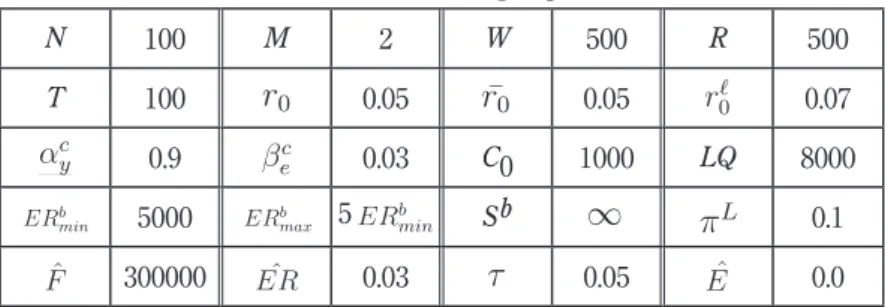
0i, which is uniformly distributed between $-5000 and $0. Table 4 shows the initial values of other parameters.
Table 4: Initial setting of parameters
N
100M
2W
500R
500T
100r
0 0.05r ¯
0 0.05r
�0 0.07α
cy 0.9β
ec 0.03C
0 1000LQ
8000 ERbmin 5000 ERbmax 5ERbminSb ∞ π
L 0.1p F ˆ
300000ER ˆ
0.03τ
0.05E ˆ
0.03.2 Reference Trends
Suppose that each of the banks can take either prudent or imprudent banking rules. To
examine the effects of these microeconomic factors, we set two pairs of parameters as Rule
1and
Rule
2: (1) Rule
1= (
Eˆj= - 0.0, DP ˆ
j= - 5,000); and (2) Rule
2= ( E ˆ
j= - 10,000, DP ˆ
j= - 20,000).
First, we conduct simulation for two scenarios: The both banks follow (1) Rule1; and (2) Rule2.
Figure 1 and Figure 2 plot the sample trends of the observation indices: the land price, the rate of interest, the money supply, and the bank’s capital ratio for each of these rules.
Second, in order to investigate how individual banks interact among themselves, we will focus on the credit limits. Fixing liquidation rule at E ˆ
j= 0, each individual bank chooses
DPˆjfrom the parameter space, {
-5,
-10,
-20,
-∞ }
× 103. Table 5 shows the period at which the centralbank depletes all the capital.
Table 5: The length of periods central bank survives
DPˆ1= - 5,000
-10,000
-20,000
-∞
DP ˆ
2=
-5,000 ∞ 409 158 9
-
10,000 - 845 125 36
-
20,000 - - 58 21
-
∞ - - - 27
Next, we assume that there is once and for all change in the value of W. W is kept at 500 during first 50 periods, and reduced to 0.0 and kept at this level thereafter. This huge reduction in W is to capture a substantial macroeconomic shock. The Figure 3 shows the trends of major observation indices when the both banks follow Rule
1. We will take a closer look at the case with (
DPˆ1,
DPˆ2)
= (
-8, - 10) × 10
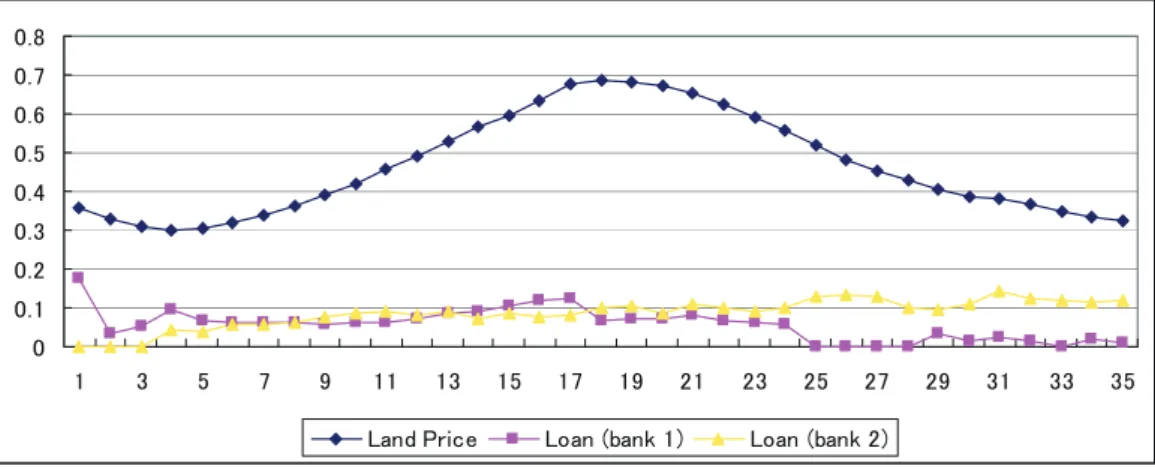
3. Figure 4 shows the trends of the land prices, and the loans outstanding of the two banks. Furthermore, fixing DP ˆ
j=
-20,000 for the both banks, we also conducted a series ofexperiments with two different values of S
b, i.e., {3, ∞ } to examine the effect of liquidation speed on the land price and the money supply. See Figure 5.
The final experiment is conducted to answer the following question: Should a central bank conduct recapitalization in a preemptive manner, or only after a banking crisis becomes obvious?
Figure 6 plots the land price and the bank capital ratios for (1) ER ˆ = 0.10, and (2) ER ˆ = 0.03.
4. Discussion
4.1 Macroeconomic versus Microeconomic Factors
As stated earlier, both macroeconomic and microeconomic factors involve systemic banking
crises. In this paper, the credit and liquidation standards represented by E ˆ
jand DP ˆ
jare among
these microeconomic factors. Figure 1 shows that the prudent banking policy maintains the health
of both the banks and the economy. This is because good credit discipline provide good business
environment by keeping the money supply fairly constant. In contrast, imprudent credit rule causes asset price bubbles and resulting in banking crises as shown in Figure 2. With prudent banking rules, the land prices and the money supply are fairly stable. Consequently, there is no need for capital injection. In Figure 2, the movement of the land prices and the money supply are more volatile. This result verifies the observation by Caprio and Kliengebiel (1997): Rapid credit growth often leads to or reflects a decline in the credit standards of individual banks. As a result, banking crises recur.
On the other hand, the substantial decline in wage rate corresponds to a macroeconomic shock. Which of these factors are more potent causes of banking crises? Figure 2 and 3 allows us to compare banking policies with macroeconomic shocks. Figure 3 indicates that, when the both banks adopt prudent standards, the banking system remains healthy even when quite a large macro shock hits the economy. The comparison appears to suggest that microeconomic factors are key factors for banking crises. Prudent risk taking considerably makes a banking system robust to macroeconomic shocks. This result implies that with imprudent credit and liquidation rules, even a minor macroeconomic shock is likely to result in banking failures. This is because the imprudent banking is like throwing fuel on a fire. It causes rapid credit growth and results in soaring asset prices. This, in turn, damages the balance sheets of the proprietors, and those of the banks eventually. This finding is consistent with historical evidence as Caprio and Klingebiel (1997) remark: although macroeconomic factors are important, microeconomic and incentive factors likely are key to determining the magnitude of banking problems and in some cases are even the main cause.
4.2 Incentive for Declining Standards
Table 5 shows that substantial disparity in the credit limits would cause the failures of banking system. Let us focus on two levels of credit limit, i.e., {50, 10} ~ 10
3. A bank with imprudent banking has far better chances to survive; the imprudent bank outperforms the other bank with prudence.
The customers transacting with an imprudent bank can take advantage of generous credit standard to buy land. Thus, they continue to buy land and thus accumulate their fortunes, assisted by steadily increasing asset prices, whereas the customers of the other bank misses the chance to be rich because the strict credit standard of their bank makes it difficult to make use of loans. This arises as the constant out flows of outstanding loans and deposits in the prudent bank’s balance sheet. Hence, even when both of the banks can benefit from prudential banking, either of them has an incentive to deviate from it. Thus, when there is a huge disparity of these rules among the banks, the banking system are likely to become fragile.
Nonetheless, in the real world, it is unlikely to find such substantial differences in credit and
liquidation standards among banks. This leads us to the next question. What if there is a smaller disparity in these rules? Consider DP ˆ
1=
-10,000,DP ˆ
2=
-8,000. Figure 4 shows that, until thebursting of an asset price bubble, the bank with less prudence earns more profits by increasing the loans more rapidly than the bank of prudence. This is a situation like prisoner’s dilemma. When credit growth is underway, it is in each bank’s interest to be abreast or even ahead of other banks by declining the credit standard. However, the imprudent bank eventually gets hurt more severely after the bubble burst by the larger number of bankruptcy of their customers than the prudent rival does. Myopic incentive to decline these standards is likely to cause rapid credit growth, resulting in an asset price bubble.
This experimental result is consistent with the finding by Gavin and Hausmann (1996): In short, these information problems imply that the very rapid expansion of bank balance sheets that occurs during a lending boom is likely, over time, to generate a deterioration of banks balance sheets. When individual banks are motivated to decline standards, it may be hard for them to impose such discipline, which implies the necessity of prudential regulation of banks.
4.3 The Speed of Liquidating Assets
In liquidating distressed borrowers, the banks obtained the borrowers’ collateral assets. The question is how quickly the banks should sell off their assets? As shown in Figure 5, it is more beneficial for the banks as well as the economy to dispose gradually these assets. A small value of S
bhelps to stabilize the land price and the money supply greatly. The reason should be obvious. Slower disposal can help maintain asset prices while quick sales leads to sharp decline in their prices, inflating bad loans even more. Since individual banks may want to sell them off to avoid downward risk, some central organization for buying and selling bad loans may be needed for asset price stability.
4.4 Central Bank
Capital injection of public funds into private banks is not politically easy. Nonetheless, Figure
6 suggests that expeditious recapitalization is necessary and helpful. Preempting recapitalization
will help banks to maintain their credit creation. This, by stabilizing the land price, will prevent the
bad loans, thus keeping the banks’ capital ratio. Consequently, no further capital injection will be
needed. In contrast, the delayed injection will cause the banks to reduce lending, leading to he burst
of bubbles. Thus, delayed recapitalization should be less effective and more costly than prevenient
one.
5. Conclusion
A systemic banking crisis is extremely costly. In the worst case, it gives rise to deflation. The paper constructs an artificial economy with an asset market in which proprietors and banks interact.
Our experimental results show that prudent credit standard is crucially important to keep the banks and the economy healthy. There exists an incentive on the part of an individuall bank to decline the standards. This can lead to rapid credit expansion, thus generating an asset bubble. This suggests the need for prudential regulation of banks. The monetary authority should also act promptly to save banks in trouble because a prevenient capital injection is more effective and less costly than a delayed one.
Several extensions seem interesting. First, the model needs to incorporate explicit liquidation rules for commercial banks to analyze contagion phenomena. The current model does not allow for the contagion of one bank failure to other banks because this paper assumes the central bank’s commitment to protect bank deposits. Second, the model does not have investment to increase capital stock. The shortage of risk money discourages investment, which in turn reduce aggregate demand. To capture deflationary spiral, investment behavior needs to be modeled. Finally, the central bank should be given wider range of policy tools other than capital injection. It is not difficult to incorporate monetary policy in conjunction with the money supply.
References
Beim, D.O. (2001). What Triggers a Systemic Banking Crisis? Working Paper, Columbia University, June 19, 2001.
Boyd, J., Gomis, P., Kwak, S., Smith, B. (2001). A User’s Guide to Banking Crises, as http://www.
worldbank.org/research/interest/confs/upcoming/deposit_insurance/ppt/boyd_smith/sld001.
htm
Capprio J.G. Klingebiel, D. (1996). Bank Insolvencies: Cross-Country Experience, World Bank Policy Research Working Paper 1620.
Capprio J.G., Klingebiel, D. (1997). Bank Insolvency: Bad Luck, Bad Policy,or Bad Banking?
Annual World Bank Conference on Development Economics 1996 The World Bank.
Capprio J.G., Klingebiel, D. (2003). Episodes of Systemic and Borderline Financial Crises, as http://econdev.forumone.com/view.php?type=18 &id=23456
Claessens, S., Djankov, S. Mody, A. eds. (2001). Resolution of Financial Distress, World Bank Institute.
Claessens, S., Klingebiel, D. Laeven, L. (2001). Financial Restructuring in Banking and Corporate
Sector Crises: What Policies to Pursue? NBER Working Paper 8386.
Kobayashi, K. (2003a) A Theory of Banking Crises, RIETI Discussion Paper Series
03-E-016Research Institute of Economy, Trade and Industry.
Kobayashi, K. (2003b) Deflation Caused by Bnak Insolvency, RIETI Discussion Paper Series
03-E-022 Research Institute of Economy, Trade and Industry.Gavin, M., Hausmann, R. (1996). The Roots of Banking Crises: The Macroeconomic Context, Office of the Chief Economist, January 27, 1998, Inter-American Development Bank.
Stiglitz, J., Greenwald, B. (2003). Towards a New Paradigm in Monetary Economics (Raffaele Mattioli Lectures), Cambridge University Press.
Takahashi, I., Okada, I. (2003). Monetary Policy and Banks’ Loan Supply Rules to Harness Asset
Bubbles and Crashes, Multi-Agent-Based Simulation III. 4th International Workshop, MABS
2003 Melbourne, Australia, July 2003, Revised Papers., Hales, D., Edmonds, B., Norling, E.,
Rouchier, J. (eds.), Springer, Lecture Notes in Artificial Intelligence 2927, 89-105.
㪇 㪇㪅㪉 㪇㪅㪋 㪇㪅㪍 㪇㪅㪏 㪈 㪈㪅㪉
㪈 㪋 㪎 㪈㪇 㪈㪊 㪈㪍 㪈㪐 㪉㪉 㪉㪌 㪉㪏 㪊㪈 㪊㪋 㪊㪎 㪋㪇 㪋㪊 㪋㪍 㪋㪐 㪌㪉 㪌㪌 㪌㪏 㪣㪸㫅㪻㩷㪧㫉㫀㪺㪼 㪛㪼㫇㫆㫊㫀㫋㩷㪠㫅㫋㪼㫉㪼㫊㫋 㪙㪸㫅㫂㩾㫊㩷㪚㪸㫇㫀㫋㪸㫃㩷㪩㪸㫋㫀㫆 㪤㫆㫅㪼㫐㩷㪪㫌㫇㫇㫃㫐
㪇 㪇㪅㪉 㪇㪅㪋 㪇㪅㪍 㪇㪅㪏 㪈 㪈㪅㪉 㪈㪅㪋 㪈㪅㪍
㪈 㪍 㪈㪈 㪈㪍 㪉㪈 㪉㪍 㪊㪈 㪊㪍 㪋㪈 㪋㪍 㪌㪈 㪌㪍 㪍㪈 㪍㪍 㪎㪈 㪎㪍 㪏㪈 㪏㪍 㪐㪈 㪐㪍 㪣㪸㫅㪻㩷㪧㫉㫀㪺㪼 㪛㪼㫇㫆㫊㫀㫋㩷㪠㫅㫋㪼㫉㪼㫊㫋 㪙㪸㫅㫂㩾㫊㩷㪚㪸㫇㫀㫋㪸㫃㩷㪩㪸㫀㫆 㪤㫆㫅㪼㫐㩷㪪㫌㫇㫇㫃㫐
㪇 㪇㪅㪈 㪇㪅㪉 㪇㪅㪊 㪇㪅㪋 㪇㪅㪌 㪇㪅㪍 㪇㪅㪎 㪇㪅㪏 㪇㪅㪐
㪈 㪍 㪈㪈 㪈㪍 㪉㪈 㪉㪍 㪊㪈 㪊㪍 㪋㪈 㪋㪍 㪌㪈 㪌㪍 㪍㪈 㪍㪍 㪎㪈 㪎㪍 㪏㪈 㪏㪍 㪐㪈 㪐㪍 㪣㪸㫅㪻㩷㪧㫉㫀㪺㪼 㪛㪼㫇㫆㫊㫀㫋㩷㪠㫅㫋㪼㫉㪼㫊㫋 㪚㫌㫊㫋㫆㫄㪼㫉㫊㩾㩷㪜㫈㫌㫀㫋㫐
Figure 3: The effect of a macroeconomic shock Figure 1: Banks with Rule
1Figure 2: Banks with Rule
2㪇 㪇㪅㪈 㪇㪅㪉 㪇㪅㪊 㪇㪅㪋 㪇㪅㪌 㪇㪅㪍 㪇㪅㪎 㪇㪅㪏
㪈 㪊 㪌 㪎 㪐 㪈㪈 㪈㪊 㪈㪌 㪈㪎 㪈㪐 㪉㪈 㪉㪊 㪉㪌 㪉㪎 㪉㪐 㪊㪈 㪊㪊 㪊㪌
㪣㪸㫅㪻㩷㪧㫉㫀㪺㪼 㪣㫆㪸㫅㩷㩿㪹㪸㫅㫂㩷㪈㪀 㪣㫆㪸㫅㩷㩿㪹㪸㫅㫂㩷㪉㪀
Figure 4: Interaction between banks with asymmetric rules
㪇 㪇㪅㪉 㪇㪅㪋 㪇㪅㪍 㪇㪅㪏 㪈 㪈㪅㪉 㪈㪅㪋 㪈㪅㪍
㪈 㪌 㪐 㪈㪊 㪈㪎 㪉㪈 㪉㪌 㪉㪐 㪊㪊 㪊㪎 㪋㪈 㪋㪌 㪋㪐 㪌㪊 㪌㪎 㪍㪈 㪍㪌 㪍㪐 㪎㪊 㪎㪎 㪏㪈 㪏㪌 㪏㪐 㪐㪊 㪐㪎 㪪㪹㪔㪊㩷㩿㪣㪧㪀 㪪㪹㪔㺙㩷㩿㪣㪧㪀 㪪㪹㪔㪊㩷㩿㪤㪪㪀 㪪㪹㪔㺙㩷㩿㪤㪪㪀