1.0 Introduction
This project has been arranged to indicate the intentions of building a productive Kids English language and education program simultaneously.
Through describing the syllabus content the reader will be able to identify current pedagogical practices in facilitating a language course for future teachers of English as a Second Language (ESL). As this study is in its second year the investigation will draw on comparisons from last year’s published research. The language exercises and explanations of classroom activities will support the ongoing task of preparing preschool teachers for the needs of the twenty- first century. In the first paper published in the previous year, the study focused on constructivist views on implementing language targets while quantitatively analysing data from those exercises.
Again in this paper the notion of building second language communication on previously acquired
knowledge will be address; likewise reflections on the results will be examined through observation and readings. Unlike the previous year, this investigation will concentrate primarily on qualitative research to generate ideas for continuing the development of English teacher training for young learners. In a general sense, the Kids English program has enjoyed the freedom of methods and practice in the first year.
Although, ideally the aim is to establish a curriculum that will show results in terms of fostering teaching skill and advancing English language development that future employers can acknowledge.
1.1 Background / Overview
Ideally, the Kids English project should meet requirements to justify the course content while overtly indicating exactly what students have learnt through practical games and activities. Thereupon, these skills specialize in language acquisition for
Activities for teaching and learning Kids English
― A second year research project into facilitating a practical foreign language course ―
教育と学習のための活動Kids English
― 実践的な外国語コースを容易にするための2年次の研究プロジェクト ―
キーワード:教育学,学習的アクティヴィティ,興味を引く,円滑化
要旨:この研究では,こども発達学科のKids Englishプログラムに関連する活動に焦点を当てます。
若い学習者が第2言語の学習に興味を持つようにするために,親,教師,教育現場での努力が必要で す。さらに,学習の内容は,注目を集めるだけでなく,永続的な印象を残すために魅力的でなければ なりません。日本は教育システム全体でより高度なコミュニケーション能力を求め続けていますが,
最も重要な段階は学習が楽しいはずの初心者レベルです。基準が満たされるように,Kids Englishの ようなカリキュラムは21世紀の特定の固定理念を見つける必要があります。うまくいけば,この2年 次の研究は正しい方向に進み,現代の英語の習得目標を達成し,将来の教師を適切な言語指導の方法 で訓練することができます。
WALSH, Anthony Department of Child Development Faculty of Education for Future Generations 次世代教育学部こども発達学科 アンソニー・ウォルシュ
22
younger learners. Providing an easy to follow step by step approach provides the nucleus for justifying the language gains while instigating techniques in enhance teaching skills. In that respect, rationalizing how students are to be evaluated is imperative to producing qualified teachers who can meet the needs of the teaching profession. Currently in Japan there is not a standard teaching practice for English instructors of younger learners which are considered the standard. Hence, the push to create programs which can overtly recognise and assess standards of practice is clearly required throughout Japan.
The Kids English program has fewer members this year than last with 11 students or Pre- Service English Teachers (PSET) in first year and 7 PSET in the second year. In second semester, one first year student quit and four second year students discontinued. The reasons given were an overcrowded curriculum which caused class timeslots to clash. Students chose to do sports, music or to focus on getting an additional primary school qualification, making their four year undergraduate status a triple degree. This was a significant drop from over 20 members in the first year. Naturally, having students with multiple interests can factor into the amount of time they can spend on mastering skills. For students that also belong to the Marching Band, they have practice sessions almost every weekday and have regular competitions on the weekends. As for the students involved in sports club activities, they also have practice session and commitments. On top of that, many students have part time work in the evenings in employment workplaces such as family restaurants and convenience stores. All of these responsibilities take their attention away from time to develop foundations of English. Also, it leaves them so tired that they are prone to fall asleep during class.
Therein, for the program to maintain a level of enthusiasm and momentum, the activities are forced to be active, stimulation and above all rhythmical.
Furthermore, Hayes, Mills, Christie, Lingard (2006) express productive pedagogies rely on supportive staff, students and people in the institution to work
together. Consequently, cooperation between all members of the university community is imperative to ensure success.
For the PSET to cognitively learn new concepts and build personal understanding they are required to construct information in a logical order they can internalize by themselves. Piaget (1926, cited in McInerney & McInerney, 2006) initially, coined the idea of schema. In his view learning occurred within the individual rather than transported from one to another. Expanding on this view Driver et al (1994 cited in McInerney & McInerney, 2006) refer the term more broadly as social constructivism which centres on learning from our environmental surrounding. Those messages children receive from their parents, siblings, neighbours, teachers and other people who come into their lives. The Kids English learning curve appears to be at a steady pace for all individuals members. Yet, at this 1st and 2nd year stage, they do not show high enough levels of leadership skills to teach a class by themselves.
Another distraction for first year learners is one of the members had lived in New Zealand for two years. She has near native level in spoken English.
Whenever the teacher communicates, all the first year members would ask her for the translation.
Often they would speak in Okayama dialect and ask her, “Nanto yuton”, which is a very casual way of asking, “What did he say?” inevitably, students were only learning through her translation and not trying to conceptualize the English spoken by the teacher.
Fortunately, through this method student did still analyse the language content even if it was not the intention of the teacher to do so.
For second year PSET that take three sessions of Kids English per week in second semester, they were able to have 5 New Zealand exchange students participate in Monday classes. Through this exchange once a week, the PSET could engage in cultural understandings and language discussion.
As the Associate Teacher (teacher in charge of the class) is in his mid forties and the New Zealanders
(TAs) are in their late teens early twenties, this was an excellent chance for students to listen to authentic language from peers their own age. The TAs, were all in voluntary nonpaid positions and did not receive credit for participating, yet they were able to make friends with Japanese PSET’s outside of their department and away from their small group, this was worth the effort for them to include this subject. One of the issues that faced one of the PSET’s was Second Language Learners (SLL) can take a long time to answer in English. In the case of young people, they like to talk in banter with the conversation jumping from person to person in a catch ball like scenario. When the Japanese students took a long time to answer questions the momentum dropped and conversation cessed. Savage (1991) suggests the teacher should find a balance in pacing the class and 75% of students should be able to keep up. The teacher made an issue of this and asked the New Zealanders how they could counterbalance this situation and how should they handle a student’s that take a long time to process second language with a response? As a group, they all made comments such as being patient and not rushing them was important.
They all tended to be empathetic to the students needs. One of the New Zealanders summarized the TA experienced by sending the teacher a message pointing out, “I get to meet new people and become friends. I can also learn from them and different aspects of their culture.” It would be favourable to have TAs in all Kids English Classes in the future, yet probably not feasibly possible.
2.0 Language tools for learning English
As English is not a set system of language forms, learners are required to activate dynamic patterns of communication. High frequency phrases such as, “one, two, three”, or “once upon a time, in a land far away”, or “are you ready to Rock’n Roll”
are repetitive essentially in music and storytelling.
Combining high frequency phrases with low frequency expressions assists in building language forms, so the SLL they can expand their regular usages by adding to these phrases for different
situations (Ellis, 2002a).
One of the main methods for learning English in IPU throughout the curriculum is by listening to music while performing a cloze text. Many of these activities which concentrate on building on high frequency phrases at IPU follow on from the training of a former Dean in the New Zealand campus and respected teacher in the field of language teaching John Fanselow. Expanding on his work in Fanselow (1976) suggests teachers should scrutinize and explores SSL through unconventional teaching methods. His theory recommends the teacher to do the opposite of what they normally would do in class by changing routine. The reason behind this is the classroom is often not the most ideal place to learn language due to the discourse used is often different to what you would hear outside of the class. An example of practice use of English is in figure 1.0.
Students would listen to the song two or three times and try to guess the answer. In figure 1.1 students receive the translation giving making the cognitive process more relaxed. Ideally, the learner would benefit from more challenging activities, yet that is where the teacher may build activities a little more difficult and challenging over a period of a few weeks.
At the end of a cycle of learning, the student should be able to speak (sing) or write a phrase in both first and second language.
Moving away from pop music and turning the attention to children’s themes, the syllabus of most classes at IPU also included Music and Movement from the, “Let’s Sing Together CD”. One of the noticeable aspects of children’s songs is the harmonies are the same with the lyrics changed. In songs 2.0 and 2.1 as well as 2.2 and 2.3 both tunes are identical. Therefore, the karaoke version of the songs will be played and the teacher can sing the different song’s lyrics. In the 2.4 to 2.6 songs, they were classic songs created by Patty and Mildred Hill sisters from Kentucky. The purpose of the songbook maladies was designed for kindergarten students to get connected in learning to communicate.
44
In the process of investigation short stories, figure 3.0 to 3.6 is a collection of activities from the children’s book “The Ginger Bread Man” retold by Sue Arengo in 1998. The amount of children’s literature is enormous and the concepts of pre- reading, reading and post-reading activities are
very useful with support from a parent, teacher or elder. Wood, Bruner and Ross (1976) suggest while carrying out activities they call, “scaffolding” the young learner becomes interesting because they can break down the learning content and make it easier for them to understand. They can point out
Figure 1.0
2.0 Head Shoulders Knees and Toes 2.1 Red Yellow Blue and Green 2.2 Twinkle Twinkle Little Star
2.3 ABC’s
2.4 Good Morning To You 2.5 Good Bye to You 2.6 Happy Birthday To You
Figure 2.0
3.0 Vocabulary Short Vowel Sounds beginning with ‘A’ woman, man has (z), happy, can, catch. Take all short vowel sounds ‘AEIOU’ words from the text and practice using them in activities before reading.
3. 1 Listen and Repeat to the words. The teacher says the words first students repeat. Do this activity twice with the students saying the word first and teacher echoing next.
3.2 Read until the short vowel letter to enthuses the short vowel sound.
3.3 Change speeds when the students have understood the pronunciation.
3.4 Group Chorus “Run Run, yes you can, but you can’t catch me I’m the Gingerbread Man” .This phrase the students practice and master, before you start to read the book and is used 4 times during the story.
3.5 Read the story (Graded Reader level 2). This book should take under 5 minutes to read.
Naturally, reading children’s books requires changing the pitch of your voice and eliciting questions during the story.
3.6 In the case of ‘The Ginger Bread Man’, the story has a tragic ending. The meaning of this can be used as a topic for discussion and/or reflection.
Figure 3.0
D"lll",::, I 0
・Little Mix clozc question:
・Last night I cause I realized the truth, they can't love me like you.
・Answer:
・Last night I lay in bed so blue. Cause I realized the truth, they can't love me like you
・It seems like gravity keeps pulling us back down
( 重力が俺たちを引き摺り込もうとしてるみたいだ)
・Don't go it's a mighty long fall
(行く な そっちは奈落の底だ)
・When you know time is up
( 時間切れ だと気付い てるなら )
5 5
what’ s important and create
a smooth transition
bet wee n p age s. W ith th eir su ppo rt the ch ild is le ss
lik ely to ex per ien ce anx iet y o r f rus tra tio n. A s w ell
as telling stories from
books, scaffolding can also
be
done through finger play
or other gesture, pictures,
symbols or word games.
In addition, selecting a
leader can also be
done in traditional ways
such as
through the
“Eeny Meeny Miny Moe”
chant.
In the
case of this rhythmical game to
choose a leader has
its variations around the
globe. This song can
has
issues with political correctness,
so the teacher may
need to be aware of whether
this could cause more
harm than good. Eeny
Meeny Miny Moe, catch
a tiger by the toe, if he hollers let him go. Eeny Meeny
Min y M oe.
In som e r acis t ve rsions , t he tige r i s
replaced by a derogatory word.
As mentioned earlier in
this paper, Fanselow
(1976) views of teachers
breaking the traditional
classroom stereotype rules can
be seen in figure
4.0.
As you ca n s ee the te xt is ups ide d ow n. Du rin g a
training session lead by
Professor Fanselow three
yea rs ago th e w rit er ask ed him w hat th e p oin t
was of doing activities
such as reading backwards,
wri ting b ack war ds or p utt ing se nte nce s t oge ther
back to front, he
said, “the brain can
synthetise the
information and has more
chance to cognitively
remember grammar points” . At
the time, naturally
there was concern that
teaching students to do
things in unusual ways
would confuse them because
it was not authentic
use of language. He
continued
by suggesting students need
to be challenged and
stimulated. These activities help them to absorb new
grammars and meanings of
words. Additionally, he
recommended drawing pictures rather
than writing
wor ds. A s t he Japa nes e w ritin g sy ste m u ses K anj i a s
its main writing system,
students can relate to
the
symbols of words to gain meaning.
Keeping a diary while
focusing on correcting
mistakes students often make.
Selinker (1972) coined
the term
‘Interlanguage’ and an example
is in 5.0
paragraph, which is understandable
for a native
reader, but not technically
correct English.
Students
can make comparisons to
the 5.1 paragraph for
the
common mistakes which are
made by SLL. Without
this example, students would
very rarely write a
journal of much substance.
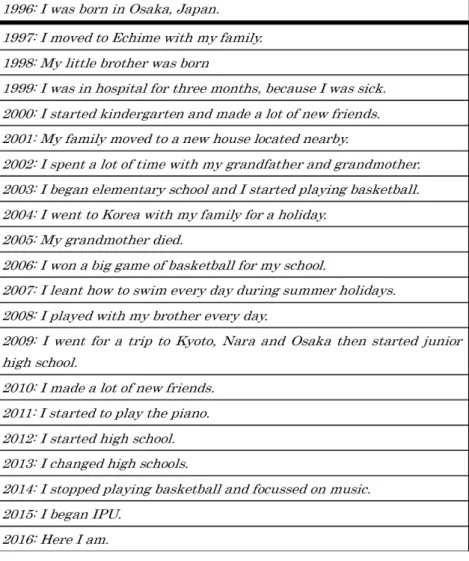
In Figure 6.0, it
shows a yearly breakdown
chronological breakdown of one of the 2
year PSET nd
lif e. T his ide a ex pand s o n Er iks on (19 50) coi ned
“Psychosocial Stages”
of infant and
adolescent
periods of social developmental.
As the
nd 2
year
students are all 19 or 20 years old
this will identify
all of the times th ey went fr om deve loping
their personalities. They perform this through writing and
speaking activities.
As the students go
through the
different years of their
lives they also conceptualize
the different social stages
which are very important
Figure 4.0
1. His name's Tomohiro and he likes playing video games.
2. Her name's Tomoko and she lik四 goingshopping. 3. Tomohiro and Tomoko are brother and sister. 4. They live in Hiroshima with th曲 motherand
father.
S. Tomohiro is funny and Tomoko is smart. 6. They're both interesting and taclka廿ve. 7. He's a teacher and she's a doctor.
u O l l e l O l a
66
for students in the department of child development.
3.0 Comparisons from the initiation of Kids English to this sophomore year and results
In the first year PSETs worked from the Firsthand Student textbook and in this year they changed to Step Into English 2 textbook Graham-Marr and McCandie (2013). Overall, the dialogues from the text were at a level between 200-350 points in TOEIC for both books. What did make a difference was the curriculum included another IPU teacher to teach TOEIC and TOEIC Bridge preparation courses.
This meant the PSET was able to build on their foundation of English skills from two teachers. The TOEIC teacher is native Japanese, so the PSETs could also benefit from the ability to explain in clear first language. In a general sense, the activities were all routine Present-Practice-Production method in both years with minor alterations. At this stage, it would appear the two years have seen progress in marginal terms, yet the standard of English has not exhibited any noticeable change. As a teachers view, explanations have shortened and expectations have become lower in terms of student commitment to stay on task. Realistically, expecting students to focus on teacher centred curriculum as it is now would be unrealistic. Therefore, the writers teaching style is in the process of change (development). Undeniably,
this approach to teaching will have an effect on the program in the future.
4.0 Future Direction for Research into Kids English at IPU
For current 2nd year students moving into 3rd year, they will have the opportunity to study abroad at the New Zealand Campus for a semester. Whereas, the 1st year students are in the process of participating in a Cambridge Knowledge of English Test (KET).
With this qualification they will be able to use it when they search for employment after graduating. The Cambridge system also has a Teachers Knowledge Test (TKT) which could be beneficial and could influence the IPU curriculum content in the future.
In 2018, IPU will provide students with a degree in early childhood studies, for the members of Kids English they will also receive a Soshi Gakuen (IPU parent company) certification of English studies.
Whether to continue with a Cambridge system or create a system focussing on phonics and routines for younger learners will need to be decided over the next year. Whichever direction the course takes, the prospective results for the program will need to show clear goals for students to aim to achieve.
Figure 5.0
Fl
・Saturday, I go Aeon Mall with friend Minori. We eat lunch at French mise and drink coffee at nice shop. Next,I want go Hinase for oyster with family member.・Bye bye,
・Hanada Aoi
□
・Last Saturday, I went to Aeon Mall with my friend Minori. We ate lunch at a French restaurant and then we drank coffee at a nice cafe. Next weekend, I want to go to Hinase and eat oysters with my family. How is
everything with you? Good I hope.
・Take care,
・Aoi Hanada
5.0 Conclusion
In this current age as education moves from twentieth century to twenty first century techniques and practices, the Kids English program has moved in a positive direction from its first year. In the progress of growing one year older, the games and activities have reflected the needs of its PSET which can be transferable into English language development.
Introducing new activities that can be evaluated and graded by an official measuring system will help to give purpose to the curriculum content. Also, having clear language targets will provide direction for all of the members from both learning and teaching backgrounds. Hopefully, this program can inspire future English teachers to develop their own skills while they in turn help others.
References:
Asher, J. J (1966). The Learning Strategy of the Total Physical Response: A Review. The Modern Language Journal. Vol 53 No. 1 PP. 3-17 JSTOR.
Ellis, N. C. (2002a). Frequency effects in language processing: A review with implications for theories of implicit and explicit language acquisition. Studies in Second Language Acquisition 24, 2, 143-88 Erikson, E.H. (1950). Childhood and society. New
York+ W. W. Norton.
Fanselow, J. F. (1976). Breaking the Rules of the Classroom Game Through Self Analysis.
Hayes, D., Mills, M., Christie, P., & Lingard, B. (2006).
Productive pedagogies. In Teachers and Schooling:
Making a difference – Productive pedagogies, assessment and performance (pp.32-81). Crowsnest, NSW: Allen & Unwin.
McInerney, D. M., & McInerney, V. (2006). Effective teaching and learning. In Educational Psychology:
Figure 6.0 1996: I was born in Osaka7 Japan.
1997: I moved to Echime with m y family. 1998: M y little brother was born
1999: I was in hospital for three months7 because I was sick. 2000: I started kindergarten and made a lot of new friends. 2001: M y family moved to a new house located nearby.
2002: I spent a lot of time with m y grandfather and grandmother.
2003: I began elementary school and I started playing basketball. 2004: I went to Korea with m y family for a holiday.
2005: M y grandmother died.
2006: I won a big game of basketball for m y school.
2007: I leant how to swim every day during summer holidays. 2008: I played with m y brother every day.
2009: I went for a trip to Kyoto7 Nara and Osaka then started junior high school.
201
o :
I made a lot of new friends. 2011: I started to play the piano. 2012: I started high school. 2013: I changed high schools.2014: I stopped playing basketball and focussed on music.
2015: I began IPU.
20J 6: Here I am.
88
Constructing learning (4th ed., pp.2-34). Frenchs Forest, NSW: Person Education.
Savage, T. V. (1991) Discipline for self-Control, Upper Saddle River, NJ: Prentice Hall.
Wood, D., Bruner. J & Ross. G. (1976) The role of tutoring in problem solving. Journal of Child Psychology and Psychiatry. 17, 2: 89-100.