Koichi K ATSURADA 1 , Masachika N IIMI 2 , Kenji H IGUCHI 1 , Toru T AKEKAWA 2 , Makiko W AKAI 1 , Masato I KEGAYA 1 , Kazutaka O UE 3 , Kenji O KUNO 3 , and Masahiro A BO 2
【症例報告】
慈恵医大誌 2018;133:17-22.
1東京慈恵会医科大学附属柏病院リハビリテーション科
2東京慈恵会医科大学リハビリテーション医学講座
3東京慈恵会医科大学救急医学講座
We report on a patient with tetanus who underwent medical rehabilitation treatment. The treatment started with mild exercise to increase range of motion while the patient was under sedation. After convulsions stopped occurring on the 19th hospital day, programs for standing and for exercise were strongly performed.
The patientʼs movement ability and nutritional status improved, and he was discharged on the 72nd hospital day. The patientʼs physical ability had improved by the time of discharge. However, the skeletal muscle mass and muscular strength were worse than those in healthy elderly persons. The degree of muscle weakness might have been decreased if a load exercise program had been performed with an attention to convulsions during the time they still occurred. When convulsion no longer occur, the patientʼs exercise program should promptly shift to having lower intensity and a higher fl uency with consideration of the nutritional status.
(Tokyo Jikeikai Medical Journal 2018;133:17-22)
1
Department of Rehabilitation Medicine, The Jikei University Kashiwa Hospital
2
Department of Rehabilitation Medicine, The Jikei University School of Medicine
3
Department of Emergency Medicine, The Jikei University School of Medicine
REHABILITATION OF A PATIENT WITH TETANUS: A CASE REPORT
桂 田 功 一1
新 見 昌 央2
樋 口 謙 次1
竹 川 徹
2
若 井 真紀子1
池ヶ谷 正 人1
麻 植 一 孝3
奥 野 憲 司3
安 保 雅 博2
日常生活の遂行に必要な身体機能を再獲得し自宅退院に至った 破傷風の一症例の経過報告
Key words; tetanus, rehabilitation, physiotherapy, muscle strength, skeletal muscle mass
Ⅰ.緒 言
破傷風は,破傷風菌の産生する神経毒素が原因 で急性の強直性痙攣を主とする臨床症状を呈する 感染症である 1) .臨床経過として,前駆期から開 口制限をはじめとする筋障害が徐々に生じ,全身 痙攣を認める痙攣期を越えると,回復期へと移行 する.開口障害の出現から全身痙攣が発生するま での期間は Onset time と呼ばれ,Onset time が 48 時間以内であると予後不良といわれている 1) .破
傷風の診断がつき次第,直ちに局所処置,化学療 法および抗毒素療法として抗破傷風ヒト免疫グロ ブリンが投与される 2) .
我々が渉猟した範囲では破傷風患者に対するリ
ハビリテーション治療の経過報告は少ない 3)4)5) .
今回我々は,鎮静管理による安静期間が長期に及
んだため覚醒以後の身体機能の低下が推察された
が,回復期に運動強度を漸増した結果,身体機能
の改善を認め自宅退院に至った破傷風症例を経験
した.本症例を通して,若干の知見を得たので,
治療経過に考察を加えて報告する.
Ⅱ.症 例 提 示
75 歳,男性
現病歴:自宅の庭で作業中に,木の枝で左前腕外 側に約 5 cm の挫創を受傷した.以後 5 日間は症状 の増悪なく経過したが,開口制限が出現し食事を 上手く摂れなくなり(第 1 病日) ,第 3 病日に他院 を受診した.破傷風と診断され,同日当院へ救急 搬送され入院加療した.入院時所見として開口制 限,構音障害,舌突出制限,筋トーヌス亢進,直 立でロボット様歩行を認めた.開口は上下歯間 7
㎜,四肢筋力は MMT5 を有していた.
既往歴:大腸ポリープ,前立腺肥大.その他の特 記事項なし.
職業:無職 定年退職後は庭作業を趣味としていた.
本発表に際し,患者へ説明し,口頭にて同意を得 た.
Ⅲ.経 過
Intensive Care Unit(ICU)入室中:
入院後,挫創の処置が行われ,破傷風トキソイ ド,テタノブリン,ペニシリン Gカリウム,アネ メトロが投与された.以後,徐々に開口制限が軽 減し,開口は 35 mmまで改善したが,第 6 病日,
全身発汗過多, 唾液量過多, 嚥下困難, 声帯麻痺,
呼吸苦が出現し,プロポフォールによる鎮静下で 人工呼吸管理が開始された.全身弛緩様で痙攣は 認めなかった.第 7 病日,全身四肢の不随意運動
が出現し,痙攣期に移行したと判断され,暗室静 音の低刺激環境での管理が開始された. 第 8 病日,
体位交換の身体刺激にて痙攣発作が出現したた め,ミダゾラムによる鎮静が開始され,痙攣時に は追加投与された.同日,下側肺障害および廃用 症候群の進行予防目的にリハビリテーション治療 が開始された.ここに臨床所見を示す(Table 1 /
Fig. 1) .リハビリテーション治療として,痙攣発
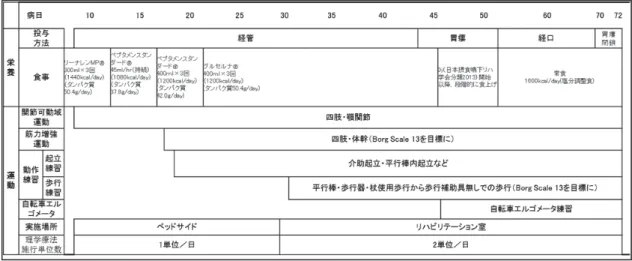
生に細心の注意を払いながら徒手胸郭介助および 排痰練習,四肢や頸部および顎関節の愛護的な可 動域練習を実施し,他の時間は看護師により体位 ドレナージおよび口腔ケアを実施した(Fig. 2) . 以降, 数日間は 1 日に数回の痙攣発作を認めたが,
第 13 病日に痙攣発作が生じないことを確認した 後に日中は鎮静が中止となり,翌日に鎮静薬の使 用を終了した.鎮静薬の残存による意識レベル低 下と人工呼吸器装着期間が続くことが予測された ため,第 16 病日に気管切開術を施行され,第 18 病日に人工呼吸器から離脱となりICU を退室し た.
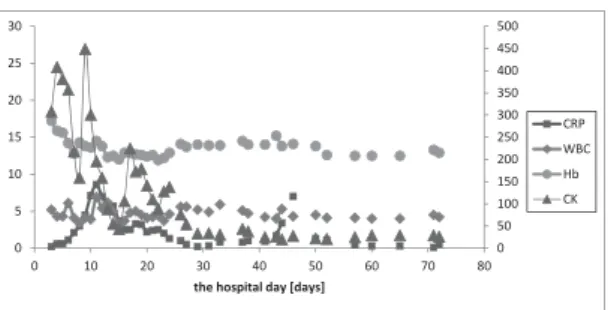
Fig. 1. Change of Laboratory data
The creatinine kinase value had became normal on the 29th hospital day, and WBC and CRP decreased. There had been no marked decline in Hb.
0 50 100 150 200 250 300 350 400 450 500
0 5 10 15 20 25 30
0 10 20 30 40 50 60 70 80
the hospital day [days]
CRP WBC Hb CK
Table 1. Clinical fi ndings on the 8th hospital days Clinical fi ndings on the 8th hospital days Environment In the ICU.Dark and silent room.
Consciousness Richmond Agitation Sedation Scale -
5 (under sedation)Respiration Ventilator: A/C (PC) CPAP FiO2 50%, PS 17cmH2O, PEEP 4mmHg, Tidal Volume 300ml SpO2 100%, Respiratory Rate 16 bpm
BGA: pH 7.525, PaO2 90.0 mmHg, PaCO2 35.2mmHg, HCO3- 29.0 (mmol/L), BE6.4 (mmol/L), P/F ratio 180 Circulation HR 56 bpm, BP152/63 (mean 96) mmHg, Hb 14.3 g/dL, ECG regular sinus rhythm
Electrolytes Na 136 mmol/L, K 2.8 mmol/L, Cl 101 mmol/L, BUN 20 mg/dL, CRE 1.11 mg/dL, eGFR 50.1 mL/min/1.73m2, In-Out: -590 ml
Motor Function Range of Motion: (U/L) slight limitation of fi nger extension (L/L) no contracture (Synovial joints of thorax) no limit
Breath Sound:Wheeze + (upper lung fi eld)
Muscle tone: no abnormality (no hypertonia and hypotonia)
Muscle Strength: Immovable (under sedation)
ICU から退室後:
意識レベルが Japan Coma ScaleⅠ -2 まで改善し たため,第 18 病日に介助下での起立練習から運 動療法を開始し,初回時には全介助にて 10 秒間 程度の保持が可能であった.徐々に介助量が減少 し,第 28 病日には軽介助にて起立が可能となり,
2 分間の立位保持が可能となった.第 29 病日に
creatinine kinase 値が正常となり,炎症状態も改善
し(Fig. 1) ,第 31 病日に平行棒内歩行練習を実 施した(Fig. 2) .運動療法は自覚的運動強度であ
る Borg Scale 13(ややきつい:最大心拍数の 60
%相当)を指標に,理学療法において歩行能力を 段階的に上げる中で日々の運動強度を設定し実施 した.この強度に併せて,病棟看護師や家族とと もに病室で杖を使用した起立練習などの自主練習 や,歩行器を使用して 300 m 程度の歩行練習を毎 日行い,リハビリテーション室での運動療法以外 の時間にも低強度高回数の運動を実施した.
栄養については第 2 病日から経鼻胃管にて投与 を開始し,下痢嘔吐症状に気をつけながら徐々に 投与量を増量した(Fig. 2) .呼吸器離脱後、第 25 病日に言語聴覚士による嚥下機能評価を行い、重 度嚥下障害に対し間接訓練からを開始した.嚥下 機能改善には時間を要することが見込まれたため 第 43 病 日 に 胃 瘻 を 造 設 し 経 鼻 胃 管 は 抜 去 し た
(Fig. 2) .気管カニューレ(複管式カフ付き側孔 あり)のカフ脱気時間やワンウェイバルブ装着時
間を延長させながら間接訓練を継続したところ,
嚥下機能に改善を認め,第 46 病日からゼリーを 用いた直接訓練を開始した.段階的に食形態を上 げ,第 51 病日には常食摂取が可能となり,予後 栄養指数(Prognostic Nutritional Index:PNI)は次 第に改善した(Fig. 3) .経過中,開口制限は改善 し,誤嚥性肺炎を合併することなく良好な摂食嚥 下機能の獲得に至り,BMIは正常範囲であった 6) . 約 30 日のリハビリテーション治療により本症 例は日常生活では杖なし歩行が自立し,Barthel
Index は 100 点まで改善した.第 61 病日に気管切
開孔が閉鎖され,第 70 病日には胃瘻が抜去され,
医学的管理が不要となり,第 72 病日に自宅退院 となった.退院時には可動域制限を認めなかった が,筋力や骨格筋量においてはサルコペニアの カットオフ (握力26 kg 未満, SMI7.0 kg/m 2 未満) 7) に 該当する身体組成であった(Table 2) .また,下
Fig. 2. Feeding / Oral-intake and rehabilitation programs
The exercise had started from standing exercise, and the walking practice in the bars had been carried out under the assistance on the
31st hospital day. The food style had been gradually modifi ed from 46th hospital day, and reached diet with no restrictions on the 51sthospital day.
Fig. 3. Change of nutritional status
Nutritional status gradually had improved after the 18th hospital day.
0 10 20 30 40 50 60
0 2 4 6 8 10 12
0 10 20 30 40 50 60 70 80
the hospital day [days]
TP Alb PNI
肢筋力とパフォーマンステストともに地域在住高 齢者の基準値 8) を下回っていた.一方で,循環機 能は基準値と比較し著明な低下を認めなかった 11) .
Ⅳ.考 察
本症例は約 14 日間の鎮静薬投与期間を必要と した症例であり,理学療法開始初期には安静環境 下での呼吸介助,関節拘縮予防を主眼に置いた介 入を実施し,回復期以降に低強度高回数の運動療 法へ移行し日常生活の改善を図った.杜若ら 3) は
Onset time が 48 時間以内の重症破傷風症例におい
て,33 日間の鎮静薬使用期間を経て,入院後 65
日で杖歩行の獲得に至ったが,リハビリテーショ ン病院へ転院となった経過を報告している. また,
鈴木ら 4) も,Onset time が 6 時間で,13 日の鎮静 期間の後,入院から 100 日で日常生活の自立に至 り,157 日で自宅退院となった重症破傷風症例の 経過を報告している. 今回我々の経験した症例は,
Onset time が 6 日であることから必ずしも重症度
は高くないが,鎮静期間は 14 日を要した.痙攣 期を過ぎた後に運動強度を速やかに上げ,運動能 力を日常生活活動に汎化することで,第 39 病日 で日常生活の自立に至った.退院時に筋力低下は 残存したが,早期からリハビリテーション治療を 実施したことにより,日常生活活動は良好に改善 Table 2. Evaluation of physical function at the time of the discharge
Evaluation of physical function
(the 66th hospital day)
Right Left Reference Value
Body Mass Index
(:BMI) 20.5 kg/m2 18.5-24.9 6)Range of motion
Active Upper limb elevation [° ]
165 165Finger Extension Contracture + Contracture -
Opening Mouth
40(Between the upper and lower teeth)[mm]
Muscle Strength
Grip Strength [kg]
10 16Cut Off 31 kg
7)Knee Extension [N]
263 228[kg]
27.5 23.3 37.3 ± 8.4 8)Using Hand Held Dynamometer
(μ-tas F1,anima)
Manual Muscle Testings : MMT
(Upper and lower limb/Neck/Trunk) 4 4
Body composition (bioelectrical impedance analysis, using InBody S10)
Skeletal Muscle Mass [kg]
22.8 26.5-32.3 9)Lean Body Mass [kg]
43.5 47.5-58.1 9)Body fat percentage [%]
25.0 10.0 - 20.0 9)Skeletal Muscle Index:SMI [kg/m
2]
6.89Cut Off 7.0 kg/m
27)Performance Test
10 meter gait [sec] 5.9sec 1.69m/sec
Cut Off 0.8m/sec
7)10steps 1.0 Step/m
Timed Up and Go Test [s]
8.46 7.85 6.0 ± 1.0 8)One leg satnding [s]
3.79 2.37 34.7 ± 33.6 8)Chair stand up test(CS-30) [times]
12 19.2 ± 4.8 8)2 Steps Test [cm] 205
Simple Test for Evaluating hand Function:
STEF
86/100 92/100 90(75-100 years)10)
Average of the similar age Exercise tolerance
(Using Aero Bike ® 75XLⅢ)VO
2max [ml/min/kg]
25.6 25.3 ± 5.3(60-69 years)11)Under line: low value from Reference
しリハビリテーション病院へ転院することなく第 72 病日で自宅へ退院することができた.
本症例では痙攣期には痙攣発生に細心の注意を 払いながら愛護的な他動運動を実施した.その結 果,訓練中に痙攣が出現する事はなく,著明な関 節拘縮を生じなかった.しかしながら,より重篤 な破傷風症例においては軽微な刺激であっても痙 攣を呈することがあり,他動運動も行えない場合 には,顎関節に対するバイトブロックの使用や四 肢に対する装具の使用により,安静肢位での関節 拘縮予防を行う必要があると考える.
また,痙攣期には鎮静薬投与を伴う安静臥床に より,筋機能低下の発生が危惧されたが,本症例 に対しては痙攣の発生を懸念し筋機能低下を予防 するような積極的なリハビリテーション治療を実 施することはできなかった.健常高齢者において 10 日間の安静臥床により,下肢筋量が 6.3 %,筋 力は 15 . 6 % 低下する 12) といわれている.さらに,
近年では長期鎮静および ICU 管理後に身体機能障 害が残存することが報告され, 筋障害や神経障害,
複合的な神経筋障害である ICU-Aquired Weakness
(:ICU-AW) 13)14) が注目されている.破傷風は神 経障害を生じるため ICU-AW の診断基準には該 当しない.しかしながら,本症例では鎮静,安静 臥床および人工呼吸管理など,ICU-AW を引き起 こすとされる因子 15)16) が複数存在し,類似した神 経筋機能障害に移行する可能性が考えられ,関節 拘縮予防のみならず筋機能低下を予防する治療が 有効であった可能性がある.Mulderら 17) は,一 日に 25 分間の起立姿勢保持による筋機能維持効 果を報告している.退院時に筋機能の低下を呈し たことを振り返ると,痙攣期であっても鎮静薬に より痙攣を抑制できている場合には,Tilt tableを 使用し筋に対して荷重を含む機械的刺激を行うこ とで筋機能低下を軽減できた可能性が考えられる.
本症例において回復期には積極的に離床を図り,
低強度ではあるが日常の中でも運動療法に取り組 む中で基本動作の自立に至った.Mitchell ら 18) は,
低強度運動負荷を高回数で実施し総負荷量(Load Product)を生み出すことで筋力増強効果が得ら れることを報告しており,回復期以降に速やかに 高回数の荷重練習を実施したことが日常生活の拡 大に奏功したと考える.また,栄養療法としては
蛋白質付加によって筋力増強効果をさらに高める 事が報告されている 19) .そのため,本症例におい ても,回復期の運動療法に加えて蛋白質を投与す ることで筋機能の改善を促進できた可能性が考え られる.
破傷風症例におけるリハビリテーションでは,
痙攣期以前から関節拘縮の予防に努め,回復期以 降は早期の積極的な離床と栄養状態を加味した低 強度高回数の運動療法へ速やかに移行することが 重要である.一方で,痙攣期の安静期間中から筋 機能低下の予防が課題として考えられ,今後は安 全かつ実施可能な運動療法について検討する必要 がある.
著者の利益相反 (confl ict of interest:COI) 開示:
本論文の研究内容に関連して特に申告なし
文 献
1) 佐々木亮.破傷風.ICUとCCU.2011;35:1065-72.
2) 八重樫泰法,佐藤信弘,小鹿雅博,鈴木泰,山田裕彦,
皆 川 幸 洋.特 殊 感 染 症 に 対 す る 集 中 治 療.ICUと
CCU.2003;27:455 -
57.3) 杜若竜司,木村美子,本田香奈恵,舌間秀雄,岩中 行己男,岩永勝ほか.重度の筋硬直を呈した破傷風 の 一 症 例 A case study of tetanus.理 学 療 法 福 岡.
2012;25:83-86.
4) 鈴木歩美,戸渡敏之,赤津嘉樹,鈴木善幸,野本恵司.
破傷風患者に対する理学療法の紹介.静岡理学療法 ジャーナル.2008;17:36-39.
5) Chun
P, Ying-Zi H, Yi Y, Hai-Bo Q.Titration of high dose sedation is effective in severe tetanus: a case report.
CASES J. 2009; 2: 6865.
6) 第 13 表.BMIの平均値及び標準偏差−年齢階級別,
人数,平均値,標準偏差−男性・女性,15 歳以上〔妊 婦除外〕
.厚生労働省健康局健康課栄養指導室編.平
成 27 年国民健康・栄養調査報告.厚生労働省;2017.p.113. http://www.mhlw.go.jp/bunya/kenkou/eiyou/h27 - houkoku.html. [accessed 2017 -
12-
06]7)
Han P, Kang L, Guo Q, Wang J, Zhang W, Shen S, et al.
Prevalence and factors associated with Sarcopenia in Suburb-dwelling Older Chinese Using the Asian Working Group for Sarcopenia Definition. J Gerontol A Biol Sci Med Sci. 2016; 71: 529-35.
8) 相馬正之,村田伸,岩瀬弘明,村田潤,上城憲司,
久保温子ほか.地域在住高齢者の 30 秒椅子立ち上が りテストと身体機能の関連.理学療法科学.2016;
31: 759-763.
9)
Ito H, Ohshima A, Ohto N, Ogasawara M, Tsuzuki M, Takao K, et al. Relation between body composition and age in healthy Japanese subjects. Eur J Clin Nutr. 2001;
55: 462-70.
10) 金子翼,平尾一幸,村木敏明,栗山洋子.上肢機能 検査の開発と標準化に関する研究.神戸大学医療技 術短期大学部紀要.1985; 1: 37-42.
11) 黒田豊,西尾進也,森山太郎,原口晃,涌井佐和子.
運 動 習 慣 非 保 有 者 の 最 大 酸 素 摂 取 量.体 力 科 学 2011;60:147
-
54.12) Kortebein
P,Ferrand A,Lombeida J,Wolfe R,Evans WJ.Effect of 10 days of bed rest on skeletal muscle in healthy older adults. JAMA. 2007; 297: 1772-74.
13) Kress JP, Hall JB.
ICU-Acquired Weakness and Recovery from Critical Illness. N Engl J Med. 2014; 370 : 1626-35.
14) Latronico N, Bolton CF. Critical illness polyneuropathy
and myopathy: a major cause of muscle weakness and
paralysis. Lancet Neurol. 2011; 10: 931-41.
15) de Jonghe B,Lacherade JC,Sharshar T,Outin H.
Intensive care unit-acquired weakness: risk factors and prevention. Crit Care Med. 2009; 37: S309-15.
16) Fan E, Zanni JM, Dennison CR, Lepre SJ, Needham DM.
Critical illness neuromyopathy and muscle weakness in patients in the intensive care unit. AACN Adv Crit Care.
2009; 20: 243-53.
17) Mulder E, Clement G, Linnarsson D, Paloski WH, Wuyts
FP, Zange J, et al. Musculoskeletal effects of 5 days of bed rest with and without locomotion replacement training.
Eur J Appl Physiol. 2015; 115: 727 -
38.18) Mitchell CJ, Churchward
- Venne TA, West DW, Burd NA, Breen L, Baker SK, et al. Resistance exercise load does not determine training-mediated hypertrophic gains in young men. J Appl Physiol. 2012; 113: 71-7.
19) 若 林 秀 隆.サ ル コ ペ ニ ア と リ ハ ビ リ テ ー シ ョ ン.