Digital Halftoning: Formulation
as a
Combinatorial
Optimization Problem and Approximation Algorithms
Based
on
Network Flow
Tetsuo
Asano1
, NaokiFujikawa1
, NaokiKatoh2,
Tomomi
Matsui3,
Hiroshi
$\mathrm{N}\mathrm{a}\mathrm{g}\mathrm{a}\mathrm{m}\mathrm{o}\mathrm{C}\mathrm{h}\mathrm{i}4$,Takeshi
Tokuyama5,
and NobuakiUsui6
1School
of Information Science, 2 Graduate School of Engineering,JAIST Kyoto University
Tatsunokuchi 923-1292, Japan Kyoto 606-8501, Japan
$\mathrm{t}[email protected] [email protected]
3 Graduate School of Engineering, 4 Dept. of Information and Computer Sciences,
University ofTokyo Toyohashi University of Technology
Tokyo 113-8656, Japan Toyohashi 441-8580, Japan
tomomi@misojiro.$\mathrm{t}$.u-tokyo.ac.jp naga@ics.$\mathrm{t}\mathrm{u}\mathrm{t}$.ac.jp
5 Graduate School of Information Sciences, 6 Peripheral Systems Laboratories,
Tohoku University Fujitsu Laboratories Ltd.
Sendai 989-3201, Japan Atsugi 243-0197, Japan
[email protected].$\mathrm{a}\mathrm{c}$
.
jp [email protected] itsu.co.jpAbstract: Digitalhalftoning is an important technique to convert animage having several
bits for brightness levels into a binary image consisting of black and white dots which looks
similarto aninput image. Thesimilaritybetween twoimages is measuredbythe totalsumof
differences inthe weighted sumsof brightness levelsofpixelsin a neighborhood surrounding
each pixel. Then, the problem of producing an optimal halftoned image is a combinatorial
optimization problem to find a binary image minimizing the measure for a given
multiple-level image. Despiteanegative result that it is $\mathrm{N}\mathrm{P}$-completeevenfor asimple neighborhood
consisting of$2\cross 2$ pixels, we can rely onapproximation algorithms mainlybased on network
flow algorithms.
Keywords: approximation algorithm, combinatorial optimization, discrepancy, matrix
rounding, network flow
1
Introduction
The quality of color printers has been drastically
improved in recent years, mainly based on the
development of fine control mechanism. On the
other hand, there seems to be no great
inven-tion on the software side of the printing
tech-nology. What is required is a technique to
con-vert an intensity image having several bits for
brightness levels into a binary image consisting
of black and white dots so that the binary image
looks very similar to the input image. Theoret-ically speaking, the problem is how to
approx-imate an input gray image by a binary image.
Sincethis is oneof the centraltechniques in
com-putervision and computer graphics, a great
num-ber of algorithms have been proposed (see, e.g.,
[12, 10, 6, 13, 14]$)$. However, there have been
very few studies discussing reasonable criteria for
evaluating the quality of output binary images;
maybe because the problem itselfis very
practi-cally oriented. Actually, the most popular
crite-rion is tojudge the quality by human eyes. It is
desirabletoestablishagood evaluation system of
halftoning methods (instead of the “humaneye’s
judgment”), and to handle the digital halftoning
problem fully mathematically. Unfortunately, to
the authors’ knowledgenomathematicalcriterion
has not been a main focus on digital halftoning
even
in the comprehensive studies in the Ph.D.So, one of the purposes of this paper is to
set-tle some reasonable mathematical criterion for
this problem based on a model for human visual
perception. Although there are extensive studies
on human visual perception (see, e.g., [16]), we
use a simplified model to analyze computational
complexity of the problem. Our criterion
mea-sures the ”difference” between the average gray
levels
or
the total sums of levels normalizedbe-tween $0$ and 1 in a neighborhood surrounding
each pixel. Then, the problem of producing an
optimal halftoned image is a combinatorial
opti-mizationproblemtofindabinaryimage
minimiz-ing the measure for agiven multiple-level image.
The complexity of the problem depends on the
choice ofthe neighborhood family. In most cases
it is $\mathrm{N}\mathrm{P}$-hard. Actually, we show that it is the
case even if each neighborhood consists of $2\cross 2$
pixels.
Although the problem itself is defined in the
two-dimensional plane, it is possible to define its
one-dimensional version in which a sequence of
real numbers is given. This problem itself is an
interesting combinatorial problem, $\dot{\mathrm{a}}$
nd we show
that it canbe solvedin polynomialtime byusing
negative cycle detection algorithms.
This implies that it is essentially necessary
to consider approximation $\mathrm{a}\mathrm{n}\mathrm{d}/\mathrm{o}\mathrm{r}$heuristic
algo-rithms. $\mathrm{E}\mathrm{v}\mathrm{e}\mathrm{n}.\mathrm{f}_{\mathrm{o}\mathrm{r}}$ the $\mathrm{t}_{\mathrm{W}\mathrm{O}-}\mathrm{d}\mathrm{i}\mathrm{m}\mathrm{e}.\mathrm{n}$sional problem,
if each neighborhood is one-dimensional along a
space-filling curve, we can apply the algorithms
for the one-dimensional case. The use of
space-fillingcurves is popular in image processing, and
we think this method (although it is merely a
heuristic method since neighborhood should be
truly $\mathrm{t}\mathrm{w}\mathrm{o}^{-}\mathrm{d}\mathrm{i}\mathrm{m}\mathrm{e}\mathrm{n}\mathrm{s}\mathrm{i}_{0}\mathrm{n}\mathrm{a}\mathrm{l}$in practice) is probably
useful if we can generate space-filling curves in
somewhat random$\mathrm{m}\mathrm{a}\mathrm{n}\mathrm{n}\mathrm{e}\mathrm{r}[4]$
.
We evaluate somepopular error-propagating algorithms in digital
halftoning in our optimization criterion.
2
Known
Basic
Algorithms
Given an$N\cross N$array$A$of real numbers between
$0$ and 1, we wish to construct a binary array $B$
of the same size which looks similar to $A$, where
entry values represent light intensities at
corre-sponding locations. The most naive method for
obtaining$B$is simply to binarize each input value
by a fixed threshold, say 0.5. It is simplest, but
the quality of the output imageis worst since any
uniformgray region becomes totally white or
to-tally black. The most important is how to
repre-sent intermediateintensities. Amonganumberof
algorithms for digital halftoning well-known are
Ordered Dither and Error Diffusion. We briefly describe them.
2.1
Ordered Dither
Instead of using a fixed threshold over an
en-tire image, this method uses different
thresh-olds. A simple way of implementing this idea
is as follows: We prepare a square submatrix
of $M\cross M$ entries which are integers ranging
from $0$ and $M^{2}-1$ and tile an input array by
this submatrix. Then, for each entry $(\dot{i},j)$ we
have an input value $A(\dot{i},j)$ in $A$ and an
inte-ger $D(i\mathrm{m}\mathrm{o}\mathrm{d}M,j\mathrm{m}\mathrm{o}\mathrm{d}M)$ in the submatrix. If
$A(\dot{i},j)$ $>D$($i\mathrm{m}\mathrm{o}\mathrm{d}M,j$ mod $M$)$/M^{2}$ then the
corresponding output value$B(i,j)$ is determined
to be 1, and otherwise it is $0$
.
This submatrixis called a dither matrix. An example is shown
$\mathrm{b}\mathrm{e}\mathrm{l}\mathrm{o}\mathrm{w}[12]$.
2.2 Error Diffusion
Ordered Dither is simple and efficient, but its
output quality is not satisfactory in many cases.
Another standard method uses a fixed
thresh-old 0.5 but it diffuses the quantization error
over unprocessed neighboring pixels according
to some fixed ratios. The ratios suggested by
Floyd and Steinberg in their paper [10] are
(7/16, 3/16, 5/16, 1/16) for the right, lower left,
lower, and the lower right pixels, respectively.
This method gives excellent results inmany cases,
but it tends to generate some visible patterns in
an areaof uniform intensity, whichare caused by
2.3
Related Combinatorial Problems
The quality of the ordered dither method
heav-ily depends
on
the dither matrix. The matrixshown above is constructed according to asimple
rule, which is known as Incremental Voronoi
In-sertion. That is, westart withanarbitrary entry.
Sincethesubmatrix tiles the entire plane, wehave
many copies of the entry. Then, we choose the
entry farthest from the existing points (entries).
Such a point must be avertex of the Voronoi
di-agram. Thus, ourstrategy is to choose aVoronoi
vertex that is farthest from the existing points. This selection is iterated until half of the entries
are chosen. The remaining half is filled in
sym-metrically.
Now we have a natural question. Does this
strategy optimize anything? Imagine a part of
an image in which intensities gradually increase.
Then, the number (or density) of white dots also
increases according to the dither matrix starting
from a dark part consisting of only O-numbered
entries until an entirely bright part. During the
transition, white dots should be uniformly
dis-tributed. This means that for any $k,$ $0\leq k\leq$
$M^{2}/2$ those entries having numbers greater than
orequalto $k$ must be asuniformly distributedas
possible. The uniformitycanbe measured by the
ratio of the minimum pairwise distance over the
diameter ofthemaximum empty circle. A
combi-natorial problem related to this is to find apoint
sequence that minimizes the maximum of the
ra-tios defined above. It is rather easy to see that
the incremental Voronoi insertion is not optimal,
but it is open to find such anoptimalsequence.
An easier combinatorial problem is to
dis-tribute a given number of points within a unit
square. This problem has been studiedfor many
years in combinatorics under the name of
Pack-ing Problem. Therewas abreak-through recently
in this study which shows best packing patterns
up to about 50 points and proved the optimality
of their packing patterns consisting of up to 26
points. In our case the base plane is not
contin-uous but discrete. If the size of the grid plane is
small enough, say, $16\cross 16$, we can find an
opti-mal solution by solving an integer programming
on 256 variables.
Another related problem
comes
from thehu-man perception. An interesting feature of
hu-man perception is that horizontal and vertical
patterns are more sensitive to human eyes than
skewed patterns. This fact suggests
us
ofa
ro-tated dither matrix. Then, the problem is how
to design sucharotated pattern consisting of$M^{2}$
elements. This is not so easy. In fact, to the
authors’ best knowledge only one method [17] is
known. It is a rotation by a so-called rational
angle defined by triangles of edges with integral
lengths. We have developeda scheme for
achiev-ingrotation ofasquaredregion approximately by
any given angle. The detail will be described in the final report.
3
Why
Raster Scan
Error Diffusion is one of the most popular
meth-ods for digital halftoning. One of the drawbacks
of this method is that it tends to generate
reg-ular patternings, which are caused by fixed scan
order andfixed coefficients forerrordiffusion. For
better quality we need to incorporate some
ran-domness. Thus, we come up withan ideato use
randomspace-fillingcurvesinstead of rasterscan.
Recently, it has been observed that error
diffu-sion along somespace-fillingcurvessuchasPeano
curvesand Hilbertcurvessometimes achieve
bet-ter quality compared with the traditional error
diffusion basedon araster scan. One drawback of
the methodscomesfrom the fact that such
space-filling curves areusually defined recursively on a
square grid plane. Thus, there is some difficulty
when theyareapplied to rectangularimages.
An-other drawback is found in its quality ofan
out-put image due to its recursive structure. Since it
is recursively defined, each quarter of an image
is completely separated and their boundaries are
often visible in the resulting binary image.
The idea of using space-filling curves for
digi-tal halftoning is not new. Velho and Gomes [19]
use space-filling curves for cluster-dot dithering.
Zhang and Webber [20] give a parallelhalftoning
algorithm based on space-filling curves. Asano,
Ranjan, and Roos [5] formulate digital halftoning
as amathematical optimizationproblem and
ob-tainanapproximation algorithm basedon
space-filling curves. So, the digital halftoning
tech-niques based on space-filling curves seem to be
promising. However, one of their serious
size, that is, the size ofan input image must be
something like a power of 2 since most of
recur-sively defined space-filling curves are defined for
square lattice planes of sizes being such.
We have developed atheory for random
space-fillingcurves. One$\mathrm{r}\mathrm{e}\mathrm{s}\mathrm{u}\mathrm{l}\mathrm{t}[3]$isasimpleway of
gen-erating a random space-filling curves for a
rect-angular grid ofeven length in each side. It first
constructs a random spanning tree on a smaller
gridof the half side lengths and then generates a
tour along the tree. It runs in linear time in the
image size.
Another way of generating a random
space-filling curve without any size constraint is also
$\mathrm{p}\mathrm{r}\mathrm{o}\mathrm{p}\mathrm{o}\mathrm{S}\mathrm{e}\mathrm{d}[4]$. It is based on the following fact:
any space-filling curve is represented by regular
arrangement of stones in such a way that white
stone always lies to the right of the curve and
black stone does to the left. Then, a
space-fillingcurvewithout selfintersection corresponds
to an arrangement of stones in such a way that
no cross of different colors is included and there
are two connected components of those stones of
the samecolor, wheretwo stones areconnected if
they have the same color and they are adjacent
horizontallyorvertically. Then,asfaras a
condi-tion called parity condicondi-tion is satisfied, there is a
space-fillingcurvewithspecified starting and exit
entries. Moreover, defining an operation called
flipping which changes the curve locally by
ex-changing two stonecolors, we canguarantee that
for any two space-fillingcurves one canbe
trans-formed to another by successive flippings. This
suggests generation of random space-fillingcurves
by successive random flippings.
4
A
Mathematical Formulation
of
Digital Halftoning
Themain taskofthissection isto define the
dig-ital halftoning problem as a combinatorial
opti-mization problem by defining a reasonable
con-crete mathematical criterion. As we defined in
theintroduction, let $A=(a_{ij})_{i,jN}=1,\ldots,,$ $0\leq a_{ij}\leq$
$1$, be a matrix representing an image in the grid
array $G$ofsize $N\cross N$.
Imagine that we look at somepixel $(\dot{i},j)$ of the
gray-levelimage$A$
.
What happens is,weactuallyperceivean average ofgray levelsofsome (small)
neighborhood of that point. Using the same
ob-servation, the intensity around the pixel $(\dot{i},j)$ of
a binary image is proportional to the number of
whitepoints in the corresponding neighborhood.
Therefore, density values should be roughly equal
around any pixel between an output binary
im-age of the digital halftoning and the input image
$A$
.
The observation motivates us to give thefol-lowing mathematical formulation:
For anyregion$R$in the gridarray $G$ (regarded
as an $N\cross N$ rectangle subdivided into $N^{2}$
pix-els each of which corresponds to an array
en-try), we consider an error function $E^{R}(A, A’)$
describing the difference between two pictures
$A$ and $A’$ within the region $R$
.
A typicaler-ror function is the
difference
of
average density$|A(R)-A’(R)|/|R|$, where $A(R)$ isthe sumof
en-tries of$A$ located in $R$, and $|R|$ is the number of
pixels in $|R|$
.
A family$\mathcal{F}$ofregions in$G$ is calleda
neighbor-hood family if there exists a map $\phi$ from $G$ to $\mathcal{F}$
such that the region $\phi(p)\in \mathcal{F}$contains the pixel
$p$ for each pixel $p\in G$
.
We call $\phi(p)$ theneigh-borhood of$p$
.
The map $\phi$ need not be surjectivenor injective. Note that this is a quite weaker
definition than the neighborhood system in usual
geometry. For a neighborhood family $F$, we
de-fine the $L_{\infty}$ distance
$Dist_{\infty}^{\mathcal{F}}(A, A’)= \max E^{R}R\in \mathcal{F}(A, A’)$
between the images $A$ and $A’$ with respect to
$\mathcal{F}$ and the error function $E$
.
This distanceis also called the maximum error between $A$
and $A’$ (with respect to $\mathcal{F}$). We only
con-sider the $L_{\infty}$ distance in this paper for
techni-cal reason, although the $L_{p}$ distance defined by
$( \sum_{R\in \mathcal{F}}(E^{R}(A, A’))p)^{1/}p$ might be a useful
mea-sure in practice.
Wemainlyconsider thefollowing family$\mathcal{F}$
con-sisting of (axis parallel) rectangular regions of a
fixed shape $l\cross k$. For an $l\cross k$ rectangular
re-gion $W$ in $G$, its center is the pixel $p(W)$ on
the $\lceil l/2\rceil$-th row and $\lceil k/2\rceil$-th column counted
from the north-west corner of $W$
.
Note that$p(W)$ has the center of gravity of$W$ in the
clo-sure of the pixel. We denote $W$ as $W(\dot{i},j)$ if
$p(W)=(\dot{i},j)$
.
This defines the neighborhoodsfor the pixels (called central pixels) $(\dot{i},j)$
satisfy-ing $\lceil l/2\rceil\leq i\leq N-\lceil(l-1)/2\rceil$ and $\lceil k/2\rceil\leq$
(callednear-boundarypixels),wedefine its
neigh-borhood as the neighborhood of its nearest
cen-tral pixel with respect to the Euclidean metric.
This correspondence makes $\mathcal{F}$ to be a
neighbor-hood family
Consideran input images $A$ andits output
bi-nary image$B$ in the digital halftoning. If the
dif-ference between the average gray level near each
pixel image is small, the picture $B$ is expected
to look very similar to the original picture $A$; at
least $B$ is avery good approximation of$A$
(with-out further knowledge of the contents ofthe
im-age). Let us consider our neighborhood system.
The number $|W(\dot{i},j)|$ ofpixels inaneighborhood
is independent of the choice of $(\dot{i},j)$. With that,
instead of the difference ofaverage density, it is
natural to use
$E^{W(i,j)}(A, B)=|A(W(\dot{i},j))-B(W(\dot{i},j))|$
.
to evaluate the visual difference near $(\dot{i},j)$
be-tween $A$ and $B$, where $A(W(\dot{i},j))$ is the sum of
elements of$A$ within $W(\dot{i},j)$
.
Note-
that.
we do not claim that our choice ofthe
ne.ighborhood
family and the error functionis the best for evaluatingpracticaldigitalimages:
A broader $\mathrm{n}\mathrm{e}\mathrm{i}\mathrm{g}\mathrm{h}\mathrm{b}\mathrm{o}\mathrm{r}\overline{\mathrm{h}}\mathrm{o}\mathrm{o}\mathrm{d}$ family is probably
bet-ter, and the error function can be generalized in
various ways adapting to real applications, e.g.,
by assigning larger weights to the pixels nearer
to the center $(\dot{i},j)$ in the neighborhood to take
the summation; however, we consider the above
simple model to investigate the complexity of its
optimization. We discuss some broader choice of
the neighborhood family in Section 5.3.
Our goal . is to bring
the local error $E^{W(i,j)}(A, B)$ close to $0$ for any
pixel $(\dot{i},j)$; That is, to minimize the $L_{\infty}$ distance
$D_{\dot{i}}st^{\mathcal{F}}\infty(A, B)$
.
Hence, we have the followingfor-mulation ofthe digital halftoningproblem:
Design a method to compute a binary
image $B$ such that $D_{\dot{i}}st^{\mathcal{F}}\infty(A, B)$ is as
smallas possiblefor an input image $A$
.
For simplicity, we write $D_{\dot{i}}st(A, B)$ for
$D\dot{i}st_{\infty}^{\mathcal{F}}(A, B)$ unless we want to emphasis the
neighborhood system $F$, error function, $\mathrm{a}\mathrm{n}\mathrm{d}/\mathrm{o}\mathrm{r}$
the $L_{\infty}$ measure. In particular, the binary
im-age $B$ minimizing $D_{\dot{i}}st(A, B)$ is called the
opti-mized digital approximation of$A$ (withrespect to
the neighborhood family $\mathcal{F}$). We investigate the
time complexity of computing the optimized
dig-ital approximation.
5
One dimensional
problem
If$l=1$, each member in $\mathcal{F}$ is a horizontal strip
of length $k$, and the problem can be solved on
each row independently. Therefore, we first
con-sider the one-dimensional version of theproblem.
Let $a=(a_{1}, a_{2}, \ldots, a_{n})$ be arational vector such
that $0\leq a_{j}\leq 1$ for all $j\in\{1,2, \ldots , n\}$ and $k$
be an integer with $1\leq k\leq n$
.
We consider theneighborhood family$\mathcal{I}_{k}$ consisting of intervals of
length $k$
.
If$k$ is a constant, it is relatively easyto design a linear time algorithm in $n$ by using
dynamic programming (in precise, $O(2^{k}n)$ time
using $O(2^{k}+n)$ space) to compute theoptimized
digital approximation $b$. However, it is
nontriv-ial to design analgorithm which is polynomial in
both $n$ and $k$.
5.1 Polynomial
time
algorithmsThe one-dimensional optimized digital
approx-imation of $a$ is the binary vector $b$ $=$
$(b_{1}, b_{2}, ’. . , b_{n})$ which is the solution of the
follow-ing integer programmfollow-ing problem, where $z$
cor-responds to the distance between $a$ and $b$ in our
measure:
minlmlze $z$
subject to $-Z \leq\sum_{j=}^{i+k}i(aj-bj)\leq z$ (1)
$(\forall\dot{i}\in\{1,2, \ldots, n-k\})$, (2)
$b_{j}\in\{0,1\}(\forall j\in\{1,2, \ldots, n\})$.
Since the variables $b_{1},$
$\ldots,$$b_{n}$ are 0-1 valued,
we can replace the inequality constraints (1) by
$\lfloor_{Z+}\sum_{j}^{i+}=i\rfloor ka_{j}\geq\sum_{j=}^{i+k}ib_{j}$
$\geq\max\{\lceil-Z+\sum^{i+k}j=ia_{j}\rceil, 0\}$
$(\forall\dot{i}\in\{1,2, \ldots, n-k\})$
.
We introduce the variables$x_{0},$ $\ldots,$$x_{n}$ satisfying
$x_{i}-x0=b_{1}+\cdots+b_{i}$ for $\dot{i}\in\{1,2, \ldots, n\}$
.
Thenthe aboveproblemis transformed to the following
problem
minlmlze $z$
subject to
$x_{i+k}-x_{i-1} \leq\lfloor_{Z+}\sum_{jj}^{i+k}=i\rfloor a$
$(\forall\dot{i}\in\{1,2, \ldots, n-k\})$, $x_{i-1}-Xi+k \leq-\max\{\lceil-Z+\sum_{j=}^{i+k}ija\rceil, \mathrm{o}\}$,
$(\forall\dot{i}\in\{1,2, \ldots, n-k\})$,
$x_{j-1}-X_{j}\leq 0$, $(\forall j\in\{1,2, \ldots, n\})$,
$x_{j}$ is aninteger, $(\forall j\in\{0,1,2, \ldots , n\})$
.
The problem of checking the existence of the
vector $(x_{0}, x_{1}, \ldots, x_{n})$ satisfying the above
con-straints when the value $z$ is fixed can be
trans-formed toanegative cycledetection problem (see
[2] for detail). The optimalvalue of$z$ (i.e.,
small-est $z$ causingno negative cycle) can befound by
the ordinary binary search technique. Each edge
weight is represented by a step function with
re-spect to $z$
.
Thus, we only need to consider thebreak points ofthe step functions. If we define
$q(s, \dot{i})=s+0.5+\sum_{j=i}^{i+k}a_{j}$ for integers $s$ and $\dot{i}$, the set $Q=\{q(s, i)|1\leq\dot{i}\leq n-k, -k\leq s\leq k\}$
contains all the break points. By applyingbinary
search technique (with some care), we can find
the optimal value of $z$ by executing the above
negative cycle detecting algorithm $\mathrm{O}(\log nk)=$
$\mathrm{O}(\log n)$ times with additional$O(n\log n)$ time for
each search process. Thuswecan find theoptimal
value of$z$ in $\mathrm{O}(n^{1.52}\log n)$ time in total.
Hence, we have the following theorem:
Theorem 5.1 The l-D optimized digital
approx-imation can be computed in $O(n^{1.5}\log n)2$ time.
The space requirement is $O(n)$
.
If $k$ is small (say, smaller than $n^{1/4}$), we can
obtain afaster algorithm.
Theorem 5.2 The l-D optimized digital
approx-imation can be computed in $O(k^{2}n\log n)$ time
us-ing $O(nk)$ space.
5.2 Optimization Under Different
Dis-tances
The previous subsection considered optimization
problem as follows:
Given a real vector $a=(a_{1}, a_{2}, \ldots, a_{n})$ such that
$0\leq a_{i}\leq 1$ for all $\dot{i}\in\{1,2, \ldots, n\}$ and $k$ is an
integer with 1 $\leq k\leq n$, find a binary vector
$b=(b_{1}, b_{2}, \ldots, b_{n})$ with $b_{i}=0,1$ for all $\dot{i}$ that
minimizes the distance to $a$, which is definedby
$D \dot{i}St(a, b)=\max_{I\in \mathcal{I}_{k}}|a(I)-b(I)|$,
where$\mathcal{I}_{k}$ is the neighborhoodfamilyconsisting of
all intervals of length $k$
.
One generalization of the problem is to use
dif-ferent distance. Another natural distance is $L_{2}$
distance, that is,
$D_{\dot{i}S}t(a, b)=\sqrt{\Sigma_{I\in \mathcal{I}_{k}}(a(I)-b(I))^{2}}$.
Figure 1: A network withquadratic costs.
This problem can be solved by reducing it to
a network flow problem as follows: Define a set
of nodes by 1, 2,
..
.
, $n-k+$. $2$ and a set of arcs$A\cup B$, where
$A=\{(1,2), (2,3), \ldots, (n-k+1, n-k+2)\}$,
$B=\{(2,1),$$(3,1),$$\ldots,$
$(j-k+1,j+k-1)$
,...
, $(n-k+2, n-k+1)\}$.
Here, each arc $(j,j+1)$ in $A$ corresponds to an
interval starting at $j$, that is, $[j,j+k-1]$ for all
$j\in\{1,2, \ldots, n-k+1\}$
.
We want the flow onthe arc to be
$a([j,j+k-1])$ .
For the purposeeach node$j$ has two incoming arcs $(j-1,j)$ and
$\mathrm{v}$
$(j+k,j)$ and two outgoing arcs $(j,j+1)$ and
$(j, j-k)$
.
The two $A$-type arcs $(j-1,j)$ and$(j,j+1)$ have capacity $[0, k]$ while the B-type
arcs $(j+k,j)$ and $(j,j-k)$ have capacity $[0,1]$
.
See Fig.1 for pictorial illustration.
Now, aflowdefined by$a([j,j+k-1])$ oneach
$A$-typearc $(j,j+1)$ and $a_{i-1}$ on each $B$-typearc
$(j,\dot{i})$ is a feasible flow. Therefore, if we define
the costs of the arcs to be $0$ for $B$-type
arcs
$\dot{\mathrm{a}}$nd
$(b([j,j+k-1])-a([j,j+k-1]))2$ for each$A$,-type
arc $(j, j+1),$ $j=1,2,$$\ldots,$$n$, then the problem is
to find a flow to minimize the total cost.
Fortu-$\mathrm{n}\mathrm{a}\mathrm{t}\mathrm{e}\mathrm{l}\mathrm{y},$
$.\mathrm{t}\mathrm{h}\mathrm{i}\mathrm{s}$ type of the cost minimization
prob-lems can be solved in
poiynomial.
time $\mathrm{b}\mathrm{o}$, th in $n$
and $k[1,15]$
.
5.3.
Larger neighborhood family andmodified
error functions
A well-known method to perform the
one-dimensional digital halftoning is “rounding with
error-propagation”. Startingfrom the first entry,
it determines the value of $b$ greedily. First, it
simply round $a_{1}$ to obtain $b_{1}=\lfloor a_{1}\rfloor$
.
Supposethat ifwe have determined $b_{1},$
$..,$
$b_{t}$, we consider
the accumulated error sum$(t)= \sum_{i=1(a_{i}}^{t}-b_{i})$
.
Then, $b_{t+1}$ is determinedas $0$ if$a_{t+1}+sum(t)\leq$
$-1/2\leq sum(t)\leq 1/2$
.
Therefore, for anyinter-val $I,$ $|a(I)-b(I)|\leq 1$, where $a(I)= \sum_{i\in I}a_{i}$
.
This means that the algorithm gives an output
sequence $b$ with $d_{\dot{i}}st(a, b)<1$ for the family
$\mathcal{I}=\bigcup_{k=1}^{n}\mathcal{I}_{k}$ of all intervals.
Ouroptimal solution described in previous
sub-sections does not have the above property, since
we have onlyconsidered the neighborhood family
$\mathcal{I}_{k}$
.
However, wecan
considera moregeneralizedform in which we consider the set $\mathcal{I}$ of all
inter-vals as the neighborhood family, define the error
function $E^{I}(a, b)=|a(I)-b(I)|/z_{I}$, where $z_{I}$ is
a constant dependent on $I$ for each $I$
.
Similarlyto the $O(n^{1.5}\log n)2$ time algorithm for $\mathcal{I}_{k}$, we
can design an algorithm with a time complexity
$O(n^{2.5}\log n)2$ for this generalized problem,
pro-vided that each $Z_{I}$ is a fractional number of a
pair of$O(\log n)$ bit integers. In particular, ifwe
set $z_{I}--1$ for all intervals, the output satisfies
that $|a(I)-b(I)|<1$ for every interval $I\in \mathcal{I}$
.
6
Matrix-rounding
$\mathrm{p}_{\Gamma \mathrm{o}\mathrm{b}}1\mathrm{e}\mathrm{m}$6.1
Discrepancy problemThe following Baranyai’s theorem is well-known
(See [7, 8, 9]):
Proposition 6.1 For any input$[0,1]$-valued
ma-trix $A=(a_{i,j})$, there exists a binary matrix $B$
attaining that $| \sum_{i=1}^{n}(a_{i,j}-b_{i,j})|<1$
for
each$j=1,2,$$\ldots,$$n,$ $| \sum_{j=1}^{n}(a_{i,j}-b_{i,j})|<1$
for
each$- i=...\cdot.1,.\cdot 2,$ $\ldots$,$n,$
and-
$| \sum_{j1}^{n}=1^{\sum_{i=}^{n}(}a_{i},j-b_{i},j$)$|<1$.
This means that ifwe consider a region family
$\mathcal{F}$ consisting of the whole matrix, all rows and
all columns of the matrix, there always exists a
rounding satisfying that $D_{\dot{i}}st_{\infty}^{F}(A, B)<1$.
How-$\dot{\mathrm{e}}\mathrm{v}\mathrm{e}\mathrm{r}$
, the rounding error is highly dependent on
the region family$F$
.
The following theorem is well-known [9]:
Theorem 6.2 The inhomogeneous discrepancy
of
a $[0,1]$ valued$n\cross n$ matrix with respect to thefamily
of
all rectangular regions is $O(\log n)3$ and$\Omega(\log n)$
.
The same bounds holdfor
theinhomo-geneous discrepancy
for
the familyof
allrectangu-lar regions containing the left-upper corner entry
of
the matrix.We are interested in the matrix-rounding with
respect to the set $\mathcal{F}_{k}$ of all $k\cross k$ square
re-gions. The following proposition is obtained ina
straightforward
manner
from the theorem above:Proposition 6.3 The inhomogeneous
discrep-ancy with respect to $\mathcal{F}_{k}$ is$O(\log^{3}k)$ and$\Omega(.\log k)$
.
Indeed, these bounds also hold
for
the union$\bigcup_{j=1}^{k}\mathcal{F}_{j}$
.
We remark that a polynomial time algorithm
for computing a rounding with an $O(\log^{4}k)$
dis-crepancy can be designed based on the proofof
Theorem 6.13 in [9]. This is theoretically better
than the popular two-dimensional error diffusion
algorithm, for which the rounding error can
be-come $k$
.
For the family$\mathcal{F}_{2}$ consisting of all$2\cross 2$ square
regions, there exists
an
instance $A$ that thedis-crepancy is exactly 1. However, the authors do
not know whether there existsaninstance
requir-ing $D_{\dot{i}}st^{\mathcal{F}}\infty 2(A, B)>1$ or not. It is easy to show
that the inhomogeneous discrepancy with respect
to $\mathcal{F}_{2}$ is at most 2; indeed, the checkerboard
bi-nary matrix $C$ satisfies$D_{\dot{i}}st_{\infty}^{F_{2}}(A, B)\leq 2$for any
input matrix $A$ simultaneously. However, it is
nontrivial to give a better upper bound; We can
prove the following result (the proofis involved,
and omitted in this version):
Theorem 6.4 For any $[0,1]$ valued matrix $A$,
there exists a binary matrix $B$ satisfying that
$Dist_{\infty}^{F}2(A, B)\leq 1.75$
.
6.2 $\mathrm{N}\mathrm{P}$-completeness of computing an
optimal
matrix
roundingWe showed the $\mathrm{N}\mathrm{P}$-completeness of the
problem
of computing an optimal matrix rounding.
Theorem 6.5 For any $\epsilon>0$, it is NP-complete
to decide whether the optimal rounding error
of
agiven matrix $A$ is greater than $1-\epsilon$ or less than
$1/2+\epsilon$ with respect to the distance $D\dot{i}st^{\mathcal{F}}\infty 2$
.
We do not repeat the proof here. Refer to [2] for the detail. The idea is the reduction from the
6.3
Approximation Algorithms(i) Error Diffusion along Two Curves
Let us consider some approximation
algo-rithms. One of them is an extension of the
proposition6.1 which guarantees theexistenceof
”good” matrix rounding in the
sense
that theer-ror at each row and each column are bounded
by 1. Another observation is that the maximum
error generated by the 1-D error diffusion along
a space-filling curve is also bounded by 1. Can
we combine the two results? That is, given two
different space-filling curves $C_{1}$ and $C_{2}$, can we
bound the maximum error by 1 simultaneously
for the two curves? Theanswer is positiveby the
following network-flow algorithm.
A space-filling curve on a matrix can be
re-garded as apermutation of matrix elements. Let
$(\sigma_{\mu}(1), \sigma_{\mu}(2),$
$\ldots,$$\sigma_{\mu}(n^{2}))$ be a permutation
cor-responding to a space-filling $C_{\mu},$$\mu=1,2$
.
Givenan image matrix $a[]$, we wish to compute a
bi-nary matrix $b[]$ of thesame size for which
$\max\{|\sum_{j}^{i}=1(a[\sigma_{\mu}(j)]-b[\sigma\mu(j)])|\}\leq 1$
holds for every $\dot{i},$$1\leq i\leq n^{2}$ and $\mu=1,2$
.
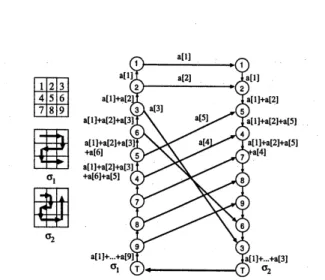
Construct a network as follows (see Fig. 3):
we have two sets of $n^{2}+1$ nodes, $V_{1}$
$=$ $\{v_{1}(1),v1(2), \ldots , v_{1}(n^{2}+1)\}$ and $V_{2}$ $=$
$\{v_{2}(1), \ldots, v2(n^{2}+1)\}$
.
The first set $V_{1}$ of nodesare connected in the decreasing order while the
second in the increasing order, that is, we have
arcs $(v_{1}(\dot{i}), v_{1}(i-1))$ for each $i=2,3,$
$\ldots$,$n^{2}+1$
and $(v_{2}(i), v2(i+1))$ for each$\dot{i}=1,2,$$\ldots$,
$n^{2}$
.
Ex-tending $\sigma_{1}$ and $\sigma_{2}$ so that $\sigma_{1}(n^{2}+1)=\sigma_{2}(n^{2}+$
$1)=n^{2}+1$, there is anobvious $\mathrm{o}\mathrm{n}\mathrm{e}- \mathrm{t}_{0}$-one
corre-spondence between the two permutations $\sigma_{1}$ and
$\sigma_{2}$
.
According to the correspondence we draw anarc $(v_{1}(\dot{i}), v_{2}(j))$ whenever$\sigma_{1}(\dot{i})=\sigma_{2}(j)$
.
Finally,we add an arc $(v_{2}(n^{2}+1), v_{1(n^{2}}+1))$.
Arc capacity is defined as follows: Each edge
$(v_{1(\dot{i}),v_{1(i}}-1)),$$2\leq i\leq n^{2}+1$ is associated
with the sum of input values sum1$(\dot{i}-1)=$
$\sum_{j=}^{i1}-a[1\sigma_{1}(j)]$
.
The capacity of the edge isde-termined by the floor and ceiling of the sum,
i.e., $[\lfloor sum_{1}(\dot{i}-1)\rfloor, \lceil sum1(\dot{i}-1)\rceil]$. For the
sec-ond set ofnodes, each edge $(v_{2}(\dot{i}), v_{2}(\dot{i}+1)),$ $1\leq$
$\dot{i}\leq n^{2}$ is associated with the sum of input
val-ues $sum_{2}( \dot{i})=\sum_{j=1}^{i}a[\sigma_{2}(j)]$
.
The capacity ofthe edge is determined by the floor and
ceil-ing of the sum, i.e., $[\mathrm{L}sum2(\dot{i})\rfloor, \lceil sum2(i)\rceil]$
.
Thecapacity of the edge $(v_{2}(n^{2}+1), v_{1}(n^{2}+1))$ is
$\ovalbox{\tt\small REJECT}_{78}4561239$
$\ovalbox{\tt\small REJECT}$
$\ovalbox{\tt\small REJECT}^{\circ_{1}}\sigma_{2}$
Figure 2: A network defined by two space-filling
curves.
Figure 3: Anetworkdefinedby two binary trees.
$[ \lfloor\sum_{i=}^{n^{2}}1a[i]\rfloor, \lceil\sum_{i=}^{n^{2}}1a[\dot{i}]1]$
.
Any other crossing arc
from $v_{1}(\dot{i})$ to $v_{2}(j)$ is associated with the input
value$a[\sigma_{1}(\dot{i})]=a[\sigma_{2}(j)]$ andits capacity is $[0,1]$
.
Now, a feasible flow is easily found since
val-ues associated with arcs defined above obviously
satisfy the capacity conditions. Thus, the
well-known integrality theorem implies the existence
of a integer-valued feasible flow. Take any such
flow, and the flow at crossing edges giveabinary
matrixwe wanted.
(ii) Combining Two Binary Structures
Thesame trick worksforadifferent structures.
The network we constructed above has not
hier-archicalstructure. Let usextend thestructure by
replacing each of the two simplepaths with a
bi-narytree structure (see Fig. 3). More concretely,
for a permutation $\sigma_{\mu}$ we construct a binary tree
$T_{\mu}$ with leaves $v_{\mu}(1),$$\ldots$,$v_{\mu}(n^{2})$
.
$\dot{\mathrm{F}}$
or the first set $V_{1}$ we orient the arcs in the
root1 down to the leaves. The arcs in the second
binary tree $T_{2}$ are oppositely directed. We draw
crossingarcsbetween the leaves of$T_{1}$ and$T_{2}$, just
like previously. Eacharcin the trees is associated
with the sum of input values of its descendants
(leaves). Similarly as above, the capacity of each
arc is determined by the floor and ceiling values
of the associated value. Then, those values
as-sociated with arcs define a feasible flow on the
network. Thus, again by the integrality theorem
an integer-valued flow does exist and it gives us
an approximated solution.
(iii) Scaling Algorithm
We have shown apolynomial-time
approxima-tion algorithm for a matrix rounding problem.
However, it does not suffice in practice because
of high timecomplexity of theunderlying flow
al-gorithm. An idea to reduce the time complexity
is to use the integrality of matrix elements.
Al-though we have assumed that each input matrix
element is a real number between $0$ and 1, they
are integers, say 8-bit integers, in an image
ma-trix. Making use of the integrality we can devise
anefficient algorithm.
Assume that each matrixelement is a $k$-bit
in-teger,$0$through$2^{k}-1$
.
Weusethesamestructureusing two binary trees shown in Fig. 3. An idea
is to repeat matrix rounding $k-1$ times until all
the matrix elements become $0$ or 1. Rounding
even
numbers cause no problem. For oddnum-bers we have to choose rounding up or rounding
$\mathrm{d}_{i}\mathrm{o}\mathrm{w}\mathrm{n}$. Our intention here is to balance rounding
ups and roundingdowns. Iftwo odd integers are
adjacent, we should apply different roundings to
them, i.e., rounding up one and rounding down
the other. This idea is generalized as follows: In
the tree$T_{1}$, we mark all leaves having odd values
and their incident arcs. We check each node at
one level up whether the two arcs incident to it
are both marked. If it is the case, we mark the
node and stop. Otherwise, we clime upone more
level in$T_{1}$ and repeat the same check. When we
reach theroot of$T_{1}$, all odd leaves are paired by
paths in $T_{1}$ or connected to the root.
The same process is applied to $T_{2}$
.
Then, weadd the crossing arcs connecting the same
ele-ments in the two sets of leaves. They altogether
form (undirected) cycle(s). Ifwe represent each
such cycle by the integer values
at
thenodesalongthe cycle excluding the duplication,a sequenceof
odd numbers is obtained. Next, we divide each
leaf value by 2. Here, those numbers in the
cy-cles must be rounded to integers. We perform
rounding up and rounding down iteratively along
the sequence obtained above. Of course, there
aretwo different ways of the rounding depending
on whether we start with rounding up or down.
Take any one of the two ways.
We iterate this process $k$ times. Then, all the
resulting leaf values become $0$ or 1. These values
naturally define a binary matrix. Although we
have no space to prove it, the resulting matrix
is one of the feasible flows on the network. This
algorithm is efficient enough.
(iv) $2\cross 2$ neighborhood
In Section 6.2 we claimed that it is NP-hard
to find an optimal rounding ofa real-valued
ma.-.
trix even for the family of $2\cross 2$ neighborhoods.
$\mathrm{H}_{\mathrm{o}\mathrm{W}\mathrm{e}}^{\backslash }\mathrm{v}\mathrm{e}\mathrm{r}$
, with little more constraints we have a
$\dot{\mathrm{p}}$olynomial-time algorithm. The idea is
$\mathrm{t}\dot{\mathrm{h}}\mathrm{e}$
fol-lowing. We regard an image matrix as a checker
board consisting of white and black cells. Then.,
we consider afamily of2 $\mathrm{x}2$ neighborhoods with
white cells at their main diagonals. By the
defi-nition, each cell belongs to at most two (usually
four except for boundary cells) neighborhoods.
Decompose each 2$\mathrm{x}2$ square into two horizontal
pairs and combine them vertically. Then, 2 $\cross 2$
squaresarecombinedhorizontally, andthe
result-ing $2\cross 4$ regions are combined vertically to have $4\cross 4$ regions, etc. Moreover, define costs of arcs
appropriately, sayby $(b-a)^{2}$ where$b$isa flow on
the arc and $a$ is the sum ofthe values in the
de-scendants. Then,we can find anoptimalsolution
in the case ofquadratic costs.
7
Concluding remarks
This paper gives an initial study on the
optimization-based evaluation of digital
halfton-ing algorithms. There are lot of open problems
whichareinteresting from both viewpoints of
the-ory and practice:
(1) For the neighborhood family consisting of
$k\cross k$ squares $(k\geq 2)$, is it always possible to
make $d_{\dot{i}}st(A, B)<c$where$c$is
a
constant strictlysmaller than$k$?
(2) If the answer to (1) is yes, can we design a
condi-tion? (Not seeking for the optimal solution).
One possible candidate is the use of random
space filling curves [4], and perform the
one-dimensional error propagation algorithm along
curves. Ifwe fix a space filling curve, we can
al-ways construct an instance so that $d_{\dot{i}S}t(A, B)>$
$k-\epsilon$; however, it is difficult to construct an
in-stance which performs badly for many randomly
chosen fillingcurves simultaneously.
(3) Are there any good approximation algorithm
which has a theoretical performance ratio?
(4) Find a very good neighborhood family and
error function to evaluate the quality of
digi-tal halftoning in practice. If such a framework
is firmly established, modern heuristic methods
can be $\mathrm{P}^{\mathrm{r}\mathrm{o}\mathrm{b}\mathrm{a}\mathrm{b}1}.\mathrm{y}$ applied to have a good digital
halftoning.
References
V. T. S\’os, Colloq. Math. Soc. J’anos Bolyai
10, pp.91-108.
[8] B. Bollob\’as, Combinatorics, Cambridge
Uni-versity Press, 1986.
[9] J. Beck and V. T. S\"os, Discrepancy Theory,
in Handbook
of
Combinatorics Volume II,(ed.R.Graham, M. Gr\"otschel, and LLova’sz)
1995, Elsevier.
[10] R. W. Floydand L. Steinberg: “An adaptive
algorithm for spatialgrayscale,” SID $7\mathit{5}D_{\dot{i}-}$
gest, Society
for Information
Display, (1975)pp.36-37.
[11] M. R. Garey and D. S. Johnson: Computers
and Intractability: A guide to theory
of
NPhardness, Feeman and Company, 1979.
[12] D. E. Knuth: “Digital halftones by dot
dif-fusion,” ACM $r_{\mathrm{b}\mathrm{a}\mathrm{n}\mathrm{s}}$
.
Graphics, 6-4 (1987),pp.245-273.
[1] R. Ahuja, T. Magnanti, and J. Orlin,
Net-work Flows, Theory Algorithms and
Appli-cations, Princeton Hall,
[2] T. Asano, T. Matsui, and T. Tokuyama:
“On the Complexities oftheOptimal
Round-ing Problems of Sequences and Matrices,”
Proc. 7th Scandinavian Workshop on
Algo-rithm Theory, pp.476-489, Bergen, Norway,
July 2000.
[3] T. Asano: “Digital Halftoning Algorithm
Based onRandomSpace-Filling Curve,”
IE-ICE $r_{\mathrm{b}\mathrm{a}\mathrm{n}\mathrm{s}}$
.
on Fundamentals, Vol.E82-A,No.3, pp.553-556, March 1999.
[4] T. Asano, N. Katoh, H. Tamaki, and T.
Tokuyama: “Convertibility among grid
fill-ingcurves,” Proc. ISAAC98, SpringerLNCS
1533 (1998), pp.307-316.
[5] T. Asano, D. Ranjan and T. Roos: “Digital
halftoning algorithms based onoptimization
criteria and their experimental evaluation,”
IEICE Trans. Fundamentals, Vol. E79-A,
No. 4, pp.524-532, Apri11996.
[6] B. E. Bayer: “An optimum method for
two-level rendition of continuous-tone
pic-tures,”
Conference
Record, IEEEInterna-tional
Conference
on Communications, 1(1973), $\mathrm{p}\mathrm{p}.(26- 11)-(26- 15)$
.
[7] Z. Baranyai, “On the factorization of the
complete uniform hypergraphs”, in
Infinite
and Finite Sets, eds. A. Hanaj, R. Rado and
[13] J. O. Limb: “Design of dither waveforms for
quantizedvisual signals,” Bell Syst. Tech. J.,
48-7 (1969), pp. 2555-2582.
[14] B. Lippel and M. Kurland: “The effect
of dither on luminance quantization of
pic-tures,” IEEE Trans. Commun. Tech.,
COM-19 (1971), pp.879-888.
[15] M. Minoux: “Solving Integer Minimum
Cost Flows with Separable Cost Objective
Polynomially,” Mathematical Programming
Study 26 (1986) pp.237-239.
[16] M. Miyahara, K. Kotani, and V.R. Algazi:
“Objective Picture Quality Scale (PQS) for
Image Coding,” IEEE Trans. on
Communi-cations, 46, 9, pp.1215-1226, Sept. 1998.
[17] V. Ostromoukhov, R.D. Hersh, and I.
Amidror: “RotatedDispersedDither: aNew
Technique for Digital Halftoning,” Proc. of
SIGGRAPH ’94, (1994) pp.123-130.
[18] R. Ulichney: Digital halftoning, MIT Press, 1987.
[19] L. Velho and de M. Gomes: ”Digital
Halfton-ing with Space FillHalfton-ing Curves,” Proc.
ofSIG-GRAPH ’91, (1991) pp.81-90.
[20] Y. Zhang and R. E. Webber: ”Space
Diffu-sion: AnImprovedParallelHalftoning
Tech-nique Using Space-Filling Curves,” Proc. of