Japan Advanced Institute of Science and Technology Title
Area of effect and compromising techniques for the detection and resolution of environmental conflicts between services in the Home Network System
Author(s) シウティス, マリオス
Citation
Issue Date 2011-03
Type Thesis or Dissertation
Text version author
URL http://hdl.handle.net/10119/9652 Rights
Description Supervisor: Tan Yasuo, School of Information Science, Master course
and resolution of environmental conflicts between services in
the Home Network System
By Marios Sioutis
A thesis submitted to
School of Information Science,
Japan Advanced Institute of Science and Technology,
in partial fulfillment of the requirements
for the degree of
Master of Information Science
Graduate Program in Information Science
Written under the direction of
Professor Yasuo Tan
and resolution of environmental conflicts between services in
the Home Network System
By Marios Sioutis (0910030)
A thesis submitted to
School of Information Science,
Japan Advanced Institute of Science and Technology,
in partial fulfillment of the requirements
for the degree of
Master of Information Science
Graduate Program in Information Science
Written under the direction of
Professor Yasuo Tan
and approved by
Professor Yasuo Tan
Professor Yoichi Shinoda
Associate Professor Mikifumi Shikida
February, 2011 (Submitted)
This thesis could not have happened if I had not been blessed with the support and love of many people. The following is just a short list of people I would like to thank and dedicate this work. Professor Yasuo Tan and all of my colleagues in Tan laboratory for the immense support and guidance that I received over the years. Especially I would like to thank my senpais, Okadasan, Nakatasan and Kiyoumisan, that helped me so much to get accustomed to life and research at JAIST.
My close friends at JAIST over the years, Peter, Dominik, Ming, Matou, Nakamura, Blaise, for the good and hard times we had together. Everyday living without you guys gets boring, I wish you the best!
My friends back at home, Nikos Kereres, Bidis, Antonis, Dimitris, Christoforas da Best and others, for their support, comic relief moments and countless hours of skype calling - I love you guys.
Professor Christos Douligeris, Dimitris Glynos, Antonis Petropoulos and all my friends back in cslabs at Unipi for shaping my undergraduate years. You have been a great influence and example for me to follow.
My family. Living away from you is hard.
My girlfriend Noula. Without your support I could not have pulled through this. Without your love, not many things would matter.
Dedicated to all of you, you help me shape my path in life. Thank you!
In this research we deal with the problem of service conflicts in the home network system (hereby referred to as HNS). Conflicts arise due to the competition for resources among the services. We propose two methods for the detection of conflicts based on information regarding the ”Area of Effect” of those services and the use of compromising techniques for the resolution of a subset of these conflicts know as ”environmental conflicts”. To demonstrate the above ideas, we created a centralised resource management system, capable of performing conflict detection and resolution in the HNS using the above ideas.
Recently, networking technology is widely being deployed inside houses, allowing devices to communicate and share resources. There has been steady progress in the field of communi-cation protocols and standardization and this has resulted in many protocols and technologies (Bluetooth, UPnP, DLNA, Echonet, others) that allow devices to interoperate.
Having solved the problem of interoperability for devices, the next step is to offer services to the home environment from an external service provider. The home is expected to become a standardized service deployment platform and services running on top of it will be able to harness its resources. Such a service platform is described by the Service Intermediary model. The characteristics of the environment (such as temperature, humidity, illumination and sound/noise levels) are also treated as resources.
There are two possible types of service conflicts in the service deployment environment de-scribed above:
• device conflicts, where services send conflicting requests towards the same device, • environmental conflicts, where services operate devices that have conflicting effects on
The algorithms that have been proposed so far for the conflict resolution involve suspending
at least one of the conflicting services in order to allow the remaining services run successfully.
While this is mostly true for device conflicts, we argue that in the case of environmental conflicts it may be possible to avoid suspending a conflicting service and still having these services run
with relative success.
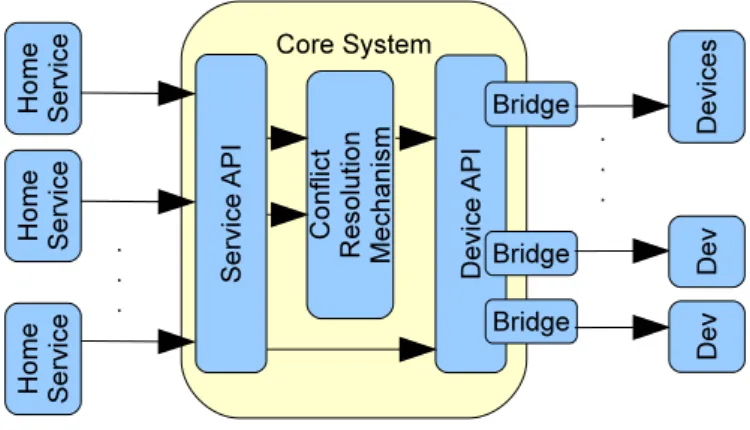
To be able to do so, we propose a centralized resource management system for the environmen-tal properties which can be integrated in the deployment platform. This system has complete control over the devices that can affect the environment and it is tasked to fulfil the requests of services regarding the four environmental properties (illumination, temperature, humidity, sound/noise levels), acting as an abstraction layer between the services and the devices. The proposed system provides a service application programming interface (API) so that services can make requests for resources as well as an internal device API to control the devices in the HNS in a unified manner.
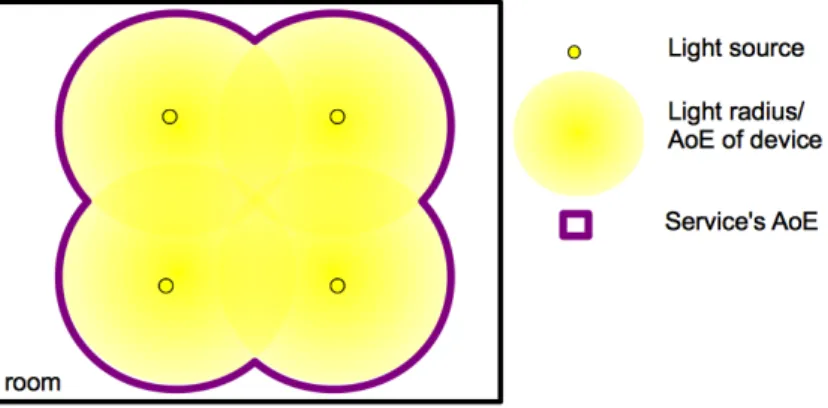
The system uses information regarding the ”Area of Effect” (AoE)of services and devices as well as compromising techniques to detect and resolve conflicts between services. We defined the AoE of a service (or a device) as the physical space for which the effect of that service (or device) lies between upper and lower intensity bounds that we are interested in. The system uses limited physics simulation to predict the effects and make estimation about AoEs.
Using this information, the system is able to detect conflicts by discovering overlapping AoEs. We take a two step approach: one per-device conflict detection step where the conflict is dis-covered by conflicting settings applied on a device inside the intended AoE and and a second step based on estimations of overlapping AoEs of devices outside the originally intended scope. Regarding conflict resolution, we propose two main categories of compromising algorithms: space-based and intensity-based. Both of these types of algorithms do not require the suspension of any conflicting service.
Space-based compromising algorithms try to limit the AoEs of the conflicting algorithms. These algorithms strive to impose the requested intensity around the anchor point of a service. The anchor point is the epicentre of execution of the service and the point which the service is most interested in. These algorithms are effective when there is a large number of conflicting devices and their locality is good (i.e. the effects of the service tend to weaken sharply as the distance from the source increases).
Intensity-based compromising algorithms try to choose an intermediate setting for devices such that all conflicting services can be satisfied to the maximum possible degree. These algo-rithms are effective when there is a small number of devices that may also have bad locality.
The above algorithms search the solution space (possible combinations of settings for devices) so that the requests of the services are fulfilled as best as possible. We identified the problem as being an optimization problem and proceeded to examine various optimization techniques and their applicability. The implemented algorithms in this prototype system can be said to be
variations of local search algorithms combined with evaluation mechanics borrowed heavily from constraint programming.
Two space based algorithms (”greedy” and ”forfeit rights”) and one intensity based algorithm (”range search”) were implemented. Various combinations of conflict detection and conflict resolution techniques were tested in a total of three experiments (scenarios for illumination, temperature and sound/noise levels).
We argue that the use of the prototype system is a significant improvement over the alterna-tives: suspending a service, or suffering from non-deterministic or erratic behaviour of devices. Finally we believe that the proposed system augments the SI model and there is potential value in a combined system.
1 Introduction 1
1.1 Home network system and services . . . 1
1.2 Target of this research . . . 2
1.3 Structure of this document . . . 2
2 Background Research 4 2.1 Services in the home network system . . . 4
2.1.1 Conventional models . . . 4
2.1.2 The Service Intermediary model . . . 6
2.2 Feature Interaction . . . 7
2.2.1 Type of feature interactions in the HNS . . . 8
2.2.2 Traditional conflict detection techniques . . . 9
2.2.3 Traditional conflict resolution techniques . . . 9
2.2.4 Advantages and disadvantages in traditional methods of conflict resolution 10 3 Area of Effect and compromising techniques 12 3.1 Resolving environmental conflicts without suspending services . . . 12
3.2 Proposed system architecture . . . 12
3.3 Area of Effect . . . 13
3.3.1 Effect of a device at a given point in space . . . 14
3.3.2 Effect of a service at a given point in space . . . 14
3.3.3 Area of Effect of a device . . . 15
3.3.4 Area of Effect of a service . . . 15
3.3.5 Conflicting services at a point p . . . . 16
3.4 Request for resources . . . 16
3.4.1 Desired AoE of a service . . . 16
3.4.2 Desired intensity of Effect . . . 17
3.4.3 The importance of service requests and a centralized control system . . 17
3.5 Conflicts between services . . . 18
3.5.1 Type of conflicts . . . 18
3.5.2 N-service conflicts . . . 19
3.6 Detection of conflicts . . . 20
3.7 Compromising Techniques . . . 20
3.7.1 Space-based conflict resolution . . . 21
3.7.2 Intensity-based conflict resolution . . . 22
3.7.3 Combined and Hybrid conflict resolution . . . 22
3.8 Optimization . . . 23
3.8.1 Formalization . . . 23
3.8.2 Tackling the optimization problem . . . 24
3.8.3 Linear Programming . . . 24
3.8.4 SAT and MaxSAT . . . 25
3.8.5 Game Theory . . . 26
3.8.6 Constraint programming . . . 27
4 System Architecture and Implementation 29 4.1 Architecture Overview . . . 29
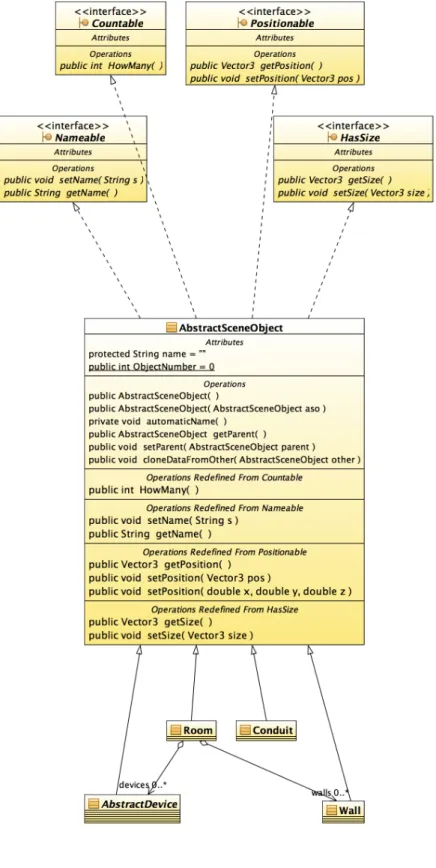
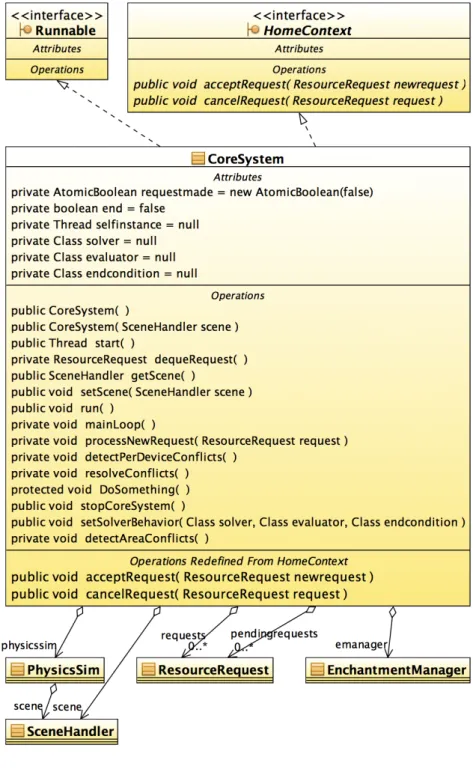
4.1.1 Class diagrams and important concepts . . . 30
4.1.2 Implementation of the Core System . . . 30
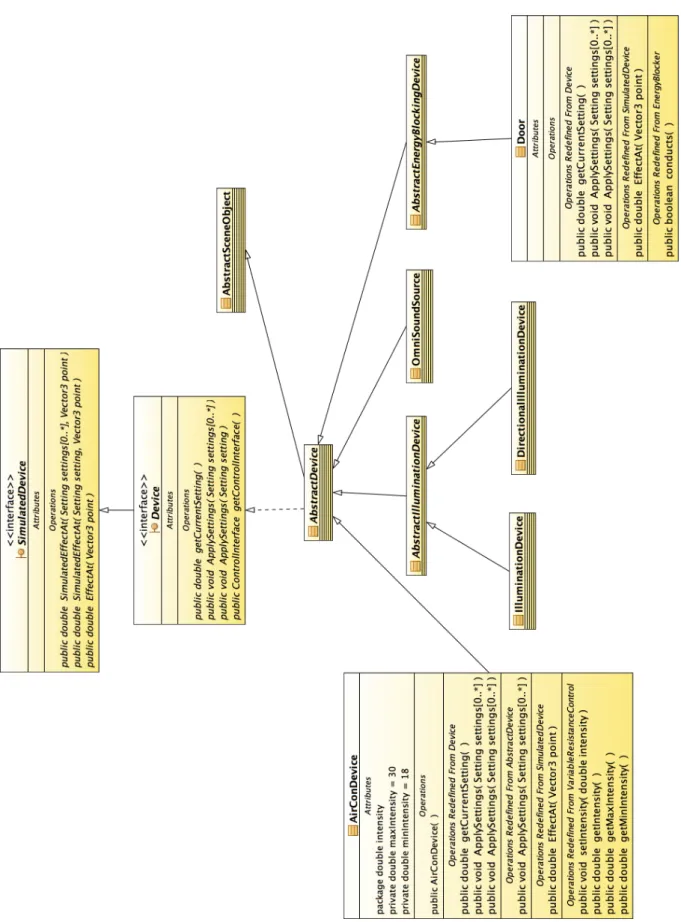
4.2 Devices and Device API . . . 33
4.3 Service API . . . 36
4.4 Detection and Resolution of conflicts . . . 40
4.4.1 Main loop of the system . . . 40
4.4.2 Enchantments, Enchantment Manager and ideal solutions . . . 41
4.5 Conflict detection algorithms . . . 45
4.5.1 Per-device conflict detection . . . 45
4.5.2 Conflict detection using AoE information . . . 46
4.6 Conflict resolution algorithms . . . 46
4.6.1 End conditions . . . 47
4.6.2 Evaluators . . . 48
4.6.3 Compromising Algorithms . . . 50
4.7 Implementation details . . . 53
4.7.1 OSGi and Java . . . 53
4.7.2 Sample Service . . . 54
5 Test cases and results 55 5.1 Space based resolution experiment . . . 55
5.1.2 Case 1: greedy algorithm and highest score end condition . . . 57
5.1.3 Case 2: greedy algorithm and constrained programming end condition . 58 5.1.4 Case 3: forfeit rights algorithm and highest score end condition . . . . 59
5.1.5 Case 4: forfeit rights algorithm and constrained programming end con-dition . . . 60
5.1.6 Comments . . . 61
5.2 Intensity based resolution experiment . . . 62
5.2.1 Scenario details and execution . . . 62
5.2.2 Comments . . . 64
5.3 Conflict detection using Area of Effect . . . 64
5.3.1 Scenario details and execution . . . 64
5.3.2 Comments . . . 66
6 Future work and improvements 67 7 Conclusions 69 A XML configuration files 70 A.1 configuration file for illumination scenario: 7x5.xml . . . 70
A.2 configuration file for temperature scenario: TemperatureScenario.xml . 74 A.3 configuration file for conflict descovery based on area of effect: SoundSce-nario.xml . . . 75
B Execution Logs 76 B.1 Space based resolution experiment results . . . 76
B.1.1 Case 1: High score + Greedy . . . 76
B.1.2 Case 2: Constrained + Greedy . . . 77
B.1.3 Case 3: High score + Forfeit rights . . . 78
B.1.4 Case 4: Constrained + Forfeit rights . . . 79
B.2 Intensity based resolution experiment results . . . 80
Introduction
1.1
Home network system and services
In the past decade the number of home appliances that have networking features has been steadily increasing. Such devices have increased perceived value for the customer because of the extra features (remote control, access to the internet, others) that they provide. At the beginning, these devices used to have a very limited application scope, provided a very specific service to the user and were not designed with interoperability in mind.
It was not before long that device manufacturers realized the potential of designing network-capable appliances that can co-operate and share resources. From this fundamental change in design, protocols such as UPnP[17], Echonet[18] and DLNA[16] were developed. These pro-tocols are backed by major organizations that are considered to be industry leaders (such as SONY, Microsoft Corp. and others) and have been adopted in the design of many commercial products that are readily available to consumers now.
Having somewhat solved interoperability and communication problems between devices, the next challenge is to offer services to the home environment in a flexible and standardized man-ner. Recently, various vendors offer services to the home using some proprietary hardware and software combination. These solutions have quite a few disadvantages such as redundant hard-ware, configuration complexity, possible conflicts between services and others. These problems will be explained in detail in section 2.1.
This research is focusing on the detection and resolution of environmental conflicts between services in the home network system (hereby referred as HNS).
1.2
Target of this research
In our research we discuss service conflicts in the home network system. We proceed to cat-egorize conflicts between services and then propose new methods to detect and resolve a sub-category of these conflicts, named as ”environmental conflicts”. Our approach is based on the notion of the ”Area of Effect” (from now on referenced as AoE) and the application of
compro-mising techniques.
We propose a centralized system in the HNS that acts as a resource manager. This system will undertake the task to receive requests on behalf of the services and try to fulfil them to the best possible degree. Furthermore, this resource management system has a comprehensive set of programming APIs that can be used to design a service with minimum effort and for the control of devices and can also be integrated with the SI model for the provision of more complex and feature-rich services that adapt to the deployment environment.
The proposed system employs new techniques for the detection and resolution of conflicts between services based on the notion of AoE and compromising techniques. It is important to note that these compromising techniques can be used effectively for only a specific type of service conflict, which we named ”environmental conflict” .
1.3
Structure of this document
In chapter 2 we will explain the background regarding the home network system (from now on referenced as HNS) and services. We will proceed to describe different architectural models for the provision of services in the HNS and then describe what is know as feature interaction between services. We will finish chapter 2 by mentioning the methods currently available to detect and solve service conflicts and explain their weaknesses.
In chapter 3 we will discuss the various types of conflicts between services, focusing on the environmental conflicts. Then we will proceed to give the various definitions regarding the AoE. Namely, we will talk about the effect of a device and the effect of a service at a given point in space, as well as the AoE of a device and the AoE of a service. We will then proceed to express the problem of assigning settings to devices as an optimization problem and evaluate different methods to tackle it.
In chapter 4 we will give an overview of the design of the prototype system we developed, and describe the various APIs used internally to handle requests from the services. We will proceed to provide some implementation details about the system.
In chapter 5 we will present some experimental setups along with the results attained. The experiments will demonstrate the advantages of the proposed conflict detection and conflict resolution algorithms in various scenarios that may occur in the HNS.
Finally in chapters 6 and 7 we present possible future work and improvements as well as the final conclusions and remarks respectively.
Background Research
2.1
Services in the home network system
In this section we will discuss the past and the current status of home services in the HNS. We will provide a definition of what constitutes a service in the HNS and present the different methods that are used for the provision of such services
A service in the HNS is a service provided to the user that satisfies a specific need. These services may offer a wide area of functionality, such as ”smart” security systems, regulation of energy consumption, context-aware environment and others. Such services are quite often provided by an external entity (a company) which from now on we will refer to as the Service Provider (SP).
2.1.1
Conventional models
The conventional method to provide services to the user in the HNS is to supply the user with specific, proprietary hardware that integrates tightly with the provided service. For example, a typical home security system (that essentially provides a home security service to the users) usually consists of many sensors that have to be retrofitted to almost all the doors and windows in a house, a device that provides the main user interface to the user and also acts as a gen-eral computation system, and possibly utilize some network connection to notify the security company of possible security breaches in the house.
Another example of a service provided in a very traditional fashion is netflix streaming services[15]. Using the netflix services a user is able to stream a wide variety of video content to a select array of ”netflix-ready” devices1. The video content is streamed directly from the service provider and
arrives directly to a certified device able to handle the video stream.
1for a list of supported devices, see http://www.netflix.com/NetflixReadyDevices (accessed on 2010-02-20)
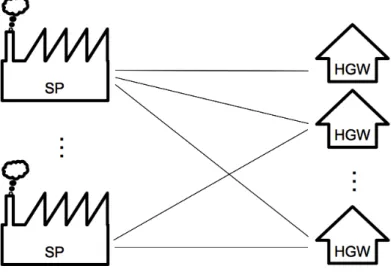
A representation of the conventional service provision model can be seen in figure 2.1. Lines between the SP and the HGW show the direct relationship between the two parties.
Figure 2.1: The conventional service provision model.
The common elements of the above solutions are the following: • custom hardware equipment to support the service
• A client-server architecture between the service provider and the required service hard-ware installed directly at the HNS of the user
• the user must enter a contract with the service provider for every service he may wish to use.
Despite the simplicity of this conventional model of providing services, there are some severe disadvantages that prohibit the realization of a more rich, unified HNS. The biggest disadvan-tages of this conventional approach to services are the following:
1. Usage of custom hardware. In most services the hardware is restricted to only provide the service it was designated to provide. Other services usually cannot take advantage of the hardware designed to be used with another service. This may also lead to redundant or duplicate hardware for similar services.
2. Configuration of the service. Due to the fact that each service is using dedicated hardware, the configuration of this hardware is usually left to the inexperienced user.
3. User interface. The user interface for each service is usually provided through some pro-prietary software/hardware solution. This ruins the feeling of consistency between ser-vices and it is also more difficult to master the peculiarities of the different interfaces.
4. Conflict between services. Because the services act independently from each other, there is a high chance that some services may conflict over the use of resources or produce conflicting results. This degrades the perceived quality of experience for those services. The above disadvantages all stem from the fragmentation of the deployment hardware. These inherent limitations of the conventional model hamper its scalability.
2.1.2
The Service Intermediary model
Service Provider, Service Intermediary, and Home Gateway
After realizing the limitations of the traditional model to provide services in the HNS, the Service Intermediary (SI) model was conceived. The core idea of this model is presented in [1]. The SI platform is designed to solve the problems of the traditional service model.
In the SI model, there are three main entities.
• The back-end Service Provider (SP). This is the actual provider of a specific service. The SP designs services that will be provided to the HNS, the final deployment target. This role is the only one that remains unchanged compared to the traditional model.
• The Home Gateway (HGW). The HGW acts as the gateway of the HNS to the outside world. Services can be executed directly on the HGW hardware. Moreover, the HGW acts as a software bridge, capable of controlling or passing command to other devices in the HNS.
• The Service Intermediary (SI) ,from which this model for service providing takes its name. The SI acts as an intermediary between the SP and the HGW. In this model, the HGW does not contact the SP to have access to a service. Instead, the SI aggregates services from various SPs and presents them to the user. The user makes a contract with the SI to have access to the services of the various SPs.
A representation of the relationships between the three parties can be seen in figure 2.2. Usu-ally, SIs aggregate services from the SPs and then a house can enter a contract with an SI.
Advantages of the SI model
The presence of the SI is the major difference between the SI model and the traditional model of services. By having a service intermediary between the various service providers and the HNS, the problem of a fragmented deployment environment is resolved. This is because, the SI can enforce a specification of the hardware platform on which the services will be executed. The SI will be responsible to verify that all services deployed on the controlled platform do not misbehave and are consistent.
Figure 2.2: The SI service provision platform.
The existence of an SI saves the user of the hassle of having to make contracts with a substantial number of different SPs. Moreover, the problem of the configuration of a multitude of different devices is resolved, since the SI can take care of it. The configuration of the services will also be taken care by the SI, and we expect that the SI will be able to offer a comprehensive and consistent user interface, not possible otherwise. Furthermore, the duplication of hardware is minimized and the same hardware may now be used by many different services, increasing its value. Moreover, the SI will be able to provide the user with all the equipment that is necessary (depending on the services the user is subscribing to), or designate compatible equipment that can be used effectively as part of the platform. Finally, according to [2], it is possible to have computationally intensive services execute on computational nodes of the SI transparently, as in the case of cloud computing.
The benefits for the service providers are also quite substantial. Firstly, the SI is now able to provide the SP with a set of application programming interfaces (APIs) for the design of services. By adhering to the APIs, now the SP does not have to worry about inconsistencies and differences in the deployment HNS. The SP now must target the service platform provided by the SI. It is the responsibility of the SI to guarantee the provision of a consistent service platform on which services can be deployed. Thus, the SP is freed from the mundane task of having to test the service with possibly hundreds of different configuration environments, simplifying the design of services targeted for the HNS.
2.2
Feature Interaction
One of the problems that the SI model is also well suited to solve is the feature interaction (from now on referenced as FI) between services. Actually, since the services now run on a unified
platform, they now compete for resources more often than before. It is critical to look into the possible feature interaction scenarios and try to classify them appropriately based on their characteristics.
Pattara in [3] gives the following definition for the feature interaction in the home network system:
”Feature Interaction is a type of functional conflict among multiple services not ex-pected from the behavior of the services in isolation. FIs bring about unexex-pected (and often undesirable) behaviours of the service and lead the service to malfunc-tion.”
Regarding FI, there are two major areas of research; feature interaction detection and feature interaction resolution. In the following sections we give an overview of the classification of FI, as well as present some of the traditional methods for detection and resolution of FI.
2.2.1
Type of feature interactions in the HNS
In [3], Pattara gives a brief explanation about the different types of Feature Interaction.
Device conflicts
Originally mentioned as ”Inconsistency in the execution of functions of an appliance”, this type of conflict occurs when two (or more) services send contradicting functionality requests to a device. For example, it is easy to imagine two services that independently want to set the state of an illumination device (possibly a simple light bulb). The final state of the device cannot be deterministically predicted. It could either be turned off, turned on, or the services may be able to detect that the state of the device is not the desired one, and keep flipping it on and off continuously.
Environmental conflicts
Originally referred to as ”Inconsistency in the execution of functions, which affects the envi-ronment”, this type of conflict occurs when two (or more) services send requests to appliances whose functions have contradicting effect on the same environment property. For instance, a service might turn on the heater in a room, but at the same time, another service may send a request to turn on the air conditioner which would result in a conflict, since the device effects are countering each other.
2.2.2
Traditional conflict detection techniques
Over the years different approaches for the detection of conflicts have been proposed. In this section we review some of the literature.
In [6] and [7], a model-checking approach using the SPIN model checker is proposed. Further-more, in [4], temporal logic is used to express the correctness criteria. To produce the temporal logic formulas, a method to express the behaviour of the services in higher level logic and a classification of the causes of FI is described.
In [10] ”Use Case Maps” are used for the design and documentation of features, whereas LOTOS([9]) is used for formal verification, including the detection of undesired interactions in a PBX telephone system.
In [8] Metzger and Webel propose a series of detection methods for building control systems based on product model and the PROBAnD requirement specification method. In that paper, four different detection strategies are introduced, each used to refine a list of possible FI. Those methods are:
• Detection at requirements level. A dependency graph between the needs and the tasks is generated.
• Detection at strategy level. Dependencies between tasks and their realization methods can occur at this level.
• Detection at object structure level. Interactions that are impossible to occur are pruned in this level using information from the object hierarchy and instantiation of objects. • Detection at environment level. This is the first notion for detection of conflicts based
on characteristics of the environment. The use of a simulator that can detect implicit interactions is suggested. In research, we further elaborate on this concept introducing the notion of ”Area of Effect”.
2.2.3
Traditional conflict resolution techniques
Stemming heavily from traditional operating system concepts, in [3], six techniques of conflict resolution between services are proposed. We will briefly describe each one of them.
Inquiry to the User
When a conflict occurs, an inquiry is made to the user regarding the method of the resolution. The following are the possible methods which the user can choose from: 1) execute one service and terminate the other or 2) if possible, reset and change the parameters of the conflicting services so that FI does not occur.
Priority of Service
According to a predetermined service priority, if FI occurs, only the service with the highest priority is executed. This method is considered to be more effective in cases were multiple services exist, and possibly many users. To implement such a resolution scheme, a database for managing the order of priority of services is considered to be necessary.
Priority of User
When FI occurs, only the service activated by the user with the highest priority is executed based on the predetermined order of priority among users. This method is considered to be more effective in scenarios were multiple users exist.
Priority of Interface
When FI occurs, only the service activated from the interface of highest priority is activated. A predetermined priority order of interfaces is assumed. This resolution scheme works best when there are multiple possible user interfaces for a given service.
Priority of Timing
There are two methods in determining the service that is to be given priority based on the order of service execution, namely, to give priority to the service that is executed first or to the one that is executed last. This resolution method can be used in any classification of FI. In order to implement this method of resolution, a database for managing the order of priority of timing is required.
Meta Priority
Meta priority is the prioritization of all the above-mentioned priority levels. When a conflict occurs, it is possible to utilize more than one type of priority level in resolving the conflict. At that point, it is also likely that interactions could occur between different types of priority levels. In order to avoid such situation, it is necessary to prioritize the different types of priority levels.
2.2.4
Advantages and disadvantages in traditional methods of conflict
res-olution
The conflict resolution methods presented in section 2.2.3 can be said that are derived from equivalent resource allocation and scheduling techniques already found in modern operating systems. As such, they offer some clear advantages:
• Easily understood and well researched.
• Easy to implement. Already existing algorithms can be slightly modified for the needs of conflict resolution.
However, all of the above conflict resolution methods (except maybe the ”Inquiry to the User” method) have one distinct disadvantage: the suspension of at least one service. This is nec-essary to allow the remaining services to continue without any conflicts. Regarding device conflicts, it may be inevitable to completely suspend/stop a service to at least allow other ser-vices run successfully. However, it is our opinion that in cases of environmental conflicts, it may be possible to avoid suspending a service and still have it execute with relative success. This would thus improve the ”availability” and effectiveness of services in the HNS.
Area of Effect and compromising
techniques
3.1
Resolving environmental conflicts without suspending
ser-vices
Traditional compromising techniques need to suspend a service in order to resolve a conflict between services. Starting from this observation, we propose a new set of conflict resolution methods that do not have this limitation. The idea is based on the observation that a meaningful
compromise may exist between the requests of the conflicting services.
In the following sections we present the notion of ”Area of Effect” of a service, and how it can be utilized for the detection and resolution of conflicts. Furthermore, we also present various compromising algorithms and their categorization. It must be said that a compromise may not be meaningful in some cases . For example, in the vast majority of device conflicts, it is almost impossible to reach a meaningful compromise. Nevertheless, it is our belief that in many cases of environmental conflicts there may exist such a compromise between the requests of the services that allows them to continue execution with a relative degree of success.
In this research we examine the cases of environmental conflicts regarding the following four
physical properties of space: illumination, temperature, humidity, sound and noise levels. The
above properties of space are those that are more often changed by the set of devices commonly available in the HNS.
3.2
Proposed system architecture
To be able to enforce a compromise between services, we took the approach of having a central-ized system that has absolute control over any device that affects the four physical properties
of space. This management system knows the state of the devices at any given point in time. Furthermore, it has the task of accepting requests from services regarding the physical properties for some area inside the house. Finally, the proposed system is responsible for the detection and resolution of any environmental conflict that may occur.
In more detail, the proposed system can be broken down to three design blocks: a service API, a device control API, and the core system responsible for the resolution of conflicts. The reasons behind this three-layered approach are quite simple:
1. By providing a service API that will be used by the services, an abstraction layer is added. Using this service API, a service will be able to make a request for a resource available in the HNS. The properties of physical space (illumination, temperature, humidity, sound and noise levels) are all treated as resources. This abstraction layer frees the service de-signer from the daunting task of designing services that are compatible with a multitude of devices, thus simplifying the design process.
2. The design of a device control API allows uniform control over devices that exist in the HNS. Thus, it is enough that a device that wants to be part of the system implements a specific control interface.
3. By taking advantage of the above APIs, it is now possible to design the logic of a conflict detection resolution mechanism with clear separation. Thus, if the device and service APIs remain constant, it is possible to have interchangeable implementations of the conflict resolution core.
Due to the clear separation between the service requests and the actual device control, the pro-posed model can easily be introduced as a part of an SI service delivery platform. The imple-mentation details of a prototype system will be explained in chapter 4.
The most important job of this centralized system is to handle the incoming requests and select proper settings for the devices in the requested area. For every request made, the system proceeds to find an ideal solution (that is, a series of settings for devices that fulfil the request). At this step, the system does not take into consideration any previous settings that may have been applied.
After the system has found an ideal solution, it then proceeds to detect conflicts. Conflict detection is based on two ideas presented in section 3.6
3.3
Area of Effect
In this section we will present the definition of ”Effect” and ”Area of Effect” of a device and a service. These ideas will come in handy during the explanation of the proposed algorithms developed for the detection and resolution of environmental conflicts.
3.3.1
Effect of a device at a given point in space
The four physical properties that were considered during this research are illumination, temper-ature, humidity, sound and noise levels.
P ro ={Illumination, T emperature, Humidity, SoundNoise} (3.1) Regarding a physical property P ro of space, we define the effect E of a device Dev at a given point in space p as:
EDev,P ro(p) (3.2)
The above expression results in a numerical value that expresses the intensity of the physical
property at the specific point p in space. The measurement unit of the intensity differs
depend-ing on the physical property measured. For example, EDev,Illumination(p) is measured in lux,
whereas EDev,SoundN oise(p) is measured in db
Using physics simulation, we are able to model the behavior of various devices inside the home environment, such as air condition units, heating devices, illumination devices and others. The modelling of those devices is usually based on simple physical laws, like the inverse square law for the propagation of sound. The modelling of devices requires an implementation of function (3.2).
3.3.2
Effect of a service at a given point in space
Assuming that a service S is currently utilizing n devices (Dev1 to Devn), the effect of that
service in regards to property P ro at a point p in space is defined as:
ES,P ro(p) = F
(
EDev1,P ro(p), . . . , EDevn,P ro(p)
)
(3.3) Function F is dependent on the property that is being examined. The target of this function is to essentially compute the combined intensity of property P ro given the already known individual effects of devices Dev1...n.
For example in the case of illumination, the individual effect of devices can be summed to express the effect of a service at a given point p
ES,Illumination(p) = n
∑
i=1
EDevi,Illumination(p)
The definition of function F allows us to predict the effect of a service at a given point p. In the prototype system developed and discussed in chapter 4, physics simulation was used for the implementation of various such functions for each physical property.
3.3.3
Area of Effect of a device
For a property P ro of physical space, given upper and lower thresholds T hreshupand T hreshlow
the Area of Effect (AoE) of a device Dev is defined as:
AoEDev,P ro={p : T hreshlow ≤ EDev,P ro(p)≤ T hreshup} (3.4)
In other words, the area of effect of a device is the set of points p for which the effect of that device is between the requested thresholds. In many cases, it may be meaningful to only have one of the thresholds present and not both. In such cases, the remaining inequalities must still be fulfilled.
It is worth noting that although it is possible to get an exhaustive set of the points inside the AoE of a device, this is not usually the case. In most computations carried out by the proposed system, checks of whether a single point of interest is in the AoE of a device (or a service) is performed.
3.3.4
Area of Effect of a service
Expanding the definition of AoE of a device, the AoE of a service S is the set of points p in physical space for which the effect of the service lies between the two given thresholds T hreshup
and T hreshlow
AoES,P ro ={p : T hreshlow ≤ ES,P ro(p) ≤ T hreshup} (3.5)
For the computation of ES,P ro(p) the computational formula 3.3 is used. Again, as with the
AoE of a device, we can perform checks against the thresholds to see if a point p in space belongs to the AoE of the service.
3.3.5
Conflicting services at a point p
Given two services S1 and S2and upper/lower thresholds T hreshupand T hreshlow for S1, we
can perform checks to find out whether S2 conflicts with S1 at a specific point p in space.
CheckAgainstS1,S2,P ro(p) =
true if ES2,P ro(p)≤ T hreshlow
true if ES2,P ro(p)≥ T hreshup
f alse otherwise
(3.6)
When the above equation returns true, service S2is conflicting with service S1. However, if the
result is false, this does not mean that a conflict has not occurred. A check of S1 against the thresholds of S2 must be made. If both checks return false, then there is no conflict.
To check if there is any kind of conflict between two services S1and S2we use the following
formula: ConfS1,S2,P ro(p) =
true if CheckAgainstS1,S2,P ro(p) = true
true if CheckAgainstS2,S1,P ro(p) = true
f alse otherwise
(3.7)
When the above equation returns true, a conflict between services S1 and S2 has occurred.
3.4
Request for resources
In this research, we assume that any service executing in the HNS is able to make a request for resource. The properties of physical space (illumination, temperature, humidity, sound and noise levels) are treated as such resources. Now, the need to be able to express requests regarding these resources arises.
More specifically, a service needs to be able to express the desired AoE of the service, as well as the desired intensity of the effect over that AoE. In the following sections, we describe the method we used to express the above requests in a relatively simple but effective manner.
3.4.1
Desired AoE of a service
The first important thing that a service request for resources must do is specify the desired area of effect. The desired area of effect is the physical space whose characteristics the service wants to control. For example, a service that wants control over the illumination of the space three meters around a user must be able to designate that desired area. To do so, we use the notion of anchor point combined with some distance specifier to describe an area. Furthermore, it is possible to designate whole rooms as the desired AoE of a service.
Almost any object inside the home environment that has a perceived position can be designated as an anchor point. For example, an anchor point can be any kind of object in a room that is
traceable (e.g. a device, a piece of furniture), an abstract point in space (e.g. the center of the room), or even a moving object (such as the user).
Combining an anchor point with a distance specifier will yield an area of space in a disc shape. This is the designated area over which the service request control. It is possible to ”expand” that area and have it to ”snap” to the size of the current room. In spite of the fact that two services may end up having equal AoEs, special care must be taken regarding the anchor point. The information regarding the anchor point (i.e. its position) plays a critical role during the later steps of conflict resolution.
3.4.2
Desired intensity of Effect
After specifying an AoE, a service must proceed and describe the actual intensity of the desired effect. Again, the service must specify the desired physical property out of the four physical properties that our system can handle. Next, the service must provide an numerical value, that describe the intensity of effect in terms of the measuring unit corresponding to the physical property selected in the previous step.
The final step to describe the desired intensity of the effect is to select between the three types of settings for the intensity: upper threshold, lower threshold and exact setting. These thresholds provide hints on how to judge the intensity of the effect.
An upper threshold states that any intensity value below the specified intensity is acceptable. Conversely, a lower threshold is used when a service request for at least as much as the specified intensity. The above two threshold definitions allow for a broader and more flexible expression of the request of a service. For example, a context-aware service that manages the environment around the user, could make requests regarding the sound and noise levels around the user when he is asleep. Such a service would request that the physical property of noise constantly remains below a specific point; such a request can be expressed with the use of upper thresholds.
Finally, the final option is to select an ”exact” setting. Using such a setting, the service can express that the intensity of the effect in the designated AoE must be as close as possible to the specified intensity. Any setting above or below that is considered to not be fulfilling the request of that service. These kind of settings make sense, for example, in the case of temperature control. With today’s technology, the user can specify a very concrete temperature with accuracy of±1 degreesoC. A service that would possibly want to control the temperature of an area can
use this kind of exact setting to express its needs.
3.4.3
The importance of service requests and a centralized control system
The idea of having services making requests for resources to a centralized management system is advantageous in many ways. in this section we will describe the advantages of this method.
The first most obvious advantage of following such a design pattern is that conflict resolution in a compromising manner is now possible. Without a centralized model and the information provided by the service requests, it would be very difficult to have compromising solutions to problems of FI due to the lack of complete information regarding the situation. The proposed system, having compete knowledge of the situation, can provide a compromising solution.
The second advantage of a standardized method for resource request is that the information contained in these requests plays a crucial role during the later steps of conflict detection and resolution. For example, using the information regarding the AoE of two services, it is possible to check whether there is an area conflict between these two services. Furthermore, the com-promising solution changes significantly depending on the threshold setting. For example, two services that make a request for a resource and both have a setting of upper (or lower) setting don’t necessarily compete with each other, and a compromising solution is very easy in this case.
3.5
Conflicts between services
Depending on the requests made by various services, we have different types of conflicts hap-pening in the HNS. Based on some basic characteristics, we attempt a rough classification of these types of conflicts.
3.5.1
Type of conflicts
Let us assume two services S1and S2that make a request regarding a physical property P ro and
that their AoEs are at least partially overlapping. For the sake of simplicity let us examine the case of a single point p in physical space that belongs to the AoEs of the two services. Finally, the desired intensity for a service S is denoted as ISand the possible threshold settings and the
setting of a service S are the following:
Settings ={UP P ER, LOW ER, EXACT } SettingS ∈ Settings
We can now try to detect conflicts and even vaguely find a compromising solution for the intensity (Isol) in the following cases:
1. SettingS1 = U P P ER and SettingS2 = LOW ER. In this case if IS1 > IS2 it is possible
to select an intermediate value for Isolsuch that
and the requirements of both services will be fulfilled successfully as per 3.7. If IS1 < IS2
then it is impossible to satisfy the requests of the services at the same time. Nevertheless, a solution in the space of (IS2, IS1) may still yield acceptable results.
2. SettingS1 = U P P ER and SettingS2 = EXACT . In this case, if IS1 ≥ IS2 then
Isol = I2. This is because CheckAgainstS2, S1, P ro will return false. In other words,
the exact setting requested by S2 does not conflict with the threshold setting of service
S1. In fact, it actually fulfils it. Now if IS1 < IS2, there is no possible setting that can
fulfil both requests. Again, a solution in the space of (IS1, IS2) may still yield acceptable
results.
3. SettingS1 = LOW ER and SettingS2 = EXACT . This case is similar to the above case.
With the same reasoning we deduce that if IS1 ≤ IS2 then Isol = I2 fulfils both services.
If IS1 > IS2 it is impossible to fulfil the conditions of both services. A compromising
solution in the space of (IS2, IS1) might yield acceptable results.
4. SettingS1 = EXACT and SettingS2 = EXACT . In the rare case that IS1 = IS2 then
Isol = IS1. Otherwise, it is impossible to fulfil the demands of both services. Again, a
compromising solution in the space of (IS2, IS1) might still yield acceptable results.
From the above types of conflict, it is easy to deduce that services that use the EXACT threshold setting express a very strict request that may be impossible to fulfil. However, even if we are unable to fulfil the request of a service, it is possible to obtain a setting that is a compromise between the conflicting requests. This is the target of the compromising techniques presented in section 3.7.
3.5.2
N-service conflicts
As the number of services increases from 2 to n > 2, using the same logic described in the previous section it is possible to estimate the solution space. With logic that is similar, we can detect if it is possible to fulfil all the requests of the services and if that is not possible, find out the possible solution space.
To check whether a solution is possible for all n services at a point p, the following algorithm can be followed:
1 For i = 1; i< n ; i++ 2 For j = i+1; j<= n ; j++ 3 If (Conflict(S1,S2,p)) 4 return true;
The above algorithm checks each service against all the other competing services. If there is even a single conflict, we know that there is no possibility of fulfilling all the requests of the services. The function Conflict(S1,S2,p) is actually the equation 3.7 presented in section 3.3.5
3.6
Detection of conflicts
In the proposed system, two main ideas are used for the detection of conflicts between services. The first method involves the detection of conflicts on a per-device fashion. After the system finds an ideal solution to satisfy the request of a service, certain settings must be applied to devices. The system keeps track of all the settings that are applied to a device using a list. If the list of settings for a device is empty, the device is not being used. If the list of settings has only one entry, it means that the device is used by exactly one service.
Now, if in the setting list for a device there are more than one settings, a conflict may have occurred. The next step is to make a check to see if the requests are contradicting, and if they are, then the two services that made these requests may have contradicting settings to more than one device. The system proceeds to discover the remaining conflicting settings on other devices used by the two services, and the conflict is successfully detected.
The second method to detect conflicts in the proposed system, is to make an estimation of the AoE of surrounding devices. For example, imagine that a service makes a request for sound and noise levels with a maximum threshold (i.e. limit the amount of noise) in a room. The system would search the devices in the intended AoE of the service (i.e.) the room, and see if their effects violate the threshold. However this is not enough.
The system must make an attempt to identify if the effects of devices outside the intended AoE have an effect on the service. To make an estimation of the area of effect, a physics simulator can be used. If indeed the effect of a device (or a combination of effects) exceeds the threshold, then the system marks these devices and proceeds to cast appropriate settings to them. Again, the conflict detection was successful, and the information from this step will be used during the conflict resolution phase.
3.7
Compromising Techniques
In this section we present the basic ideas behind compromising techniques. The main idea behind compromising techniques is to have the system decide appropriate settings for all the devices involved in a conflict. The final settings combination should be deemed acceptable based on some predetermined criteria. Finally, a compromised solution may not honour the original requests (and their threshold settings) made by the services.
We divide the compromising algorithms into two categories, ”Space-based” resolution meth-ods and ”Intensity-based” resolution methmeth-ods.
3.7.1
Space-based conflict resolution
The target of space-based conflict resolution methods is to mitigate the conflict effect by clearly separating the AoEs of the conflicting services. To do so, a space-based conflict resolution algorithm must decide which should be the prevailing setting for a contended device.
Assuming that we have two competing services S1 and S2 and a contended device Dev , the centralized management system will first go through the process of deciding proper settings for
Dev in order to fulfil the request of each service separately. Now the system is faced with the
choice between two settings for Dev: the setting that would fulfil S1 or the setting that would fulfil S2. Selecting one of the two settings in essence means that Dev was assigned to one of the two competing services. If the number of conflicting devices is n the system is faced with the challenge of assigning proper devices to services. With a good assignment of the devices to services, it is possible to create areas in space where the effect of one of the two services is prevailing, thus creating a strong illusion of separation of AoEs.
One of the initial strategies is to assign each device to the service with the closest anchor
point. The anchor point is assumed to be the point in space that the service is most interested
in controlling. Considering the fact that in most cases the effect of the device is weakening as the distance between the device and the anchor point is growing (illumination and sound decaying, heat losses), the solution described above is intuitively the simplest solution that we can have: devices closer to the anchor point have greater effect, devices further away have less of an impact.
Such a simple device assignment will not really yield interesting results. Nevertheless, it is actually a good starting point. In [5] we used that initial assignment and then proceeded to improve the device assignment in an iterative manner.
The space-based algorithms can yield acceptable solutions to scenarios that involve many
devices that exhibit strong locality. A device that has a clearly discernible (and possibly small
in radius) AoE is said to have strong locality. As an example, a spot light device that is affixed to the ceiling can be said that it exhibits good locality, since the area around the device will be illuminated sufficiently, but areas that are just a few centimetres further will have a severe drop in the measured illumination intensity. Such is the case of devices that were assumed for the experiment presented in [5].
3.7.2
Intensity-based conflict resolution
Contrary to space-based conflict resolution algorithms, the target of an intensity-based algorithm is to decide an intermediate setting that would combine the settings of the conflicting services. Sometimes, a clear separation of the AoEs of the conflicting services might not be possible due to the limited number of devices that can control the requested physical property. For example, in the case of temperature and humidity, the AoE of a device can be substantially large, something that can hinder the separation of AoEs. Furthermore, operating more than two temperature controlling devices with different settings could potentially be a conflict, since the effects of these devices could counter each other.
For example, imagine that two conflicting services wish for different room temperatures, and the only available device in the room is an air condition unit. Let us assume that service S1 and service S2 want corresponding settings of 25oC and 28oC with EXACT threshold settings.
We soon realise that separation of AoEs in this case is not an option because there is only a single temperature controlling device. So the best possible solution is to settle for an interme-diate solution for the setting of the contended device. The actual deciding parameters for the final intensity setting can defer depending on the physical property being examined, the policies enforced by the system and the implementation characteristics of the intensity-based algorithm used.
Intensity based conflict resolution methods usually work better in the following cases: 1. when the number of conflicting devices is small (possibly just a couple of devices) 2. when devices have effects that counter each other (such as in the case of temperature) 3. when the conflicting devices have poor locality (AoEs that extend in the size of a room or
even expand to several adjacent rooms)
4. when the target of the compromising is to achieve a homogeneous intensity for the target property in the conflicting area.
3.7.3
Combined and Hybrid conflict resolution
A combined conflict resolution algorithm is an algorithm that combines the characteristics of space-based and intensity-based resolution algorithms. Such algorithms could potentially select to completely assign some device to a service completely or apply an intermediate setting to a device if this is deemed appropriate.
As hybrid conflict resolution mechanisms, we categorize any combination between a conflict resolution mechanism and a conventional conflict resolution mechanism, such as those presented in 2.2.3. Although we did not proceed to implement any such algorithm in this research, we
believe that such a combination is not only possible, but could potentially yield even better solutions for service conflicts.
3.8
Optimization
The target of a compromising algorithm is to decide suitable settings for all the devices that are involved in a conflict. To evaluate the appropriateness of a solution, an evaluation function is used. Using this evaluation function and by estimating the total effect of the devices on a service, we can produce a numerical score that expresses how good the given solution is. The true nature of the problem is that of an optimization problem; find the solution with the best score given specific criteria.
3.8.1
Formalization
Let us assume that n devices Dev and m services Serv are involved in a conflict. For each device Devi there is a corresponding setting Seti for it. Furthermore let us have:
D ={Dev1, Dev2, . . . , Devn}
S = {Set1, Set2, . . . , Setn}
Services ={Serv1, Serv2, . . . , Servm}
where D is the set of all devices involved in a conflict,S is the set of settings for those devices and Services is the set of services involved in that conflict. Furthermore, let us assume an evaluation function
Eval(Servi, D, S) (3.8)
that evaluates the total effect of devices D with settings S on service Servi. We also assume
that if Eval(Servi, D, S) ≥ 0 then the service request is fulfilled successfully, whereas if
Eval(Servi, D, S) < 0 the request of the service is not fulfilled.
Finally let us define a function that computes the total score of the solution, i.e. the selected settings for the devices:
SolutionScore(Services, D, S) = G(Eval(Serv1, D, S), Eval(Serv2, D, S),
. . . , Eval(Servm, D, S)
) (3.9) Without any loss of generality, we can say that an optimal compromising solution must maximize
SolutionScore. Thus we need to select Smaxsuch that:
There are a couple of points worth noting regarding the above functions. Firstly, the function
Eval(Servi, D, S) is responsible to
• compute the total effect of devices in relation to Servi (for example, evaluate the total
effect of the devices at the anchor point of the service)
• assign a score for the service by comparing the total effect of the devices to the original request made.
In essence, this function combines the measuring method used to estimate the total effect of the devices (for example, take samples from points at random and average them) as well as the scoring strategy. The scoring strategy can be different depending on the physical property dis-cussed. For example, in the case of an illumination request, it makes sense to score the services based on a logarithmic scale, because the human perception of light changes in a logarithmic fashion [11]
Secondly, the function SolutionScore can be used to express a desired scoring scheme. De-pending on the characteristics of this scoring function, different policies can be implemented, thus enabling flexibility and the ability to adopt our scoring methods depending on the situation.
3.8.2
Tackling the optimization problem
Having established that the selection of appropriate settings for devices is an optimization prob-lem, we examined several options to solve the problem. A brief commentary about each method’s characteristics and an evaluation follows.
3.8.3
Linear Programming
Using linear programming and the simplex method, it is possible to find an optimal maximum to an optimization problem. However, some prerequisites must hold, namely, that of the linearity of the system.
Suppose that we have n number of variables xi and we want to find the maximum of a target
function f (x1, . . . , xn). Each variable xi may have some constraint e.g. being non-negative.
If the problem can be expressed as a set of linear equations and inequalities in regards to the unknown variables, then we can use linear programming techniques to find an optimal solution. To use linear programming techniques, we have to answer whether the problem of finding an optimal compromising solution can be expressed as a linear problem. Looking back at the prob-lem of finding an optimized compromising solution, it boils down to whether the SolutionScore equation (3.9) and the service score function (3.8) can be combined to form a linear equation.
If we assume that both of the above equations are linear (for example, both equations are simple summation equations) it is possible to derive the following linear function
SolutionScore(Services, D, S) = c1Set1+ . . . + cnSetn
where c1, . . . , cn are constants and Seti is the setting for Devi. Thus, the system would be
expressed as a linear programming problem and solved accordingly (e.g. by using the simplex method).
Unfortunately, it is not always possible to do so. There are cases where the equations (3.8) and (3.9) are not linear equations. For example, in the case of equation (3.8), for the evaluation of sound and noise levels it is desirable to express the intensity as a logarithm of a desired setting. Moreover, the scoring function (3.8) is not always guaranteed to be linear. The total scoring strategy can change, and to express interesting scoring schemes usually a linear equation is not enough.
To avoid limiting the expressiveness of equations (3.8) and (3.9), we avoid the use of linear programming as a prospective solution to the problem.
3.8.4
SAT and MaxSAT
We briefly consider the possibility of expressing the optimization problem as SAT / Max-SAT boolean satisfiability problem.
In a typical SAT problem, we assume n boolean variables. Let us also assume that there is a function f that consists of the aforementioned variables and a combination of the operators AND, OR, and NOT. The problem is to find an assignment for variables such that the whole formula evaluates to true.
There are several special cases of the SAT problem (e.g. formulas are required to be in a conjunctive normal form, 3SAT, others), but one with many interesting properties is Max-SAT. Max-SAT is the problem of determining the maximum number of clauses of a given boolean formula that can be satisfied by some assignment.
Taking into consideration the fact that the intensity settings of devices may span a continuous space, it becomes difficult to express the problem of finding a compromising solution as a SAT/ Max-SAT problem. Depending on the number of devices and their possible settings, a SAT encoding of the problem may lead to unrealistically high execution times. Furthermore, the complexity of the evaluation functions makes matters even worse, not allowing an easy transition from the problem as defined in 3.8.1 to be expressed as SAT/ Max-SAT. Thus, we believe that such an approach is not realistically possible.
3.8.5
Game Theory
Citing [12] ”game theory is the formal study of conflict and cooperation. Game theoretic con-cepts apply whenever the actions of several agents are interdependent. These agents may be individuals, groups firms, or any combination of these. The concepts of game theory provide a language to formulate, structure, analyze and understand strategic scenarios.”
A game is the formal model of an interactive situation. In non-cooperative game theory,
Play-ers play the game in order to maximize their pPlay-ersonal gain (a rational gamer). Furthermore, there
is cooperative game theory where players may form a coalition to dominate the game. In a game, each player follows a strategy and it is also assumed that the player is rational (i.e. the player strives for maximum personal benefit).
There are two forms in which games can be expressed: a strategic form (also called a normal
form) and an extensive form (also known as game tree). The strategic form of a game lists
the strategies of the players and also the outcome of each possible combination of them. The outcome is presented as a separate payoff for each player.
The extensive form of a game is more detailed than the strategic form, and holds complete information on how the game evolved over time. This includes the order in which players take actions, the information the players have at each major point in time, and the times at which any uncertainty in the situation is resolved. A game expressed in extensive form can be converted to a game in strategic form.
A final concept in game theory that is interesting and potentially useful in a compromising solution, is the concept of Nash equilibrium A Nash equilibrium recommends a strategy to each player that the player cannot improve upon unilaterally, i.e. the other players behave rationally and follow the recommended strategies.
II I Co-op Deflect Co-op 2 2 3 0 Deflect 0 3 1 1
Figure 3.2: The prisoner’s dilemma
Having explained the above notions, let us have a quick look at the prisoner’s dilemma. The strategic form can be seen in figure 3.2. In this game, each player has two strategies: cooperate or deflect. The payoffs for player I is the number in the lower left corner of each combination whereas the payoffs for player II are on the upper right corner.