
近畿大学学術情報リポジトリ
33
0
0
全文
(2) Vol.. 57,. No.. 3. INTRODUCTION. Starting. a conversation. representatives. of the Dutch railways. ing, enthusiastic. and very engaged. with the situation. trains. learned. ferent. in Tokyo,. Many. culture"). discussion.. railways. to improve. remained. sceptical. Nowadays,. a. deeper. This wider acknowledgement. results. to Japan that have been organised years,. Japanese. covering. get a wider support exchanges. between. base throughout. What exchanges. sector.. of a substantial understanding. the railway. of implementation. from improvement. of. Japanese. 'the. numbers. hierarchy.. of study professional. learned,. how are they perceived by the railway. while. more than. inspired. ten. by these ex-. and the Netherlands. what are the 'Japanese. railway. railway. context,. for new solutions.. highlighting. lessons' been. It first gives. the elements. It then provides. 26 ( 516 )—. in the. sector and has much already. This paper tries to shed some light on these issues.. conducive to an opening. in. sector and to. As a result,. already. of measures. trips. This allowed the. profession. started. lessons'.. rapidly.. the past decades,. an overview of the Dutch. fever' can be even most—. of the Dutch railway. sector. ?. a 'Japanese. group of railway. of the railway. is a dif-. potential. from the increasing. railway. implemented. ("Japan. Many—perhaps. have taken place between Japan. during. of the Dutch. (such as by NS Reizigers,. on the contrary,. and the Netherlands. years ago, concrete examples changes are now growing. offi-. facts and possible lessons. specialists. down the hierarchy. Japan. for many years. for a widening. lower layers. lessons to trickle. the performances. performance. to railway. have become aware of the existence. recent. railway. could be. to be presented. from. difference. but few would have been able to tell what. even when more detailed. come. in a fascinat-. This is a considerable. bullet train. felt at the head offices of the Dutch railway. could. bound to result. with. in over-. 1997; or van de Velde, 2002).. that. practices. and of the pushers. specialists. from Japan started. railway. years ago when most Dutch. of the Japanese. from the Japanese. railways.. is nowadays. only ten or twenty. cials would have heard crowded. on the lessons from Japanese. that were. an inventory. of the.
(3) The Japanisation exchanges. of the Dutch Railways (Van de Velde). that have taken place and the resulting. the paper is then devoted to a reporting with top and senior representatives during the last decade. currently. on extensive. That section summarises. pect for the coming years.. A major part of. explorative. of the Dutch railway. perceived by the interviewees. this learning. publications.. held. sector who visited Japan. the Japanese. railway. and provides an outlook. lessons as. on what they ex-. The paper closes with some general conclusions. about. process.. The inventory. of exchanges. effect of the extensive. support. and reporting. on the lessons learned illustrate. that the author. the last two decades from professor. (Kinki University,. This paper is written. Osaka).. the. of this paper and the Dutch railway. sector have received during. of professor. interviews. in honour. Takahiko. Saito. and on the occasion. Saito's retirement.. CONTEXT. The Dutch railways,. together. with the Swiss railways,. time been seen as the best performers read in various. international. able, such position. econometric. good by international. tween infrastructure Commission. satisfaction. While envi-. that would not necessarily. standards,. management. and train. that. be. and train punctuality while service quantity. (see Figure (frequencies). 1).. that brought. last two winters. the railways. the separation. dictated. be-. by the European. Performances. have since been. were also increased, of growing. very critical about the railways'. This was compounded. followed. e.g., a sharp decline in customer. the media and the expression. remained. some of the performances. operations. The years 2000 and 2001 witnessed,. a whole, through. standards. studies.. perceived as such by the actors in the sector.. of the sector have indeed declined in the years. particular,. scene, as can be. that it can lead to some level of un-. ("We are the best anyhow"). While remaining. restored,. railway. or benchmarking. also has the disadvantage. conscious complacency directly. on the European. have for quite a long. political. concerns. in. performances.. by unusually. twice to a grinding 27 ( 517 )—. but society as. heavy snowfall by Dutch halt lasting. several days..
(4) 0N. Vol. 57, No. 3 The bad luck of a fire at a major. traffic. control centre. system once more to a stop which exacerbated professional. during. awareness. amongst. These events. railway. crease the resilience growing. restored. was related to the lack of adequate. the disruptions.. and robustness. and frequency. increases. normal. information. undoubtedly. professionals. the train. the public's discontent,. and swift way in which the railway. major complaint. in 2010 brought. of the railway,. A. to an increased. needs to be done to in-. especially. are being contemplated,. operations.. to the passengers. contributed. that something. despite the. as ridership. increasing. is still. the need for. reliability. The ministry's. policy is focussed on the growth of train usage and on facilitat-. ing the introduction trains. in 2020 of a basic frequency. of 6 intercity. per hour in the busiest part of the country. Rail' programme,. which is part. and on an increased vestment. of the 'Japanese. space for freight. traffic. budget is available to facilitate. ro), together the yearly. with an increased. cal readiness. to supply the railways. money can be observed. formances. Q. > 8 N. .-. R0. lessons'. budget. A very substantial. in-. (4, 5 billion eu-. (500 million euro on top of. Despite this, a relative decline in politi-. This stance is related manager. Nb ,,7,>==i,.7>= 800Q080 ,T,4 CV"0RN(NIRIR C+.1. as we will see further). this in the coming years. with unconditioned. of the Dutch infrastructure. and 6 local. (the so-called 'High Frequency. on the tracks.. maintenance. 800 million paid by the State).. trains. and large. to the critical (ProRail)(0,. u")57.. NI-. m N. amounts. position. of. on the per-. even though. studies. ocr) Q N. quarter Figure. 1. Customer. satisfaction. and. punctuality. NS. (Source: NS). (1) The Dutch railway sector is organized in one state-owned train operator (NS) and one state-owned infrastructure manager (ProRail). Regional branch lines are increas-/ 28 ( 518 )—.
(5) The Japanisation show that Verkeer. of the Dutch Railways (Van de Velde). these are in line or better. en Waterstaat,. money constitutes. 2008, p. 26).. another. In this context,. than European. (Ministerie. As we will see, this shorter. element fostering. the Japanese. standards. railway. example and its remarkable. level to strive for and a new benchmark. can be seen from Figure ances, here exemplified ity of JR Kyushu. 2, Japanese by showing. compared. supply of public. a change in approach.. ance levels came at the right time to provide the Dutch railway proved performance. railways. exhibit better. the systematically. to NS (the Japanese. to learn from. punctuality. higher. operator. standards,. shows the average. the performances (2001-2004) 5-minute. monthly. JR Kyushu. compared. to the average. train-km. per track-km. of NS are remarkably punctuality. data. perform-. sector with an im-. an area of Japan that is similar in size and density to the Netherlands). European. van. good.. for various. As. performpunctualoperates. in. Yet, by Figure. 3. countries. level of capacity. utilisation. (measured. in thousands. in 2003) in those. countries.. Although. dated,. of. tentative. 10%. 9. Figure. 2. 8. –. Monthly punctuality (Source: NS) (2). 2 ti. 8. 2 ti. of NS and JR Kyushu. compared. (1997-2010). kingly contracted out by competitive tendering by regional transport authorities and receive public money to cover their costs. NS's national train services cover their costs by farebox revenue. NS, the regional and freight operators pay infrastructure charges to ProRail covering only a minor part of total infrastructure maintenance costs. The rest is paid by the State. All-in-all, about 50% of the integral railway costs (train operations and railway infrastructure) are covered by the farebox. (2) The definition of punctuality for NS within this figure is "in time within 5 minutes of scheduled arrival time, as measured at 33 nodal points". The data series for JR Kyushu is based upon the number of trains and minutes of delay (as measured by JR Kyushu) and has been recalculated by NS to be comparable to NS data. (Data source: NS) 29 ( 519 )—.
(6) 0 1 0 Figure. 3. S. Railway (5 min.). position. pean railways,. ¶5. this figure. can nevertheless. of the average. the Swiss and Dutch. tremes, but closer to their Japanese. Japanese. hiko Saito's incessant.. the Japanese. It also stimulated. ances of the Japanese. Japanese junction. services, customer railways. a number. that. started. these ex-. favouring. of knowledge. sector.. during. when I first. Professor. and. Taka-. all these years. my own interest. by the high performances. orientation. services),. in between. of exchanges. contribution. was. for the perform-. visited Japan. in 1988.. of the sector in terms. and also by the way in which private. develop their environment. with transport. the high. versus that of most Euro-. being located. and complemented. railways. punctuality. OF EXCHANGES. Osaka). That visit had left me fascinated of railway. versus. and the Dutch railway. (Kinki University,. 30. be used to illustrate. railways. railways. The last two decades have cumulated between. 25. counterparts.. HISTORY. experience. 20. track utilisation (1000 train-km/track-km) (Source: Treinreiziger, 2008). and based on averages, performance. 410. (stations,. retail,. the development. real estate. in con-. of a railway-minded. society. It was during. my visit to Japan in 1993 that I first met professor. been charged by the Dutch public transport. reform committee. 30 ( 520 )—. Saito.. I had. (Brokx Committee).
(7) The Japanisation to report gapore. on the regulation and Japan). that region.. of Asian public transport. in the margin. During. of the Japanese. 1993).. Shortly. University. Netherlands. sector.. and interesting. contacts. change between. Japanese. the current. 'Japanese. the future. and Dutch. railways, and regular. of high-speed. visit (NS Reizigers,. practices. in particular train. services. 1997) captures. and punctuality,. personnel,. (retail),. and perfect. planning. method. reaching planning rolling. and ultimately. ex-. generating. (planning. Simplicity".. buffers). stock by spending. seem obvious for Japanese. high punctual-. were, amongst. others,. readers. 31 ( 521 )—. to. of the op-. to review timetable driver. in. compare its actions to the. the reliability. more on preventive. focus on planning,. the role of the train. him to more precisely. specialist. and operational. to passengers,. to increase. and react to this, and to increase. of this. The main points. to have a clearer steering. the information. of. of the rolling stock and of the. Recommendations business,. be-. lesson in only a. of the passengers,. of the infrastructure,. by allowing. The report. needs and its transport,. perfect information. operations.. to improve. punctuality. to realise a fruitful. the essence of the Japanese. increase the focus on the transport staff,. in the. This was in the context. simple fares, simple timetable. a high reliability. erational. specialists. for senior executives. in the Netherlands.. focus on the passenger. were: strong. ity through. with pro-. from the complementarity. services.. of interest. stations. too. in 1997 with as main aim to learn from the. "Simply Perfect by Perfect. attractive. Rotter-. provided us useful examples. helping. few words as it is titled. safety. University. for railway. Saito always. railway. visited Japan. trains. opening. lectures. to learn from, constantly. of the Japanese. tween high-speed. the interesting. 1995. While working. study tours to Japan. Professor. to. fever'.. The Dutch railways operations. me about. at Erasmus. 1994 to August. to prepare. and later also to organise. of the Dutch railway. by my students. and later, I had the privilege of collaborating. fessor Saito on many occasions. Sin-. (van de Velde and Westeneng,. Saito stayed. from September. (Hong-Kong,. organised. Saito taught. bus and rail regulation. after that Professor. dam (the Netherlands). systems. of a study tour. that visit, professor. aspects. at the Erasmus. of the Dutch Railways (Van de Velde). maintenance.. of infrastructure Much. and. of this may.
(8) Vol. 57, No. 3 From 1998 onwards,. many. ways were given to various professor tatives. lectures. on various. aspects. audiences.. In September. specialised. Saito to give a lecture to various railway. on the rail and real estate synergy. (Saito, 1997).. Later more publications. real estate in Japan. opment. department. gathered. affairs. in Japan. in Japan. the Japanese parable. on the synergy. examples,. and finance.. comparing. infrastructure. As a result. ses, etc.. This information. the existence. transport. in the Netherlands.. about. Netherlands.. This two-year. in a faster succession more opportunities reliability was current. and modifications practice. by the Dutch. in Japan. on a com-. usage. later. rail. tracks),. to the signalling. system,. (NS et al., 2003, p. 12). 32 ( 522 )—. together. of. initiated. infrastructure. of speed differences. (passing. collabo-. and the ministry. concluded that key factors. a reduction. on one of the. This programme. of the. clas-. specialists. en Bouwen'). sector. con-. master. across railway. ( `Benutten. railway. how. This presentation. constituted. improvements.. programme. for overtaking. utili-. to explain. of transport,. awareness. benchmark. a more intensive. of trains,. of engi-. on the same topic for Dutch railway. and the resulting. performance. new thinking. and asking. NS, the ministry. of the Japanese. to stimulate. of this trip and the knowledge. to realise twice as high a train frequency. manager,. organised. of trans-. Saito, the Dutch association. many inputs to the so-called 'Use and Construct' programme. organ-. 1999 to give a lecture on high track capacity. to what is usual. the infrastructure. and Tokyu. of the ministries. it to the Dutch situation,. manage. to. devel-. Saito and I joined a study tour to Japan. me in August. railways. 2002; Offer-. such as Hankyu. various senior representatives. sultants,. rative. between rail and. 2008).. was followed by a long series of lectures. about. railways. with the help of professor. neers(KIvI)invited sation. as developed by the Japanese. and van de Velde, 2007), we gave lectures. Japanese. 1998 professor. ised by NS and including port, economics. represen-. appeared. (van de Velde and Rontgen,. In September. officials and ministry. of NS and provided some input for their strategy. on the basis of concrete. Corporations. rail-. 1998, I invited. (van de Velde, 1999; van de Velde and Offermans,. mans and van de Velde, 2004; Röntgen the real-estate. of the Japanese. a. in the. were located. between trains. and. with an improved. and mentioned. that. this.
(9) The Japanisation. of the Dutch Railways (Van de Velde). A main input in this programme professor. was the study tour that we organised. Saito in 2002 upon request. programme. extensive. of the board. This, as well as the subsequent help of the Dutch Embassy. representatives tion issues.. of all parts. study tours,. in Japan.. of the railway. railway. locations. "Japanese. Horizon" (van de Velde, 2002).. utilisation. in Japan. that. It formulated. developing. a more tailor-made. of paths. of train. of infrastructures,. eleven senior. The report. both in the To-. observed a track on the busiest. (more signals and passing. speeds, but only when required;. (the watch of the driver in Japan). and working. allocating. and making. communication. functioning company *), tion. sector.. of the Japanese. the company, (EA).. copied one-to-one,. that. following. utilisation. nese railways. the report. observed. in Japan. stressed. to understand order. would generate. published. in the. professional. Maartens,. 2003; van de Velde, 2005a).. and paying. a higher. much atten-. letting. people. 'flow'. that things. can always. that. should not be. things. the processes. to learn.. These and other observations. as well as conclusions. driver (fs11/E114re. by. with behind this the conviction. these lessons. by 2010.. as ultimate. professionalism. but that it is necessary. ate the improvements. than in minutes. system are the notion that it works as 'one'. and. In this respect,. punctuality. that crucial aspects to the. to move in this direction. management. the roll-. within and between the compo-. also concluded. for the customer. the personnel. to knowledge. improved. railway. or process, choosing. stimulating. through. The report. in seconds rather. tracks);. improving. ing stock more closely to single routes; using simple means to manage. nents of the railway. could. for the Netherlands:. rolling stock and personnel;. sure to have maximum. utilisa-. were specific practices. for improvement. infrastructure. using more homogenisation the reliability. companies. is twice as high as in the Netherlands. a number. with the. of the trips were collected in a 115 pages re-. port titles. tracks.. was organised. sector and focussed on capacity. kyo and Osaka areas and visited numerous The findings. "Use and Construct". The trip gathered. We discussed with many Japanese. be observed in practice.. of the. with. that gener-. The report. punctuality. on the regulation. be. concluded. and capacity of the Japa-. on what could be learned from it were later. press. in the. Netherlands. Interestingly, 33 ( 523 )—. perhaps,. (van. de Velde. and. I was also asked to.
(10) Vol. 57, No. 3 give a lecture. in Japan. to a group. all these Dutch railwaymen practices. of transport. specialists. were so interested. in those details of Japanese. that seemed so obvious and not so interesting. In the meantime anniversary. trip had been organised. of 400 years of relations. bined several railway. another. occasions.. cruise from the Netherlands. port visited a transport. research. symposium. kyo) and TRAIL Delft University Kyushu—NS. cooperation. that both companies. and the Netherlands.. with NS a transcontinental. in Nagasaki. of Technology. organised. to an exchange. under the leadership. 1999.. many years before.. This cooperation. both companies scribed. also involved. (Hatch,. and analysed. 2000).. written. of JR Kyuwhile stay-. board visited NS in May initiatives. between. between both companies. jointly. with professor. Velde and Saito, 2000), while a paper in the Japan. Railway. (van de Velde, 2000a) described the Dutch and Japanese changes. The JR. of experiences. practices. benchmarking. These exchanges. in a chapter. by ITPS (To-. of the chairman. JR Kyushu's. several. of trans-. (van de Velde, 2000b).. shu at the time, who had himself learned from Dutch railway ing in the Netherlands. It com-. and the Dutch minister. was also closely related. had started. railway. or special to them.. had organised to Nagasaki. why. in 2000 on the occasion of the. between Japan. JR Kyushu. as they wondered. are de-. Saito. (van de. & Transport. Review. railway. reforms. and ex-. in more general terms.. The growing initiatives. interest. for Japan. of visits to Japan,. in the railway. such as a visit by a representative. ture management. company to Japan. on benchmarking. infrastructure. its and of earlier. presentations. costs and maintenance.. rolling-stock the railway the Japanese. the train. maintenance. (preventive). approach. management. publication. of these viscompany. in-. of the infrastructure. a visit to Japan of NS to learn. was organised from. Japanese. while other less senior representatives. of. to dig deeper into what could be learned from. to train operations. to Japan for a few senior directors. Later. company. maintenance,. sector visited Kintetsu. of the infrastruc-. The results. that the infrastructure. (van de Velde and Swier, 2001).. by NedTrain,. several other. in the end of 1999 and later in 2001, focussing. vited me to make were collected in an internal manager. sector generated. and track. maintenance.. of NS was organised 34 ( 524 )—. Another. trip. in 2003 with our help and.
(11) The Japanisation that of professor. of the Dutch Railways (Van de Velde). Saito.. The study tour to Japan that we organised the ministry. of transport,. Dutch Embassy lessons that senger. in Tokyo, had a different. could be learned. information,. of high capacity. The trip. for further. (van de Velde, 2005b). the participants,. in our. University's. Figure. 4. teaching. picture,. Train'. a basic frequency. for the. Master. station. design,. concrete. systems,. lists. after returning. progress. lessons'. of Business. al-. examples of lessons. to the Neth-. in a series of regular. and monitored. pas-. meetings. in the realisa-. even received a fixed. in Rail. Systems. at Delft. teaching.. with. professor. Hoogfrequent of 6 intercity. part of the country,. included. In 2008, the 'Japanese. Saito. compared. In April 2009, we organised. on. the. programme. of action for the sector.. (Programma. Saito and the. chip card payment. The trip resulted. By 2009, the 'Use and Construct' programme. development,. implementation. which fostered. professional. Group. report. and. It focussed on the commercial. flows in stations,. utilisation.. tion of the lessons learned. place. station. of professor. was taken to have a repeated look at interesting. that would be considered. amongst. support. interest.. in Japan:. customer. though the opportunity. erlands. with the strong. in April 2005 for NS, ProRail. foreground. - April. had generated. This so-called 'Programme Spoor' or PHS in Dutch). trains. and 6 local trains. to currently. 2009. 35 ( 525 )—. tour. a new common High-Frequency. aims at introducing. per hour in the busiest. 4 and 4 on most routes. a study tour to Japan. Study. in that area.. with the help of professor. Saito.
(12) Vol. 57, No. 3 and the Embassy to learn from Japanese tion of the PHS programme. (Figure. specific field trips and company understand PHS.. the theory. The report. ture redesign switches),. examples 4).. the findings. infrastructure. stock design. (adequate. maintenance. (`zero defect'),. ment, considerable a reduction. of disruptions. ture capacity,. trips,. we selected. relevant. examples. to for. along the following items: infrastrucand reduction. maintenance. and simplification. of the traffic. another. and a more second-wise. rolling. manage-. control process with increased. approach. operational. of. rolling stock. in personnel. infrastructure,. planning,. improved. flows), improved. focus on punctuality. and a simplified. of the number. (`zero defect'),. to passenger. increased. simpler timetable. ning and operations,. and highly. shortening. door numbers. reduction. the realisa-. visits that would enable the Dutch delegation. and simplification(block. improved. As for the previous. and see very concrete. summarised. that could facilitate. infrastruc-. to margins. approach. in plan-. (van de Velde,. 2009). 2010 saw an increase ProRail's. specialists. terestingly,. (Mr. Klaas Hofstra). Mr. Hofstra's. reau', can probably. are typical. performance. analysis. Mr. Hofstra hierarchy. and NS.. again provided while in Japan Rail via regular. in letting. called 'performance. from. lessons'. trickle by. this time also less senior people in the. communicated on ProRail's. of enlarging. from Japan.. the knowl-. Professor. The findings. intranet.. These regulars railways. of Procolumns. at a time, such as. train passes from one company's. ture to the other, the placing of signals along a track, a new railway 36 ( 526 )—. Saito. of Mr. Hofstra. to the whole of the personnel. one aspect of the Japanese. the change of driver when a Japanese. bu-. (plan-do-check-act. the "Japanese. This had the advantage. columns posted. analysis. of checking and learning. for several of these trips.. were regularly. In-. Several visits to Japan were organised. base for what could be learned. 2010) presented. for a period of one year.. future performances. this period, involving. support. of one of. lesson in itself, as it is involved with approach. was very fruitful. of NS and ProRail.. edge and support. (Hofstra,. of the Japanese. of ProRail. during. at ProRail,. in order to improve. This period. down the hierarchy. department. with the stationing. in Japan. be seen as a Japanese. actions that. cycles).. of the pace of learning. infrastruc-. line to Narita.
(13) The Japanisation airport,. and many other examples.. clear explanations, track. of the Dutch Railways (Van de Velde). layout. photo. Each column. material. diagrams.. and graphics. The staff. participates. in spreading. conferences.. They summarise. on. the. tor accepts to see the advantages. crease the low speeds around and higher. capacity. in. the simplicity. of the Japanese. ap-. in the Netherlands. if the railway. sec-. more signals,. but. proach that would have involved over-specified. The lessons ous section. inventoried. ple by the sector.. 14 years. we can even observe are. more. sector.. to come. after. lessons. opinion. this,. and. senior. representatives. during. ten. study. tours. should. has of the nature be implemented. have started. light. of the Japanese in the near. or more. Dutch. presented. in the. of the Japanese on the Japanese. of the. ap-. the. last. and the extent. decade. that. railway of 2011. who. visited. The following. the sector. to which. exam-. and there. Dutch. sector. previ-. lessons. at the beginning. railway. on the perception. distant. Dutch. to be implemented,. survey. during. lessons. times. (Weeda et al., 2010).. representatives. of the. organised. help to shed more. reports. and report. we held an explorative. top. sections. and. trip. of senior. travelling. the more traditional. on the perception. the first. several. in the. To illustrate. amongst Japan. that. impact. in shorter. to in-. JAPAN. exchanges. have had a substantial. the possibility. infrastructures. FROM. in the. simplicity:. resulting. at much lower costs than. LESSONS. now actively. approach. and consequently. the stations,. or. further. of infrastructure. less switches. diagrams. department. Japanese. it by mentioning. proach and the fact that it is implementable. with simple,. such as timetable. from Mr. Hofstra's. knowledge. only in the driving direction,. was accompanied. they. currently are or will. future.. The survey The interviewees transport;. included representatives. a few of them currently. 24 officials could be interviewed. working. of NS, ProRail. and the ministry. in other functions. of. or organisations.. out of the 32 officials who were invited to partici-. pate, a few of them had been to Japan on more than one occasion. -. 37 ( 527 )—. We were over-.
(14) Vol. 57, No. 3 whelmed. by. collaborating. the. enthusiast. to this. The interviews an explorative. reactions. paper were. of. in the honour. conducted. character.. the. of professor. following. The main. questions. railway. these to be implementable * What were the three. of the. idea. of. list of question. interviews. but had. were:. that you observed during your visit. (irrespective. of whether. in the Netherlands). you considered. ?. and for which you considered. in the Netherlands. Is the implementation. that. they could be. ?. * For each of these three main lessons:. To what aim would it contribute. of the lesson currently. on the agenda ?. ?. To what. extent has it already been implemented. ?. In how much time do you think. that results. from the implementation. of the lesson will become visible ?. How many. barriers. hinder (ed) the implementation. of the lesson ?. you believe that some of the lessons should get more/less is currently. six statements. were also asked to indicate to what extent. submitted. to them and two open questions. the essence of the Japanese hampering. Extensive. processed anonymously. were rated. mentioned. lute numbers. reports. they agreed with. of lessons from Japan. were made, but the results. of the interviews. are. in this paper.. to the questions. on the three eye-openers. and three main lessons considered. as. two point for the next one and one point for the third element. It is important enabling. ing a summation. to. sector, and to the main. by giving three points to the item that the interviewee. most important,. than. were asked related. lessons for the Dutch railway. the drawing. interview. The answers. attention. Do. the case ?. The interviewees. barriers. the. main lessons that you drew from the study tour in. which you participated, implemented. sector. at. Saito.. a structured. * What were the three main eye -openers to the Japanese. interviewees. to note that this rating. a precise comparison. of ordinal variables,. method. does not deliver abso-. of the importance. the resulting 38 ( 528 )—. rating. of each item.. only provides. Be-. a rough.
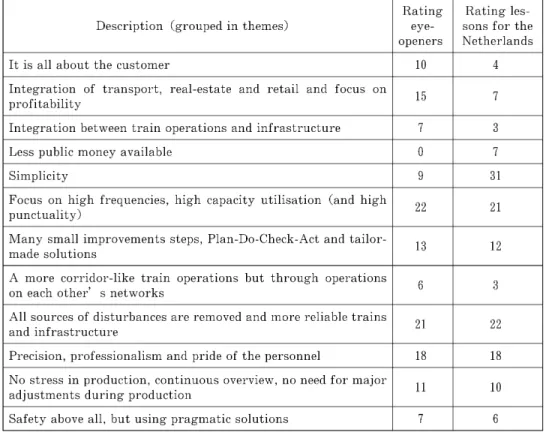
(15) The Japanisation ranking.. Table. 1 presents. ing the eye-openers basis. tion. and. mentioned. sectorial. improve. in the. clustering.. ees and then. The clustering. has been realised. without. A second. themes. much. of data. and background. on the. reinterpretation.. inevitably—entails. round. group-. reports,. a por-. processing,. with. could be used to. further.. sections. their. de Velde) of logical. This—perhaps. of the interviews. the clustering. The two next. use.. (Van. in clusters. by the interviewees was. analysis. Railways. grouped. lessons.. expertise. of arbitrariness. an even deeper. the results. and the main. of the items. Logic. of the Dutch. review. perception. first. the eye-openers. of the main. mentioned. by the interview-. lessons.. Eye-openers The focus on high frequencies, was a point that. equally. points in Table 1). the operations. struck. sive eye-opener. (21 points). bances. dispunctuality. Netherlands.. pecially. the participants. railways. observed form. simplicity,. professionalism. the. pride and. sive (18 points). the integration. during. the various. a much. of the. The focus on profitability. tion and was thought. by the railway.. reliability. seriousness. development. to be inspiring. were used during The relative. nance of large plans. study tours. are removed from. more. study. important. in the. lessons identified. are re-. The next eye-opener. is closely related too.. personnel. was seen as very by the Japanese. and retail at stations. for the Dutch railways. (15 points),. indeed. but that are often bound to. of small steps that—in the long run—contribute (13 points). and, instead, the continuperhaps. is the next eye-opener. point of view, the participant 39 ( 529 )—. developed of a domi-. ous focus on a multitude. From a more operational. and atten-. before even being implemented). even more than large plans to improvement. impres-. attracted. to the Netherlands. (aimed at solving all problems. Es-. railway. the trips to visit and use the facilities. absence compared. as distur-. problem. and robustness.. taken. tours,. be expensive or out-dated. the rating.. (22. is clearly seen as the other most impres-. and pride of the personnel). with real-estate. many occasions. and high punctuality. to the various. As we will see later, many of the Japanese. lated to this point: (precision,. utilisation. The fact that most sources of disturbances. of the Japanese. causing. high capacity. in. to the study.
(16) Vol. 57, No. 3 tours. were repeatedly. pare to the situation continuous. impressed. in the Netherlands. at traffic. and platform. during. production. re-allocation,. etc.). strong focus on the customer, and infrastructure,. more corridor-like. train. centres. 'simplicity'. eye-openers. in general,. integration. but also through. the. and—. adjustments. train re-routing. mentioned. were:. the. between train op-. safety above all, but using pragmatic operations. (10 points),. of extensive. (train en crew rescheduling, The other. com-. has over the operations. absence of a need for the management. to the operations. in the production. control. control and overview that the personnel. consequently—the. erations. by the absence of stress. operations. solutions,. and a. on each other's. networks.. Table. 1. Eye. openers. Description. and main. relevant. lessons. (grouped. in themes). mentioned. by the. interviewees. Rating eyeopeners. It is all about. Integration. the. customer. of transport,. real-estate. and. retail. and. focus. on. Rating lessons for the Netherlands. 10. 4. 15. 7. 7. 3. 0. 7. 9. 31. 22. 21. 13. 12. 6. 3. 21. 22. 18. 18. 11. 10. 7. 6. profitability Integration. between. Less public. money. train. operations. and infrastructure. available. Simplicity. Focus on high frequencies, punctuality) Many small improvements made solutions A more on each. steps,. corridor-like train other' s networks. All sources of disturbances and infrastructure Precision,. high capacity. Plan-Do-Check-Act. operations. and. pride. No stress in production, continuous adjustments during production Safety. above. all, but. Perception The second ered. using. of main rating. to be lessons. that. but. are removed. professionalism. utilisation. pragmatic. and tailor-. through. and more. of the. (and high. operations. reliable. trains. personnel. overview, no need for major. solutions. lessons column. in. could. be. Table 1 relates to what the interviewees or already. are implemented. 40 ( 530 )—. in the. consid-. Netherlands..
(17) The Japanisation. of the Dutch Railways (Van de Velde). As can be seen, there is for many of the themes a high level of correlation rating. for the eye-openers.. themes of the table.. differences. The following paragraphs. ble 1, using the comments provide further. The main. provided. are located. in the first. review all items as clustered. by the interviewees. during. tomer focus of the Japanese and also mentioned explain. mention. more concrete. closer to their. railways. this surprising. the interviews. was clearly observed during. discrepancy. lessons during. daily professional. timetabling,. is that most interviewees. the interviews. occupation. operational. The main reason that. control,. (see further. (infrastructure. etc.). design and manage-. Furthermore,. most. of them. system and profitability,. thus—ultimately. attractiveness customer. a striking. difference. of the railway. focus.. Yet, this seemingly. with the attitude. and—. focus illus-. railway. tended. to start. every explanation. by mentioning. tomer needs that the railways. wanted to fulfil using that practice.. of the interviewees. the recent customer. mentioned,. in Dutch parliament. ing the recent winter of urgency. goals such as. more technical. of many Japanese. did. managers. during the study tours who, when asked to explain specific Japanese. practices,. terference. to. in the table),. reliability,. general. can. tended. and more general. railway. to. the study tours. make a link between the lessons they did mention. encountered. in Ta-. despite the fact that the cus-. as one of the main eye openers.. probably. trates. four. interpretations.. Customer focus: This gets one of the lowest ratings. ment,. with the. disruptions. dissatisfaction. due to deficient passenger could contribute. needed to put passenger. specific cusIndeed, as one. and political in-. travel information. to the appearance. needs in a more central. position. dur-. of the sense in the near. future. Integration of transport, real-estate and retail, and focus on profitability: The discrepancy between trates. the rating. the admiration. of this theme as eye-opener. for the performances. of the Japanese. and at the same time a certain level of resignation reached in the Netherlands European. standards. in real estate. for various. the Dutch railways. and station. retail.. and as potential. reasons.. in accepting. on this topic. that this cannot be. It has to be said though that by. do develop quite a high level of activities. The Dutch regulatory -. railways. lesson illus-. 41 ( 531 )—. context. in term of land-.
(18) Vol. 57, No. 3 use planning. is however such that a pure Japanese. seem possible.. Yet, as four interviewees. the right direction, ties and railways The Hague-Leiden interviewees terviewee. corridor,. of housing. even though. are slowly moving in. along the Dordrecht-Rotterdam-. little has been realised. until now.. of the ministry. will help stimulate. of transport. with the min-. this development.. Integration between train operations and infrastructure: This constitutes ference in institutional interviewees ture,. between. do not mention reintegration. explaining. tioned clearly making. organisation. its low position that. more difficult. by focusing ments'. further. ments. were presented. authority).. as a realistic. possibility. However,. Interestingly,. by all groups. a few of them. it made decisionto be overcome. pro and contra. of interviewees. separation. (NS, ProRail although. to be used too much as an excuse for not looking for cooperative setting.. Indeed, it does seem that cooperation. that cross the infrastructure-operations real problems. could appear in the. divide works. (near ?) future. men-. (see also the section on 'state-. A main concern was that the separation,. the current. Most. for the near fu-. this could or—rather—'needed'. as if being 'one company'. in this paper).. a main dif-. and the Netherlands.. had gone too far and that. even though. on behaving. Japan. in the rating.. the separation. The. to be visible within 2 to 5 years and one in-. hopes that the recent merger planning. things. does not immediately. developed common vision by local authori-. do expect concrete results. istry of land-use. mentioned,. such as the recently on the development. approach. argu-. and. public. hindering,. tends. solutions. within. on optimising. issues. reasonably. well now.. when real investments. But. or costs. will have to be made and that these will appear to be more on the one or the other side of the fence. (`simplification') ing stock. For example,. likely to be positive. Although. (following. the costs for one of the parties railway,. the integral. the Japanese. cost balance. example),. (the operators).. is mentioned. 42 ( 532 )—. of the roll-. for the sector. is. this is likely to increase. but it may be one in the separated. inject money in the railway. side. This would indeed be no barrier. Less public money available: The reduced of readiness conditionally. on the infrastructure's. are likely to require a much higher level of reliability. and personnel.. in an integrated. some cost reductions. case.. of the public sector to unby several interviewees. as.
(19) The Japanisation a crucial. factor. of the Dutch Railways (Van de Velde). in the stimulation. They expect the fruits directly mentioned. of creativity,. leading. to higher. of this to become visible within a few years.. as a concrete Japanese. with what happened. in the years around. JNR to the JR companies. in Japan. 2002).. also that the reduction. (Matsuda,. of availability. solute yet as this government the railway. while the new government's. not. the reform of. The shutting-off. of the ac-. there as a main source of renewal.. of public money in the Netherlands. even announced. and a continuation. Although. lesson, this item was included here as it. bears a lot of resemblance. cess to public funds was also mentioned. efficiency.. Note. is not ab-. an increase in public investments. of the investments. according. policy was much harsher. in. the PHS-programme. for other. sectors. of the. economy. Simplicity: This is really seen as the number was already 1997).. the case in NS' first report. on the Japanese. railways. at stations. more simplicity management ity of the. (less switches. in traffic. (NS Reizigers,. (as the one existing. infrastructure etc.. prisingly,. with - consequently. (less switch. at NS/ProRail),. defects),. 13 out of 24 interviewees. a higher. possibilities. mention topics related. sector's. entails was certainly. infrastructure. many barriers. The anxiousness. simplification.. The general. have now been overcome.. agenda. even. that a sim-. that was put forward. opinion,. The interviewees. Unsur-. only to a very par-. for the loss of flexibility. the main argument. speeds. to this the-. of main lessons.. though almost all agree that the lessons have been implemented tial degree at the moment.. reliabil-. for higher. all agree that the theme is clearly on the railway. pler infrastructure. -. control and the lack of a need for the large disturbance. organisation. stations,. and conflict points),. me, and 8 of them give it the first position in the rating. against. and this. This theme groups a large number of items related to a simpler infrastruc-. ture layout. around. one lesson from Japan,. however,. also strongly. is that disagree. as to the period of time after which this lesson will have been clearly implemented, but many mention. concrete cases and current. within the next years, such as the redesign. plans which will lead to first results of the infrastructure. at Utrecht. Cen-. tral station. Focus on high frequencies, high capacity utilisation (and high punctuality): 43 ( 533 )—. Another.
(20) Vol. 57, No. 3 main lesson in the rating of the. tracks,. punctuality.. is the focus on changes. enabling. higher. frequencies. while. being. able. This topic is very closely linked to the 'simplicity'. the 9 interviewees. capacity. to. maintain. theme.. 5 out of. who selected this theme have given it their top lesson rating.. The theme covers again a number. of measures,. tance between. trains. age of shorter. blocks in the signalling,. contrary. that will allow a higher. to Dutch. (`kortvolgen').. current. and usage of passing speeds in station. approach. The immediate. practices. tracks. all meant. Japanese. with signals that. to allow a shorter example. having. (linked with simplicity),. is the us-. only on one side of the track. focus more on flexibility,. at stations,. less switches etc.. the building. enabling. higher. Quite some effort. veloped by the sector at the moment to show that more time and punctuality can be won with this approach more infrastructure. than with a more traditional. and general. in lower costs too.. maximum. The interviewees. speed increases,. mostly. the agenda and that it will lead to results. dis-. approach. is degains. based on. and that this results. agree that the topic is adequately. on. within only a few years.. Many small improvements steps, Plan-Do-Check-Act and tailor-made solutions: This lesson surprisingly. occupies only a medium position in the rating,. izen theme. is recognised. statements). as one of the core aspects. viewees repeatedly. examples. around. infrastructure. details,. As an interviewee. to improve. (see further. of the Japanese. mentioned. to appear, especially tleneck stations.. by all interviewees. consequences. in the. lessons.. of small improvements. stated,. section. Moreover,. on. inter-. that have started. conflict point reconfigurations. in bot-. there should be an increased. focus on. many smaller points while getting. for the large positive. while the same Ka-. of such smaller. an increased. improvements.. consciousness Another. men-. tioned that there would be much to gain by having a clearer common vision of the direction. to take (sectorial. long-term. vision) rather. cal plans that are supposed to solve problems,. than developing. large techni-. and he perceived that Japan was do-. ing much better in this respect. A more corridor-like train operations but through operations on each other's networks: This lesson received a low ranking, The explanation. lower even that the corresponding. for this can probably. eye-opener.. be found in the fact that the introduction 44 ( 534 )—. of.
(21) The Japanisation the new railway. timetable. of the Dutch Railways (Van de Velde). in 2007, which was more corridor-like. sors, is seen to be a realisation. of a Japanese. section on concrete implementations be formulated. about. a fashion. the other", mainly in an attempt network.. Reality. of Japanese. this lesson is that. preted in too black-and-white. in Japan. quent local and semi-fast. trains. do on average. do on the contrary. train. less frequent. example tends. companies. punctuality,. in the Netherlands. then see the return. of more through. sons on reliability,. punctuality,. sharply. summarised. is so high (due to various. to organise. circulation. operations. (intercity). from one line to the other, as. such through. over the past years,. did not allow for this through. over the while fre-. longer-distance. their own lines and even those of other companies,. frequency. run from one line to. and tailor-made:. level in Japan. can afford. to be inter-. of dispunctuality. One of the interviewee. saying that the punctuality railway. A worry that could. keep more to one line than in the. often circulate. is or was the case in the Netherlands.. amongst. the Japanese. is in fact more complex. trains. measures)that. examples).. to avoid the spreading. it should be noted that. the paradox. (see also the example list in the. as: "do not let trains. Dutch practice, in Japan. lesson. than its predeces-. circulation. while the increase in. combined with a lack of anymore,. when the basics. the future. may. (see the other les-. etc) are improved.. All sources of disturbances are removed and more reliable trains and infrastructure: This is the second main lesson rated. volving paying special attention to the planned services. the Japanese. approach,. including. technical. pointing. and calling practice. all potential. sources of disturbance. infrastructures. and rolling stock reliability. systems to cover the event of a failure),. loud as additional. information. to addressing. The study tours revealed that this focus is ubiquitous. dundant. managing. The theme covers again a range of items in-. of staff. safety measure. the behaviour on waiting. pointing. (WIZ:)). of passengers. cated that much more priority management.. from most reactions. of the Dutch participants. its status. and passenger. management. (actively. door), etc.. by detailed indication. and. A few interviewees. indi-. As to the finger-pointing. -. (the. and calling. should be given to these behavioural. spect of passengers'. (re-. at signals. on the platforms. areas for each train. staff management. in. aspects in re-. practices,. it appears. during the study tours that the im-. 45 ( 535 )—.
(22) Vol. 57, No. 3 plementation. of such practice. tic, despite mistake. in the Netherlands. studies and evidence in Japan. reductions. engendered. ment focus on the high reliability. quires. reduction. higher. failure. rates. a shift from curative. to preventive. measures,. concrete. example,. one interviewee. difficult. lated to this theme attention.. Several stated. is an important structure. condition. side in terms. The interviews be realisable. that. re-. were indeed related to this. by the interviewees,. One is the. But much. more expenses to be made on maintenance, due to the financial. this theme. that a higher. should. reliability. constraints,. who mentioned. as. items re-. get more or much more. of rolling-stock. and personnel. for the success of what will soon be done on the infra-. of simplification. also identified. a problem. before 5 years at the least.. the rolling. this issue. and much of the examples. 10 out of the 13 interviewees. considered. manage-. seem to have sub-. Addressing. not mentioned. to push through. mentions.. railways. to 'Doctor Yellow' on the Dutch tracks.. to be done and this requires. which is currently. study tours. even though. usage of an equivalent. remains. level of. and the infrastructure.. stock and infrastructure to Japan.. during the various. current. stock. compared. studied in Japan related. unrealis-. the very substantial. is the Japanese. of the rolling. good too, the Dutch rolling. stantially. showing. as totally. by this practice.. One main example of disturbance. Though. is considered. stock could e.g. be hard. (see also the theme on the separation). being that much of this will probably The lack of reliability. to improve,. not. of some parts. as its design creates. of. too many. limitations. Precision, professionalism and pride of the personnel: This is the fourth stated,. and equally ranked. the attitude exemplary. of the railway. in the eye-openers. personnel,. The picture of the Japanese. checking their watch and comparing. with the timetable quality-consciousness to be impressive.. has deeply impressed. Many tend to mention precision. train driv-. to the study tours.. The. are other aspects that were found. the Japanese and pride.. 46 ( 536 )—. to be. by the second their difference. all participants. and pride of the personnel. dition to realise this dedication,. theme covers mainly. which is perceived by the interviewees. precise and dedicated in Japan.. ers regularly. This cluster. main lesson. culture. as an essential. con-. However, we have been able.
(23) The Japanisation to observe Japanese. that. this conviction. exchanges.. Many. remarks. that the railway. management. if confronted. substantial. with the increasing this, stating. interviewees. that. of. the differ-. tended to be too 'afraid' more. pointed. to the fact. of the reactions. of the per-. Japanese—practices.. that this should get much more management. At the same time all agreed that the barriers. and that. years. should not be used as an excuse. made by several. with changed—perhaps. this agreed. the near future.. confirmed. and the Dutch culture. to do nothing.. mentioning. tended to diminish. Most interviewees. ence between the Japanese. sonnel,. of the Dutch Railways (Van de Velde). the longer. Those priority. in. to change are very. change. is unlikely. before. run. (5 years. at the. topic mentioned. and related. to this theme is that of the knowledge. least). Another management. and degree of professionalism. where considered nese managers conductor,. to be very impressive had spent. etc) and. second. many aspects of the railway experience. separation. between. manager.. Compared. pean approach. that. organisation business.. positions. are. the organisation. NS and ProRail. and the typical. to the Japanese. management. of the senior. the company. interviewees,. may be problems. sonal commitment. Consequently, is managed. in guaranteeing. sufficient. Japa(driver,. in Japan. knowledge. of the. have much less op-. way, while the 'circu-. is severely career. hampered. by the. path of a European. approach,. tends to be more focussed on the manager's in his life.. duties. rotated. to ensure a thorough. in a much less systematic. throughout. practices. first that even senior. Dutch senior managers. panies on several occasions. there. Two Japanese. time in operational. management. and certainly. lation' of management. and effective:. a very substantial. across the whole of a railway. erational. of the sector.. the Dutch/Euro-. career, changing. and this was stated by people 'passing knowledge. build-up. comby one. by' and and per-. to improvement.. No stress in production, continuous overview, no need for major adjustments during production: This theme scores an average openers.. The interviewees. for the fact that Japanese of the situation,. mainly train. and—behind. rating. mentioned. operational. this—that. both in the list of lessons and eyeitems related. staff always. adequate. 47 ( 537 )—. to their. admiration. had such good overview. means were provided. to them to.
(24) Vol. 57, No. 3 have this overview. Examples. The high punctuality. given were the role played. made this task even simpler. by the platform. exist in the same sense in the Netherlands, have a timetable. diagram. by the Dutch visitors, nese traffic. centres. much heavier traffic. mentioning. or the fact that many. rest and lack of stress. compared. in Japan.. it a first or second rating, plemented,. to the Netherlands,. The four interviewees. all complained. ward the more pragmatic pan, and complaining approaches. in the operations. safety as potential. the. management. from train. level responsible. this item gave. sometimes. is widely recognised railway. lesson essentially. exaggeratedly. by the. companies.. by putting. sector manages. for-. safety in Ja-. bureaucratic. safety. especially after the separation. operations.. By removing. for integral. safety. with the separation. (both infrastructure. tions), a vacuum appeared that can and often is seen to engender. the. and opera-. exaggerate. regu-. lations by norms that are, in the words of one of the interviewees,. completely. of proportion.. practices. trating. They found. that alternative. did not, however,. very refreshing. approaches. the. in the Netherlands.. way in which the railway about. at the Japa-. and this despite. of Japanese. that have developed in the Netherlands,. of infrastructure. staff. should be paid to staff informa-. as a main focus of the management mentioned. present. mentioning. Safety above all, but using pragmatic solutions: Safety. The interviewees. station. that no concrete lesson had yet been im-. that much more attention. tion overview and stress-reduction. interviewees. which does not. in their pocket, which was found to be very astonishing. or the relative. control. supervisor,. of course.. to observe. Japanese. exist and are safe as well.. expect much change in this respect. out illus-. The interviewees. in the Netherlands. in the. coming years, much to their regret.. Concrete. implementation. The interviews. of Japanese. mentioned. nese lessons at the Dutch railways.. sponding. indicating example.. at the Dutch. railways. were also used to collect the concrete cases that the interview-. ees had spontaneously. examples,. lessons. the number. as example. of actual. implementation. of Japa-. Table 2 gives the overview of those concrete of interviewees. Out of 24 interviewees,. who have mentioned. 19 of them mentioned. 48 ( 538 )—. the corre-. concrete. cases.
(25) The. Table. 2. Concrete. Japanisation. implementation. of. the. Dutch. Railways. of Japanese. lessons. Concrete case, as spontaneously mentioned +short explanation of the example. (Van. de Velde). as perceived. by the. interviewees. Number of interviewees mentioning the example. by the interviewees. Doorstroom Station Utrecht" (DSSU) (to be realised in the coming years) * Redesign of the track infrastructure of Utrecht Central station , moving towards a substantial simplification: reduction of the number of switches, more corridor-like approach, increase of the approach speed, copying the less complex layout of many Japanese stations.. 11. Redesign of the infrastructural needs for Schiphol-Amsterdam-Almere-Lelystad (SAAL) (investment to be realised in the coming years) * Taking account of the Japanese lessons in a redesign of the infrastructural. 6. needs of the SAAL-corridor, e.g. allowing to increase train frequencies on a 2 track infrastructure and avoiding the needs for a full 4-track reconstruction by using shorter blocks, passing tracks, (etc.) following Japanese inspiration. Various small, punctual infrastructure redesign examples (concrete cases during recent years) * Redesign of various capacity conflicts points across the country , such as at station Eindhoven, Arnhem, Zwolle, Schiphol, etc. (displacing a signal, adding a signal, (re)moving a switch, etc. by searching for small improvement steps at the local level, analysing daily performances). 6. High-Frequency Train investment programme (PHS) (investment programme for the coming years) * Programme of investments that aims at introducing a basic frequency of 6 in -. 5. tercity trains and 6 local trains per hour in the busiest part of the country (the SAAL project mentioned above is part of the PHS programme). New timetable 2007 (implemented) * Simplification of the NS timetable (Japanese) approach and a higher table change since 1970.. 3. , with a step towards a more corridor-like punctuality. This was the most major time-. Modernisation of the braking tables (train safety regulation) (currently under review) * The official braking tables(theoretical braking distance for trains , as assumed in safety regulations, determining the principle of the minimum distance between signals) are outdated and do not correspond anymore to current train braking characteristics, that are substantially better than what the regulations assume. The old tables make improvements 'Japanese style' (shorter blocks) difficult to implement.. 3. Operational Control Centre Rail (OCCR) (realised) * New centralised operational control centre for the railways. 3. "A train every 10 minutes" experiments (ETMET) (2009 -2010) * Two experiments , lasting several weeks on the Amsterdam-Utrecht-Eindhoven corridor, to test the feasibility of increasing the frequency of trains from 4 — 4 to 6 —6 on the major corridors, and realising a situation where customers do not have to worry about the timetable for the next departure (Japanese quality). This test is part of the PHS programme.. 2. Fixed train stopping places, indicated in the platform (after 2005) * Experiment held on the Zwolle -Emmen regional line, with fixed train composition and fixed stopping places on the platform, indicating to passengers where to board which class, etc., as customary on most Japanese railway stations.. 2. Installation of redundant generators (planned) * Implementing the high-reliability. 1. , coordinating the resolution of incidents on the tracks, in which all parties co-operator (operators, infrastructure manager, track maintenance companies, etc.), partly influenced by the example of JR Kyushu' s Hakata central traffic control centre.. the occasion of a planned. in trains Japanese. when refurbishing example. mid-life refurbishment. 49 ( 539 ). at mid-life. in the rolling-stock. , on.
(26) Vol. 57, No. 3 and linked them to lessons from the Japanese Many of the examples to planning. relate to infrastructure. and operational. crete lessons revolve around experiment. processes.. infrastructure. the PHS programme:. Central. seems to confirm the relative lated to personnel and mentioned. station. in the coming. con(the. and first real large-. years. that is currently. and operations—as. by some of the interviewees. prove reliability. DSSU, SAAL or ETMET. lessons will be the redesign. lack of attention. management. fewer of them relate. The most important. of several Japanese. of Utrecht. redesign,. As can be read in the table, many. 'a train every ten minutes').. scale implementation. exchanges.. of the track. (DSSU).. This. paid to lessons re-. seen elsewhere. in this paper. — but which is probably. crucial to im-. as achieved by the Japanese. railways.. Statements The interviewees with six statements.. were asked to state to what level they agreed The following. viewees who participated. figures. in this part. indicate. or disagreed. how many of the 20 inter-. of the interview. answered. in each of the. categories. As can be seen in Figure 5, all agreed that the Japanese tinuous. improvement). forms the core of the Japanese. Kaizen approach. approach,. although. part of them believed that this is not the whole story.. The belief that "things can always be improved" approach (Plan-Do-Check-Act).. Fully agree. is the core of the Japanese. Mainlyagree Mainlydisagree Fully Figure 5 50 ( 540 )—. disagree. No opinion. (cona large.
(27) The Japanisation. of the Dutch Railways (Van de Velde). In line with this, a large tween the Dutch to a difference countries'. culture. (Figure. company. agreed. and Japanese. in company. cultures. mented that implicitly. (lower). majority. 6).. culture. that. (higher). the observed. performances. than to a fundamental However,. and country. eight. differences. are more related. difference. between. of the interviewees. culture. be-. are closely related,. the. also comindicating. that much can be learned from Japan but that it might be unrealistic. to. reach the same high level.. The differencesinperformancesbetween the Dutchand the Japanese railwaysare not determined by a differencein nationalculture, but bya differencein companyculture.. Fullyagree. Mainlyagree Mainlydisagree Fullydisagree. Noopinion. Figure 6 A majority. of the interviewees. considered. nese language. does not hamper. substantially. mentioned. in their comments. by the openness. that this barrier. of the Japanese. Saito, and by the reports that. that the barrier. counterparts,. that resulted maintaining. the. learning. and in particular. contacts. in the Netherlands,. sons have already will actually mains present. been charted.. be implemented. with Japan. a large majority a substantial. in the Netherlands; agree. minority. agreed that even. believes that all les-. also believes that more lessons. even though a clear scepticism. (Figure. 51 ( 541 )—. lessons can and will be. of interviewees. A large majority. as most only 'mainly'. where English could. e-mail exchanges.. to which the Japanese. more lessons can be learned although. also by professor. more. than what would be the case with other countries. implemented. solved. is substantially. complicated. the extent. Many. Some. though,. further. 7).. trips organised.. mentioned,. Discussing. (Figure. had in fact been adequately. from the various. more easily be used for short and continued. formed by the Japa-. 8).. Furthermore,. re-. several of.
(28) Vol.. ^ The language substantially. barrier. 57,. between. the drawing. No.. 3. the Netherlands. of lessons. from. and Japan. the Japanese. hampers. practice.. 0 Fully agree. Mainly. Mainly disagree. agree. Figure. them. commented. now. is to really. that. although. implement. • More. Japanese. many. Fully disagree. No opinion. 7. lessons. had. been. drawn,. real. challenge. them.. CAN be implemented. in the Netherlands. More Japanese lessons WILL be implemented happens at the moment.. in the Netherlands. happens. the. lessons. than what. at the moment. than. what. 14. 0. Fully agree. Mainly agree. Mainly disagree Figure. The Japanese. railway. management. is often put forward. by many Japanese. duct of an efficient railway. to react on the extent operations. in the Netherlands. by an absence of separation. and train operations, railway. The next statement. to which the existing. and this is a feature. managers therefore. separation. 52 ( 542 )—. as essential. bethat. to the con-. asked the interviewees. between infrastructure. does or does not constitute -. No opinion. 8. system is characterised. tween infrastructure. Fully disagree. and. an obstacle to the imple-.
(29) The Japanisation. of the Dutch Railways (Van de Velde). mentation. of Japanese. lessons.. Most agreed. to say that the separation. constitute. an obstacle,. although. a substantial. minority. opposite and only a small number (Figure. considered. (one third). that it constituted. does not. considered. no problem. the at all. 9).. The separation. between. infrastructure. management. existing in the Netherlands does NOT constitute implementation of most Japanese lessons.. and train. a barrier. operations. to the. 0. Fullyagree. Mainlyagree MainlydisagreeFullydisagree Noopinion Figure 9. It was interesting most passionate. to observe. and extensive. that a proper integration as in Switzerland, and ProRail,. that the comments. of all.. Those critical. of infrastructure. to this statement of the separation. and operations. circulating. Some viewed the separation. as a huge barrier. pering. a proper. Others. balancing. saw the separation of investment. on both the vehicle and the track. tion as a barrier. nevertheless. cult due to the existence topic is very contentious. to efficiency. above NS. in the Netherlands,. as it would not really lead to a proper. line.. or at least. of a holding. would not solve the problem. the Japanese. considered. as in Japan,. would be needed and that the creation. in line with some ideas currently. were the. integration.. improvements. as a cause of cost increases. decisions. including. along by ham-. all cost implications. Even some of those who did not see the separa-. mentioned. that it made decision-making. of two power bases. (NS and ProRail).. and the end of the discussion. more diffiClearly,. this. is not yet foreseeable.. CONCLUSIONS. The results. of the interviews. show how passionate 53 ( 543 )—. the debate. has. become..
(30) Vol. 57, No. 3 The Japanese. lessons are clearly on the agenda of the railway. man of ProRail television,. presenting. aims at taking reduction. even recently. measures. to improve. larger. of Tokyo. that. example in the press and on. the infrastructure. the reliability. management. of the railway. was the comparison. (28) and Utrecht. The chair-. system,. company. such as a drastic. The example given to es-. of the number. (280), while traffic. of switches. is probably. in the. ten times. in Tokyo.. ProRail was inspired. is clearly. in a 'Japan'. by this as it featured. train on the family's ter (1_. the Japanese. in the number of switches across the country.. tablish the link with Japan stations. mentioned. sector.. table. t ct .5) poster. mood.. Even one of its 2011 New Year's. a family. eating. (notice the chopsticks,. sushi,. the ikebana. on the wall).. Dank voor de samenwerking laten we in 2011 op dat spoor. in 2010, verder. gaan.. ProRail Figure. 10. ProRail's. 2011. New. 54 ( 544 )—. Year. card. circulating. card. on a toy-. and the stationmas-.
(31) The Japanisation More seriously tour reports. of the Dutch Railways (Van de Velde). perhaps,. comparing. the lessons as drawn. and the lessons as drawn in the latter. general lesson themes have remained. unchanged. (simplicity,. focus, professionalism,. crete, technical. lessons have now also been drawn. Furthermore,. numerous. internal. calculations. tages of implementing been unthinkable. those lessons.. crete implementations Important. remain. communication. more time.. switches,. been complemented. aimed at proving. by. the advan-. their way to con-. infrastructure.. to be addressed.. cooperation. of more con-. Some of these lessons - and this would have. The personnel's. and not to forget. of appropriate. Continued. improve-. signaling,. ago - are now even finding. them, the rolling stock is another, quate. the last two years. in the track and signaling. challenges. (blocks,. and even simulations. only a few years. continuous. etc.) but that a great number. these have during. study. trips, one can observe that the. ment, customer. etc.).. in the first. side is one of. the passengers. communication. to them.. will also be required. and the adeThese. require. even when costs. and. gains do not end up on the same side of the fence More fundamentally, true learning generate. and as already. from the 'Japanese. the practices. organisations.. focus to generate. for small improvements. a critical. throughout. this is very important. in Japan. report,. a. will have been internal-. This has more to do with a shift in. but constructive. and continuous. the whole of the organisations.. do with the copying of specific Japanese even though. in the 2002 study tour. lessons' will only happen when the processes that. that we find so interesting. ized within the Dutch railway management. stated. It has less to. recipes in term of infrastructure. and certainly. search. layout,. very useful for the time being.. In other words, we have to hope that the current. implementation. of Japanese. sons will prove so successful. an autonomous. and internalized. search for continuous Happily,. improvements. that will then generate. the first signs of this happening. reconfiguration After. that it will generate. projects appearing. almost twenty. have helped to generate Dutch railway. true 'Dutch lessons'.. can be seen in the small infrastructure. across the country.. years, we now have the pleasure a growing. les-. consciousness. sector of the huge potential. across the management. for improvement. 55 ( 545 )—. to see that all efforts of the. that can be found in.
(32) Vol.. the Japanese are now. being. inspiring. help. railway. practices,. implemented. of professor. and repeatedly. explaining. another. of Dutch. group. and None. Saito,. 57,. that. No.. 3. a growing. of this. would. overcoming. the functioning. the. number. of concrete. have been possible cultural. of the Japanese. measures without. the. barrier,. opening. doors. railway. system. to yet. visitors.. REFERENCES. Hatch, D. J. (2000), "Cooperative Benchmarking between the Dutch and Japanese ways", Japan Railway & Transport Review, 18-25. Hofstra, K. S. (2010), "Onze Man in Japan - Verzamelde columns van Klaas Hofstra",. RailPro-. Rail Verkeersleiding, Prestatie Analyse Bureau, Utrecht, 46 pp. Matsuda, M. (2002), Making the impossible possible: one man's mission to reform the Japanese railways, Japan Productivity Center for Socio-Economic Development, Tokyo. Ministerie van Verkeer en Waterstaat (2008), "Evaluatie voortgang 'Op de Rails', Ministerie van Verkeer en Waterstaat, Den Haag, 75 pp. NS, ProRail and Railion (2003), "Benutten en Bouwen", Utrecht, 36 pp. NS Reizigers (1997), "Eenvoudig perfect door perfecte eenvoud - Visie op de Japanse spoorwegen - Verslag van NS studiereis", NS Reizigers - Productmanagement IC, Utrecht, 40 pages pp. Offermans, R. N. and D. M. van de Velde (2004), "Value Capturing: Potentieel financieringsinstrument voor Nederland", Report for the Dutch National Transport Council, Erasmus University, Rotterdam, 51 pp. Rontgen, E. and D. M. van de Velde (2007), "Spoorbedrijf ook voor winkelen, wonen, werken en sporten", Verkeerskunde, 10, 34-39. Saito, T. (1997), "Japanese private railway companies and their business diversification", Japan Railway & Transport Review, 10, 2 —9. Treinreiziger (2008), Punctualiteit NS internationaal vergeleken, http://www.treinreiziger.nl/kennisnet/punctualiteit/punctualiteit _ns_internationaal_ vergeleken, Februari 2011. van de Velde, D. and E. Röntgen (2008), "Strategie NS Poort: International vergelijking en "t easers" uit Japan", Rapport aan NS Poort, inno-V, Amsterdam, 40 pp. van de Velde, D. M. (1999), "Met onroerend goed stimuleert Japan het openbaar vervoer", OV Magazine, 1, 10-13. van de Velde, D. M. (2000a), "Dutch and Japanese van. van van van. Railway. Reforms. and Exchanges",. Japan. Railway & Transport Review, 24, 10-16. de Velde, D. M. (2000b), "Public transport: the Netherlands vs. Japan", ITPS Symposium, Tokyo, 10 October 2000, Institute for Transport Policy Studies (Tokyo, Japan)- TRAIL Research School (Delft, the Netherlands). de Velde, D. M. (2002), "Japanse Horizon, Verslag studiereis naar Japan", Regiegroep "B enutten en Bouwen 2003-2015"/Erasmus Universiteit, Utrecht/Rotterdam, 115 pp. de Velde, D. M. (2005a), "De Japanse concurrentiecocktail", Trens, 5(5), 2. de Velde, D. M. (2005b), "Studiereis Japan 2005: Een aantrekkelijke spoorsector door maatwerk", Rapport in opdracht van NS en ProRail, NEA, Rijswijk, 22 pp.. 56 ( 546 ).
(33) The Japanisation. of the Dutch. Railways. (Van. de Velde). van de Velde, D. M. (2009), "Leren van Japan voor PHS - Bevindingen. van de studiereis. naar. Japan (voorjaar 2009)", Rapport in opdracht van ProRail, NS en het ministerie van Verkeer & Waterstaat, inno-V, Amsterdam. van de Velde, D. M. and M. Maartens (2003), "Japanse spoorwegen: stap voor stap beter", OV-Magazine, 24 april 2003, 8 -11. van de Velde, D. M. and R. N. Of fermans (2002), "Railways and real estate development Case Study: Japan", Discussion paper, 2002/PT/03, 13 pp., Transport Economics, Erasmus University, Rotterdam. van de Velde, D. M. and T. Saito (2000), "The Cooperation between the Dutch Railways (NS) and JR Kyushu; Experience and Potential", In: Mirroring Consensus, Decision-making in Japanese-Dutch Business (Eds.: Benders, J., N. Noorderhaven, A. Keizer, H. Kumon and J. Stam), 151-163, Lemma, Utrecht. van de Velde, D. M. and J. Swier (2001), "Japanse Lessen", Railinfrabeheer, Utrecht, 95 pages pp. van de Velde, D. M. and J. D. M. Westeneng (1993), "Japan, Hong Kong, Singapore: Regulering van het openbaar vervoer: Adequaat ?" , Erasmus Universiteit Rotterdam, Rotterdam, 126 pp. Weeda, V., B. van Touw and K. S. Hofstra (2010), "Japan loont (sneller, vaker, veiliger, stiller, goedkoper)", Speurwerk, Roermond,. 26-26 november. 2010, 7 pp.. op Nederlands spoor: eenvoud Colloquium Vervoerplanologisch.
(34)
図



+2

関連したドキュメント
This paper presents an investigation into the mechanics of this specific problem and develops an analytical approach that accounts for the effects of geometrical and material data on
While conducting an experiment regarding fetal move- ments as a result of Pulsed Wave Doppler (PWD) ultrasound, [8] we encountered the severe artifacts in the acquired image2.
For a fixed discriminant, we show how many exten- sions there are in E Q p with such discriminant, and we give the discriminant and the Galois group (together with its filtration of
Actually it can be seen that all the characterizations of A ≤ ∗ B listed in Theorem 2.1 have singular value analogies in the general case..
• Informal discussion meetings shall be held with Nippon Kaiji Kyokai (NK) to exchange information and opinions regarding classification, both domestic and international affairs
- Parts of the foregoing machinery, apparatus or equipment Plates, cylinders and other printing components; plates, cylinders and lithographic stones, prepared for printing purposes
[r]
Amount of Remuneration, etc. The Company does not pay to Directors who concurrently serve as Executive Officer the remuneration paid to Directors. Therefore, “Number of Persons”
