
金属酸化物ナノシート膜の開発:水および有機溶剤中における分離性能
2
0
0
全文
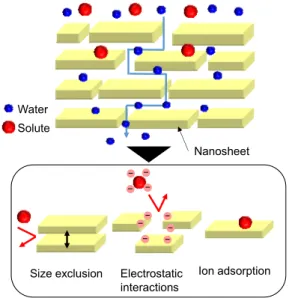
(2) presented to explain the membrane performances (Fig.2d).. and organic solvents such as methanol, ethanol and hexane. These results suggest that the laminar NbO membrane was stable against such organic solvents. 3. Niobate nanosheet-based composite membranes Intercalation of nanomaterials between nanosheets is. without swelling. Furthermore, the NbO membranes. a promising strategy to control the channel structure in the. demonstrated relatively high rejection performances such. laminar membrane. NbO-GO nanosheet composite. as 85% rejection for Evans blue (EB, Mw: 960.8) in. membranes were fabricated using NbO and GO colloidal. methanol.. nanosheets by same vacuum filtration. The effects of the. membranes in organic solvents will be discussed.. The. separation. mechanism. for. NbO. composite ratio of NbO/GO and composite methods on their membrane performances were investigated. The water permeability of the NbO/GO composite membranes. 5. Conclusion In summary,. was drastically changed by the composite ratio. A. oxide-based nanosheet membranes by simple vacuum. composite membrane with weight ratio of NbO:GO =. filtration. The membranes retained structural stability in. 55:45 (NbO55/GO45) showed higher water permeability. water and organic solvents, and demonstrated superior. as compared with NbO membranes and GO membranes. rejection of organic dyes and salts, thus fulfilling. with similar rejection against salts . Thus the water. important criteria for water purification and organic. permeability of NbO membrane was apparently improved. solvent filtration. This approach is expected to be. by the addition of GO. The changes of nanochannel size. expandable to other transition metal oxide nanosheet. and surface charge affected their membrane performances.. membranes, which may open valuable perspectives for. 7). 20. Rej. of Na2SO4 2 4. fabricated. laminar. metal. wide applications of functional membranes such as. 100. Permeability. catalytic membrane reactor.. 80. 15. 60. 10. 40. 5. 20. 0. 0. Rejection [%]. Permeability [L m-2 h-1 bar-1]. 25. we. References 1) Liu, G., Jin, W., Xu, N., Chem. Soc. Rev., 44, (15), 5016 (2015). 2) Nakagawa, K., Jia, T., Zheng, W., Fairclough, S. M., Katoh, M., Sugiyama, S., Tsang, S. C. E., Chem. Commun., 50, (89), 13702 (2014). 3) Nakagawa, K., Yamashita, H., Saeki, D., Yoshioka, T., Shintani, T., Kamio, E., Kreissl, H. T., Tsang, S. C. E., Sugiyama, S., Matsuyama, H., Chem. Commun.,. Fig. 3 Water permeability and .rejection of Na2SO4 for the NbO-GO composite membranes.. 53, (56), 7929 (2017). 4) Nakagawa, K., Sera, T., Kunimatsu, M., Yamashita, H., Yoshioka, T., Shintani, T., Kamio, E., Tsang, S. C. E., Matsuyama, H., Sep. Purif. Technol. 219, 222. 4. Separation performance in organic solvents. (2019).. Solvent-related separations, such as purification of. 5) Kreissl, H. T., Nakagawa, K., Peng, Y.-K., Koito, Y.,. products from impurities, concentration of products and. Zheng, J., Tsang, S. C. E., J. Catal., 338, 329 (2016).. solvent recovery are critical issues in view point of. 6) Kreissl, H. T., Li, M. M. J., Peng, Y.-K., Nakagawa,. economic, operational and environmental considerations. Therefore,. membrane. structure. and. K., Hooper, T. J. N., Hanna, J. V., Shepherd, A., Wu,. separation. T.-S., Soo, Y.-L., Tsang, S. C. E., J. Am. Chem. Soc.,. performances in organic solvents have also been. 139, (36), 12670 (2017).. investigated. For NbO membrane, anodic aluminum oxide. 7) Kunimatsu, M., Nakagawa, K., Yoshioka, T., Shintani,. was used as a support. There was little difference in the. T., Yasui, T., Kamio, E., Tsang, S. C. E., Li, J.,. interlayer spacing of the laminar structure between water. Matsuyama, H., submitted.. -37-.
(3)
図

関連したドキュメント
In external radiotherapy, there is concern regarding the relationship between image quality and total patient dose during real-time tumor tracking, because it is necessary to
Although the picture element (pixel) in conventional image sensors are placed in the form of a lattice for ease of implementation, the lattice place- ment of pixels intrinsically
さらに、NSCs に対して ERGO を短時間曝露すると、12 時間で NT5 mRNA の発現が有意に 増加し、 24 時間で Math1 の発現が増加した。曝露後 24
Standard domino tableaux have already been considered by many authors [33], [6], [34], [8], [1], but, to the best of our knowledge, the expression of the
An example of a database state in the lextensive category of finite sets, for the EA sketch of our school data specification is provided by any database which models the
This paper deals with the a design of an LPV controller with one scheduling parameter based on a simple nonlinear MR damper model, b design of a free-model controller based on
あらまし MPEG は Moving Picture Experts Group の略称であり, ISO/IEC JTC1 におけるオーディオビジュアル符号化標準の
A connection with partially asymmetric exclusion process (PASEP) Type B Permutation tableaux defined by Lam and Williams.. 4
