総合観光学会誌『総合観光研究』第 19 号 2021 年 3 月 Japanese Journal of Tourism Studies,No.19 March 2021
Evaluating Rural Tourism Operators’ Satisfaction:
Evidence from Taining, Fujian Province, ChinaRuying WANG Kumar BHATTA Yasuo OHE
Abstract: Although rural tourism (RT) can contribute to reducing the rural-urban economic gap by providing additional opportunities for income, literature on the topic is limited, particularly in developing economies. Thus, firstly we investigated this issue by a fixed-effects model of panel data at the semi-micro level focusing on eight districts of Fujian province, China. Results revealed that when the GDP of tourism increased in rural areas, the rural-urban income gap became smaller. Secondly, by a binary logit model applied at the micro-level from our surveyed data in Taining county, Fujian province, we investigated the factors contributing to operators’ satisfaction and incomes. The results showed that those RT operators who have RT income from 10% to 30% of their total have repeat visitors and are more satisfied. Operators with only a primary school education are less satisfied with their RT operation. Operators who desire to improve service quality, have their own business and have easily accessed farms derive more income from RT. At the same time, it is important for operators to balance tourism activities with other farm activities due to constraints on managerial resources.
Keywords: rural tourism, fixed effect model, income gap, operator’s satisfaction, China 1. Introduction
Rural tourism (RT) has many advantages not only in monetary terms but also by providing other benefits to rural areas and its residents. For instance, Su (2011) reported that RT had a positive effect on increasing farmers’ revenue by providing a supplementary income. Further, Perales (2002) mentioned that RT played an essential role in the development of rural areas that were economically and socially depressed. However, quantitative studies on the economic impact of RT are still limited despite a growing number of case studies.
In China RT is called Nongjiale, which literally means “happy farmers’ home” (Park, 2014). Farmers host guests using their own houses and supply rustic foods that are traditional and eco-friendly and gain benefits from RT. RT first appeared in the 1980s in Chengdu, Sichuan province; then it became
Master student, Department of Food and Resource Economics, Chiba University, Chiba, Japan PhD student, Department of Food and Resource Economics, Chiba University, Chiba, Japan Professor, Department of Agribusiness Management, Tokyo University of Agriculture, Tokyo, Japan
popular throughout the country in the 1990s. Considering that the income gap between urban and rural areas has become increasingly larger in China (Lu and Chen, 2004), the current study has two objectives. Firstly, it aims to verify whether tourism has the effect of reducing income inequality between rural and urban regions, although it has been shown to be effective in increasing rural people’s revenue (Mahadevan and Suardi, 2019; Ohe, 2020; pp.4-6). To investigate this question from a semi-micro perspective in Fujian province, China, we used a set of panel data. Rural areas of Fujian province have an accumulation of RT operators although rural resources are not fully utilized for RT.
Secondly, this study aims to investigate RT operators’ satisfaction that would enhance their motivation and utilization of resources because motivation is a crucial factor in raising the
potential of local resources (Ohe, 2020; pp.233-253). Further, highly motivated operators are more capable of resource management (Ohe, 2020; pp.87-105). Hence, the second part of this study investigated the satisfaction of RT operators and the determinant factors based on data derived from a questionnaire survey of RT operators in Fujian province. Finally, policy implications are suggested.
2. Literature review 2.1. Studies on income gap
With the diffusion of RT, studies on the benefits of such tourism have been conducted. Krakover (2004) stated that tourism’s influence on regional development, particularly on the income gap issue, is one of today’s most complex research topics in this field. Li et al. (2016) noted that tourism is closely related to other economic sectors such as agriculture and retailing and that its development affects the rest of the economy. Additionally, Li et al. (2016) revealed that tourism could be used as a tool to alleviate poverty in rural areas and to reduce the income gap among regions. Chen et al. (2016) showed that Nongjiale in China has positive effects on improving farmers’ income and increasing the employment rate. Kumar et al. (2012) and Mahadevan and Suardi (2019) indicated that tourism growth failed to reduce the population of poor people; however, they did prove that the growth of tourism reduced the income gap between rural and urban areas. Although tourism has many positive influences in solving problems in rural areas, whether tourism can reduce the inter-regional income gap has not been thoroughly investigated yet.
Much research has focused on determining what impacts the rural-urban income gap. The ratio of per capita income of the urban area to the per capita income of the rural area is usually used to explain the urban-rural income gap (Liu and He, 2019). Urbanization also has influenced the urban-rural income gap
(Lu and Chen, 2004). Lu and Chen (2004) further revealed that the economic open-door policy had a positive effect on increasing the urban-rural income gap, while the modernization of agriculture decreased the income gap. Income generation through RT might contribute to minimizing the regional economic gap and is an important matter to be investigated.
2.2. Supply-side studies
There are few quantitative studies on the supply side that deal with factors related to RT operators. Konishi and Ohe (2016) clarified that the degree of customer satisfaction is the most significant factor for increases in satisfaction of rural restaurant managers. Ohe (2020) revealed that by performing tourism activities a farm operator’s network expands, which increases the operator’s satisfaction, which eventually leads to more utilization of local resources. Sharpley and Vass (2006) reported that usually female counterparts in the farm operation are responsible for the tourism business and that tourism brings them job satisfaction and a sense of independence. However, these studies did not thoroughly discuss what factors affected an operator’s satisfaction and income by performing tourism activities in rural areas. Therefore, in this study, we investigated the determinants of RT operators’ satisfaction, which would lead to better management of local resources in rural areas.
2.3. Demand-side studies
Ge and Ohe (2011) mentioned that the quality of agricultural products provided by the supply side affected tourists’ satisfaction and that the public’s requirements regarding both the environment and transportation in a rural area are stringent. Zhou et al. (2008) found that rural tourists who visited Zhuzhou City in China were not satisfied with the rural environment and infrastructure and suggested that
improvements in the infrastructure and efforts toward environmental protection would be effective in increasing the number of tourists. Results of these studies showed that the quality of RT products, transportation and the environment affect tourists’ satisfaction.
In summary, from the literature review, we could understand that tourism has a positive effect on improving farm operators’ income in rural areas. It was also pointed that rural tourism work can help expand the operator’s network, which is a positive factor in increasing operator’s satisfaction. Transportation is also an essential factor in the expansion of RT. Therefore, in this study, we investigated the impact of RT on the rural economy and factors that affect RT operators’ satisfaction and income. We also examined the roles of transportation in RT.
3. Methods
3.1 Study area: Taining county
This study was conducted in Fujian province located in southeast China, facing Taiwan across the sea. It has abundant tourism resources like a sea view and glorious
mountains. Taining county, which is rich in natural resources, is located in northwest Fujian. Its core scenic spots are the World Geological Park and Lake Dajin, and it has a unique Danxia landform. Taining government started to develop RT beginning in 1994 in this region. Thus, we chose this county as a study area.
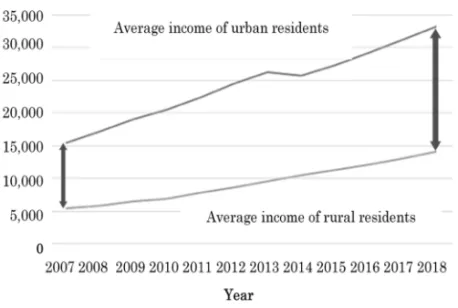
The proportion of tourism GDP to Taining’s total GDP increased from 20.38% in 2008 to 42.98% in 2018. Zhao et al. (2009) mentioned Figure 1. Trend of disposable income in urban
and rural area in Fujian province
Note: CPI-deflated data is used here, 2007=100 Source: Fujian Statistics Bureau
potential of local resources (Ohe, 2020; pp.233-253). Further, highly motivated operators are more capable of resource management (Ohe, 2020; pp.87-105). Hence, the second part of this study investigated the satisfaction of RT operators and the determinant factors based on data derived from a questionnaire survey of RT operators in Fujian province. Finally, policy implications are suggested.
2. Literature review 2.1. Studies on income gap
With the diffusion of RT, studies on the benefits of such tourism have been conducted. Krakover (2004) stated that tourism’s influence on regional development, particularly on the income gap issue, is one of today’s most complex research topics in this field. Li et al. (2016) noted that tourism is closely related to other economic sectors such as agriculture and retailing and that its development affects the rest of the economy. Additionally, Li et al. (2016) revealed that tourism could be used as a tool to alleviate poverty in rural areas and to reduce the income gap among regions. Chen et al. (2016) showed that Nongjiale in China has positive effects on improving farmers’ income and increasing the employment rate. Kumar et al. (2012) and Mahadevan and Suardi (2019) indicated that tourism growth failed to reduce the population of poor people; however, they did prove that the growth of tourism reduced the income gap between rural and urban areas. Although tourism has many positive influences in solving problems in rural areas, whether tourism can reduce the inter-regional income gap has not been thoroughly investigated yet.
Much research has focused on determining what impacts the rural-urban income gap. The ratio of per capita income of the urban area to the per capita income of the rural area is usually used to explain the urban-rural income gap (Liu and He, 2019). Urbanization also has influenced the urban-rural income gap
(Lu and Chen, 2004). Lu and Chen (2004) further revealed that the economic open-door policy had a positive effect on increasing the urban-rural income gap, while the modernization of agriculture decreased the income gap. Income generation through RT might contribute to minimizing the regional economic gap and is an important matter to be investigated.
2.2. Supply-side studies
There are few quantitative studies on the supply side that deal with factors related to RT operators. Konishi and Ohe (2016) clarified that the degree of customer satisfaction is the most significant factor for increases in satisfaction of rural restaurant managers. Ohe (2020) revealed that by performing tourism activities a farm operator’s network expands, which increases the operator’s satisfaction, which eventually leads to more utilization of local resources. Sharpley and Vass (2006) reported that usually female counterparts in the farm operation are responsible for the tourism business and that tourism brings them job satisfaction and a sense of independence. However, these studies did not thoroughly discuss what factors affected an operator’s satisfaction and income by performing tourism activities in rural areas. Therefore, in this study, we investigated the determinants of RT operators’ satisfaction, which would lead to better management of local resources in rural areas.
2.3. Demand-side studies
Ge and Ohe (2011) mentioned that the quality of agricultural products provided by the supply side affected tourists’ satisfaction and that the public’s requirements regarding both the environment and transportation in a rural area are stringent. Zhou et al. (2008) found that rural tourists who visited Zhuzhou City in China were not satisfied with the rural environment and infrastructure and suggested that
improvements in the infrastructure and efforts toward environmental protection would be effective in increasing the number of tourists. Results of these studies showed that the quality of RT products, transportation and the environment affect tourists’ satisfaction.
In summary, from the literature review, we could understand that tourism has a positive effect on improving farm operators’ income in rural areas. It was also pointed that rural tourism work can help expand the operator’s network, which is a positive factor in increasing operator’s satisfaction. Transportation is also an essential factor in the expansion of RT. Therefore, in this study, we investigated the impact of RT on the rural economy and factors that affect RT operators’ satisfaction and income. We also examined the roles of transportation in RT.
3. Methods
3.1 Study area: Taining county
This study was conducted in Fujian province located in southeast China, facing Taiwan across the sea. It has abundant tourism resources like a sea view and glorious
mountains. Taining county, which is rich in natural resources, is located in northwest Fujian. Its core scenic spots are the World Geological Park and Lake Dajin, and it has a unique Danxia landform. Taining government started to develop RT beginning in 1994 in this region. Thus, we chose this county as a study area.
The proportion of tourism GDP to Taining’s total GDP increased from 20.38% in 2008 to 42.98% in 2018. Zhao et al. (2009) mentioned Figure 1. Trend of disposable income in urban
and rural area in Fujian province
Note: CPI-deflated data is used here, 2007=100 Source: Fujian Statistics Bureau
that although Taining’s RT increased quickly, its tourism products still lack local characteristics. Also, it is a common phenomenon that in every part of China there is an income gap between rural and urban areas. We observed this widening regional gap in Fujian province as well (Figure 1).
3.2 Data
Primary and secondary data were utilized in this study. The secondary data for 8 districts (Fuzhou, Quanzhou, Amoy, Putian, Nanping, Sanming, Zhangzhou and Ningde) in Fujian province from 2007-2018 were taken from the Bureau of Statistics of Fujian province. Considering the increasingly inflated prices in China, we used the Consumer Price Index (CPI) to deflate nominal data series into real values (base year: 2007).
For the primary data, a questionnaire survey was conducted by the authors from March 3rd to 5th, 2019 in Lake Dajin area located
in Taining county. A total of 35 samples were collected by visiting the farms. More than two-thirds of the respondents were female. Other attributes of the respondents are presented in Figure 2.
3.3. Estimation methods
We conducted two types of estimations, the semi-micro estimation for the regional level and the micro estimation for the local level.
Semi-micro perspectives
By using secondary data, a semi-micro level estimation was conducted using a fixed effects model and random effects model to identify whether tourism activities can reduce income equality between urban and rural areas. A Hausman test was conducted to verify the more suitable model. We did not perform a unit root test because we had panel data for only 12 years and conducting a unit root test required data over a longer span (Chen, 2014; Cochrane,1991;
Zapata et al, 2011). The estimation model is: Regarding city i (i = Fuzhou, Quanzhou, Amoy, Putian, Nanping, Sanming, Zhangzhou and Ningde) and year t (t = 2007, 2008, 2009, …, 2018)
Yit = �0+�1Xit1+�2Xit2+�3Xit3+�4Xit4+Zi+�it (1)
where,
Yit = income disparity index (income per
resident in urban area/income per resident in rural area)
Xit1 = foreign trade value (yuan)
Xit2 = GDP of first industry per capita (yuan)
Xit3 = Urbanization rate (percentage)
Xit4 = GDP from tourism per capita (yuan)
�i = parameters to be estimated (�0 = constant),
(i=1, 2 , … , m) �it = error term
Zi = fixed effect
Micro perspectives
A binary logit model was employed for the local level estimation. First, the explained variable was the RT operators’ satisfaction, according to a Likert scale of 1 to 5, with 5 indicating satisfaction; 4, slightly satisfied; 3, do not know; 2, not very satisfied; and 1, not satisfied. However, we followed the methods of Ohe and Kurihara (2013) and Bhatta et al. (2019) and integrated the original data into binary data (satisfied → yes=1, other answers → no=0) because preliminary statistical tests did not show any statistically acceptable results.
Second, according to some previous research and based on the present income level in the local area, income from RT, which was the second explained variable, was mapped into five stages: <10,000 RMB, 10,000–30,000 RMB, 30,000–50,000 RMB, 50,000–100,000 RMB and >100,000 RMB. This variable was also converted into a binary variable as >30,000 RMB →yes=1, others →=0. To create the binary variable, we selected 30,000 RMB as the borderline value because 51.4% of respondents reported an income level below 30,000 RMB
(Figure 2).
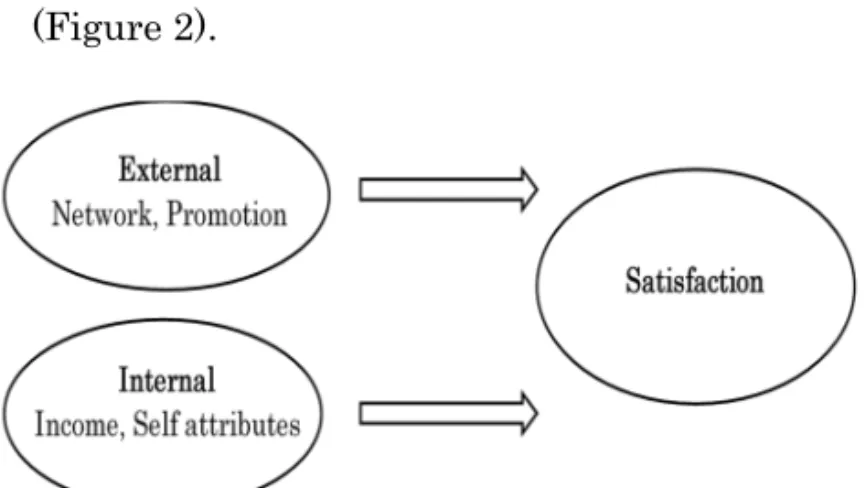
For the selection of explanatory variables for satisfaction by RT operators, we assumed that internal and external factors impacted these factors (Figure 3). Thus, the operator’s network and RT promotion are considered as external factors, while the operator’s self attributes and income from RT are recognized as internal factors that might contribute to RT operator’s satisfaction.
The estimation model of operators’ satisfaction, Model I, is generalized below:
Ln{Y/(1-Y)} = �0+�1X1+�2X2+�3X3+ �4X4+�� �(2)
where,
Y = operator’s satisfaction (yes=1, no=0) X1 = Income share of RT is 10%-30%
(yes=1, no=0)
X2 = network has been expanded (yes=1, no=0)
X3 = most new guests are introduced by
repeaters (yes=1, no=0)
X4 = primary school education (yes=1, no=0)
�i = parameters to be estimated (�0 = constant),
(i = 1, 2, 3, …, m) �i = error term
The variable X1 in this model was originally
measured in 6-stages as (below 10%, 10-30%, 30-50%, 50-70%, 70-90% and over 90%). Where 10-30% itself was 41.2%. Therefore, we transferred the original data into a binary variable as 10-30%=1, otherwise=0. After variable transformation, we used the trial-and-error process and selected this variable as a best
than others.
Similarly, income from RT may be influenced by internal and external factors (Figure 4). Inter-operator relationships and accessibility of the farmhouse are considered as external factors while the motivation for performing RT work and significance of tourism work are internal factors for RT income.
The estimation model of income level, Model II, is below:
Ln{y/(1-y)} =�0+ �1x1+ �2x2+ �3x3+ �4x4+�� �(3)
where,
y= income of RT exceeds 30 thousand yuan (yes=1, no=0)
x1= relationship with neighboring operators is
very good (yes=1, no=0)
x2= transportation is convenient (yes=1, no=0)
x3= want to improve quality of service
(yes=1, no=0)
x4= want to have own business (yes=1, no=0)
x5= RT work is very meaningful (yes=1, no=0)
αi = parameters to be estimated (α0 = constant),
(i = 1,2, 3, …, m) � = error term
4. Results and discussion
4.1. Estimation results of semi-micro data Table 1 shows the results of estimations from the semi-micro perspective. Using the Wald test for heteroskedasticity, we found that heteroskedasticity existed; therefore, log transformation was used. The Hausman test indicated that the fixed effect model was more
Figure 4. Factors affecting RT income Figure 3. Factors affecting operators’ satisfaction
that although Taining’s RT increased quickly, its tourism products still lack local characteristics. Also, it is a common phenomenon that in every part of China there is an income gap between rural and urban areas. We observed this widening regional gap in Fujian province as well (Figure 1).
3.2 Data
Primary and secondary data were utilized in this study. The secondary data for 8 districts (Fuzhou, Quanzhou, Amoy, Putian, Nanping, Sanming, Zhangzhou and Ningde) in Fujian province from 2007-2018 were taken from the Bureau of Statistics of Fujian province. Considering the increasingly inflated prices in China, we used the Consumer Price Index (CPI) to deflate nominal data series into real values (base year: 2007).
For the primary data, a questionnaire survey was conducted by the authors from March 3rd to 5th, 2019 in Lake Dajin area located
in Taining county. A total of 35 samples were collected by visiting the farms. More than two-thirds of the respondents were female. Other attributes of the respondents are presented in Figure 2.
3.3. Estimation methods
We conducted two types of estimations, the semi-micro estimation for the regional level and the micro estimation for the local level.
Semi-micro perspectives
By using secondary data, a semi-micro level estimation was conducted using a fixed effects model and random effects model to identify whether tourism activities can reduce income equality between urban and rural areas. A Hausman test was conducted to verify the more suitable model. We did not perform a unit root test because we had panel data for only 12 years and conducting a unit root test required data over a longer span (Chen, 2014; Cochrane,1991;
Zapata et al, 2011). The estimation model is: Regarding city i (i = Fuzhou, Quanzhou, Amoy, Putian, Nanping, Sanming, Zhangzhou and Ningde) and year t (t = 2007, 2008, 2009, …, 2018)
Yit = �0+�1Xit1+�2Xit2+�3Xit3+�4Xit4+Zi+�it (1)
where,
Yit = income disparity index (income per
resident in urban area/income per resident in rural area)
Xit1 = foreign trade value (yuan)
Xit2 = GDP of first industry per capita (yuan)
Xit3 = Urbanization rate (percentage)
Xit4 = GDP from tourism per capita (yuan)
�i = parameters to be estimated (�0 = constant),
(i=1, 2 , … , m) �it = error term
Zi = fixed effect
Micro perspectives
A binary logit model was employed for the local level estimation. First, the explained variable was the RT operators’ satisfaction, according to a Likert scale of 1 to 5, with 5 indicating satisfaction; 4, slightly satisfied; 3, do not know; 2, not very satisfied; and 1, not satisfied. However, we followed the methods of Ohe and Kurihara (2013) and Bhatta et al. (2019) and integrated the original data into binary data (satisfied → yes=1, other answers → no=0) because preliminary statistical tests did not show any statistically acceptable results.
Second, according to some previous research and based on the present income level in the local area, income from RT, which was the second explained variable, was mapped into five stages: <10,000 RMB, 10,000–30,000 RMB, 30,000–50,000 RMB, 50,000–100,000 RMB and >100,000 RMB. This variable was also converted into a binary variable as >30,000 RMB →yes=1, others →=0. To create the binary variable, we selected 30,000 RMB as the borderline value because 51.4% of respondents reported an income level below 30,000 RMB
(Figure 2).
For the selection of explanatory variables for satisfaction by RT operators, we assumed that internal and external factors impacted these factors (Figure 3). Thus, the operator’s network and RT promotion are considered as external factors, while the operator’s self attributes and income from RT are recognized as internal factors that might contribute to RT operator’s satisfaction.
The estimation model of operators’ satisfaction, Model I, is generalized below:
Ln{Y/(1-Y)} = �0+�1X1+�2X2+�3X3+ �4X4+�� �(2)
where,
Y = operator’s satisfaction (yes=1, no=0) X1 = Income share of RT is 10%-30%
(yes=1, no=0)
X2 = network has been expanded (yes=1, no=0)
X3 = most new guests are introduced by
repeaters (yes=1, no=0)
X4 = primary school education (yes=1, no=0)
�i = parameters to be estimated (�0 = constant),
(i = 1, 2, 3, …, m) �i = error term
The variable X1 in this model was originally
measured in 6-stages as (below 10%, 10-30%, 30-50%, 50-70%, 70-90% and over 90%). Where 10-30% itself was 41.2%. Therefore, we transferred the original data into a binary variable as 10-30%=1, otherwise=0. After variable transformation, we used the trial-and-error process and selected this variable as a best
than others.
Similarly, income from RT may be influenced by internal and external factors (Figure 4). Inter-operator relationships and accessibility of the farmhouse are considered as external factors while the motivation for performing RT work and significance of tourism work are internal factors for RT income.
The estimation model of income level, Model II, is below:
Ln{y/(1-y)} =�0+ �1x1+ �2x2+ �3x3+ �4x4+�� �(3)
where,
y= income of RT exceeds 30 thousand yuan (yes=1, no=0)
x1= relationship with neighboring operators is
very good (yes=1, no=0)
x2= transportation is convenient (yes=1, no=0)
x3= want to improve quality of service
(yes=1, no=0)
x4= want to have own business (yes=1, no=0)
x5= RT work is very meaningful (yes=1, no=0)
αi = parameters to be estimated (α0 = constant),
(i = 1,2, 3, …, m) � = error term
4. Results and discussion
4.1. Estimation results of semi-micro data Table 1 shows the results of estimations from the semi-micro perspective. Using the Wald test for heteroskedasticity, we found that heteroskedasticity existed; therefore, log transformation was used. The Hausman test indicated that the fixed effect model was more
Figure 4. Factors affecting RT income Figure 3. Factors affecting operators’ satisfaction
reasonable. The GDP of tourism per capita had a negative value with statistical significance (1%). This indicated that when the GDP from tourism increases in rural areas, the income gap between urban residents and rural residents would be smaller. This is strong evidence that engaging in RT can help achieve the goal of income equality. Thus, it is necessary to investigate further the possible benefits of RT. 4.2. Results of estimations of micro data
The highest variance inflation factor (VIF) generated from the ordinary least square method was 1.23 for model I and 1.16 for model II; values less than 10 mean there is no multicollinearity between the explanatory variables. Similarly, the Pseudo R2 were 0.5213 and 0.6105 in model I and model II, respectively. Further, no heteroscedasticity was detected in either model (used OLS), and the robust estimation and standard estimation did not differ greatly in terms of p-values.
Satisfaction: Model I
Table 2 shows factors determining RT operators’ satisfaction. Two network-related explanatory variables (i.e., the network has been expanded and most new guests are introduced by repeaters) both have positive parameters at the 10% and 5% significance 1evel, which means
building good relationships with tourists and neighboring operators are important for RT operations. It is necessary for operators to increase capabilities in guest management to acquire repeat visitors.
Similarly, operators who had RT income shares of 10% – 30% were more satisfied with their RT operation at the 5% significance level than those with other income shares. During the field survey, we found that most RT operators considered the RT operation as a side occupation. Therefore, an RT income share of 10% – 30% was in the comfort zone wherein operators could balance their regular work with the RT operation and family life. At this stage, rural resources are not fully utilized. To utilize the rural resources fully it is crucial to increase the number of full-time RT operators. Primary school education level was a negative parameter with 10% significance, indicating that less-educated operators had lower business satisfaction. It can be assumed that their management capability should be improved. Table 1. Estimation Results (semi-micro data)
Y= Income disparity index Explanatory
variables
Random effects
model Fixed effects model Coefficient
(z value) Coefficient (t value) Foreign trade value
per capita 0.0022 (0.06) - 0.0060 (- 0.12) GDP of primary
industry per capita - 0.0760** (- 2.46) 0.0418 (0.44) Urbanization rate 0.0561 (0.27) - 0.0657 (- 0.30) GDP from tourism
per person - 0.1038*** (- 4.01) - 0.1192*** (- 4.04) Constant 2.3628*** (4.23) 1.1588** (2.03) Note: ***, ** correspond to 1% & 5% significance. Source: Fujian Bureau of Statistics, 2019.
Table 2. Determinants of RT operators’ satisfaction (Logit model I)
Y= Operation satisfaction compared with past work (yes=1, no=0)
Explanatory
variables (z value) Coeff. Mar. effect (z value) VIF Network was
expanded by doing RT (yes=1, no=0)
2.1522*
(1.69) 0.2238** (2.05) 1.23 Most new guests
are introduced by repeat visitors (yes=1, no=0) 3.0995** (2.14) 0.3223*** (3.17) 1.03 Income share of RT is 10%-30% (yes=1, no=0) 3.7362** (2.23) 0.3885*** (3.53) 1.15 Primary school education (yes=1, no=0) - 3.3563* (- 1.87) - 0.3490** (- 2.47) 1.06 Constant - 3.2102** (- 2.24) − − Note: ***, **, * correspond to 1%, 5%, 10% significance, respectively, RT= rural tourism. VIF is calculated by OLS.
Source: The survey by the authors, March 2019.
Moreover, the government should also offer support to operators with a low level of education. From the estimated marginal effect, the income share from RT was the highest contributor, followed by educational experiences and network-related variables for RT operators’ satisfaction.
Income: Model II
Table 3 summarizes the determinants of RT operators’ income (Model II). A
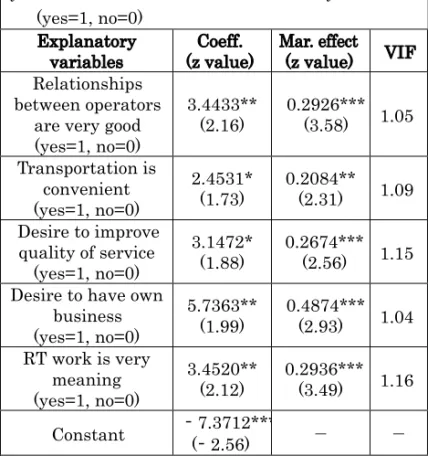
good relationship with neighbor operators had a positive effect on improving RT revenue. We assume that during busy seasons for tourism, operators will help each other with RT operations. The parameter of convenient transportation also had a positive value (10%), which suggests that in order to develop rural tourism, the accessibility of farmhouses should be improved. This result is consistent with a Japanese case study (Ohe, 2020; pp.197-215). Two motivation-related variables (desire to
improve quality of service and desire to have their own business) had significant positive values at 10% and 5%, respectively. From these findings, we can assume that when operators feel that RT activities are very meaningful, it would help increase their income and provide positive feedback on their daily tasks related to RT. Highly motivated operators could be expected to have higher incomes.
5. Conclusion
Two sets of data were used to investigate the effects of RT and determinants of RT operators’ satisfaction and income in Fujian province, China, from semi-micro and micro perspectives.
From the estimations using the fixed effects model, the results revealed that RT activity contributed to reducing the income gap between urban and rural areas. Thus, it is effective to develop tourism, especially in rural areas, to narrow that income gap. However, from the micro perspective, we found that rural resources were not fully utilized for RT purposes. Therefore, increasing the number of full-time RT operators not only would enhance the potential of RT but also increase rural resource utilization for RT purposes because RT operators prefer engaging in RT as a part-time job at present. Having a greater number of full-time RT operators in a destination signifies that the destination has promoted tourism as a main source of income. A destination which receives more income from tourism promotes tourism in farm diversification. According to Taining Bureau of Statistics (2019) tourism share in total GDP in 2018 was 43.0% and this survey found that 45.7% of the RT operators earn only between 10,000-30,000 yuan as the part-timers. In this regard, if the part-timers turned into full-timers in RT, they utilize more resources which contribute to earning more from tourism. Increased income from tourism also adds its share on GDP in the Taining country. Ultimately, it helps reduce the income gap between urban and rural regions.
In the second part of the estimation, it was revealed that building a network and enhancing operators’ motivation both had positive effects Table 3. Determinants of RT operators’ income
(Logit model II)
y= Income of RT exceeded 30 thousand yuan (yes=1, no=0)
Explanatory
variables (z value) Coeff. Mar. effect (z value) VIF Relationships
between operators are very good (yes=1, no=0) 3.4433** (2.16) 0.2926*** (3.58) 1.05 Transportation is convenient (yes=1, no=0) 2.4531* (1.73) 0.2084** (2.31) 1.09 Desire to improve quality of service (yes=1, no=0) 3.1472* (1.88) 0.2674*** (2.56) 1.15 Desire to have own
business (yes=1, no=0) 5.7363** (1.99) 0.4874*** (2.93) 1.04 RT work is very meaning (yes=1, no=0) 3.4520** (2.12) 0.2936*** (3.49) 1.16 Constant - 7.3712***(- 2.56) − − Note: ***, **, * correspond to 1%, 5%, 10% significance, respectively, RT= rural tourism. VIF is calculated by OLS.
reasonable. The GDP of tourism per capita had a negative value with statistical significance (1%). This indicated that when the GDP from tourism increases in rural areas, the income gap between urban residents and rural residents would be smaller. This is strong evidence that engaging in RT can help achieve the goal of income equality. Thus, it is necessary to investigate further the possible benefits of RT. 4.2. Results of estimations of micro data
The highest variance inflation factor (VIF) generated from the ordinary least square method was 1.23 for model I and 1.16 for model II; values less than 10 mean there is no multicollinearity between the explanatory variables. Similarly, the Pseudo R2 were 0.5213 and 0.6105 in model I and model II, respectively. Further, no heteroscedasticity was detected in either model (used OLS), and the robust estimation and standard estimation did not differ greatly in terms of p-values.
Satisfaction: Model I
Table 2 shows factors determining RT operators’ satisfaction. Two network-related explanatory variables (i.e., the network has been expanded and most new guests are introduced by repeaters) both have positive parameters at the 10% and 5% significance 1evel, which means
building good relationships with tourists and neighboring operators are important for RT operations. It is necessary for operators to increase capabilities in guest management to acquire repeat visitors.
Similarly, operators who had RT income shares of 10% – 30% were more satisfied with their RT operation at the 5% significance level than those with other income shares. During the field survey, we found that most RT operators considered the RT operation as a side occupation. Therefore, an RT income share of 10% – 30% was in the comfort zone wherein operators could balance their regular work with the RT operation and family life. At this stage, rural resources are not fully utilized. To utilize the rural resources fully it is crucial to increase the number of full-time RT operators. Primary school education level was a negative parameter with 10% significance, indicating that less-educated operators had lower business satisfaction. It can be assumed that their management capability should be improved. Table 1. Estimation Results (semi-micro data)
Y= Income disparity index Explanatory
variables
Random effects
model Fixed effects model Coefficient
(z value) Coefficient (t value) Foreign trade value
per capita 0.0022 (0.06) - 0.0060 (- 0.12) GDP of primary
industry per capita - 0.0760** (- 2.46) 0.0418 (0.44) Urbanization rate 0.0561 (0.27) - 0.0657 (- 0.30) GDP from tourism
per person - 0.1038*** (- 4.01) - 0.1192*** (- 4.04) Constant 2.3628*** (4.23) 1.1588** (2.03) Note: ***, ** correspond to 1% & 5% significance. Source: Fujian Bureau of Statistics, 2019.
Table 2. Determinants of RT operators’ satisfaction (Logit model I)
Y= Operation satisfaction compared with past work (yes=1, no=0)
Explanatory
variables (z value) Coeff. Mar. effect (z value) VIF Network was
expanded by doing RT (yes=1, no=0)
2.1522*
(1.69) 0.2238** (2.05) 1.23 Most new guests
are introduced by repeat visitors (yes=1, no=0) 3.0995** (2.14) 0.3223*** (3.17) 1.03 Income share of RT is 10%-30% (yes=1, no=0) 3.7362** (2.23) 0.3885*** (3.53) 1.15 Primary school education (yes=1, no=0) - 3.3563* (- 1.87) - 0.3490** (- 2.47) 1.06 Constant - 3.2102** (- 2.24) − − Note: ***, **, * correspond to 1%, 5%, 10% significance, respectively, RT= rural tourism. VIF is calculated by OLS.
Source: The survey by the authors, March 2019.
Moreover, the government should also offer support to operators with a low level of education. From the estimated marginal effect, the income share from RT was the highest contributor, followed by educational experiences and network-related variables for RT operators’ satisfaction.
Income: Model II
Table 3 summarizes the determinants of RT operators’ income (Model II). A
good relationship with neighbor operators had a positive effect on improving RT revenue. We assume that during busy seasons for tourism, operators will help each other with RT operations. The parameter of convenient transportation also had a positive value (10%), which suggests that in order to develop rural tourism, the accessibility of farmhouses should be improved. This result is consistent with a Japanese case study (Ohe, 2020; pp.197-215). Two motivation-related variables (desire to
improve quality of service and desire to have their own business) had significant positive values at 10% and 5%, respectively. From these findings, we can assume that when operators feel that RT activities are very meaningful, it would help increase their income and provide positive feedback on their daily tasks related to RT. Highly motivated operators could be expected to have higher incomes.
5. Conclusion
Two sets of data were used to investigate the effects of RT and determinants of RT operators’ satisfaction and income in Fujian province, China, from semi-micro and micro perspectives.
From the estimations using the fixed effects model, the results revealed that RT activity contributed to reducing the income gap between urban and rural areas. Thus, it is effective to develop tourism, especially in rural areas, to narrow that income gap. However, from the micro perspective, we found that rural resources were not fully utilized for RT purposes. Therefore, increasing the number of full-time RT operators not only would enhance the potential of RT but also increase rural resource utilization for RT purposes because RT operators prefer engaging in RT as a part-time job at present. Having a greater number of full-time RT operators in a destination signifies that the destination has promoted tourism as a main source of income. A destination which receives more income from tourism promotes tourism in farm diversification. According to Taining Bureau of Statistics (2019) tourism share in total GDP in 2018 was 43.0% and this survey found that 45.7% of the RT operators earn only between 10,000-30,000 yuan as the part-timers. In this regard, if the part-timers turned into full-timers in RT, they utilize more resources which contribute to earning more from tourism. Increased income from tourism also adds its share on GDP in the Taining country. Ultimately, it helps reduce the income gap between urban and rural regions.
In the second part of the estimation, it was revealed that building a network and enhancing operators’ motivation both had positive effects Table 3. Determinants of RT operators’ income
(Logit model II)
y= Income of RT exceeded 30 thousand yuan (yes=1, no=0)
Explanatory
variables (z value) Coeff. Mar. effect (z value) VIF Relationships
between operators are very good (yes=1, no=0) 3.4433** (2.16) 0.2926*** (3.58) 1.05 Transportation is convenient (yes=1, no=0) 2.4531* (1.73) 0.2084** (2.31) 1.09 Desire to improve quality of service (yes=1, no=0) 3.1472* (1.88) 0.2674*** (2.56) 1.15 Desire to have own
business (yes=1, no=0) 5.7363** (1.99) 0.4874*** (2.93) 1.04 RT work is very meaning (yes=1, no=0) 3.4520** (2.12) 0.2936*** (3.49) 1.16 Constant - 7.3712***(- 2.56) − − Note: ***, **, * correspond to 1%, 5%, 10% significance, respectively, RT= rural tourism. VIF is calculated by OLS.
on an RT operation. RT operators who have repeat visitors were more satisfied. At the same time, it is important for operators to create a balance with the farm and other activities since there is an optimal level of income proportion from RT that is compatible with other farm activities due to the constraints on managerial resources.
Further, results also indicated that the government needs to improve traffic infrastructure in rural areas and to provide support to operators to raise their managerial capability because RT operators want to improve the quality of the services they provide. The improved quality of services and a better transportation network may attract more tourists as repeat visitors.
The results presented in this study are only based on statistics from a single province. We found that the part-timers are more satisfied in Taining. Although we mentioned full-timers are important for RT operation to reduce the income gap between rural and urban areas, it is necessary to investigate whether it is rational for farmers to be full-time operation. Further, given the rich diversity in the rural heritage of China, additional research is necessary to confirm whether the results are consistent with conditions in other provinces. Finally, we also need to investigate the endogeneity between the income gap and GDP in more details.
Notes: This paper was originally presented at the 37th
annual conference of the Japan Society for Interdisciplinary Tourism Studies held at online on January 10th, 2021. This study was supported by
Kakenhi (Grants-in-Aid for Scientific Research) No. 18H03965, No.20H04444, and Grand-in-Aid for JSPS Fellows No. 20J11833 from Japan Society for the Promotion of Science (JSPS).
References
Bhatta, K. Itagaki, K. and Ohe, Y. (2019) Determinant Factors of Farmers’ Willingness to Start Agritourism
in Rural Nepal, Open Agriculture, 4, 431-445. Chen, G., Glasmeier. A.K., Zhang, M. and Shao, Y. (2016)
Urbanization and Income Inequality in Post-Reform China: A Causal Analysis Based on Time Series Data, PLoS One, 11(7), 1-16.
Chen, Q. (2014) Advanced Econometrics and Stata Applications ( 高 级 计 量 经 济 学 及 Stata 应 用 ), 2nd
Edition (in Chinese), Beijing: Higher Education Press. Cochrane, J.H. (1991) A Critique of the Application of Unit Root Tests, Journal of Economic Dynamics and Control, 15(2), 275-284.
Ge, Y. and Ohe, Y. (2011) Tourists’ Consciousness of Rural Tourism in Eastern Coast Area of China: Case of Fujiabian Agricultural Science and Technology Park in Jiangsu Province (in Japanese), The special Issue of Journal of Rural Economics, 454-461. Konishi, T. and Ohe, Y. (2016) Evaluating Managers’
Satisfaction with Farm Restaurant (in Japanese), Journal of Rural Problems, 52(4), 199-204.
Krakover, S. (2004) Tourism Development—centres Versus Peripheries: The Israeli Experience During the 1990s, International Journal of Tourism Research, 6(2), 97-111.
Kumar, R., Gill, S.S. and Kunasekaran, P. (2012) Tourism as a Poverty Eradication Tool for Rural Areas in Selangor, Malaysia, Global Journal of Human, 12(7), 21-26.
Li, H., Chen, J.L., Li, G. and Goh, C. (2016) Tourism and Regional Income Inequality: Evidence from China, Annals of Tourism Research, 58, 81-99.
Liu, H.T. and He, Q.Y. (2019) The Effect of Basic Public Service on Urban-rural Income Inequality: A Sys-GMM Approach, Economic Research-Ekonomska Istraživanja, 32(1), 3205-3223.
Lu, M. and Chen, Z. (2004) Urbanization, Urban-Biased Economic Policies and Urban-Rural Inequality (in Chinese), Economic Research Journal, 2004-6, 50–58. Mahadevan, R. and Suardi, S. (2019) Panel Evidence on the Impact of Tourism Growth on Poverty, Poverty Gap and Income Inequality, Current Issues in Tourism, 22(3), 253-264.
Ohe, Y. (2020) Community-based Rural Tourism and Entrepreneurship: A Microeconomic Approach, Singapore: Springer.
Ohe, Y. and Kurihara, S. (2013) Evaluating the Complementary Relationship Between Local Brand Farm Products, Tourism Management, 35, 278-283. Park, C.H. (2014) Nongjiale Tourism and Contested
Space in Rural China, Modern China, 40(5), 519-548. Perales, R.M.Y. (2002) Rural Tourism in Spain, Annals
of Tourism Research, 29 (4), 1101-1110.
Sharpley, R. and Vass, A. (2006) Tourism, Farming and Diversification: An Attitudinal Study, Tourism Management, 27(5), 1040-1052.
Su, B. (2011) Rural Tourism in China, Tourism Management, 32 (6), 1438-1441.
Taining Bureau of Statistics (2019) National Bureau of Administration; Taining Bureau of Statistics (in Chinese)
.
Zapata, H.O., Maradiaga, D.I., Pujula, A.L. and Dicks, M.R. (2011) Recent Development in Unit Root Tests and Historical Crop Yields, Paper Presented at the Agricultural & Applied Economics Association’s Annual Meeting, 1-29.
Zhao, Y.M., and Lin, H.P. (2009) The Research of Taining County’s Rural Tourism Development (in Chinese), Graduate Thesis, Fujian Agriculture and Forestry University.
Zhou, S., Ikeda, T. and Zhou, X. (2008) A Study on Actual Condition of “Happy Farmhouse” in Hunan Province, China : A Case Study of Town Area of Zhuzhou City (in Japanese), Journal of Architecture and Planning, AIJ, 73(632), 2139-2146.
on an RT operation. RT operators who have repeat visitors were more satisfied. At the same time, it is important for operators to create a balance with the farm and other activities since there is an optimal level of income proportion from RT that is compatible with other farm activities due to the constraints on managerial resources.
Further, results also indicated that the government needs to improve traffic infrastructure in rural areas and to provide support to operators to raise their managerial capability because RT operators want to improve the quality of the services they provide. The improved quality of services and a better transportation network may attract more tourists as repeat visitors.
The results presented in this study are only based on statistics from a single province. We found that the part-timers are more satisfied in Taining. Although we mentioned full-timers are important for RT operation to reduce the income gap between rural and urban areas, it is necessary to investigate whether it is rational for farmers to be full-time operation. Further, given the rich diversity in the rural heritage of China, additional research is necessary to confirm whether the results are consistent with conditions in other provinces. Finally, we also need to investigate the endogeneity between the income gap and GDP in more details.
Notes: This paper was originally presented at the 37th
annual conference of the Japan Society for Interdisciplinary Tourism Studies held at online on January 10th, 2021. This study was supported by
Kakenhi (Grants-in-Aid for Scientific Research) No. 18H03965, No.20H04444, and Grand-in-Aid for JSPS Fellows No. 20J11833 from Japan Society for the Promotion of Science (JSPS).
References
Bhatta, K. Itagaki, K. and Ohe, Y. (2019) Determinant Factors of Farmers’ Willingness to Start Agritourism
in Rural Nepal, Open Agriculture, 4, 431-445. Chen, G., Glasmeier. A.K., Zhang, M. and Shao, Y. (2016)
Urbanization and Income Inequality in Post-Reform China: A Causal Analysis Based on Time Series Data, PLoS One, 11(7), 1-16.
Chen, Q. (2014) Advanced Econometrics and Stata Applications ( 高 级 计 量 经 济 学 及 Stata 应 用 ), 2nd
Edition (in Chinese), Beijing: Higher Education Press. Cochrane, J.H. (1991) A Critique of the Application of Unit Root Tests, Journal of Economic Dynamics and Control, 15(2), 275-284.
Ge, Y. and Ohe, Y. (2011) Tourists’ Consciousness of Rural Tourism in Eastern Coast Area of China: Case of Fujiabian Agricultural Science and Technology Park in Jiangsu Province (in Japanese), The special Issue of Journal of Rural Economics, 454-461. Konishi, T. and Ohe, Y. (2016) Evaluating Managers’
Satisfaction with Farm Restaurant (in Japanese), Journal of Rural Problems, 52(4), 199-204.
Krakover, S. (2004) Tourism Development—centres Versus Peripheries: The Israeli Experience During the 1990s, International Journal of Tourism Research, 6(2), 97-111.
Kumar, R., Gill, S.S. and Kunasekaran, P. (2012) Tourism as a Poverty Eradication Tool for Rural Areas in Selangor, Malaysia, Global Journal of Human, 12(7), 21-26.
Li, H., Chen, J.L., Li, G. and Goh, C. (2016) Tourism and Regional Income Inequality: Evidence from China, Annals of Tourism Research, 58, 81-99.
Liu, H.T. and He, Q.Y. (2019) The Effect of Basic Public Service on Urban-rural Income Inequality: A Sys-GMM Approach, Economic Research-Ekonomska Istraživanja, 32(1), 3205-3223.
Lu, M. and Chen, Z. (2004) Urbanization, Urban-Biased Economic Policies and Urban-Rural Inequality (in Chinese), Economic Research Journal, 2004-6, 50–58. Mahadevan, R. and Suardi, S. (2019) Panel Evidence on the Impact of Tourism Growth on Poverty, Poverty Gap and Income Inequality, Current Issues in Tourism, 22(3), 253-264.
Ohe, Y. (2020) Community-based Rural Tourism and Entrepreneurship: A Microeconomic Approach, Singapore: Springer.
Ohe, Y. and Kurihara, S. (2013) Evaluating the Complementary Relationship Between Local Brand Farm Products, Tourism Management, 35, 278-283. Park, C.H. (2014) Nongjiale Tourism and Contested
Space in Rural China, Modern China, 40(5), 519-548. Perales, R.M.Y. (2002) Rural Tourism in Spain, Annals
of Tourism Research, 29 (4), 1101-1110.
Sharpley, R. and Vass, A. (2006) Tourism, Farming and Diversification: An Attitudinal Study, Tourism Management, 27(5), 1040-1052.
Su, B. (2011) Rural Tourism in China, Tourism Management, 32 (6), 1438-1441.
Taining Bureau of Statistics (2019) National Bureau of Administration; Taining Bureau of Statistics (in Chinese)
.
Zapata, H.O., Maradiaga, D.I., Pujula, A.L. and Dicks, M.R. (2011) Recent Development in Unit Root Tests and Historical Crop Yields, Paper Presented at the Agricultural & Applied Economics Association’s Annual Meeting, 1-29.
Zhao, Y.M., and Lin, H.P. (2009) The Research of Taining County’s Rural Tourism Development (in Chinese), Graduate Thesis, Fujian Agriculture and Forestry University.
Zhou, S., Ikeda, T. and Zhou, X. (2008) A Study on Actual Condition of “Happy Farmhouse” in Hunan Province, China : A Case Study of Town Area of Zhuzhou City (in Japanese), Journal of Architecture and Planning, AIJ, 73(632), 2139-2146.