A Two-Period Model of Capital Investment under
Ambiguity*
Motoh TsujimuraFaculty ofCommerce, DoshishaUniversity
1
Introduction
Animportantfactorin economic decisionmaking is thetreatmentofuncertainty. Knight (1921)
defines two kinds of uncertainty: risk, under which the probability ofan outcome is uniquely
determined; and uncertainty, under which it is not. The latter is termed Knightianuncertainty
or deep uncertainty. In this paper, following Ellseberg (1961),
we
term Knightian uncertaintyambiguity. For a survey of decision making under uncertainty, see, for example, Camerer and
Weber (1992), Etner et. al. (2012) and Guidolin and Rinaldi (2013).
We examine capital investment under ambiguity in a two-period setting. We extend the
model ofMiao (2004), who investigates optimal consumption under ambiguity in
a
two-periodsetting. We analyze a production economy and derive optimal capital investment in a
general-equilibrium setting. Suppose that there are a large number of identical
consumers
and firmsin an economy. For analytical simplicity, the number of consumers is equal to that of firms,
and
consumers
own the firms. This enables us to consider a representativeconsumer and firm.The representative
consumer
is riskaverse
and hasa
constant absolute risk aversion utilityfunction. Because there is ambiguity, the representative
consumer
considersa
set of probabilitydistributions. Then, we formulate the utility function
as
the multiple-priors expected utilityof Gilboa and Schmeidler (1989). We formulate the central planner’s problem and derive the
optimal level of capital investment. Furthermore, we analyze the comparative static effects of
the$mo$del’sparameters. Wefindthat ambiguityaversion and riskaversion have different effects
on capital investment. The more ambiguity averse the central planner, the higher the capital
investment. Bycontrast, at alowlevel ofrisk aversion, themore riskaversethe centralplanner,
the lower the capital investment. Once risk aversion has reached a certain level, increased risk
aversion stimulates capitalinvestment.
The rest of the paper is organized as follows. In Section 2, we describe the setup of the
production economy and formulate the central planner’s problem. In Section 3, we solve the
central planner’s problem. In Section 4,
we
conducta
numerical analysis. Section 5 concludesthe paper.
2
The Model
We consider atwo-period productioneconomy. There are alarge number ofidentical
consumers
and firms. The number of
consumers
is equal to that of firms. The firmsare
owned by theconsumers and produce identical outputs. We consider a representative consumer and firm.
’This researchwassupportedin part byaGrant-in-Aidfor Scientific Research(No. 24510213) fromthe Japan
The representative
consumer
receives an endowment in each period $t(t=1,2)$.
Thisendowment isa random variable on $(\Omega, \mathcal{F}, \mathbb{P})$
.
Therepresentativefirmproducesoutput byusingcapital $K$. The firm’s production function $f(k)$ isgiven by:
$f(k)=Ak^{\alpha}$, (2.1)
where $A>0$ reflects the level of technology and $\alpha>0$ is the output elasticity of capital.
The
consumer
receives utility from consumption $C_{t}$ in each period. The utility function $u(c)$ isassumed to be given by:
$u(c)=- \frac{1}{\theta}e^{-\theta c}$, (2.2)
where the coefficient $\theta>0$ is the degree of absolute risk aversion. The representative
con-sumer maximizes the utility $u$ from consumption subject tothe following intertemporal budget
constraint:
$C_{1}+K=Y_{1}$, (2.3)
$C_{2}=Y_{2}+(1-\delta)K+f(K)$, (2.4)
where $\delta\in(0,1)$ is the depreciation rate of capital. Suppose that the representative consumer
does not uniquely determine the probability distribution of future endowments but instead
considers
a
set of probability distributions. Then,we
formulate the representative consumer’sutility function
as
themultiple-priors expected utilityof Gilboa and Schmeidler (1989):$U(C_{1}, C_{2})=u(C_{1})+ \beta\min_{\mathbb{Q}\in \mathcal{P}}\mathbb{E}_{\mathbb{Q}}[u(C_{2})]$ , (2.5)
where$\beta\in(0,1)$ isa discount factor and $\mathcal{P}$ is aset ofpriorsover $(\Omega, \mathcal{F})$
.
Following Miao (2004)and Kogan and Wang (2002), we define $\mathcal{P}$ as:
$\mathcal{P}(\mathbb{P}, \phi)=\{\mathbb{Q}\in \mathcal{M}(\Omega);\mathbb{E}_{\mathbb{Q}}[\ln(\frac{d\mathbb{Q}}{d\mathbb{P}})]\leq\phi^{2}\}$, (2.6)
where $\mathcal{M}(\Omega)$ is the set of probability measures on $\Omega,$ $d\mathbb{Q}/d\mathbb{P}$ is the Radon-Nikodym derivative
and $\mathbb{E}_{\mathbb{Q}}[\ln(d\mathbb{Q}/d\mathbb{P})]$ is the relative entropy
index.2
This specification is basedon
robust controltheory.3
The parameter $\phi>0$ representsambiguity aversion. The higher $\phi$, themore ambiguityaverse the representative consumer,
We assume that $\mathbb{P}$
is the probability measure of the normal distribution with mean $\mu$ and
variance$\sigma^{2}$
. All probability measuresin $\mathcal{P}(\mathbb{P}, \phi)$ have normaldistributions. $\mathbb{Q}$ is theprobability
measure
of the normal distributionwithmean
$\mu-h$andvariance $\sigma^{2}$, where $h>0$representsthe
mean distortion chosen by the decision maker. Then, the relative entropy of $\mathbb{P}$ and $\mathbb{Q}$ is given
by:
$\mathbb{E}_{\mathbb{Q}}[\ln(\frac{d\mathbb{Q}}{d\mathbb{P}})]=\frac{h^{2}}{2\sigma^{2}}$
.
(2.7)The derivation of (2.7) isin Appendix A.
2Thisis also termed theKullback-Leibler divergence.
The representative firm maximizes profits, given prices and technology. We formulate the
central planner’s problem as:
$\max U(C_{1}, C_{2})$, (2.8)
$\{C_{1},C_{2},K\}$
s.t. (2.3) and (2.4).
Rewriting the central planner’s problem yields:
$\max_{\{K\}}\{-\frac{1}{\theta}e^{-\theta(Y_{1}-K)}+\beta_{\mathbb{Q}}\min_{\in \mathcal{P}}\mathbb{E}_{\mathbb{Q}}[-\frac{1}{\theta}e^{-\theta[Y_{2}+(1-\delta)K+AK^{\alpha}]}(]\}\cdot$ (2.9)
In the nextsection, we solve problem (2.9) and derive the optimal level ofcapital investment.
3
Optimal Capital
Investment
In this section, we derive optimal capital investment. From (2.9), we obtain:
$- \theta Y_{1}+\theta K=\ln\beta[(1-\delta)+\alpha AK^{\alpha-1}]-\theta[(1-\delta)K+AK^{\alpha}]+\ln(\max \mathbb{E}_{\mathbb{Q}}[e^{-\theta Y_{2}}])$
.
(3.1)From the relative entropy expression, (2.7), we obtain:
$\ln(\max \mathbb{E}_{\mathbb{Q}}[e^{-\theta Y_{2}}])=\ln(\max_{h}[e^{-\theta(\mu-h)+\theta^{2}\sigma^{2}/2}])$
(3.2)
$=-\theta(\mu-\sqrt{2}\sigma\phi)+\theta^{2}\sigma^{2}/2.$
Substituting (3.2) into (3. 1) yields:
$- \theta AK^{\alpha}+\ln\beta[(1-\delta)+\alpha AK^{\alpha-1}]-\theta(2-\delta)K+\theta[Y_{1}-(\mu-\sqrt{2}\sigma\phi)]+\frac{\theta^{2}\sigma^{2}}{2}=0$
.
(3.3)The optimal level of capital investment $K^{*}$ is derived from (3.3). Optimal consumption $C_{1}^{*}$ is
$C_{1}^{*}=Y_{1}-K^{*}$
.
If the production function exhibits constant return to scale $(\alpha=1)$, we obtain theexplicit solution:$K^{*}= \frac{y_{1}}{2-\delta+A}+\frac{\log\beta(1-\delta+A)}{\theta(2-\delta+A)}-\frac{\mu-\sqrt{2}\sigma\phi}{2-\delta+A}+\frac{\theta\sigma^{2}}{2(2-\delta+A)}$
.
(3.4)Otherwise, it is impossible to obtainanexplicit formula for $K^{*}$. In thenext section, we
numer-ically derive optimal capital investment.
4
Numerical
Examples
In this section, we numerically calculate the optimal level ofcapital investment $K^{*}$ and
inves-tigate its response to parameter changes. The basic parameter values are
as
follows: $Y_{1}=10$;$\delta=0.5;A=3;\alpha=0.75;\beta=0.95;\mu=5;\sigma=2;\theta=1;\phi=1$. Given these values, optimal
Figures 1-5illustrate the results of thecomparativestaticsanalysisforoptimalcapital
invest-ment $K^{*}$. Figure 1 shows that although optimal capital investment $K^{*}$ is initially decreasing
in
the coefficient of absoluteriskaversion$\theta$, oncerisk aversionhas reacheda certain level $(\theta=0.621$
in thebase case), $K^{*}$ increases in $\theta$
.
This result impliesthat acentral planner who is barely riskaverse
initially will cut capital investment once he or she becomes more risk averse. However,once
a certain level of risk aversion has been reached, the central planner’s capital investmentincreases with his or her risk aversion.
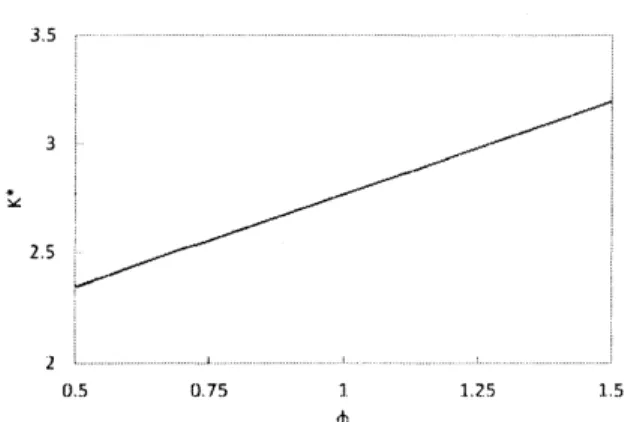
Figure 2 shows that optimal capital investment $K^{*}$ is increasingin thedegree of ambiguity
aversion $\phi$
.
Recall that a decision maker with a higher value of$\theta$is more averse to uncertainty.Figure 2 implies thata central planner who is moreaverseto ambiguity invests more in capital.
Thisgenerates wealth in period 2.
Figure 3 shows that optimal capital investment is increasing in the volatility of endowments
$\sigma$. Such volatility leads a centralplanner toinvest more incapitalso that the riskof having less
wealth inperiod 2 is avoided.
Figure 4 shows that optimal capital investment is decreasing in the technology, represented
by the parameter $A$. Technological advancecauses less capital to be
needed by raising output.
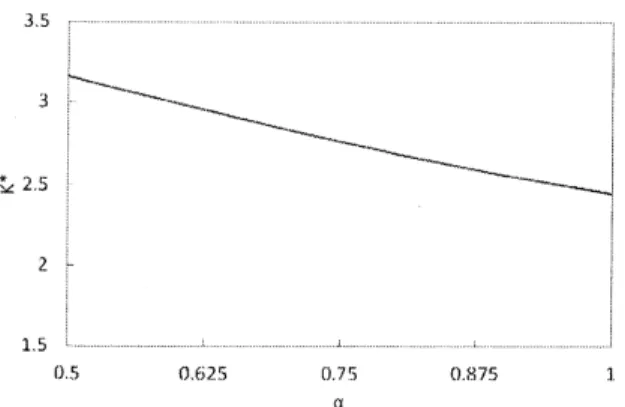
Figure5shows thatoptimal capitalinvestment is decreasing intheoutput elasticityofcapital
$\alpha$
.
This is because output increases in the output elasticity ofcapital.$25$
2
0.$05$ 0.$3$ $0^{\ulcorner_{\backslash }\ulcorner}$ 0.$8$ $10_{:}^{\Gamma}$ $|..3$ $0$
$35$
1 $..-1$
($J$.5 075 ] 125 15 $\phi$
Figure 2: Comparative static effects of$\phi$ on optimal capital investment
$0 125 2_{i}\ulcorner) 375 5$
Figure
3:
Comparative static effects of $\sigma$on
optimal capital investment$0$ $25$ 5 $75$ 10
$A$
$3_{\lrcorner}^{}\backslash$ $\sim_{\sim_{\sim}}$ 3 $\sim_{\neg\sim}$ $\sim_{\sim\sim}$ $\sim_{=.\sim\sim}$ $*\cross 25$ $\sim_{\sim\sim\infty}$ $2\succ$ 15 $0^{r_{)}} (_{J^{\backslash }}7_{J}^{r} 0_{J}7^{\ulcorner} 0875 7$
Figure 5: Comparative static effects of$\alpha$ onoptimal capital investment
5
Conclusion
In thispaper,
we
analyzedcapitalinvestmentunderambiguity inatwo-period setting. We solvedthe central planner’s problem and numerically derived the optimal level ofcapital investment.
Comparative statics analysis revealed that ambiguity aversion and risk aversion affect capital
investment differently.
There are several ways to extend this paper. Although Figure 4 shows that capital
invest-ment is affected by technological progress, we didnot consider uncertainty about technological
progress. Such uncertainty could be formulated by using the Poisson distribution. One could
also incorporate capital in addition to that used in production. For example, incases in which
production generates pollution, there is a need to invest in environmental capital that reduces
emissions. These important topics are left to future research.
References
Camerer, C. and M. Weber, Recent Developments in Modeling Preferences: Uncertainty and
Ambiguity, Journal
of
Risk and Uncertainty, 5, 325-370, 1992.Ellseberg, D., Risk, Ambiguity, and the Savage Axioms, Quarterly Journal
of
Economics, 75,643-669, 1961.
Etner, J., M. Jeleva and $J$.-M. Tallon, Decision Theory under Ambiguity, Journal
of
EconomicSurveys, 26, 234-270, 2012.
Gilboa, I. and D. Schmeidler, Maximin Expected Utility with Non-unique Priors, Journal
of
Mathematical Economics, 18, 141-153, 1989.
Guidolin, M. and F. Rinaldi, Ambiguity inAsset Pricing and Portfolio Choice: A Reviewof the
Literature, Theory Decision, 74, 183-217, 2013.
Hansen, L.P. and T.J. Sargent, Robust Control and Model Uncertainty, American Economic
Knight, F.H., Risk, Uncertainty, and Profit, 1921.
Kogan, L. and T. Wang, A Simple Theory ofAsset Pricing underModel Uncertainty, Working
Paper, MITand University
of
British Columbia, 2002.Miao, J., A Note
on
Consumption and Savings under Knightian Uncertainty, Annalsof
Eco-nomics and Finance, 5, 299-311, 2004.
Appendix
A.
Given the assumptions about the probability
measures
$\mathbb{P}$ and$\mathbb{Q}$, we obtain
$\ln(\frac{d\mathbb{Q}}{d\mathbb{P}})=\ln(\mathbb{Q})-\ln(\mathbb{P})$
$= \ln(\frac{1}{\sqrt{2\pi}\sigma})-(\frac{(y-(\mu-h))^{2}}{2\sigma^{2}})-\ln(\frac{1}{\sqrt{2\pi}\sigma})+(\frac{(y-\mu)^{2}}{2\sigma^{2}})$ ($A$
.
1) $= \frac{-2h(y-\mu)-h^{2}}{2\sigma^{2}}.$Then, relative entropy is
$\mathbb{E}_{\mathbb{Q}}[\ln(\frac{d\mathbb{Q}}{d\mathbb{P}})]=\int\ln(\frac{d\mathbb{Q}}{d\mathbb{P}})d\mathbb{Q}$ $= \frac{-2h(E_{\mathbb{Q}}[y]-\mu)-h^{2}}{2\sigma^{2}}$ ($A$.2) $= \frac{-2h(\mu-h-\mu)-h^{2}}{2\sigma^{2}}$ $=\underline{h^{2}}$ $2\sigma^{2}.$
Faculty of Commerce, Doshisha University
Kamigyo-ku, Kyoto, 602-8580 Japan
$E$-mail address: [email protected]