太陽光発電・蓄電池を用いた住宅規模での電力最適運用計画
出水宰,梅谷俊治,森田浩 大阪大学大学院情報科学研究科情報数理学専攻 大阪府吹田市山田丘1Email: [email protected]
概要
近年,低炭素社会の実現に向けて,太陽光発電
($PV$ :Photovoltaic) などの再生可能エネルギーを 導入した住宅規模でのエネルギーマネジメントが注目されている.昼間に $PV$で発電した電力を蓄電 池に蓄えて夜間に使用することでの省エネルギー効果や,余剰電力を売電することでの省コストな電 力利用が期待できる.しかし,$PV$の発電量や宅内消費電力量に伴う不確実性や,売電の価格体系及 び電力の逆潮流に関する制約が将来的に変更される可能性などから,その運用には様々な検討がなさ れている.本研究では,時空間ネットワーク
(TSN: Time-Space Network)を用いて数理モデルを構築し,宅
内規模での最適な電力運用計画を導出する.想定する環境は一般的な住宅内で $PV$ と蓄電池とが連携 し,$PV$の発電量や宅内消費電力に応じて電力運用を行うものとする.これらを TSN 上で表現し,各 ノード問の電カフローを変数として混合0-1整数計画問題に定式化する.これを解くことにより蓄電 池の充放電タイミングや$PV$出力電力の配分などを決定し,宅内の電カコストを最小化する.また売 電の価格体系や$PV$ の逆潮流方式の将来的な変動を考慮し,複数のマネジメントシナリオごとに最小 の電カコストを導出し,運用方法の違いによるコストへの影響を解析する.数値実験では,実際の宅 内消費電力量および$PV$発電量のデータを元にして季節ごとに35日間のスケジュールを導出する.1
INTRODUCTION
In recent years, Smart Grid attracts attention as a new electric power system. The new system
controls the flow of electric power from the both sides of supply and demand and enablesusto use
efficiently electric power with high quality. In addition, it is expected that the renewable energy
such
as
photovoltaics ($PV$) leads to reduction ofgreenhouse gas. The Japanese govemment aimsat
a
spread of photovoltaics [1] and started feed-in tariff. However, the photovoltaics will changedue to
a
season, weather and time, so it has biginfluenceon
the other part ofthe electric powersystem. Inorder to reduce thisinstability, it hasbeen proposedto introduce storagebatteries into
the grid[2, 3]. Then, it can stabilize the balance of electric power supply and demand by holding
surplus power generated in photovoltaics at daytime and storing electric power witha lowpriceat
night.
This paper considers an optimal electric power management using photovoltaics and battery
system. Assuming several management scenarios, we determine an optimal management plan for
each scenario and discuss their costs. In section 2, we define the electric power management
problem, and in section 3, we explain the mathematical model using a time-spacenetwork (TSN).
2
ELECTRIC
POWER
MANAGEMENT
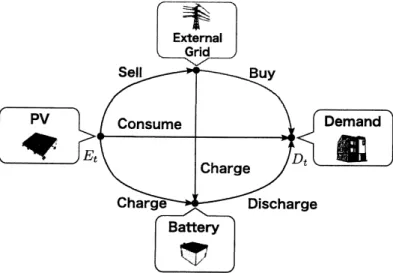
We consider electricpower managementin aresidentialbuildingusing photovoltaic and battery
system. Figure 1 shows the electric power network treated in this study. The demand ofelectric
powerin a residence differs at time, and the total supply from
an
extemal gird, $PV$anda
batterymust satisfy the
demand
at every time. $PV$ generates electric energy at each time, and it candistribute the energy to three demands, i.e., the extemal grid, the residential demand and the
battery.
In the current pricing system in Japan, the selling price is generally higher than the buying
price. Therefore, everyone may consider to sell electricity by $PV$ asmuch as possible, and to buy
necessary electricity in a residence. This is an incentive to introduce $PV$, however, the essential
purpose of introducing$PV$is localproduction for localconsumption, notto
save
electricity costforeach
consumer.
Weassume
two types of regulation in the operation of delivering electricity from$PV$back into the external grid.
1. Total amount type: The delivered power should be no more than the power generated by
$PV$
.
It is possible to sellthe total electricenergyof$PV$ to the external grid.2. Surplus amount type : The electric
energy
of$PV$ is used preferentially for the residentialdemand. The delivered power should be
no
more
than thesurplus power.For the battery, we have to make the regulations in charging
resources
and dischargingtiming. Ifthere is no restriction on battery, that is, wecan charge battery from extemal grid
as
well as $PV,$and discharge at any time, everyone may consider to charge the cheap electricity at night and to
sell it during daytime by higher price, which is regardless the existence of$PV$
.
Herewe
considertwo types ofregulation in discharging from the battery:
1. Nomal type : Discharging from the battery is not forbidden. It is always possible to
dischargefrom the battery.
2. Regulation type: Discharging from the battery is forbiddenwhile$PV$ generateselectricity.
Thenit ispossible to dischargeonly during night or arainy day.
Moreover,
we
assume
two types of regulation in thesource
for charging the battery:1. $PV$ and grid type: The battery can charge from $PV$ and the external gird.
2. $PV$ type: The batterycan charge fromonly $PV.$
There
are
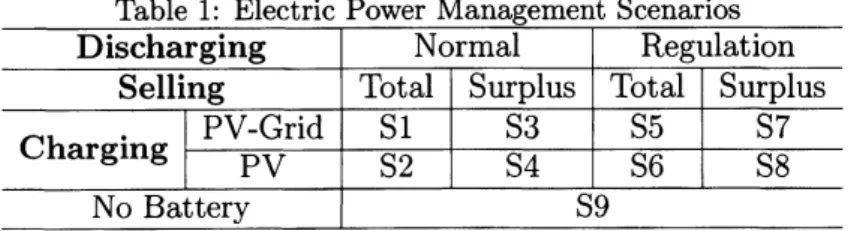
several management scenarios by the combination of these constraints about $PV$ andcharging and discharging ofthe battery. Table 1 shows that electric power managementscenarios considered in this study. Here, the scenario Sl is the most flexible management. It is possible to
sell or to charge the electricity produced by $PV$, and also to charge the battery from grid. Since
Sl has no restriction on electric power flow, Sl gives us the lowest cost of electricity usage, ifwe
do not take into account ofthe cost of battery.
Comparing to Sl, we consider
some
scenarios. S3 isadded therestrictionthat theselling amountofelectricity does not exceed thesurplus. S5 is added the restriction that the discharging time is
limitedat night. S2 is added the restriction that the charging
resource
should be only $PV$.
S4 isthecurrent situationin Japan, where thebattery is notconnectedto
an
extemalgrid directly, andprohibited to sell to and to buy from the grid. We note that we add scenario S9 which removed
the battery from the electricpower network inorder toverify the effect of abattery.
We also mention the unit price of electric power in Japan. When
we
buy electricity from the extemalsupplier inthe grid, theunit priceis a fixed rate, which varies dependingon
the timeand adayoftheweek. Onthe otherhand, when we sellelectricityback into thegridfrom $PV$, the unitprice is fixed and is set tomore expensive than buying price.
Table 1: ElectricPower Management Scenarios
3
MATHEMATICAL MODEL
We explain a formulation for the electric power management usingatime-space network (TSN)
model. TSN extends the usual network in the direction of a time-axis. Figure 2 shows a TSN
model for the electric power network in a residentialbuilding.
In this electric power network, wehave to determine the amount of flows between the nodes at
each time. Then, we formulate it as a mixed 0-1 integer programming problem ($0$-IMIP). In this
formulation, weuse abinaryvariablethat denotes the existence ofaflow. Itenablesus todescribe
constraints, such
as
the exclusion of charging and discharging operation of the battery, and theprohibition of the inflow and the outflow via the external grid at the same time. Furthermore, by
using a continuous variable denotes the amount of a flow, we
can
describe the demand satisfiedconstraint. Under these constraints we consider minimizingthe cost concerning electricpowerin
a
$PV$
Extemal
Gnd
Battery
Demand
$t-1 t t+1 t+2 t+3$
Time
Figure 2: Time-Space Network Model for the Electric Power Network
Input data
$p_{t}^{b}$ unit price
in buying electricity at time $t$
$p^{s}$ unit price in selling electricity
$C$ capacityof the battery
$g_{\max}$ maximum electric power chargedthe battery
hmax
maximumelectricpower discharged the battery$\varphi$ decay rate from$AC$ to $DC$
$\psi$ decay rate from $DC$to$AC$
$T$ set of timeperiods for the management
$E_{t}$ electric power generated by$PV$ at time $t$
$D_{t}$ demand in the residence at time$t$
$w_{0}$ initial rate ofelectricenergy onthebattery at time $0$
Decision variables
$x_{i,j,t}$ a binary variable denoting theexistence ofa flow from node $i$ to node$j$ at time $t$
$y_{i,j,t}$ a continuousvariable denoting the amount ofa flow from node $i$ to node$j$ at time $t$ $w_{t}$ rate ofelectric energy onthe battery at time $t$
Node symbols
$p$ node of$PV$
$c$ node of external grid
$s$ node of battery
$d$ node ofdemand
Formulation of mathematical model
Minimize
$\sum[(y_{c,d,t}+y_{c,s,t})p_{t}^{b}-y_{p,c,t}p^{s}]$ (1)$t\in T$
subject to $y_{p,d,t}+y_{c,d,t}+\psi y_{s,d,t}=D_{t}$ (2)
$y_{p,c,t}+y_{p,d,t}+y_{p,s,t}=E_{t}$ (3)
$Cw_{t}+\varphi(y_{p,s,t}+y_{c,s,t})\leq C$ (4) $Cw_{t}-y_{s,d,t}\geq 0$ (5)
$\varphi(y_{p,s,t}+y_{c,s,t})\leq g_{\max}$ (6) $\{$ $x_{p,c,t}+x_{c,d,t}\leq 1$, (7) $\{$ $x_{p,s,t}+x_{s,d,t}\leq 1$, (8) $x_{p,c,t}+x_{c,s,t}\leq 1$ $x_{c,s,t}+x_{s,d,t}\leq 1$ $\varphi(y_{p,s,t}+y_{c,s,t})-y_{s,d,t}=C(w_{t+1}-w_{t})$ (9) $\{$
$\{\begin{array}{ll}0\leq y_{s,d,t}\leq h_{\max}\cdot x_{s,d,t}, 0\leq y_{p,c,t}\leq E_{t}\cdot x_{p,c,t}, 0\leq y_{p,d,t}\leq E_{t}\cdot x_{p,d,t}, (11)0\leq y_{p,s,t}\leq E_{t}\cdot x_{p,s,t}, \end{array}$ $x_{s,d,t}\in\{0,1\},$
$x_{p,c,t}\in\{0,1\},$ $x_{p,d,t}\in\{0,1\},$$x_{p,s,t}\in\{0,1\}$, (10)
$x_{c,d,t}\in\{0,1\},$$x_{c,s,t}\in\{0,1\}$
$0\leq y_{c,d,t}\leq D_{t}\cdot x_{c,d,t},$
$0\leq y_{c,s,t}\leq\simeq_{\varphi}\underline{\max}.$$x_{c,s,t}$
$0\leq w_{t}\leq 1$ (12)
In this formulation, we consider all the constraints in $t\in T$
.
The objective function (1) is thetotal price calculatedby the amounts ofelectricity bought and sold via the extemal grid. Eq.(2)
implies the residential demand should be satisfied, and eq.(3) is the distribution constraint about
electric power generated by$PV$
.
Eqs.(4) and (5) show the capacity constraints of the battery withcharging and discharging. Eq.(6) shows the limit of electric power in charging the battery. Eq.(7)
shows theexclusionconstraints of buying and selling electricity via the extemal grid. Eq.(8) shows
the exclusion constraints of charging and discharging operations of the battery. Eq.(9) shows
the conservation of
electric energy
of chargingor
dischargingthe
battery. Eq.(10) defines binary variables for each electric flow. Eq.(ll) defines the ranges for each electric flow. Eq.(12) shows the range ofthe charging rate of the battery.This isa mathematicalformulation forscenario Sl,whichisa basic model
on
this study and theotherscenarios can be described by adding several constraints to this formulation. For example, in
thescenario S3 and S4 weadd the followingconstraint about the amount ofdelivered power from
$PV$back into the extemal grid.
$\{\begin{array}{ll}y_{p,c,t}=0, t\in T_{1}=\{t\in T|E_{t}-D_{t}\leq 0\}y_{p,c,t}\leq E_{t}-D_{t}, t\in T_{2}=\{t\in T|E_{t}-D_{t}>0\}\end{array}$ (13)
Eq.(13) shows therestriction on the dehveredpower considering the surplus of the electric power.
Moreover, in the scenario $S5-SS$ we add the following constraint about the existence of the flow
between the batteryand the demand.
$x_{s,d,t}=0, t\in T_{3}=\{t\in T|E_{t}>0\}$ (14)
Eq.(14) shows the prohibition of discharging from the battery while $PV$ generating. Finaly, we
consider the constraint about the scenario S2, S4, S6 and SS.
$x_{c,s,t}=0, t\in T$ (15)
Eq.(15) shows the prohibition of charging the battery from the external grid. Then the battery is
4
CASE STUDY
We
assume
the management scenarios and evaluate each minimum cost. We note that theuncertainty about the amount of demand $D_{t}$ andthat of $PV$output $E_{t}$ is not consideredfrom the
viewpoint of compering the minimumcosts amongall the considered scenarios.
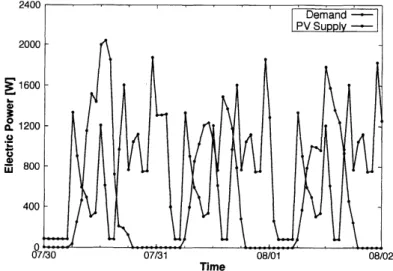
We get these data $D_{t}$ and $E_{t}$ from a real residential building for three different seasons, i.e.,
summer, winterand mid-term. Figure3shows changesfor every
one
hour in the demand of electricenergy and the supply by$PV$ at
summer.
Figure 3: Changes in Demandof Electric Power and Supply by $PV$
The management planning period of each season is 35 days. In each season, the unit price of
buying electricity from the external grid is fixed with time and a dayof the week. Table 2 shows
the unit price of buying electricity.
Table 2: Unit Price ofBuying Electricity
We have changedthe unit price of selling electricitybetween$0$and
45
$[yen/kWh]$ tosee how eachmanagement scenario works and its minimum cost. We have used ILOG CPLEX 12.4 for solving
the$0$-IMIP.
We also note the other parameters about the management. The capacity of battery $C$ is 6
$[kWh]$, and the maximum electric power of both charging and discharging the battery, $g_{\max}$ and
$h_{\max}$, is 3 $[kW]$, respectively. Incharging and discharging the battery, electric poweris decreased
because ofthe conversion between $AC$ and $DC$
.
The decay rate $\varphi$ from$AC$ to $DC$ is 0.9 and viceversa.
Figures 4 and 5 show the comparison of the minimum cost over 35 days among theseven
Figure4: Comparison ofthe Minimum Cost
over 35Daysamong 9Management
Scenarios
in SummerFigure 5: Comparison of the MinimumCost
over 35Daysamong 9Management
Scenarios in Winter
From these figures,
we
obtainedthe following fourfindings:1. The total cost decreasesgreatly by introducingabattery in
case
ofalowunit priceof selling electricity.2. There is few effect ofbattery
as
the unit pricegoesup,when thesource
ofcharginga
batteryis only $PV$such
as
S2, S4, S6 and SS.3. Ifthereisno restrictionsuch asSl, the reduction of total costis remarkablein caseofahigh
unit price of selling electricity.
4. Comparingsummerand winter, thecharacteristicsbetween scenarios is almost samein spite
that the total cost has shifted.
In the next experimentation,
we
analyze the cost reduction effect of the management factors by using the analysisofvariance (ANOVA). Thereare 4
factors, that is selhng, charging, dischargingand season, and they have each level
as
the table 3shown.Table 3: Management Factors and Their Levels
Here, we
assume
season’s factoras
an uncontrollable factor. Then we analyze the effect oftheother 3 factors and their interactions byremovingthis factor. Inthisexperiment, theunit priceof
sellingis fixed at 42 yen per $kWh$ andits price issame tocurrent Japan.
Figure6showthe resultofANOVA. Forthe factorial effect, there isasignificant difference in all
the factor. Especially, the factor of charging, that is factor $C$, shows the most significant effect of
the three factors. Between$PV$-Grid type and $PV$type, thereisacost differenceof 2,000 yen. Next,
for the interactioneffect, there is also asignificant difference in all. Especially, the interaction of Discharging and Selhng, that is Interaction $A*B$, is the most influential effect. At the level A2,
Factorial Effect of A Factorial Effectof$B$ FactorialEffectof$C$ $\overline{\underline{e\omega\wedge}}$ $\overline{\underline{\Phi=\succ}}$ $\overline{O\omega Q}$ $\mathring{0}{\}$ $\frac{\in}{\in}$ $\in E\ni$ $\overline{e}$ $\overline{\epsilon}$ $\dot{\overline{\Xi}}$ $\dot{\overline{\Xi}}$ Al A2 Bl B2 Cl C2
InteractionEffect of$A^{*}B$ Interaction Effectof$A^{\star}C$ lnteractionEffectof$B^{*}C$
$\overline{\underline{\Phi=>\backslash }}$
$\overline{\underline{c\omega}}$
誘
8
ぢ
$=\underline{\frac{\in 3}{\epsilon}\in}$ $=\underline{\frac{\in}{\epsilon}3\in}$Al A2 Al A2 Bl B2
Figure 6: Effect of Factors and Interactions
5
CONCLUSION
In this study,wehave considered anoptimal electric power management ina residentialbuilding
using $PV$ and battery system. To get an optimal management plan, we formulate the problem
as
$0$-IMIP through a TSN model. By solving it under several management scenarios, we showthe comparison of each minimum cost. Finaly, we analyze the cost reduction effect causedby the
management factors by using ANOVA.
REFERENCES
[1] Overview$of$”$PV$roadmap toward
2030”,
NewEnergy and IndustrialDevelopmentOrganization(NEDO), Tokyo, (2004).
[2] B. Lu andM.Shahidehpour, Short-termscheduhngof bat-teryina grid-connected$PV$/Battery
system, IEEE transac- tionon power systems, vol. 20, no. 2, pp. 1053-1061, (2005).
[3] Y. Riffonneau, S. Bacha, F. Barmel and S. Ploix, Optimal power flow management for grid
connected$PV$systems with batteries, IEEEtransaction onsustainable energy, vol. 2, no. 3, pp.