Analysis of
an intrusion
tolerant
database
system
via
semi-Markov
processes
植村俊和, 土肥正
Toshikazu
Uemura and Tadashi
Dohi
Department of Information
Engineering,
Graduate
School of Engineering,
Hiroshima
University, Japan
1. Introduction
The
use
of computer-based systems and lnternet has been undergoing dramatic growth in$8cale$,vari-ety and penetration, implying
our
growing dependenceon
them fora
large number of businesses and$day- t\triangleright day$ lifeservices. Unfortunately, the
complexity, the heterogeneity and the openness ofthe
sup-portinginfrastructures to untrusted
users
have also given rise toan
increasing number ofvulnerabilitiesand malicious threats (viruses, worms, denial ofservice attacks, fishing attempts, etc.). For malicious
attackers, if the
access
right strengthens, the probability that the security intrusion may happen will effectively decrease, but the utilizationon
accessibUity will be ratherlost. The claesical security-relatedwork has traditionally privileged, with
a
few exceptions, intrusion avoidance techniques (vulnerability elimination, strong authentication, etc.) and attack deterrence (attacktracing, auditing, etc.). However, suchtechniques haveprovedto be notsufficient toensure
the security ofsystemsconnected to networks. Morerecently, intrusion tolerance techniques, inspiredfromtraditional techniques commonly usedfortolerating accidental faults in hardware $and/or$ software systems, have received considerable attention
to complement intrusion avoidance techniques, and improve the security ofsystems connected to the
Internet.
So
far, mostefforts in security have been focusedon specification, design and implementationissues. In fact several implementation techniques ofintrusion toleranoe at the architecture level have
beendeveloped for realcomputer-based systemssuch
as
distributed systems [1], databasesystems $[6,7]$,
middleware$[15,16]$,
server
systems [2]. Theabove
implementationapproachesare
basedon
the redundantdesign at the architecture level
on
secure
software
systems. In other words, since these methodscan
be categorized by a design diversity technique in
secure
system design and need much cost for thedevelopment, theeffect
on
implementationhasto be evaluated carefully and quantitatively.Thequantitativeevaluation of
information
security basedon
modelingisbecoming muchpopular tovalidatethe
effectiveness
of computer-based systems with intrusiontolerance. Littlewood et$d$.
$[5]$ foundthe analogy between the information security theory and the traditional reliability theory in aesessing the quantitative security of operational software systems, and explored the feasibility ofprobabilistic
quantMcation
on
security. Jonssonand Olovsson [4] gavea
quantitativemethod to studytheattacker’sbehaviorwiththeempiricaldata observed inexperiments. Ortalo,Deswarteand Kaaniche[11] applied the
privilegegraphand the$continuoll\triangleright time$Markov chain(CTMC) toevaluate thesystem vulnerability,and
derived the
mean
effort
to security failure. Singh, Cukierand Sanders [12] designed stochastic activitynetworks model for probabilistic validation ofsecurity and performance of several intrusion tolerant architectures.
Stevens
et al. [13] also proposed probabilistic methods to modelthe DPASA (DesigningProtection
and Adaptationinto a SurvivableArchitecture).approachesto design the state transition diagramofsystem securitystatesby incorporating both attacker
and system behaviors under uncertainty. Madan et al. [9] dealt with
an
architecture with intrusiontolerance, calledSITAR(ScalableIntrusion TolerantArchitecture) anddescribed the stochastic behavior
ofthe system by discrete-time semi-Markov chain (DTSMC). They also derived analytically the
mean
time length to security failure. Imaizumi, Kimura and Yasui [3] and Uemuraand Dohi [14] focused
on
the typical denial of service attacks for
server
systems and formulatedthe
optimization problemson
theoptimal monitoringtime and theoptimal patchmanagementpolicy viacontinuoll&time semi-Markov
chain (CTSMC) models. Although they mainlyconsideredthe expectedcost models which
are
familiartothe$Markov/semi$-Markovanalyses,the relationship with security attributes
vas
stillunclearin modeling.For the purposeof comprehensive modelingofsystem-level security quantification, it is actually diffi-culttomodel certain security attributessuch
as
confidentiality and $intq|\dot{\tau}ty$usingthe probabilistic tech-niquesas
wellas
to quantify thehigh-level security requirement with different security attributes [10].Hence, themeasurementtechniques for model parameterization andvalidationmustbe carefullyselected
in securityevaluation. In such
a
situation,the$s$urvivabtity analysisis becoming verycommon
to quantifythe computer-based systems underthe assumptionthat failure may
occur
and that theoutcomeof
thefailurenegatively impacts
a
large segmentof the subscribers totheITinbastructure,where
such failures maybethe result ofdeliberate,malicious attacks againsttheinbastructurebyan
adversary.In this paper
we
consider thesecure
design of an intrusiontolerant database (ITDB) system with acontrol parameter, and describe the stochastic behaviorof
an
intrusion tolerant database system (ITDB). First,Liu et al. $[6,7]$proposedseveralITDB architecturesand presentedthedesign andimplementation$methodo\log i\infty$
.
While traditionalsecure
databaeesystemsrelyon
preventivecontrolsandare
very limitedin surviving malicious attacks, the ITDB
can
detect intrusions and isolate attacks. Inaddition, itcan
contain,
essess
and repairthedamagecausedby intrusionsina
timelymanner
such that sustained,self-stabilzed levels ofdataintegrityand availability
can
be providedto applications inthe face ofattacks.With the aim
to
quantify the ITDB, Yu,Liu
and Zang [18] and Wang and Liu [17] developed simpleCTMC
models to evaluate the survivability of the ITDB. Especially, Wang and Liu [$1\eta$ formulatedtwosurvivability measures; system integnity andrewarding
availability1.
In this paperwe
extend it toa
CTSMC
modelwithnon-exponentiallydistributed transitiontimes,andprovidemore
robustquantitative framework to maliciousattacks with avarietyofprobabilistic patterns.Further, by introducing
an
additionalcontrol parameter called the switching time,we
developsecure
control schemes of the ITDB, which maximize the security messures; system integrity and rewarding availabUity,
as
wellas
thecommon
system availability. Necessary and sufflcient conditions toeXista
finiteand unique optimal switching time
are
derived undera
mild parametric amumption. These analyticalresults enable
us
to maximize the utihty ofintrusion tolerance in the ITDB. Numerical examplesare
devoted to examine thedependenceof modelparameters
on
theoptimal switchingtime and itswociated
security
measures.
Throughout the sensitivity analysison
themodelparameters, itisshownnumericallythat the ITDB should be designed to minimize mission impact by $\infty ntaining$ both the intrusion and
failure. FinaUy, thepaperis concludedwith
some
remarks andfutureresearch directions.1Theintegritydeflned in[17]seemstobesomewhat different ftom the usualqualitativedefinitionasasecurityattribute. Inthispaper wecallit thesystem$|ntq’\backslash ty$whichisaquantitative measure,and distinguish fromthe qualitativemeasure.
Figure 1; Bssic ITDB architecture.
2.
Intruslon Tolerant Database
System 2.1. Basic ConceptFirst ofall,
we
givea
brief summaryon
the intrusion tolerant database (ITDB). Inthe ITDB,once
it isdamaged
&om
anyreason
suchas
infections andattacks, the damaged $part8$are
automatically located,contained and repaired
as soon as
possible,so
that the databasecan
continue being operative with theintrusion tolerant functions. Figure 1 shows the major components of
a
compreheoive ITDB, whichwas
introduced in $[6, 7]$.
Ina
fashion similar to the reference [17], we $a1_{8}0$ focuson some
significant components; Mediator, Damage containment and Damage recovery, in Fig.1 and describe the stochasticbehavior of functions in major components. Mediator subsystem may function
as
a
proxy for eachuser
transaction and transaction processing call to the databaeesystem, andenables tokeep theuseful informationon
user
transactions, suchas
$read/w\dot{n}te$ operations. This function $i_{8}$ quite important togeneratethecorrespondinglogsfor damage
recovery
andcontainment.Moreprecisely, in thetraditional
secure
databasesystem, the damagecontainmentcan
not be madeuntil the data items
are
identifiedas
damagedones.
In this situation,a
signiflcant damage assessmentlatencymayhappen,
so
that the damage caused by attacksor
intrusions maypropagateto the other dataitems. In the ITDB, theso-called multi-phasedamage containment technique is applied
as an
intrusion toleranttechnique [6], where it involvesonecontaining phaseandone
more
uncontaining phasesreferred to as Containment relaxation. Once an intrusion is detected by Intrusion detector, Damage recovery sukystemhasthe responsibility tothe damageassessmentand repair, andretrievesthemalicioustrans-action
messages
reported fromIntrusion
detector. On theother hand, Damage containment$suky_{8}tem$traces
thedamage propagationbycapturing thedependent-upon relationshipamong transactions.Hence, the control by
Intrusion
detector playsan
central role to the design of the ITDB.Since
Intrusion detector isbssed
on
both the trails on the logs andsome
relevant rules to identify malicioustransactions, however, $it_{8}$ effect is lmited. In other words, it would be impossible to detect $aU$
the
intrusions automatically within the real time. In practice, two control modes can be ready; automatic
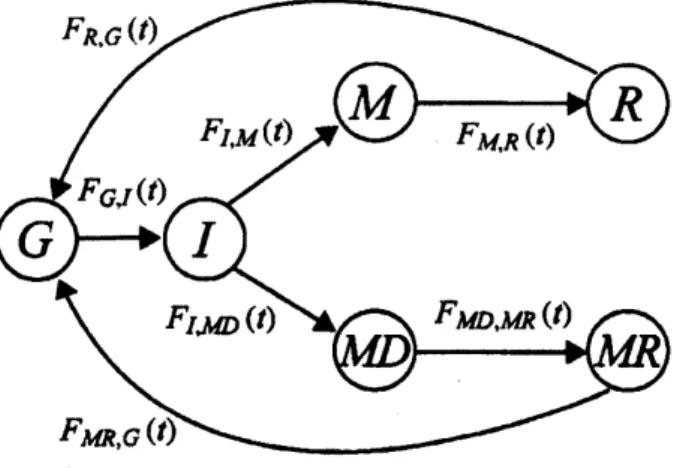
Figure2: Semi-Markovtransitiondiagram
a
manual detection mode ifIntrusion detector does return no response during the real time operation.Wang andLiu[$1\eta$ developed
a
simpleCTMCmodel withrandom switchingfroman
automatic detectionmode toa manual one, andevaluatedthe security
measures
for the ITDB.2.2.
Model DescriptionFollowing WangandLiu [17],
we
alsofocuson threecomponents intheITDB,Mediator, DamagerecoveryandDamage containmentsystems. Supposethatthe database systemstartsoperatingat time$t=0$with NormalState; $G$
.
Ifattackersor hackers
detect thevulnerability of thedatabase, they try to attack thedatabase andthe state may make
a
transitiontoInfection
State; $I$,
where the transition time from $G$to $I$ has the continuous cumulative distribution function (c.d.$f.$) $F_{G,I}(t)$ with
mean
$\mu_{G,l}(>0)$.
Once
the malicious attack by
an
attackerwas
successful inState
$I$, the intrusion detector begins operating automatically. Ifthe infection ofpartsor data items is detected in the automatic detection mode, thestatemakes
a
transitionfrom$I$toMaintenance State; $M$,
wherethe transition time from$I$to$M$is givenby
a
randomvariable having the continuous c.d.$f$.
$F_{I,M}(t)$ andmean
$\mu_{l,M}(>0).$. In this phase, when
the infected items
are
identifledmore
specifically through thedamageassessor,
the correctiverecovery
operation is triggered in Recovery State; $R$ in the damage recovery system. Let the state transition
time from $M$ to $R$ be the random variable having the c.d.$f$
.
$F_{M.R}(t)$ andmean
$\mu_{M,R}(>0)$.
Afterthe completionof recovery operation, the infected parts
are
fixed and the database systemcan
becomeas good as new with Normal State, where the completion time to recover the database is given by the
non-negative continuous randomvariablewiththe c.d.$f$
.
$F_{R,G}(t)$ andmcan
$\mu_{R,G}(>0)$.
On the other hand, it should be worth mentioning that the infection ofparts
or
data items is not always possible only in the automatic detection mode. In other words, the intrusion detection is not always perfect forallpossible attacks,so
that the systemmanager$and/or$thefull vendor may searchtheinfectedparts in the manual detection mode. Wang andLiu [$1\eta$ considered the possibUity of switching
from the automatic detection modeto the manual detectionmode,and assumed that
the
switchingmayoccur
randomly. This correspondstothe switchingfrom theunconfinement executortotheconfinementexecutor. In [17], theassociated stochastic model is based
on
a
CTMC with exponentially distributedtransition times. Instead ofthe exponential switching time,
we
model the switchingtime by thenon-negative continuous random variable withthe c.d.$f$
.
$F_{I,MD}(t)$ andmean
$\mu_{I,MD}(>0)$,
where ManualWhen the intrusion is detected, the system state makes transition from $MD$ to $MR$, and next the
recoveryoperationstarts immediately. Finally, when the recoveryoperationiscomplete,the state makes
a
transition from $MR$to$G$with NormalState. In thisway, thesame
cyclerepeatsagain andagainover
an
infinitetime horizon. Since theunderlyingstochastic processisa
CTSMC, it is notedthatour
modelis
an
extended versionto theCTMC
model in [17]. Figure2 illustrates the state-transition diagram fortheCTSMC model.
In this context, the automaticdetection mode is randomlyswitchedto the manual detection mode.
Dissimilar toWang and Liu [17], we introduce the time limit to turn
on
the manual detection, $t_{0}(0\leq$$t_{0}<\infty)$
,
periodically and call it the switching time. If the automatic detection is switched to the manualdetection, then the system state goes to $I$ from $MD$
.
Without any loss ofgenerality,we
define thetransitionprobabilityfrom$I$to $MD$by
$F_{I,MD}(t)=\{\begin{array}{l}(t\geq t_{0})0(t<t_{0})\end{array}$ (1)
This
means
that the detection modecan be switched fromthe automaticmodetothe manual modelatevery
$t_{0}$ time unit.3.
Security Measures3.1. System Integrity
Wang andLiu [17] defined thesystemintegrity
as
a
fraction oftime when allaccessible data items inthedatabase
are
clean. As mentioned previously in Section 1, the integrity is regardedas one
ofthe mosttypical securityattributesin addition to authentication andnon-repudiation. Whenthe integrity is high,
theITDS
can
serve
theusers
by utilizing the goodor
cleandata with high probability. InFig. 2, all dataitems in the ITDB
are
clean and accessible in State $G$.
When attacks occur,some
dataitems $wiU$ beaffectedand thepartof accessible dataitemsinstate$I$
may
be dirty. Aftertheintrusionis identified,theITDB
can
contain all the damaged data until it finishes the repair process. In this situation,the ITDBcarriesout the selective containment and repair, andis still available,
so
that the accessibledata itemsare
clean duringthecontainment, damage assessment andrepair process. InFig. 2, since the system states
under considerationare $G,$ $M,$ $R$ and $MR$, the system integrityis deflned by IN$(t_{0})=U_{IN}(t_{0})/T(t_{0})$
,
where
$U_{IN}(t_{0})=\mu_{G,I}+(\mu_{M,R}+\mu_{R,G})F_{I,M}(t_{0})+\mu_{MR,G}\overline{F}_{I,M}(t_{0})$, (2)
$T(t_{0})=U_{IN}(t_{0})+ \int_{0}^{t_{0}}\overline{F}_{I,M}(t)dt+\mu_{MD,MR}\overline{F}_{I,M}(t_{0})$
.
(3)Then, the problem is to derive the optimal switchingtime $t_{0}^{s}$ maximizing $AV(t_{0})$
.
For thepurpose,we
makethefollowingparametricaesumption:
$(A\cdot 1)\mu_{MR,G}>\mu_{M,R}+\mu_{R,G}$
.
In (A-1),it is assumed that thetime length to detect
an
intrusion automatically isstrictlyshorterthanthatbythemanual detection. This
seems
to be intuitivelyvalidated fromtheviewpoint of theutility inautomatic detection.
Proposition 1: (1) Suppose that the c.d.$f$
.
$F_{I,M}(t)$ isstrictlyDHR
under (A-1). Define the function:$-[1+\{(\mu_{M}+\mu_{R})-(\mu_{MD}+\mu_{MR})\}r_{D}(t_{0})]U_{lN}(t_{0})$
.
(4)(i) If$q_{IN}(0)>0$ and $q_{IN}(\infty)<0$, then there exists
a
finite and unique optimal switchingtime $t_{0}^{*}(0<t_{0}^{*}<\infty)$ satisfying$q_{JN}(t_{0})=0$
(ii) If$q_{IN}(0)\leq 0$, then$t_{0}^{r}=0$ (lii) If$q_{IN}(\infty)\geq 0$
,
then $t_{0}^{*}arrow\infty$(2) Suppose that the c.d.$f$
.
$F_{I,M}(t)$isIHR under(A-1). IfIN$(O)>IN(\infty)$, then$t_{0}^{*}=0$otherwise $t_{0}^{l}arrow\infty$.
The proofisomitted for brevity. For theactual managementofdatabasesystems,it is
more
significant to keep the clean and accessible data. So, whenthe quality ofdata is considered, the system integrityshouldbethe
more
attractivesecuritymeasure
thanthe$8y8tem$availability.3.2. Rewarding Availablllty
Thesystem availability isdefined
as a &action
oftime when theITDB is providingservicesto itsusers,and does not
care
thequalityof data. Since theITDB perform theon-the-fly repairandwill notstopits service facedby attacks, it
can
be expectedthat the correspondingsystemavalabilityisnearly 100%in almost all
cases.
For better evaluation of the security attribute in the ITDB, Wang and Liu [17]considered anothertypeofavailability, called$re$warding availability,which is defined
as a &action
of timewhenall the clean dataitems
are
accessible. Iftheclean datacan
not be accessed intheITDB, itcan
be regardedas
a
serious loss of service tousers.
Dissimilarto the system integrity, since the system states under considerationare
$G,$ $R$and$MR$,
therewarding availabihty isdefinedby$RA(t_{0})=U_{RA}(t_{0})/T(t_{0})$,
where
$U_{RA}(t_{0})=\mu_{G,I}+\mu_{R_{*}G}F_{I,M}(t_{0})+\mu_{MR,G}\overline{F}_{I,M}(t_{0})$
.
(6) Wegivethe characterization resulton
theoptimalswitchingtimemaximizing therewarding availability without the proof.Proposition2: (1) Supposethat the c.d.$f$
.
$F_{I,M}(t)$ isstrictlyDHR under (A-1). Definethefunction:$q_{RA}(t_{0})=(\mu_{R,G}-\mu_{MR,G})r_{I,M}(t_{0})T(t_{0})$
$-[1+\{(\mu_{M,R}+\mu_{R,G})-(\mu MD,MR+\mu_{MR},c)\}r_{I,M}(t_{0})]U_{RA}(t_{0})$
.
(6)(i) IfqRA(0) $>0$ and $q_{RA}(\infty)<0$
,
then thereexist8a
finite and unique optimal switchingtime$t_{0}(0<t_{0}<\infty)$ satisfying$q_{RA}(t_{0}^{*})=0$
(11) If$q_{RA}(0)\leq 0$, then$t_{0}=0$
(iii) If$q_{RA}(\infty)\geq 0$
,
then $t_{0}^{*}arrow\infty$(2) Supposethat the c.d.$f$
.
$F_{I,M}(t)$isIHR
under (A-1). If$RA(O)>RA(\infty)$,then$t_{0}^{r}=0$otherwise$t_{0}arrow\infty$
.
Inthis section,
we
optimizedthethree securitymeasures
for the ITDB andderived theoptimalswitching timesforrespectivequantitativecniteria. InthefoUowing section,we
will givesome
numerical$\alpha ampl\alpha$,4. Numerical$nlu\epsilon tratlo118$
4.1.
Parameter
SetWe focus
on
boththesystemlntegrity andtherewardlngavailability, andtreatthedatabasemanagementsystem with Oracle St
server
in [17]. Although thesecurity model in [17]was
basedon a
simple CTMC,we here
assume
that the c.d.$f$.
$F_{I,M}(t)$ is given by the Weibull distributionwith scale parameter$\eta$ and
shapeparameter$m$:
$F_{l,M}(t)=1-\exp\{-(t/\eta)^{m}\}$
.
(7)This assumption implies that the transition time from an intrusion to the containment sate is
DHR
$(m\leq 1)$
or
IHR $(m\geq 1)$, andcan
represent themore
general transition phenomena. When $m=1$, itreducesto theexponentialdistributionwith constant hazard rate. The othertransitionratesfromstate
$i$ to state $j$
are
assumed to constant, $i.e.,$ $1/\mu:.j=\lambda_{i,j}(i,j\in\{G,I,M, R, MD, MR\}, i\neq j)$, exceptfor $(i,j)=(I, M)$
.
In particular, we introduce the attack hittingrate $\lambda_{\alpha}$ and the false alarm rate$\alpha$as
Wang and Liu [17] did
so.
It should be noted that Intrusion detector in Fig. 1 $wiU$waa
the systemuser
ofmahcious$attack/intrusioo$as
wellas
thesystem failure bymeans
ofa
fake alarm. Let $T_{a}$ and$\tau_{fa}$ be the intrusion time and the systemfailure time measured from time $t=0$in
State
$G$, and be theexponentially distributed random vaniables withparameters $\lambda_{a}$ and $\alpha$, respectively. Then the bction
$F_{G,I}(t)$ isregarded
as
the c.d.$f$.
ofthe randomvariable$\min\{T_{a},T_{f^{a}}\}$ and is theexponentlal c.d.$f$.
withparameter $\lambda_{a}+\alpha$
.
Table 1 presents the model parametersusedin this example, where theyare
almostsame
in [17]. We set$m=0.2$,and choose$\eta$so as
tosatisfy $\mu_{I,M}=\eta\Gamma(1+1/m)$.
4.2. System Integrity
kble 2presentsthemaximized the systemintegrity forvaryingmodelparameters,where$t_{0}arrow\infty$implies the nomanual detection policy. IFYomthistable, it is
seen
that the optimalcontrol of the switchlngtimeto the manual detection mode leads to the $2.8\%\sim$ 35.5% improvement of system integrity. In this
numerical example, it
can
beobservedthattheperiodicswitchlngtothe manualdetectionmode and therapid $containment/repair$ bom the damage due to attacks
or
intrusionsare
quite important factorstoincrease
thesystemintegrity. In Fig.3,we
plot the behavior ofthe systemintegrity vith respectto theattack hltting rate and the false alarm rate.
IFVom
this result, itcan
beseen
that thesystem integrityincreases
to 0.2%\sim 1.4% $(1.3x10^{-2}\%\sim 0.16\%)$whentheattack hittingrate(falsealarmrate)decreases.This
resultcan
be explained physically,so
that the system integritycan
increase ifthe total operationtimeof the ITDB becomeslonger with thelowerattackhltting rate$and/or$if the load of the ITDB with
4.3. Rewarding Availabillty
SimilartoSubsection4.2,
we
examine the dependenceofmodelparameterson
the optimal switching time and its associated rewarding availabilityin Table 3. Rom thistable, itcan
be found that the periodic controlon
the switching to the manualdetection mode enablesus
to increase therewardingavailabilityup to 0.2%\sim 12.3%.
As
the detectionspeedbecomes faster, itcan
beincreased to 0.3%\sim 3.9%. Figure4 shows the behaViorof rewarding availability
on
the attack hitting rate and the falsealarm, where therewarding availability varies inthe rangesof 27.2%\sim 32.8%and 1.7%\sim 3.2% for$\alpha$and$\lambda_{\alpha}$
,
respectively.Thus, the attackhitting rateis
more
sensitive thanthe falsealarmrateto not only the system integrity but also the rewardingavailability.5. Concluslons
In this paper we havereconsidered
an
ITDB architectureinWangandLiu [$1\eta$anddevelopeda
CTSMCto
assess
the securitymeasures
suchas
system availabUity, system integrity and rewarding availability.Further,
we
haveoptimizedtheswitchingtimes formaximizing theabovemeasures
andgiventheoptimaldesign methodologies in terms of intrusion tolerance. In numerical examples,
we
have calculated theoptimal switchingtimes and their associated security measures, andcarried outthe sensitivity analysis
on
model parameters. As the lesson learned from the numerical examples, it has been shown that the system integrity and the rewarding availability could be improved by controlling appropriatelytheFigure
3:
Behaviorofsystemintegrity withrespectto $\lambda_{a}$ and$\alpha$
.
Figure 4: Behavior ofrewarding availabilitywith r\mbox{\boldmath$\theta$}\eta禾禾i to$\lambda_{a}$ and$\alpha$
.
In the on-going research,
we
willevaluate quantitatively the othermeasures
in survivability in theITDB. Since the survivability
can
be evaluated in thesame
framemorkas
performabihty [?, 10], theCTSMC
modeldeveloped inthis papercan
bestill usefulfor theanalysiswithdifferentmeasures.
Also,though
we
focusedon
only Mediator subsystemas
a
proocy
for eachuser
$tra$osaction and transactionprocessing call to the database system, the other part
on
dynamic transaction processing suchas
thedatabase system itself may be included for modeling from the macroecopic point of view. Such
an
integrated model should be developed by applying the semi-Markov analysis in thefuture.
References
[1] Y. Deswarte, L. Blain and J. C. Fabre, “Intrusion tolerance in distributed computing systems,“
Proceedings
of
1991 IEEESymposiumon
Research in Security and Privacy, pp. $11\triangleright 121$,
IEEE CS$Pr\infty$ (1991).
[2] V. Guputa, V. Lam, H.
V.
Ramasamy,W.
H.Sanders
andS.
Slngh, “Dependability andpeIhr-mance
evaluation of intrusion-tolerantserver
architectures,” LADC$200S$, LNCS
2847, pp. 81-101,Springer-Verlag (2003).
[3] M. Imaizumi,M. Kimuraand K. Yasui, “Reliability analysisof
a
networkserver
systemwith Megalaccess,” AdvancedRdiability ModelingII(W.Y.YunandT. Dohi, eds.),pp.4047,WorldScientific
(2006).
[4] E. Jonsson and T. Olovsson, “A quantitative model of the security intrusion process based
on
attacker behavior,” IEEE IVunsactions on
Software
Engineering, 23 (4),pp. $235-u5$ (1997).[5] B.Littlewood,S. Brocklehurst, N. Fenton, P. Mellor,S. Page, D.Wright,
J.
Doboson,J. McDermidand D. GoUmann, “Ibwards operational
measures
of computer security,” Joumalof
Computer Secu 何瑠, 2 (2/3),pp. 211-229
(1993).[6] P. Liu,
“Architectures
for intrusion tolerant databasesystems,” Proceedingsof
18th AnnualCom-puter Security Applicatiom
Conference
(ACSAC 2002),pp. 311-320, IEEECS Press (2002).[7] P. Liu,
J.
Jing, P. Luenam, Y. Wang, L. Ll and S. Ingsriswang, $u_{The}$design andimplementatlonof
a
self-healingdatabase$sy_{8}tem$,
Joumalof
IntdligentInformation
Systems, 23 (3),pp.247-269
[8] Y. Liu, V.B. Mendiratta, and K. Trivedi, “Survivability analysis of telephone
access
network,” Proceedingsof
15th International SymposiumonSoftware
Reliability Engineering (ISSRE2004),pp.367-377, IEEECS Press (2004).
[9] B. B.Madan,K. Goseva-Popstojanova,K. Vaidyanathan,andK.S.hivedi, “A method formodeling
and quantifyingthe security attributes ofintrusiontolerantsystems,”,
Performance
Evaluation,56(1/4), pp.
167-186
(2004).[10] D. M. Nikol, W. H. Sanders and K.
S.
hivedi, “Model-based evaluation: bom dependabllity tosecurity,” IEEE Jhansactions
on
Dependabilityand Secure Computing, 1 (1), pp. $4\triangleright 65$ (2004).[11]
R.
Ortalo, Y. Deswarte and M. Kaaniche, “Experimenting with quantitative evaluation tools formonitoring operational security,” IEEE $Ihn8actions$
on
Software
Engineering,25
(5), pp. $63ffi50$(1999).
[12] S. Singh, M. Cukier and W. H.Sanders, “Probabilistic validationofan intrusiontolerantreplication
system,” Proceedings
of
S3rdAnnual$IEEE/IFIP$InternationalConference
on
Dependable Systemsand Networks (DSN2003), pp.615-624,
IEEE
CS
Press (2003).[13] F. Stevens, T. Courtney, S. Singh,
A.
Agbaria, J. F. Meyer,W.
H. Sanders and P. Pal,“Model-based validation of
an
intrusion-tolerant information system,” Proceedingsof
2Srd IEEE RdiableDistributed Systems Symposium (SRDS 2004),pp. 184-194, IEEECS Press (2004).
[14] T.
Uemura
and T. Dohi, “Quantitative evaluation of intrusion tolerant systems subject to DoS attacks via semi-Markovcostmodels,” EmergzngDirections
inEmbedded and Ubiquitous Computing: IntemationdConfere
nce EUC 2007Workshops(M.K.Denko,C.-S.Shih,K.-C.Li,S.-L. Tsao,Q.-A.Zeng, S.-H. Park, Y.-B. Ko,
S.-H.
Hung and J.-H. Park, eds.),LNCS
4809, pp. 31-42, Springer-Verlag (2007).[15] P. E. Verissimo, N. F. Neves and M. Correia, “Intrusion-tolerant architectures: conceptsanddesign,”
ArchitectingDependable Systems (R. Lemos,
C. Gacek
andA.
Romanovsky, eds.),LNCS
2677, pp. $\succ 36$,
Springer-Verlag (2003).[16] P. E. Verissimo, N. F.Neves, C. Cachin, J. Poritz,D. Powell, Y. Deswarte, R. Stroud and I. Welch,
“Intrusion-tolerant $mi$ddleware,” IEEESecurity and Privacy, 4 (4), pp. 54-62 (2006).
[17] H. Wang and P. Liu, “Modelng and evaluatingthe survivabilityof
an
intrusion tolerant databasesystem,
ESORICS 2006
(D. Gollmann,J. Meier and A.Sabelfeld,eds.),LNCS
4189, pp. 207-224,Springer-Verlag (2006).
[18] M. Yu, P. Liu and W. Zang, “Self-healing workflow systems under attacks,“ Proceedings
of
24th
Intemational