2-Disjoint Path
Covers in
Mesh-Torus
牧野格三(Kozo Makino)
東京工業大学大学院情報理工学研究科数理計算科学專友
Dept. ofMathematicalandComputing Sciences,
Tokyo Inst. of Technology, Japan
Abstract
For
a
graph$G$,
a $k$-disjointpathcover
prvblem, is finding $k$ vertex-disjoint paths joining$k$distinct source-sinkpairsthatcover allvertices in the graph. We call a set containing such $k$ disjoint paths k-DPC. Fora
reculanglargrid graph(we call it mesh), it is known that there exists
a
necessary andsufficient condition for the existence of 1-DPC in mesh of size $\geq 4\mathrm{x}4[3]$
.
Inthis paper,
we
treata
mesh-torus$M$, which is obtained from mesh by addingcolumn- and row- wraparound edges, of size
even
$\mathrm{x}$ even. More precisely,such$M$ isexpressedby$M=(V=V_{1}\cup V_{2}, E)$
,
sincemesh-torus is bipartite.For any 2 distinct source-sink pairs in $M$ of size $\geq 4\mathrm{x}4$ : $(s,t),$ $(u,v)$, if two of them
are
in$V_{1}$,
theothersare
in $V_{2}$, weshow the existence of 2-DPCjoining $s$ and$t,$ $u$and $v$
.
1
Introduction
Oneof issues in various interconnection networks isfindingnode-disjointpaths. Anode-disjoint path
can
beusedas
parallel paths for efficient data routingamongvertices. Aninterconnection networks is modeledas a
graph, in which vertices and edges corresponded to nodes and links, respectively. Ina
graph,a
node-disjoint path problem in interconnection networks is calledvertex-disjoint path problem(disjoint path problem, forshort).
There
are
threecategoriesof disjoint paths, i.e., one-to-one, one-to-many, and many-to-many.One-to-one type has
a
singlesource
$s$ and asingle sink$t$.
The purpose isfinding disjoint pathsjoining$s$ and $t.$ One-to-many type deals with the disjoint pathsjoiningasingle
source
8 and$k$ distinct sinks$t_{1},$$t_{2},$$\cdots,$$t_{k}$
.
$\mathrm{M}\mathrm{i}\mathrm{y}- \mathrm{t}\triangleright \mathrm{m}\mathrm{a}\mathrm{n}\mathrm{y}$ typedeals with thedisjoint pathsjoining $k$distinctsources
$s_{1},$$s_{2},$$\cdots,$$s_{k}$ and $k$ distinct sinks$t_{1},t_{2},$ $\cdots,$$t_{k}$.
The works in many-to-many type havea relative paucity because of its difficulty and some results can be found in [5, ?]. All of three types of disjointpaths do not carewhetherit
covers
all verticesinthe graphornot. A k-disjoint pathcover
pmblem($k$-DPCP, forshort) ina
graph$G$isfinding disjoint paths containingall vertices in $G$
.
We denote aset containing such $k$ disjoint paths is k-DPC. Ifnecessary, we denote $k- \mathrm{D}\mathrm{P}\mathrm{C}[G, (s_{1},t_{1}), (s_{2}, t_{2}), \cdots, (s_{k}, t_{k})]$.
J.H.Park et al. [8] proposeda
certain graph$G$which hasa$k$-DPC (more precisely, $f(\mathrm{v}\mathrm{e}\mathrm{r}\mathrm{t}\mathrm{i}\mathrm{c}\mathrm{e}\mathrm{s}\mathrm{o}\mathrm{r}/\mathrm{a}\mathrm{n}\mathrm{d}\mathrm{e}\mathrm{d}\mathrm{g}\mathrm{e}\mathrm{s})- \mathrm{f}\mathrm{a}\mathrm{u}\mathrm{l}\mathrm{t}$-free $k$-DPC) for any
source
and sinksets.
The
case
of $k=1$, the problem corresponds to hamiltonian path problem ina
graph $G$,that is, the problem is to find
a
path joining given $s$ and $t$covers
all vertices in $G$.
For$G$ is hamiltonian(resp.hamiltonian-connected) if thereexists
a
hamiltoniancycle (resp. if eachpair ofvertices
are
joined bya
hamiltonian path) in $G$.
Note that ifa
graph $G$ is hamltonian,then$2\leq\delta(G)$ where $\delta(G)$ isminimum degree ofvertices of$G$
.
If$G$is hamiltonian-connected,then $3\leq\delta(G)$
.
The bipartite graph $G=(V_{1}\cup V_{2},E)$can
not behamilitonian-connected
because there is
no
hamiltonian pathfrom
$s$ to$t$for
$s,t\in V_{2}$ suchthat $|V_{1}|\geq|V_{2}|$.
A bipartitegraph $G$ with $|V_{1}|\geq|V_{2}|$ is bihamiltonian-conneced if
one
of followingare
satisfied:(1) if $|V_{1}|=|V_{2}|$
,
thereisa
hamiltonian pathfrom $s$ to $t$ for all $s\in V_{1}$ and $t\in V_{2}$.
(2) if $|V_{1}|=|V_{2}|+1$
,
thereisa
hamiltonianpathfrom
8 to $t$for all $s,t\in V_{1}$.
Fromthe definition above,bihamiltonian-connected is defined, only at $|V_{1}-V_{2}|\leq 1$
.
Forgiven
a
graph$G$,
it isdifficulttodetermine whether$G$is (bi)hamiltonian-connectedor
not.Ofcourse, almost of classes ofgraphs is $\mathrm{n}\mathrm{o}\mathrm{n}- \mathrm{h}\mathrm{a}\dot{\mathrm{u}}\mathrm{l}\mathrm{t}\mathrm{o}\mathrm{n}\mathrm{i}\mathrm{a}\mathrm{n}$-connected. But
a
rectangular grid
graph(we $\mathrm{c}\mathrm{a}!^{\iota}$it mesh) $R(m,n)$ of size$\geq 4\mathrm{x}4$is bihamiltonian-connected[3].
In this paper, wediscuss about the
case
of$k=2.$ For reviewing theproblem, we define the2-disjoint path
cover
problemformally. $V(P_{1})$means
a
setofverticesincluded in the path $P_{1}$.
2-Disjoint Path CoverProblem(2-DPCP) Instance: graph $G=(V,E)$ and$s,t,\mathrm{u},v\in V$
.
Question: Find2
paths$P_{1},P_{2}$ such that(i) $P_{1}$ connects8 and $t,$ $P_{2}$ connects $\mathrm{u}$ and $v$
.
(ii) $P_{1}$ and $P_{2}\cdot \mathrm{a}\mathrm{r}\mathrm{e}$ disjoint.
$(\mathrm{i}\mathrm{i}\mathrm{i})V(P_{1})\cup V(P_{2})=V$
.
Like
a
1-DPCP, we definesome
new
definitions for 2-DPCP. We call the given fourver-tices $(\epsilon,t, u,v)$ endpoint. Given $G$ and four endpoints, $[G, (\mathit{8},t), (u,v)]$ is solvable if there is a
$2- \mathrm{D}\mathrm{P}\mathrm{C}[G, (\mathit{8},t), (\mathrm{u},v)]$
.
A graph $G$ is coverable if $[G, (s,t), (u,v)]$ is solvable for any pairs ofvertices: $(\mathit{8}, t)$,$(u,v)$
.
Note that ifagraph $G$is coverable, then$3\leq\delta(G)$.
A bipartite graph$G$is $bi$-coverobleif
one
the followings conditionsare
satisfied:(A) if $|V_{1}|=|V_{2}|,$ $[G, (\mathit{8},t), (u,v)]$ is solvable for any $s,t,u,v$ such that two endpoints of
$\{\epsilon,t,u,v\}$
are
in $V_{1}$,
the restare
in $V_{2}$.
(B) if $|V_{1}|=|V_{2}|+1,$ $[G, (s,t), (u,v)]$ is solvable for any $\epsilon,t,u,v$ such that threeendpoints of $\{\mathit{8},t,u,v\}$
are
in $V_{1}$,
the rest is in $V_{2}$.
Inthis paper,
we
considera
given graph $G$isa
mesh-torus$M(m,n)$,
whichis obtained from$R(m,n)$ by addingcolumn- and row-wraparound edges. Note that $M(m,n)$ is not bipartite if
$m$
or
$n$is odd. Therefore, when$m$ and $n$is even,we
can
discuss about whether mesh-torus is$\mathrm{b}\mathrm{i}$-coverable
or
not. In addition, $|V_{1}|=|V_{2}|$ istrue since$m$ and $n$ is
even.
So ifa
graph $G$ ismesh-torus, the only
case
we consider is thecondition (A) of$\mathrm{b}\mathrm{i}$-coverable. And ourresult is
following:
Theorem 1.1.
If
$n$ and $m$are
$even\geq 4,$ $M(n,m)$ is bi-coverable.For showing the Theorem 1.1, we introduce
a
certain operation (roughly speaking, inserttwo columns
or
rows
to mesh-torus) for creatingany
instance of2-DPCP fromsome
“$p\dot{n}m\epsilon$”instance. We show that the $\mathrm{e}\mathrm{x}\mathrm{i}_{8}\mathrm{t}\mathrm{e}\mathrm{n}\mathrm{c}\mathrm{e}$ of2-DPC is
retained after this operation. Then,
our
claim is proved if all “prime” instance is all
bi-coverable.
This
paper
is organizedas
follows. In section 2,we
explainthe definitions
and essential factsinprevious
papers.
Next section,we
provide theoperationand its properties. Then, Theorem 1.1 isshowed in section 4. In the finalsection,we
concludeour
result again. This paper,some
2
Preliminaries
Here
we
prepare necessary notions andnotations, andreviewsome
importantfactson
l-disjointpath
cover
problem.A mesh $R(m,n)$
,
more
simply $R$ if $m$ and $n$are
fixed, isa
graph of $m\mathrm{x}n$ vertices such that (i) each vertex $v$ corresponds toa
grid point $(x,y),$ $x\in\{1,2, \ldots,m\}$ and $y\in\{1,2, \ldots,n\}$,
and (ii) each edge corresponds to
an
edge betweena
pair of adjacent grid points. We considerthat
a
mesh isidentical to its corresponding rectangular subgridon
$\mathrm{R}^{2}$; verticesand edgesare
regarded
as
correspondinggrid points and edges. For each vertex$v$ in $R(m,n)$,we
use
$v_{x}$ and$v_{y}$ to denote itsx- and $y$-coordinate respectively. A vertex $v$is called
even
if $(v_{x}+v_{y})$ is even,andodd otherwise. For
our
explanation,we
assume
that all verticesare
colored either blackor
whitein the $\mathrm{f}\mathrm{o}\mathrm{u}\dot{\mathrm{o}}\mathrm{w}\mathrm{i}\mathrm{n}\mathrm{g}$
:
colorevery
even
vertex bywhite, and odd vertex by black. We denote$V_{1}$ is
a
setof white vertices, $V_{2}$ is $V\backslash V_{1}$.
A column-toru8$T_{\mathrm{c}}(m,n)$ is $R(m,n)$ with $m$ column-wraparound edges; $((i,n),$$(i, 1))(1\leq$
$i\leq m)$
.
$\mathrm{A}\cdot me\mathit{8}h- tom\mathit{8}M(n,m)$ is obtained $\mathrm{k}\mathrm{o}\mathrm{m}T_{\mathrm{c}}(m,n)$by adding$n$row-wraparoundedges;$((m,i),$$(1,l)’)(1\leq i\leq n)$
.
Note that $M(m,n)$ is bipartite graph ff$m$ and$n$ is even, $T_{\mathrm{c}}(m,n)$isbipartiteiff$n$is
even.
Weassume
thatall vertices incolumn- andmesh-torusare
colored bysame
way at mesh. In the follwing, four endpointsare
satified that two endpointsare
in $V_{1}$,
the others
are
in $V_{2}$.
Fact 1. $Ifm,n\geq 4$
, or
$m=3$ and$n$ is odd, $R(m,n)\dot{\mathrm{u}}bihamiltonian- connected[SJ$.
Fact 2. $R(2,n)$ is bihamiltonian-connected exoept that two endpoints
are
insame
non-boundary$mw[\mathit{3}J$
.
Lemma 2.1. Given
a
$T_{\mathrm{c}}(1,n)(n\geq 4)$ and asource
$\epsilon$,
thereare
two sinks $t\mathit{8}uch$ that there tsa
$hamilton|an^{-}$’$path$joining$s$ and$t$
.
Lemma
2.2. $T_{\mathrm{C}}(2,n)$ is bihamiltonian-connected.Remark.
Given
$T_{\mathrm{c}}(2,n)(n\geq 4)$ anda
source
8, the number of candidates ofsink $t$ such thatthere exists
a
hamiltonianpathjoining$\epsilon$ and$t$and $t_{x}=i(i=1,2)$ is at least 2.Lemma 2.3. Given a $T_{\mathrm{c}}(1,n)(n\geq 4)$ and two $\mathit{8}ou|oe\mathit{8}S=(1,\mathit{8}_{y}),u=(1,u_{y})(u_{y}>s_{y})$, there
are
twopair8 $(t_{1},v_{1}),$ $(t_{2},v_{2})$ such that $2- DPC\beta_{\mathrm{c}}’(1,n),$ $(s,t_{1}’),$$(u,v_{1})Jex|\epsilon t\mathit{8}(i=1,2)$.
3
Unit Insertion
and
Its
Properties
For proving
our
theorem,we
introducean
operation for expandinga
mesh-torus ofa
given2-DPCP
instance. A unit $|n\mathit{8}e\hslash ion$is inserting two columnsor
rows
toa
mesh-torus$M$.
Then,the
following
two lemmasare
essentialfor
our
theorem..Lemma 3.1. Let$\mathrm{Y}$ be
an
$imtan\alpha$of
2-DPCPobtaindfivm
some
$X=[M(m,n), (s,t), (u,v)]$($m,n$
are
$even\geq 4$) by any unit $ime\hslash ion$ to M.If
$Xi\mathit{8}$ solvable,so
$\dot{u}$ Y.In
our
argument,we
definesome
notions for two column insertions; tworow
insertionsare
treated inthe
same
way. Forany
unitinsertion,a
inserted line–a
betweenness of two adjacentcolumns– is called chink, a inserted 2 $\mathrm{x}n$ component is called river. Now, $X$ has
a 2-DPC.
is called bridge. Let $b$ be the number of bridges. And the lemma is proved by simple analysis
about $b,$ $\mathrm{i}.\mathrm{e}.,(1)b=0$ and (2) $b\neq 0$
.
For eachcase, we can construct
a
2-DPC
of $\mathrm{Y}$ from2-DPC of
$X$,
easily.So
the proofof this lemma is omitted.The empty columnis
a
columnwhich has no endpoint.Lemma 3.2. Let$X$ be any instance
of
2-DPCP
$[M(m,n), (\mathit{8},t), (u,v)]$ ($m,n$are
$even\geq 4$).The $Xi\mathit{8}$ obtained
flom
one
of
thefolloutng $in\mathit{8}tanoes$of
2-DPCP
bysome
unit insertion;$(A)[M(4,4), (\mathit{8}’,t’), (u’,v’)]$
$(B)[M(6,l), (\mathit{8}’,t), (u’,v’)](l=4,6,8)$ and each$\mathit{8}ide$
of
any empty columnare
non-empty.$(C)[M(8,l), (\mathit{8}’,t), (u’,v’)]\beta=4,6,8)$ and each side
of
any empty columnare
non-empty.This proof is easily by simple
case
analysis of distances of endpoints.So
the proof is omitted. An instance of2-DPCP
$X$ is prime, if $X$ isone
of (A), (B), (C). The Figure 1 expressesa
ambiguous shapes (i.e., almostrows are
omitted) of (B) and (C). In this figure,a
columnwithcircle(s)
means
that the column has endPoint(s). In tihenexts..ection,
we
prove theprimes’solvality.4
Prime Instances
In this section,
we
show the existence of -DPC for all prime instances. Let $S_{1}$ bea
set ofall instances is categorized in (B) and (C) described in the Lemma3.2, and $S_{2}$ be
a
set of allinstances of (A). We denote $[M(m,n), (c_{1}- c_{2} -... - c_{m})](\Sigma_{1\epsilon[1,m1^{\mathrm{q}}}=4, c_{i}\geq 0(\forall 1\leq i\leq m))$ is
a
set of instances of 2-DPCP such that column $i$ hasa
$c_{i}$ endpoint(s). For example, the$(\mathrm{B})-(1)$ in the Figure 1 is an element of $[M(6,$$l)$
,
(1-0-1-0-2-0)$]$.
In the follwing,we
often say$[M(m,n), (c_{1}- c_{2} -... -c_{m})]$ is$\mathrm{b}\mathrm{i}$-coverable if for any fourendpointssatisfying such condition
described
as
above, it is solvable.Lemma 4.1. For
any
imtanoeof
$S_{1}$,
it $become\mathit{8}$ toa
$\mathit{8}om\epsilon$ elementof
[$T_{\mathrm{c}}(3,l),$a-0-3)].It is easily toshow by usingFacts and Lemmas in section 2. Soit is omitted. Lemma 4.2. $A[T_{c}(3,l), (1- 0- 3)]$($l$ is even) is bi-coverable.
Theproof oftheLemma, is simple
case
analysis, is omitted.Remark. If$l=4$, there isonlytwo
case
of thepositionof$r;r_{\nu}=2$or
4. For each assignmentofendpoints, it is easy to showthat there is
a
2-DPC contains the edge $((3,3),(3,4))$.
Lemma 4.3. A $M(4,4)$ is $bi$
-covera
$bl\epsilon$.
proof. We
prove
the claim bycase
analysis. We divideall
instance of2-DPCP
by the order ofa
number of endpoints. That is,our
cases
are
(1)$[M(4,4),(4- 0- 0- 0)],$ (2)$[M(4,4),(3- 1-0-$$0)],$ (3)$[M(4,4),(3- 0- 1- 0)],$ (4)$[M(4,4),(2- 2- 0- 0)],$ (5)$[M(4,4),(2- 0- 2- 0)],$ (6)$[M(4,4),(2- 1- 1- 0)]$
,
(7)$[M(4,4),(2- 1- 0- 1)]$
,
and (8)$[M(4,4),(1- 1- 1- 1)]$.
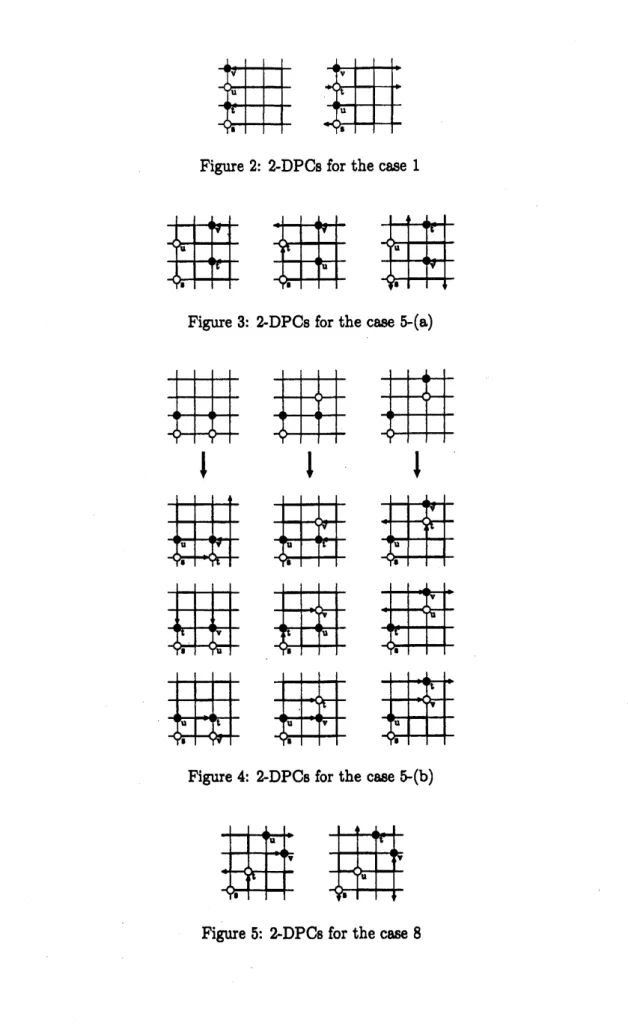
Case 1 There
are
only two patterns of the combination of pairs. A 2-DPC for these patternsare
inthe Figure2.Case 2 We
can
deliver the three endpoints in the column 1 to the column 4 by covering the all vertices in the column 1. Then, we obtain the instance of $[T_{c}(3,4),(1- 0- 3)]$.
ByLemma 4.2, the all instance of this
case
is solvable.Case 3 Wereseta$\mathrm{y}$-coordinateof
some
white endpointinthe column1is1. BytheLemma4.2 (Remark), the left 3 $\mathrm{x}4$ column-torus has 2-DPC, and it contains
a
$((3,3)(3,4))$.
Then,
we
cuttheconnectionof that edge, andconnect$(3, 3)$ to$(4, 3)$, $(3, 4)$to$(4, 4)$.
Next,we
connect $(3, 4)$ to $(4, 4)$ bya
path crossing column-wraparound edge. In consequence,we
obtaina
2-DPC for $[M(4,4),(3- 0- 1- 0)]$.
Case 4 We
can
deliverone
endpoint in thecolumn
2to the
column1
and the otherto
the
column 3
by $\mathrm{c}\mathrm{o}\mathrm{v}\mathrm{e}\mathrm{r}\dot{\mathrm{i}}\mathrm{g}$ all vertices in the column2.
Then,we
obtaina
instance of$[T_{\mathrm{c}}(3,4),(1- 0- 3)]$
.
By thesame
argument of thecase
2, all instanceofthiscase
issolvable.Case 5 Without loss of generality,
we
can
set the vertices in column 1are
(a) [$(1,1)$ and$(1, 3)]$
,
and$(\mathrm{b})$[$(1,1)$ and (1, 2)]. Thecase
of(a), thereare
twopatteasofthecombinationofpairs. A 2-DPC for these patteas
are
in theFigure 3.The
case
of (b), thereare
three furthercases
of location of the rest two endpoints. We express such threecases
in the Figure 4(upper side). Furthermore,we
consideran
assignment of endpoints for all
cases
inthe figure. A -DPC for these patternsare
in the Figure4(under side). So, in the caseof 4, allinstance of thiscase
issolvable.Case 6 and 7 We
can
obtainan
instanceof$[T_{c}(3,4),(1- 0- 3)]$ from all instance of thesecases
by
sune
argument in thecase
2or
4
(the delivered endpointsare
in column 2 to column1 in
case
6,are
incolumn 1 to column 2 incase
7).Case 8 The rest
cases
whichwe
have to consider is only one; i.e., each column androw
have just
one
endpoint. And there are only two patterns of combination ofpairs. The Figure 5 expressesa
2-DPC for thesetwo patterns. $\mathrm{O}$Therefore,
we
proveour
main theorem.Theorem 1.1.
If
$n$,
and $m$ are even) 4, $M(n, m)i\mathit{8}$bi-coverable.5
Conclusion
and
Remarks
In thispaper,
we
showa
$\mathrm{b}\mathrm{i}$-coverability ofeven
$\mathrm{x}$even
mesh-toruslarger than 4$\mathrm{x}4$.
However,there is
no
idea for another sizecases;
even
$\mathrm{x}$ odd, odd $\mathrm{x}$ odd, since such mesh-torus is notbipartite. But,
some
instance expressed by $X=$ [$M$(odd, even),(s,$t),$$(u,v)$] has 2-DPC. Sonext problem is whether $M$(odd, even) is coverable
or
not. Furthermore,we
are
interested inthe classor property of graphs which is (bi-)coverability. By the way, in this paper,
we
treatonly 2-DPCP in mesh-torus. A mesh-torus is -regularbipartite graph with
some
restriction.For $k$-DPCP, what is
a
minimum number $l$ such thata
$l$-regular bipartite graph withsome
restrict(as
a
mesh-torus) is (bi-)coverable (expandingthe definitionof coverability of2-DPCPto $k$-DPCP)? For example,
a
mesh-torus is not coverable for $3\mathrm{D}\mathrm{P}\mathrm{C}\mathrm{P}$ since $5\leq\delta$ is necessaryAcknowledgement
The author wouldlike tothankProfessorOsamuWatanabe for supervising this work,Professor Hiro Ito for hosting
an
important research meetingabout combinatorial games and puzzles atSep. 2005, and Professor Gisaku Nakamura for helpful advices. Thanks also go to Professor
Akinori Kawachi and member ofWatanabe’s group. for significant discussions.
References
[1] F.Luccioand$\mathrm{C}.\mathrm{M}\mathrm{u}\mathrm{g}\mathrm{n}\dot{\mathrm{a}}$, “Hamiltonian Paths
on
aRectangular Chessboard”, 16thAnnual AllertonConference (1978)pp.73-78.
[2] Y.Perland Y.Shiloach, “Finding Two Disjoint PathsBetweenTwoPairs of VerticesinaGraphs”, Joumal of the$A\epsilon\epsilon o\mathrm{c}\mathrm{i}\mathrm{a}uon$for Computing Machinery25(1) (l978) pp.1-9.
[3] $\mathrm{A}.\mathrm{I}\mathrm{t}\dot{\mathrm{u}}$, C.H.Papadimitriou andJ.L.Szwarcfiters, “Hamilton
Paths inGridGraphs”, SEAM Journal
on Computing11(4) (1982)pp.676-686.
[4] H.Everett, “FindingHamilton Pathsin Non-rectangular Grid Graphs”, CongressusNumerantium
53 (1986)
PP.185-192.
[5] S. Madhavapeddy, I.H. Sudborough “ATopological Property of hypercubes: Node DisjointPaths”, inProc. of$\Re b$IEEE Symposiumon Parallel andDistributed Processing(1990)pp. 532-539.
[6] H.C.KimandJ.H.Park, t‘Fault Hamiltonicity ofTwo-Dimensional‘IbrusNetworks”, Workshop on AlgorithmsandComputation (WAAC 2000)pp. 110-117.
[7] S.D.Chen, H.Shen, and R.Tbpor, “An efficient algorithm for constructing Hamiltonian path8 in
meshes”,Parallel(lOmputing28(2002)pp.1293-1305.
[8] J.H.Park, H.C.Kim, and H.S.Lim, $u_{\mathrm{M}\mathrm{a}\mathrm{n}\mathrm{y}- \mathrm{t}\mathrm{o}-}$-Many DisjointPath Coversin a Graph with Faulty
Elements”, Proc. of the International SymposiumonAlgoritbmsand Computation (ISAAC 2004)
pp. 742-753. rm
(C)
Figure 2: 2-DPCs for the
case
1Figure3: 2-DPC8 for the
case
5-(a)\dagger
\dagger
$\downarrow$Figure4: 2-DPCs for the