45
On Learning
Equal
Matrix
Languages
*Yuji Takada
International Institute
for
Advanced Study
of
Social
Information
Science (IIAS-SIS)
FUJITSU
LIMITED
140, Miyamoto,
Numazu,
Shizuoka 410-03,
Japan
1
Introduction
In this paper, we consider the learning problem for a restricted family of matrix languages
called strongly bounded equal matrix languages. The languages consist of strings of the form
$a_{1}^{n_{1}}\cdots a_{m}^{n_{m}}$, whereeach$a_{i}$ is a symbol and$n_{i}$ is anonnegative integer, andaredefined interms
of certain parallel rewriting grammars called equal matrix grammars. Also, the languages
closely related to semilinear subsets of the Cartesian product ofnonnegative integers. The
family contains a language which is not context-free and does not contain any context-free
languages.
We show that (1) the family of strongly bounded equal matrix languages is not learnable
from positive examples, while there exists a meaningful subfamily which is learnable from
positive examples, (2) given any teacher called an ideal teacher, who presents elements of
any language$L$ for the questionwhether$L\subseteq L(G)$ for any grammar $G$ and eventuallygives
sufficient examples for learning, the subfamily is learnable in polynomial time of the size of
inputs.
2
Preliminaries
Let $\Sigma$ be an alphabet, i.e., a finite set of symbols and $\Sigma^{*}$ be the set of all strings over $\Sigma$
containing the null string $\lambda$. For each string
$w,$ $w^{0}=\lambda$ and $w^{i}=w^{i-1}w$ for each integer $i\geq 1$, and $w^{*}=\{w^{i}|i\geq 0\}$
.
A language over $\Sigma$ is a subset of $\Sigma^{*}$.
Definition A language over an alphabet $\Sigma$ is said
$\cdot$
to be strongly bounded if and only if
$L\subseteq a_{1^{*}}\cdots a_{k^{*}}$
where,
$\Sigma=\{a_{1}, \ldots, a_{k}\}$.*This is.a part of the work in the major R&D of the Fifth Generation Computer Project, conducted
underprogramset up by MITI.
数理解析研究所講究録 第 695 巻 1989 年 45-54
46
Definition An equal matrix grammar (abbreviated $EMG$)
of
order $k$ is a 4-tuple $G=$$(N, \Sigma, \Pi, S)$, where
1. $S$ is the initial symbol.
2. $N$ is a finite nonempty set consistingof k-tuples $(A_{1}, A_{2}, \ldots, A_{k})$, called a nonterminal,
such that for any pair $(A_{1}, A_{2}, \ldots, A_{k})$ and $(B_{1}, B_{2}, \ldots, B_{k})$ of $N,$ $\{A_{1}, A_{2}, .. , , A_{k}\}\cap$ $\{B_{1}, B_{2}, \ldots, B_{k}\}=\emptyset$.
3. $\Pi$ is a finite nonempty set consisting of the following types of matrix rules;
(a) $[Sarrow w_{1}A_{1}w_{2}A_{2}\cdots w_{k}A_{k}]$,
(b) $[A_{1}arrow w_{1}B_{1}, A_{2}arrow w_{2}B_{2}, \ldots A_{k}, arrow w_{k}B_{k}]$,
(c) $[A_{1}arrow w_{1}, A_{2}arrow w_{2}, , . ., A_{k}arrow w_{k}]$,
where $S$ is the initial symbol, and $(A_{1}, A_{2}, \ldots , A_{k}),$ $(B_{1}, B_{2}, \ldots, B_{k})$ are nonterminals,
$w_{1},$ $w_{2},$ $\ldots,$$w_{k}\in\Sigma^{*}$.
An equal matrix grammar is an $EMG$ of any
finite
order $k$.We denote $\Sigma\cup N\cup\{S\}$ by $V$
.
Let $G=(N, \Sigma, \Pi, S)$ be an $EMG$of order$k$. We define the$relation\Rightarrow between$strings in
$V^{*}$
.
For any$x,y\in V^{*},$ $x\Rightarrow y$ if and only if either (1)$x$ is the initial symbol$S$and the initial
matrix rule $[Sarrow y]$ is in $\Pi$ or (2) there exist strings
$u_{1},$$\ldots,$$u_{k},$ $v_{1},$ $\ldots,$$v_{k}$ over $\Sigma$ such that
$x=u_{1}A_{1}v_{1}\cdots u_{k}A_{k}v_{k},$ $y=u_{1}z_{1}v_{1}\cdots u_{k}z_{k}v_{k}$, and the matrix rule $[A_{1}arrow z_{1}, \cdots, A_{k}arrow z_{k}]$ is
in $\Pi$
.
$\Rightarrow^{*}$ denotes thereflexive and transitive closure $of\Rightarrow$
.
The language generated by $G$, denoted $L(G)$, is the set $L(G)=\{w\in\Sigma^{*}|S\Rightarrow^{*}w\}$.
Definition A language $li$ is said to be an equal matrix language (abbreviated $EML$) if
and only ifthere exists an $EMGG$ such that $L=L(G)$ holds.
In this paper, we consider the learning problem for a strongly bounded equal matrix
lan-guage (abbreviated SBEML). The family of SBEMLs contains context-sensitive languages.
For example, the context-sensitive language $\{a^{n}b^{n}c^{n}|n\geq 1\}$ is an SBEML. Also, there
ex-ists a context-free language which is not an SBEML. For example, the context-free language
$\{a^{n}b^{n}|n\geq 1\}^{*}$ is not an SBEML (Ibarra [3]).
3
Algebraic Characterization
Let $\mathcal{N}$ denote the nonnegative integers. For each integer $k\geq 1$, let $N^{k}=\mathcal{N}\cross\cdots\cross \mathcal{N}(k$ times) and for each $n\in \mathcal{N},$ $n^{k}=(n, \ldots, n)$ ($k$ times). We regard $\mathcal{N}^{k}$ as a subset of the
47
Given an element $c$ and a subset $P$ of$\mathcal{N}^{k}$, let $Q(c, P)$ denote the set
$Q(c,P)=\{q|q=c+n_{1}p_{1}+\cdots+n_{r}p_{r}, n_{i}\in \mathcal{N}, p_{i}\in P\}$.
$c$ is called the constant and each $p_{i}$ is called a period of$Q(c, P)$.
A subset $Q$ of$\mathcal{N}^{k}$ is said to be linear if and only if there exist an element
$c$ and a finite
subset $P$ of$\mathcal{N}^{k}$ such that $Q=Q(c, P)$
.
$Q$ is said to be semilinear if and only if $Q$ is the
union of a finite number of linear sets. Furthermore, a subset $Q=Q(c, P)$ of$\mathcal{N}^{k}$ is said to
be simple if and only if the elements of$P$ are linearly independent. A subset $Q$ is said to be
semi-simple if and only if$Q$ is a finite disjoint union of simple sets.
We note that any linear set has more than one description in terms of constants and
periods, and so does any $s$emilinear set. Therefore, we distinguish between a semilinear set $Q$ and a description $Q(c_{1}, P_{1})\cup\cdots\cup Q(c_{n}, P_{n})$ of $Q$
.
Definition
A description$Q(c, P)$ of a linear set is said to be canonical ifand only ifeachperiod is not linear sum of the other periods. Also, description $Q(c_{1}, P_{1})\cup\cdots\cup Q(c_{n}, P_{n})$
ofa semilinear set is said to be canonical if and only if each description $Q(c_{i}, P_{i})$ of a linear
set is canonical.
Note that for any linear subset $Q$ of$\mathcal{N}^{k}$, a canonical description $Q(c, P)$ is unique because
$c\in \mathcal{N}^{k}$ and $P$ is a finite subset of $\mathcal{N}^{k}$
.
We also note that for any linear set $Q$, a canonicaldescription is effectively found from a description of $Q$. However, there exists a semilinear
subset such that a canonical description is not unique.
The Parikh mapping defined as follows connects EMLs with semilinear subsets of$\mathcal{N}^{k}$
.
Definition Let $\Sigma=\{a_{1}, \ldots, a_{k}\}$ be an alphabet. The Parikh mapping $\psi_{(a_{1},\ldots,a_{k})}$ or
$\psi$ when $(a_{1}, \ldots, a_{k})$ is understood, is the function from $\Sigma^{*}$ into $\mathcal{N}^{k}$ defined by $\psi(w)=$
$(\# a_{1}(w), \ldots\# a_{k}(w))$, where $\#_{a}.(w)$ is the number ofoccurrences of$a_{i}$ in $w$
.
We call $\psi(L)=\{\psi(w)|w\in L\}$ the Parikh set
of
an $EMLL$.The following theorem is due to Siromoney [4]:
Theorem 3.1 (Siromoney) Let$\Sigma=\{a_{1}, \ldots, a_{k}\}$ be an alphabet. For any strongly bounded
language $L$ over$\Sigma,$ $L$ is generated by an $EMGG$
of
order$k$if
andonlyif
the Parikh setof
$L$is a semilinear subset $Q$
of
$\mathcal{N}^{k}$.
Moreover, an$EMGG$ is effectivelyfound from
a descriptionof
$Q$ and vice versa.For anysemilinear set $Q$, an $EMGG$which generates an SBEML is effectively constructed
from a description of $Q$ in the following manner: It is enough to show the case that $Q$ is a
linearset. Let $Q(c, \{p_{1}, \ldots, p_{r}\})$be a description of the linear set$Q$. Also, let $c=(c_{1}, \ldots, c_{k})$
and $p_{i}=(p_{i}^{1}, \ldots,p_{i}^{k})$
.
$Then_{(}G=(N, \Sigma, \Pi, S)$ where $\Sigma=\{a_{1}, \ldots, a_{k}\},$ $N=\{(A_{1}, \ldots, A_{k})\}$,48
$[A_{1}arrow a_{1^{1}}^{p_{*}}A_{1}, \ldots, A_{k}arrow a_{k}^{p^{k}}A_{k}]$ for each $i$
From Theorem 3.1, we may regard the learning problem for SBEMLs as the learning
problem for semilinear sets.
From these, we can consider meaningful subfamilies of SBEMLs:
Definition For each positive integer $n$, an SBEML $L$ is $s$aid to be n-linears SBEML if
and only if$\psi(L)$ is a union of exactly $n$ linear $s$ets and there is no $i<n$ such that $\psi(L)$ is a
union of $i$ linear sets.
Thus, a l-linear SBEML is an SBEML whose Parikh set is a linear set.
4
Learnabilities
from
Positive
Examples
On learning of formal languages, Angluin [1] presented a necessary and sufficient condition
for languages to be learnable from positive examples.
Condition 1 An indexed family of nonempty languages
satisfies
Condition 1 if and only ifthere exists an effective procedure which on any input $i\geq 1$ enumerates a set of strings $T_{i}$
such that (1) $T_{i}$ is finite, (2) $T_{i}\subseteq L_{i}$, and (3) for all$j\geq 1$, if$T_{i}\subseteq L_{j}$ then $L_{j}$ is not a proper
subset of $L_{i}$.
The next theorem shows that Condition 1 is a necessary and sufficient condition for a
family oflanguages to be learnablefrom positive examples.
Theorem 4.1 (Angluin) An indexed family
of
nonempty recursive languages is learnablefrom
positive examplesif
and onlyif
itsatisfies
Condition 1.The following condition is simply Condition 1 with the requirement of effective
enumer-ability of$T_{i}$ dropped.
Condition 2 We say an indexed family of nonempty recursive languages $L_{1},$ $L_{2},$ $L_{3},$
$\ldots$,
satisfies
Condition 2 provided that, for every $i\geq 1$, there exists a finite set $T_{i}\subseteq L_{i}$ suchthat for every$j\geq 1$, if$T_{i}\subseteq L_{j}$ then $L_{j}$ is not a proper subset of$L_{i}$.
Theorem 4.2 (Angluin)
If
$L_{1},$ $L_{2},$ $L_{3},$$\ldots$, is an indexed family
of
recursive languages thatis learnable
from
positive examples, then itsatisfies
Condition 2.This theorem may be used to show that a family of languages is not learnable from positive
examples..
We note that the Angluin’s results described above are concerned with only the
49
sets, straightforwardly. In the sequel, we apply them to the problem for semilinear subsetsof$\mathcal{N}^{k}$
.
Let $\preceq$ be the relation on $\mathcal{N}^{k}$ defined by $u\preceq v$ for elements $u=(u_{1}, \ldots, u_{k})$ and
$v=$
$(v_{1}, \ldots, v_{k})$ ifand only if$u_{i}\leq v_{i}$ for each $i$. The $relation\preceq is$ a partial order on $\mathcal{N}^{k}$.
Definition
Let $Q$ be a linear subset of$\mathcal{N}^{k}$ and $Q(c, \{p_{1}, \ldots, p_{r}\})$ be a canonicaldescrip-tion of $Q$. Then, a chamcteristic set
of
$Q$ is the finite $s$et$C(Q)=\{c\}\cup\{c+p_{i}|1\leq i\leq r\}$.
We note that, given the characteristic set $C(Q)$ ofa linear set $Q$, a canonical description
of $Q$ is effectively found. That is, the constant $c$ is the unique minimum element of $C(Q)$
with respect $to\preceq and$ then the set of periods is $\{p_{i}|q_{i}-c, q_{i}\in C(Q)-\{c\}\}$.
Let $Q((c_{1}, \ldots, c_{k}), P)$ be a description of a linear subset of $\mathcal{N}^{k}$
.
Then, for each element$q=(q_{1}, \ldots, q_{k})$ of $Q$, we denote $(q_{1}-c_{1})^{2}+\cdots+(q_{k}-c_{k})^{2}$ by $|q|_{c}$. The next lemma
immediately follows from definitions $Q$ and $C(Q)$:
Lemma 4.3 Let $Q$ be a linear subset
of
$\mathcal{N}^{k},$ $Q(c, P)$ be a canonical descriptionof
$Q$, and$C(Q)$ be the characteristic set
of
Q. For any element $q$of
$Q$ such that $q\not\in C(Q)$, there existperiods $p_{1},$
$\ldots,$$p_{m}\in P$ such that
for
each $i,$ $|q|_{c}>|p_{i}|_{c}$ and $q=c+n_{1}p_{1}+\cdots+n_{m}p_{m}$,where each $n_{i}\geq 1$
.
Lemma 4.4 Let $Q$ be a linearsubset $of\mathcal{N}^{k}$ and $C(Q)$ be the characteristic set
of
Q. Then,for
any linear subset $Q’$of
$\mathcal{N}^{k}$,if
$C(Q)\subseteq Q’$ then $Q\subseteq Q’$.
Proof.
Let $Q=Q(c, P)$ be a linear subset of $\mathcal{N}^{k}$ and$C(Q)$ the characteristic set of $Q$
.
Suppose that $Q’=Q(c‘, \{p_{1}’, \ldots, p_{r}’\})$ is a linear subset of$\mathcal{N}^{k}$ such that $C(Q)\subseteq Q’$
.
Since$C(Q)\subseteq Q’$, for each % of $C(Q),$ $q_{j}=c‘+n_{1}^{j}p_{1}’+\cdots+n_{r}^{j}p_{r}’$. Therefore, for each period $p_{i}$ of $Q,$ $p_{i}=q_{i}-c=(n_{1}^{i}-n_{1}^{c})p_{1}’+\cdots+(n_{r}^{i}-n_{r}^{c})p_{r}’$. Hence, for each $q\in Q$, there exist
$m_{1},$$\ldots$ ,
$m_{r}\in \mathcal{N}$such that $q=c’+m_{1}p_{1}’+\cdots+m_{r}p_{r}’$. $\square$
Lemma 4.5 The family
of
linear subsetsof
$\mathcal{N}^{k}$ is learnablefrom
positive examples.Proof.
Let $Q(c_{1}, P_{1}),$ $Q(c_{2}, P_{2}),$ $Q(c_{3}, P_{3}),$ $\ldots$ , be an effective enumeration of alldescrip-tions of linear sets. It is obvious that there exists an effective procedure which on any input
$i\geq 1$ enumerates a characteristic $s$et $C_{i}$ of a linear set $Q(c_{i}, P_{i})$. By definition of
charac-teristic sets of linear sets, $C_{i}$ is finite and $C_{i}\subseteq Q(c_{i}, P_{i})$. Moreover, by Lemma 4.4, for all
$j\geq 1$
,
if $C_{i}\subseteq Q(c_{j}, P_{j})$ then $Q(c_{j}, P_{j})$ is not a proper subset of $Q(c_{i}, P_{i})$.
Therefore, thefamily satisfies Condition 1 and by Theorem 4.1 the proof is completed. $\square$
Corollary 4.6 The family
of
simple subsetsof
$\mathcal{N}^{k}$ is learnable$5t_{J^{j}}$
Since for each$Q(c_{i}, P_{i})$ there exists an effective enumeration$\psi_{i1},$$\psi_{i2},$$\psi_{i3},$
$\ldots$, of all Parikh mapping, byan obviousdovetailing, $L_{11},$ $L_{21},$ $L_{21},$
$\ldots,$$L_{ij},$$\ldots$, is an indexed family of l-linear
SBEMLs, where $Q(c_{i}, P_{i})=\psi_{ij}(L_{ij})$
.
Therefore, from Theorem 3.1 and Lemma 4.5, we havethe following theorem.
Theorem 4.7 The family
of
l-linear SBEMLs is learnablefrom
positive examples.On the other hand, for $n\geq 2$, the family of n-linears SBEMLs is not learnable from
positive examples, as shown in the followings:
Lemma 4.8 The family
of
semilinear subsetsof
$\mathcal{N}^{k}$ consistingof
two linear sets is notlearnable
from
positive examples.Proof.
Consider the semilinear set $Q=Q_{1}\cup Q_{2}$, where $Q_{1}=Q((0,0),$$\emptyset$) and$Q_{2}=$
$Q((1,1),$$\{(1,0), (0,1)\})$
.
Let $T=\{q_{1}, \ldots, q_{n}\}$ be any nonemptyfinitesubset of$Q$.
Considerthe $s$emilinear $s$et $Q^{T}=Q_{1}^{T}\cup Q_{2}^{T}$, where
$Q_{1}^{T}$ $=$ $Q((1,1),$$\{q_{i}-(1,1)|q_{i}=(1, m)\in T\})$ $Q_{2}^{T}$ $=$ $Q((0,0),$$\{qJ\in T|q_{j}=(n_{1}, n_{2}), n_{1}\neq 1\})$.
Clearly, $T\subseteq Q^{T}$ and it is easy to verifythat $Q^{T}\subseteq Q$. Foreach$q_{i}\in T$ let $q_{i}=(n_{1}^{i}, n_{2}^{i})$
.
Let$n_{1}^{m}$ be the maximum integer of$n_{1}^{1},$
$\ldots,$$n_{1}^{n}$
.
Then, $q_{n}=(n_{1}^{m}+1,1)$ is in $Q$ but not in $Q^{T}$, so $Q^{T}$ is a proper subset of$Q$.
Thus Condition 2 fails. $\square$The following lemma is proved by the trivial extension of the proof of Lemma 4.8.
Lemma 4.9 For each $n\geq 2$, the family
of
semilinear subsetsof
$\mathcal{N}^{k}$ consistingof
$n$ linearsets is not leamable
from
positive examples.Proof.
Let $n$ be an integer greater than 2. Consider the semilinear subset $Q=Q_{1}\cup\cdots\cup Q_{n}$of$\mathcal{N}^{2}$, where for $l(1\leq l\leq n-1),$ $Q_{l}=Q((I-1,0),$$\emptyset$) and
$Q_{n}=Q((n-1,1),$$\{(1,0), (0,1)\})$
.
Let $T$
.
$=\{q_{1}, \ldots , q_{n}\}$ be any nonempty finite subset of $Q$.
Consider the semilinear set $Q^{T}=Q_{1}^{T}\cup\cdots\cup Q_{n}^{T}$, where$Q_{l}^{T}$ $=$ $Q((l-1,0\}, \emptyset)$ for $1\leq l\leq n-2$
$Q_{n-1}^{T}$ $=$ $Q((n-1,1),$$\{q_{i}-(n-1, l)|q_{i}=(n-1, m)\in T\})$
$Q_{n}^{T}$ $=$ $Q((n-2,0),$$\{q_{i}\in T|q_{i}=(n_{1}, n_{2}), n_{1}\neq n-1\})$
Fromthe proof of Lemma 4.8, it is easy to verify that $T\subseteq Q^{T}$ and $Q^{T}$ is a proper$s$ubset of
$Q$. Thus Condition 2 fails. $\square$
The next theorem follows from Theorem 3.1 and Lemma 4.9.
Theorem 4.10 For each $n\geq 2$, the family
of
n-linears SBEMLs is not learnablefrom
positive examples.
$5_{-}1$
Procedure $IDI$
Input: A positive presentation$s_{1},$ $s_{2},$ $s_{3},$$\ldots$, ofa l-linear SBEML $L$.
Output: Asequence $G_{1},$ $G_{2},$ $G_{3},$$\ldots$, of EMGs.
Let $E_{0}:=\emptyset$ and $Q_{0}:=Q(0^{k},\emptyset)$; For each $i\geq 1$ do
Read $(+,w_{i})$;
$E_{i}$ $:=E_{i-1}\cup\{\psi(w_{i})\}$;
If $Q_{i-1}$ is con$s$istent with $E_{i}$
then $G_{i}$ $:=G_{i-1},$$Q_{i}$ $:=Q_{i-1}$, output $G_{i}$ and go to $i+1$ step;
If found a unique minimum element $q$of$E_{i}$ with respect $to\preceq$
then $1etqbeaconstantofQ_{i}$
else let $0^{k}$ be a constant of$Q_{i}$;
While $Q_{i}$ is not consistent with $E_{i}$ do
find $q\in E_{i}$ such that $q\not\in Q_{i}$ and $|q|_{c}$ is minimum;
add newperiod q–c to $Q_{i}$;
Construct an $EMGG_{i}$ from$Q_{i}$ and output $G_{i}$;
goto $i+1$ step;
Figure 1: The learner $IDl$
5
A
Simple
Learning
Method for l-linear SBEMLs
Let $L$ be an unknown l-linear SBEML over an alphabet $\Sigma$
.
As described in the previous$s$ections, if the characteristic set of a linear set $\psi(L)$ is found, then an$EMG$ which generates
$L$ is effectively found. Therefore, the learner $IDI$, illustrated in Figure 1, tries to find the
characteristic set from the given examples. $IDI$ outputs the same $EMG$ as a conjecture
while it is consistent with the given examples. When a conjecture is not consistent with the
examples, $IDI$ constructs a new conjecture.
Definition Let $L$ be a l-linear SBEML. A representative sample $R(L)$ of $L$ is a finite
subset of $L$ such that $\psi(R(L))$ contains the characteristic set of the linear set $\psi(L)$
.
Lemma 5.1 Let $L$ be a l-linear SBEML. Given a representative sample
of
$L$, the learner$IDI$ constructs an $EMGG$ which generates $L$.
Proof.
Weshallshow that, givena representativesampleof$L,$ $IDl$ constructsadescriptionof a linear set $Q=\psi(L)$
.
Since $\psi(R(L))$ contains the characteristic set of $Q,$ $IDI$ findsa unique minimum element of it with respect to $\preceq$, which is precisely a constant $c$ of a
description of $Q$
.
Also, Lemma 4.3 and the construction of$IDl$ ensure that $IDI$ finds each52
Since for any positive presentation $\sigma=s_{1},$$s_{2},$ $s_{3},$ $\ldots$, there exists a positive integer
$i$
such that the set of strings appearing in $s_{1},$ $s_{2},$
$\ldots,$$s_{i}$ is a representative sample of $L$, by
Lemma 5.1, we have the followingtheorem:
Theorem 5.2 The learner $IDl$
identifies
any l-linear SBEML in the limitfrom
positiveexamples.
Unfortunately, $IDI$ uses membershipness of examples, whichis anNP-complete problem,
so $IDI$ is time-consuming. If there is a polynomial-time algorithm to solve the problem of
finding a canonical description of a linear set consistent with the given examples, then we
couldhavealearnerwhich makes a conjecturein polynomial time for each time and identifies
any l-linear SBEML in the limit. However, we give $s$ome partial evidence for the difficulty
ofthe case.
Theorem 5.3
If
$P\neq NP_{f}$ then there is no polynomial-time algorithm to solve the followingproblem: given a
finite
subset $E$of
$\mathcal{N}^{k_{f}}$find
a canonical description $Q(c, P)$of
a linearsubset
of
$\mathcal{N}^{k}$ which contains all elementsof
$E$.Proof.
Suppose that there exists an algorithm $A$ that runs in polynomial time and issuch that for any subset $E$ of $\mathcal{N}^{k},$ $A$ on input $E$ outputs a canonical description $Q(c, P)$
of a linear subset of $\mathcal{N}^{k}$ which contains all elements of $E$. We
$s$hall use $A$ to construct a
polynomial-time algorithm to decide whether $q\in Q(c, P)$ for an arbitrary element $q\in N^{k}$
and a canonical description $Q(c,P)$
.
Since this latter problem is NP-complete, this willimply $P=NP$, proving the theorem.
Let $q$ be an element in $N^{k}$ and $Q(c, P)$ be a canonical description of
a
linear subset of$\mathcal{N}^{k}$. We may construct the characteristic set $C$ of $Q(c, P)$ in polynomial time. Run $A$ on
input $C\cup\{q\}$ and denote the output by $Q(c’, P’)$
.
Since a canonical description is uniquefor any linear set, ifc’ $=c$ and $P=P’$ then $q\in Q(c, P)$, otherwise, $q\not\in Q(c,P)$. We may
test whether $c=c’$ and $P=P’$in polynomial time, we complete the proof. $\square$
Thus, as far as based on linear sets, it seems that the learning problem for l-linear
SBEMLs is computationally intractable.
Remark It is easy to verify that all processes of$IDI$ otherthan the consistency check are
done in polynonial time of thesize of inputs.
Consider the family of SBEMLs such that the Parikh sets of any language in the family
is a simple $s$et. This family is also learnable from positive examples by Corollary 4.6. Since
the membership problem of simple sets is solvable in polynomial time, for each time $i,$ $IDI$
constructs an $EMG$ in polynomial time of $i,$ $k$, and $m$. Therefore, from the above remark,
53
Procedure IDIS
Input: A positive presentation$s_{1},$ $s_{2},$ $s_{3},$$\ldots$ , ofa l-linear SBEML $L$.
Output: A sequence$G_{1},$ $G_{2},$ $G_{3},$$\ldots$, of EMGs.
Let $E_{0}$ $:=\emptyset$ and $Q_{0}$ $:=Q(0^{k}, \emptyset)$;
For each $i\geq 0$ do
Construct an $EMGG_{i}$ from $Q_{i;}$
Ask the ideal teacher whether$L\subseteq L(G_{i})$;
If the teacherreplies yes then output $G_{i}$ and halt
Read $(+,w_{i})$;
$E_{i}$ $:=E_{i-1}\cup\{\psi(w_{i})\}$;
If found a unique minimum element $q$ of$E_{i}$ with respect $to\preceq$ then let $q$ be a constant of$Q_{i}$
else let $0^{k}$ be a constant of$Q_{i}$;
For each element $q$ in $E_{i}$ do
let q–c bea new period of$Q_{i;}$
go to $i+1$ step;
Figure 2: The learner IDIS
Theorem 5.4 For the family
of
SBEMLs such that the Parikh setof
any language in thefamily is a simple set, there exists a learner which,
for
each time $i(i\geq 1)$, constructs an$EMGG$ in polynomial time
of
$i,$ $k$ and $m$, where $k$ is the cardinalityof
$\Sigma$ and$m$ is the
maximum length
of
the given examples.6
Learning
l-linear
SBEMLs
with
an Ideal Teacher
In the previous section, we had no assumption on presentations of examples. In this time,
weassume that there exists a teacher who can answer questions of a learner and the learner
get informations from the teacher.
Let $L$ be an unknown SBEML. An ideal teacher gives informations to a learner on the
following conditions: (1) for any question whether $L\subseteq L(G)$, the ideal teacher answers yes
if$L\subseteq L(G)$ and $no$ otherwise. In addition, if the answer is $no$, the teacher gives an element $s\in L-L(G)$ to the learner. (2) Eventually, the set of examples given by the ideal teacher
constitutes a representative sample of $L$. Note that an ideal teacher gives only positive
examples.
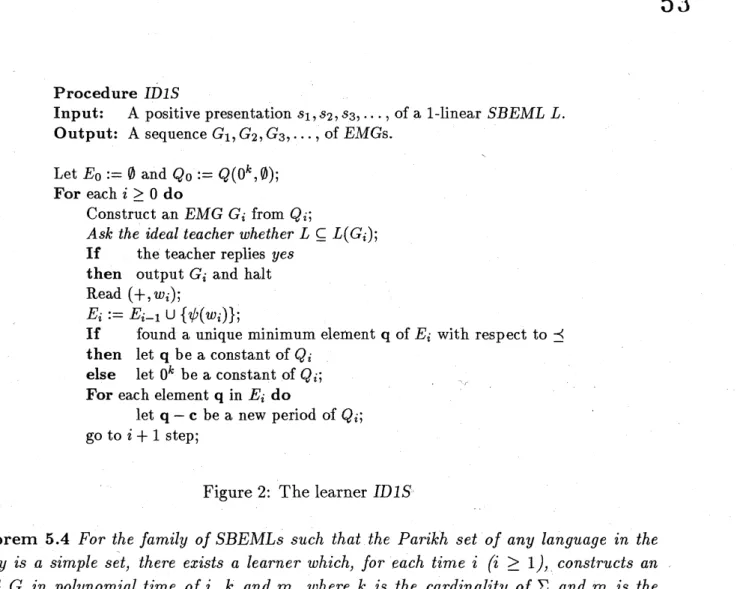
Foreachtime $i(i\geq 0)$, the learner IDIS, illustrated in Figure 2, asks whether$L\subseteq L(G_{i})$
to the teacher. Ifthe answer is yes, then IDIS outputs $G_{i}$ and halts. Otherwise, IDIS reads
a new example and reconstructs a description from the given examples.
The learner $IDI$ constructs anew conjecture only if a current conjecture is not consistent
54
new example. IDIS constructs a conjecture in the same way as $IDI$ does. Therefore, as we
have shown in Section 5, given a representative sample of $L$, IDlS constructs an $EMGG$
which generates $L$. Therefore, when all given examples consists of a representative sample
of$L$, the teacher should answer yes, so thelearner halts. From these observations, we have
the following theorem.
Theorem 6.1 Given any ideal teacher, then
for
any l-linear SBEML $L_{f}$ IDlS eventuallyoutputs an $EMGG$ such that $L=L(G)$ and halts.
We note that an identified description ofa linear set is not always canonical.
The condition (2) on an ideal teacher is crucial. If examples are provided by a teacher
satisfying only the condition (1), IDIS might not identify a linear set. For example, consider
a linear subset $Q((0,0),$$\{(1,0), (0,1)\})$ of$\mathcal{N}^{k}$. If the teacher always gives examples from the
set $\{(n, 1)|n>0\}$, then IDIS never identifies the linear set.
Next, we show the time complexity of learning. As we have remarked in Section 5, all
processes of $IDI$ other than the consistency check are done in polynomial time of$i,$ $k$, and
$m$, where $i$ is a time, $k$ is the cardinality of $\Sigma$, and
$m$ is the maximum length of the given
examples. Since the learner IDIS never checks whether a conjecture is consistent with the
examples, we have the following theorem.
Theorem 6.2 Given any ideal teacher, then
for
any l-linear SBEML, the total runningtime
of
IDIS is bounded by a polynomial in $k,$ $n$, and $m_{f}$ where $k$ is the cardinalityof
analphabet $\Sigma_{f}n$ is the number
of
all examples given by the teacher, and $m$ is the maximumlength
of
the examples.7
Concluding Remarks
Intrinsically, our methods are based on semilinear subsets of$\mathcal{N}^{k}$. Therefore, we could apply
the methods to families oflanguages other than SBEMLs, which havethe same properties as
SBEMLs on the Parikhmappings, and also tofamilies ofobjects closelyrelated to semilinear
sets such as Presburger formulas, Petri nets, and so on.
References
[1] D. Angluin. Inductive inference of formal languages from positive data.
Information
andControl, 45:117-135, 1980.
[2] S. Ginsburg. The Mathematical Theory
of
Context Free Languages. McGraw-Hill, NewYork, 1966.
[3] O. H. Ibarra. Simple matrix languages.