Nagoya City University Academic Repository
学 位 の 種 類 博士(ナノメディシン科学) 報 告 番 号 甲第1538号 学 位 記 番 号 第314号 氏 名 村門 愛 授 与 年 月 日 平成 28 年 3 月 23 日 学位論文の題名 コロイド系の温度誘起結晶化とゲル固定結晶のイオン透過性の研究 論文審査担当者 主査: 尾関 哲也 副査: 山中 淳平, 林 秀敏, 松本健郎(名古屋工業大学)
名古屋市立大学学位論文
コロイド系の温度誘起結晶化と
ゲル固定結晶のイオン透過性の研究
平成27年度(2016年3月)
名古屋市立大学大学院薬学研究科
共同ナノメディシン科学専攻
コロイド・高分子物性学分野
村門 愛
1. 本論文は、2016 年 3 月名古屋市立大学大学院薬学研究科において審査され たものである。 主査 尾関 哲也 教授 副査 林 秀敏 教授 松本 健郎 教授(名古屋工業大学) 山中 淳平 教授 2. 本論文は、学術情報雑誌に収載された次の報文を基礎とするものである。 1. Ai Murakado, Akiko Toyotama, Masaaki Yamamoto, Ryota Nagano, Tohru Okuzono and Junpei Yamanaka, Thermoreversible crystallization of charged colloids due to adsorption/ desorption of ionic surfactants.
J. Colloid Interface Sci., 465, 200-207 (2016).
2. Ai Murakado, Yuri Nishimura, Akiko Toyotama, Tohru Okuzono and Junpei Yamanaka, Ion transport through gel-immobilized charged colloidal crystals. in preparation
3. 本論文の基礎となる研究は、山中 淳平教授の指導のもとに名古屋市立大学 大学院薬学研究科において行われた。
本論文においては、以下に示す略号、記号を用いた。 略号表
bcc 体心立方構造
fcc 面心立方構造
VDW van der Waals
PS ポリスチレン
EG エチレングリコール
CMC 臨界ミセル濃度
SOS sodium alkyl sulfate SHS sodium hexadecyl sulfate 記号表 d 粒子径 ε 誘電率 r 中心間距離 1/κ デバイ遮蔽長 ap 粒子半径 I イオン濃度 I* 相境界におけるイオン濃度 φ 粒子の体積分率 Zeff 実効表面電荷数 Z0 粒子表面の解離基の数 σeff 実効表面電荷密度 η 粘度 Λ モル伝導率 λ 波長 n 屈折率 CEG EG の濃度 CSOS SOS の濃度 Csurf 界面活性剤濃度 Csurf* 相境界における界面活性剤濃度 U(d) Yukawa ポテンシャル
S 吸着した界面活性剤濃度 S* 相境界における吸着した界面活性剤濃度 C 未吸着の界面活性剤濃度 C* 相境界における未吸着界面活性剤濃度 Cc 粒子の対イオン濃度 CS 媒体中の塩濃度 ζ ゼータ電位 κ 電気伝導率(第三章) D 拡散係数 D0 ゲルのみの拡散係数 C HCl の濃度(第三章) J 流速 Q 透過量 V セルの体積 A ゲル膜の面積 dx ゲル膜の厚さ 𝜉 電解質の濃度 X 固定電荷密度 𝜔! カチオンのモル移動度 𝜔! アニオンのモル移動度 Ds 障壁効果 t イオンの輸率
目次
第一章 緒言 1 1. コロイド結晶 1−2 コロイドとコロイド結晶 1−2 粒子の安定化 1−3 結晶化の制御 1−4 コロイド結晶の材料への応用 2. 温度誘起結晶化 3. イオン透過 4. 本研究の概要 第二章 EG/水混合液中における荷電コロイドの結晶化 7 2—1 はじめに 2−2 試料 2—3 方法 2—4 結果と考察 A. EG/水混合液中での結晶化 B. EG/水混合液中での表面粒子への吸着 C. 温度誘起結晶化メカニズム D. 結晶化挙動における EG 濃度の影響 2—5 結論 第三章 コロイド結晶ゲル固定のイオン透過性 24 3—1 はじめに 3−2 試料 3—3 方法 3—4 結果と考察 A. PS 粒子のゲル固定 B. 結晶固定ゲルのイオン透過性 C. ゲル中での拡散に関する検討 3−5 結論第四章 結論 34
第五章 今後の展望 35
謝辞 36
1
第一章 緒言
1. コロイド結晶 1−1 コロイドとコロイド結晶 コロイドとは、分散媒と分散相からなり、 少なくとも一次元的にはナノメートルから マイクロメートルサイズの分散相が媒体に 分散している状態をいう。コロイド粒子は、 適切な条件において,液体中において体心立 方構造(bcc)や面心立方構造(fcc)のように三 次元的に規則正しく配列する。この規則構造 をコロイド結晶と呼び、規則的研究が長年検 討されてきた[1-4]。コロイド系の結晶構造 は、(1)一粒子を光学顕微鏡によりその場 観察ができる、(2)粒子間に働く相互作用が多様で、その大きさの制御が広範 囲でできる、(3)結晶成長などの非平衡過程や動的過程のモデルとして観察が できる。などの特性がある。このため、コロイド結晶は原子・分子系のモデル としても有用である[5,6]。 1−2 粒子の安定化コロイド粒子間にはvan der Waals(VDW)引力が働く。粒子間の VDW 引
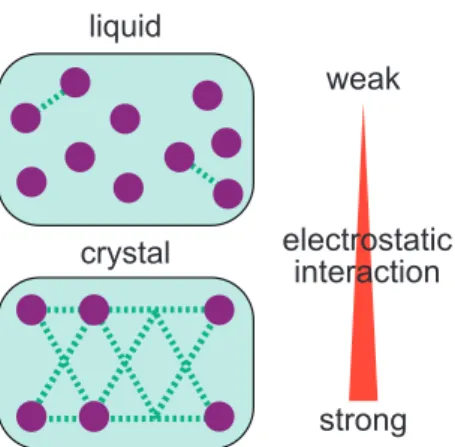
力は強く、長距離に作用するため、粒子の凝集を生じる。コロイド系を安定に 保つためは、(1)VDW 引力を十分小さくする、(2)高分子などにより粒子表 面を修飾し、立体障害により粒子同士の直接接触を防ぐ、(3)粒子表面に電荷 を導入し、粒子間の静電反発により凝集を防ぐなどの手法を用いる。 荷電コロイド粒子は、媒体中において、粒子表面に存在する硫酸基やシラノ ール基などの解離基が解離することにより表面電荷を持つ。粒子間に働く静電 的相互作用により、荷電コロイド系は安定化している。静電相互作用が弱いと き、系はランダムに配列した液体状態を示し、静電相互作用が強いとき、粒子 が三次元的に規則正しく配列した結晶状態に相転移する[1-4]。(Figure 1)結晶 は体心立方構造または面心立方構造をとり、Bragg 回折により構造色が観察さ れる。構造色は粒子径やコロイド粒子の粒子濃度により調節できる。この光学 特性より、コロイド結晶はフォトニック材料として用いられる[7-9]。 crystal liquid weak strong electrostatic interaction
Figure 1 Crystallization of colloidal
particles. Model of the charged colloidal dispersions.
2 静電相互作用を考える上で、媒体中に存在する対イオンや塩に由来するイオ ンの静電遮蔽効果が重要である。媒体中のイオン濃度が大きいほど、粒子間相 互作用が働く距離は短くなる。中心間距離 r を隔てた半径 ap, 電荷数 Z の二つ の粒子に対し、二粒子間のポテンシャルは以下のような湯川型の遮蔽されたク ーロンポテンシャルによって表される(Figure 2)[1-4]。なおεは媒体の誘電率 である。 𝑈 𝑟 = 𝐴 𝑍𝑒4𝜋𝜀!exp −𝜅𝑟𝑟 𝐴 = exp 2𝜅𝑎! 1 ÷ 𝜅𝑎! ! ここで、e は電気素量、κは遮蔽の程度を表している。1/κはデバイの遮蔽長と呼 ばれる。A は幾何学的因子と呼ばれ、粒径の影響を含んでいる。また、Robbins らは、パラメーターとしてkBT / U(d) とκd を用いて、計算機シミュレーション により結晶化相図を決定している(Figure 3)[10]。
Figure 2 Yukawa potential (Screened Coulomb potential).
Figure 3 Phase diagram of charged colloid simulated by Robbins et al., J.Chem.Phys.88,3286(1988).
ap - - - - - - + + + + + + Z + + - - Cs Cc
Cc : counter ion concentration Cs : salt concentration Z : charge number
1/K d : average interparticle distance
(d ~ F -1/3) 1/K d r r ( r ~ φ-1/3) 𝑘!𝑇 𝑈(𝑑) 𝜅𝑑
3 1−3 結晶化の制御 コロイド結晶は、一般に、多数のグレインからなる多結晶構造を持つ。結晶 相と液体相の相境界付近では核生成頻度が少ないため、グレインサイズは大き くなる。これは、原子・分子系においても共通する挙動である。しかし、グレ インの大きい結晶を生成する条件は限定されている。一方、結晶材料の応用は 結晶サイズにより制限されるため、大型結晶作成方法の検討がされている[11]。 原子・分子系の単結晶の形成では、温度勾配による作成が一般に用いられる。 しかし、荷電コロイドの結晶化には温度 T は弱い変数であることが知られてい る[10,12]。これは分散媒の誘電率εrの温度依存性による。誘電率は理想的には 1/T に比例し、εr T は一定である。このため、相互作用は T により大きく変化し ない[10]。なお剛体球の結晶化は粒子の体積分率のみによって決まる[13,14]が、 浸透圧の温度依存性[15]、相分離[16]や感熱性マイクロゲル粒子の体積変化 [17,18]、枯渇作用を用いた剛体球の結晶化 [19]により制御可能である。 荷電コロイド系では、塩濃度I、体積分率φ、電荷数 Z のいずれかが変化する ことにより、温度勾配下でも一方向結晶化が起こる。シリカコロイドのような pH 依存性のコロイドの場合では、コロイド系にピリジンなどを添加し、ピリジ ンの解離度の濃度依存性を利用する結晶化を温度制御できる[20,21]。これを用 いたゾーンメルト法[22]などの温度勾配により結晶をコントロールする方法が ある。しかし、これらの方法は、pH に依存する電荷を持つものに限定される。 1−4 コロイド結晶の材料への応用 コロイド結晶の特性を生かして光学材料への応用が検討されているが[7-9]、 コロイド結晶は軽い振とうやひずみにより容易に破壊されるため、応用展開に は結晶構造の固定化が必要である。ポリスチレンやポリアクリル系高分子など の汎用性ポリマーや、シリコンおよびメラミン樹脂などの熱硬化性プラスチッ クなどでの固定化が期待されている。一般に、低誘電率媒体中ではクーロン力 が強くなるため結晶化しやすいが、媒体中で粒子の表面電荷が解離しづらくな るため、電荷数が下がり結晶化が起こりにくい。また、電荷を与えることがで きると結晶は安定化する。コロイド結晶の材料応用のため、低誘電率媒体中で の結晶化の研究が重要であるが、これまで詳細は報告されていない。
4 2. 温度誘起結晶化 これまで本研究室では、冷却により結晶化、昇温により融解する温度誘起結 晶化について報告している[23]。この方法は、粒子表面へのイオン性界面活性剤 の吸着の温度依存性を基にしている。イオン性界面活性剤の吸着はコロイドの 安定化に広く用いられ、強い吸着により結晶化を制御できる[24]。 一般に、粒子に界面活性剤が吸着する場合、自由エネルギー変化∆𝐺 = ∆𝐻 − 𝑇∆𝑆 において、分子の吸着により自由度が減少するため、エントロピーは減少 する。一方、自発的な吸着の場合、∆𝐺は熱として放出されるため減少する。よ って∆𝐻 = ∆𝐺 + 𝑇∆𝑆 < 0より、系は発熱する。ルシャトリエの法則により、系を 冷却すると吸着平衡は発熱方向にシフトするため、低温にすると吸着量は増加 する[23]。 イオン性界面活性剤存在下における水分散ポリスチレン粒子を用いた温度誘 起結晶化メカニズムをFigure 4 に示す。界面活性剤の濃度は、臨界ミセル濃度 (CMC)以下で行う。界面活性剤を添加すると、分子は粒子表面に吸着して粒 子の表面電荷数を増加させる。未吸着の界面活性剤は水中に残るため、媒体中 のイオン濃度I が増加する。系を冷却すると、界面活性剤分子がより吸着し、電 荷数 Z が増加する。また、イオン濃度 I は減少する。よって静電相互作用が増 加するため、結晶化する。一方、系を加熱すると、吸着量が減少するため、電 荷数Z は減少し、イオン濃度 I が増加するため、結晶化が起こらない。
Figure 4 Thermoresponsive crystallization of PS dispersion due to temperature dependence of ionic
surfactant (sodium alkylsulfate) adsorption. Na+ ions are not shown.
low T high T
low I high I
high Z low Z
crystal liquid
5 しかし、温度誘起結晶化メカニズムについて、Z や I の変化のいずれが結晶化 に重要かは明らかになっていない。 本研究では、エチレングリコール(EG)/水の混合液中において PS コロイド 粒子を用いた温度誘起結晶化を検討した。EG/水混合系で、粒子の表面へのイオ ン性界面活性剤の吸着量を調節することによって結晶化を制御した(Figure 5)。 結晶化のメカニズムについて吸着実験と理論相図をもとに議論を行った。
Figure 5 Thermoreversible crystallization of charged colloids.
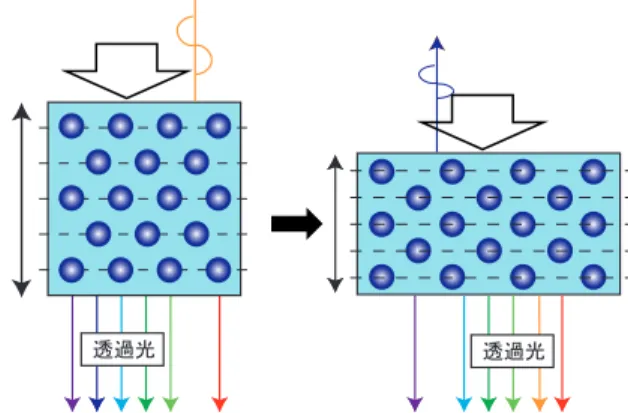
3. イオン透過 コロイド結晶の医学・薬学分野への応用が期待されている。特に、センシン グや製剤学への応用が期待される[25]。現在、コロイド結晶を高分子ゲルで固定 する方法[26,27]が報告されている。高分子ゲルは外力や温度変化などの外部環 境に応答するという性質を持つ。コロイド結晶をゲルで固定することで、コロ イド結晶の性質とゲルの性質を併せ持ち、光センサーへの応用が期待される。 外力や温度変化によりゲルは容易に変形する。このとき、固定されているコロ イド結晶の格子面間隔が変化するため、Bragg 波長の制御が可能である(Figure 6)[28]。この特性を利用した、チューナブル分光素子、超小型光センサーへの応 用が期待される。
Figure 6 Illustration of the Bragg peak shift for the immobilized charged colloidal crystal by mechanical
compression.
Thermoreversible crystallization of charged colloids due to adsorption/
desorption of ionic surfactants
Ai Murakado, Akiko Toyotama, Masaaki Yamamoto, Ryota Nagano, Tohru Okuzono, Junpei Yamanaka
⇑
Faculty of Pharmaceutical Sciences, Graduate School of Nagoya City University, 3-1 Tanabe, Mizuho, Nagoya City, Aichi 467-8603, Japan
h i g h l i g h t s
!Colloidal dispersions crystallized
thermoreversibly via ionic surfactant adsorption.
!The colloids crystallized on cooling
and melted upon heating.
! The mechanism was studied by using
polystyrene particles in ethylene glycol/water.
!The crystallization was caused by a
decrease in the ionic strength of the medium.
!The present findings will be useful for
fine control of colloidal crystallization.
g r a p h i c a l a b s t r a c t
a r t i c l e i n f o
Article history: Received 14 September 2015 Revised 12 November 2015 Accepted 25 November 2015 Available online 2 December 2015Keywords: Charged colloid Colloidal crystal Ionic surfactant Ethylene glycol Controlled crystallization
a b s t r a c t
We report that charged colloids exhibit thermoreversible crystallization via the adsorption of ionic sur-factants onto particle surfaces. Due to the temperature dependence of the adsorption quantity, the col-loids crystallized upon cooling and melted upon heating. To clarify the influences of surfactant adsorption on the crystallization, polystyrene (PS) particles dispersed in ethylene glycol (EG)/water mix-tures were employed, enabling continuous tuning of the adsorption quantity by changing the EG concen-tration. The thermoreversible crystallization/melting behavior was found to be mainly attributable to changes in the ionic strength of the medium resulting from variation in the concentration of the non-adsorbed ionic surfactant molecules with temperature. We expect that the present findings will be useful for fine control of colloidal crystallization and the further study of colloidal crystallization in low permit-tivity media.
! 2015 Elsevier Inc. All rights reserved.
1. Introduction
Colloidal dispersions of charged particles exhibit structural phase transitions from disordered ‘‘liquid” state to ordered ‘‘crystal” state as the magnitude of the electrostatic interparticle
interactions increase[1–4]. In the liquid state, the spatial distribu-tion of the colloidal particles is nearly random and analogous to that of the liquid state in atomic and molecular systems. In the crystal state, the particles are regularly arranged in body-centered-cubic or face-body-centered-cubic lattices. The Bragg wave-lengths of these colloidal crystals can be established in the visible to near-infrared regimes by selecting the appropriate size and con-centration of the colloidal particles. Thus, colloidal crystals have attracted considerable attention as potential photonic materials
[5–7]. http://dx.doi.org/10.1016/j.jcis.2015.11.064
0021-9797/! 2015 Elsevier Inc. All rights reserved.
⇑ Corresponding author.
E-mail addresses: [email protected] (A. Murakado), toyotama@ phar.nagoya-cu.ac.jp (A. Toyotama), [email protected] (M. Yamamoto), [email protected](R. Nagano),[email protected](T. Okuzono), [email protected](J. Yamanaka).
Journal of Colloid and Interface Science 465 (2016) 200–207
Contents lists available atScienceDirect
Journal of Colloid and Interface Science
j o u r n a l h o m e p a g e : w w w . e l s e v i e r . c o m / l o c a t e / j c i s
Thermoreversible crystallization of charged colloids due to adsorption/
desorption of ionic surfactants
Ai Murakado, Akiko Toyotama, Masaaki Yamamoto, Ryota Nagano, Tohru Okuzono, Junpei Yamanaka
⇑
Faculty of Pharmaceutical Sciences, Graduate School of Nagoya City University, 3-1 Tanabe, Mizuho, Nagoya City, Aichi 467-8603, Japan
h i g h l i g h t s
!Colloidal dispersions crystallized
thermoreversibly via ionic surfactant adsorption.
!The colloids crystallized on cooling
and melted upon heating.
!The mechanism was studied by using
polystyrene particles in ethylene glycol/water.
! The crystallization was caused by a
decrease in the ionic strength of the medium.
! The present findings will be useful for
fine control of colloidal crystallization.
g r a p h i c a l a b s t r a c t
a r t i c l e i n f o
Article history: Received 14 September 2015 Revised 12 November 2015 Accepted 25 November 2015 Available online 2 December 2015Keywords: Charged colloid Colloidal crystal Ionic surfactant Ethylene glycol Controlled crystallization
a b s t r a c t
We report that charged colloids exhibit thermoreversible crystallization via the adsorption of ionic sur-factants onto particle surfaces. Due to the temperature dependence of the adsorption quantity, the col-loids crystallized upon cooling and melted upon heating. To clarify the influences of surfactant adsorption on the crystallization, polystyrene (PS) particles dispersed in ethylene glycol (EG)/water mix-tures were employed, enabling continuous tuning of the adsorption quantity by changing the EG concen-tration. The thermoreversible crystallization/melting behavior was found to be mainly attributable to changes in the ionic strength of the medium resulting from variation in the concentration of the non-adsorbed ionic surfactant molecules with temperature. We expect that the present findings will be useful for fine control of colloidal crystallization and the further study of colloidal crystallization in low permit-tivity media.
! 2015 Elsevier Inc. All rights reserved.
1. Introduction
Colloidal dispersions of charged particles exhibit structural phase transitions from disordered ‘‘liquid” state to ordered ‘‘crystal” state as the magnitude of the electrostatic interparticle
interactions increase [1–4]. In the liquid state, the spatial distribu-tion of the colloidal particles is nearly random and analogous to that of the liquid state in atomic and molecular systems. In the crystal state, the particles are regularly arranged in body-centered-cubic or face-body-centered-cubic lattices. The Bragg wave-lengths of these colloidal crystals can be established in the visible to near-infrared regimes by selecting the appropriate size and con-centration of the colloidal particles. Thus, colloidal crystals have attracted considerable attention as potential photonic materials
[5–7]. http://dx.doi.org/10.1016/j.jcis.2015.11.064
0021-9797/! 2015 Elsevier Inc. All rights reserved.
⇑ Corresponding author.
E-mail addresses: [email protected] (A. Murakado), toyotama@ phar.nagoya-cu.ac.jp (A. Toyotama), [email protected] (M. Yamamoto), [email protected](R. Nagano),[email protected](T. Okuzono), [email protected](J. Yamanaka).
Journal of Colloid and Interface Science 465 (2016) 200–207
Contents lists available at ScienceDirect
Journal of Colloid and Interface Science
j o u r n a l h o m e p a g e : w w w . e l s e v i e r . c o m / l o c a t e / j c i s
6 本研究室では、アクリルアミドゲルを用いた、コロイド結晶の固定化を行い、 ゲルからの薬物放出制御[29]やコロイド結晶のセンシング応用についての検討 を行ってきた。コロイド結晶固定ゲルのイオン選択透過性や分離特性について の研究は、コロイド結晶のセンシング分野への応用のために必要不可欠である。 これまで、ゲルの膜透過性や高分子膜、荷電膜のイオン透過性についての研究 はなされているが、コロイド粒子がイオン透過性に及ぼす影響についての詳し い報告はされていない。 そこで本研究では、ゲル中におけるコロイド結晶状態がイオンの透過に及ぼ す影響(Figure 7)に関して、コロイド粒子結晶固定ゲルを荷電膜として膜透過 実験を行った。また、Teorell の理論との比較を行った。
Figure 7 Mechanism of on transport through gel-immobilized charged colloidal crystals.
4. 本研究の概要 (1) 水よりも低い誘電率をもつエチレングリコール(EG)/水の混合溶液中 において、界面活性剤の粒子表面への吸着を利用して荷電ポリスチレンコロイ ド粒子の結晶化を検討した。また、吸着挙動と結晶化メカニズムについての検 討を吸着実験と理論相図をもとに行った。 (2) ゲル中におけるコロイド結晶状態がイオンの透過に及ぼす影響に関し て、ポリスチレンコロイド粒子結晶固定ゲルを荷電膜として膜透過実験を行っ た。Teorell の理論との比較からイオン透過に及ぼす影響について検討した。 電位の効果 障壁効果
7
第二章
EG/水混合液中における荷電コロイドの結晶化
2−1 はじめに 本研究室ではこれまでに水系における界面活性剤の吸着を用いた温度誘起結 晶化について報告している[23]。本研究では、エチレングリコール(EG)/水の 混合液中においてPS コロイド粒子を用いた温度誘起結晶化を検討した。また結 晶化は、イオン濃度と温度による誘電率の変化、電荷数の変化によって決まる と考えられ、そのメカニズムについて議論した。 2−2 試料 A. PS 粒子 ポリスチレン(PS)粒子として 100 nm 程度の3種類の PS 粒子を用いた。 結晶のピーク位置が可視光領域に存在するためである。また、光学顕微鏡観察 には480 nm の PS 粒子を用いた。PS 粒子は、ソープフリー乳化重合法により合成した[30]。モノマーとして styrene (St, Wako, Scheme 1)、アニオン性コモ
ノマーとしてp-styrenesulfoic acid sodium salt(NaSS ,和光純薬工業, Scheme
2)、溶媒として Milli-Q 水および methanol(MeOH,和光純薬)、架橋剤として divinylbenzene (DVB, ナカライテスク, Scheme 3) 、ラジカル重合開始剤とし てpotassium peroxydisulfate (KPS, 関東化学, Scheme 4)を用いた。なお、 styrene と divinylbenzene は 1N の NaOH を用いて重合禁止剤を取り除いて用 いた。
水、MeOH、St、NaSS、スチレン、DVB を混合し、ホットプレート付マグ
ネットスターラー(東京理化器械)及びアルミブロック恒温槽(SynFlex,東京理
化器械)で 80℃に保ち、回転数 600rpm、アルゴン雰囲気下で 2 時間攪拌を行っ
た。その後KPS を添加してさらに 7 時間攪拌することによりポリスチレン粒子
(p(St-co-NaSS), Scheme 5) を 得 た (Scheme 6) 。 水 は Milli-Q シ ス テ ム (Millipore,MA,U.S.A)により得た超純水(18.2MΩ・cm)をアルゴンバブリングし
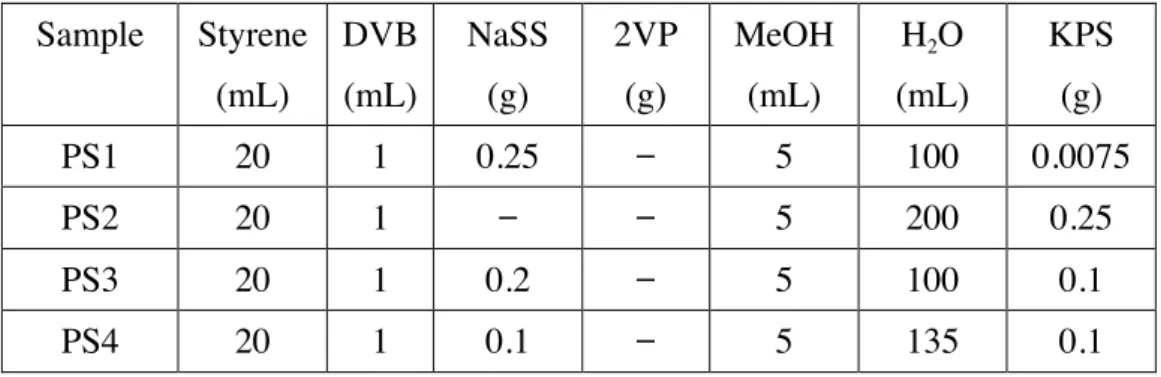
て用いた。粒子合成の際の試薬の組成をTable 1 に示す。
8
Table 1. Compositions of reaction solutions for PS particle synthesis.
得られたPS 粒子はヴィスキングチューブ(日本メデカルサイエンス社)に入
れ、イオン交換水 (Elix) および MilliQ 水に対して一ヶ月以上透析を行い、水
の電気伝導度が 1.0 µS/cm 以下になるまで精製した。さらに、イオン交換樹脂
としてAG501-X8(D)型 mixbed(Bio-Rad Labs,CA,U.S.A.)を用いて精製した。
後述の動的光散乱法および電気伝導度測定により粒子径 d と、実効表面電荷
数Zeff,0を求めた(Table 2)。また、電気伝導度滴定により粒子が表面にもつ解
離基の数 Z0を決定した[31]。さらに実効表面電荷密度σeff,0を d と Zeff,0の値か
ら求めた。
Table 2. Characteristics of colloidal particles used in the present study.
Sample Styrene (mL) DVB (mL) NaSS (g) 2VP (g) MeOH (mL) H2O (mL) KPS (g) PS1 20 1 0.25 — 5 100 0.0075 PS2 20 1 — — 5 200 0.25 PS3 20 1 0.2 — 5 100 0.1 PS4 20 1 0.1 — 5 135 0.1
Sample d (nm) Zeff,0 Z0 σeff,0 (μC/cm 2) PS1 140±26 1300 — 0.39 PS2 440±120 4230 — 0.09 PS3 120±12 850 13100 0.40 PS4 130±17 1360 14800 0.39 Scheme 4 Scheme 5
9 B. 界面活性剤
イオン性界面活性剤として、アニオン性のsodium alkyl sulfate (n=6, 12, 16,
18)(Figure 8)を用いた。
Figure 8 Sodium alkyl sulfate.
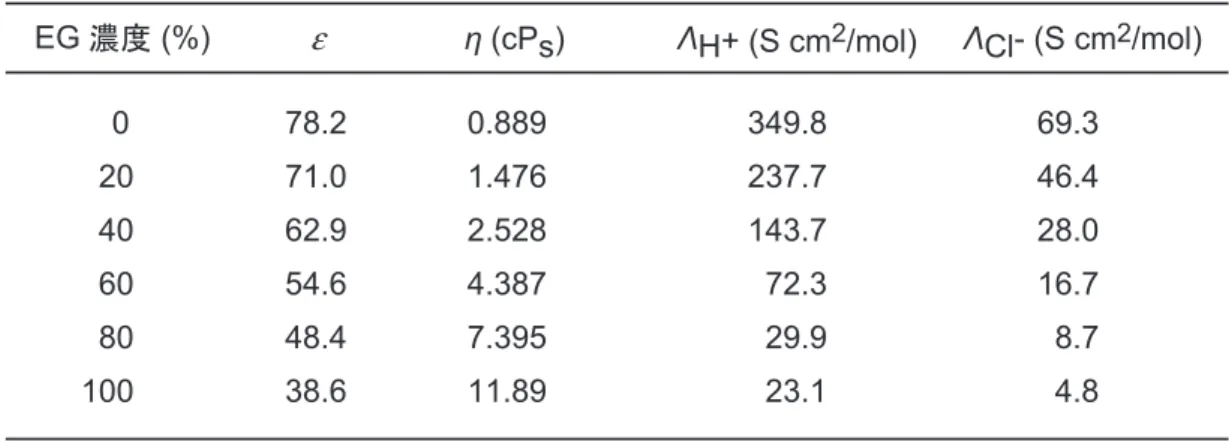
C.分散媒 分散媒として、水およびエチレングリコール(EG)水溶液を用いた。 水は、Milli-Q システム(Millipore,MA,U.S.A.)によって精製した超純水(電気伝 導度 0.6 µS/cm 以下) を用いた。 EG は、80%EG 水溶液をイオン交換樹脂存在下で 30 分間震盪させるイオン 交換法により精製を行った。精製後のEG 水溶液は、電気伝導度が 0.05 µS/cm 以下であることを確認して用いた。各 CEG(%)に対する EG の誘電率εは誘電率 計、ΛH+は電気伝導度測定により求めた(T = 25℃)。粘性とΛCl-は文献値である。 (Table 3)
Table 3. Characteristics of EG/water
2−3 方法 A. 動的光散乱法による粒子径の測定 合成した粒子の粒子径を動的光散乱法により求めた。試料分散液を調製し、 [NaCl]=0.1 mM として石英製 DLS 用セルを用いて動的光散乱解析装置
S
O
O
O- Na+
O
( )
CH
2 nH
0 20 40 60 80 100 EG 濃度 (%) 78.2 71.0 62.9 54.6 48.4 38.6 E 0.889 2.528 1.476 4.387 7.395 11.89 η (cPs) 349.8 237.7 143.7 72.3 29.9 23.1 ΛH+ (S cm2/mol) ΛCl- (S cm2/mol) 69.3 46.4 28.0 16.7 8.7 4.810 (FDLS-3000S:大塚電子社製)を用いて測定した。3 回の測定値の平均値を用 いた。 B. 粒子濃度の決定 分散液中の粒子濃度を、絶対乾燥法によって決定した。3 mL のガラス製サン プル管瓶を超純水で洗浄後、80℃で乾燥させた後、室温でシリカゲルを共存し た空気雰囲気下で冷却・乾燥させて秤量し、風袋の値を得た。PS 粒子水分散液 1 mL をサンプル管瓶にとり、80℃で 2 日間乾燥させた後、恒量値を秤量した。 ポリスチレン粒子の比重 (1.05)を用いて、分散液中の粒子の体積分率(φ)を決定 した。秤量には、電子天秤 (METTLER TOLEDO)を用いた。 C. 電気伝導度測定 電気伝導度計(DS-52, HORIBA)を用いて測定した。測定には、特注のガラス 製の並行型白金電極の抵抗セル、セル定数は 0.966 cm-1を用いた。測定中の温 度は水を循環させて25℃とした。また、電気伝導度滴定により粒子の電荷数を 決定した。φ=0.01 の PS 水分散液 5 mL に 0.01 M の NaOH 水溶液を添加しな がら、電気伝導度測定を行った。 D. 粘度測定 精製した EG 水溶液の粘度ηを水で希釈して測定した。オストワルド型粘度
計を用いて25℃で測定した。EG の濃度(CEG)は ηrとCEGの関係式CEG (%) =
-47.94+58.64η-10.631η2から決定した(Figure 9)。
Figure 9 Viscosity of EG solution.
25 20 15 10 5 0 ηr 1.8 1.6 1.4 1.2 1.0 CEG (%)
11 E. 光学顕微鏡
反射型の倒立顕微鏡(ECLIPSE 80i, ECLIPSE Ti-S, Nikon 社製)を用いて
EG/水中における結晶の観察を行った。対物レンズは油浸対物レンズ(100×) (Nikon 社製 Plan Flour)を用いた。サンプルはアルミニウムブロックヒータ ーを用いて、顕微鏡のステージ上で温度制御を行いながら観察した。
F. 反射スペクトル測定
コロイド結晶からの Bragg 反射に起因するピークの有無を反射スペクトル測
定により評価した。可視および近赤外領域における反射ピークを光ファイバー 型の分光光度計(USB2000 および NIR512, Ocean Optics, FL)を用い、測定
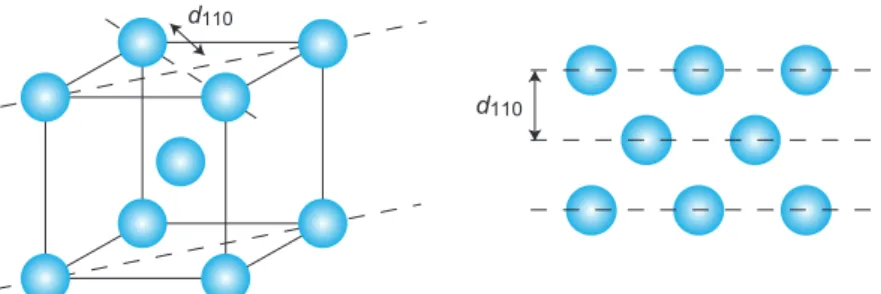
した。光は直角に反射させ、測定範囲は直径1 mm の円状領域の平均を用いた。 さらに、計算によりピーク波長位置を求めた。Bragg 回折は で表さ れ、d は格子面間隔、θは格子面と光の入射とがなす角度、m は任意の自然数、 n は屈折率、λは入射光の波長である。 さらに結晶はbcc 構造をとるので、格子面間隔d (110)
=
!!𝑎より
𝜆 =
!"!!"#!!!(1)
と表される(Figure 10)。また、1 粒子あたりの体積V は、𝑉 =!!𝜋𝑟!と表せる (r は粒子の半径)。ここで数密度 N に着目すると、𝑁 =
!!=
!!!となる。(φ : 体積分率, 分散液 1 cm3あたりの粒子が占める体積の割合)。以上より𝑎 =
!!!! ! ! (2) を得る。ここで、n はコロイドの平均屈折率であり、水の屈折率を 1.33、PS の 屈折率を1.59、EG の屈折率を 1.43 として、 n = 1.59𝜙 + 1.43𝐶!"+ 1.33𝐶水 1 − 𝜙 (3) である。(1), (2), (3)式より、ピーク波長λを求めることができる。 ただしここでは m = 1 または 2, θ = 90°である。 θ λ sin 2n m d =12
Figure 10 Structure unit of colloidal crystal of bcc lattice.
G. 吸着量測定
イオン性界面活性剤の粒子への吸着量を測定するために、水系では超遠心機 Optima XE-90(ベックマンコールター社製, CA)を用いて測定を行った。25℃
で 30,000rpm、3 時間遠心分離した。また、高濃度の EG/水系においては遠心 では十分な分離ができないため、フランツセルを用いた測定[32,33]を行った (Figure 11)。ポアサイズ 0.1 µm の半透膜を介し、セル A に界面活性剤を添加 したPS 分散液、セル B に溶媒のみを入れ、平衡状態になるまで撹拌を行った。 空気恒温槽内で実験を行い、温度は一定である。T = 5, 25, 50℃で測定を行った。 未吸着の界面活性剤の濃度の評価の際、吸着平衡に達するため、48 時間後に測 定を行った。 平衡状態に達した後、セル B 内に存在する未吸着の界面活性剤濃度を測定し た。メチレンブルーによる比色法[34]を用いて、SOS 中の S の定量を行った。 セルB からとった溶液 3 mL にメチレンブルー(8.0 × 10⁻⁵ M, 3 mL)を混ぜ、 クロロホルム(5 mL)を加える。10 分撹拌し、20 分静置した。水中に存在し
ているSOS は、SOS 中の S イオンがメチレンブルーと錯体を形成し、SOS は
クロロホルム層に移動する。そこで、クロロホルム層をとり、吸光光度計を用
いて吸収スペクトル測定を行った。S イオンの 652 nm におけるピークから、界
面活性剤の吸着量を決定した。なお、超遠心機による分離と分配セルによる分 離は吸着量の差はなかった。
Figure 11 Mechanism of adsorption experiment.
(A)PS分散液+SOS (B)溶媒のみ (A) (B) 平衡前 (A)PS分散液+SOS (B)遊離のSOS (A) (B) 平衡後 d110 d110 d θ θ d110 d110 d θ θ
13 H. 結晶化相図の作成 反射スペクトル測定によるBragg 回折の検出により EG/水における PS の結 晶化相図を作成した。界面活性剤としてSOS を用いた。コロイド試料はポリメ チルメタクリレート製のセル(内部体積1×1×4.5 cm)に全量 1 mL のサンプ ルを調製した。添加した界面活性剤の濃度は未吸着の界面活性剤の濃度がCMC 以下になるようにした。セルはふたをし、テフロンテープにより密閉した。恒 温槽に10 分間浸け、温度を調節しスペクトル測定を行った。水中における SOS のCMC は、電気伝導度滴定の結果から、25℃で 140 µM, 40℃で 230 µM と分 かっている。結晶化相図は、結晶状態と液体状態の共存しており、少しでも結 晶状態が見られるものは相図において“結晶”と表している。 2−4 結果と考察 A. EG/水混合液中での結晶化 界面活性剤のコロイド粒子表面への吸着を利用して、EG/水混合媒体中におい てPS 粒子の結晶化を検討した。EG は 25℃において誘電率はεr = 38.7 である。 これは、水の誘電率78.3 よりも低いが、理論計算からイオンの解離やコロイド 粒子の結晶化には十分である[35]。また、EG 濃度(CEG)を変えることにより、 界面活性剤の疎水部とPS 粒子の親和性を制御することができる。イオン性界面
活性剤として、炭素鎖の長さの違うSodium alkyl sulfate(n = 6, 12, 16, 18)
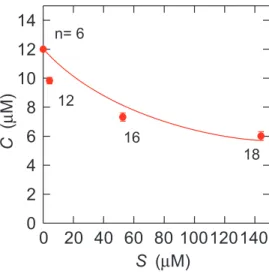
を用いた。各界面活性剤の粒子への吸着量を超遠心法によって測定した。吸着
している界面活性剤の濃度をS (µM)、未吸着の界面活性剤の濃度を C (µM)とす
る。様々な界面活性剤を用いて、仕込みの界面活性剤濃度に対するS と C の割
合をプロットした。結果をFigure 12 に示す。その結果、n=18 のとき吸着量が
多いことが分かった。そこで、炭素鎖の長さが長く、十分な吸着量が得られる
14
Figure 12 Adsorbed amounts (S) of various surfactants onto PS4 particles.
EG/水混合媒体中における結晶化の一粒子観察を室温(約 25℃)、40℃でそれ
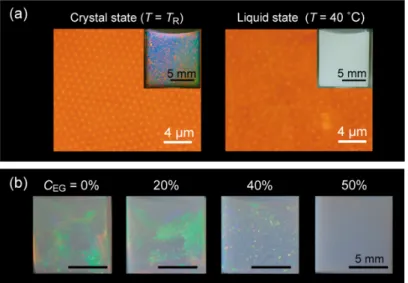
ぞれ光学顕微鏡により行った。Figure 13(a)に EG 水溶液 PS2 のCEG=30%分散
系の光学顕微鏡像を示す。体積分率φ=0.015 とした。加えた界面活性剤の濃度 CSOS=10 μM である。 試料は室温では結晶状態にあったが、40℃に昇温すると、結晶は融解し液体 状態をとることが明らかになった。また、PS1 φ = 0.01, CSOS = 20 µM の結晶化 の外観から、室温では結晶化し40℃では液体状態をとることが明らかになった。 また、T = 5℃において、様々な CEGに対するPS4 の結晶化の様子を観察した
(Figure 13(b)). CEG ≦40%のときサンプルは結晶化したが、CEG = 50%のとき、
液体状態を示した。この結果から、高濃度の CEG中では結晶化が起こりにくい ことが明らかになった。理由として、CEGが高くなるとEG と界面活性剤の疎水 部との親和性がEG と PS 粒子との親和性よりも高くなり、粒子への吸着量が減 少するためと考えられる。 14 12 10 8 6 4 2 0 C ( M M) 140 120 100 80 60 40 20 0 S (MM) n= 6 12 16 18
15
様々なCEGにおけるSOS 添加系の PS4 の目視による結晶化相図を Figure
14 に示す。このときφ = 0.01 である。シンボルが結晶と液体の相境界を示す。 相境界よりも高温側が液体状態、低温側が結晶状態である。様々な CEGに対し て、低温では結晶化し、高温では結晶が融解する温度誘起結晶化が観察された。 また、CSOSが高いほど結晶境界温度T*は下がることが明らかになった。この挙 動は、水系における温度誘起結晶化と同じである[23]。さらに、CEGが高くなる につれ、結晶領域が CSOS の低い方に限定されることが明らかになった。また、 結晶状態を確認するために反射スペクトル測定を行った。CEG = 20%, CSOS =20 µM のとき、系の温度を T = 5℃, 50℃と交互に変え、反射スペクトルを測定し た。5℃において結晶の反射ピークが 550 nm 付近に確認されたが、50℃ではピ ークが消え、結晶が融解していることが確認できた。Bragg 回折の式から得ら れた反射ピークの位置は 585 nm であった。実験から得られた波長とわずかに ずれが見られた。また、この操作を何度か繰り返し行い、温度誘起結晶化は可 逆的であるということが確認できた。
3.4. Mechanism of thermoresponsive crystallization
The electrostatic interactions between two charged particles have often been described based on their pair potentials according to the Yukawa form[2,3]:
UðrÞ ¼ AðZe0Þ2expð$jrÞ=ð4pere0rÞ; ð1Þ
when the interaction is sufficiently weak. Here r is the center-to-center distance between the two particles, e0is the elementary
charge, ande0is the vacuum permittivity. The correction factor
for the particle size is given by A = exp(2jap)/(1 +jap)2, where ap
is the particle radius and Debye parameter j is defined as j2= e
0 2I/(e
re0kBT). The term exp($jr) represents the electrostatic
screening effect due to small ions present in the medium. Based on U(r), Robbins et al. determined the crystallization phase diagram
[9]in the parameter plane for the reduced temperature kBT/U(d)
and the coupling parameterjd, with d representing the average center-to-center distance between the particles (//$1/3).
Following the addition of surfactant molecules to charged col-loids, the molecules are partially adsorbed onto the particle sur-faces, resulting in an increase in Z, while the non-adsorbed surfactant molecules in the medium increase the value of I, as illus-trated inFig. 1. The values of Z and I can be related to S and C, as follows. The incremental change in Z (donated asDZ) is equal to the number of surfactant molecules per particle. Because the par-ticle number density (q) is given byq= 3 //(4pap3), we have:
Z ¼ Z0þ DZ; with DZ ¼ ½4pa3
pNA=ð3000/Þ'S:
ð2Þ (a) (b)
Fig. 2. (a) Crystallization phase diagram for PSN colloid defined by temperature T and surfactant concentration Csurf. Particle volume fraction / = 0.01. Inset is magnified plot
of small Csurfregion. (b) Reflection spectra for colloidal silica 1. [EPC] = 170lM, [SOS] = 12lM as a function of T from 5!C to 60 !C starting from initial T of 25 !C. / = 0.05.
Fig. 3. Crystallization phase diagram for aqueous dispersions of cationic PS particles (PS(+)) in the presence of CPC. / = 0.013.
Fig. 4. (a) Optical micrographs of PS2 colloids in EG/water in the presence of SOS at room temperature (TR) and 40!C. / = 0.015, [SOS] = 10lM. Insets are overviews of PS1
colloids at the same TS. / = 0.01; [SOS] = 20lM, CEG= 30%. (b) Overviews of PS1 colloids in EG/water at various CEGvalues. T = 5!C.
204 A. Murakado et al. / Journal of Colloid and Interface Science 465 (2016) 200–207
Figure 13 (a) Optical micrographs of PS2 colloids in EG/water in the presence of SOS at room
temperature (TR) and 40 °C. φ = 0.015, [SOS] = 10 µM. Insets are overviews of PS1 colloids at the
same TS. φ = 0.01; [SOS] = 20 µM, CEG=30%. (b) Overviews of PS4 colloids in EG/water at various
16 φ = 0.01 のとき CEG > 60%では結晶化は観察されなかったが、粒子濃度を高 くすると、CEGが高くても結晶化が観察された。PS3 を用いて、CEG = 80%にお ける結晶化を検討した。このとき、Csurf = 10 µM、φ = 0.04, 0.05, 0.06 で T*は それぞれ、23℃, 30℃, 55℃であった(Figure 15(a))。また、反射ピークはT = 5℃ のとき530 nm 付近で見られた。これは Bragg 回折から計算により求めた反射 ピーク516 nm とほぼ一致したことから結晶は bcc 構造をとることがわかった。 また温度誘起結晶化は可逆的であるということが確認できた。(Figure 15(b)) PS1を用いた場合でも温度誘起結晶化が見られた(Figure 16)。結晶化におけ るCEG高いと結晶化しなくなり、またCSOSが高いほど結晶境界温度の減少が見 られ、温度誘起結晶化はよく再現した。
Figure 15(a) Crystallization phase diagram for PS3 colloid in the presence of SOS at various φ values. (b) Reflectance spectrum for PS3, CEG = 80%, Csurf = 10 µM.
Figure 14 (a) Crystallization phase diagram for PS4 (φ = 0.01) colloid in the presence of SOS at various CEG values. (b) Reflectance spectrum for PS4, CEG = 20%, CSOS = 20 µM.
60 40 20 0 200 150 100 50 0 CEG = 0% 10% 20% 30% 40% 50% Csurf ( M) T ) C ( 580 540 500 reflectance (a.u.) time wavelength (nm) T=50 ℃ 5 ℃ ( a ) ( b ) 60 50 40 30 20 10 0 T (℃ ) 0.06 0.055 0.05 0.45 0.04 φ crystal liquid 580 540 500 wavelength (nm) reflectance (a.u.) time T=60 ℃ 5 ℃ ( a ) ( b ) φ
17
Figure 16 The crystallization phase diagram of PS1 + SOS colloids definedby T and Csurf at various
values of CEG.
B. EG/水混合液中での表面粒子への吸着
分配セル法により、PS 粒子への SOS の吸着量を測定した。まずCEGにおけ
るSOS の検量線を求めた。CSOSに対する吸光度をプロットした検量線をFigure
17 に示す。つぎに、様々なCEGに対するPS4(φ = 0.01)への SOS の吸着量を
求めた。未吸着の SOS 分子の濃度を C(µM)、吸着している SOS 分子の濃度
をS(µM)、S = Csurf — C として算出した。C を吸光度測定により決定した。
Figure 18 にCEGに対してS /Csurfをプロットした結果を示す。
Figure 17 The standard curve of SOS at various CEG.
3.0 2.5 2.0 1.5 1.0 0.5 0 40 30 20 10 0 CEG = 0% 10% 20% 30% 40% 50% CSOS (MM) Abs.
18
Figure 18 Adsorbed quantity (S) of SOS onto PS4 particles reduced by Csurf as a function of CEG at three
values of T. φ = 0.01. Csurf =20 µM. このときの系の温度は、相図作成時に顕著な差が見られたT = 5℃, 25℃, 50℃ で行った。またCsurf = 20 µM で行った。結果から、全ての条件において、CEG が増加するほどS /Csurfの量は減少することが明らかになった。この理由として、 CEGが高いとき、SOS 分子の疎水基と EG 溶液の親和性が強まることが考えら れる。S /Csurfの量は系の温度T が高いほど減少することが明らかになった。こ の減少は、CEGが増加するほどより顕著に見られた。例として、CEG = 40%のと きT =50℃における吸着量は 5℃のときと比較して 20%であった。 C. 温度誘起結晶化メカニズム 荷電粒子間には電気的な相互作用が働く。この相互作用はYukawa 型の遮蔽 されたクーロンポテンシャルに基づく[2,3]。(式 1) 𝑈 𝑟 = 𝐴 𝑍𝑒! !𝑒𝑥𝑝 −𝜅𝑟 4𝜋𝜀 !𝜀!𝑟 (1) 相互作用が十分弱いときに成り立つ。r は二つの粒子の中心間距離、e0は電気 素量、ε0は真空中における誘電率をそれぞれ示す。粒子の半径apは補正因子A 中に考慮され、デバイ長κは𝜅! = 𝑒!!𝐼 𝜀 !𝜀!𝑘!T である。 𝐴 = 𝑒𝑥𝑝 2𝜅𝑎! 1 + 𝜅𝑎! ! (2)
19 前述の通り、荷電コロイド粒子に界面活性剤分子を加えることによって、粒 子表面に部分的に吸着し、電荷数Z が増加する。一方、未吸着の界面活性剤分 子が媒体中で増加すると、イオン濃度I が増加する。Z と I をそれぞれ S と C に依存する、とすると、電荷数の増加分ΔZ は一粒子上に吸着した界面活性剤の 数と等しい。系の粒子数密度 ρは 3φ /(4πap3)であるので、ΔZ は以下に示す通り である。 𝑍 = 𝑍!+ ∆Z ∆𝑍 = 4𝜋𝑎!!𝑁 ! 3000𝜙 𝑆 (3) ここで、Z0は界面活性剤がないときの電荷数、NAはアボガドロ定数である。 粒子は電荷を持つが、粒子表面近くの対イオンにより打ち消され、実際に働く 電荷数Zeffは小さくなる[30]。界面活性剤存在下での電荷数Z と Zeffの割合 α = Zeff / Z は、静電表面ポテンシャルが増加することにより Z が増加するほど小さ くなる。よって、界面活性剤存在下では次式で表される。 𝑍!""= 𝛼 𝑍!+ ∆𝑍 (4) 分散媒中に存在する全てのイオンが一価であるとき、媒体中のイオン濃度は 次のように表される。 𝐼 = 1 2 𝐶!+ 𝐶! (5) 𝐶!, 𝐶!はそれぞれ粒子の対イオン濃度と媒体中の塩濃度を示す。𝐶!はZ と r に比 例し、以下の式で表される。 𝐶! = 3000𝜙 4𝜋𝑎!!𝑁 ! 𝑍 (6) 𝐶! = 𝐶 + 𝐶! (7) 本実験は無塩系で行ったため、𝐶!は媒体中の不純物イオンの濃度を示す。電 気伝導度測定より𝐶!は2 µM であった。 水中におけるZ0を電気伝導度滴定の結果(Figure 19(a))と(3)式を用いて、 Z0 = 14800 と算出した。また、25℃のときの界面活性剤なしのときの有効電荷
数Zeff,0を様々なCEGにおいて電気伝導度測定より求めた。この結果、Figure
20
Figure 19 (a) Conductometric titration of PS4, (b) Zeff vs CEG. 𝑍!"" 𝐶!" = a + b 𝐶!",a = 1.27×
10!, b = −2.3
以前の実験から、Zeff,0の温度依存性が見られる[13]が、本研究では一定と仮定
した。また、SOS 存在下におけるαは(4)式より、α = 0.086 であった。Csurf
はごく少量でΔZ は Z に対してとても小さいため、αは Z に依存することが示唆
された。文献値[36-38]より、各温度における EG /水の誘電率を Table 4 に示す。
Table 4 Relative permittivity εr
T (℃) CEG = 0 (%) 10 20 30 40 50 5 84.94 82.04 79.86 76.05 72.76 69.2 25 78.37 75.55 72.88 69.71 66.56 63.14 50 70.16 67.44 64.15 61.79 58.82 55.57 また、式(3)〜(7)から EG/水中において PS4 に SOS を添加したときの 粒子の電荷数Z および塩濃度 I を計算した。このとき Csurf = 20 µM である。結 果を Table 5, 6 に示す。
Tables 5 Charge number Z
T (℃) CEG = 0 (%) 10 20 30 40 50 5 1396 1368 1339 1314 1286 1229 25 1396 1367 1333 1305 1259 1195 50 1395 1351 1301 1264 1204 1175 2000 1500 1000 500 0 Z e ff 50 40 30 20 10 0 [EG] (%) 80 60 40 20 K (M S/cm 2) 600 500 400 300 200 100 0 NaOH (ML) 0 ( a ) ( b )
21
Tables 6 Salt concentration Is (µM)
T (℃) CEG = 0 (%) 10 20 30 40 50
5 0.674 1.1 1.8 1.7 2.2 7.7
25 0.57 1.2 2.7 3.2 6.8 13.7
50 0.8 3.8 8.0 10.1 16.1 17.0
様々なCEGとT における ZeffとI を用いて理論計算により相境界を求め、
Robbins らによる理論相図に対してプロットした(Figure 20)。Robbins らに
よる理論上の相境界を実線で示す。各シンボル●, ▲, ■はT = 5, 25, 50℃に対 応する。シンボルは左からCEG = 0%, 10%, 20%, 30%, 40%, 50%のときの相境 界を表している。結果から、全プロットが単一のマスターカーブで表されるこ とがわかり、相転移はCEGとT に依存することが明らかになった。理由として 温度T の項はεrT として𝑘!𝑇 𝑈 𝑑 および𝜅𝑑において導入されている((8)式)。
𝜅
!=
!! !!!!! !!!! (8) しかし、実際はT の減少にともない、εrは 1/T に比例して変化するため、εT は温度によって変化しない。また、d と apは一定であるため、κは I によって決まる。また、kBT / U(d)は exp (k(T )) = exp (I (T )1/2)に比例する。すなわち、こ
の系においてkBT / U(d)と𝜅𝑑の関係は、主に温度変化によって依存するイオン
22
Figure 20 Experimental conditions for data points shown in Fig. 6 for PS4 colloids represented in
kBT/U(d)–κd parameter plane. Open circle, filled triangle, and open squares indicate results for T = 5℃,
25℃, and 50℃, respectively. Data points are those at CEG = 0%, 10%, 20%, 30%, 40%, and 50%, from left to right. Inset is magnified figure for κd = 5.5–6.2.
相境界におけるイオン濃度I*はRobbins らによる計算機シミュレーションに
より求められる。Figure 21 (a)に示す破線に、様々なCEGにおけるI*
の値を示 す。また、吸着実験から求めたI*の値をシンボルで示す。どちらも青がT = 5℃、 緑が25℃、赤が 50℃にそれぞれ対応している。また、Figure 21 (b)に示した理 論の相境界と吸着等温線から求めた相境界におけるCEG* (●)と結晶化相図よ り求めた相境界(■)は良く一致した。本研究のEG/水中での SOS の吸着挙動 による PS コロイドの結晶化は系の温度による静電遮蔽効果の影響であること が明らかになった。
Figure 21 (a) I determined from adsorption data (symbols) and I* calculated from phase diagram
according to Robbins et al. (dashed curves) at three values of T plotted vs. CEG. (b) C*EG at crystallization
phase boundary determined from data in (a) (circles), and observed crystallization boundaries in Fig. 4 (rectangular symbols). Solid curve is provided to guide the eyes.
2.5 2.0 1.5 1.0 0.5 0 kBT U(d) liquid crystal 5 7.5 10 d K
respectively) are shown in Fig. 9(b); the ultracentrifuge method was applied to obtain the data at CEG= 20% and 30%, while the
dif-fusion cell method was used to collect the data at CEG= 40%. Both S⁄
and C⁄are significantly lower at higher C
EGdue to the lower C!surf
values.
Because in this case Z varied significantly,awas also expected to vary. It was thus necessary to determine the Zeffvalues.
Electri-cal conductivity measurements were not applicable, however, because it was also necessary to determine the contribution of I. Consequently, zeta-potential (f) measurements using dilute (/ = 0.001) samples in the presence of SOS (Csurf= C⁄) were performed,
and the Z values were determined from the f values using the Pois-son–Boltzmann equation. The absolute values of f (|f|) and the Z values are plotted as functions of CEGinFig. 9(c). It can be seen that
as CEGincreases, both Z and I clearly decrease. These results explain
the decrease in C!
surf with increasing CEG. Thus, the CEGdependence
of the crystallization is attributable to changes in both Z and I, although the T dependence was mainly governed by variations in I.
4. Conclusions
In the present paper, we reported that charged colloids exhibit thermoresponsive crystallization in the presence of ionic tants. Steric + charge stabilization of colloid by using ionic surfac-tant has frequently been used in colloid science[2]. However, to the best of our knowledge, controlled crystallization using ionic surfactant has been reported only by Palberg et al. [22] and in our previous[21]and present studies. Colloidal crystallization typ-ically exhibits little or no temperature dependence [9,10]. Ther-mally induced crystallization of non-charged colloids has been enabled using the temperature dependence of the osmotic pres-sure[14], phase separation of media[15], volume changes in ther-mosensitive microgel particles[16,17], and depletion effect[18]. Additions of the ionic surfactants increase both the surface charge number of colloidal particle, Z, and the ionic strength of the med-ium, I [21]. Here we found that the observed thermoresponsive crystallization was explainable in terms of changes in the ionic strength of the medium, i.e., variation of the electrostatic screening effect due to non-adsorbed ionic surfactants. The increase in Z, which also occurred on cooling, was less significant at least under the condition examined here. In atomic and molecular crystalline materials, high-purity single crystals have been fabricated by means of controlled crystallization techniques under temperature gradients, e.g., the Czochralski and zone-melting methods [8]. The present colloids will be useful for the fabrication of colloidal crystalline materials via these controlled crystallization methods. Furthermore, the present study also showed the thermoreversible crystallization was enabled in non-aqueous media. If the present method will be further applicable to more apolar resin monomer, Fig. 7. Experimental conditions for data points shown inFig. 6for PS4 colloids
represented in kBT/U(d)–jdparameter plane. Open circle, filled triangle, and open
squares indicate results for T = 5!C, 25 !C, and 50 !C, respectively. Data points are those at CEG= 0%, 10%, 20%, 30%, 40%, and 50%, from left to right. Inset is magnified
figure forjd= 5.5–6.2.
(a)
(b)
Fig. 8. (a) I determined from adsorption data (symbols) and I⁄calculated from
phase diagram according to Robbins et al. (dashed curves) at three values of T plotted vs. CEG. (b) C!EGat crystallization phase boundary determined from data in
(a) (circles), and observed crystallization boundaries inFig. 5(rectangular symbols). Solid curve is provided to guide the eyes.
(a) (b) (c)
Fig. 9. (a) C!
surffor PS3 colloids (/ = 0.01) in the presence of SOS at T = 25 !C. (b) S⁄vs. C⁄at three values of CEG. (c) Z and jfj plotted vs. CEG.
206 A. Murakado et al. / Journal of Colloid and Interface Science 465 (2016) 200–207
respectively) are shown in Fig. 9(b); the ultracentrifuge method was applied to obtain the data at CEG= 20% and 30%, while the dif-fusion cell method was used to collect the data at CEG= 40%. Both S⁄ and C⁄are significantly lower at higher C
EGdue to the lower C!surf values.
Because in this case Z varied significantly,awas also expected to vary. It was thus necessary to determine the Zeffvalues. Electri-cal conductivity measurements were not applicable, however, because it was also necessary to determine the contribution of I. Consequently, zeta-potential (f) measurements using dilute (/ = 0.001) samples in the presence of SOS (Csurf= C⁄) were performed, and the Z values were determined from the f values using the Pois-son–Boltzmann equation. The absolute values of f (|f|) and the Z values are plotted as functions of CEGinFig. 9(c). It can be seen that as CEGincreases, both Z and I clearly decrease. These results explain the decrease in C!
surfwith increasing CEG. Thus, the CEGdependence of the crystallization is attributable to changes in both Z and I, although the T dependence was mainly governed by variations in I.
4. Conclusions
In the present paper, we reported that charged colloids exhibit thermoresponsive crystallization in the presence of ionic tants. Steric + charge stabilization of colloid by using ionic surfac-tant has frequently been used in colloid science[2]. However, to the best of our knowledge, controlled crystallization using ionic surfactant has been reported only by Palberg et al. [22] and in our previous[21]and present studies. Colloidal crystallization typ-ically exhibits little or no temperature dependence[9,10]. Ther-mally induced crystallization of non-charged colloids has been enabled using the temperature dependence of the osmotic pres-sure[14], phase separation of media[15], volume changes in ther-mosensitive microgel particles[16,17], and depletion effect[18]. Additions of the ionic surfactants increase both the surface charge number of colloidal particle, Z, and the ionic strength of the med-ium, I[21]. Here we found that the observed thermoresponsive crystallization was explainable in terms of changes in the ionic strength of the medium, i.e., variation of the electrostatic screening effect due to non-adsorbed ionic surfactants. The increase in Z, which also occurred on cooling, was less significant at least under the condition examined here. In atomic and molecular crystalline materials, high-purity single crystals have been fabricated by means of controlled crystallization techniques under temperature gradients, e.g., the Czochralski and zone-melting methods [8]. The present colloids will be useful for the fabrication of colloidal crystalline materials via these controlled crystallization methods. Furthermore, the present study also showed the thermoreversible crystallization was enabled in non-aqueous media. If the present method will be further applicable to more apolar resin monomer,
Fig. 7. Experimental conditions for data points shown inFig. 6for PS4 colloids represented in kBT/U(d)–jdparameter plane. Open circle, filled triangle, and open
squares indicate results for T = 5!C, 25 !C, and 50 !C, respectively. Data points are those at CEG= 0%, 10%, 20%, 30%, 40%, and 50%, from left to right. Inset is magnified
figure forjd= 5.5–6.2.
(a)
(b)
Fig. 8. (a) I determined from adsorption data (symbols) and I⁄calculated from
phase diagram according to Robbins et al. (dashed curves) at three values of T plotted vs. CEG. (b) C!EGat crystallization phase boundary determined from data in
(a) (circles), and observed crystallization boundaries inFig. 5(rectangular symbols). Solid curve is provided to guide the eyes.
(a) (b) (c)
206 A. Murakado et al. / Journal of Colloid and Interface Science 465 (2016) 200–207
23 D. 結晶化挙動における EG 濃度の影響
これまで説明した通り、温度誘起結晶化挙動はCsurfが一定のとき、媒体中の
イオン濃度によって決まる。また、温度一定のとき、CEGが結晶化に影響する。
界面活性剤存在下において、PS3 を用いφ = 0.01、T = 25℃で様々な CEGに対
してCsurf*をFigure 22 (a)にプロットした。その結果、予想された通りCEGの
減少に伴い、Csurf*も減少した。S と C の値は Csurf により求められた(Figure
22(b))。今回、CEG = 20%, 30%の吸着量の測定は超遠心法を用いた。CEG = 40% では分配セル法により測定を行った。CEGが高いほどS*およびC*は明らかな減 少が見られた。これはCEGが高いほどCsurf*が小さくなるためと考えられる。 電荷数の変化によりαもまた変化するため、Zeff の決定は必要不可欠である。 SOS の存在下でゼータ電位測定を行い、電荷数はゼータポテンシャルから Poisson-Boltzmann 式より算出した。CEGのときの、ζ値および電荷数 Z をプ ロットしたものをFigure 22 (c)に示す。CEGの増加にともない、Z と I の減少が 見られた。これらの結果から、CEGの増加によりCsurf*は減少することが明らか となった。したがって、様々な CEGにおける結晶化は、主に温度に依存するイ オン濃度に起因することが明らかになった。
Figure 22 (a) Csurf* for PS3 colloids (φ = 0.01) in the presence of SOS at T = 25 °C. (b) S* vs. C* at three
values of CEG. (c) Z and ⏐ζ⏐ plotted vs. CEG.
2−5 結論 ポリスチレンコロイド粒子 EG/水分散系においても、粒子表面へのイオン性 界面活性剤の吸着を利用した、結晶化の温度制御が可能であった。結晶化相図 は界面活性剤の吸着等温線に基づいて定量的に説明できた。界面活性剤の吸着 を利用した温度誘起結晶化は、媒体中のイオン濃度の変化によることが明らか になった。
respectively) are shown in Fig. 9(b); the ultracentrifuge method was applied to obtain the data at CEG= 20% and 30%, while the
dif-fusion cell method was used to collect the data at CEG= 40%. Both S⁄
and C⁄are significantly lower at higher C
EGdue to the lower C!surf
values.
Because in this case Z varied significantly,awas also expected to vary. It was thus necessary to determine the Zeffvalues.
Electri-cal conductivity measurements were not applicable, however, because it was also necessary to determine the contribution of I. Consequently, zeta-potential (f) measurements using dilute (/ = 0.001) samples in the presence of SOS (Csurf= C⁄) were performed,
and the Z values were determined from the f values using the Pois-son–Boltzmann equation. The absolute values of f (|f|) and the Z values are plotted as functions of CEGinFig. 9(c). It can be seen that
as CEGincreases, both Z and I clearly decrease. These results explain
the decrease in C!
surf with increasing CEG. Thus, the CEGdependence
of the crystallization is attributable to changes in both Z and I, although the T dependence was mainly governed by variations in I.
4. Conclusions
In the present paper, we reported that charged colloids exhibit thermoresponsive crystallization in the presence of ionic tants. Steric + charge stabilization of colloid by using ionic surfac-tant has frequently been used in colloid science[2]. However, to the best of our knowledge, controlled crystallization using ionic
surfactant has been reported only by Palberg et al. [22] and in
our previous[21]and present studies. Colloidal crystallization typ-ically exhibits little or no temperature dependence[9,10]. Ther-mally induced crystallization of non-charged colloids has been enabled using the temperature dependence of the osmotic pres-sure[14], phase separation of media[15], volume changes in ther-mosensitive microgel particles[16,17], and depletion effect[18]. Additions of the ionic surfactants increase both the surface charge number of colloidal particle, Z, and the ionic strength of the
med-ium, I [21]. Here we found that the observed thermoresponsive
crystallization was explainable in terms of changes in the ionic strength of the medium, i.e., variation of the electrostatic screening effect due to non-adsorbed ionic surfactants. The increase in Z, which also occurred on cooling, was less significant at least under the condition examined here. In atomic and molecular crystalline materials, high-purity single crystals have been fabricated by means of controlled crystallization techniques under temperature
gradients, e.g., the Czochralski and zone-melting methods [8].
The present colloids will be useful for the fabrication of colloidal crystalline materials via these controlled crystallization methods. Furthermore, the present study also showed the thermoreversible crystallization was enabled in non-aqueous media. If the present method will be further applicable to more apolar resin monomer, Fig. 7. Experimental conditions for data points shown inFig. 6for PS4 colloids
represented in kBT/U(d)–jdparameter plane. Open circle, filled triangle, and open
squares indicate results for T = 5!C, 25 !C, and 50 !C, respectively. Data points are those at CEG= 0%, 10%, 20%, 30%, 40%, and 50%, from left to right. Inset is magnified
figure forjd= 5.5–6.2.
(a)
(b)
Fig. 8. (a) I determined from adsorption data (symbols) and I⁄calculated from
phase diagram according to Robbins et al. (dashed curves) at three values of T plotted vs. CEG. (b) C!EGat crystallization phase boundary determined from data in
(a) (circles), and observed crystallization boundaries inFig. 5(rectangular symbols). Solid curve is provided to guide the eyes.
(a) (b) (c)
Fig. 9. (a) C!
surf for PS3 colloids (/ = 0.01) in the presence of SOS at T = 25 !C. (b) S⁄vs. C⁄at three values of CEG. (c) Z and jfj plotted vs. CEG.
24
第三章 コロイド結晶固定ゲルのイオン透過性
3−1 はじめに 生体内の細胞膜やイオンチャネルはイオン選択透過性をもち、電子やイオン の移動が起こる。イオンの移動には膜電位が重要である。その機構を解明する ために、コロイドを用いたゲルや膜中のイオン透過における電位効果に関する 研究は有用である。また、医薬分野におけるコロイド結晶の医療用センサー応 用が期待されている。細胞中では外液と内液のイオンの濃度差が存在する。ゲ ル固定コロイド結晶を透過膜として用いる場合、結晶の存在がイオン透過に及 ぼす影響に関する研究は、センシング応用においてとても重要である。 これまでの研究で、ゲル膜を用いたイオン透過性について、ポリマーの網目 の障壁効果がイオンの透過性に影響を及ぼすことが明らかになっている。 電解質が膜を透過するとき、拡散電位と Donnan 電位が生じる。電解質が膜 中を濃い方から薄い方へと拡散する場合、拡散速度はそれぞれのイオンの種類 によって異なる。一般に、同一場所におけるイオン濃度は等しいとはいえず、 陽イオンと陰イオンの濃度が異なることにより正・負電荷の偏りが生じる。こ の偏りが生じない方向に電位勾配が発生する。この電位勾配により偏りは平衡 的に落ち着き、時間的に変化しなくなる。例えば、Figure 23 に示すように HCl の場合、H+の移動度は大きいが、Cl—は小さい。H+とCl—間に電気的な力が働き、 電位差が生じる[39]。このとき、両イオンが対となって移動するためこのとき両 者の速度は等しくなる。この濃度差により生じる電位を拡散電位という。この 電位差を表した式を Nernst の式という((1)式)。𝜔!, 𝜔!は両種イオンのモル移 動度を示す。∆𝐸 = −
!!!!! !!!!! !! !ln
!! !0 ( 1 )Figure 23 Electrolyte diffusion. The highly mobile H+ and the slower Cl- to move at the same rate by
electrostatics force.
H+:rapid
Cl-:slow