Japan Advanced Institute of Science and Technology
JAIST Repository
https://dspace.jaist.ac.jp/
Title 金属基板上の単結晶様芳香族分子多層膜エピタキシャ
ル成長の理解と制御 Author(s) FRIEDLEIN, RAINER
Citation 科学研究費助成事業研究成果報告書: 1-6
Issue Date 2013-06-03
Type Research Paper
Text version publisher
URL http://hdl.handle.net/10119/11379 Rights Description 研究種目:基盤研究(C), 研究期間:2010∼2012, 課題番号:22560006, 研究者番号:80452118, 研究分 野:超分子科学、界面物理・化学、光電子分光法, 科 研費の分科・細目:応用物理学・工学基礎、応用物性 ・結晶工学
様式C-19
科学研究費助成事業(科学研究費補助金)研究成果報告書
平成25年 6 月 03 日現在 研究成果の概要(和文): 相互作用の異なる金属基板上への有機分子結晶薄膜のエピタキシャル成長を行った。炭素と水 素以外の元素を含む分子は、部位特異的に基板と共有結合するが、Cu(110)表面上のオリゴアセ ンの成長は拡張界面準位により特徴付けられ、基板上の第一層は分子が「寝て」いる。一方で Bi(001)やシリセンの様な相互作用の小さい表面上では分子が「立って」いる場合と「寝て」い る場合の両方が観察され、分子結晶との格子整合性が重要であることが明らかとなった。 研究成果の概要(英文):The epitaxial growth of single-crystalline-like organic multilayer films on selected metal surfaces, chosen to provide either weak or strong interactions at the hybrid interface, has been studied. In particular, while molecules containing heteroatoms form site-specific covalent bonds, the growth of oligoacenes on the Cu(110) surface is characterized by extended interfacial states and a flat molecular orientation in the first layer. On the contrary, for surfaces providing weak interactions like Bi(001) and silicene, both standing and flat orientations occur and are governed by the specific lattice-matching conditions for various crystallographic planes of the thin film crystals. The results provide a detailed understanding of the influence of the substrate beyond the widely studied first layer in achieving epitaxial growth and uniaxial alignment of the grains. 交付決定額 (金額単位:円) 直接経費 間接経費 合 計 2010 年度 2,300,000 690,000 2,990,000 2011 年度 800,000 240,000 1,040,000 2012 年度 500,000 150,000 650,000 年度 年度 総 計 3,600,000 1,080,000 4,680,000 研究分野:超分子科学、界面物理・化学、光電子分光法 科研費の分科・細目:応用物理学・工学基礎、応用物性・結晶工学 キーワード:有機エレクトロニクス、光電子分光、エピタキシャル成長 1.研究開始当初の背景
Even if the condition of lattice matching is met, the epitaxial growth of
a thin organic film with large (>100 m) single-crystalline domains is rarely achieved. This is because usually in the 機関番号:13302 研究種目:基盤研究(C) 研究期間:2010~2012 課題番号:22560006 研究課題名(和文) 金属基板上の単結晶様芳香族分子多層膜エピタキシャル成長の理解と制 御
研究課題名(英文)Understanding and control of the epitaxial multilayer growth of aromatic molecules on single crystalline metal substrates
研究代表者
FRIEDLEIN RAINER (フリードライン ライナー) 北陸先端科学技術大学院大学・マテリアルサイエンス研究科・准教授 研究者番号:80452118
sub-monolayer regime, condensation starts from various nuclei (C. Seidel et al., Phys. Rev. B 64, 195418 (2001)) leading often to a Stranski-Krastanov growth of multilayer islands, the occurrence of rotational domains, and subsequently of grains of a very limited size. Molecular aggregation at surfaces is controlled by the tempera- ture-dependent competition between the molecule-molecule and the molecule- substrate interactions, where two-dimen- sional gas, liquid and crystalline phases can be distinguished (A. Langner et al., Surf. Sci. 574, 153 (2005)). Examples of the very few single-crystalline monolayer films with a horizontal molecular orientation include pentacene on Cu(110) (H. Yamane et al., Phys. Rev. B 76, 165436-1 (2007)) surfaces while pentacene molecules are vertically aligned on Bi(001) surfaces (J. T. Sadowski et al., Appl. Phys. Lett. 86, 073109 (2005)). The latter system provides also the first example of a single-crystalline organic film with vertical orientation and “double- epitaxy” since the Bi(001) film is itself epitaxially grown on the Si(111) surface.
If some gold atoms are deposited on the same Si(111) surface, for very sub-monolayer coverages, a substantial change of the growth mode is observed (G. E. Thayer et al., Phys. Rev. Lett. 95, 256106 (2005)). Obviously, the Au-related electronic states at the very surface play a significant role in the adsorption process. Increasing the film thickness starting from the highly ordered monolayer, it is extremely difficult to achieve a growth of single-crystalline multilayers. Consequently, for highly-studied oligo- acenes and to our best knowledge, prior to the present project, there has been known only four cases so far: pentacene (H. Yamane et al., phys. stat. sol. (b) 245, 793 (2008)) and anthracene (F. Bussolotti et al., Phys. Rev. B 80, 153402 (2009)) on Cu(110) and recently pentacene (R. C. Hatch et al., Phys. Rev. B 80, 081411(R) (2009)) and anthracene (Ref.⑦) on Bi(001), where molecules grow as single- crystalline multilayer films with ver- tical molecular orientation. Note that the growth on Cu(110) proceeds very different from that on Bi(001). For the former surface, the first layer is strongly chemisorbed (with a flat molecular
orientation).
Consequently, following layers need to reorient by maintaining an epitaxial relation with the substrate. On Bi(001), on the other hand, the interaction is very weak such that the already the first layer can grow with a vertical orientation. By comparing various materials systems, it has been argued that the electronic properties of the substrate surface play a dominant role in the initial growth and structural ordering of thin organic films (G. E. Thayer et al., Phys. Rev. Lett. 95, 256106 (2005)). For crystals, the substrate electronic density tailing out of the solid into the vacuum has a spatial distribution periodic along crystal- lographic directions of the surface. Molecules recognize this periodic electronic density, even leading to a surface band formation involving both molecular and substrate wave functions, as observed for a pentacene monolayer on the Cu(110) surface (H. Yamane et al., phys. stat. sol. (b) 245, 793 (2008)). While the importance of the structural motive is in no doubt, details like e.g. the involvement of bonding and antibonding orbitals of the molecules and of the substrate surface for the interaction strength has only been partially discussed.
2.研究の目的
For high-performance organic electronics applications, a fast trans- port of charges across the organic layers and the organic/ electrode interfaces is required. One of the fundamental issues in the engineering of such devices is the achieving a high degree of structural order since any defect will scatter or trap charge carriers. Recognizing the importance of this issue, the research performed in the project was aimed to investigate the fundamental electronic interactions at selected organic/metal interfaces leading to the observed epitaxial growth of thin films of oligoacene and related molecules. In particular, it was the goal of the project
(1) to relate the electronic properties of the substrate surface and of the thin organic films to particular growth modes and temperature-dependent phase transitions in mono- and
multilayers of anthracene, tetracene, pentacene and related molecules; (2) to explore the epitaxial growth of
organic mono- and multilayer thin films on both single-crystalline metals and on metallic thin films grown on semiconductors;
(3) to measure the electronic band structure of the substrate surface and of the organic thin films and to relate it to electronic properties of the substrates;
(4) to find predictions for the growth of single-crystalline organic multilayers shall be achieved based on the knowledge of fundamental factors obtained in this study. 3.研究の方法
(1) The experiments have been performed in a costum-built, ultra-high vacuum (UHV) set-up that contains a liquid nitrogen sample cooling and a sample preparation system for the preparation of thin organic films on inorganic substrates (incl. sputtering and high-temperature heating), as well as a high-resolution angle-resolving ultraviolet photoelec- tron (ARUPS) spectrometer (VG Scienta SES-100 electron analyzer). Structural characterization was performed in situ using Reflection High- Energy Electron Diffraction (RHEED) and Low- Energy Electron Diffraction (LEED) instruments. (2) In order to prepare silicene, thin ZrB2 films have been grown on Si (111) wafers by thermal decomposition of metal- borohydride, using a custom-built UHV chemical vapor deposition system equipped with a RHEED system. Following the transfer on air to the set-up used for the growth of organic films, native oxide was removed by annealing at about 780 ºC under UHV conditions (Ref. ④).
4.研究成果
(1) Strong interactions - Aromatic molecules on Cu(110)
While anthracene forms ordered multi- layers on Cu(110) that are characterized by a thickness-dependent reorientation (F. Bussolotti et al., Phys. Rev.B 80, 153402 (2010)), tetracene multilayers on the same surface are disordered, due to a missing epitaxial relation.
In the case of adenine on metals, particular site-specific covalent bonds are formed between the heteroatoms and the
metal surface (Ref. ⑩). On the other hand, between oligoacenes and Cu(110) substrates, interfacial states are de-localized (Ref. ⑪).
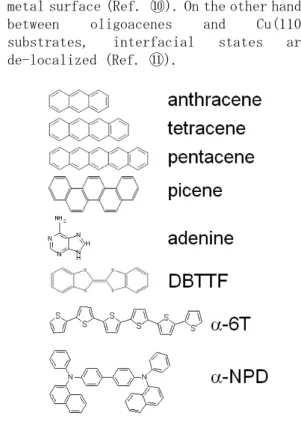
Fig. 1: Chemical structures of the molecules used in this project.
The study was extended to an aromatic molecule that contains both electron donating and accepting functional groups - dibenzotetrathiaful- valene (DBTTF). The molecular orientation of DBTTF molecules grown on the Cu(110) surface and the interactions at the interface have been found to depend strongly on the coverage and on the substrate temperature. The reason is that interactions at the interface are strong but have an opposite effect for different functional groups of the molecule.
(2) Weak interactions - Anthracene and tetracene on Bi(001)
The re-investigation of anthracene/ Bi(001) prepared on non-vicinal Si(111) surfaces proofs the existence of rota- tional domains. It is now understood that the electronic band structure along high- symmetry directions, shown in Fig. 2, could be measured because band edges provide a higher spectral weight making the turning points visible. Uniaxial alignment of large domains on hexagonal substrates requires therefore the use of vicinal surfaces.
Anthracene multilayer films are isostructural to the “thin-film” phase of pentacene on the same substrate, the
intermolecular band structures differ significantly from each other. The evaluation of the relationship between crystal and electronic structures provides important information on the dependence of microscopic charge transport parameters on small deviations of the lattice parameters (Ref. ⑦).
Fig. 2: Ultraviolet photoelectron spectra of anthracene multilayer films on Cu(1100, along high symmetry directions and of as a function of the polar emission angle (from Ref. ⑦). Unlike pentacene (J. T. Sadowski et al., Appl. Phys. Lett. 86, 073109 (2005)) and anthracene, a temperature-dependent growth mode has been observed. Since at 150 K, the flat-lying mono- layer exhibits an epitaxial relation with the substrate, it is suggested that epitaxial conditions play an important role when the interaction with the metal substrate and the molecules are weak.
(3) Oligoacenes on silicene
Silicene - the Si version of graphene – has recently been found by us to form epitaxially on thin zirconium diboride, ZrB2 (0001), films prepared on silicon
wafers as substrates (Refs. ①,②,④). In our attempt to characterize the chemical properties of silicene, we have deposited mono- and multilayer anthracene and
pentacene films onto silicene, held at different temperatures.
At 140 K, molecules are found to grow with the long molecular axis aligned parallel to the surface, in a point-on-line commen- surate relationship between the bulk-like bc-plane of anthracene and silicene, and with an out-of-plane spacing that is consistent with a layered structure (Fig. 3). At 293 K, molecules adsorb on silicene. This fact indicates that the interactions between anthracene molecules and silicene are stronger than those on the graphite (0001) surface and enhanced by the atomic-site specific charge distribution associated with the buckling of silicene.
Fig. 3: (a) and (b), RHEED patterns of the silicene/ZrB2(0001)substrate and of the anthracene multilayer film on silicene prepared at 140 K, respectively. (c) Model of the in-plane crystal structure of the anthracene film.
In contrast, for pentacene, the UPS spectra and RHEED patterns are consistent with “flat-lying” and “standing-up” molecular orientations in the surface
region of the films, for the low- and high temperature films, respectively. Only a low degree of only local order within the two-dimensional planes of standing mole- cules exists.
(4) Picene on Ag(110)
Picene is a w-shaped isomer of pentacene. To study this molecule has not been part of the original research plan. However, it has recently been attracted a lot of attention due to remarkable and unusual transport properties like superconductivity (R. Mitsuhashi et al., Nature 76, 464, 2010). In order to understand these properties, it is important to be able to grow highly- ordered films epitaxially. As proven by RHEED, we succeeded to obtain such highly-ordered films on the Ag (110) surface (Ref. ⑧ ). A model of the as- derived in-plane unit cells of co-existing twin domains shows the length of the unit cell vectors within the a-b plane of 8.79 Å and 12.12 Å is consistent with a unit cell of an epitaxial monolayer containing four molecules. In subsequent layers, this monolayer unit cell gives naturally rise to a unit cell that would be half the size. Picene thin films on Ag(110) exhibit a “standing-up” orientation from the very beginning. This is markedly distinct to monolayer thin films of pentacene and of other aromatic molecules on the same surface where the molecular plane is parallel to the substrate surface. The orientational difference may indicate a particular molecule-substrate interaction governed by epitaxy conditions.
(5) Organic/organic heterointerfaces The influence of molecular order on the electronic structure and the charge transport characteristics at an organic/organic heterointerface was investigated. It was found that the molecular orientation of -NPD molecules changes the ionization energy and leads to a modification of the charge injection barrier at the -sexithiophene/-NPD interface (Ref. ③). The full name of -NPD is NNdiphenylN’bis(1naph- thayl) 1,1biphenyl4,4diamine. This molecule has traditionally been considered to form only a disordered aggregation state.
5.主な発表論文等
(研究代表者、研究分担者及び連携研究者に は下線)
〔雑誌論文〕(計 11 件)
① R. Friedlein, A. Fleurence, T. Ozaki, Y. Yamada-Takamura, Silicene: atom- thick silicon with tunable properties, SPIE Newsroom, 2013, doi: 10.1117/2.1201304.004854, 査読無. ② Y. Yamada-Takamura, A. Fleurence, R.
Friedlein, T. Ozaki, シリセン:ケイ素 で出来たグラフェン?, 日本物理学会誌 68, 305-308, 2013, 査読無.
③Y. Wang, T. Matsushima, H. Murata, A. Fleurence, Y. Yamada-Takamura, R. Friedlein, Molecular order, charge injection efficiency and the role of intramolecular polar bonds at organic/organic heterointerfaces, Org. Electr. 13, 1853-1858, 2012, 査読有. ④ A. Fleurence, R. Friedlein, T. Ozaki,
H. Kawai, Y. Wang, Y. Yamada-Takamura, Experimental evidence for epitaxial silicene on diboride thin films, Phys. Rev. Lett. 108, 245501, 2012, 査読有. ⑤ Y. Wang, A. Fleurence, Y. Yamada- Takamura, R. Friedlein, Intermolecular band dispersion in quasi-one-dimen- sional adenine assemblies, Chem. Commun. 47, 12349-12351, 2011, 査読有.
⑥ R. Friedlein, S. Braun, M. P. de Jong, W. Osikowicz, M. Fahlman, W. R. Salaneck, Ultra-fast charge transfer in organic electronic materials and at hybrid interfaces studied using the core-hole clock technique, J. Electr. Spectr. Relat. Phenom. 183, 101-106, 2011, 査 読有.
⑦ F. Bussolotti, Y. Yamada-Takamura, Y. Wang, R. Friedlein, Structure-depen- dent band dispersion in epitaxial anthracene films, J. Chem. Phys. 135, 124709, 2011, 査読有.
⑧ Y. Wang, S. Di Motta, F. Negri, R. Friedlein, Effect of oxygen on the electronic structure of highly crystalline picene films, J. Am. Chem. Soc. 133, 10054-10057, 2011, 査読有. ⑨ R. Friedlein, Y. Wang, A. Fleurence, F.
Bussolotti, Y. Ogata, Y. Yamada- Takamura, Stacks of nucleic acids as molecular wires: Direct measurement of the intermolecular band dispersion in multilayer guanine assemblies, J. Am. Chem. Soc. 132, 12808-12808, 2010, 査 読有.
⑩ F. Bussolotti, R. Friedlein, Hybrid interfaces of biological molecules and metals: The prototypical case of adenine on Cu(110), J. Chem. Phys. 132, 184705, 2010, 査読有.
⑪ F. Bussolotti, R. Friedlein, Hybri- dization and charge transfer at the anthracene/Cu(110) interface: Compari- son to pentacene, Phys. Rev. B 81, 115457, 2010, 査読有.
〔学会発表〕(計 19 件)
① R. Friedlein, A. Fleurence, F. Bussolotti, Y. Yamada-Takamura, Epitaxial silicene – tunable hybrid- dization with the substrate and weak interactions with epitaxial organic overlayers, Spring Meeting of the German Physical Society, 2013.3.13, Regensburg, Germany.
② R. Friedlein, A. Fleurence, Genetic matter as high mobility materials – the intermolecular band dispersion in guanosine and mixed guanosine-cytosine assemblies, 6th Intl. Meeting on
Molecular Electronics, 2012.12.5, Grenoble, France.
③ A. Fleurence, R. Friedlein, T. Ozaki, Y. Wang, Y. Yamada-Takamura, Epitaxial silicene on ZrB2 buffer layers:
Structure and electronic properties, Spring Meeting of the European Materials Research Society, 2012.5.12, Strasbourg, France.
④ R. Friedlein, Y. Wang, A. Fleurence, F. Bussolotti, Y. Ogata, Y. Yamada- Takamura, Stacks of nucleic acids as molecular wires: Measurement of the intermolecular band dispersion in guanine and adenine assemblies, 6th Intl.
Symp. on Surface Science, 2011.12.13, 東京.
⑤ R. Friedlein, Extended electronic states in self-assembled genetic matter, 6th Japan-Sweden Workshop on‘Advanced
Spectroscopy of Organic Materials for Electronic Applications’, 2011.11.25, 加賀温泉.
⑥ Y. Wang, S. Di Motta, F. Negri, R. Friedlein, Effect of oxygen on the electronic structure of highly- crystalline picene films, 6th
Japan-Sweden Workshop on‘Advanced Spectroscopy of Organic Materials for Electronic Applications’, 2011.11.25, 加賀温泉.
⑦ R. Friedlein, Bonding and electronic
states at organic/metal interfaces with strong interactions, 6th Intl. Workshop
on ‘Electronic Structure and Processes at Molecular-based Interfaces’, 2011.9.27, Karlsruhe, Germany. ⑧ R. Friedlein, Bonding and electronic
states at organic/metal interfaces with strong interactions, 6th Intl. Workshop
on ‘Electronic Structure and Processes at Molecular-based Interfaces’, 2011.9.27, Karlsruhe, Germany. ⑨ R. Friedlein, Y. Wang, Peculiar
electronic structure of K intercalated and O2 exposed picene – why are the
transport properties of doped picene so special?, 5th Intl. Meeting on Molecular
Electronics, 2010.12.9, Grenoble, France.
⑩ R. Friedlein, F. Bussolotti, Hybrid electronic states at anthracene /Cu(110) and adenine/Cu(110) interfaces, Intl. Vacuum Congress, 2010.8.26, Beijing, China. 〔図書〕(計 0 件) 〔産業財産権〕 ○出願状況(計 0 件) ○取得状況(計 0 件) 〔その他〕 ホームページ等 http://www.jaist.ac.jp/ms/labs/friedl/ 6.研究組織 (1)研究代表者 FRIEDLEIN RAINER (フリードライン ライ ナー) 北陸先端科学技術大学院大学・マテリアル サイエンス研究科・准教授 研究者番号:80452118 (2)研究分担者 高村 由起子(山田由起子)(TAKAMURA YUKIKO) 北陸先端科学技術大学院大学・マテリアル サイエンス研究科・准教授 研究者番号:90344720 (平成 22 年度のみ) (3)連携研究者 なし