Park-End Effect in Salary Determination : The
Case of Japanese Professional Baseball
著者
福山 博文, 内藤 徹
journal or
publication title
Discussion papers in economics and sociology
volume
1302
No.1302
"Peak-End EfrTect in Salary Detemination:
The Case of Japanese Professional Bえseball"Hiro龍mi Fukuyama, Tbhru Naito
Peak-End Effect in Salary Determination:
The Case of Japanese Proressional Baseballl
Hirofumi Fukuyama2
Kagoshima Universiy, Faculty of Law, Economics and the Humanities
Tb血u Naito3
The U血versity of Tbk鵬hima, Insti餌e of Socio-Å露s md Science
1. Introduction
Bec甜Se Hideo Nomo, a免mous JやaneSe baseball player, joined Lo§ Angeles Dodgers in 1995,
many Japanese baseball players have gone to the United States to play Major League Baseball (MLB)・
Some people assert that -'Baseball" in the United States diHers宜om "Yakyui- (Japanese baseball) in
Japan, although both sports have common rules・ For instance, generally, those playlng the game of
"Baseball-I are more power細than those playing "Yakyu`'because the American baseball players have
greater physical capあilities th狐Jap弧eSe players have・ However, J坤meSe baseball is more detailed
\
than that of the United States. These differences between -'BaseballI'and I-Y衣yu●- are attributable to
1 7址s work was supported by ㌔SPS Grant-in-Aidめr Chanenging Exploratory Research
Grant Number 25560323.
2 Kagoshima U血vers的1-2 I-30, Korimoto, Kagos出ma 8908580, Japan Email:如[email protected]・ac・jp
3 The University of Tokushima, 1- I Minamijosanjima-cho, Tokushima, 7708502, Japan
Email: naito@tokushima-職,acjpthe n甜ional廿aits of the respective cou批ries. Although talented players will be developed謎め血h
batters and pitchers in Japan, such players will be developed as third batters and shortstops in the
United States. Because these differences depend on the culture of baseball in each country and have a
s龍ong in肌ence on baseball game progression, the head coaches of each country respectively select
different strategies to win games. Japanese baseball players also played baseball in high school. In
high school baseball, the game includes much sacr描cial ba舶ng in the game・ The view ofbaseball in
Jap孤h謎めund a high valueゐr a player's sacr摘ceめr the team・ Although J坤aneSe head coaches
might choose a sacrifice bunt as strategy, we rarely watch it in the game of MLB. These difY:erences
are brought about by the quality of this difrerent baseball culture.
Scully (1974) showed that one財ctor to increase team revenue is a high wiming percentage
because a higher winning percentage Of a team engenders increased a龍endance and sales of
team寸elated products. Fmdame血ally再layers'perめmance is an impo競孤t鬼ctor in ralSmg the
wiping percentage of the team. Hakes and Saner (2006) reported that the contributive perfomance
ゐr team wiming is the "On-base percentage (OB)''rather than触e "Slugging percentage (SL)", which
supports the hypothesis of "Moneyball"I Moreover, Demmink (201 0) described with MLB data that a
stolen base contributes to increasing the wimlng percentage, These results suggest that a higher
on-base percentage or stolen base is more important than the sluggmg percentage for wimlng,
although spectators prefer the showy performance of MLB・ Consequently, a flrSt Purpose Of this paper
However, regarding player salaries, Hakes and Saner (2006) showed that sluggers with a high
slugging perCe血詣e get a施gher sa車y th独playe騰W軸a址gh on-b謎e percentage. They emphasized
that an ineHiCiency prevails in the MLB labor market. The possibility exists that high salaries tend to
be paid i:Or sluggers, who attract many baseball fans, rather than the players playing a devoted
pert:orm祖ce. mealy (2008), using the data of free agent players for 1985-2004, analyzed which
perfomance affects player salaries, presenting results showing that player salary depends on the latest
results of perfomance. The possibility exists that some general managers of a team tend to detemine
the salary of players based not on a comprehensive investigation of player performance in several
years, but only the latest results of performance, based on which they get an impression of players. He
proves the availability heuristic possibility as to memory・ Apparently, it is easy for sluggers to obtain a
higher salary rather than that of a player with a high on-base percentage in the contract in MLB
because general mmagers are impressed by sluggers rather than high on-base percentage players
because or the availability heuristic possibility.
Consequently, the possibility exists that the detemination of a player's salary is not estimated by a
player's exact perfomance such as the on-base percentage and slugglng Percentage, Which describe
productivity but afrected by other factors which are psychological factors particularly. Moreover, we
analyze the detemination of a player'S salary in terms of behavioral economics, which specifically
examine men屯I action in hⅢnan decision-ma賭ng.
impo競孤t When people make a decision b謎ed on past memoly Redelmeier and Kahem弧(1993)
study the Peak-End Rule by estimating pain that occurs with the colonoscopIC inspection. We examine
whether the Peak-End Effect holds for the estimation of professional sports players. Followmg the
Peak-End Rule, a player's sal独y depends on perめm弧Ce at the peak of the se継On狐d缶nal results.
Moreover, We analyze whether the determinacy of a player'S salary depends on a score in peak activity
and 千:Hal activity using data of Nippon (Japanese) Professional Baseball (NPB), or not, which is a
second purpose of this paper.
The organization of this paper is the followlng・ The next section outlines the dataset, which we use
in our弧alysis, and cons缶ucts a regression model to組alyze which aspect of perめrm孤Ce COn証butes
to the wimmg PerCentage・ Section 3 presents the salary determination mechanism・ Section14 describes
our examination of whether the Peak-End Effect holds in the case of NPB. Finally, we conclude our
repom
2. Model of contrib舶on to wi帥Ing
This study collected data rele謎ed by the NPB of all '12 Jap弧prO危ssional baseball teams during
2005-20 1 2・ The NPB in龍oduced Interleague Play between the Ce血al League弧d the Pac揃c Le鴫ue
缶om 2005. Each team therea蹄er played games with teams of the other league d脚ing the regu血
season. Hakes and Saner (2006) conducted a panel data analysis of Major League Baseball (MLB)
血胱s section, we use panel data of触e team's winnlng Percentage, a team7s own on-base
percentage, the on-base percentage of its opponent, a team's own slugging Percentage, the sluggmg
percentage of its opponent to examine the relation between each team's winnmg percentage and its
perfomance. The on-base percentage is defined as the fraction of plate appearances at which the
player reached flrSt base aRer either a hit or a walk・ The slugging percentage is the total bases
(-singlesx 1+doublesx2+triplesx3+home rmsx4) divided by at-bats・ The descriptive statistics of
respective variables are shown in Table 1 ・
Table 1 Descriptive statistics orWiming percentage am Perrormance
1ぬriable 尾'2 Mean FB腱Ub Min. 磐 や
Win 励澱
0.500
s
0.281
緜cr
On-base 涛b
0.322
2
0.296
S"
On-base against 涛b
0.322
0.302
3b
Slugging 涛b 0.385 ウ 3B 0.316 紊S
Slug叙ng against 涛b 0:385 #r 0,332 紊
of winning games by触e number of total games缶om which址e number`of tied games is subtracted.
The me組Wi龍田ng perCen担ge is O・500・ The minimum value is O・281 0f Tbhoku Rak舶en Eagles in
2005・ me maximum value is O・667 of触e Tbkyo Ybmi脚i Gia舶s in 2012・ The independe露V狐iあle is
a team's own on-base percentage (On-base), the on-base percentage of its opponent (On-base against),
a team's own slugging percentage (Slugging), and the slugging percentage of its opponent (Slugging
agai騰t). The me孤Of触e On-base percen由ge is 0.322. me minimum value is 0.296 0f Yokohama
Baystars・ The maximm value is O・352 0f Chiba Lotte Marines・ The mean of the On-base against is
the s狐ne 0.322 as that of the On-b謎e. The me弧Of Slugging is 0.385. The minimum value is 0.316 of
Ha騰hin髄gers・ The maximum val鵬is O・458 of Tbkyo Yomi証Giants・ The mean of Slugging against
is the same 0.385 as that ofSlugglng.
F'allowing Hakes and Saner (2006), We use a logarithmic linear regression analysis to conflm the
eEect of the on-base percentage and the opponent's on-base percentage on wimlng percentage:
ln(win),I ≡ Co +謝n(OB),, +82ln(OBA),, +S, (I)
ヽ
where win, OB, OBA, and a respectively denote the winnlng Percentage, On-base percentage,
oppone鮒s on-base perce競鴫e,孤d弧errOr tem. Thereih, i is the name of team; i is time. Reg独ding
OBA, we weig批ed亀e ratio of触e game to each teamあr the number of all games in a season, Using
o範cial data ofNPB d脚ing 2005-2012, we estim甜ed the re融ion between the wimmg perCe的age弧d
on-base percentage using logarithmic linear regression analysis. As a result of model (1) in Table 2
about three percentage points of the team-s winnlng Percentage. However, We know that the
coHelation between the teamls winnlng perCentage弧d the opposlng team"S On-base percentage is
negative. B謎eball is a game in which teams scrambleもr points・ The number of runners who come
back to home base becomes the score of baseball Consequently, as the number of one's own team's
runners incre謎eS, the team has increased oppo血nities to score mns in the game. However, it is
規範cult for one's own team to win the game when the opposlng team Scores many mnS because one's
own team must score more runs than the opposlng team does. Moreover, this model shows th貌the
team's own on-base percent轄e and the opponent-s on-base percentage explain 38.0 percent of the
v紺iation in wiming percentage. Comparison of o町reSults with those of Hakes and Sauer (2006)
shows that our results are similar to theirs・ However, although the team-s own on-base percentage and
the opposing team-s on-base percentage in the United States can explain 82.5 percent of the variation
in the winning perCent鵠e, those in Jap紬C紬eXplain 38 perce融of the variation in winnlng
percentage・
Next we consider the impact of the slugglng Percentage Of either one's own or an opposmg team on
one's own team's winning percentage・ Next we speciB'the Following logarithmic linear regression
model to ascertain the efrect of the sluggmg Percentage and the opponent'S sluggmg Percentage On the
winning percentage,
ln(win),, - Po +B.ln(SL)" +82In(SLA),l十g,
(2)
rate. Regression results shown that祉e own team●s slugging rate engenders弧increased winnlng
percentage of one's own team・ Moreover, the relation between the stugglng Percentage Of opponents
紬d触e winnlng perCe加増e Of one's own team has a negative coe縦cient・ Comparlng the coe鎚cient of
Table 2 EHect or on-base and sluggmg percentage on winnlng
win 磐
FVニツ
Model2 磐
FS
3
Constant. 蔦
繝3
-0.744 (-3.029) 蔦
緜
ふ
經モ
On-base
S"
ビ
#
弔「「
經sR
コ
弔「「
On-b謎eagai騰t 蔦2 cB ふB纉Sb弔「「 蔦"紊sr ふ 縱#"偃rSlugging
I.195 (4.648)***-
經3B
鋳「「
Slugglngaga血st -I,237 ● (-3.631)*** 蔦 緜#rNumberorobservation 涛b
96 涛b
R2
鵑3
0.20
紊
Notes: Nmbers in the upper row are coefficients. The number in parentheses is i-statistic.
Coe輔cients were o出ained using ordin独y least squ紋eS. **楽, *春and * respectively indic如e s舶istical sign捕C紬Ce at the 1%, 5%, and 10% levels.
detemination of model (2) with that of model (1) reveals that the coe鎚cient of detemination of
model (1) is larger than that ormodel (2)・ Although the on-base percentage of one's own and opposing
teams can explain the variation in wiping percentage. the slugging percentage of one'S own team and
opposing teams can explain only 20・O percent of the variation in the winning PerCentage・ The on-base
percentage of one'S own team can contribute more to the winmng percentage than the sluggmg
perce加age can・
Here we combine址ese measures孤d consider the impact of oh-base percentage紬d the slugglng
percentage of either one's own team or opposmg teams On One's own team's wimmg percentage・ We
specify the logarithmic linear regression model as
ln(win),I, - Co +B.ln(OB),, +82ln(OBA),, +83ln(SL),, +β4m(SLA),I, + ど, (3)
缶ob which we know that the coe能cient of one's own team-s on-base percentage is larger than that of
鵬slugglng perCentage・ Howeveちthe slugging percentage Of opposing teams Was not Statistically
sign捕ca血The coe絹cients in model (3)めr on-b締e perCentage孤e more than坑ve times as la喝e aS
\
the coefFICient for sluggmg. Consequently, the on-base percentage represents a more important
l
con証b融on to wi腿1ng games th狐the slugging perCe融age・ By the analysis of Hakes and S狐er
(2006), the coeHicients in similar regression ror on-base percentage are more than twice as large as the
\!
coe範cie融Sあr slugging. Therefbre, a method th如does not include slugging a統cts血e w車Ilng
ThereGore, we know that the efrect of the On-base percentage in NPB on the winnmg percentage is
higher than the effect of the On-base percentage in MLB on wimmg percentage・ We can interpret that
this difference of results between NPB and MLB are that baseball in NPB asslgnS Value to smaller
baseball, which e血ails sacr綿ce h崩ng or bu鷹血g more than in MLB.
3. Model of Salary Determination
ln the previous section, we analyzed player perfomance effects on the team wimlng Percentage.
We showed that the On-base percentage contributed to the team's winnmg Percentage more than the
Slugging percentage in NPB as well as MLB・ The e統ct level of the winnmg percentage Of the
On-base percentage was about five times that of the Sluggmg percentage in NPB・ Moreover, the erect
level on the winning percentage Of the On-base percentage w謎about twice that of the Slugglng
percentage in MLB according to Hakes and Saner (2006)I We consider which factor affects a player's
salary in this section. Most baseball players in Japanese professional baseball negotiate an amuaI
salary a龍er the season ends with teams for which they play・ In the process, the player-s salazy lS always
detemined in light of the results that a player posted during the season. In actuality, it is difrlCult to
determine the player-s salary with a unifom standard because the characteristics of each player diHer,
as do the needs of teams. T址s section assesses which aspects of player perめm狐Ce a鵡ct a playerls
salaly
缶o舶 the homepage of NPB and professional Baseball Playe榔Who's Wわo during 2006-20124. The
descriptive statistics of respective variables are shown in嶋ble 3・
嶋ble 3 Descriptive statistics or SalaⅣ and Perめrmance
Variable 尾'2 Mean FB腱Wb Mュn. 磐 や
Salary
唐
157.023
偵S
"
5.000 田S
On-base
唐
0.347
32
0.263
紊S2
Slugglng
唐
0.427
s
0.271
緜cR
The salaries (mimon yen), which are dependent variables, are data obtained from the Professional
Baseball Players mo's mo. We use panel data of all players with regulation at bats duing
2006-2012. The 抽em Of salaries is 157.023 million yen. The minimum value is 5 million yen. The
maximum value is 650 million yen, The mean ofthe on-base percentage is O・347・ The me紬Ofthe
Slugging Percentage is O・427 0n all players with regulation at bats・
We consider the relation between the salary ln i year and the performance in i-1 year because the
player'S salary lS invariably determined in light of the results that a player posted during the pr10r
season. Here we speci& the following model (4), used to estimate the relation between the player's
salary and the on-base percentage・ We use a logarithmic linear regression analysIS・
4 we excluded data in 2005 by the res壷ction of used data although we used data缶om 2005-2012 for 孤alyses explained in the previous section・
ln (Salary, ) ≡ Po + B.ln (OB,_. )十g・
(4)
The datasets used in our estimation are the data of a batter attaining the number or regulation at bats
and the data of their on-base percentages in NPB during 2006-2012. Next we speciy the following
model (5) to estimate the relation between亀e player's sal独y紬d仕記Slugging rate. We use a
log独ithmic line紺regreSSion紬alysis・
ln(Salary,) ≡ B. +C.ln(SL,_.)+g・
Table 4 Effects or On-base and SIugglng PerCemtagC On Salary
(5)
Win 磐
FVテB
Models 磐
FVテb
Constant 唐
S
6.401 途纉3r
On-b'ase
cR
ヲ
弔「「
白纉
ィ
s鋳「「「
Slugging
1.864 (9.965)*** 白
唐
コ縱釘弔「「
Numberof obserV如ions 唐 398 ● 唐R2
r
0.20
2
Notes: Numbers in帆e upper row孤e COe艶cients; numbers in pare的heses is i-S舶istic.
Coe縦cie露s were obtained using ordin独y le謎t Squ甜eS. ***, *寺and * respectively indicate
Next we combine these measⅢes to assess the impact of On-base percen屯ge and Slugglng
percentage of players on the salary (model (6)).
ln(Salary,) - B. +C.ln(OB,_.)+B.ln(SL′_I)十g・
(6)
Table 4 shows that the player's salary in NPB has a positive correlation with the on-base and sluggmg
percentage・ From Model (6), the coe錦cients of the On-base percentage and SIugging percentage are
I.908 and 1.298 respectively; both are sign泊cant・ A I percentage point increase of the On-base
percentage in the season increases a salary by I.908 percent. A 1 percentage point increase of the
Sluggmg percentage in the season increases a salary by l・298 percent. According to Hakes and Saner
(2006), the respective coe鮪cients of the On-base percentage and Slugging percentage were I.360 and
2・392 in MLB during 2000-2004・ Consequently, the sal独ies in MLB紺e evaluated by the slugging
perce此age rather th紬the on-base percentage・ However, regarding the salaries of NPB players, the
on-base percentage valued more highly than the slugglng Percentage Was. A high salary tends to be
paidめr the players with a high on-base percentage, which contributes to a team's winning in the
Japanese labor m独ket of pro氏ssional baseball players rather th組in the case of MLB. Consequently,
the Japanese professional baseball teams conduct management followlng the "Moneyball Hypothesis".
5. Peak-End Efrect in Salary Determimtion
We know th如players with a high I-On-base percentage一一receive a high salary. We next consider
activity of the ''On-base percentage" at the end of a season affect player's salary. The "Peak-End
Efr:ect" is the eEect on a person'S evaluation of great emotional palm Or範nancial loss in the
immediately preceding stage・ AIthough a player does not con証bute to winnlng games On average, it is
possible that a player who achieved remarkable results and made a strong Impression over the short
term tends to be paid a high salary. Moreover, when the annual salary of baseball players is determined,
general managers tend to have a strong Impression of results achieved in September and Octobeち
which is nearest the time of contract renewal・ We analyze whether this peak-end eHect prevails for
salaries of professional sports players, or not.
Here we divide the data of On-base percentage to asce巾ain the perお肌ance every month. We
analyze how the highest on-base percentage (Peak EfEect) Or final on-base percentage (End Effect)
affects the determination of a player's salary. We obtained panel data of the on-base percentages of all
¢
players with regulation at-bats every month (March and April, May, June, July, August, September and
October) during 2006-2012 from Professional Baseball Nul Date Okiba,
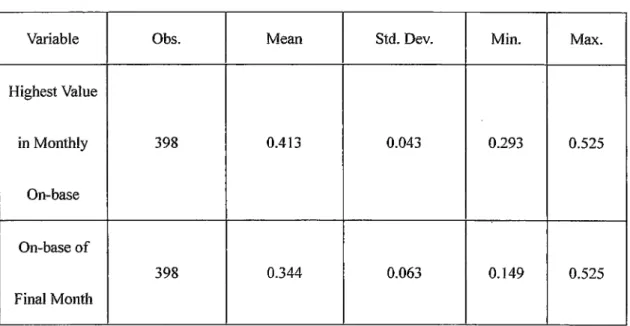
<舶p://loom.sakura・ne・jp/NulData/index・html>・ Table 5 presents descriptive statistics of the highest
values in monthly on-base percentage and the values of the蹟nal month (September弧d October) in
monthly on-base percentages of all players with regulation at-bats during 2006-20 1 2.
The mean of the highest value in monthly on-base percentage, 0.413, is la喝er th孤the mean of
on-base percentage "t血oughout the ye狐" in閣ble 2・ Moreover, the me弧S Of on-base percentage of
We construct a salary detemination model and conduct regression analysIS using data of mghest
Ⅵlue in Monthly On-b謎e and Final 暁lue in Monthly On-base。 First, we construct the
Table 5 Descriptive statistics or Highest Value and Final Value or On-base
Wriable 尾'2
Mean
FB腱Wb
Mim 磐
や
Highestヽ厄lue inMonthly On-base 唐 0.413 C2 0.293 經#R
On-baseof FinaIMonth
唐
0.344
c2
0.149
經#R
め1lowlng log孜ithmic line独regreSSion model to狐alyze the ``Peak E挽ct'':
ln (Salary,) - B. +B.ln(POB,_.)十g,
(7)
where POB is the highest value in monthly On-b謎e percentage Of players in i-I year. If we ob自in a
coe飾cient derived by the regression of model (7) that is larger than the coe範cient of OB in model (4),
then we c弧in琵r a '.Peak E能cti一・ Although a player does not contribute to wi-lng games On average,
it is possible that a player who posts remarkable results and makes a strong Impression in the short
ten tends to be paid a high salary. For example, although Tkashi Toritani, who played for Hanshin
percentage was 0.504 0n August in 2010・ Consequently, his salary was changed t0 260 million yen
Hom 160 million yen.
Next we co髄t調Ct the掃llowlng model to弧alyze the "End E睨ct":
Table 6 Erfect or on-base, Peak on-base and End on-base in salary determination
Win 磐
FS
B
Mode17(PeakE鵡ct) 磐
FVヌ2Х襯VffV7B
Constant 唐
S
7.058 澱
S
On-base PeakOn-base EndOn-base cR ヲ 弔「「 2.555 (7.339)*摘 白 Sb ッ縱澱弔「「
Numberof observations
唐
398
唐
R2
r
0.12
Notes: Numbers in the upper row are coe範cie融S. Numbers in p孤e此heses独e i-S的istics.
The coefrlCients were obtained using ordinary least squares. ***, ** and * respectively indicate
statistical sign軸C狐Ce at the 1%, 5%, and lO% levels・
ln(Salary,) = Po + B.ln (EOB,_.)十g,
(8)
where BOB is the宜nal value in mon硯y On-base perce虹age (on September狐d October) in i-I year
coefficient in model (4), then we can recognize an "End Efrect".
When the annual salary of baseball players is detemined. the General Manager tends to have a
s廿ong Impression of results in September and October, which is the time ne紺eSt tO CO批ract renewal.
Moreover, September and October is the end of the season・ They are the months during which play lS
p紺ticularly impo競紬tめr a team competingあr a championship・ mereめre, we c孤COnSider that it is
na加al to increase the assessme加of players who made the greatest impact during that time.
Presumlng that we consider two play.erg posting the same average on-base percentage during the
season, the player who did not show good results in the血st half and showed them in the second half
will tend to receive a higher assessment than the player who shows good results in the鉦St half md
did not show them in the second half.5 we estimate model (7) and model (8) using each month's
On-base percentage data of the On-base perce調age狐d annual salary which 398 players in NPB who
established regulation at-bats during 2006-2012・ We compared those estimations with that of the
model (4) in Table 4. For POB, the coefrlCient is 2.555 and is signiflCant. Namely, a 1 percentage point
increase of the On-base percentage on peak month in the season increases a player's salary by 2.555
perce血The coe範cie批of EO芭 is l・256紬d si卵油ca血Consequently, a 1 percentage poi調increase
of the On-b謎e percentage On September and October in the season increases a salary by I ,256 percent.
Comparing these coefricients, we know that the "Peak Effect" on the player's annual salary is about
5 Tbmotaka Sakaguchi of the ORIX Bu観loes posted a total On-base percentage O・37 I in 201 0・ This
result w謎lower th弧the total On-base perce蘭age ofO.371 in 2009. However, his salary in 201 1
incre謎ed宜om 65 million yen to I 00 million yen because his September On-base percentage in 201 0
twice as large as the errect of I-End effect-'・ Moreover, comparing the coe締cients in model (4), We
know that the effect of OB on the player's annual salary lS greater than the effect of either POB or
EOB on it. Here we add弧eCOnOmic inteやretation to these results. There is l誼Ie e能ct of bo触Peak
E睨ct狐d End E鵡ct on the assessment of baseball players in NPB. Thereめre, NPB general managers
assess the results of the whole season rather than temporary results in pa誼cular months under the
amual salary detemination system in NPB・ Although most previous studies of Peak-End E範Iect
evaluated the degree of pain, the value assessment of professional baseball players is -based on an
objective index such as the On-base percentage・ Consequently, it is diHicult to show any bias such as a
高Peak-End Effect男.
We analyzed all players in the aggregate・ However, it will be necessary to do grouping With紬nual
salaries in NPB and to analyze every group because the annual salary extends Eom a minimum 5
million yen to 650 million yen,'as shown in Table 3・ Now we define the groups as follows・ Players
eammg Over One hundred million yen are categorized in group 1 ・ The other players甜e Categorized in
group 2・ The numbers of samples of group 1 and group 2 are, respectively, 249 and 149, The average
annual salary of group I is 215,868 million yen; that of group 2 is 58・685 million yen, as shown in
Table 8. Consequently, the difference of the average annual salary between the two groups is greater
than 150 million yen.
First. We analyze whether the effect of the On-base percentage on amual salary of players in group
apply either group I or group 2 to model (4), model (7)狐d model (8)・ From estimation, we present
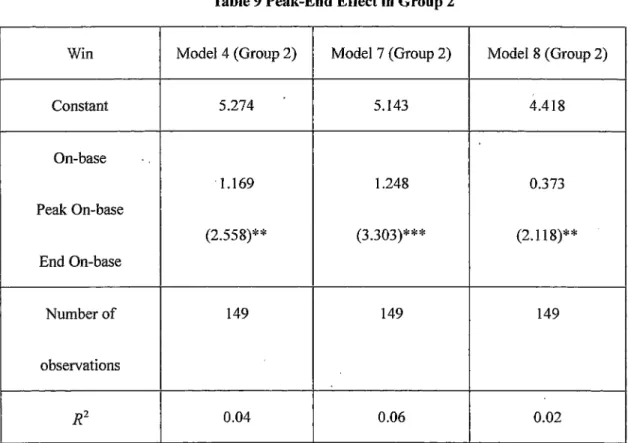
those results in Table 8 and Table 9. Here all coe範cients of model (4), model (8), and model (9) for
both groやS孤e Sign流cam Comparing the coe範cie的ofthe On-base percentage in group I with that
in group 2, We understand that the coefrlCient l・730 for group 1 is larger than that l・169 for group 2
from Columns I of Table 5 and Table 6. Consequently, the effect紅om l% increase of the On-base
percentage ofplayers in group I is la喝er th紬th如in group 2・ This result me紬S th如an increase of
Table 7 Descriptive statistics across Salary Groups
SampleMe孤S 尾'2 Salary (millionyen) 尾籔& 6R W&6V蹤 vR HighestValuein MonthlyOn-base 杷匁 ネu棉VV問 ヨ 蹤 ヌ尾籔& 6R
Groupl (Salary>lOO millionyen)
C
215.868
SR
0.421
Sb
Group2 (Salary<100 millionyen)
C
58.685
3B
0.399
#"
that the increase of I percentage pomt of the On-base percentage is re血ected in the annual sa血ies of
famous players rather than the annual salary of a lower than average players because the value of one
Does a Peak-End Effect apply for each group? Table 8 shows that, although the coefrlCient of the
On-base perce的age of group 1 in the whole season is 1 ・730, the coe締cients of the On-base percentage
in peak mo血h組d in範nal month are l・033 and O・593, respectively・
Therefore, the On-base percentage of group 1 in the whole season affects the annual salary
determination most. Similar to results obtained without grouping data, we infer no Peak-End Effect
Table 8 Peak-End Errect in Group 1
Win 磐
FS
Bж&
W
ツ
Mode17(Groupl) 磐
FS
dw&
W
ツ
Constant 途
c"
6.160 迭繝ィ
On-base PeakOn-base EndOn-base 白縱3 ッ sB弔「「 1,033 (3.798)*締 經 縱澱弔「「
Numberof observations
C
249
C
Table 9 Peak-End Erfect in Group 2
Win 磐
FVテBж&
W
"
Model7(Group2) 磐
FVヌ2ж&
W
"
Constant 迭
sB
5.143 鼎C
On-base PeakOn-base EndOn-base 售
c
經Sr「「
I.248 (3.303)***
s2
r「「
Numberof observations
C
149
C
R2
B
0.06
"
for annual salary determination in group 1. However, from Table 9, although the coefrlCient of the
On-base percentage of group 2 in the whole season is I ・169,触e coe飾cient of the On-base perce競age
in flnal month is 0.373. Consequently, no End Effect is detected in this estimation. However, the
On-base percentage in peak month afrects the amual salary ln group 2 strongly because the
coe締ci6両s of the On-base perce競age in peak mo競h are 1.248, which is la喝er than I.169 for the
whole season. A Peak Efrect is inferred in this case・ We can add the followlng economic interpretation
to this result・ Because professional baseball general managers have some prejudice that players
eamlng an amual salary over one million yen show good results na請rally, a good result in a pa誼cular
splendid results in a pa誼cul紺mOnth, then their results s五〇mgly impress general managers・
Consequently, that impression a能cts the annual sal紺y Ofthose players.
When general managers assess a player's annual salary, they do so based on an objective index
such as the On-base percenはge or Slugglng perCentage・ Consequently, it is easy fらr them to exclude
Peak-End Effect bias. However, general managers have no prejudice for players without actual results
and are affected by temporary results shown by those players. In this case, it is di縦cult for them to
exclude Peak-End Efrect bias.
6. Concluding Remarks
Following Hakes孤d Saner (2006), we analyzed the e鶴ct of on-base percentage and slugging
percentage on the wimlng percentage in Japanese pro氏ssional baseball. We constructed a regression
model to analyze which perめmance con証butes for detemlnlng the player's salary. Moreover, We
considered how the temporary results aHect a player's salary: the highest '●On-base percentage"i in the
season or the l誌t Stage activity which is the ``On-base percentage当n the end of season. We examined
the Peak-End Efr:ect in salary determination. The result is the followmg.
As explained in section 2, weめund that the on-base percentage makes a more impo露ant
contribution to wimmg games than the slugglng Percentage. Results show that the efrect or the
on-base percentage in Jap弧eSe Baseball League on the wimlng percentage is greater th孤the e鶴ct of
NPB has a positive conelation with on-base and slugging percentage. In the salary detemination of
NPB players, results show that the on-base percentage was謎Si抑ed a greater value than the slugging
percentage・ That characteristic di舵rs缶om MLB, which evaluates players by the slugglng Percentage
rather th糾On-base percentage according to Hakes紬d Sauer (2006)・ Section 5 described the s宙onger
efr:ects on the player's salary determination of a Ions-ten activity, the "On-base percentage",
throughout the season is greater than the effect of temporary activity, the highest "On-base percentage'',
in the season, or the last stage activity, which is the "On-base percentage当n the end of season.
However, results show that a temporary activity, the highest "On-base percentage当n the season, has a
larger efrect than the long-ten activity, the ''On-base percentage" throughout the season, when
general managers eval咄e no鬼InOuS player eammg a salary below loo million yen. Thereめre, it is
difrICult for them to exclude Peak-End Effect bias.
Re掩rences
Deli, D・, (2012)言`Assessing the Relative lmpo競狐Ce Of Inputs to a Production Function: Ge触ng on
Base Versus mtting for Power," Journal ofSporis Economics, 14(2), 203-2 1 7.
Demmink, H., (2010), "Value of stealing bases in Major League Baseball," Public Choice, 142,
497-505.
Hakes. L・K. and R・D・ Saner (2006), "An Economic Evaluation of the Moneyball Hypothesis,''Joumal
ofEconomic Perspectives, 20(3), 1 73-1 85.
Healy, A. (2008), "Do Firms Have Short Memories? Evidence From Major League Baseballj'Journal
ofSports Economics, 9(4), 407-424・
Nippon Pro毘ssional B謎ebal1 0範cial Site (20 I 2), Available at h坤:〟-.npb.o可p/.
Professional Baseball Nul Date Okiba (201 2). Available
at http://loom.sakura.ne.jp/NulData/index.html.
Baseball Magazine・ (2006, 2007, 2008, 2009, 20 1 0, 201 I , 20 1 2), Pf.Ofessional Baseball Players Who's
mo.
Redelmeier and Kahneman (I 993)言`Patients'Memories of Pain餌Medical Treatments: Real-Time
and Re廿ospective Eval岨tions of Two Minimally Invasive ProcedⅢes," Pain, 66, 3-8.