
幼児期における人間関係の質的発達とカテゴリー : 幼稚園の遊び時間における観察事例をもとにして
8
0
0
全文
(2) 132. family phenomena deprived friends in the same. this point of view is age. I think even children are. community. Children have lost a chance to play. same age, their quality of play is not same. The. among the same and similar generations.. age is very important factor to judge the quality of. e. Relationship between parents and their friends;. play, but it does not explain the reason why chiL. the relationship in the community is getting. dren tend to be alone even 6 years old. Therefore, I. weak. This may be reason why Japanese young. would like to study about this. But, I would like to. adult generation does not like deep relationship. study it based on his work. To recognize these. with others. SO, they often like to spend with. stages may help us to find factors. Here, I attempt. specific friends.. to categorize the relationship among children. And,. f. Parents choose their children s friends in some. I would like to help that we can find out factors,. reasons. They say "Our child likes to spend. which influence children s relationship in the future.. with this child." However, teachers guess that. I would like to clear the difference among the. they choose friend with good social status back-. same age and similarity among the different age,. ground.. and categorized quality of the human relations. g. Absence of knowledge of nursing for parents; most of Japanese families are consisted of single. through the cases of children's plays at the kindergarten.. generation Children in the community are getChapter 2. Approach. ting less. There is less communication in the community. Parents depend on nursing manual books too much. It is first time to meet the par-. 1. Method. ents who have the same age of their child for those parents. Then, they come to know how to. a. Place; the kindergarten of the Hyogo University. take care of their children. These factors are. of Teacher Education in Yashiro, Hyogo prefec-. based on teachers experiences. '. ture.. Children used to be thought that they could make friends easily even though they met first. b. Age; from 3 to 6 years old c. Period and Time of observation; September 8th. time, and they could share play quickly. What is. and 9th, 1998, from 8:30 A.M. to 10:30 A.M.. happening to children? What kindergarten and nurs-. that is called "Ureshino Time , which was estab-. ing schoolteachers guessed might be possible, but I. lished for free activities for children. Children. think that the factors are complex because several. start to come to kindergarten between 8:30. environments influence human beings. Thus,工must. A.M. and 9:00 A.M. There are some parents. find out how many factors there are what factor is. around there at that time. The condition of chil-. most influenced, and how factors influence children.. dren are several, some are sleepy, grumpy, and hungry. But, they began their favorite activities. Chapter 1. Purpose. with some friends or alone. Classes are mixed. There is no regulation for activities. They are. But, there are some questions to find out fac-. allowed to make activities in the room, play-. tors. I think that the relationship between human. ground and the rabbit gaze. Teachers make some. being is not so easy. We can not describe that he. activities for example playing soccer, feeding. has many friends, or he likes isolation.; That is just the amount. The quantity is not same as the. pets, and making crafts with a part of children.. d. Method of recording; Portable VCR.. quality. There are depth and width about human re-. I must pay attention to the children s intention. lationship. I think there may be some stages on. to me. Because playing with children disturbs. human relationship. Almost 30 years ago, Dr. Mioii. my observation. I must record their natural be-. Saito, who was a professor of Aichi University of. havior, conversation, and so on. Because I must. Education, studied the classification of play, the. relieve them under the pressure. For that pur-. point of development. This study is based on the. pose, I should record them as if I were a stone. age of children. I think this work is valuable, but. on the ground. I kept some distance for them..
(3) The Development of the Quality of the Human Relations in the Early Childhood. The children who were recorded by me did not. 133. can easily help each other.. ask any questions about my portable VCR. I re-. These points of view are consisted in most of. corded a group of children whose number was. children's activities, which I observed at the kinder-. more than two. I paid attention to their behav-. garten.. 1or and communication. I analyzed the recorded Chapter 3. Categorization through my observing chil-. tape at my house.. dren s play. 2. The point of view Section 1. The cases of play. I think that the factor, which prescribes the human relationship, must be trust. The depth of the human relationship is related to how much trust. I would like to introduce the cases of play of children, which I took at the kindergarten.. they have. Therefore, that is a question how I can. Case 1. Soccer. measure the trust among children. I concentrated. First, there were five boys. Each boy had his own. children s behavior and communication. I wonder. ball and kicked it against wall. Second, two groups. how they behave and have the communication each. of boys were formed and kicked each other. Third,. other among children. I noticed some points of view. they made one group, and began to play a game.. while I was observing.. A boy said "It is a off-side. I thought they had a. At first, how do they communicate each. rule but it might be not their own rule. It might be. other? J. Dewey said "Communication is very im-. J-league rule. Finally, a teacher joined the game.. portant. She told children to call more children to join them.. method. to. share. experiences.止Without. communication, we do not understand each other.. Children started to go for calling other children. A. Communication connects us. Communication means. couple minutes late, they prepared two soccer goals,. not only verbal communication, but also non-verbal. took apart of two teams, and set off the game.. communication. Communication is to begin the. The teacher took a role of judge.. human relation as well as to deepen it. Thus, I. Case 2. Drawing. think that the amount of children s communication. Two boys drew pictures on the playground. They. is very important. Second, how do they help each other? If they. were drawing at the same place but they did not talk at all.. want to enjoy play with other children, they must. Case 3. Playing a house. corporate each other in the same activity. I must. Spontaneously, some children came to a play-. find out how they help each other. Third, how do they keep rules? To keep. house. They decided their role. Then, they brought some tools, for example, source pan, kettle, and. rule, or to respect a rule means giving trust to. cooking board. They seemed to begin to play a. other children, but if you do not trust someone,. house.. you make a rule with him. I think that keeping a. Case 4. Isolation. rule and respecting a rule have two opposite mean-. A boy poured water into a pot by himself. A teacher was by him. The teacher tried to talk to. ings. Forth, how do they understand the role of play? If we make action together, we must under-. him, but he did not answer to him. Case 5. A playground equipment. stand goal. Without understanding our purpose, we. Four children played at the play ground equip-. can not reach to our goal together. If, I understand,. ment. They talked and enjoyed, but they enjoyed by. each of children playing together knows their role. themselves. They did not play together.. in their play, they understand their goal in their. Case 6. Blocks. play. Finally, how do they share image of activi-. Two boys played with large blocks. They built an. ties? They have to know their goal of activity.. airplane. However, they did not talk about their. But it is not enough, until their goal, they must. plane at all.. know where they are. If they share the image, they. Watching those cases, I can find some clues.
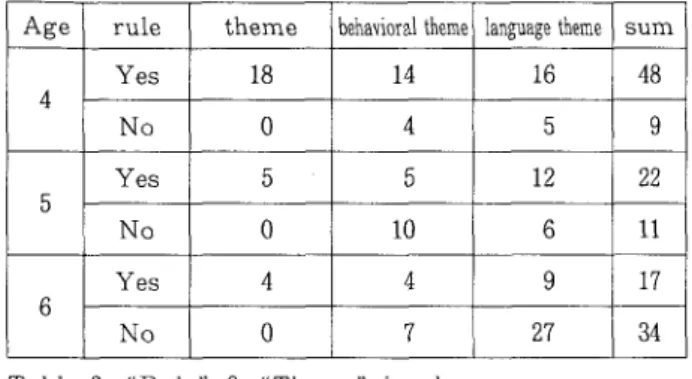
(4) 134. for classifying the human relations. 1. At the beginning, children played alone, then. He said that the stages of play were based on prior stage, but after children took the prior stage of. some children came together. Then, they. play. began to play under a rule. Finally, authorized. [Table 3]. into. inside,. they. stepped. up. to. the. next. stage.玩. I would like to classify the human relations. person conducted the game. 2. They enjoyed drawing but not playing together.. based on that point. And I also think that the de-. The pictures were not same, or-similar. They. velopment of human relations is regulated by the. might stay together. They did not talk at all.. following three aspects, image, communication, and. 3. From the beginning, children came together,. rule-respect. I would like to renewal his designs.. they decided the role, and then, they prepared. Here, I classify the quality of human relation in. toys and tools. They did not talk so much.. three levels and five stages.. But soon after the starting to play a house, they played the role and talked.. Section 3. Renewal. 4. I thought this was a teacher s one way commumcation. The teacher did not understand what. I attempted to classify the quality of human. he imaged. He did not communicate with a. relations into three levels and five stages with three. person who did not understand him.. aspects of images, communication, and rule-respect,. 5. They enjoyed play at the playground equip-. 1. Image. ment, not friends. By chance, children who like. I think it is very important to share image. to play it came together. Their rules and im-. of play for children who attend the same activity.. ages were not same or similar.. For example, a couple of children play with big. 6. Their image about an airplane is very similar.. blocks to build an airplane. If their image is quite. Thus, they could build an airplane without any. different, they can not complete their airplane. Or,. talking.. if some children play a house, without sharing image, they live in a different house. To share the. Section 2. The Dr. M. Saito's theory about developmerit of play. image makes their play complete. 2. Communication The communication both verbal and non-. He classified play of children in two points. verbal is needed to share image. The more commu-. of view. One was "theme," the other was "rule.". nication they have, the more they understand each. "Theme meant how children expressed the content. other. The amount of communication among chil-. of their play by the behavior or language. Judging. dren expresses how much they have relationship.. from this point of view.. 3. Rule-respect. A. The play without "theme". There are a couple of rules in an easy play.. B. "Theme" by behavior. For example, a slid, they regard it as a mountain,. C. "Theme" by language. that is a rule. Rule making helps to share an image. Observing plays by this point of rule, we can. of play. I think that a person never promises a rule. see not only the change of quantity (increase of. with a person whom he hates. That means that. rules), but also quality (physical to relational). they need some trust to make a rule. I think there. [table 1, 2] This change shows that play develops. are two types, one is to obey general rule in their. on the group of stages.. society, and the other is to make a rule among chil-. 1. At the stage of the simple repeat of the play. dren. The latter is needed more trust among chil-. without "theme , we can see the play without a. dren.. rule.. 2. At the stage of "theme'by behavior, we can see. Chapter 3. Categories. the play with ad hoc rule. 3. At the stage of "theme by language, we can see the play with relational rule.. a. Three levels The point of image as followmgs can classify.
(5) The Development of the Quality of the Human Relations in the Early Childhood. three levels,. 135. However, their trust is not enough strong to con-. 1. Non-image sharing. trol them by themselves. They can not ask a child. 2. Partly image sharing. to make their rule, and they can not negotiate. 3. Completely image sharing.. each other to make rules. Therefore, they take. 1. Non-image sharing. rules, which are made by other people, or social. There are no sharing images among children who. rules.. are alone or even together.. 3. Autonomy rule. 2. Partly image sharing. They can make their own rules by negotiation. Children do not share image of activity well.. or other methods. They trust each other very. But they can make some activities together.. much. They can solve their troubles by them-. They need explanation on each activity to do at. selves.. each time each other. 3. Completely image sharing. I am going to categorize the quality of the human relations into three levels and five stages. At first, children decide what they are going to. with those aspects. (Table4). do. Then, children can understand their activity. A. Isolation. each other without any explanations during their. B. Non-communication but staying together. activity.. C. Communication but no rule. These are classified by how much children share. D. Heteronym rule & communication. their image on play together.. E. Autonomy rule & communication. b. Five stages Five stages are classified By communication;. A. Isolation The condition that child does not spend their. 1. Non-communication. time with other children. For example, drawing. 2. Minimum necessity communication. picture.. 3. Fully-communication,. B. Non-commumcation but staying together. Rule-respect ;. Children seem to play with other child, but. 1. Non-rule. they do not either share image, or commumca-. 2. Heteronym rule. tion. They are together, but they do not play to-. 3. Autonomy rule. gether. For example, a child drew on ground, another child stayed beside him and drew on. 1. Non-communication There is no communication among children even though they stay together.. 2. Minimum necessity communication Their communication among children appears. ground, but there was no communication. D. Communication but no rule Children play at the same place and enjoy communication, but they do not have rules, for example, when they play at ground equipment,. just when they feel necessity.. they enjoy playing with it, but they do not en-. 3. Full-communication. joyed playing with their friends.. The communication among children is made for not only explanation about activity but also enjoying itself. 1. Non-rule There is no rule among their play. Even they. E. Heteronym rule & communication When children play soccer, they use J-League soccer rules. Or, if there is a kindergarten teacher, children obey the rule, which is made by the teacher. They can share image, and have com-. do not make rules. Because they play together,. munication, but they can not make their own. but they do not join the play. Each enjoys by. rules.. himself. They share time and space, but they do. F. Autonomy rule & communication. not share joy. Thus, they do not need rules. 2. Heteronym rule They enjoy sharing time, space, and joy.. On playing a house, they must make their own rules. Each child has to understand what it should do for playing a house. They attempt to.
(6) 136. help each other, for example, a child brings a source pan, and another child brings water. They must trust each other.. i These are based on the paper of Hiroaki Sono at the Japan Society of Children Study 1998 in Sendai. ii Dewey, John, translated by Hiroyuki Kanemaru,. Conclus ion. Democracy and Education 1984 Tamagawadaigaku Shuppanbu, pp.36-37. As I explained above, we can categorize the activities of children with three levels and five stages. These levels and stages are classified based on three aspects of contents of children s activities. But, I think the base of the human relationship is trust. The meaning of the development of human relationship is to develop the trust between more than two persons. It is very difficult to evaluate human trust. A mouth does not always speak only truth. Therefore, I attempted three aspects, which can be judged by looking outside. These levels and stages are based on real children's activities. It is true that children's activities are not easily cut down. They are more complex. I think these levels and stages will help to find out the factors, which influence the relationship to children. The quality of human relationship is influenced by their ability to create, maintain, and develop mutual human relations. The ability of human relations is called the third human ability, following intelligence and emotion. Thus, we must find out how to measure the third human ability.. Bibliography. (1) J.デューィ,金丸弘幸訳『民主主義と教育』 1984玉 川大学出版部 (2) R.E. --トレー, L.K.フランク,R.M.ゴールデンソー,. 上田礼子訳『子どもの発達と遊び』 1978岩崎学術出版 (3) F.ハイダー『対人関係の心理学』 1978誠信書房 (4)兼子宙『人間関係の心理』 1958中山書店 (5) S.ミラー,森垂敏・森林監訳『遊びの心理学』 1980 家政教育社 (6)ピアジェ,エリクソン,赤塚徳郎・森柳監訳『遊びと発 達の心理学』 1983繋明書房 (7)西頑三雄児『遊びと幼児期』 1974福村出版 (8)高橋たまき『乳幼児の遊び-その発達プロセスー』 1984 新曜杜 著者 田中亨胤兵庫教育大学幼児教育講座 爾寛明兵庫教育大学大学院博士課程 佐藤哲也兵庫教育大学幼児教育講座. iii Saito, Mioji, Asobi to Youiiki, 1974 Fukumura Shuppan. pp.159-161.
(7) The I⊃evelopraent of the Quality of the Human Relations in the Early Childhood. A ge. R o le sh a rin g. "R u le '. Su m. N o. u n clea r. Y es. Y es. 31. 7. 10. 48. N 0. 4. 1. 4. 9. Y es. 9. 7. 6. 22. N 0. 2. 3. 6. ll. Y es. 7. 4. 6. 17. N 0. 0. 2. 32. 34. 4. 5. 6. Table 1. Role sharing and "rule'of play. A ge. r u le. th em e. behavioraltheme language them e Su m. Y es. 18. 14. 16. 48. N O. 0. 4. 5. 9. Y es. 5. 5. 12. 22. N O. 0. 10. 6. ll. Y es. 4. 4. 9. 17. 0. 7. 27. 34. 4. 5. 6. l. N 0. Table 2. "Rule" "Theme" in play. S tage. nam e P re-play. 1. O bserving play Sim ple im itation play P lay w ithou t "rule. 2. P lay w ith "them e. &. "them e. but w ithout "rule. P lay w ith "th em e ' & b uilding 3. `rule". P lay w ith "them e" & rule. Table 3. The stages of development of play. Stage im age communication Rule-respect 1. LOW. Low. LOW. nam e Isolation. 2. Non-communication but staying together. 3. Communication bat no rule. 4. Heteronym t a le a communication. 5. H igh. H igh. H igh. Aut o nomy rule & communication. Table 4. The stage of development of the human relational quality. 137.
(8) 138. 幼児期における人間関係の質的発達とカテゴリー ー幼稚園の遊び時間における観察事例をもとにして一 要約 子ども社会において人間関係作りの難しさが指摘されることが多くなってきた。保育現場からの報告によると、幼 稚園や保育所において1日中1人で過ごしたり、特定の仲間としか遊ぶことが出来ない子どもが目立ってきている。 友達ができない子どもについての研究はかねてより行われてきているが、以前と比べると質ならびに量において変化 が見られる。量においては人間関係作りの難しい子どもが目立ち初め、質においては、かつては性格的に他者から受 け入れられない、例えば、暴力的であるなど、このような状況であったのであるが、昨今ではむしろ自分の方から積 極的に関わりを持とうとしなくなっているのである。このようなことから、ここ数年の間に子ども社会にどのような 変化が起こってきたかについて考える必要がある。社会においては少子化現象・子どもにおいては遊び時間の短縮や 遊びの質的変化などが考えられるが、その要因としてあげられるのは様々である。しかし、何が、もしくはどのよう に組み合わさることによって、人間関係作りの難しい子どもを形成しているであろうか。その要因を見つけだすこと が重要である。 各々の要因についてはその強度・量・方向性によって違いが生じる、また幾っかの要因が複雑に絡み合うことで結 果においてはさらなる差異が生じてくる。したがって、安易に人間関係作りの難しい子どもとそうでない子どもとの 二元的に分けることでは本質的な問題は見えてこない。そこで人間関係において、そのつながり方に幾つかの段階が あるものであると推察するのである。これは例えば子どもの友達の人数が多いか少ないかというような見方もあるが、 しかし一方で、 「友達は多いが親友と呼べる者はいない」というように、数と深さは必ずしも一致するとは限らないo ここで問題としたいのは、 「数」よりも「質」である。したがって子ども期における人間関係の質的段階について考え る必要がある。 人間関係模様が顕著に見られるのは、自由遊び時間である。したがって、遊びにおける子どもの人間関係を観察す ることが最適な方法であると考えた。遊びについてはピアジェなどによって、その発達が述べられている。しかし、 一般的に述べられているのは、認知発達に基づく遊びの発達であって、主として年齢段階によって規定されているも のである。しかし、そうしたモデルでは同年齢における差異、異年齢における同質性についての説明には不十分であ る.そこで新たなる指標が必要となってくる.そこで「遊びの発達」のモデルを用いて、それに新たにコミュニケー ションという軸を盛り込むことにより、イメージの共有を基本として三水準に分け、コミュニケーションとルールを 基本としてそれを五段階に分けることにした。 この三水準五段階モデルによって、子ども同志の人間関係における信頼関係を見ることで、子どもの人間関係の質 的段階を判断できるものと考える。しかし、子どもの信頼関係というのは相対的なものであるので、相手が変わるこ とによってその質的な変化が起こるのではなかろうか。したがって、子どもの複数の人間関係にも目配りをしていく 必要がある。それにより、子どもがどれほどの人間関係を持っことができるのかが明らかになる。子ども個人の持っ 人間的能力としての「人間関係力」を導き出すことができるのである0.
(9)
図
関連したドキュメント
たRCTにおいても,コントロールと比較してク
79 人民委員会議政令「文学・出版総局の設立に関して」第 3 条、Инструкция Главлита его местным органам, I-7-г 1922.11.「グラヴリット本部より地方局への 訓示」第1条第 7 次、等。資料
断面が変化する個所には伸縮継目を設けるとともに、斜面部においては、継目部受け台とすべり止め
[11] Karsai J., On the asymptotic behaviour of solution of second order linear differential equations with small damping, Acta Math. 61
の総体と言える。事例の客観的な情報とは、事例に関わる人の感性によって多様な色付けが行われ
ヨーロッパにおいても、似たような生者と死者との関係ぱみられる。中世農村社会における祭り
なお、保育所についてはもう一つの視点として、横軸を「園児一人あたりの芝生
Digital media has had a profound impact on human behavior.. Nevertheless, articles about digital media have focused on the power of the technology rather than the impact it has had on
