What Impact Does Work Experience in the Field
of ELT have on Teacher Use of Moodle, a Well
Known Course Management System?
著者
Stanley Iain
journal or
publication title
Comparative culture,the journal of Miyazaki
International College
volume
16
page range
52-68
year
2011
52
What Impact Does Work Experience in the Field of ELT
have on Teacher Use of Moodle, a Well Known Course
Management System?
Iain Stanley
Abstract
This paper looks at the impact that work experience has on the use of technology, specifically, a Course Management System, called Moodle. Participants came from a private language university in Japan. Participants completed an online survey relating to their use of Moodle, and their work experience in the field of ELT. Prior research had indicated that work experience was a factor in the use of
technology. A Spearman’s Rank Order correlation test, and a Kruskal-Wallis means test was used in SPSS to analyse the results from the online survey. No correlation or link was evident.
Introduction
Research in the past decade has shown that computer technology is an effective means for widening educational opportunities. The advancement of
technology in the field of education has been rapid, and in the last ten to twenty years, the development of tools for teaching through technology has been astounding, so much so that educators and curriculum planners have found it difficult to keep up with the pace of the technology. However, research has also indicated that most teachers neither use technology as an instructional delivery system, nor integrate technology into their curriculum.
53
There have been a variety of reasons put forward as to why technology has not been integrated into education as ubiquitously as it has been in everyday life. Some reasons include a lack of pre-service training; a lack of in-service opportunities; a lack of confidence in using technology; a disconnect between teaching values and perceptions of technology; and a lack of understanding in using specific forms of technology.
The purpose of this study is to look at the impact that work experience has on the use of technology. Specifically, it is looking at faculty members at a private
language university in Japan, and what impact their work experience had on their uptake and use of a Course Management System, called Moodle.
Moodle
It is important in the context of this study to explain what Moodle is, and how it relates to the advances in educational technology and the availability to educators. Moodle is a well-known e-learning platform in educational institutions, including universities and colleges. Since its inception in 1999, many universities and colleges have chosen to use Moodle as their exclusive CMS. Indeed, as of October, 2011, there were 56,349 active Moodle sites, that had been registered from 213 countries. Some well known universities and colleges currently using Moodle include University of California, Irvine; Dublin City University, Ireland; University of York, UK; California State University, Humboldt; The Open University, UK; Louisiana State University, USA; Idaho State University; USA; The University of Barcelona, Spain.
54
One advantage of using a CMS such as Moodle, is that teachers can keep everything centralized in the one online learning environment. Teachers at any place that has Moodle installed simply create a course, name it accordingly, have their students enroll in the course and then upload any files they need to. They can also create any number of activities for students to participate in. Some typical features provided by Moodle include file upload / download; assignment submission for students; online quizzes; instant messages; email; online calendar; online news and announcements (at a site-wide level or single-course level); discussion forums; wikis; and grading features.
Importantly also, is the fact that Moodle is consistently ranked among the top CMSs available. An annual evaluation of different CMSs (and any other form of technology) is that done by the Centre for Learning and Performance Technologies (http://www.c4lpt.co.uk/), a well-respected and publicized website that houses one of the most complete compilations of trends and tools in the emerging technologies landscape. In its ‘Top 100 Tools For Learning’ guide for the years 2007-2010, it listed Moodle as the top CMS each year. In 2007, Moodle was ranked equal 12th (and top CMS); in 2008, Moodle was ranked 9th (and top CMS); in 2009, Moodle ranked equal 14th (and top CMS), 2010, Moodle ranked 10th overall (and top CMS), in 2011,
Moodle ranked 5th overall (and top CMS).
The explanation of Moodle is an important point in the context of this study, because particular forms of technology are vitally important in the decision-making process of educators to use them or not. All technology is not the same. As Rogers (2003) says, the importance of a particular innovation cannot be underestimated in the diffusion process. Thus, in demonstrating that Moodle is indeed one of the top forms
55
of CMSs available, it serves to illustrate that faculty members had the opportunity to incorporate one of the most potentially beneficial tools into their teaching practice.
However, the fact remains that Moodle was very much underused at the university. There may have been a number of reasons for that, but to look at them all is beyond the scope of this study. This study will focus on work experience, and examine what impact it had on the decision of faculty members to use Moodle or not.
Literature Review
Work experience has consistently been referred to as an influential factor in relation to technology use and take-up by teachers (Dupagne & Krendl, 1992; Fordham & Vannatta, 2004; Hadley & Sheingold, 1993; Honey & Moeller, 1994; Jaber & Moore, 1999). Rogers’ diffusion theory (2003), states that the process of innovation adoption is certainly influenced by one's experience. According to Rieber and Welliver's (1989) model of instructional transformation, experience is a
fundamental part of taking up an innovation.
A good example of prior research which indicates the role that work experience may play in technology use and take-up by teachers was that done by Meskill et al. (2002). In her study, Meskill and her colleagues examined L2 teachers’ use of computer technology in relation to prior technology training, by focusing on the contrast between novice and experienced teachers. The findings of the study showed that the novice teachers, even if they had received prior, formal technology training, felt less comfortable in using computer technology for their classroom instruction, than did the experienced teachers with no, or relatively little, formal technology training. The implication here is that teachers with more years in the ELT field, regardless of
56
training or prior education in the use of technology, are more likely to use and/or feel more comfortable integrating technology into their teaching practice. This sentiment is further reflected by Jacobsen (2000), who says through his research that years of experience in a particular field has a big impact on the decision to use and integrate technology into teaching practice.
In addition, Tornatsky and Klein (1982) found that an important innovation characteristic which had a positive correlation with technology adoption was
‘compatibility’. In explaining ‘compatibility’, Tornatzky and Klein describe it as the degree to which an innovation is perceived as being consistent with the existing values, past experiences, and needs of the users. In relation to the work experience of a teacher, the interesting point about this is that if new, relatively inexperienced teachers are consistently being hired at universities, with little to no pre-service training or past experiences, then it may be arguable that such teachers have any ‘existing values’, ‘past experiences’ or particular ‘needs’. As Tornatzky and Klein indicate, ‘compatibility’, in the form of existing values and past experiences, are seen as important in the take up and use of technology. Ritchie and Wiburg (1994) add further weight to this idea by saying that "traditional perceptions of what teaching, learning, and knowledge should look like are major limiting factors to integrating technology" (p. 152).
A further study which echoed the sentiments above was that done by Russell et al (2003). The study highlighted important relationships among teachers’ levels of computer use and their beliefs about, and confidence for, using technology.
Surprisingly, high confidence for using technology was not a direct predictor of teachers’
57
classroom uses. It indicated that, while new teachers may be more comfortable with the technology tools, they may lack an appreciation for the value of technology as an instructional tool. Alternatively, they may lack the organization and management skills needed to use technology effectively in the classroom, which are skills that are developed through years of experience. The salient point being made here is that experience is a more pertinent issue in relation to teacher take-up of technology.
The literature seems to suggest that work experience has a powerful influence on the adoption rate of technology. The issue seems to revolve around the experience that a teacher has, and how that experience shapes their beliefs and values about education, teaching, and pedagogy. This would suggest that teachers with more experience, and years in the ELT field, would be more likely to take up technology, or identify an innovation as being consistent with their own ideals. In turn, one might infer that if teachers with little, to no prior experience in the field, are hired for
positions, then they would be far less likely to use an innovation or see it as consistent with any values they may have had. It will be interesting to see if the ideas posited are consistent with the results of this study.
Methodology
This study used a quantitative approach. Quantitative research is usually linked to the notion of science as objective truth or fact, and usually begins with pre-specified objectives focused on testing preconceived outcomes. When applying quantitative methods, numerical estimation and statistical inference from a
generalizable sample are often used in relation to a larger "true" population of interest. As a result, quantitative research is most often seen as a method trying to demonstrate
58
relationships under standardized (controlled) conditions. (Casebeer & Verhoef, 1997). In this study, a quantitative approach was used to ascertain any relationships between work experience and use of Moodle.
Data Collection Method - Online Survey
An online survey was used to collect data relating to use of Moodle, and experience in the field of English Language Testing (ELT). The online questionnaire was created using www.esurveyspro.com. It was designed so that when participants opened their email they had to click on a link embedded in the email, which then directed them to the survey. An online questionnaire was the most efficient and convenient way of collecting data from faculty members, as the majority of faculty members had easy access to the internet and email. In the case of this particular study, because of the spread of participants around the world at the time the survey was sent, and a lack of home or work addresses for each, an online survey was the easiest and most efficient method of acquiring responses. The survey was sent to every teacher who was employed during the 2008/9 academic year, numbering 51. It was hoped that about 40 teachers would respond. In the end, a total of 42 teachers responded.
The dependent variable consisted of one item, relating to use of Moodle. The item that participants had to answer was How often did you use Moodle in your
classes in 2008/9? (over both semesters), with the answer options being Never; In one or two classes; In some classes; In most classes; In all classes.
The independent variables related to experience in the field of ELT. There were 4 items, or questions, sent to participants. The items, and the answer options available, were:
59
1. How many years’ teaching experience had you had in ELT (any kind of job) by 2008?
It was my first year; 1-3 yrs; 4-6 years; 7-10 years; 10+ years
2. How many years’ teaching experience had you had at the university level by 2008?
As above
3. How many years’ teaching experience had you had abroad at the university level by 2008?
As above
4. How many years’ teaching experience had you had at the university level in Japan by 2008?
As above
Participants
For this study, the subjects used were university teachers who were working at a private language university in Japan in the 2008/9 academic year. The total number was approximately 50.
Analysis
Analysis of the online survey was carried out using the statistical software package, SPSS. In relation to the question in this study, a variety of statistical methods of analysis were used.
A Spearman’s Rank Order Correlation test was run to test for relationships between the dependent variable ‘How often did you use Moodle?’, and each of the 4
60
items, or questions, in the category ‘Work Experience’. A Spearman’s Rank Order Correlation test was preferred to the Pearson Product Moment Correlation test. Even though the Pearson Product Moment Correlation test is one of the most common tests to be used in correlation tests, it can only be used when the two variables to be
measured are on either an interval or ratio scale (Laerd Statistics, n.d; Brown, 1998). The variables used in the correlation tests in this study were on an ordinal scale. Using an ordinal variable in the Pearson Product Moment Correlation test would necessarily violate the assumptions necessary. If the variables are on an ordinal scale, the
Spearman’s Rank Order Correlation test is the preferred test to use (Brown, 1998). Furthermore, in order to make comparisons between multiple groups of teachers, a Kruskal-Wallis test was preferred to the one-way ANOVA. The
Kruskal-Wallis Test is the nonparametric test equivalent to the one-way ANOVA and an extension of the Mann-Whitney Test, to allow the comparison of more than two independent groups.
Moreover, it is used when the basic assumptions of a parametric test
(including the one-way ANOVA) are not met. The three basic assumptions that need to be met if a parametric test is to be used are explained below.
1) You must have data that are from a measure that is at least interval -
nominal and ordinal variables are not good enough (Holttum & Blizard, 2003). An interval scale is one in which intervals at different points on the scale are equal. Examples are the Celsius and Fahrenheit temperature scales (Everitt & Wykes, 1999).
61
2) Your data must be from a population that has a normal distribution.
3) If you are comparing samples, the variances within each sample must be similar - this is known as homogeneity of variance (Holttum & Blizard, 2003).
If each of these three basic assumptions are not met, then a parametric test, including the one-way ANOVA, should not be used (Holttum & Blizard, 2003). In the case of my data, the basic assumption of the first criteria of parametric tests was not met. The variables used in my data were of a measure that was ordinal, not interval. For example, in the item ‘How many years had you worked at university in Japan by 2008?’ the options were ‘it was my first year; 1-3 years; 4-6 years; 7-10 years; 10+ years. In this case, it is clear that the intervals on the scale are not equal.
Therefore, it was not appropriate for me to use a parametric test, such as the one-way ANOVA. In that case, the equivalent non-parametric test was preferable. The non-parametric version of the one-way ANOVA, is the Kruskal-Wallis test.
Results
Descriptive Statistics
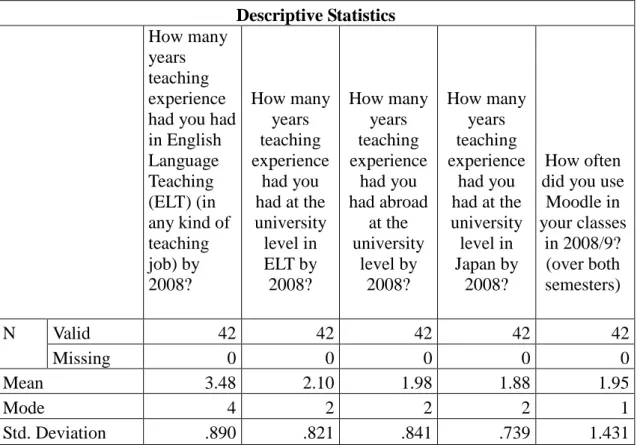
Table 1 below illustrates the descriptive statistics for each of the 5 questions that participants had to answer. In relation to the dependent variable How often did you use Moodle in your classes in 2008/9? (over both semesters) the most common response was ‘Never’ (signified by the number 1). The mean score was 1.95 (1= Never, 2 = In one or two classes). For the item relating to experience in the field of ELT, the mean score was 3.48 (3 = 4-6 years, 4 = 7-10 years). This would suggest that most participants were not completely new to the field of ELT. The three items
relating to university experience
each had a mean score around 2.00 (2 = 1-3 years), which suggests that most
62
internationally.
Table 1: Descriptive statistics for each item in the online survey
Descriptive Statistics
How many years teaching experience had you had in English Language Teaching (ELT) (in any kind of teaching job) by 2008? How many years teaching experience had you had at the university level in ELT by 2008? How many years teaching experience had you had abroad at the university level by 2008? How many years teaching experience had you had at the university level in Japan by 2008? How often did you use
Moodle in your classes in 2008/9? (over both semesters) N Valid 42 42 42 42 42 Missing 0 0 0 0 0 Mean 3.48 2.10 1.98 1.88 1.95 Mode 4 2 2 2 1 Std. Deviation .890 .821 .841 .739 1.431
Spearman’s Rank Order Correlation test
A Spearman’s Rank Order correlation test was run to determine the
relationship between the dependent variable How often did you use Moodle in your classes in 2008/9 (over both semesters)? and the category Work experience
(consisting of 4 items). The results
indicate that there was no significant correlation between the dependent variable and any of the independent variables.
The results from the Spearman’s Rank Order correlation test can be seen in full below. Table 2: Spearman’s Rank Order Correlation test results for Use of Moodle / Work Experience
63
Dependent Variable:
How often did you use Moodle in your classes in 2008/9? (over both semesters) How many years teaching experience had you had in English Language Teaching (ELT) (in any kind of teaching job) by 2008? How many years teaching experience had you had at the university level in ELT by 2008? How many years teaching experience had you had abroad at the university level by 2008? How many years teaching experience had you had at the university level in Japan by 2008? Spearman’s Rank Order Correlation test Correlation Coefficient -.050 -.029 -.127 -.068 Sig. (2-tailed) .753 .853 .422 .670 N 42 42 42 42
Kruskal-Wallis means test
Finally, a Kruskall-Wallis means test was used in order to test for differences among the means of teacher groups in relation to use of Moodle, and work
experience.
For the four items in the ‘Work Experience’ category, teachers were placed into one of five groups, depending on their answers. The different groups were: it was my first year; 1-3 years; 4-6 years; 7-10 years; 10 + years.
64
The results from each of the Kruskal-Wallis tests used on each item in the ‘Work Experience’ category, indicated that there were no statistically significant differences between group means, relating to use of Moodle. This means that teacher use of Moodle was not influenced by the groups that teachers belonged to, as
determined by the Kruskall-Wallis test. The table can be seen in full below.
Table 3: Kruskal-Wallis test results checking for difference between group means
Discussion
Initially, it appears that the results here are contrary to what was suggested in the literature review. The results in the Spearman’s Rank Order correlation test, and the Kruskal-Wallis means test, indicated that there was no correlation, or link, between work experience and use of Moodle. Granted, the literature review did not specifically look at Moodle, but as the review of Moodle illustrated, it is one of the top forms of technology available to educators, and arguably the top Course
Dependent Variable: How often did you use Moodle in your classes in 2008/9 (over both semesters)?
Grouping variables below (1-4)
Chi-square df Asymp.Sig (P value)
1. How many years’ teaching experience had you had in
ELT (any kind of job) by 2008? 1.938 3 .585
2. How many years’ teaching experience had you had at
the university level by 2008? 1.073 3 .784
3. How many years’ teaching experience had you had
abroad at the university level by 2008? 4.042 3 .257
4. How many years’ teaching experience had you had at
65
Management System. Therefore, there is no reason to believe that Moodle itself was inherently any different from what the authors were describing as ‘technology’ in the literature review, or that it was somehow worse than any other form of technology the authors may have been referring to.
At an individual level, there was no correlation between use of Moodle and work experience, and at a group level, there was also no difference among the means of each group, in relation to their use of Moodle. This means that work experience had no bearing on how a much a faculty member used Moodle or not. It is interesting that Everett Rogers (2003), considered by most to be the pre-eminent scholar in diffusion theory, suggests that experience has a key role to play in the diffusion process. It is interesting because in his diffusion theory, Rogers places innovation adopters into five distinct categories - Innovators; Early Adopters; Early Majority; Late Majority;
Laggards. However, in admitting individuals into one of the five categories, Rogers doesn’t really attribute any clearly defined characteristics to each category, and therefore they may be somewhat broadly interpreted and inclusive. For example, in discussing the dominant characteristics of each category, Rogers characterizes innovators as ‘venturesome’, early adopters as ‘opinion leaders’ who are widely respected in their social circle, early majority members as ‘deliberate’, the late
majority as ‘skeptical’ about the value of an innovation, and laggards as ‘traditional’. Though people may get a basic understanding of the type of innovator, or technology user, Rogers is trying to identify, it is not clear from these characteristics what role work experience might play in terms of the characteristics. For example, it is fair to say that a teacher with 10 years’ experience, or a teacher with 10 weeks’ experience, could both be deemed as ‘venturesome’ and willing to take risks in their
66
teaching practice. The teacher with 10 years’ experience may be in a better position to use the technology more effectively and efficiently, but it doesn’t necessarily mean he or she is more ‘venturesome’. Alternatively, there is no clearly defined maxim that states that a teacher with 10 years’ or 10 weeks’ experience will be any more or less ‘skeptical’ about an innovation than the other. The characteristics of Rogers’ innovator groups are not overly clear, and perhaps it is understandable then, why the results from the analyses indicated that work experience did not show any significant relationship with the uptake, or use of, Moodle.
It is also interesting to note that the majority of the participants had between 1-3 years’ experience at the university level. The descriptive statistics indicated that the total number of years’ experience in ELT for participants was mostly between 7-10 years. However, at the university level, it was only 1-3 years for the majority of participants. This illustrates that the majority of participants were new to the level of university teaching, and thus relatively inexperienced at that level. However, the results from the analyses indicated that this had no bearing, or correlation, to use of Moodle. Some teachers with few years’ experience at the university level used Moodle a lot, while other teachers with few years’ experience at the university level used Moodle sparingly, if at all. Furthermore, some teachers with a higher number of years’ experience in ELT used Moodle a lot, while other teachers with a higher number of years’ experience in ELT used Moodle sparingly, if at all.
Conclusion
This study examined the impact that work experience had on the use of Moodle, at a private language university in Japan. Prior research indicated that work
67
experience was influential in a teacher’s decision to incorporate technology into their teaching practice or not. An online survey was sent to approximately fifty teachers, asking them about their use of Moodle at the university, and their work experience in the field of ELT.
Despite indications of prior research, the results here showed that there was no correlation, or link, between work experience and use of Moodle. The results of this study seem to contravene a lot of the prior research on the subject. However, work experience itself has never been listed as a singular, or dominant factor, in the use and/or uptake of technology. It has always been presented as a factor, among many others.
There may have been other, unique, circumstances that were more of a factor in faculty use of Moodle. However, in looking solely at work experience, it appears that in the context of this study, it was not a factor in why Moodle was relatively underused at the university, or why some faculty used it much more than others.
References
Casebeer, A., Verhoef, M. (1997) Combining qualitative and quantitative research methods: Considering the possibilities for enhancing the study of chronic diseases, Chronic Diseases in Canada, 18(3), 130-135
Dupagne, M., & Krendl, K.A. (1992). Teachers' attittides toward computers: A review of the literature, Journal of Research on Computing in Education, 24{3), 420-429.
Hadley, M., Sheinglod, K. (1993) Commonalities and distinctive patterns in teachers’ integration of computers, American Journal of Education, 101(3), 261-315
Holttum, S., Blizard. B. (2003), Which test? A clinical psychologist's online guide to selecting a statistical test. Retrieved from http://whichtest.info/index.htm
68
Different values, different understandings (Technical Report 6). New York: Center for Technology in Education.
Jaber, W., Moore, D. (1999) A survey of factors which influence teachers' use of computer-based technology, International Journal of Instructional Media, 26(3) 253-256.
Jacobsen, M (2000) Paper presented at ED-MEDIA 2000: World Conference on Educational Multimedia/Hypermedia & Educational Telecommunication, June 26 - July 1, 2000, Montreal, Quebec, CANADA
Rieber, L., Welliver, P., (1998) Infusing educational technology into mainstream educational computing International Journal of Instructional Media, 16 (1), 21-31 Vannatta, R., Fordham, N. (2004) Journal of Research on Tecbnology in Education Teacher Dispositions as Predictors of Classroom Technology Use, 36 (3)