Iridium-Hydride-Mediated Stannane−Fluorine
and −Chlorine sigma-Bond Activation:
Reversible Switching between X-type Stannyl
and Z-type Stannane Ligands
著者
Kameo Hajime, Baba Yuki, Sakaki Shigeyoshi,
Bourissou Didier, Nakazawa Hiroshi, Matsuzaka
Hiroyuki
journal or
publication title
Designs, Codes and Cryptography
volume
86
number
9
page range
1947-1962
year
2018-09
権利
This document is the Accepted Manuscript
version of a Published Work that appeared in
final form in Organometallics, copyright (C)
American Chemical Society after peer review
and technical editing by the publisher. To
access the final edited and published work see
https://doi.org/10.1021/acs.organomet.7b00137.
URL
http://hdl.handle.net/10466/00016555
1
Iridium-Hydride-Mediated
Stannane−Fluorine and −Chlorine
-Bond
Activation: Reversible Switching between
X-type Stannyl and Z-type Stannane Ligands
Hajime Kameo,*,† Yuki Baba,† Shigeyoshi Sakaki,‡ Didier Bourissou,§,║Hiroshi
Nakazawa,┴ Hiroyuki Matsuzaka†
† Department of Chemistry, Graduate School of Science, Osaka Prefecture University,
Gakuen-cho 1-1, Naka-ku, Sakai, Osaka 599-8531, Japan
‡Fukui Institute for Fundamental Chemistry, Kyoto University, Takano-nishihiraki-cho
34-4, Sakyo-ku, Kyoto 606-8103, Japan
§Université de Toulouse, UPS, Laboratoire Hétérochimie Fondamentale Appliquée, 118
route de Narbonne, F-31062 Toulouse, France
║ CNRS, LHFA UMR 5069, F-31062 Toulouse, France
┴ Department of Chemistry, Graduate School of Science, Osaka City University, Sugimoto
2 ABSTRACT
The Iridium(I) carbonyl hydride Ir(H)(CO)(PPh3)3 (1) cleaves the Sn−F and Sn−Cl bonds
of the four-coordinate stannanes {o-(Ph2P)C6H4}3Sn(X) (X = F (2a), Cl(2b)) to afford the
stannyl complex [{o-(Ph2P)C6H4}3Sn]Ir(CO) (3) and HX (X = F, Cl) thanks to phosphine
chelation. A plausible intermediate [{o-(Ph2P)C6H4}3(Cl)Sn]Ir(H)(CO) (6) featuring Z-type
Ir→R3SnCl interaction was synthesized by the reaction of 3 with HCl. Compound 6 readily
regenerated 3 upon treatment with Brønsted bases, enabling reversible switching between
X-type stannyl and Z-type stannane ligands. DFT calculations suggest plausible pathways
for Sn−F and Sn−Cl bond cleavage reactions, and support that the species bearing a Z-type
3 INTRODUCTION
Transition metal-mediated bond activation participates in a range of catalytic systems,1
and therefore the study of bond activation by transition metals is essential for opening the
possibility of novel catalytic reactions. Heavier group 14 elements such as silicon and
germanium form a polar and considerably strong -bonds with fluorine,2,3 and the E−F
-bonds (E = Si, Ge) in four-coordinate silanes and germanes are rarely activated by
transition metals.4 Tin also makes very strong -bond with a fluoride,3 however it is known
that early transition metal complexes can cleave not only Sn−F -bonds in hypervalent
species but also Sn−F -bonds in four-coordinate stannanes.5,6 Roesky et al. reported that
Cl/F exchange effectively occurs in reactions between Me3SnF and early transition metal
chloride species.6,7 For example, titanocene chloride dimer [(Cp
2Ti)( -Cl)]2 reacts with
Me3SnF to afford the fluoride analogue [(Cp2Ti)( -F)]2 and Me3SnCl (Scheme 1a).6a On
the other hand, late transition metal complexes rarely cleave Sn−F bond of four-coordinate
stannanes. This is probably attributed to high affinity between relatively electropositive
early transition metals and fluorine, the most electronegative element. Actually, the Cl/F
exchange is thermodynamically feasible in titanocene chloride dimer ( G0
4
kcal/mol), while Cl/F exchange in Vaska type complex is endergonic ( G0
298K = 7.8
kcal/mol).8 For the development of Sn−F activation by late transition metals, a new method
besides Cl/F exchange is required. Holland et al. achieved reductive Sn−F bond cleavage
through a radical pathway (Scheme 1b), in which a cobalt(I) complex cleaved the Sn−F
bond in Me3SnF to afford a doubly-bridged fluoride cobalt(II) complex accompanied with
the formation of several stannanes bearing Sn−Sn bonds.9
Scheme 1. (a) Cl/F exchange reaction of [(Cp2Ti)( -Cl)]2 with Me3SnF.6a (b) Reductive
Sn−F bond cleavage via a radical pathway by the cobalt(I) complex.9
Recently, we reported iridium-hydride-mediated bond activation reactions using
phosphine chelation.10 The cleavage of Si−F bonds10c in {o-(Ph
5
{o-(Ph2P)C6H4}3Si(F) as well as Ge−F bond10d in {o-(Ph2P)C6H4}2Ge(F)2 were achieved by
the reactions with the iridium hydride Ir(H)(CO)(PPh3)3 (1) (Scheme 2) through -bond
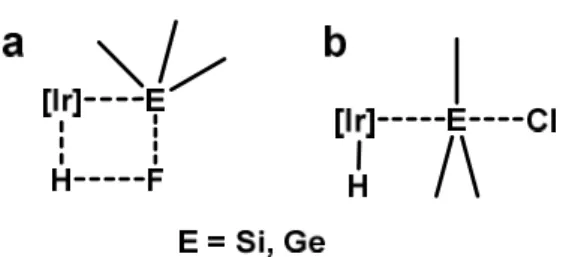
metathesis involving Ir−H and E−F bonds (E = Si, Ge) (Figure 1a). The chelation strategy
also facilitates the cleavage of Si−Cl and Ge−Cl bonds in chloro analogues
{o-(Ph2P)C6H4}2E(Cl)2 (E = Si, Ge) by 1, in which SN2-type pathway was proposed (Figure
1b).10e These findings prompted us to investigate the activation of Sn−F and Sn−Cl bonds.
We herein report iridium-mediated Sn−F and Sn−Cl bond activation together with
mechanistic studies using DFT calculations. Further, interconversion between Z-type (2
electron acceptor)11 stannane and X-type stannyl coordination is substantiated.
Scheme 2. Si−F -bond cleavages of {o-(Ph2P)C6H4}nSi(F)(4-n) (n = 2, 3)10c and Ge−F
6
Figure 1. (a) -bond metathesis for Si−F and Ge−F -bond cleavage. (b) SN2-type
reaction for Si−Cl and Ge−Cl -bond cleavage.
RESULTS AND DISCUSSION
To investigate the possibility of Sn−F bond cleavage by 1, we attempted to synthesize
P2SnF2-type compound {o-(Ph2P)C6H4}2Sn(F)2. However, the synthesis of this precursor
was unsuccessful despite of a lot of efforts. Therefore we employed the P3SnF-type
compound {o-(Ph2P)C6H4}3Sn(F)12 (2a) (Scheme 3). Reaction of iridium hydride 1 with 2a
took place over 60 °C, and the reaction was completed at 80°C within 32 hours to afford a
mixture of [{o-(Ph2P)C6H4}3Sn]Ir(CO) (3)13 and [{o-(Ph2P)C6H4}2(F)Sn]Ir(CO)(PPh3) (4a)
in a ratio of 41:59.14 Product 3 was produced through the expected Sn−F bond activation,
while 4a was probably formed through the oxidative addition of Sn−CAr bond15 of 2a
followed by the reductive elimination of the H−CAr bond (Scheme 4). Although one may
7
the reactions of 3 with HF∙pyridine and K[HF2] (vide infra). Similar types of Sn-C bond
cleavages were reported by our group10a and Iwasawa et al,16 and in this study the
feasibility of the Sn−CAr bond cleavage was ascertained by DFT calculations (see page S21
in Supporting Information). Although the formation of HF and HF2− could not be confirmed
by 1H and 19F NMR spectroscopy, 19F and 31P NMR spectra indicated the formation of
several intractable products, which were the same as the products from the reaction of PPh3
with K[HF2]. Therefore, it is likely that PPh3 acts as a scavenger of HF in a similar way to
Si−F and Ge−F bond cleavage reactions by 1.10c,10d
Next, Sn−Cl bond activation was investigated by using the P3SnCl-type precursor
{o-(Ph2P)C6H4}3Sn(Cl) (2b).17 The reaction of 1 with 2b took place under similar
conditions to those of the reaction with 2a to afford a mixture of Sn−Cl and Sn−CAr cleaved
products 3 and [{o-(Ph2P)C6H4}2(Cl)Sn]Ir(CO)(PPh3) (4b) in a ratio of 70:30 (Scheme 3).14
Although HCl was not detected by 1H NMR spectroscopy, 31P NMR measurements
supported the formation of phosphonium [HPPh3][Cl] ( = 6.1 ppm in THF-d8) together
with several intractable products. Monitoring the reactions of 1 with 2a and 2b by 31P NMR
spectroscopy demonstrated that the ratio of the products 3 and 4 remained unchanged
8
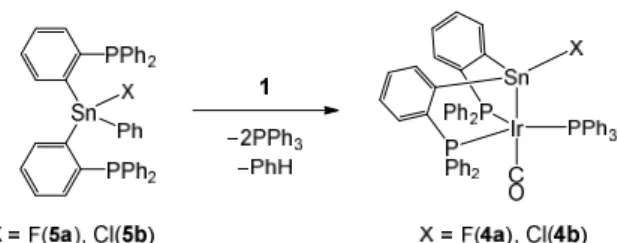
products 3 and 4 were formed through competitive independent pathways. Compounds 4a
and 4b were isolated from the reactions of 1 with {o-(Ph2P)C6H4}2Sn(Ph)(X) (5a: X = F,
5b: X = Cl)18 in an excellent yield via the selective Sn−C
Ph bond cleavage (Scheme 5), and
these molecular structures were confirmed by X-ray diffraction analysis (Figure 2).19
Scheme 3. Competing Sn−X and Sn−CAr -bond cleavages in {o-(Ph2P)C6H4}3Sn(X)
(2a: X = F, 2b: X = Cl) by iridium hydride 1.
9
Scheme 5. Synthesis of 4a and 4b through exclusive Sn−CPh -bond cleavages in
{o-(Ph2P)C6H4}2Sn(Ph)(X) (5a: X = F, 5b: X = Cl) by iridium hydride 1.
Figure 2. Molecular structures of stannyl complexes 4a (left) and 4b (right). Hydrogen
atoms, phenyl groups (except for ipso-carbons), and solvent molecules are omitted for
clarity. Thermal ellipsoids set at 40% probability. Selected bond distances [Å] and angles
[deg]. 4a: Ir1-Sn1: 2.5948(4), Ir1-P1: 2.3169(14), Ir1-P2: 2.3197(13), Ir1-P3: 2.3146(13),
Ir1-C1: 1.875(6), Sn1-F1: 1.975(3), P1-Ir1-P2: 117.96(5), P1-Ir1-P3: 119.48(5), P2-Ir1-P3:
120.40(5), Sn1-Ir1-C1: 167.65(15). 4b: Ir1-Sn1: 2.5794(6), Ir1-P1: 2.3248(16), Ir1-P2:
2.3291(18), Ir1-P3: 2.3331(16), Ir1-C1: 1.873(7), Sn1-Cl1: 2.4006(16), P1-Ir1-P2:
10
Because no intermediates were detected spectroscopically in these Sn−X bond (X = F,
Cl) cleavages reactions, reverse transformations, namely reactions of HX with 3, were
performed to isolate plausible intermediates. Reactions of 3 with HF∙pyridine and K[HF2]
provided mainly [{o-(Ph2P)C6H4}3SnIr(H)(CO)][BF4] (6-BF4)13 in addition to several
intractable products, and the B atom in the tetrafluoroborate would stem from glass vessels.
As previously reported, compound 6-BF4 was readily synthesized from the reaction of 3
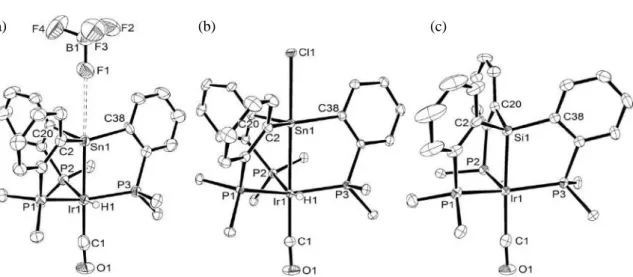
with [HOEt2][BF4],13 and reanalysis of X-ray diffraction in this study (Figure 3a)
demonstrated that one of F atoms in BF4 weakly interacted with the stannyl moiety in the
cationic part (Sn1−F1: 2.971(21) Å), which is consistent with the 19F{1H} NMR spectrum
(in THF-d8) showing two singlets at = −151.41 and −151.47 ppm in an intensity ratio of
1:3 (Figure S5).20 This indicated significant Lewis acidity of the stanyl moiety in the
cationic part. In contrast to the reactions with HF∙pyridine and K[HF2] affording no desired
HF adduct,21 HCl readily reacted with 3 to afford the chlorostannane complex
[{o-(Ph2P)C6H4}3(Cl)Sn]Ir(H)(CO) (7) (Scheme 6). Compound 7 reacted with PPh3 and
NEt3 to exclusively regenerate 3, supporting that 7 is an intermediate for Sn−Cl bond
activation. X-ray diffraction study of 7 (Figure 3b) clearly revealed the presence of Sn−Cl
11
of three C−Sn−C angles (358.33(17)°) imply the presence of strong dative
LP(Ir)→ *(Sn−Cl) interaction.23,24 This was supported by significantly longer Sn−Cl bond
(2.7512(7) Å) in 7 relative to that of Ph3SnCl (2.360 Å).25 NBO analysis of DFT
computational results also supported the presence of significant LP(Ir)− *(Sn−Cl) CT
interaction (69.4 kcal/mol)26 (The optimized geometry (in gas phase) at B3PW9127 (SDD(Ir,
Sn), 6-311G*(P, Cl, Hydride), 6-31G*(C, O, H except Hydride)) level of theory reproduced
X-ray structure well; see page S15 in Supporting Information.) CO frequency of 7 was
observed at 1992 cm−1 (KBr pellet), which is intermediate between neutral iridium(I) 1 (1920 cm−1)28 and cationic stannyl iridium(III) 6 (6-BF413: 2019 cm−1, 6-BPh4: 2021 cm−1)
complexes. These results indicate that the coordination of Z-type stannane ligand decreases
the electron density of the Ir center but its effect is less than that of stannyl cation.29
In contrast to the solid state, the Sn−Cl linkage would be ionized or generate a contact
ion pair in solution. DFT calculations (B3PW91) in gas phase provided no stable
intermediate for fluorine dissociation modeled by the elongation of the Sn−F bond, while
dissociation of the Sn−Cl bond was exergonic in tetrahydrofuran solution (PCM model)
( G0 = −1.3 kcal/mol; larger stabilization energies are observed in PBE, B3LYP, and M06
12
signals of 7 in THF-d8 exhibited mutually-coupled resonances (2JPP = 13.3 Hz) at 32.8 (d,
2P) and 33.8 (t, 1P) ppm (Figure S1 in Supporting Information), which are significantly
different from those of cationic stannyl complex 6-BPh4 with a non-coordinating
tetraphenylborate anion ( 25.8 (d, 2J
PP = 9.4 Hz, 2P) and 27.4 (m, 1P)). These spectral data
implied that the significant interaction of Lewis acidic moiety with the Cl atom exist even
in solution, and strongly influence on the coordination environment around the iridium
center.
Figure 3. Molecular structures of stannyl complex 6-BF4 (a),30 stannane complex 7 (b),
and silyl complex 9-Cl (c). Hydrogen atoms (except for a hydride), phenyl groups (except
for ipso-carbons), Cl anion, and solvent molecules are omitted for clarity. Thermal
ellipsoids set at 40% probability. The hydride in 9-Cl could not be determined by difference
Fourier synthesis due to poor quality of single crystals. Selected bond distances [Å] and
13
angles [deg]. 6-BF4: Ir1-Sn1: 2.6290(12), Ir1-P1: 2.335(2), Ir1-P2: 2.408(3), Ir1-P3:
2.342(2), Ir1-C1: 1.931(13), Ir1-H1: 1.63(9), Sn1-F1: 2.971(21), P1-Ir1-P2: 102.99(8),
P1-Ir1-P3: 145.98(9), P2-Ir1-P3: 103.54(9), P1-Ir1-C1: 97.6(3), P2-Ir1-C1: 101.5(3),
P3-Ir1-C1: 97.6(3), C2-Sn1-C20: 103.3(3), C2-Sn1-C38: 133.8(3), C20-Sn1-C38: 112.1(3).
7: Ir1-Sn1: 2.8009(3), Ir1-P1: 2.3189(7), Ir1-P2: 2.3710(7), Ir1-P3: 2.3032(7), Ir1-C1:
1.927(3), Sn1-Cl1: 2.7512(7), Ir1-H1: 1.49(4), P1-Ir1-P2: 104.14(2), P1-Ir1-P3: 143.89(2),
P2-Ir1-P3: 103.21(2), P1-Ir1-C1: 98.26(9), P2-Ir1-C1: 103.14(10), P3-Ir1-C1: 98.01(9),
C2-Sn1-C20: 110.20(10), C2-Sn1-C38: 132.04(10), C20-Sn1-C38: 116.09(10). 9-Cl:
Ir1-Si1: 2.368(3), Ir1-P1: 2.337(3), Ir1-P2: 2.337(3), Ir1-P3: 2.341(2), Ir1-C1: 1.962(11),
P1-Ir1-P2: 105.41(9), P1-Ir1-P3: 149.51(11), P2-Ir1-P3: 100.44(9), P1-Ir1-C1: 94.3(3),
P2-Ir1-C1: 102.8(4), P3-Ir1-C1: 95.5(3), C2-Si1-C20: 113.5(5), C2-Si1-C38: 113.7(5),
C20-Si1-C38: 104.5(5).
Scheme 6. Reversible HCl addition to stannyl and silyl complexes
[{o-(Ph2P)C6H4}3E]Ir(CO) (3: E = Sn, 8: E = Si).
Interestingly, HCl addition to the Si analogue [{o-(Ph2P)C6H4}3Si]Ir(CO) (8) of 3
provided the cationic silyl complex [{o-(Ph2P)C6H4}3SiIr(H)(CO)][Cl] (9-Cl), in which the
14
in THF-d8 at 23.2 (d, 2JPP = 10.6 Hz, 2P) and 24.0 (t, 2JPP = 10.6 Hz, 1P) of 9-Cl is
essentially the same as those of cationic silyl iridium complex
[{o-(Ph2P)C6H4}3SiIr(H)(CO)][BF4] (9-BF4),13 suggesting that the Cl anion does not
strongly interact with the Si atom in solution either. It should be noted that the stannyl
moiety in 3 exhibits larger Lewis acidity than the silyl moiety in 8 toward Cl anion,
although Cl atoms generally make stronger bonds with Si than with Sn atoms. This has
probably to do with the Ir−Si/Sn interactions which affect the Lewis acidity of the group 14
element, as well as the geometric constraints associated with the cage structure of the
complexes.
To consider the reaction mechanism of Sn−F and Sn−Cl bond activations, we performed
DFT(B3PW91) calculation using model compounds, where phenyl groups on phosphine
ligands were replaced by methyl groups.32 Considering reactions of 1 with 5a and 5b did
not provide the products of Sn−X bond cleavage (X = F, Cl), the coordination of three
phosphine arms was essential for inducing Sn−F and Sn−Cl bond cleavage. Hence we
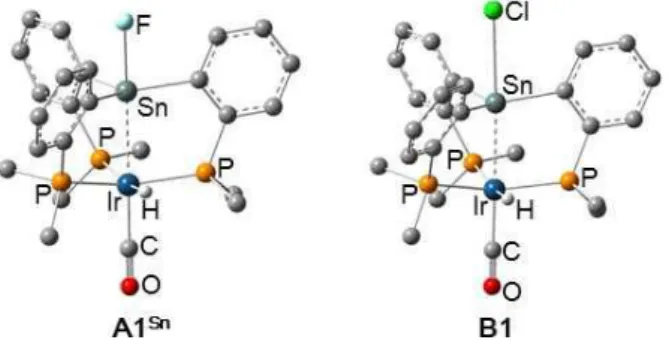
considered pathways starting from a model {(o-Me2PC6H4)3(Cl)Sn}Ir(H)(CO) (B1) for 7
and its F analogue {(o-Me2PC6H4)3(F)Sn}Ir(H)(CO) (A1Sn) (Figure 4). Due to difficulty in
15
PCM (THF solution) for optimizing all model compounds. Prior to bond cleavage,
phosphine exchange between Ir(H)(CO)(PMe3)3 with (o-Me2PC6H4)3Sn(X) (X = F, Cl)
takes place with significantly negative Gibbs energy change to afford A1Sn and B1,
respectively (A1Sn: G0 = −36.8 kcal/mol in Figure 5, B1: G0 = −37.4 kcal/mol in Figure
6). This Gibbs energy change is much more negative than that in the reaction of
Ir(H)(CO)(PMe3)3 with Si analogue (o-Me2PC6H4)3Si(F) ( G0 = −20.0 kcal/mol) (Figure 5),
which is attributed to the relatively higher stability of hypervalent structure of tin than that
of silicon. The presence of significant d(Ir)→ *(Sn−X) charge transfer (CT) interactions
(X = F, Cl) was confirmed not only in B1 but also in A1Sn; LP(Ir)→ *(Sn−F) and LP(Ir)→ *(Sn−Cl) CT interactions were evaluated by NBO to be 58.7 and 101.1 kcal/mol,
respectively.
Figure 4. Optimized structures of {(o-Me2PC6H4)3(F)Sn}Ir(H)(CO) (A1Sn) and
16
except for hydrides are omitted for clarity.
First, we investigated an SN2-type pathway starting from A1Sn for Sn−F bond cleavage.
However, models bearing the elongated Sn−F bond did not provide any stable intermediates,
indicating that the possibility of SN2-type pathway for Sn−F bond cleavage was ruled out.
Second, -bond metathesis involving Ir−H and Sn−F bonds was considered (Figure 5). This
reaction takes place via transition state TSA1/A2Sn to afford A2Sn with a Gibbs activation
energy ( G0‡) of 25.4 kcal/mol and a Gibbs reaction energy ( G0) of 14.0 kcal/mol. In the
Sn−F bond activation process, the geometry around the Ir atom changes from octahedron to
trigonal pyramid geometry, in which three P−Ir−P angles are averaged (P−Ir−P angles[°].
A1Sn: 151.9, 101.5, 99.5. A2Sn: 140.5, 106.9, 106.2). Although this geometrical change
alleviates the distortion around Sn, the bond activation process of Sn−F bond is uphill in
Gibbs free energy, which is marked contrast with previously reported Si−F bond activation
(vide infra). The subsequent elimination process of HF from A2Sn to A3Sn is further uphill
in Gibbs energy by 1.0 kcal/mol. Probably, the subsequent reaction of HF with PPh3 drives
the Sn−F cleavage reaction forward,33 despite the unfavorable energetic balance. Although
17
found two significant differences between Si−F bond and Sn−F bond cleavages (Figure 5);
(i) The Gibbs activation energy is significantly larger in Sn−F bond cleavage than in Si−F
bond cleavage and the Gibbs reaction energy is positive in Sn−F bond cleavage but
negative in Si−F bond cleavage, although Si−F bond is much stronger than Sn−F bond. (ii)
The intermediate A4Sn is absent (corresponding to the intermediate A4Si in the Si−F bond
cleavage) prior to Sn−F bond cleavage. These differences are attributed to significantly
high stability of A1Sn bearing a pentacoordinate tin center owing to the larger tendency of
tin versus silicon to form hypervalent structures.34,35 This feature would be responsible for
the isolation of a plausible intermediate of stannane complex 7, while that of the
18
Figure 5. Comparison of energy profiles between Sn−F and Si−F bond cleavages.
19
Next, the reaction of Sn−Cl bond activation starting from B1 was investigated (Figure 6).
Unlike Sn−F bond activation, no pathway involving -bond metathesis was found on the
potential energy surface but an SN2-type transition state TSB1/B2 was located. The Gibbs
activation energy is very small ( G0‡ = 0.3 kcal/mol) and the Gibbs free energy is slightly
negative ( G0 = −1.3 kcal/mol). Although the subsequent HCl elimination was significantly
endergonic ( G0 = 16.5 kcal/mol), it is likely that PPh
3 acts as an acceptor and/or scavenger
of HCl to make the reaction feasible in a similar way to that proposed for the Sn−F bond
cleavage.33 DFT computational results of Sn−Cl bond activation are basically consistent
with the early study on Sn−Cl bond activation36 by Pt complexes, in which S
N2-type
pathway was proposed.36d The mechanistic difference between Sn−F and Sn−Cl bond
activation would be attributed to the bonding natures of the Ir→Sn−X interactions, and the
simultaneous formation of strong H−F bond appears to be required for the cleavage of
stronger Sn−F bond than Sn−Cl bond.
CONCLUSION
In conclusion, we report here challenging Sn−F bond cleavage reaction by a late
20
bond cleavage with a four-coordinate stannane. Thanks to phosphine chelation, the iridium
hydride 1 cleaves the Sn−F bond of fluorostannane 2a and Sn−Cl bond of chlorostannane
2b to afford the stannyl complex 3 and HX (H = F, Cl). Addition of HCl to 3 provided a
plausible intermediate 7, which readily regenerated 3 upon treatment with Brønsted bases.
The addition and elimination of HCl induce reversible interconversion between X-type
stannyl to Z-type stannane ligands. This phenomenon is reminiscent of the coordination
behavior of Sb-based ligands recently reported by Gabbaï et al.,37 but such a coordination
switch was unprecedented with Sn-based ligands. DFT calculations support that the
pentacoordinate species featuring a dative LP(Ir)− *(Sn−X) interaction (X = F, Cl) are key
intermediates, and that Sn−F and Sn−Cl bond cleavages operate via two different pathways,
namely -bond metathesis and SN2-type reaction.38 Sn−F bond cleavage by transition
metals potentially would provide novel synthetic strategy for tin compounds, and we are
working on its applications to asymmetric synthesis and multi-component coupling
reaction.
General procedures. All experiments were performed under dry nitrogen atmosphere
21
tetrahydrofuran-d8 were dried over sodium and distilled under a dinitrogen atmosphere.
Chloroform-d and dichloromethane were dried over 4Å molecular sieves. The other
reagents used in this study were purchased from commercial sources and used without
further purification. 1H, 13C{1H}, 19F{1H}, 31P{1H}, and 119Sn{1H} NMR spectra were
recorded with a JEOL JNM-AL 400 spectrometer. The 1H and 13C{1H} NMR data were
analyzed with reference to the residual peaks of the solvent, and the 19F{1H}, 31P{1H}, and 119Sn{1H} NMR chemical shifts were referenced to external hexafluorobenzene (−164.9
ppm), 85% H3PO4 (0 ppm), and tetramethylstannane (0 ppm) samples, respectively.
Elemental analyses were conducted using a J-Science Lab JM-10 or FISONS Instrument
EA1108 elemental analyzer. IR measurements were performed by the KBr pellet method.
{o-(Ph2P)C6H4}Li∙Et2O,17 Ir(H)(CO)(PPh3)3 (1),28 and {o-(Ph2P)C6H4}3Sn(F) (2a),12
{o-(Ph2P)C6H4}3Sn(Cl) (2b),17 [{o-(Ph2P)C6H4}3E]Ir(CO) (3: E = Sn, 8: E = Si),13 and
[{o-(Ph2P)C6H4}3SnIr(H)(CO)][BF4] (6-BF4)13 were prepared as described in the literature.
Preparation of {(o-Ph2P)C6H4}2Sn(Ph)(Cl) (5b) A Schlenk tube was charged with
{o-(Ph2P)C6H4}Li·Et2O (481 mg, 1.40 mmol), toluene (12 mL), and the solution was
cooled to −78 °C. PhSnCl3 (0.63 mmol), 1 M solution in toluene, was added slowly to the
22
mixture was stirred at 100 °C for 14 h. The solution was filtered and the volatile materials
were removed under vacuum to afford a white solid. The residue was washed with a 1:5
mixture of ether and n-hexane (6 mL×3), and dried under vacuum to afford 5b (344 mg,
0.458 mmol) in 73 % yield as a white powder. 1H NMR (400 MHz, CDCl
3): 6.86-7.43 (m, 29H), 7.84 (d, J = 7.4 Hz, 2H), 7.96 (d, J = 7.1 Hz, 2H). 13C{1H} NMR (100 MHz, CDCl 3): 128.4 (m), 128.5 (m), 128.8 (s), 129.2 (s), 130.2 (d, JP-C = 20.7 Hz), 133.0 (m), 133.5 (m), 134.4 (s, JC-119Sn = 62.8 Hz), 136.0 (m), 136.7 (t, JP-C = 18.1 Hz), 136.8 (m), 142.3 (t, JP-C = 6.6 Hz), 143.6 (d, JP-C = 1.7 Hz, JC-119Sn = 69.4 Hz), 155.1 (dd, JP-C = 76.8, 6.6 Hz). 31P{1H} NMR (162 MHz, CDCl3): 2.0 (s, JP-119Sn = 13.9 Hz). 119Sn{1H} NMR (187 MHz, CDCl3):
−100.1 (t, JP-119Sn = 13.9 Hz). Anal. Calcd for C42H33ClP2Sn: C, 66.92; H, 4.41. Found: C,
66.71; H, 4.45.
Preparation of {(o-Ph2P)C6H4}2Sn(Ph)(F) (5a) A Schlenk tube was charged with 5b
(336 mg, 0.446 mmol), CsF (351 mg, 2.31 mmol), and toluene (25 mL). After stirring at
50 °C for 76 h, the volatile materials were removed under vacuum to afford a white solid.
The residue was washed with methanol (4 mL × 3) and a 1:3 mixture of ether and n-hexane
(4 mL × 3), and dried under vacuum to afford 5a (215 mg, 0.292 mmol) in 66% yield as a
white powder. 1H NMR (400 MHz, CDCl
23 (d, J = 6.4 Hz, 2H), 7.90 (d, J = 7.2 Hz, 2H). 13C{1H} NMR (100 MHz, CDCl 3): 128.4 (m), 128.6 (s), 128.8 (s), 129.1 (s), 130.2 (d, JP-C = 10.5 Hz), 133.0 (t, JP-C = 8.1 Hz), 133.5 (t, JP-C = 9.1 Hz), 134.1 (s, JC-119Sn = 63.0 Hz), 135.9 (m), 136.5 (t, JP-C = 18.7 Hz), 136.9 (m), 142.5 (m), 143.8 (s, JC-119Sn = 36.3 Hz), 155.9 (dd, JP-C = 86.8, 15.2 Hz). 19F{1H} NMR (376 MHz, CDCl3): −214.1 (t, JP-F = 39.1 Hz, J119Sn-F = 2359.0 Hz). 31P{1H} NMR (162 MHz, CDCl3): 4.1 (d, JP-F = 39.1 Hz). 119Sn{1H} NMR (187 MHz, CDCl3): −143.3
(d, J119Sn-F = 2359.0 Hz). Anal. Calcd for C42H33FP2Sn: C, 68.41; H, 4.51. Found: C, 68.21;
H, 4.48.
Preparation of [{(o-Ph2P)C6H4}2Sn(F)]Ir(CO)(PPh3) (4a) A Schlenk tube was charged
with Ir(H)(CO)(PPh3)3 (1) (129.0 mg, 0.128 mmol), 5a (98.7 mg, 0.134 mmol), and toluene
(10 mL). After stirring at 80 °C for 18 h, the volatile materials were removed under vacuum
to afford a yellow residue. The residue was washed with n-hexane (4 mL × 3), and dried
under vacuum to afford 4a (135.0 mg, 0.118 mmol) in 92% yield as yellow solid. 1H NMR
(400 MHz, CDCl3): 6.67-6.73 (m, 4H), 6.85-7.02 (m, 20H), 7.05-7.19 (m, 9H), 7.23-7.30
(m, 4H), 7.47-7.53 (m, 4H), 8.29 (d, J = 6.8 Hz, 2H). 13C{1H} NMR (100 MHz, CDCl 3):
127.6 (d, JP-C = 10.5 Hz), 127.7 (t, JP-C = 4.8 Hz), 128.4 (m), 128.7 (m), 130.2 (s), 131.6 (t,
24 138.5 (t, JP-C = 24.8 Hz), 139.1 (d, JP-C = 41.1 Hz), 140.6 (m), 141.8 (m), 161.5 (m), 188.9 (m, CO). 19F{1H} NMR (376 MHz, CDCl 3): −212.0 (dt, JP-F = 11.7 Hz, 9.8 Hz, 1J117Sn-F = 2474.3 Hz, 1J 119Sn-F = 2598.1 Hz). 31P{1H} NMR (162 MHz, CDCl3): 11.2 (td, 2JP-P = 88.8
Hz, JP-F = 11.7 Hz, PPh3), 46.6 (dd, 2JP-P = 88.8 Hz, JP-F = 9.8 Hz, PPh2). Anal. Calcd for
C55H43OFIrP3Sn: C, 57.81; H, 3.79. Found: C, 57.82; H, 3.94. IR (KBr, cm-1) ν (CO): 1964
cm−1. 119Sn{1H} NMR data of 4a is not available due to the low solubility in organic
solvents.
Preparation of [{(o-Ph2P)C6H4}2Sn(Cl)]Ir(CO)(PPh3) (4b) A Schlenk tube was
charged with Ir(H)(CO)(PPh3)3 (1) (68.4 mg, 0.0677 mmol), 5b (93.3 mg, 0.0711 mmol),
and toluene (5 mL). After stirring at 80 °C for 18 h, the volatile materials were removed
under vacuum to afford a yellow residue. The residue was washed with n-hexane (4 mL ×
3), and dried under vacuum to afford 4b (73.4 mg, 0.0633 mmol) in 94% yield as yellow
solid. 1H NMR (400 MHz, CDCl 3): 6.66-6.73 (m, 4H), 6.96-7.02 (m, 20H), 7.05-7.12 (m, 9H), 7.24-7.30 (m, 4H), 7.43-7.53 (m, 4H), 8.31 (d, J = 6.8 Hz, 2H). 13C{1H} NMR (100 MHz, CDCl3): 127.6 (d, JP-C = 10.0 Hz), 127.8 (t, JP-C = 4.8 Hz), 128.5 (m), 130.5 (s), 131.6 (t, JP-C = 6.0 Hz), 132.1 (s), 133.0 (d, JP-C = 12.9 Hz), 133.2 (t, JP-C = 7.2 Hz), 135.6 (t, JP-C = 11.7 Hz), 138.3 (t, JP-C = 25.3 Hz), 138.4 (d, JP-C = 41.5 Hz), 140.1 (m), 141.7 (m),
25
161.0 (m), 188.3 (m, CO). 31P{1H} NMR (162 MHz, CDCl
3): 11.8 (t, 2JP-P = 89.2 Hz,
PPh3), 46.0 (d, 2JP-P = 89.2 Hz, PPh2). Anal. Calcd for C55H43OClIrP3Sn: C, 56.99; H, 3.74.
Found: C, 56.99; H, 3.99. IR (KBr, cm-1) ν (CO): 1969 cm−1. 119Sn{1H} NMR data of 4b is
not available due to the low solubility in organic solvents.
Preparation of [{(o-Ph2P)C6H4}3Sn(Cl)]IrH(CO) (7) A Schlenk tube was charged with
{(o-Ph2PC6H4)3Sn}Ir(CO) (53.7 mg, 0.0478 mmol) and tetrahydrofuran (5 mL). After
addition of HCl (1M diethylether solution, 0.15 ml), the reaction mixture was allowed to
stir at ambient temperature for 15 h. After the volatile materials were removed under
vacuum, the white residue was washed with Et2O (5 mL). Slow diffusion of n-hexane into
dichloromethane solution of the residue afforded 7 (43.2 mg, 0.0377 mmol) in 78% yield as
colorless crystals. 1H NMR (400 MHz, CDCl
3): −12.28 (td, JP-H= 97.2Hz, JP-H = 18.8Hz,
1H, Ir-H), 6.47 (t, J = 7.4 Hz, 1H ), 6.73-6.80 (m, 3H, Ar), 6.83-6.92 (m, 17H, Ar),
7.07-7.13 (m, 6H, Ar), 7.21-7.33 (m, 10H, Ar), 7.52 (t, J = 7.2Hz, 2H, Ar), 9.12 (d, J =
7.2Hz, 1H, Ar), 9.40 (d, J = 7.6Hz, 2H, Ar). 13C{1H} NMR (100 MHz, CDCl
3): 127.5 (m),
127.8 (d, JP-C = 9.9 Hz), 128.2 (m), 128.4 (m), 129.2-130.9 (6 overlapping), 132.6 (m),
132.7 (m), 133.5 (d, JP-C = 10.0 Hz), 138.7 (d, JP-C = 19.3 Hz), 139.0 (d, JP-C = 6.9Hz),
26
JP-C = 20.5 Hz), 177.1 (td, JP-C = 3.6Hz, JP-C = 1.5Hz, CO). 31P{1H} NMR (162 MHz,
THF-d8): 32.8 (d, 2JP-P = 13.3 Hz, PPh2), 33.8 (t, 2JP-P = 13.3 Hz, PPh2). Anal. Calcd for
C55H43OClIrP3Sn: C, 56.99; H, 3.74. Found: C, 56.79; H, 3.70. IR (KBr, cm-1) ν (CO):
1992 cm−1. 119Sn{1H} NMR data of 7 is not available due to the low solubility in organic
solvents.
Preparation of [{(o-Ph2PC6H4)3Si}IrH(CO)][Cl] (9-Cl) A Schlenk tube was charged
with {(o-Ph2PC6H4)3Si}Ir(CO) (34.0 mg, 0.0329 mmol) and tetrahydrofuran (2 mL). After
addition of HCl (1M diethylether solution, 0.10 ml), the reaction mixture was allowed to
stir at ambient temperature for 15 h. After the volatile materials were removed under
vacuum, the white residue was washed with Et2O (3 mL). Slow diffusion of n-hexane into
dichloromethane solution of the residue afforded 9-Cl (29.2 mg, 0.0278 mmol) in 84%
yield as colorless crystals. 1H, 31P{1H} NMR and IR spectra are essentially the same as
those of [{(o-Ph2PC6H4)3Si}IrH(CO)][BF4] (9-BF4).13
Reactions of 7 with Brønsted Bases. (i) Reaction of 7 with NEt3. An NMR tube was
charged with 7 (5.9 mg, 0.0050 mmol) and tetrahydrofuran (0.50 mL), and a capillary filled
with a toluene solution of trimesitylphosphine was placed in the NMR tube as an internal
27
quantitative formation of 3. (ii) Reaction of 7 with PPh3. An NMR tube was charged with
7 (5.9 mg, 0.0050 mmol), PPh3 (4.1 mg, 0.016 mmol) and tetrahydrofuran (0.50 mL), and a
capillary filled with a toluene solution of trimesitylphosphine was placed in the NMR tube
as an internal standard. The reaction was performed at 80 °C for 24 hours to afford 3
quantitatively.
Anion (BF4/BPh4) Exchange of 6-BF4. A Schlenk tube was charged with 6-BF4 (20.1
mg, 0.0166 mmol), NaBPh4 (56.5 mg, 0.165 mmol), and methanol (2 mL). After the
reaction mixture was allowed to stir at ambient temperature for 24 h, the volatile materials
were removed under vacuum. The white residue was washed with methanol (2 mL x 3) to
afford 6-BPh4 (19.8 mg, 0.0137 mmol) in 83% yield as white solid. 6-BPh4: 1H NMR (400
MHz, THF-d8): −12.44 (td, JP-H= 98.9Hz, JP-H = 18.9Hz, 1H, Ir-H), 6.65-7.43 (m, 57H,
Ar), 7.66 (t, J = 7.3Hz, 2H, Ar), 8.31 (d, J = 7.9Hz, 1H, Ar), 8.59 (d, J = 7.3Hz, 2H, Ar).
31P{1H} NMR (162 MHz, THF-d
8): 25.9 (d, 2JPP = 9.4 Hz, 2P), 27.2 (m, 1P). Anal. Calcd
for C79H63BIrOP3Sn: C, 65.76; H, 4.40. Found: C, 65.99; H, 4.53. IR (KBr, cm-1) ν (CO):
2021 cm−1.
Determination of NMR yield. (a) Reaction of 1 with 2a. An NMR tube was charged
28
and a capillary filled with a toluene solution of trimesitylphosphine was placed in the NMR
tube as an internal standard. The reaction at 80 °C was monitored by 31P NMR spectroscopy.
After 30 hours, 3 and 4a were formed in 41% and 59% NMR yield, respectively. (b)
Reaction of 1 with 2b. An NMR tube was charged with 1 (5.0 mg, 0.0050 mmol), 2b (4.6
mg, 0.0049 mmol), and tetrahydrofuran (0.50 mL), and a capillary filled with a toluene
solution of trimesitylphosphine was placed in the NMR tube as an internal standard. The
reaction at 80 °C was monitored by 31P NMR spectroscopy. After 32 hours, 3 and 4b were
formed in 70% and 30% NMR yield, respectively.
Structure Determination by X-ray Diffraction. Suitable single crystals of 4a, 4b, 7, 9-Cl, and 9-BF4 were obtained from the slow diffusion of n-hexane into a dichloromethane
solution (4a, 4b, and 7), a chloroform solution (9-Cl), a tetrahydrofuran solution (9-BF4),
and a tetrahydrofuran/dioxane mixed solution (6-BF4). Diffraction intensity data were
collected with a Rigaku/MSC Mercury CCD diffractometer at 200 K (4a and 4b), a
Rigaku/Saturn724 CCD diffractometer at 200 K (6-BF4 and 9-BF4), and a Rigaku/R-AXIS
RAPID IP diffractometer at 173 K (7 and 9-Cl), and a semiempirical multi-scan
absorption39 correction was performed. The space groups were chosen based on the
29
subsequent difference Fourier synthesis, and refined by full matrix least-squares procedures
on F2. All non-hydrogen atoms were refined with anisotropic displacement coefficients.
The hydrogen atoms except for hydrides were treated as idealized contributions and refined
in rigid group model. The hydride ligands in 7 and 9-BF4 was determined by difference
Fourier synthesis and refined isotropically. All software and sources of scattering factors
are contained in the SHELXL97 program package.41 CCDC 1520115 (4a), 1520116 (4b),
CCDC 1533991 (9-BF4), 1533992 (6-BF4), 1533993 (7), and 1533994 (9-Cl) contain
supplementary crystallographic data for this paper. These data can be obtained free of
charge from the Cambridge Crystallographic Data Centre via
www.ccdc.cam.ac.uk/data_request/cif.
Density Functional Theory (DFT) Calculation. The Gaussian09 program was
employed for all calculations here.42 All of the geometry optimizations were performed by
the density functional theory (DFT) with the B3PW91 functional in THF solution, where
the polarizable continuum model (PCM)43 was used to calculate solvation effect. The
effective core potentials (ECPs) of the Stuttgart-Dresden-Bonn group were employed for
the core electrons of iridium and tin and the corresponding basis sets44 were used for the
30
vibrational frequencies were calculated to identify the structure in the equilibrium state, i.e.,
the structure that was true minima or transition states. Here, the Gibbs activation energy
( G°‡) is defined as a difference in the Gibbs energy at 298.15 K between a transition state
and an intermediate, when the intermediate exists before the transition state and it is more
stable than the reactant. Otherwise, G°‡ is defined as the Gibbs energy difference between
the transition state and the reactant. The Gibbs reaction energy ( G°) is defined as the
difference in Gibbs energy between the product and the reactant. In the calculation, we
employed model compounds where the phenyl groups of the phosphine were replaced by
methyl groups to save the CPU time.
ASSOCIATED CONTENT Supporting Information
Crystallographic data, Computational details. Crystallographic data are also available in
CIF format.
The Supporting Information is available free of charge on the ACS Publications website.
31 Corresponding Author
*E-mail: [email protected]
Notes
The authors declare no competing financial interest.
ACKNOWLEDGMENT
This research was supported by a Grant-in-Aid for Scientific Research (C) (No. 15K05458
and 15K05459) from Japan Society for the promotion of Science (JSPS) and by
Grant-in-Aid for that Scientific Research on Innovative Areas “Stimuli-responsive
Chemical Species for the Creation of Functional Molecules” (No. 15H00940, 15H00957,
and 15H00958) from the Ministry of Education, Science, Sports, and Culture of Japan
(MEXT).
REFERENCES
(1) (a) Crabtree, R. H. Organometallic Chemistry of the Transition Metals, 6th ed., John Wiley & Sons, Inc., New Jersey, 2014; (b) Hartwig, J. F. Organotransition Metal Chemistry
32
from Bonding to Catalysis, University Science Books, Sausalito, 2010.
(2) Apeloig, Y. in The Chemistry of Organic Silicon Compounds, Vol. 1 (Eds.: Patai, S.;
Rappoport, Z.), John Wiley & Sons, Inc., 1989, Chapter 2.
(3) Bond dissociation energies: DSi−F = 540 kJ/mol, DGe−F = 485 kJ/mol, DSn−F = 467
kJ/mol, DSi−Cl = 456 kJ/mol, DGe−Cl = 432 kJ/mol, DSn−Cl = 406 kJ/mol: Lange's Handbook
of Chemistry, 13th ed. (Eds.: N. A. Lange, J. A. Dean), McGraw-Hill, New York, 1985, pp.
3–131.
(4) (a) Sakaki, S.; Ieki, M. J. Am. Chem. Soc. 1993, 115, 2373-2381. (b) Kameo, H.;
Sakaki, S. Chem. Eur. J. 2015, 21, 13588-13597.
(5) (a) Doherty, N.M.; Hoffman, N.W. Chem. Rev., 1991, 91, 553-573; (b) Murphy, E.F.;
Murugavel, R.; Roesky, H.W. Chem. Rev., 1997, 97, 3425-3468.
(6) (a) Herzog, A.; Liu, F.-Q.; Roesky, H. W.; Demsar, A.; Keller, K.; Noltemeyer, M.;
Pauer, F. Organometallics 1994, 13, 1251-1256. (b) Liu, F.-Q.; Usón, I.; Roesky, H. W. J.
Chem. Soc., Dalton Trans, 1995, 2453-2458. (c) Köhler, K.; Herzog, A.; Steiner, A.; Roesky,
33
Herzog, A.; Roesky, H. W.; Demsar, A.; Noltemeyer, M.; Schmidt, H.-G. Inorg. Chem.
1996, 35, 23-29. (e) Murphy, E. F.; Yu, P.; Dietrich, S.; Roesky, H. W.; Parisini, E.;
Noltemeyer, M. J. Chem. Soc., Dalton Trans. 1996, 1983-1987. (f) Liu, F.-Q.; Herzog, A.;
Roesky, H. W.; Usón, I. Inorg. Chem. 1996, 35, 741-744. (g) Yu, P.; Murphy, E. F.; Roesky,
H. W.; Lubini, P.; Schmidt, H.-G.; Noltemeyer, M. Organometallics 1997, 16, 313-316. (h) Pevec, A.; Demsar, A.; Gramlich, V.; Petricek, S.; Roesky, H. W. J. Chem. Soc., Dalton
Trans. 1997, 2215-2216. (i) Roesky, H. W. Inorg. Chem. 1999, 38, 5934-5943.
(7) Parkin et al. reported the synthesis of zinc fluoride via Sn−F bond cleavage of
Me3SnF; see Sattler, W.; Ruccolo, S.; Parkin, G. J. Am. Chem. Soc. 2013, 135,
18714-18717.
(8) DFT calculations were carried out at the B3PW91 (SDD for Ir, Sn and 6-311G* for
other atoms) level of theory.
(9) Dugan, T. R.; Goldberg, J. M.; Brennessel, W. W.; Holland, P. L. Organometallics
2012, 31, 1349-1360.
34
Kameo, H.; Ishii, S.; Nakazawa, H. Dalton Trans. 2013, 42, 4663-4669. (c) Kameo, H.;
Kawamoto, T.; Sakaki, S.; Bourissou, D.; Nakazawa, H. Chem. Eur. J. 2016, 22, 2370-2375.
(d) Kameo, H.; Ikeda, K.; Bourissou, D.; Sakaki, S.; Takemoto, S.; Nakazawa, H.;
Matsuzaka, H. Organometallics 2016, 35, 713-719. (e) Kameo, H.; Ikeda, K.; Sakaki, S.;
Nakazawa, H.; Takemoto, S.; Matsuzaka, H. Dalton Trans. 2016, 45, 7570-7580. (f) Kameo,
H.; Nakazawa, H. Chem. Rec. 2017, 17, 268-286.
(11) Selected references for ligand classification of transition metal complexes; see (a)
Green, M. L. H. J. Organomtet. Chem. 1995, 500, 127-148. (b) Hill, A. F. Organometallics
2006, 25, 4741-4743. (c) Parkin, G. Organometallics 2006, 25, 4744-4747. (d) Kuzu, I.;
Krummenacher, I.; Meyer, J.; Armbruster, F.; Breher, F. Dalton Trans. 2008, 5836-5865. (e)
Braunschweig, H.; Dewhurst, R. D.; Schneider, A. Chem. Rev. 2010, 110, 3924-3957. (f)
Owen, G. R. Chem. Soc. Rev. 2012, 41, 3535-3546. (g) Kameo, H.; Nakazawa, H. Chem.
Asian J. 2013, 8, 1720-1734.
(12) Kameo, H.; Kawamoto, T.; Sakaki, S.; Nakazawa, H. Organometallics 2014, 33,
5960-5963.
35
(14) The ratio of 3:4a/b would be determined at the coordination step of the third
phosphine arm; see page S21 in Supporting Information.
(15) Cabon, Y.; Reboule, I.; Gebbink, R. J. M. K.; Deelman, B.-J. Organometallics, 2010,
29, 5904-5911 and references for transition-metal-mediated Sn-C bond cleavage therein.
(16) Takaya, J.; Nakamura, S.; Iwasawa, N. Chem. Lett., 2012, 41, 967-969.
(17) Kameo, H.; Ishii, S.; Nakazawa, H. Organometallics 2012, 31, 2212-2218.
(18) i-Pr analogues {o-(i-Pr2P)C6H4}2Sn(Ph)(F) and {o-(i-Pr2P)C6H4}2Sn(Ph)(Cl) of 2a
and 2b were reported by Bourissou and Gabbaï, and the intramolecular P→Sn interactions
in these compounds were studied. See (a) Gualco, P.; Lin, T.-P.; Sircoglou, M.; Mercy, M.;
Ladeira, S.; Bouhadir, G.; Pérez, L. M.; Amgoune, A.; Maron, L.; Gabbaï, F. P.; Bourissou,
D. Angew. Chem. Int. Ed. 2009, 48, 9892-9895. (b) Lin, T.-P.; Gualco, P.; Ladeira, S.;
Amgoune, A.; Bourissou, D.; Gabbaï, F. P. C. R. Chim. 2010, 13, 1168.
(19) 31P{1H} NMR spectrum of 4a and 4b exhibited mutually-coupled resonances (4a:
11.2 (dt, JP-F = 11.7 Hz, 2JP-P = 88.8 Hz) and 46.6 (dd, JP-F = 9.8 Hz, 2JP-P = 88.8 Hz), 4b:
11.8 (t, 2J
36
observed as a doublet of triplet (JP-F = 11.7, 9.8 Hz) with a satellite due to 119Sn and 117Sn
(1J
119Sn-F = 2598 Hz, 1J117Sn-F = 2474 Hz) at −212.0 ppm. These spectral data are consistent
with C2v symmetrical structures observed for the solid states.
(20) Despite of the presence of F3B−F→Sn interaction,,31P{1H} NMR spectrum (in
THF-d8) of 6-BF4 ( 25.8 (d, 2JPP = 9.4 Hz, 2P) and 27.4 (m, 1P)) is only slightly shifted in
comparison with 6-BPh4 ( 25.9 (d, 2JPP = 9.4 Hz, 2P) and 27.2 (m, 1P)) with a
non-coordinating tetraphenylborate anion (see page S2 in Supporting Information),
presumably indicating that the F3B−F→Sn interaction does not strongly influence
coordination environment around the iridium center.
(21) Although salt metathesis reactions of [{o-(Ph2P)C6H4}3SnIr(H)(CO)][BF4] (7-BF4)
with KF and CsF were also investigated to synthesize fluorostannane complex
[{o-(Ph2P)C6H4}3(F)Sn]Ir(H)(CO), neutral complex 3 was mainly formed. Then, a broad
signal was observed around = 16 ppm46 (w
1/2 = 83.6 Hz, in DMSO-d6), suggesting the
formation of [HF2]−. These results imply that the isolation of
[{o-(Ph2P)C6H4}3(F)Sn]Ir(H)(CO) is difficult due to readily elimination of HF.
37
(2.80 Å). Cordero, B.; Gómez, V.; Platero-Prats, A. E.; Revés, M.; Echeverría, J.; Cremades,
E.; Barragán, F.; Alvarez, S. Dalton Trans. 2008, 37, 2832.
(23) We reported that iridium hydride 1 also formed a dative metal→Z interaction (Z =
Z-type ( -electron acceptor) ligand) in the reactions with di- and triphosphine borane; see
(a) Kameo, H.; Nakazawa, H. Organometallics 2012, 31, 7476-7484. (b) Kameo, H.;
Hashimoto, Y.; Nakazawa, H. Organometallics 2012, 31, 4251-4258.
(24) Examples bearing a dative M→E interaction (E = heavier group 14 element
compounds) have been studied by several groups; see (a) Grobe, J.; Krummen, N.; Wehmschulte, R. W.; Krebs, B.; Laege, M. Z. Anorg. Allg. Chem. 1994, 620, 1645-1658.
(b) Grobe, J.; Wehmschulte, R.; Krebs, B.; Läge, M. Z. Anorg. Allg. Chem. 1995, 621,
583-596. (c) Grobe, J.; Lütke-Brochtrup, K.; Krebs, B.; Läge, M.; Niemeyer, H. -H.,
Würthwein, E. -U. Z. Naturforsch. 2007, 62b, 55-65. (d) Wagler, J.; Hill, A. F.; Heine, T.
Eur. J. Inorg. Chem. 2008, 4225-4229. (e) Wagler, J.; Bredler, E. Angew. Chem. Int. Ed. 2010, 49, 624-627. (f) Cabon, Y.; Kleijn, H.; Siegler, M. A.; Spek, A. L.; Gebbink, R. J. M.
K.; Deelman, B.-J. Dalton Trans. 2010, 39, 2423–2427. (g) Gualco, P.; Mercy, M.; Ladeira,
38
10808-10817. (h) Truflandier, L. A.; Brendler, E.; Wagler, J.; Autschbach, J. Angew. Chem.
Int. Ed. 2011, 50, 255-259. (i) Derrah, E. J.; Sircoglou, M. M.; Mercy, M.; Ladeira, S.;
Bouhadir, G.; Miqueu, K.; Maron, L.; Bourissou, D. Organometallics 2011, 30, 657-660. (i)
Brendler, E.; Wächtler, E.; Heine, T.; Zhechkov, L.; Langer, T.; Pöttgen, R.; Hill, A. F.;
Wagler, J. Angew. Chem. Int. Ed. 2011, 50, 4696–4700. (j) Sakaki, S.; Kawai, D.;
Tsukamoto, S. Collect. Czech. Chem. Commun. 2011, 76, 619–629. (k) Martincová, J.;
Dostál, L.; Herres-Pawlis, S.; Růžička, A.; Jambor, R. Chem. Eur. J. 2011, 17, 7423-7427.
(l) Kano, N.; Yoshinari, N.; Shibata, Y.; Miyachi, M.; Kawashima, T.; Enomoto, M.;
Okazawa, A.; Kojima, N.; Guo, J. -D.; Nagase, S. Organometallics 2012, 31, 8059-8062.
(m) Autschbach, J.; Sutter, K.; Truflandier, L. A.; Brendler, E.; Wagler, J. Chem. Eur. J.
2012, 18, 12803-12813. (n) Wächtler, E.; Gericke, R.; Zhechkov, L.; Heine, T.; Langer, T.;
Gerke, B.; Pöttgen, R.; Wagler, J. Chem. Commun. 2014, 50, 5382-5384. (o) Wahlicht, S.;
Brendler, E.; Heine, T.; Zhechkov, L.; Wagler, J. Organometallics 2014, 33, 2479-2488. (p)
Kameo, H.; Kawamoto, T.; Bourissou, D.; Sakaki, S.; Nakazawa, H. Organometallics 2015,
34, 1440-1448. (q) Gualco, P.; Ladeira, S.; Kameo, H.; Nakazawa, H.; Mercy, M.; Maron,
L.; Amgoune, A.; Bourissou, D. Organometallics 2015, 34, 1449-1453. (r) Sun, J.; Ou, C.;
39
M.; Freitag, S.; Schubert, H.; Gerke, B.; Pöttgen, R.; Wesemann, L. Chem. Eur. J., 2015, 21, 4628-4638. (t) Lin, T.-P.; Gabbai, F. P. Polyhedron 2017, 125, 18-25.
(25) (a) Tse, J. S.; Lee, F. L.; Gabe, E. J. Acta Crystallogr. Sect. C 1986, 42, 1876. (b) Ng,
S. W. Acta Crystallogr. Sect. C 1995, 51, 2292.
(26) Analysis of charge-transfer (CT) energy was performed using the second-order
perturbation with the NBOs.
(27) (a) Vosko, S.H.; Wilk, L.; Nusair, M. Can. J. Phys. 1980, 58, 1200-1211. (b) Becke,
A.D. Phys. Rev. 1988, A38, 3098-3100. (c) Becke, A.D. J. Chem. Phys. 1993, 98,
5648-5652. (d) Perdew, J.P.; Wang, Y. Phys. Rev. 1992, B45, 13244-13249.
(28) Wilkinson, G. Inorg. Synth. 1972, 13, 126.
(29) The influence of the borane coordination on the electron density of transition metal
centers were similarly discussed using CO frequency; see (a) Bontemps, S.; Sircoglou, M.; Bouhadir, G.; Puschmann, H.; Howard, J. A. K.; Dyer, P. W.; Miqueu, K.; Bourissou, D.
Chem. Eur. J. 2008, 14, 731-740. (b) Gualco, P.; Mercy, M.; Ladeira, S.; Maron, L.;
40
Hashimoto, Y.; Nakazawa, H. Organometallics 2012, 31, 3155-3162.
(30) One of two independent molecules is displayed here, and the other molecule is
shown on page S12 in Supporting Information.
(31) In the solid state, the Si center in 9-BF4, was separated more than 5.0 Å from the BF4
anion.
(32) Calculations on the real system (without replacement) were also performed on Sn-F
bond activation, which basically provides similar results to model system; see page S19 in Supporting Information.
(33) PPh3 may contribute to promoting the proton loss, which is not very clear at this
stage.
(34) Kutzelnigg, W. Angew. Chem. Int. Ed. Engl. 1984, 23, 272-295.
(35) Five membered-rings E-Cipso-Cipso-P-Ir change in the bond activation processes (the
conversion from A1E (E = Si, Sn) to A2E (E = Si, Sn)) as shown follows (Average of three
distances and angles are given). The geometrical changes are smaller in Sn than in Si
41
system.
(36) Selected examples for Sn−Cl bond activation by late transition metals: (a) Kuyper, J.
Inorg. Chem. 1978, 17, 77-81. (b) Kuyper, J. Inorg. Chem. 1978, 16, 2171-2176. (c) Levy,
C. J.; Vittal, J. J.; Puddephatt, R. J. Organometallics 1996, 15, 2108-2117. (d) Levy, C. J.; Puddephatt, R. J. J. Am. Chem. Soc. 1997, 119, 10127-10136. (e) Rendina, L.M.;
Puddephatt, R.J. Chem. Rev. 1997, 97, 1735-1754. (f) Janzen C. R.; Jennings, M. C.;
Puddephatt, R. J. Organometallics 2001, 20, 4100-4106. (g) Cabon, Y.; Reboule, I.; Lutz,
M.; Gebbink, R. J. M. K.; Deelman, B.-J. Organometallics 2010, 29, 5904-5911. (h) Warsink, S.; Derrah, E. J.; Boon, C. A.; Cabon, Y.; de Pater, J. J. M.; Lutz, M.; Gebbink, R.
J. M. K.; Deelman, B.-J. Chem. Eur. J. 2015, 21, 1765–1779. (i) Wächtler, E.; Wahlicht, S.;
42
Bhargava, S. K. Inorg. Chem. 2017, 56, 5316-5327.
(37) (a) Wade, C. R.; Gabbaï, F. P. Angew. Chem. Int. Ed. 2011, 50, 7369-7372. (b) Wade,
C. R.; Ke, I.-S.; Gabbaï, F. P. Angew. Chem. Int. Ed. 2012, 51, 478-481. (c) Ke, I.-S.; Gabbaï, F. P. Inorg. Chem., 2013, 52, 7145-7151. (d) Ke, I.-S.; Jones, J. S.; Gabbaï, F. P.
Angew. Chem. Int. Ed. 2014, 53, 2633-2637. (e) Jones, J. S.; Wade, C. R.; Gabbaï, F. P. Angew. Chem. Int. Ed. 2014, 53, 8876-8879. (f) Jones, J. S.; Gabbaï, F. P. Acc. Chem. Res. 2016, 49, 857-867.
(38) Although DFT calculations provided fairly plausible pathways for Sn−X bond
cleavage (X = F, Cl), the possibility of bimolecular (intermolecular) mechanism at Sn−X
bond cleavage step could not be ruled out.
(39) Rigaku. REQAB. Version 1.1. Rigaku Coporation, Tokyo, Japan, 1998.
(40) Altomare, A.; Burla, M.C.; Camalli, M.; Cascarano, G.; Giacovazzo, C.; Guagliard,
A.; Moliterni, A.G.G.; Spagna, R. J. Appl. Crystallogr. 1999, 32, 115.
(38) G.M. Sheldrick, SHELXL97: Program for the Refinement of Crystal Structures,
43
(39) Frisch, M. J.; Trucks, G. W.; Schlegel, H. B.; Scuseria, G. E.; Robb, M. A.;
Cheeseman, J. R.; Scalmani, G.; Barone, V.; Mennucci, B.; Petersson, G. A.; Nakatsuji, H.; Caricato, M.; Li, X.; Hratchian, H. P.; Izmaylov, A. F.; Bloino, J.; Zheng, G.; Sonnenberg, J. L.; Hada, M.; Ehara, M.; Toyota, K.; Fukuda, R.; Hasegawa, J.; Ishida, M.; Nakajima, T.; Honda, Y.; Kitao, O.; Nakai, H.; Vreven, T.; Montgomery, Jr., J. A.; Peralta, J. E.; Ogliaro, F.; Bearpark, M.; Heyd, J. J.; Brothers, E.; Kudin, K. N.; Staroverov, V. N.; Kobayashi, R.; Normand, J.; Raghavachari, K.; Rendell, A.; Burant, J. C.; Iyengar, S. S.; Tomasi, J.; Cossi, M.; Rega, N.; Millam, N. J.; Klene, M.; Knox, J. E.; Cross, J. B.; Bakken, V.; Adamo, C.; Jaramillo, J.; Gomperts, R.; Stratmann, R. E.; Yazyev, O.; Austin, A. J.; Cammi, R.; Pomelli, C.; Ochterski, J. W.; Martin, R. L.; Morokuma, K.; Zakrzewski, V. G.; Voth, G. A.; Salvador, P.; Dannenberg, J. J.; Dapprich, S.; Daniels, A. D.; Farkas, Ö.; Foresman, J. B.; Ortiz, J. V.; Cioslowski, J.; Fox, D. J. Gaussian09, Gaussian, Inc., Wallingford CT, 2009.
(40) (a) Mennucci, B.; Tomasi, J. J. Chem. Phys. 1997, 106, 5151-5198. (b) Cancés, M.T.;
Mennucci, B. J.; Tomasi, J. J. Chem. Phys, 1997, 107, 3032-3041. (c) Cossi, M.; Barone,
V.; Mennucci, B.; Tomasi, J. Chem. Phys. Lett, 1998, 286, 253-260. (d) Tomasi, J.; Persico, M. Chem. Rev. 1994, 94, 2027-2094.
44
(41) (a) Andrae, D.; Haeussermann, U.; Dolg, M.; Stoll, H.; Preuss, H. Theor. Chem. Acc.,
1990, 77, 123-141. (b) Bergner, A.; Dolg, M.; Kuechle, W.; Stoll, H.; Preuss, H. “Ab-initio
energy-adjusted pseudopotentials for elements of groups 13-17,” Mol. Phys., 1993, 80,
1431-1441.
(42) (a) Krishnan, R.; Binkley, J.S.; Seeger, R.; Pople, J.A. J. Chem. Phys. 1980, 72,
650-654. (b) McLean, A.D.; Chandler, G.S. J. Chem. Phys. 1980, 72, 5639-5648.
45