1.
は じ め に天然の生態系では,植物プランクトン(一次生産 者)は動物プランクトン(一次消費者)に,動物プラ ンクトンは小さな魚(二次消費者)に,小さな魚は大 きな魚(高次消費者)に食べられるという「食物連 鎖」がある(Fig. 1)。そしてその中で生物の窒素同 位体比は,被食―捕食の関係を通して被食者(餌)か
総 説
アミノ酸の窒素同位体比を用いた 水棲生物の栄養段階の解析
力 石 嘉 人
*・小 川 奈々子
*・高 野 淑 識
*土 屋 正 史
*・大河内 直 彦
*(2010年5月14日受付,2010年10月5日受理)
Food chain analysis by nitrogen isotopic composition of amino acids Yoshito C
HIKARAISHI*, Nanako O. O
GAWA*, Yoshinori T
AKANO*,
Masashi T
SUCHIYA*and Naohiko O
HKOUCHI**
Institute of Biogeosciences,
Japan Agency for Marine-Earth Science and Technology (JAMSTEC), 2-15 Natsushima, Yokosuka, Kanagawa 237-0061, Japan
Nitrogen isotopic composition (
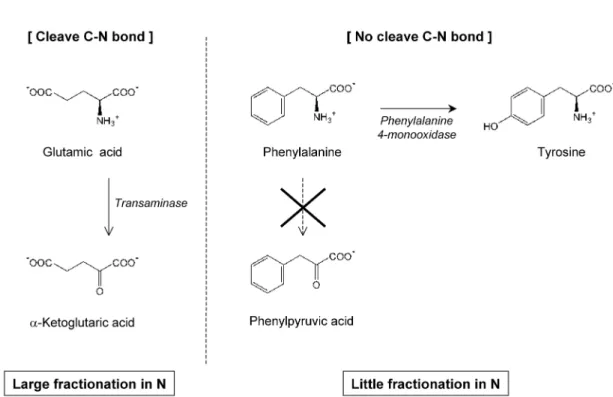
δ15N) of individual amino acids has recently been employed as a potential powerful method for estimating the trophic level of organisms in food webs. In metabolic processes, one group of amino acids has little change in their nitrogen isotopic compo- sition (e.g., 0.4‰ for phenylalanine), although another group has a large isotopic fractionation (e.g., 8.0‰ for glutamic acid). This fractionation could be associated with the cleavage of carbon- nitrogen bond in the metabolic processes (e.g., transamination) of amino acids. Therefore, a comparison between
δ15N values of these two types of amino acids would provide the trophic level of organisms. In fact, we can estimate the trophic levels of aquatic organisms with a small error (1
σ=0.12), employing the equation: [Trophic level]=(δ15N
glutamic acid−δ15N
phenylalanine−3.4)/7.6+
1. Thus, a key advantage of this method is that the trophic level can be obtained based on the
δ15N values of two amino acids from a single organism; consequently, unlike the bulk method, it is not necessary to characterize theδ
15N values of primary producers. Here, we review the princi- ple of this amino acid method and its application to natural organisms in marine and freshwater environments.
Key words: stable isotope, ecology, food web, trophic level, nitrogen, amino acid
*独立行政法人海洋研究開発機構海洋・極限環境生物 圏領域
〒237―0061 神奈川県横須賀市夏島町2―15
Chikyukagaku(Geochemistry)44,233―241(2010)
Fig. 1 Relationship between the trophic level (TL)
andδ
15N of bulk organisms.
ら捕食者(消費者)に受け継がれるため,生態系に属 する全ての生物の窒素同位体比は,一義的には食物連 鎖網のベースにいる一次生産者の同位体比を反映す る。例えば,海水中の硝酸イオンを窒素源として生育 した植物プランクトンの全窒素同位体比(生き物まる ごと,バルクの同位体比)は,+3〜+10‰(例えば,
Altabet and Francois, 1994)であるのに対し,窒素
ガスの固定により生育したシアノバクテリアの全窒素 同位体比は,約0‰(例えば,Minagawa and Wada,1986)である。そのため,彼らを餌とする動物プラ
ンクトン,そしてその動物プランクトンを餌とする魚 の全窒素同位体比は,この生産者の同位体比の違いを 反映する(例えば,Wada and Hattori, 1976)。一方 で動物の全窒素同位体比は,その動物が食べた餌に比 べて平均で3.3‰高い値になる(例えば,Miyake andWada, 1967)
。これは,動物は捕食によって餌から窒素を得る一方,代謝された窒素を尿素やアンモニアと して体外に排出し,その際に排出される窒素は15
N
に 乏しく,体組織に残る窒素は15N
に富むという同位体 分別が起こるためである。この関係を利用すること で,生物の全窒素同位体比からその生物の生態系の中 での位置「栄養段階(trophic level, TL)」を推定す ることができる(式(1), Minagawa and Wada, 1984; Wada and Yoshioka, 1995)
。TL=
(δ15N
生物−δ15N
一次生産者)/3.3+1
(1)δ15
N
生物は 研 究 対 象 の 生 物 の 全 窒 素 同 位 体 比 を,δ15
N
一次生産者は研究対象の生態系の一次生産者の全窒素 同位体比を表す。植物プランクトンの栄養段階が1で あり,それを食べる動物プランクトンが2,さらに動 物プランクトンを食べる魚が3となる。また,植物プ ランクトンと動物プランクトンの両方を捕食する魚 は,2〜3の中間的な値になる。このように,生物の全窒素同位体比は,生物の栄養 段階を明らかにし,生態系の食物連鎖網解析などの研 究に有用な情報をもたらす。これまでに数多くの研究 が行われ,多くの論文(例えば,Wada et al., 1987;
Hobson and Welch, 1992; Yoshii
et al., 1999; Ogawa et al., 2001)が発表されていることからも,本手法の 有用性は疑いようがない。とくに,窒素同位体比から 得られる栄養段階の情報に,炭素同位体比の情報を加 えて,生態系の食物連鎖構造を客観的に捉えるという 手法は,現在の生態学研究にとって最も重要なアプ ローチの一つであり,また,この手法の登場により,今日の 同位体生態学 と呼ばれる分野が発展してき た(和田,1997; Fry, 2006)。
しかしこの手法には,(1)捕食に伴うδ15
N
の 上 昇(3.3‰)が系によって変化する,(2)妥当なδ15
N
一次生産者を求めることが難しい,という2つの問題があり,得 られる結果の精度がしばしば議論の対象となってきた
(例えば,Cabana
and Rasmussen, 1996; Post, 2002; Matthews and Mazumder, 2005)
。例えば,植 物プランクトンの全窒素同位体比は,窒素源として窒 素ガス,硝酸,アンモニアの何を使ったのか,または その利用割合に応じて,ときには10‰以上の非常に 大きな変動を示す(例えば,Yoshioka et al., 1994;Dore
et al., 2002)。また,単一の窒素源を用いていても,その利用効率の違い(たくさん使ったのか,少し 使ったのか)によっても,植物プランクトンの全窒素 同位体比は大きく変動する(例えば,Altabet
and Francois, 1994)
。すなわち,この一次生産者の全窒 素同位体比の変動(バックグラウンドの変動)が,捕 食に伴うδ15N
の上昇(3.3‰)に比べて大きすぎるた めに,これまでの研究では,生物の全窒素の窒素同位 体比分析が,絶対的な栄養段階を定量的に示すツール というよりは,相対的な被食―捕食の関係を示すツー ルとして用いられることが多かったのである(例え ば,Rauet al., 1992; O’Reillyet al., 2002; Schmidtet al., 2003)。2000年代に入ると,この重い同位体(
15N)の濃縮
をバルク(生き物丸ごと)としてではなく,生物に含 まれる個々の有機化合物,とりわけアミノ酸に注目し た研究が行われるようになった(McClelland
and Montoya, 2002; McClelland
et al., 2003; Schmidt et al., 2004; Pakhomovet al., 2004)。それにより,捕食 者のアミノ酸の窒素同位体比は餌に対して,フェニル アラニン(Phe)で約0.4‰,グルタミン酸(Glu)で 約8.0‰高 く な る こ と が わ か っ て き た(Fig. 2;Chikaraishi
et al., 2009)。すなわち,生物に含まれ る両者のアミノ酸の窒素同位体比を比較することで栄 養段階(式(2);水棲生物の場合)や一次生産者の 窒素同位体比を推定することができる(Chikaraishi et al., 2009)。TL
Glu/Phe=(δ15N
Glu−δ15N
Phe−3.4)/7.6+1
(2)このアミノ酸を用いた分析法は,生物の栄養段階を推 定するうえで,一次生産者の同位体比を必要とせず に,言い換えれば,一次生産者の窒素同位体比の変動
に左右されずに,研究対象の生物に含まれる2つのア ミノ酸の同位体比を見るだけで正確に栄養段階を推定 することができるという点で本質的に優れている。
この手法の登場により,生物の栄養段階はカメラの ピントを合わせたようにクリアーに見ることができる
ようになった(Fig. 3, McCarthyet al., 2007; Poppet al., 2007; Chikaraishiet al., 2009, 2010a)。生態系の 一次生産者の値と考えることができるフェニルアラニ ンの窒素同位体比(−3.4〜+10.1‰)が示すように, 天然の生物は,多様な窒素同位体比を持つ一次生産者 を起点とする生態系に属している。しかし,アミノ酸 の窒素同位体比(式(2))により導かれた栄養段階
(TLGlu/Phe)は,そのような一次生産者の同位体比の
バラツキに関わらず,シアノバクテリア,植物プラン クトン,海藻などの一次生産者が1,動物プランクト ンや貝などの一次消費者が2と,生物学的な知 見 に ぴったり一致する。また,カニやエビが2.5前後,魚 が3〜4,サメが4後半,というように,雑食者や高次 消費者の栄養段階も非常に妥当な値を示す。
2.
原 理生体に含まれるアミノ酸には,食物連鎖に伴い窒素 同 位 体 比(δ15
N)が ほ と ん ど 変 化 し な い ア ミ ノ 酸 Fig. 2 Relationship between the trophic level (TL)
and
δ15N of amino acids.
Fig. 3
δ15N values of glutamic acid and phenylalanine, and the TL
Glu/Phevalues in natural aquatic organ-
isms (after Popp
et al., 2007; Chikaraishiet al., 2009, 2010a).(メチオニン,フェニルアラニンなど,
Source amino acid)と,3〜8‰上 昇 す る ア ミ ノ 酸(ア ラ ニ ン,
バ リ ン,イ ソ ロ イ シ ン,プ ロ リ ン,グ ル タ ミ ン 酸 な ど,Trophic
amino acid)の2種 類 が 存 在 す る
(McClelland and Montoya, 2002; Chikaraishiet al.,
2007)
。これは,両者の代謝系が異なるためであ る(Fig. 4; Bender, 2002)。前者のアミノ酸は,代謝の 主反応にアミノ基(窒素)が関わらないため,代謝さ れるアミノ酸と代謝されずに残るアミノ酸の間に同位 体分別がほとんどない。一方で後者のアミノ酸は,代 謝の主反応がアミノ基の脱離反応であるために,代謝 されるアミノ酸と代謝されずに残るアミノ酸(体組織 になるアミノ酸)の間に同位体分別が起こる。そのた め,前者のアミノ酸の窒素同位体比は,高次捕食者で あっても生態系の一次生産者がはじめに持っていた値 と ほ と ん ど 一 致 す る(Chikaraishi et al.,
2007,
2009)
。また,どの栄養段階の生物であっても,その生物に含まれる両者のアミノ酸の窒素同位体比を比較 することで,以下の一般式より(式(3)),栄養段階
(TL)を推定することができる(Chikaraishi et al.,
2009)
。TL=
(δ15N
trophic−δ15N
source−β)/
(Δ
trophic−Δsource)+1
(3)δ15
N
source,δ15N
trophicは,それぞれ,食物連鎖に伴い窒素同位体比が変化しないアミノ酸(Source
amino acid)と,変化する(上昇する)アミノ酸(Trophic amino acid)の同位体比を,βは一次生産者における
両者のアミノ酸の同位体比の差を,Δsource,Δtrophicは,両者のアミノ酸の食物連鎖に伴う同位体比の上昇値を 示す。原理的には,δ15
N
source,δ15N
trophicには様々なア ミノ酸を用いることができるが,式(3)の各項β,Δtrophic,Δsourceの生物間でのバラツ キ(Table 1)や,
同位体比の測定のしやすさ(次章参照)を考慮する
と,δ15
N
sourceにフェニルアラニンを,δ15N
trophicにグルタミン酸を用いた場合(式(2))に最も優れた精度
Fig. 4 Nitrogen isotopic fractionation during amino acid metabolisms.
Table 1 Summary of the isotope difference be- tween amino acid and phenylalanine ( ),
15
N-enrichment factor along trophic level
(
Δ), and their variability (1
σ) for aquatic
organisms.
(1σ=0.12)で 栄 養 段 階 を 求 め る こ と が で き る
(Chikaraishiet al., 2009)。
3.
アミノ酸の窒素同位体比の測定 アミノ酸の窒素同位体比分析は一般的に,(1)生体 試料の酸加水分解,(2)精製と誘導体化(力石ほか,2009)
,(3)ガスクロマトグラフ/質量分析 計(GC/IRMS)に よ る 同 位 体 比 測 定(力 石・大 場,2008;
Chikaraishi
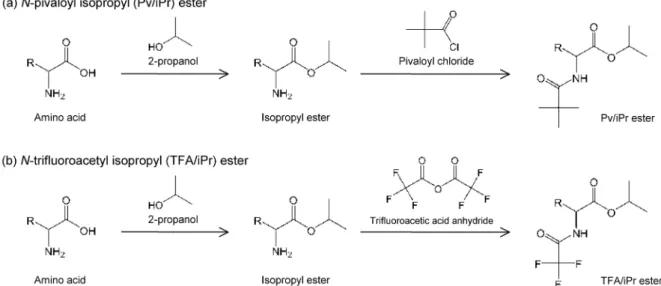
et al., 2010b)で構成される。誘導体化 には,ピバロイル/イソプロピル(Pv/iPr)エステル 化(Fig. 5a:カルボキシル基をイソプロピルエステル 化し,アミノ基をピバロイル化したもの,例えば,Metges
et al., 1996),または,トリフルオロアシル/イソプロピル(TFA/iPr)エステル化(Fig. 5b:カル ボキシル基をイソプロピルエステル化し,アミノ基を トリフルオロアシル化したもの,例えば,
Engel
et al.,1990)が用いられる。ただし,フッ素を含む化合物
は
GC/IRMS
に深刻なダメージを与える恐れがあるため,TFA/iPrエステル化を用いる場合は
GC/IRMS
の 運用に細心の注意を払う必要がある(Chikaraishi et al., 2010b)。GC/IRMS
での測定では,Fig. 6に示すようなクロマトグラムが得られ,個々のアミノ酸の窒素同位体比 が測定される。同位体比を正確に測定するためには,
個々のアミノ酸のピークを必ずベースライン上で分離 し な け れ ば な ら な い(力 石・大 場,2008)。例 え ば
Fig. 6では,アスパラギン酸とトレオニンのピークが
重なっており,このような場合にはアスパラギン酸とトレオニンの同位体比を個々に得ることはできない。
一方で,グルタミン酸とフェニルアラニンのピークの 周辺に他のアミノ酸や夾雑物のピークは見あたらず,
グルタミン酸とフェニルアラニンの同位体比は,ほと んどの試料において容易に測定することができる。一 般的に,1試料あたりの測定時間は40〜60分,必要な 試 料 量 は 各 ア ミ ノ 酸 ご と に 窒 素 量 で 約30 ng(窒 素 含 有 量 が5%の 試 料 で あ れ ば,試 料 全 体 で200〜
500μ g
程 度),測 定 精 度 は0.5‰(1σ)程 度 で あ る(Chikaraishiet al., 2010b)。
4.今後の展開
アミノ酸を用いた手法は,バルク法に比べて,(1)
栄養段階の見積もりに一次生産者の情報を必要としな い,(2)得られる栄養段階の精度が格段に高い,(3)
少量の試料で分析できる,(4)ホルマリン固定試料,
骨や殻に含まれるアミノ酸にも利用できる,という優 れ た ア ド バ ン テ ー ジ が あ り(Chikaraishi et al.,
2010a)
,バルク法に替わる新しい手法として今後の幅広い利用が大いに期待されている。しかし,この新 しい手法を用いた研究の実績は,残念ながらまだまだ 限定的である。それは,アミノ酸の同位体比の研究 が,まだ始まったばかりであるために,生体アミノ酸 の同位体比の挙動に関する基礎的なデータが不足して いることや,微小試料からアミノ酸の窒素同位体比を 正確に測定できるようになるまでには前処理や
GC/
IRMS
についてかなりの経験が必要となるためであ る。実際に,式(2)は,植物プランクトンなどを一Fig. 5 Derivatizations employed for nitrogen isotope analysis of amino acids.
次生産者として,動物プランクトン,魚などの生物で 構成される水界生態系の生食連鎖においては,海棲,
淡水棲にかかわらず,その妥当性が高く評価されてい るが(Fig. 3; Chikaraishiet al., 2009),式(2)を直 接,腐食連鎖系や陸上生態系,化学合成生態系,共生 系などに適用できるかどうかは,まだはっきりしてい ない。また,式3のβは,水界生態系では+3.4‰であ るが,陸上生態系 で は,C 3植 物 を 起 点 と し た 場 合 に,−8.4‰,
C 4植物を起点とした場合に+0.4‰と,
系によっ て 異 な る 値 を も つ こ と が 報 告 さ れ て い る
(Chikaraishiet al., 2010a)。今後,得られる情報の 精度を高め,質の高い議論を行うためには,様々な ケースについて,培養やコントロール下での飼育実験 などを通じて,基礎的なデータをさらに増やしていく ことが必要である。また同時に,前処理や測定法の簡 易化・最適化などの研究(山口ほか,2009)も重要 である。
生態学における食物連鎖網研究の究極的な目標の1 つは,生態系に生息する動物が何を餌としているかを 明らかにすることであり,栄養段階の推定はその全体 像を客観的に理解するためのひとつの手段にすぎな い。フェニルアラニンの窒素同位体比が一次生産者の それとほとんど一致すると言っても,コントロール下
での飼育実験や,生物学的に何が何を食べているかが 明らかな系を除く複雑な自然界のほとんどのケースに おいては,これらの窒素同位体比から一次生産者を明 確に特定することは簡単でない。しかし,アミノ酸の 窒素同位体比から得られる栄養段階や一次生産者の窒 素同位体比に加えて,アミノ酸の炭素同位体比を測定 することができれば,複雑な天然の食物連鎖網をさら に詳しく捉えることができる可能性がある。例えば,
植物プランクトンの炭素同位体比は,炭素固定に用い た光合成系の違いや溶存二酸化炭素の濃度・同位体比 を反映してバリエーションをもつ。従って,炭素同位 体比が測定できれば,Fig. 7に示すように,異なる炭 素同位体比を持つ生態系に属する生物群を区別できる 可能性がある。残念ながら,現時点では,生物に含ま れる個々のアミノ酸の炭素同位体比を正しく(0.5〜
1.0‰以内の誤差で)測定する一般的・汎用的な手法
は確立していない。これまで,TFA/iPr誘導体化を用 いて,GC/IRMSで炭素同位体比を測定している論文 が多数報告されているが,その全てが,誘導体化に伴 う同位体分別についての正確な補正を行っていない(Chikaraishi and Ohkouchi, 2010)。1990年代前半 以前に用いられていたような,イオン交換クロマトグ ラフィーにより個々のアミノ酸を単離し同位体比を測
Fig. 6 Representative chromatogram of GC/IRMS analysis of amino acids.
定するという,一部の科学者だけが扱える特殊な技術 で,分析に多くの試料と時間を必要とする手法(例え ば,Engel and Macko, 1984; Hare et al., 1991;
Minagawa
et al., 1992)が,現時点で最も正確な同位 体比を出すことのできる手法である。しかし,アシル/メチルエステル(Ac/Me)誘導体化とその同位体分 別の補正法(Corret al
, 2007a, 2007b)
,エチルエス テル(Et)誘導体化と極性GC
カラムを用いた同位 体比測定法(Chikaraishi and Ohkouchi, 2010),誘 導体化を用いずにHPLC/IRMS
により炭素同位体比 を測定する手法(Smithet al., 2009)などの研究が積 極的に行われている。近い将来,アミノ酸の炭素同位 体比を加えた議論も可能になるであろう。D
体,L体アミノ酸を区別した光学異性体レベルで 同位体比の情報を得ることも,大きな進展をもたらす と考えられる。我々高等動物の身体を構成するタンパ ク質は,基本的にL
体アミノ酸で構成されているが,一部の臓器,組織や,バクテリアには多くの
D
体ア ミノ酸が存在する。現在,光学異性体レベルでの同位 体比測定法の開発も積極的に行われており(Takanoet al., 2009),今後それらが一般的に利用できるよう
になれば,例えば,海洋や湖沼の
POM(粒子状有機
物)や堆積物におけるバクテリアの活動,生態系(腐 食連鎖)の情報も得られるようになるであろう。謝 辞
本稿の内容は,科学研究費補助金(力石・高野・小 川)により実施した研究成果の一部を取り纏めたもの である。本研究を進めるにあたり,和田英太郎先生
(海洋研究開発機構)には,様々なアドバイスをいた だきました。本研究プロジェクトを推進するにあたり 北里洋領域長(海洋研究開発機構)には様々な支援を
頂きました。本稿の挿絵(水棲生物のイラスト)は廣 野留都さんに提供して頂きました。心より厚く御礼申 し上げます。また,匿名の査読者(2名)には,本稿 の査読を通じて貴重なアドバイス・コメントを頂きま した。記して厚く感謝致します。
引 用 文 献
Altabet, M. A. and Francois, R. (1994) Sedimentary nitrogen isotopic ratio as a recorder for surface ocean nitrate utili- zation.Global Biogeochemical cycles,8, 103―116.
Bender, D. A. (2002) Introduction to Nutrition and Metabo- lism. CRC Press, London, UK.
Cabana, G. and Rasmussen, J. B. (1996) Comparison of aquatic food chains using nitrogen isotopes.Proceeding of the National Academy of Sciences of USA, 93, 10844―
10847.
力石嘉人・大場康弘(2008)ガスクロマトグラフ/同位体比 質量分析計による分子レベル安定同位体比分析法.Re- searches in Organic Geochemistry,23/24,99―122.
Chikaraishi, Y. and Ohkouchi, N. (2010) An improved method for precise determination of carbon isotopic composition of amino acids. In:Earth, Life, and Isotopes(eds. Ohok- ouchi, N., Tayasu, I. and Koba, K.), Kyoto University Press, pp. 355―366.
Chikaraishi, Y., Kashiyama, Y., Ogawa, N. O., Kitazato, H.
and Ohkouchi, N. (2007) Biosynthetic and metabolic con- trols of nitrogen isotopic composition of amino acids in marine macroalgae and gastropods: implications for aquatic food web studies.Marine Ecology Progress Series, 342, 85―90.
Chikaraishi, Y., Ogawa, N. O., Kashiyama, Y., Takano, Y., Suga, H., Tomitani, A., Miyashita, H., Kitazato, H. and Ohkouchi, N. (2009) Determination of aquatic food-web structure based on compound-specific nitrogen isotopic composition of amino acids. Limnology and Oceanogra- phy: Methods.,7, 740―750.
力石嘉人・高野淑識・大河内直彦(2009)アミノ酸(ピバロイ ル/イソプロピルエステル誘 導 体)のGC/MSに よ る 解 析.Researches in Organic Geochemistry,25,61―70.
Chikaraishi, Y., Ogawa, N. O. and Ohkouchi, N. (2010a) Fur- ther evaluation of the trophic level estimation based on nitrogen isotopic composition of amino acids. In: Earth, Life, and Isotopes (eds. Ohokouchi, N., Tayasu, I. and Koba, K.), Kyoto University Press, pp. 37―51.
Chikaraishi, Y., Takano, Y., Ogawa, N. O. and Ohkouchi, N.
(2010b) Instrumental optimization for compound-specific nitrogen isotope analysis of amino acids by gas chroma- tography/combustion/isotope ratio mass spectrometry. In:
Earth, Life, and Isotopes(eds. Ohokouchi, N., Tayasu, I.
and Koba, K.), Kyoto University Press, pp. 367―386.
Corr, L. T., Berstan, R. and Evershed, R. P. (2007a) Optimisa- tion of derivatisation procedures for the determination of δ13C values of amino acids by gas chromatography/com-
Fig. 7 Potential to access complex networks of food
chain by
δ15N-
δ13C of amino acids.
bustion/isotope ratio mass spectrometry.Rapid Commu- nications in Mass Spectrometry,21, 3759―3771.
Corr, L. T., Berstan, R. and Evershed, R. P. (2007b) Develop- ment ofN-acetyl methyl ester derivatives for the deter- mination of δ13C values of amino acids using gas chromatography-combustion-isotope ratio mass spec- trometry.Analytical Chemistry,79, 9082―9090.
Dore, J. E., Brum, J. R., Tupas, L. M. and Karl, D. M. (2002) Seasonal and interannual variability in sources of nitro- gen supporting export in the oligotrophic subtropical North Pacific Ocean.Limnology and Oceanography,47, 1595―1607.
Engel, M. H. and Macko, S. A. (1984) Separation of amino acid enantiomers by high-performance liquid chromatog- raphy for stable nitrogen and carbon isotopic analyses.
Analytical Chemistry,56, 2598―2600.
Engel, M. H., Macko, S. A. and Silfer J. A. (1990) Carbon iso- tope composition of individual amino acids in the Mur- chison meteorite.Nature,348, 47―49.
Fry, B. (2006) Stable Isotope Ecology. Springer, New York, USA.
Hare, P. E., Fogel, M. L., Stafford, Jr. T. W., Mitchell, A. D.
and Hoering, T. C. (1991) The isotopic composition of car- bon and nitrogen in individual amino acids isolated from modern and fossil proteins. Journal of Acrchaeological Science,18, 277―292.
Hobson, K. and Welch, H. E. (1992) Determination of trophic relationships within a high Arctic marine food web using δ13C andδ15N analysis.Marine Ecology Progress Series, 84, 9―18.
Matthews, B. and Mazumder, A. (2005) Consequences of large temporal variability of zooplanktonδ15N for model- ing fish trophic position and variation. Limnology and Oceanography,50, 1404―1414.
McCarthy, M. D., Benner, R., Lee, C. and Fogel, M. L. (2007) Amino acid nitrogen isotopic fractionation patterns as in- dicators of heterotrophy in plankton, particulate, and dis- solved organic matter. Geochimica et Cosmochimica Acta,71, 4727―4744.
McClelland, J. W. and Montoya, J. P. (2002) Trophic relation- ships and the nitrogen isotopic composition of amino ac- ids in plankton.Ecology,83, 2173―2180.
McClelland, J. W., Holl, C. M. and Montoya, J. P. (2003) Re- lating lowδ15N values of zooplankton to N2-fixation in the tropical North Atlantic: insights provided by stable iso- tope ratios of amino acids.Deep-Sea Research, I,50, 849―
861.
Metges, C. C., Petzke, K. J. and Henning, U. (1996) Gas chro- matography/combustion/isotope ratio mass spectrometric comparison of N-acetyl- and N-pivaloyl amino acid esters to measure15N isotopic abundances in physiological sam- ples: A pilot study on amino acid synthesis in the upper gastro-intestinal tract of minipigs.Journal of Mass Spec- trometry,31, 367―376.
Minagawa, M. and Wada, E. (1984) Stepwise enrichment of
15N along food chains: further evidences and the relation betweenδ15N and animal age. Geochimica et Cosmo- chimica Acta,48, 1135―1140.
Minagawa, M. and Wada, E. (1986) Nitrogen isotope ratios of red tide organisms in the Rast China Sea: a Chracteriza- tion of biological nitrogen fixation.Marine Chemistry,19, 245―259.
Minagawa, M., Egawa, S., Kabaya, Y. and Karasawa-Tsuru, K. (1992) Carbon and nitrogen isotope analysis for amino acids from biological sample.Mass Spectroscopy,40, 47―
56.
Miyake, Y. and Wada, E. (1967) The abundance ratio of15N /14N in marine environments. Records of Oceanographic Works,9, 37―53.
O’Reilly, C. M., Hecky, R. E., Cohen, A. S. and Plisnier, P. -D.
(2002) Interpreting stable isotopes in food webs: Recog- nizing the role of time averaging at different trophic lev- els.Limnology and Oceanography,47, 306―309.
Ogawa, N. O., Koitabashi, T., Oda, H., Nakamura, T., Ohkouchi, N. and Wada, E. (2001) Fluctuations of nitro- gen isotope ratio of gobiid fish (Isaza) specimens and sediments in Lake Biwa, Japan, during the 20th century.
Limnology and Oceanography,46, 1228―1236.
Pakhomov, E. A., McClelland, J. W., Bernard, K., Kaehler, S.
and Montoya, J. P. (2004) Spatial and temporal shifts in stable isotope values of the bottom-dwelling shrimp Nau- ticaris marionis at the sub-Antarctic archipelago.Marine Biology,144, 317―325.
Popp, B. N., Graham, B. S., Olson, R. J., Hannides, C. C. S., Lott, M., López-Ibarra, G. and Galván-Magaña, F. (2007) Insight into the trophic ecology of yellowfin tuna, Thun- nus albacares, from compound-specific nitrogen isotope analysis of proteinaceous amino acids. In:Stable Isotopes as Indicators of Ecological Change (eds. Dawson, T. E.
and Siegwolf, R. T. W.), Academic Press, 173―190.
Post, D. M. (2002) Using stable isotopes to estimate trophic position: models. Methods, and assumptions.Ecology,83, 703―718.
Rau, G., H., Ainley, D. G., Bengtson, J. L., Torres, J. J. and Hopkins, T. L. (1992).15N/14N and13C/12C in weddell Sea birds, seals, and fish: implications for diet and trophic structure.Marine Ecology Progress Series,84, 1―8.
Schmidt, K., Atkinson, A., Stubing, D., McClelland, J. W., Montoya, J. P. and Voss, M. (2003) Trophic relationships among Southern Ocean copepods and krill: Some uses and limitations of a stable isotope approach.Limnology and Oceanography,48, 277―289.
Schmidt, K., McClelland, J. W., Mente, E., Montoya, J. P., Atkinson, A. and Voss, M. (2004) Trophic-level interpre- tation based onδ15N values: implications of tissue- specific fractionation and amino acid composition. Ma- rine Ecology Progress Series,266, 43―58.
Smith, C. I., Fuller, B. T., Choy, K. and Richards, M. P. (2009)
A three-phase liquid chromatographic method forδ13C analysis of amino acids from biological protein hydro- lysates using liquid chromatography-isotope ratio mass spectrometry.Analytical Chemistry,390, 165―172.
Takano, Y., Chikaraishi , Y., Ogawa, N. O., Kitazato, H. and Ohkouchi, N. (2009) Compound-specific nitrogen isotope analysis of D-alanine, L-alanine, and valine: application of diastereomer separation toδ15N and Microbial Peptido- glycan Studies.Analytical Chemistry,81, 394―399.
和田英太郎(1997)窒素安定同位体による生物地球化学的研 究.地球化学,31,17―25.
Wada, E. and Hattori, A. (1976) Natural abundance of15N in particulate organic matter in the North Pacfi Ocean.Geo- chimica et Cosmochimica Acta,40, 249―251.
Wada, E. and Yoshioka, T. (1995) Isotope biogeochemistry of several aquatic ecosystem. Geochemistry International,
32, 121―140.
Wada, E., Terazaki, M., Kabaya, Y. and Nemoto, T. (1987).
15N and13C abundances in the Antarctic ocean with em- phasis on the biogeochemical structure of the food web.
Deep-Sea Research,34, 829―841.
山口保彦・力石嘉人・横山祐典・大河内直彦(2009)アミノ酸
(エトキシカルボニル/エチルエステル誘導体)のGC/MS による解析.Researches in Organic Geochemistry,25,71
―82.
Yoshii, K., Melnik, N. G., Timoshkin, O. A., Bondarenko, N.
A., Anoshko, N., Yoshioka, T. and Wada, E. (1999) Stable isotope analyses of the pelagic food web in Lake Baikal.
Limnology and Oceanography,44, 502―511.
Yoshioka, T., Wada, E. and Hayashi, H. (1994) A stable iso- tope study on seasonal food web dynamics in a lake.Ecol- ogy,75, 835―846.