• 検索結果がありません。

. We report here a rare case of a colorectal P-J type polyp showing the hamartoma-adenoma-carcinoma sequence in a non-Peutz-Jeghers syndrome patient.

N/A
N/A
Protected

Academic year: 2021

シェア ". We report here a rare case of a colorectal P-J type polyp showing the hamartoma-adenoma-carcinoma sequence in a non-Peutz-Jeghers syndrome patient."

Copied!
4
0
0

読み込み中.... (全文を見る)

全文

(1)

Introduction

 A Peutz-Jeghers(P-J)type polyp is a hamartomatous polyp that occurs in patients with P-J syndrome, but is rarely found as a solitary polyp in non-P-J syndrome patients

1)

. There have been some reports of polyposis and cancerous transformation in patients with P-J syndrome, but few reports of solitary P-J type polyps containing cancer foci

2, 3)

. We report here a rare case of a colorectal P-J type polyp showing the hamartoma-adenoma-carcinoma sequence in a non-Peutz-Jeghers syndrome patient.

Case Report

 A 48-year-old woman was admitted to our hospital for medical examination. Colonoscopy revealed a solitary pedunculated polyp, 10 10 8 mm in size, in the sigmoid colon, and polypectomy was performed. No abdominal symptoms were present, and carcinomatous

Showa Univ J Med Sci 22 (1) , 69 〜72, March 2010

Solitary Peutz-Jeghers Type Colorectal Polyp with Hamartoma-adenoma-carcinoma Sequence in

a Non-Peutz-Jeghers Syndrome Patient

Shuei A

RIMA

, Toshiaki K

UNIMURA

, Kai M

ATSUO

, Takahiro H

OBO

, Koji N

OGAKI

, Kaoru K

ATO

, Hisashi H

OSAKA

, Koji S

AITO

, Tomoko S

UGIYAMA

and Toshio M

OROHOSHI

Abstract : Peutz-Jeghers(P-J)syndrome is an inherited disorder characterized by multiple hamartomatous gastrointestinal polyps, mucocutaneous pigmentation, and an increased risk of both digestive tract and non-digestive tract cancers.

P-J type polyps are characteristic of P-J syndrome but rarely present as soli- tary polyps. Though cancerous lesions frequently develop from polyposis in P-J syndrome, reports of malignancy in solitary colorectal P-J type polyps are rare ; our literature search identified only two examples. This report describes a non-Peutz-Jeghers syndrome patient with a solitary P-J type polyp showing the hamartoma-adenoma-carcinoma sequence.

Key words : Peutz-Jeghers type polyp, hamartoma-adenoma-carcinoma sequence, non-Peutz-Jeghers syndrome patient, hyperplasia of the lamina muscularis mucosa, desmin

Case Report

First Department of Pathology, Showa University School of Medicine, 1-5-8 Hatanodai, Shinagawa-ku, Tokyo 142-

8555, Japan.

(2)

Shuei A

RIMA

, et al 70

merger of other organs was not found in other parts of the alimentary canal. There was no unusual mucocutaneous pigmentation. The patient had been healthy, but a uterine leio- myoma had been detected at 36 years of age. No hereditary disease was identified in her family.

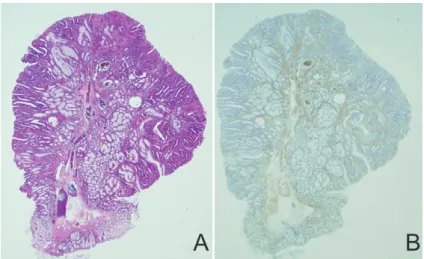
 Histopathologically, the polyp showed hyperplasia of a hamartomatous gland supported by hyperplasia of the lamina muscularis mucosa, which was immunohistochemically positive for desmin(Fig. 1) . In addition, hyperalasia of the low grade adenomatous gland was observed around the cupular part of the polyp. Furthermore, the polyp contained well-differentiated adenocarcinoma-like foci, but the cancer cells remained in the mucosa without further invasion. We diagnosed the polyp as a well-differentiated tubular adenocarcinoma within adenoma within hamartoma(Fig. 2) .

Fig. 1. Low-power view of the polyp(original magnification, 1.25)

A : The polyp showed hyperplasia of the hamartomatous gland supported by hyperplasia of the lamina muscularis mucosa.

B : The lamina muscularis mucosa was immunohistochemically positive for desmin.

Fig. 2. Medium-power view of the polyp(original magnification, 10)

Adenoma component(right upper part)and

adenocarcinoma component(lower part)are shown

in the hamartomatous glands.

(3)

71 Solitary Peutz-Jeghers Type Colorectal Polyp

 The postoperative course was good and the patient was discharged from the hospital on the next day. Curative resection of the polyp was performed endoscopically and the lesion required no further treatment the patient was monitored as an outpatient.

Discussion

 In P-J syndrome, gastrointestinal polyposis and excessive deposition of mucosal melanin in the skin are pathognomonic. However, for the solitary P-J type polyp, in the alimentary canal is rare, though the small intestine is the favored location for polyps in general, as well as in P-J syndrome. Only 27 previous case reports of solitary P-J type polyps were found.

In the reports of Lantz et al

1)

, Oncel et al

2)

and Sone et al

4)

, 16 males and 11 females were discussed. One polyp was located in the stomach, 21 were in the small intestine, and five were found in the large intestine. Only two cases of cancerous transformation in a solitary P-J-type polyp have been reported to date. One is the case of Ichiyoshi et al in which the polyp was located in the duodenum

3)

, and the other is the report of a colorectal P-J polyp by Oncel et al

2)

. The present case is the 2nd case report of cancerous transfor- mation in a colorectal Peutz-Jeghers-type polyp.

 P-J syndrome is an autosomal dominant disorder characterized by pigmentation of skin mucosa and alimentary canal polyposis with an increased risk of cancerous transformation

5)

. In the P-J syndrome cases of Narita et al, 52 polyps were examined, and the incidence of the neoplastic changes, such as the development of adenomas or carcinomas, was about 6%

6)

. Perzin and Bridge reported an examination of more than 100 P-J syndrome polyps and the incidence was about 3%

7)

. In non-P-J syndorome, the risk of cancer development from a P-J type polyp is not well understood. Solitary P-J type polyps are histologically similar to those observed in P-J syndrome, but the hereditary element is absent, and their malignant potential is unclear.

 In Cronkhite-Canada syndrome, juvenile polyposis and Cowden syndrome, adenomatous and carcinomatous changes are also seen on the luminal surface. Nonomura et al found that eight of 54 patients had gastrointestinal carcinoma(about 15%)in Cronkhite-Canada syndrome

8)

. Another study examined ninety-nine juvenile polyposis patients who underwent 138 gastrointestinal operations, and the incidence of a gastrointestinal carcinoma was about 17%

9)

. However, in Cowden syndrome, the risk of malignant transformation in gastrointes- nal polyps is still unclear

10)

.

 The hypothesis of hamartoma-adenoma-carcinoma sequence has been suggested for cancer-

ous transformation in hamartomatous polyps

11)

. In our present case, the tumor component

was predominantly tubular adenoma, containing foci of adenocarcinoma. This suggests that

the cancer-causing mechanism in our case is not only similar to usual carcinogenic process

in colorectal cancer(namely the adenoma-carcinoma sequence

12)

) , but seems to support the

hypothesis of the hamartoma-adenoma-carcinoma sequence.

(4)

Shuei A

RIMA

, et al 72

References

1) Lantz H, Doos WG and Affi A : Peutz-Jeghers-type hamartomatous polyp in a patient without Peutz-Jeghers syndrome. Gastrointest Endosc 60:316-317(2004)

2) Oncel M, Remzi FH, Church JM, Goldblum JR, Zutshi M and Fazio VW : Course and follow-up of solitary Peutz-Jeghers polyps : a case series. Int J Colorectal Dis 18:33-35(2003)

3) Ichiyoshi Y, Yao T, Nagasaki S and Sugimachi K : Solitary Peutz-Jeghers type polyp of the duodenum contain- ing a focus of adenocarcinoma. Ital J Gastroenterol 28:95-97(1996)

4) Sone Y, Nakano S, Takeda I and Kumada T : Solitary hamartomatous polyp of Peutz-Jeghers type in the jeju- num resected endoscopically. Gastrointest Endosc 51:620-622(2000)

5) Kazuoki H, Mitsuo I, Takayuki M, Kohrogi N, Kinoshita H, Yao T and Fujishima M : Cancer in Puetz-Jeghers syndrome. Cancer 72:2777-2781(1993)

6) Narita T, Eto T and Ito T : Peutz-Jeghers syndrome with adenomas and adenocarcinomas in colonic polyps. Am J Surg Pathol 11:76-81(1987)

7) Perzin KH and Bridge MF : Adenomatous and carcinomatous changes in hamartomatous polyps of the small intestine(Peutz-Jeghers syndrome) : report of case and review of the literature. Camcer 49:971-983(1982)

8) Nonomura A, Ohta G, Ibata T, Shinozaki K and Nishino T : Cronkhite-Canada syndrome associated with sigmoid cancer. Acta Pathol Jpn 30:825-845(1980)

9) Coburn MC, Pricolo VE, DeLuca FG and Bland KI : Malignant potential in intestinal juvenile polyposis syn- drome. Ann Surg Oncol 2:386-391(1995)

10) Bosserhoff AK, Grussendorf-Conen EI, Rübben A, Rudnik-Schöneborn S, Zerres K, Buettner R and Merkelbach-Bruse S : Multiple colon carcinomas in a patient with Cowden syndrome. Int J Mol Med 18:643- 647(2006)

11) Bosman FT : The hamartoma-adenoma-carcinoma-sequence. J Pathol 188:9-13(1999)

12) Muto T, Bussey HJ and Morson BC : The evolution of cancer of the colon and rectum. Canaer 36:2251-2270

(1975)

[Received December 24, 2009 : Accepted January 14, 2010]

Fig.  1. Low-power  view  of  the  polyp(original  magnification,  1.25)

参照

関連したドキュメント

Wang, A new inequality of Ostrowski’s type in L 1 norm and applications to some special means and to some numerical quadrature rules, Tamkang J. Wang, A new inequality of

YANAGIDA, Powers of class wA(s, t) operators associated with gen- eralized Aluthge transformation, J. YUAN, Extensions of the results on powers of p- hyponormal and

WANG, A new inequality of Ostrowski’s type in L 1 −norm and applications to some special means and to some numerical quadrature rules, Tamkang J. WANG, Applications of

This approach is not limited to classical solutions of the characteristic system of ordinary differential equations, but can be extended to more general solution concepts in ODE

Once bulk deformation b is chosen (so that there is a torus fiber L whose Floer cohomology is non-vanishing), then we consider the Floer chain complex of L with a generic torus fiber

J. Pure and Appl. This proof was presented by G. 249]) but here we follow the presentation which can be found in Professor Lars Hörmander’s book [26, p.. Carleman’s Inequality

The construction of homogeneous statistical solutions in [VF1], [VF2] is based on Galerkin approximations of measures that are supported by divergence free periodic vector fields

We consider a class of nonlinear elliptic equations containing a p- Laplacian type operator, lower order terms having natural growth with respect to the gradient, and bounded