I. Introduction
The purpose of this paper is to review the development of bond markets in developing Asian countries after the Asian financial crisis, to assess the present situation, and to show
Development of Asian Bond Markets and Challenges: Keys to Market Expansion
*Satoshi Shimizu
Senior Economist, Economics Department, The Japan Research Institute, Limited
Abstract
Asian bond markets have expanded significantly in terms of quantity and have grown more mature than before in terms of quality. However, the degree of bond market develop- ment varies widely across countries, and the formation of well-balanced financial systems has yet to be completed. In South Korea and Malaysia, which have corporate bond markets that are relatively well developed, laws, regulations and market infrastructure have been es- tablished as a result of ongoing market development efforts since before the Asian financial crisis of 1997, and there are many bond issuers and investors. On the other hand, in other countries such as the Philippines and Indonesia, where market development has lagged be- hind, the issuance of corporate bonds started in earnest only in the mid-2000s. As a result, policy measures for market development have not necessarily been implemented sufficient- ly, and there are relatively few issuers and investors. In addition, as these countries have structural problems in their financial systems, it is difficult to change the situation in which banks act as the main providers of finance. In the future, it will be necessary to devote ef- forts to market development and continue to hold discussions on the role of the corporate bond market. Meanwhile, concerning countries whose corporate bond markets are well de- veloped as well, there remain many problems that must be corrected, such as the ill-bal- anced mix of issuer industries and the underdevelopment of investors’ investment skills, leaving room for further market development.
Keywords: Asian bond markets, Asian Bond Markets Initiative (ABMI), Asian Bonds Online, Credit Guarantee and Investment Facility (CGIF), ASEAN+3 Bond Market Forum (ABMF), factors of bond market development, financial sys- tem, institutional investors
JEL Classification: F36, G23, 016
* The author has been involved in research on Asian bond markets since 2002, and in addition to writing research papers, has participated in a few research projects, such as “Asian Bond Markets Development and Regional Financial Cooperation” in 2010-2011 within the 21st Century Public Policy Institute, and some projects within the ASEAN+3 Research Group. This pa- per is based on all the above achievements and the author would like to sincerely thank all the people who kindly cooperated on the research activities. However, any possible mistake in this paper is solely the author’s responsibility.
the future outlook. It is pointed out that with the exceptions of Korea and Malaysia, corpo- rate bond market development is rather delayed and market liquidity is limited. The reason for this is discussed in this paper. In addition, this paper discusses questions such as if there is any potential problem regarding expanded corporate bond markets in Korea, Malaysia and China and if there is a variety of investors in the region. There has been insufficient dis- cussion on the purposes of market development, assessment of the present situation, and challenges for further development, and this paper should complement the discussion on these points.
This paper’s contents are as follows. Section 2 confirms the purposes of developing Asian bond markets and states the achievements of the Asian Bond Markets Initiative (ABMI). Section 3 explains the overview and challenges of Asian bond markets. Section 4 examines factors for bond market development based on previous research. Under this framework, section 5 states the present situation, factors and future challenges of bond mar- ket development in eight Asian countries. Section 6 discusses future prospects.
II. Purposes of developing Asian bond markets and achievements of the ABMI
II-1. Purposes of developing Asian bond markets
Based on the experience of the 1997 financial crisis, the ABMI was started in 2003.
Since then, development of bond markets in the region has become an important policy tar- get. The purpose of developing an Asian financial system is for efficient and safe financial intermediation for inclusive economic development. The funds can be divided into funds from inside and funds from outside of the country, and the latter can be divided into those from inside and outside of the Asian region.
When the financial crisis occurred, bond markets were not developed in many Asian countries. What can bond market development achieve?
First, reemergence of the crisis can be prevented. Before the crisis, Asian companies were overly dependent on bank loans from inside and outside of their country, which caused the so-called “double mismatch” of currency and maturity. Also, there was a close relation- ship among the governments, banks and companies, and banks’ assessment and monitoring of companies was insufficient. It was expected that the development of bond markets would solve this problem, and that the financial system would become sounder with diminished possibility of another crisis.
Second, the financial system can be improved. As bond markets provide long-term fi- nancial intermediation, bond issuance activates capital investment and infrastructure devel- opment, and investment in bonds enables efficient management of abundant savings in the region, along with the growth of institutional investors in the region.
In addition, construction of a balanced financial system between the banking sector and
bond markets will cause risk diversification and reduce costs of the financial system as a whole. Furthermore, the interest rate structure that is established by bond markets is indis- pensable for many purposes, such as efficient resource allocation and risk management.
Third, bond markets contribute to economic development. Since the beginning of the ABMI, it has been said that channeling Asian savings into Asian investment is important.
The meaning of this common expression is firstly to channel domestic savings into domestic investment (promotion of domestic demand), and secondly to channel regional savings into regional investment (expanding regional financial integration).
Promotion of domestic demand cannot be achieved only by bond market development, but it is possible that expanding bond market promotes domestic demand. Also, due to the establishment of the ASEAN Economic Community, deepening regional financial integra- tion has become an important policy goal, in addition to developing bond markets in each country.
II-2. Achievements of the ABMI
The ABMI was established in 2003 through the ASEAN+3 finance ministers’ meetings (later finance ministers and central bank governors’ meetings), and the ABMI Roadmap was created in 2005. In 2008, a new roadmap was drawn up as a framework for a more compre- hensive approach. The tasks were also restructured into four areas: expansion of bond sup- ply, expansion of bond demand, improvement of the regulatory framework, and improve- ment of related market infrastructure. Task Forces (TF) were formed to be in charge of each task.
In 2012 and 2016, the Roadmap was revised again and the tasks were reviewed. In addi- tion, since the beginning of the ABMI, technical assistance has continued for the market de- velopment of each country.
The main achievements of the ABMI are as follows. First, in December 2004, Japanese yen-denominated cross-border Collateralized Bond Obligation (CBO) was issued, whose underlying assets were the bonds issued by Korean small and medium-sized companies.
Also, since 2004, many Asian currency -denominated bonds have been issued by various in- ternational organizations.
Second, Asian Bonds Online was established in May 2004. On this website, various in- formation and data on Asian bond markets are provided with constant improvements. In ad- dition, a regular publication named the Asia Bond Monitor was launched. With a remarkable improvement in its content, this publication has now become a rich source of information on the current investment climate, the policy progress of each bond market within the region, and so on.
Third, in November 2010, the Credit Guarantee and Investment Facility (CGIF) was es- tablished as an Asian Development Bank trust fund with initial funding of $700 million. 19 guarantees were implemented between April 2013 and November 2017.
Fourth, the ASEAN+3 Bond Market Forum (ABMF) was established in 2010 as a dis-
cussion platform with participants from both public and private sectors. This forum has suc- ceeded the achievements of the report on the impediments of cross-border bond transactions, published in 2005, as well as of the Group of Experts report, published in April 2010. At the ABMF, mainly two topics have been discussed. One is the construction of the ASEAN+3 Multi-Currency Bond Issuance Framework (AMBIF). This is an effort to integrate the bond markets for professional investors in each of the region’s countries by mutual recognition. In September 2015, Mizuho Bank became the first issuer of the bond utilizing the AMBIF.
Another topic is the improvement and integration of the settlement systems of each country. In TF 4 of the ABMI, reassessment of feasibility from business considerations for the establishment of the Regional Settlement Intermediary was finished. Also, the Cross-bor- der Settlement Infrastructure Forum (CSIF) was established and discussion is being imple- mented on how to construct settlement systems assisting cross-border bond transactions (discussed further in section Ⅵ).
III. Overview and challenges of Asian bond markets III-1. Expansion of market size and problems
This section provides an overview of the Asian bond markets. First, the Asian market as a whole has expanded significantly since the financial crisis. According to Table 1 and Table 2, the outstanding balance of government and corporate bonds for eight countries and one region in total has increased by a factor of 24.6 from $414.1 billion at the end of 1997 to
Table 1. Outstanding balance of Asian bond markets
(Note) Regarding 1997, China (corporate bond), Indonesia (government bond), Korea (corpo- rate bond), Malaysia and the Philippines (government and corporate bonds) are by BIS data.
Vietnam data is as of 2000 from Asian Bonds Online.
(Source) Park (2016) for India, Japan and U.S., Asian Bonds Online for others
$10.179 trillion at the end of 2016. During this period, no country experienced a reduction in its GDP ratio. In particular, the balance of the Chinese market is $7.129 trillion, dominat- ing 70% of the total, and its expansion since the end of 1997 has been significant.
Second, the level of market development varies widely among countries in the region.
GDP ratios of government bond outstanding balance are 40-50% except for in Indonesia, the Philippines and Vietnam. On the other hand, the government bond markets in Cambodia, Laos and Myanmar are still in their infancy stage. These countries are just graduating from being aid-receiving countries, and it is an urgent task to ensure fund procurement tools by developing government bond markets.
Regarding corporate bond markets, the GDP ratios of Korea and Malaysia are high, and the GDP ratio of Korea is higher than that of its government bond market. According to BIS Monetary and Economic Department (2016), a result of hearing surveys shows that the cor- porate bond markets of Korea, Malaysia, Singapore and Hong Kong are highly developed.
On the other hand, the GDP ratios of Indonesia, the Philippines and Vietnam are still low.
Compared with government bonds, the difference among countries is larger regarding cor- porate bonds. Also, in India, the GDP ratio of the corporate bond market is low.
For reference, the GDP ratio of the US corporate bond market is very high at 117.1%, but that of Japan is 15.8%, which is lower than both the level at the end of 1995 and the lev- el of many developing Asian countries.
Third, while the development of government and corporate bond markets is balanced to some extent, development of the corporate bond market is relatively delayed. That is partly because development of the government bond market is a prerequisite for that of the corpo- rate bond market. The government bond market outstanding balance of eight countries and
Table 2. Outstanding balance of Asian bond markets, GDP ratio
(Note) Regarding 1997, China (corporate bond), Indonesia (government bond), Korea (corpo- rate bond), Malaysia and the Philippines (government and corporate bonds) are by BIS data.
Vietnam data is as of 2000 from Asian Bonds Online.
(Source) Park (2016) for India, Japan and U.S., Asian Bonds Online for others
one region in total is $6.572 trillion and is about 65% of bond markets in total. Also, the ex- pansion rate of government bond markets since the end of 1997 is much larger than that of corporate bond markets. This is also true when the Chinese market is excluded. In conclu- sion, challenges are left for developing corporate bond markets.
However, some countries have experienced a rather high growth rate of their corporate bond market. For example, in India, the corporate bond market has expanded by a factor of 42.4.
Fourth, compared with advanced countries, challenges are left for developing Asian bond markets. The proportion of the outstanding balance of Asian bond markets in the world increased from 2.1% at the end of 1996 to 8.1% in September 2011. However, of this differ- ence of 6% between 1996 and 2011, 4.6% can be explained by China. Also, the number of 8.1% is composed of 4.8% from China, 1.7% from Korea, and 1.6% from all the others.
Thus, the presence of other countries is still small.
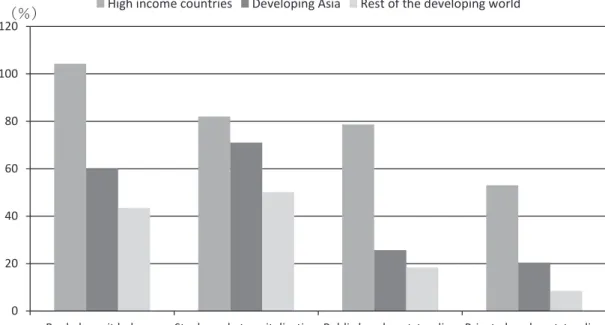
As stated, expansion was larger than that in advanced countries, but the development of the Asian financial sector is delayed compared with that of the real economy. Figure 1 shows that GDP ratios of the Asian financial sector are relatively high among developing countries but small compared to developed countries. The difference with developed countries is es- pecially large regarding bond markets. In Asia, the financial system is bank-centric, and stock markets have developed to some extent. Therefore, room for development is largest regarding bond markets.
Figure 1. Financial structure around the world at the end of 2011 by GDP ratio
(Source) Asian Development Bank (2015a), p. 49
III-2. Market maturity and an increase in investments from abroad III-2-1. Market maturity
In Felman et al. (2011), it is said that the corporate bond market expansion in ASEAN5 countries is an effect of policies, and the efforts of each government and the ABMI are high- ly evaluated. Also, according to the above paper, in the wake of the Global Financial Crisis (GFC), Asian bond markets were comparatively successful in maintaining their normal functions and steadily expanded after the crisis. It is pointed out that this is evidence of mar- ket maturity. Just after the crisis occurred in 2008, bond issues decreased for a while, but af- ter that, most financial institutions and major companies that became unable to raise funds overseas sought to return to domestic markets. This experience led to renewed recognition that excessive reliance on capital flows was problematic and that bond market development was an effective strategy to alleviate this problem. Also, the IMF pointed out that after the crisis occurred, large Asian companies that had suffered from the reluctance of banks to lend money issued bonds at lower than bank loan rates. It is said that corporate bond markets have played the role of spare tires. Thus, it was shown by the GFC that when capital inflows and domestic bank loans decrease, the bond market plays an important complementary role.
It must be added, though, that Felman et al. (2011) also pointed out that there was room for further bond market development, and that impediments of cross-border transactions should be decreased as investment appetite was increasing from abroad.
III-2-2. Increase of investments from abroad
Until the mid-2000s, investment in developing countries’ bonds from developed coun- tries’ institutional investors was concentrated in major currency-denominated bonds. How- ever, investors have become increasingly interested in local currency-denominated bonds, and the investment expanded rapidly after the GFC. In Asian countries, ratios of foreign in- vestors in government bond holdings have risen significantly (at the end of September 2016:
39.2% for Indonesia, 35.8% for Malaysia, 14.8% for Thailand, 10.3% for Japan, and 10.1%
for Korea).
The push factors (in developed countries) for these capital flows were expansion of in- stitutional investors, improvement of risk management capability due to the development of financial technology, and increase of money for investment and so-called “search for yields,” due to monetary easing.
The pull factors (in Asian countries) are as follows. First, as the macroeconomic factors, (a) bond markets have expanded, (b) foreign investors feel more confident thanks to the ef- forts of individual countries to improve their markets, as well as regional financial coopera- tion through the ABMI and other mechanisms, and (c) Asian economies have recovered and sovereign ratings of Asian countries have improved (Table 3).
Second, as the performance factors, (a) Asian bonds are a tool for international invest-
ment diversification, (b) nominal interest rates are relatively high, even though fiscal condi-
tions are better than those of most advanced countries, and (c) long-term interest rates can be expected to fall and currency values to rise in step with economic development.
Third, as the structural factors, foreign investors are being encouraged to participate through regulatory changes, such as the easing of restrictions on capital transactions.
III-3. Challenges of bond markets
III-3-1. Challenges about corporate bond issuers and maturities of bonds
Next, various challenges of bond markets are discussed. Firstly, corporate bond issuers are limited to certain large companies, and the proportion of top-ranking companies with large outstanding amounts is high. Particularly, government-affiliated corporations are play- ing a major role as corporate bond issuers, and there is still considerable scope for the ex- pansion of issues by private sector companies. The range of industries represented in bond markets is also weighted heavily toward banking and infrastructure, and there are few issues by nonfinancial companies. Mainly in China and Malaysia, there are many corporate bond issues related to energy and infrastructure, and that is one reason for many issues by govern- ment-affiliated corporations.
Also, there are few issues by companies with low ratings. Furthermore, bond maturities are generally short due to low credibility of issuers and lack of long-term finance.
Of course, while diversification of issuers is an important priority, bond issues remain an appropriate method of raising funds for companies in such areas as energy and infrastruc- ture, and it will also be necessary to encourage expansion of issues in these sectors. The is- suers’ characteristics identified here are common to most of the economies studied in this paper.
III-3-2. Challenges for development of investors
The scale of institutional investors is different among countries depending on the devel- opment stage of their financial system (Table 4). In Hong Kong, Singapore, Korea and Ma- laysia, institutional investors are relatively developed. In many Asian countries, the GDP ra-
Table 3. Long-term local currency sovereign rating by Standard & Poor’s
(Note) Shadows are for “Up” and “Unchanged” countries.
(Source) Asian Bonds Online
tios of investors’ assets are gradually increasing, but there is still much room for further expansion.
According to Felman et al. (2011), one reason for slow expansion of Asian corporate bond markets is insufficient expansion of institutional investors. The authors point out that in the old five countries of ASEAN, the presence of the banking sector is high, and the scale of mutual funds is also increasing. On the other hand, the GDP ratios of assets of pension funds and life insurance companies are slow to increase.
However, in many countries, the composition of bond market investors has become more diversified due to the increase of domestic institutional investors and foreign investors.
III-3-3. Challenges for secondary market liquidity
Many challenges are left on secondary market liquidity. In each country, decrease of bid- ask spreads and increase of average transaction amounts are steadily progressing. On the other hand, in many cases, turnover ratios have not improved significantly (Table 5-1, Table 5-2). In particular, in the case of corporate bonds, issue size is small in many cases and after one to two months of issuance, they are passed on to buy-and-hold type investors. That is why liquidity is generally low. The Asian Development Bank conducts an annual survey on secondary market liquidity of market participants, and in many answers, the most important factor for liquidity is investor diversity.
In order to improve liquidity, in addition to investor diversity, development of market infrastructure such as repos and derivatives, and careful planning of bond types are neces- sary. Also, as each investor has a different investment style, it is meaningful to diversify in- vestors, but many investors in the region are not matured and their investment style is most- ly buy-and–hold. In order to increase turnover ratios, change of investment style of each investor is necessary. As foreign investors are expanding, domestic institutional investors must become larger and improve their level.
Table 4. Assets of institutional investors to GDP
(Note) Figures are as of the end of 2014.
(Source) Asian Development Bank (2015b), Appendix
III-4. Achievements regarding the purposes of developing Asian bond markets III-4-1. Construction of a balanced financial system
This section checks the effects of bond market development. Table 6 shows the changes Table 5-2. Bond market liquidity (turnover ratio)
(Source) Asian Bonds Online
Table 5-1. Bond market liquidity (bid-ask spreads)
(Source) Asian Bonds Online
of GDP ratios of outstanding bank credit to the private sector, and of outstanding balance of corporate bonds, between the end of 1997 (or 1995) and the end of 2015. In crisis-affected countries such as Indonesia, Malaysia, the Philippines and Thailand, the GDP ratios of bank credit have declined between 1997 and 2015, which means a corresponding reduction of fi- nancial intermediation functions. However, if limited to the period since the GFC, GDP ra- tios have been increasing in many countries, which shows steady recovery of bank loans.
On the other hand, the GDP ratios of outstanding balance of corporate bonds have been increasing in many countries. Therefore, ratios of corporate bonds to bank loans have in- creased between 1997 and 2015 in many countries except in Hong Kong and Japan. Howev- er, these ratios are less than 25% even in 2015, with the exceptions of Korea and Malaysia.
In summary, sizes of banks and corporate bond markets are not well balanced in many coun- tries and more needs to be done for further development of corporate bond markets.
Table 6. Bank credit to the private sector and corporate bond outstanding balance (each to GDP)
(Note) Regarding 1997, the corporate bond data for China, Korea, Malaysia and the Philippines are BIS data.
Vietnam data is as of 2000 from Asian Bonds Online.
(Source) Asian Development Bank, Key Indicators, Asian Bonds Online, Park (2016) for India, Japan and U.S.
III-4-2. Improvement of the double mismatch issue
Due to the lessons of the 1997 financial crisis, Asian countries generally avoid foreign currency-denominated short-term borrowings, so it can be said that the double mismatch is- sue has been improved. Many external bank borrowings have also become local curren- cy-denominated.
However, it is not easy to evaluate the contribution of bond market development to the
risk reduction from capital inflows. First, regarding governments and corporations that have
issued domestic bonds, it may be said that the issues have caused reduction of foreign cur-
rency-denominated borrowings. However, as stated previously, issuers of corporate bonds are limited to large companies. Second, even if the effect of expansion of bond markets to decrease capital inflows is small, the role of spare tires that was played during the crisis pe- riod in 2008 shows that bond markets have dampened the effect of capital outflows. There- fore, in any event, bond markets were effective to depress the impact of the crisis. Third, ex- pansion of foreign investors in domestic bond markets entails a new type of capital outflow risk. Fourth, after the GFC, US interest rates have declined and Asian governments and cor- porations have been increasing US dollar, euro and yen-denominated bond issues (Figure 2).
In these Asian countries, both GDP ratios of private sector debt and foreign currency-de- nominated debt have been increasing. As capital flows to developing countries have become more volatile recently than before, regulation and supervision on balance sheets of banks and corporations must be strengthened.
Figure 2. Dollar, euro and yen-denominated international bond issuances by ASEAN-5 countries
(Note) ASEAN-5 countries are Indonesia, Malaysia, the Philippines, Singa- pore and Thailand.
(Source) Asian Bonds Online
III-4-3. Promotion of regional financial integration
Figure 3 shows Asian countries’ intraregional investment ratios regarding long-term bond investment. The ratios are stable and not as low in recent years. Further increases may be possible through continuous efforts toward regional financial integration.
Incidentally, the proportion of investment amount of these countries within the global
investment amount increased from 2.0% in 2010 to 4.4% in 2016. Additionally, investment
acceptance amount of these countries to the global total increased from 1.5% to 3.1%. These
figures show that the presence of Asian bond markets in the world has been increasing
steadily.
Figure 3. Ratios of intra-regional investments of Asian countries regarding long-term bonds
(Note 1) Investment from Hong Kong, Indonesia, Korea, Malaysia, the Philippines, Singapore and Thailand to these seven countries/re- gion, plus China and Vietnam.
(Note 2) As of the end of June for 2016.
(Source) IMF, Coordinated Portfolio Investment Survey
III-5. Summary of this section
Asian bond markets expanded significantly and the financial system changed substan- tially. It can be said that the efforts for market development achieved impressive results. In many countries, investment in the government bond market from developed countries in- creased rapidly.
However, the level of market development varies widely among countries in the region.
Corporate bond issuers are limited, and institutional investors are not matured in general. In total, there is much room for further development of bond markets.
In the future, various challenges stated here must be tackled for improvement, and in particular focus must be placed on the development of relatively underdeveloped markets in countries such as Cambodia, Laos and Myanmar.
IV. Factors of bond market development IV-1. Macroeconomic factors
This section considers factors for developing bond markets, particularly corporate bond markets. The following contents are based on Baek and Kim (2014) (hereafter, “the Previ- ous Study”), which covered eight countries and one region (China, Hong Kong, Indonesia, Japan, Korea, Malaysia, the Philippines, Singapore and Thailand).
1The first group is macroeconomic factors. The first factor is Economy Size. In the larger
countries, it is easier for bond markets to develop because fixed costs are necessary for con- structing market infrastructure, and because it is easier for larger markets to become liquid.
In the Previous Study, Economy Size has negative impact on expansion of government bond markets, and has positive impact on that of corporate bond markets. Therefore, the impact on total bond markets (total of government and corporate bonds) is insignificant.
The second factor is Economic Development. Low development entails various impedi- ments to bond market development, such as poor investment environments, government in- terventions in commercial activities, and immature laws and institutions (creditors’ rights, transparency, corporate governance, etc.). In the Previous Study, it is said that Economic Development certainly has an impact, but the truly important factors are laws and institu- tions that are correlated with Economic Development. However, it seems that Economic Development has an impact on expansion and maturity of issuers and investors.
The third factor is macroeconomic stability. Particularly, Volatility of Inflation Rate and Foreign Exchange Rate is important. Low and stable inflation rate stabilizes the value of cash flows, and is indispensable for expanding long-term bond markets. Also, stable foreign exchange rate decreases exchange rate risk and increases investment from abroad. In the Previous Study, these relationships were confirmed, which shows that stable inflation rate and foreign exchange rate promote expansion of bond markets.
IV-2. Financial system factors
Financial system development seems to promote bond market expansion. In the Previ- ous Study, the explanatory variables related to financial system development firstly include Bank Size. Banks play important roles as issuers, investors and intermediaries. Therefore, it seems that bank size and bond market size have positive correlation. On the other hand, bank loans and bond issues are alternative procurement tools with each other, and in the fi- nancial system in which banks have developed early, banks sometimes depress bond market expansion. In the Previous Study, this kind of activity by market dominant banks is as- sumed, and Concentration of the Banking System is adopted as the second variable. Also, Stock Market Size (market capitalization) is adopted as the third variable.
The results of the analysis show that in the case of total (government and corporate) bond markets, market expansion has positive correlation with Bank Size, and negative cor- relation with Concentration of the Banking System and Stock Market Size. However, gov- ernment bond market expansion has significant correlation only with Stock Market Size, and in the case of corporate bond market, there is no significant relationship.
Therefore, the relationship between bond market expansion and the explanatory vari- ables of banks and stock markets is unclear, particularly in the case of corporate bonds.
1 This study analyses the determinants of bond market development, based on various previous studies. Its dependent variables are GDP ratios of bond market size, and its explanatory variables are Economy Size (GDP), Economic Development (per capi- ta GDP), Financial Sector Development (Bank Size and Stock Market Size), Volatility of Inflation Rate and Foreign Exchange Rate, and Institutional Factors (Institutionalized Democracy, Strength of Legal Rights, Depth of Credit Information).
However, as both bond markets and stock markets are capital markets and they need market institutions, issuers and investors, it seems possible that bond market expansion and stock market size have positive correlation.
IV-3. Factors of laws and institutions
Establishment of laws and institutions plays an important role in expanding financial systems. In the Previous Study, the explanatory variables on this point are Institutionalized Democracy, Strength of Legal Rights, and Depth of Credit Information.
2The analysis shows that for government bond markets, the first variable is 10% significant, but the second and third variables are insignificant. For corporate bond markets, the first variable is insignifi- cant, but the second and third variables are 1% significant, which indicates the importance of creditors’ legal rights and credit information.
In addition, the following points are also important regarding laws and institutions. i) Market-related laws and regulations: Securities and exchange law, corporate law, bankrupt- cy law, etc. Capital account regulations may be included. For bond markets, it is particularly important to develop bankruptcy law, and clarify creditors’ rights and responsibility of debt- ors. ii) Corporate information disclosure including credit ratings: Development on this point causes heightened investment incentives and leads to market expansion and improvement of liquidity. It may also become possible that companies with relatively high credit risk can is- sue bonds. iii) Accountants, securities analysts, credit rating agencies, and courts. iv) Re- forms of taxes that impede bond investment, such as withholding tax for non-residents: If the tax system is a heavier burden for bond markets than for other financial tools, it becomes an impediment of bond market development.
IV-4. Other factors IV-4-1. Issuers
As components of bond markets, issuers and investors are of the utmost importance.
Market participants must have enough participation incentives such as economic profits and capacity of participation. In the case of issuers, they must have large demand for long-term funds caused, for example, by facility investments, and it is necessary that bond issuing costs are lower than interest rates for bank borrowings.
3Market participation can be promot- ed through various developments of issuing environments.
Most Asian companies are small and medium-sized corporations, and very few compa- nies have enough size and credibility for bond issuance. The following possible methods ex-
2 Refer to Baek and Kim (2014), p. 315 for the details.
3 Issuing costs of corporate bonds include managers’ fees including underwriting fees, fees for registration to regulatory au- thorities and listing (including legal fees), rating fees, sales costs to investors (presentations, etc.), taxes, and so on. These costs are greatly different among countries, and some costs are significantly expensive in the first issue. Also, as they have the char- acteristics of fixed costs, the burden will become smaller as the issuing amount increases. Therefore, if the issuing costs are ex- pensive, small and medium-sized companies or low rating companies lose a large part of incentives for issuing bonds.
ist for conquering this restriction. First, corporations can improve credibility through opera- tional restructuring or better governance. Second, by developing market infrastructure, such as simplification of issuing regulations, development of information disclosure, and devel- opment of bankruptcy laws, issuing costs and information asymmetry can be decreased.
Third, issuance by non-residents such as international institutions and multi-national corpo- rations can be increased. For this, the level of market infrastructure must be improved by adopting international standards, for example. Fourth, small and medium-sized companies can issue bonds by utilizing tools such as securitization and credit guarantees. In this case, issuers’ moral hazard must be avoided. Fifth, companies of low credibility can become issu- ers of high-yield bonds by expanding investment targets of investors.
IV-4-2. Investors
Institutional investors, individual investors, and foreign investors must be expanded. In- stitutional investors are expected to bring bond market expansion, improvement of liquidity, progress of financial technology, and improvement of corporate governance. To realize ac- tive transactions by institutional investors, easing restrictions on investment targets; such as compulsory ownership of government bonds, lowest credit ratings regulations, etc.; promot- ing adoption of market-price accounting, and assisting improvement of asset management and risk management skills are necessary.
IV-4-3. Intermediaries and policy authorities
There should be appropriate competition among intermediaries. Local securities compa- nies and banks are expected to play central roles. In corporate bond markets, intermediaries play a role in disclosing a portion of necessary information, and they also have to become a market maker. Therefore, a high level of expertise is required for intermediaries. Also, there must be authorities that are highly committed to market development. As market develop- ment is related to fiscal and monetary policies, etc., conflicts of interest may emerge be- tween other authorities. Therefore, appropriate capabilities of relevant authorities are critical for market development.
IV-4-4. Market infrastructure
i) Government bond and short-term money markets: Government bond markets provide
benchmark interest rates and promote growth of intermediaries. Short-term money markets
are necessary for constructing short-term interest rate structure, and their development is re-
lated to expansion of transactions such as repos and interest rate and currency swaps. ii)
Trading platforms such as securities exchanges. iii) Information infrastructure of market
prices and transaction situations: Transparency of market prices increases reliability of
transactions and assists market-price valuation of investment portfolios. iv) Derivatives and
repo markets: Derivatives transactions enable hedging of market and credit risks, and im-
prove transparency and correctness of market prices, which leads to higher market liquidity
and lower volatility. v) Bond transaction and settlement systems. vi) Foreign exchange mar-
kets: Foreign exchange trades are very important for cross-border transactions.
IV-4-5. Factors affecting development of secondary markets
The annual surveys on regional bond market liquidity by the Asian Development Bank of market participants consider factors affecting liquidity, such as (1) Greater Diversity of Investor Profile, (2) Market Access, (3) Foreign Exchange Regulations, (4) Transaction Funding (availability of short-term funding by market participants), (5) Tax Treatment, (6) Settlement and Custody, (7) Hedging Mechanisms, and (8) Transparency. (1) is a factor re- lated to market participants, (2), (3) and (5) are the factors related to laws and institutions, and (4), (6), (7) and (8) are the factors related to market infrastructure. Each year, the survey indicates that (1) is the most important factor affecting liquidity.
V. Situation of bond market development of eight Asian countries
This section explains the present situation of bond markets in eight countries (Korea, Malaysia, China, Thailand, India, the Philippines, Indonesia and Vietnam) with a focus on corporate bond markets. Consideration is given to how the market development factors have been working. The order of countries is mostly decided by the GDP ratios of corporate bond outstanding balance.
V-1. Korea
Before the Asian financial crisis, bond market expansion was mainly led by corporate bonds, and 3-year corporate bonds were the benchmark issue. Their liquidity was much higher than that of government bonds. The government bond market was divided by each is- sue, and issuing interest rates were lower than market level. However, after the crisis, issues of government and public bonds increased for economic recovery and promotion of struc- tural reforms (Figure 4). Various market development policies were implemented and the 3-year government bond (later the 5-year government bond) became a new benchmark issue replacing corporate bonds. Issuance amount of government bonds increased rapidly in 2009 due to stimulus economic policies. Since then, issuance amounts are stable. The GDP ratio of government bond outstanding balance has been over 50% since 2014.
Regarding corporate bonds, a law that promotes the development of capital markets was adopted in 1968 and the development of the corporate bond market started. Before the 1997 crisis, most of the corporate bonds were guaranteed by financial institutions such as com- mercial banks, merchant banks, securities companies and guarantee corporations. It was in 1972 that guarantees for corporate bonds and issuance by public placement were introduced.
After the crisis, many banks suffered a management crisis and became unable to underwrite corporate credit risks. Therefore, the guarantees for corporate bonds decreased
4. Since 2003, less than 1% of issues have carried guarantees.
Also, after the crisis, various problems that make investors recognize credit risks oc-
curred, and after 2000, corporate bond issuance decreased
5. In the mid-2000s, issuance start- ed to increase again, and the GDP ratio of outstanding balance increased from 39.6% in 2005 to 74.4% in 2016. Regarding issuers, Korea’s situation is the same as many Asian countries, namely, government-affiliated corporations and large companies are the main is- suers, and the industries are weighted toward finance, energy, infrastructure, and so on. In September 2016, the top 30 companies of outstanding balance occupied 63.5% of the total market and 17 of them were government-affiliated companies and institutions
6. At least 37.2% of outstanding balance was occupied by them. Among them, there were many public institutions such as the Korea Deposit Insurance Corporation. Therefore, if we consider that the most important purpose of the development of corporate bond market is changing fi- nancing structure of private companies, market expansion of Korea cannot necessarily be evaluated only positively.
Furthermore, 21 of the top 30 companies were financial institutions, 6 were infrastruc- ture-related companies, and one was a real estate company. At least 45.5% of outstanding balance was occupied by financial institutions. In 1997, manufacturing companies occupied over 70%. Thus, the situation has greatly changed, because now the presence of govern- ment-affiliated corporations and financial institutions is very large. (It should be noted that many of them are government-affiliated financial institutions, which causes double count- ing.)
The investor composition of the bond markets was as follows as of June 2016 (omitting very small investors; this point is mostly the same for each country): Government bonds:
Banks 13.4%, Insurance Companies and Pension Funds 31.7%, Other Financial Institutions Figure 4. Outstanding balance of bond markets to GDP (Korea)
(Source) Asian Bonds Online
4 One of the reasons for the decrease of guarantees was that a regulation was introduced that requires banks to prepare re- served funds for guarantees.
5 In July 1999, the Daewoo Group went bankrupt, and in March 2003, the accounting scandal of the SK Group and the deteri- oration in the management of credit card companies occurred.
6 The company that had the largest outstanding balance was Korea Housing Finance Corporation.
20.5%, General Government 19.3%. Corporate bonds: Banks 8.2%, Insurance Companies and Pension Funds 37.7%, Other Financial Institutions 33.1%, General Government 12.3%.
The proportion of banks decreased significantly, and that of various institutional investors increased. Foreign investors occupied 9.7% of government bonds, and only 0.1% of corpo- rate bonds. There were few individual investors. Regarding corporate bonds, many investors fall in the buy-and-hold type, and corporate bond transactions in the secondary market are less than 10% of those of government bonds recently.
As liquidity of commercial banks will be regulated more strongly by Basel 3, banks will continue to hold certain amounts of bonds. Total assets of the National Pension Service have expanded rapidly, and 56% of its investments in financial products is domestic bonds. The assets under management (AUM) of insurance companies were about 788 trillion won as of February 2017. This size was second only to Japan in Asia. 35.6% of their assets were in- vested in public bonds, and 5.7% in corporate bonds. The asset management industry con- sisted of 86 companies licensed by the Financial Supervisory Service as of October 2014, including Investment Trust Companies (ITCs), trust accounts of commercial banks, securi- ties companies, and so on.
The contributing factors of corporate bond market development were, first, that active market development policies have been implemented since the 1970s, and corporate bond issuance began to be regarded as one of the important fund procurement tools, equal to bank loans, in the very early stage. Necessary laws and regulations have been developed steadily.
Second, backed by high economic growth, issuers (mostly large companies that belong to Chaebol groups) increased. The factor that also promoted corporate bond issuance was that as growth was led by manufacturing industries, financing demand of major companies for facility investments was large.
Third, before the crisis, bank guarantees expanded the market. After the crisis, guaran- tees stopped, and the new contribution factor was expansion of securitization transactions activated by dealing with banks’ non-performing loan problems.
In the former years of the 2000s, confidence in the corporate bond market began to wane and issues were concentrated in those with high credit ratings. In recent years, low-rating is- sues are promoted through introduction of high-yield bond funds and the construction of the professional investors’ market, but the result is still poor (Table 7). Also, as bank guarantees stopped, the role of rating agencies increased, and the regulations for four rating companies have been strengthened.
Fourth, ITCs were utilized politically as the means for market development. This ac- companied various problems such as dominance of ITCs’ management by the Ministry of Finance and Economy, lack of market-price valuation of securities in the funds, and guaran- tees of fund profit rates to customers. Recently, rapid increase of assets of pension funds and insurance companies is promoting corporate bond market expansion.
The above contributing factors also had problems. Before the crisis, corporate bonds
were issued with bank guarantees and were close to bank loans. Also, investments by ITCs
were promoted politically. Therefore, market expansion did not necessarily accompany cor-
rect recognition of credit risks of issuers.
After the crisis, investors experienced many market confusions and became cautious to- ward credit risks of corporate bonds. Therefore, it became difficult to issue low-rating bonds. That is why the issuers of corporate bonds are mostly limited to large companies in Chaebol groups or government-affiliated corporations, and include very few small and me- dium-sized companies
7. In addition, one of the reasons why there are many corporate bond issues is that bank borrowings by large companies are relatively small compared with Japan.
Investors are still conservative now. As the economy is not in good condition and financ- ing demand is low, excellent companies do not issue many corporate bonds nowadays. And even in this condition, it is not necessarily easy to issue medium-risk bonds such as A-rated bonds.
V-2. Malaysia
Government bonds were issued to finance economic development, and outstanding bal- ance increased by 17% annually on average between 1970 and 1985. Since the latter half of the 1980s, the government’s focus was on corporate bond market development, and govern- ment bond issuance decreased. After 1998, the issues started to rise again to deal with the effects of the crisis (Figure 5). Various market development policies were implemented, such as regular issuance and introduction of reopening (several issuances of the same bond).
Table 7. Credit ratings by local rating agencies for local-currency corporate bonds (from January 2010 to September 2015)
(Note 1) As a percentage of the number of bonds issued.
(Note 2) Regarding the U.S. and Europe, ratings are by Standard & Poor’s for bonds issued by all industries and are issued in all currencies in the first quarter of 2015.
(Source) BIS Monetary and Economic Department (2016), p. 7
7 Also, it is pointed out that issues by securities companies are related to sales of Equity-Linked Securities, not for their own funding.
Government Investment Issues (Islamic government bonds) and Savings Bonds for individ- ual investors are also issued.
Backed by the 9
th5-year plan (2006-2010) and economic stimulus policies after the GFC, the GDP ratio of outstanding government bonds increased from 42.0% in 2006 to 61.6% in 2012. After that, issuance decreased and the GDP ratio became 51.5% in 2016.
Government bonds are included in the benchmark index used by investors of developed countries, and that is one factor that promotes investments.
The Private Debt Securities (PDSs) market started to develop in the mid-1980s because, since that period, a policy to make private sector the engine of economic development was adopted, and market expansion was promoted. In 1988, the Central Bank issued guidelines concerning the issuance of PDSs, prescribing the qualifications of issuers (minimal capital, highest limit of debt ratio, and so on) and the minimal issuing amount (25 million ringgit).
Before the crisis, many PDSs were issued with bank guarantees, such as 45% of the is- sued amount in 1995 (Suto (2001)). This was because minimum rating limits still existed, and because the investment regulations for institutional investors included a clause that lim- ited the investment to bonds with bank guarantees. Since 1998, banks have become cautious toward credit risks, and bank guarantees have mostly disappeared.
Also, in 1995, 86.7% of the issued amount was privately placed; namely, the number of investors was no more than 10 (Suto (2001)). It seems that the issuance of PDSs was very close to bank lending in character. Another reason for the high ratio of private placement was the time-consuming procedures for public placement (Bank Negara Malaysia (1999)).
In July 2000, the issuing procedures for PDSs were simplified by the Securities Com- mission, and the issuance increased. Other factors also contributed to the increase, such as interest rate reduction that caused increase of liquidity, replacement of financing sources from bank lending, and utilization for corporate restructuring. Securitization deals also in- creased by Cagamas Group, a housing loan institution established in 1986, but the transac- tions decreased rapidly after the GFC.
Furthermore, Islamic finance is playing a very important role. An Islamic corporate bond Figure 5. Outstanding balance of bond markets to GDP (Malaysia)
(Source) Asian Bonds Online
was issued for the first time in 1990. In 2002, the issuing amount became larger than con- ventional bonds, and some preferential treatment was given to Islamic issues. At the end of 2006, the outstanding balance of Islamic corporate bonds became larger than conventional bonds, and as of September 2016, the ratios of Islamic bonds in outstanding balance were 39.9% for government bonds and 73.3% for corporate bonds. Most Islamic corporate bond issues are Islamic Medium-Term Notes (MTNs). Foreign issuers often issue foreign curren- cy-denominated Islamic bonds. According to the statement by RAM Ratings, the largest rat- ing agency in Malaysia, by participating in sukuk markets, issuers can diversify investors, and investors can diversify investment products.
Before the crisis, many of the issuers were related to infrastructure (electricity, toll roads, communication services, etc.). After the crisis, the issues by finance, insurance, and real estate companies increased. Manufacturing companies had a certain ratio until the for- mer part of the 2000s, but are currently not very active issuers.
At the end of September 2016, the top 30 issuers by outstanding balance occupied 54.7% of the market (536.6 billion ringgit). The industry composition of the issuers was the following: Banking 6; Finance 9; Transport, Storage and Communications 6; Energy, Gas and Water 7; Construction 1; and Property and Real Estate 1. 29.6% of corporate bond bal- ance was by banks and finance companies. 19 of the top 30 were government-affiliated com- panies, and the second to seventh companies by outstanding balance were all govern- ment-affiliated.
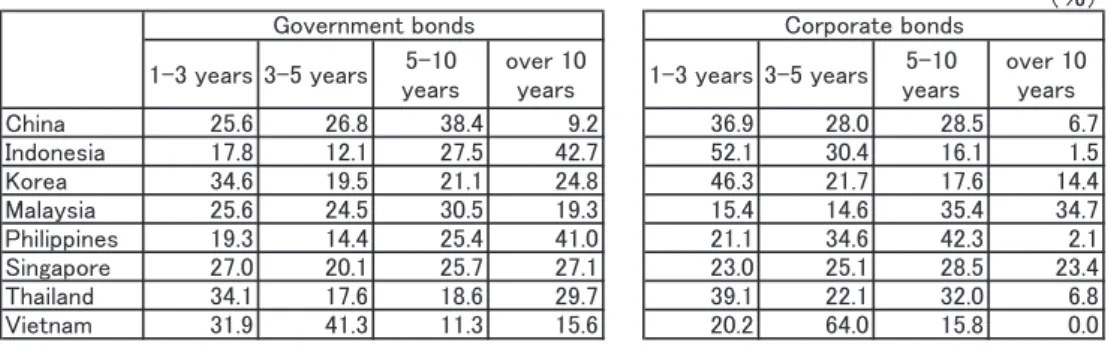
Issuing maturities are becoming longer both for government and corporate bonds (Table 8). 34.7% of corporate bonds are longer than 10 years, and corporations of AA ratings or higher can issue 15-20 year bonds relatively easily. There are very few issues of A ratings or lower, and this situation is referred to with the term “rating-cliff.” The main reason is con- servative investment regulations for pension funds, insurance companies and financial insti- tutions. As the issuing costs for companies whose ratings are A or lower are high, these companies usually use bank loans.
The investor composition of the bond markets was as follows as of June 2016: Govern- ment bonds: Financial Institutions 28.5%, Foreign Holders 34.3%, Social Security Institu-
Table 8. Maturity structure of bond markets as of the end of 2016
(Source) Asian Bonds Online
tions 27.9%, Insurance Companies 5.1%. Corporate bonds: Domestic Commercial and Is- lamic Banks 46.5%, Foreign Commercial and Islamic Banks 5.8%, Life Insurance Companies 33.3%, Employees Provident Fund (EPF) 9.9%.
Banks are important investors and Islamic government bonds are mostly held by banks and Islamic banks. EPF is a representative social security institution and occupies over 85%
of total assets of provident funds. These funds are important investors in bond markets.
AUM of EPF was 731.1 billion ringgit at the end of 2016, which was 2.6 times larger than 10 years ago. Also, the total assets of life insurance companies and general insurance com- panies at the end of March 2017 were 241 billion ringgit and 39.8 billion ringgit, respective- ly. Compared with the end of 2011, they were 1.45 times and 1.28 times larger, respectively.
Furthermore, Net Asset Value of unit trusts increased from 105.7 billion ringgit in 2011 to 189.4 billion ringgit at the end of 2015.
The contributing factors of corporate bond market development were firstly that active market development policies have been implemented since 1980s. Promotion of Islamic fi- nance was also a unique strategy, and various policies were implemented such as establish- ment of yield curve by issuing Islamic government bonds and tax reforms that make Islamic bond issues smoother. The Financial Sector Blueprint 2011-2020 also includes a strategy to promote internationalization of Islamic finance.
Secondly, markets expanded along with high economic growth before the crisis. During this period, there were many bank guaranteed bonds and corporate bond issues were utilized as an alternative to bank loans. After the crisis, development of securitization contributed to market maturity and expansion. Utilization of bond markets for infrastructure financing, such as active project bond issues, is also promoting market development. Active project bond issues are caused by the fact that project bonds are close to Islamic finance that accom- panies real assets transactions. Also, foreign issuers of corporate bonds are increasing be- cause interest rate risk hedging (government bond futures and short-term interest rate risk hedging) has become available to non-residents, the rating obligation of corporate bonds and sukuks was abolished at the end of 2016, and the accounting standards are based on IFRS.
Thirdly, institutional investors are developed and their AUM are increasing. The authori- ties are focusing on the financial intermediation functions of institutional investors, and they say that EPF and other investors should contribute to decrease the imbalance between sav- ings and investments by increasing investments in risk assets.
The challenges of the market are that many of the issuers are government-affiliated cor- porations, which is partly related to the utilization for infrastructure financing, that even pri- vate issuers are weighted toward certain industries, and that low rating issues are very few.
In the Capital Market Masterplan 2 (2011-2020), to enable bond issues by various compa-
nies, tasks are pointed out such as expansion of investors, diversification of bond types and
improvement of market infrastructure. Particularly, improvement of market practices regard-
ing documentation and information disclosure, as well as strengthening of rating agencies,
are emphasized. Investors in bond markets are concentrated to certain institutional investors,
and they are extremely conservative. Therefore, improvement on this point is also an im-
portant task.
V-3. China
The bond market size of China is the third largest in the world, following the U.S. and Japan. The public bonds include i) central government bonds issued by the Ministry of Fi- nance, ii) savings bonds for individual investors without a secondary market, iii) central bank notes, iv) local government bonds (sometimes issued by the central government as a representative), v) policy bank bonds issued by the China Development Bank, Export-Im- port Bank of China and Agricultural Development Bank of China (Figure 6).
In January 2015, a new budget law was implemented and the regulation on issuance of local government bonds was changed to allow them to be issued in limited cases. Since then, issuance of local government bonds has rapidly increased.
Regarding bonds issued by corporations, there are enterprise bonds issued by non-listed companies, mainly state-owned enterprises (SOEs), and exchange-traded bonds issued by listed companies, mainly private companies. In addition, there are MTNs, Commercial Pa- pers (CPs), Super short-term Commercial Papers, convertible bonds, bonds with warrants, and private-placement bonds. Furthermore, there are panda bonds that are issued in China by non-residents, and three types of bonds only for small and medium-sized corporations.
Securitization started in 2005, but due to the chaos after the GFC, new issues were stopped. In 2012, pilot programs restarted by the announcement of the authority. Since then,
Figure 6. Outstanding balance of bonds by type (China)
(Note) As of September 2016. Treasury bonds include savings bonds and local government bonds.
(Source) Asian Development Bank, Asia Bond Monitor. Nov. 2016.
there have been securitization deals of loans by commercial banks, of auto loans by car sales financing companies, and so on. In 2015, the issue amount of securitization products reached 602 billion yuan, which was almost 30 times that of 2013. However, the investors are limited to certain financial institutions and institutional investors, and investment by for- eign investors is regulated.
In offshore markets centering on Hong Kong, renminbi-denominated bonds are issued, and in Hong Kong, these bonds are called Dim Sum Bonds (the issuance started in 2009). In 2014, issuance of Dim Sum Bonds peaked at 225.7 billion yuan, less than 1 percent of the domestic market, and in recent years, the issuance significantly decreased along with the re- treat of RMB internationalization.
Bond markets are divided into the Interbank Bond Market, where large banks play im- portant roles, the Exchange Bond Market, where the bonds of listed companies are traded, and the Commercial Bank Counter Market, which is for individual investors and is consid- ered to be an extension of the Interbank Market. The Interbank Bond Market is by far the largest in terms of issuing and transaction amounts.
Outstanding balance of government bonds has been increasing steadily backed by active fiscal policy, but corporate bonds have been under strict issuing regulation (Figure 7). The purpose of issues had to fit with the government’s industrial policies, and was limited to the financing of large SOEs or government-led projects.
Since around 2005, issues of financial institution bonds and corporate bonds increased rapidly. This was because issuing regulations were eased and the approval process was sim- plified. Issuance of various bonds became possible, such as straight bonds and subordinated bonds by commercial banks, CPs by ordinary companies, and Asset Backed Securities. In 2005, the Asian Development Bank and International Finance Corporation issued panda bonds. In 2014, Daimler AG issued a 500 million yuan one-year private placement panda bond as the first issue by a business company. Since the fall of 2015, panda bond issuance has increased rapidly.
Figure 7. Outstanding balance of bond markets to GDP (China)
(Source) Asian Bonds Online
Enterprise bonds have been regulated by the National Development and Reform Com- mittee, and in 2007, issuance of exchange traded bonds supervised by the China Securities Regulatory Commission became possible, and the issuance of bonds by corporations be- came more flexible. Enterprise bonds and exchange traded bonds had been traded in the Ex- change Market, but trading of these bonds in the Interbank Bond Market became possible in 2005 and 2007, respectively. Since then, almost all the trading of bonds has been conducted in the Interbank Bond Market.
In April 2008, in the Interbank Bond Market, it became possible to issue CPs approved by the People’s Bank of China, and MTNs that follow the voluntary rules decided by the National Association of Financial Market Institutional Investors (NAFMII), a self-regulato- ry organization. Since then, many 3-5 year MTNs have been issued and MTNs have become the central part of corporate bonds. This is an ongoing situation, and according to Deutsche Bank, in May 2016 the composition of outstanding corporate bonds was as follows: CPs 17%, MTNs 30%, exchange traded bonds 18%, enterprise bonds 21%, and private place- ment bonds 14%.
The main issuers of corporate bonds are large SOEs and commercial banks (Table 9). As of September 2016, the outstanding balance of the top 30 companies in total was 5.6 trillion yuan, 38.2% of the total. Compared with ASEAN countries, issuers have been diversified.
On the other hand, 23 of the top 30 were SOEs, and 14 were banks. Through the introduc- tion of Basel 3, subordinated bond issues will increase for the purpose of improving maturi- ty mismatch and increasing capital.
The investor composition of the bond markets was as follows as of September 2016:
Government bonds and policy bank bonds: Banks 68.4%, Insurance Companies 4.4%, Funds Institutions 13.6%. Corporate bonds: Banks 18.1%, Insurance Companies 6.3%,
Table 9. Top 10 issuers of local currency corporate bonds (China)
(Note) As of the end of September 2016.
(Source) Asian Development Bank, Asia Bond Monitor. Nov. 2016, p. 71.
Funds Institutions 44.9%, Others 30.3%.
Main investors in bond markets are financial institutions such as national commercial banks, institutional investors, ordinary companies, foreign investors and individual inves- tors. Regarding both government and corporate bonds, the proportion held by banks and in- surance companies has been decreasing, and that of funds institutions such as mutual funds has increased. In the government bond market, because the investment style of banks, the main investors, is buy-and-hold for the purpose of maintaining liquidity, there is room for improving secondary market liquidity.
As a pension fund, the National Social Security Fund was established in 2000. Over 40% of its assets must be invested in bank deposits, central government bonds and policy bank bonds, and investment in local government bonds and corporate bonds must be under 20%. Also, over 20% of assets must be invested in government bonds. Next, insurance com- panies are very conservative. At the end of 2015, bank deposits and bonds occupied 56.2%
of AUM, stocks and mutual funds 15.2%, and foreign assets were less than 1%. Further- more, mutual funds are also expanding and are actively investing in stocks and bonds.
The contributing factors of corporate bond market development were as follows. Firstly, in the 2000s, thanks to gradual easing of regulations, it became possible to issue various types of bonds. Secondly, during this period economic development was realized at the same time, and many SOEs in industries such as manufacturing, energy, public utilities, ma- terials, real estate, and so on, had a strong demand for funding. Also, many commercial banks issued bonds.
The challenges of the bond markets are as follows. First, partly due to the regulation that limits participation from abroad, investor composition of secondary markets is not balanced.
The holding ratio of foreign investors in the bond market is about 2%. In the government bond market, market volatility has been amplified by rapid inflows of money. In December 2016, due to the increase of short-term interest rates and other factors, bond prices suddenly fell. Further diversification of investor base, and particularly expansion of institutional in- vestors such as pension funds and insurance companies, is expected.
Participation of foreign investors had been limited to QFIIs and RQFIIs, but since 2015, external opening of the Interbank Bond Market was gradually progressed, and July 2017 saw the start of so-called Bond Connects, referring to mutual bond transactions between Hong Kong and mainland China. In the future, to promote investment from abroad, it is an urgent task to improve liquidity. On the other hand, it is expected that Chinese markets, through external opening, will be included in global bond indexes. If realized, investment from abroad will be greatly promoted.
Second, various bonds are issued and the market is divided by each type of bond, due to various reasons such as that each bond is supervised by different institution, and so on. Also, the secondary market is divided into the Interbank Bond Market and Exchange Market, and individual investors cannot trade in the former.
Third, corporate bond issuers are mostly limited to SOEs. Private companies occupy
only about 10% of outstanding balance, and that is far under the proportion of their econom-
ic activities
8. One reason for this is that the size of SOEs is generally large, but the more im- portant reason is that a policy that prioritizes financing of SOEs has been continued for a long time. In order to diversify issuers, one method is to increase panda bond issues, but regulatory development is insufficient and the relevant regulations have some vague parts.
Fourth, until recently, many investors believed that corporate bonds had implicit guaran- tees with them. The fact is that the first default of a corporate bond occurred in 2014. Inves- tors have to recognize corporate credit risks correctly. For that purpose, it is also necessary to improve the reliability of rating agencies. As defaults have begun to occur, the number of corporate bond issues is becoming smaller.
Fifth, the proportion of stock and bond issuance in corporate financing is small. By con- structing a more balanced financial system, improvement of moral hazard is expected. How- ever, it must be added that the corporate bond market has various problems such as the ef- fect of policy purposes on issuing approvals, and utilization of corporate bond issues as a tool for financing inefficient infrastructure projects in rural areas
9. Therefore, it is a major challenge to decrease government interventions in the market.
V-4. Thailand
In Thailand, in the former half of the 1980s, government bonds were issued to finance infrastructure and other projects, but after that, the fiscal balance became a surplus and gov- ernment bonds were not issued from 1987 to 1997. At the end of 1997, the outstanding bal- ance of government bonds was only 2.5% of the total bond market. However, after the cri- sis, government bond issues expanded rapidly for the purposes of dealing with losses of financial institutions, financing fiscal deficit, and financing various projects for the develop- ment of society and economy (Figure 8). Along with interest rate declining, market develop- ment progressed and 20-year government bonds started to be issued. Government bonds for individuals were also issued.
In Thailand, SOE bonds are also issued. As these bonds have government guarantees, they can be treated as liquidity reserves for financial institutions.
In 1992, the Securities and Exchange Act was passed and the issuance criteria for corpo- rate bonds were decided. Before then, only public limited companies could issue corporate bonds. The new act made it possible for private limited companies to issue corporate bonds with the approval of the Securities and Exchange Commission. This change caused a large increase in the number of issues.
Because of the crisis, the issuing of corporate bonds stopped for a while, but restarted in the latter half of 1998. In 1999, issues jumped mainly due to issues by banks. The back- ground of the increase of issuance had the following factors: that interest rate reductions have prompted corporations to replace their borrowings with lower interest rate financing,
8 Refer to Borst and Lardy (2015), p. 327.
9 Refer to Gomi (2014).