感染性心内膜炎発症予防のための 歯科処置時抗菌薬投与の今後
―日本循環器学会ガイドライン改訂班の立場から―
大原 貴裕1)・中谷 敏2)
1)東北医科薬科大学地域医療学教室*
2)大阪大学大学院機能診断科学
受付日:2019 年 3 月 14 日 受理日:2019 年 8 月 19 日
侵襲的歯科処置時における感染性心内膜炎(IE)予防のための抗菌薬投与は 1950 年代から行われて きたが,1990 年代の欧米のガイドラインではその部分的,全面的な見直しが行われた。本邦の IE ガイ ドラインを改訂するにあたって,1)歯科治療が先行する IE の頻度,2)IE リスクとなる疾患の重みづ け,3)欧米のガイドラインの変更後における IE 頻度の変化,4)予防的抗菌薬投与の費用対効果,5)
医師/歯科医師の間のガイドラインに対する認識,6)予防的抗菌薬投与の副作用についてエビデンスを 集め,議論が行われた。その結果,2017 年に改訂された日本循環器学会のガイドラインでは,高度リ スク群,中等度リスク群共に歯科治療時の予防的抗菌薬投与を推奨することとした。本ガイドラインの 英語版がすでに発行されており,新しいガイドラインの周知,検証が望まれる。
Key words: infective endocarditis,dental and oral surgical procedure,antibiotic prophylaxis
● ● ● ● ● ● ● ● ● ● ● ● ● ● ● ● ● ● ● ● ● ● ● ● ● ● ● ● ● ● ● ● ● ● ● ● ●
はじめに
感染性心内膜炎(IE)はまれだがいったん罹患 すると,適切な治療を行わないと死にいたる重篤な 疾患である。塞栓症特に脳梗塞を合併すると患者の 生活を大きく障害する。適切に治療された場合でも 長期間の入院や手術を必要とする。したがって早期 診断,早期治療と同じかそれ以上に予防が重要であ る。
抜歯などの観血的歯科処置は
IE
のきっかけとし て重要視されてきた。1950年代の米国心臓協会の ガイドラインから,観血的歯科処置時の予防的抗菌 薬投与が推奨されてきた1)。しかし,1990年代にな ると予防的抗菌薬投与の有用性に対して疑問が投げ かけられ,欧米のガイドラインでは部分的または全 面的に観血的歯科処置時の予防的抗菌薬投与が推奨 されなくなった1〜3)。そのような流れの中で,2018年
3
月に日本循環 器学会の『感染性心内膜炎の予防と治療に関するガ イドライン』をおよそ10
年ぶりに改訂・発行した4)。 ガイドライン改訂にあたり,欧米でのガイドライン 変更前後でのIE
発症率の変化に関する報告などの 新しいエビデンスを考慮に入れて議論した。新しい ガイドラインでは,現在の欧米におけるガイドライ ンとは一線を画し,観血的歯科処置時の予防的抗菌 薬投与を推奨した4)。また,2019年には英語版も発 行された61)。本稿では推奨にいたるまでの議論を整 理して振り返りたい。I. 観血的歯科処置時予防的抗菌薬投与にかかわ る論点
予防的抗菌薬投与を推奨するかどうかに関する以 下の論点のそれぞれについて,現在までの知見,議 論を整理する。
*宮城県仙台市宮城野区福室 1―15―1
1)観血的歯科処置に伴う IE の頻度は?
欧米における
IE
の登録研究においては先行する 観血的歯科処置のあったものは5〜30%
とされ5〜8), 本邦においても10〜22%
9〜12)とほぼ同様であった。原因菌の侵入経路としては皮膚からの侵入に次いで 口腔内/歯科処置に伴うものが多く,口腔内/歯科処 置は依然として重要な予防のターゲットと考えられ る5)。
先行する観血的歯科処置が,本当に
IE
の原因と なったのか証明することは容易ではない。われわれ の実施した登録研究での解析では,先行する観血的 歯科処置がある群の原因菌はその他の群に比べて緑 色レンサ球菌(Oral streptococci)が有意に多く,黄色ブドウ球菌が少なかった。このことは先行する 観血的歯科処置と
IE
の因果関係を支持する結果と 考えられる。2)すべての心疾患患者が対象となるか―IE リスク の層別化
一般成人における
IE
の頻度は3〜9/10
万人・年 である。結核やリンパ腫,胃がんや急性心筋梗塞な どの疾患と比べてIE
の頻度は少ない。一方,基礎 心疾患,背景疾患によってIE
発症リスクが上昇す る(Table 1)。この中でも,IE発症リスクが高い のみならずIE
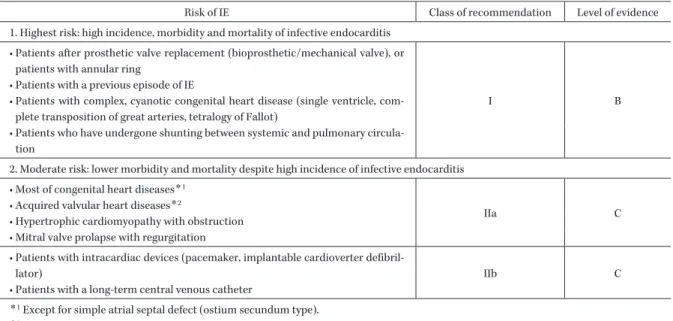
発症時の死亡率や重症度が高いもの を高度リスク群として区別することが一般的となっ てきた1〜4)。高度リスク群は,人工弁置換術後,IE 既往,そしてチアノーゼ性先天性心疾患である(Ta-ble 2)
4)。高度リスク群以外のIE
発症リスクが高い 疾患は中等度リスク群とされる。人工ペースメーカ,植込み型除細動器などの心内デバイス植込み患者は 欧米のガイドラインでは
IE
リスクと明記されてい ないが,本邦のガイドラインでは中等度リスク群と して扱っている(Table 2)4)。小児においては,先天性疾患例の
IE
発生が多い,外科手術時に使用される人工物の表面に細菌が付着 しやすい,右心系
IE
の頻度が高く右―左短絡に伴 う塞栓症の頻度も少なくない,乳歯から永久歯に変 わるため抜歯などの観血的歯科処置の機会が成人に 比べて多い,IEに対して弁置換が行われた場合の 影響は生涯にわたる,などの特殊性がありIE
予防 の重要性は成人よりもさらに高い。小児/先天性心 疾患患者においても成人と同様に,人工弁置換術後,IE
既往,そしてチアノーゼ性先天性心疾患が高度リスク群と考えられ,それ以外の大多数の先天性心 疾患は中等度リスク群とみなされている(Table 3)4)。
最近,大動脈二尖弁,僧帽弁逸脱症では,中等度 リスク群である他の背景疾患に比して歯科処置由来 の
IE
の割合が高く,手術になる率も高いことが示 された8)。これら2
つの疾患は現在中等度リスク群 と分類されているが,高度リスク群と分類すべきか もしれない。3)予防的抗菌薬投与で IE は予防できるか?
実験的な
IE
モデルにおいて,予防的抗菌薬投与 による抜歯時のIE
発症の抑制が示されてきた13)。し かし,予防的抗菌薬投与の有用性を臨床例において 示すことは容易ではない。症例対象研究の結果は一 定ではなく,予防的抗菌薬投与のIE
予防に対する 有用性は明確には示されなかった7,14,15)。逆に予防的 抗菌薬投与がなされたにもかかわらずIE
を発症し た例があることも報告された16)。また,はみがきや 食事など日常生活の中でも菌血症が生じることが示 されてきた17)。このような議論の結果,1990年代から予防的抗 菌薬投与が見直されてきた。2007年の米国心臓協 会ガイドラインでは,高度リスク群における予防的 抗菌薬投与は推奨するが,中等度リスク群では予防 的抗菌薬投与を推奨しないと大きく方向転換がされ た1)。さらに,英国国立医療技術評価機構のガイド ラインでは,高度リスク群も含めて予防的抗菌薬投 与を一切推奨しないとされた3)。
ガイドライン変更前後での
IE
発症率の変化につ いての報告がなされてきた。米国と,英国以外の欧 州では高度リスク群のみに予防的抗菌薬投与を行う とされたが,ガイドラインの発表前後でのIE
発症 率の変化についての報告は一定ではない6,18〜26)。こ れは,高度リスク群のみに予防的抗菌薬投与を行う という戦略の有用性を支持するともいえるが,ガイ ドラインがどの程度遵守されていたかははっきり報 告されておらず,ガイドライン変更の変化を直接反 映した結果であるかはわからない。最近,米国の保 険診療データを用いた解析が報告された27)。ガイド ライン変更後に中等度リスク群,高度リスク群に対 する予防的抗菌薬投与が減少したことが観察される と同時に,IE
発症率は低リスク群では変化せず,高 度リスク群で有意に増加,中等度リスク群でも増え る傾向にあった27)。これは予防的抗菌薬投与の効果Table 1. Incidence of IE by backgrounds
Backgrounds Incidence (per 100,000 person-years) References
General population 2-7
6, 26, 37-42)Incidence of tuberculosis in Japan (2014) 15.4
43)Incidence of malignant lymphoma in Japan (2012) 20.9
44)Incidence of gastric cancer in Japan (2012) 103.6
44)Incidence of acute myocardial infarction in Japan (2002-2009) 144
45)Elderly 10-25
40-42, 46)Children and young adults (<18 years old) 0.3-0.6
47-49)Background heart diseases
Rheumatic valvular disease 380-440
1)Aortic regurgitation 40
50)Aortic stenosis 73
50)Mitral prolapse/regurgitation 50-1,300
1, 50)Mitral prolapse without regurgitation 4.6
1)Mitral stenosis 17
50)Prosthetic valve 300-600
1, 51)Previous IE 740
1)Cardiac valve replacement for native valve IE 630
1)Cardiac valve replacement for prosthetic valve IE 2,160
1)Children/young-adults with congenital heart disease 50-75
52)Congenital heart diseases 90-120
53)Cyanotic congenital heart diseases 210-820
49, 52, 54)Ventricular septal defect 20-380
49, 52-56)Aortic stenosis 200-270
49, 54, 55)Congenitally corrected transposition of the great arteries 230
53)Bicuspid aortic valve 210
53)Aortic coarctation 70
54)Patent arterial duct 35
52)Atrial septal defect 20
53)Pulmonary stenosis 9.4
55)After surgery for congenital heart diseases
Tetralogy of Fallot with palliative systemic-to-pulmonary shunt 820
56)Aortic stenosis 720
56)Pulmonary atresia 640
56)Aortic coarctation 120
56)Tetralogy of Fallot (after definitive surgical repair) 70
56)Dextro transposition of the great arteries 70
56)Ventricular septal defect 60
56)Atrial septal defect, patent arterial duct, pulmonary stenosis 0
53, 56)Hypertrophic cardiomyopathy with obstruction 380-920
57)After first pacemaker implantation (after 1 year) 102
58)After pacemaker replacement (after 1 year) 326
58)Others
Intravenous drug users 70-1,300
59)Hemodialysis 483
60)Peritoneal dialysis 248
60)Table translated and reproduced from Ohara T: Epidemiology of infective endocarditis. Antibiotics & Chemotherapy 2018;
34: 225-30 with permission from Iyaku (Medicine and Drug) Journal Co., Ltd.
IE: infective endocarditis
を支持する結果と考えられる。
一方英国においては,高度リスク群も含めたすべ ての患者に対して歯科処置前の予防的抗菌薬投与は 推奨しないとされたが3),この前後で予防的抗菌薬 の処方量が激減したことが観察されている28,29)。初
期のフォローでは
IE
発症率の増加は証明されな かったが28),長期間フォローすることによってIE
発症率の統計学的に有意な増加が示された29)。また,高度リスク群のみならず,中等度以下のリスク群で も
IE
発症率が増加していることが示された29)。Table 2. Risks of Infective Endocarditis in Adults According to Underlying Heart Disease, Recommendations of Antibiotic Prophylaxis during Dental and Oral Surgical Procedures, and Level of Evidence
4)Risk of IE Class of recommendation Level of evidence
1. Highest risk: high incidence, morbidity and mortality of infective endocarditis
• Patients after prosthetic valve replacement (bioprosthetic/mechanical valve), or patients with annular ring
I B
• Patients with a previous episode of IE
• Patients with complex, cyanotic congenital heart disease (single ventricle, com- plete transposition of great arteries, tetralogy of Fallot)
• Patients who have undergone shunting between systemic and pulmonary circula- tion
2. Moderate risk: lower morbidity and mortality despite high incidence of infective endocarditis
• Most of congenital heart diseases
*1IIa C
• Acquired valvular heart diseases
*2• Hypertrophic cardiomyopathy with obstruction
• Mitral valve prolapse with regurgitation
• Patients with intracardiac devices (pacemaker, implantable cardioverter defibril-
lator) IIb C
• Patients with a long-term central venous catheter
*1
Except for simple atrial septal defect (ostium secundum type).
*2
The risk of IE is low in mitral valve stenosis without regurgitation.
IE: infective endocarditis Class of Recommendation
Class I: There is evidence and/or general agreement that a given procedure or treatment is effective and/or useful.
Class II: There is no consistent evidence and/or general agreement that a given procedure or treatment is effective and/or useful.
Class IIa: Weight of evidence and opinion is in favor of usefulness and/or effectiveness.
Class IIb: Usefulness or effectiveness is not fully established by evidence or opinion.
Class III: There is evidence and/or general agreement that the procedure or treatment is not effective and/or useful or may even be harmful.
Level of Evidence
Level A: Demonstrated with multiple randomized, controlled studies or meta-analyses.
Level B: Demonstrated with a single randomized intervention clinical study or non- randomized, non-intervention studies.
Level C: Only consensus opinion of experts and/or small-scale clinical studies (including retrospective studies and registration).
小児・若年者の
IE
症例数は成人に比してさらに 少なく,臨床例での予防的抗菌薬投与における有用 性の証明はいっそう難しく,ガイドライン変更の影 響は証明されていない24,30)。しかし,小児のIE
で は先天性心疾患が多く重症化しやすいという特殊性 から,予防の重要性はむしろ成人よりも大きいと考 えられる31)。これらの議論をふまえて,今回のガイドライン改 訂においては,成人,小児のどちらにおいても,高 度リスク群と中等度リスク群の両群で観血的歯科処 置時の予防的抗菌薬投与を推奨すること と し た
(Tables 2,3)4)。
4)予防効果の費用対効果は?
本邦の登録研究
CADRE
における検討では513
例中92
例(18%)に先行歯科処置を有したが,先 行する観血的歯科処置を有する群の大半で予防的抗 菌薬投与が行われていなかった12)。このうち予防的抗菌薬投与が行われていたものを除き,観血的歯科 処置から
IE
発症までの期間が1
カ月以内のものに 限定すると6.2%
であった。さらにこのうち原因菌 が口腔内レンサ球菌と証明され,アンピシリン感性 であったものは全体の1.8%
であった。これは,予 防的抗菌薬投与で予防できたはずの症例をより厳密 に見積もった割合といえる。本邦の人口を
1.27
億とし,IEの発症率を3.2
人/10
万人・年と見積もるならば,本邦のIE
発症数は4,064
人/年と計算される。上述のように予防的抗菌薬投与で予防しえた割合を少なく見積もって
1.8%
とすれば,予防的抗菌薬投与で予防しえた患者数は
73
人/年となる。IE治療にかかる費用をDPC
デー タから1
人あたり583
万円とすると,予防しえたIE
の治療にかかる費用は本邦全体で4.2
億円/年と計 算される。一方,予防的抗菌薬投与に必要な費用は薬価に処
Table 3. Risks of Infective Endocarditis in Pediatric/Congenital Heart Disease According to Underlying Heart Disease, Recommenda- tions of Antibiotic Prophylaxis during Dental and Oral Surgical Procedures, and Level of Evidence
4)Risk of infective endocarditis Class of recommendation Level of evidence 1. Highest risk: high incidence, morbidity and mortality of infective endocarditis
• After prosthetic valve surgery
I B
• History of IE
• Unrepaired cyanosis type congenital heart disease including palliative anastomo- sis and use of artificial blood vessels
• Within 6 months after the repair of congenital heart disease using artificial mate- rials regardless of surgery or catheterization
• Cases accompanying residual lesions at the repair site in spite of repair with patch or artificial materials
• Aortic coarctation
2. Moderate risk: lower morbidity and mortality despite high incidence of infective endocarditis
• Congenital heart diseases except for those in the highest-risk group and the low- risk group (including bicuspid aortic valve)
IIa C
• Hypertrophic cardiomyopathy with obstruction
• Mitral valve prolapse with regurgitation
3. Low risk: No particular risk of infection, and almost the same risk of infection as ordinary people
• Solitary atrial septal defect of ostium secundum type
III C
• Ventricular septal defect or patent ductus arteriosus occurring 6 months after surgery and without residual shunt
• After coronary artery bypass surgery
• Mitral valve prolapse without valvular regurgitation
• Physiological, functional or innocent cardiac murmur
• History of Kawasaki disease without valve dysfunction IE: infective endocarditis
The criteria of class of recommendation and level of evidence are per the legends of Table 2.
方料を加えて
800
円程度である。予防的抗菌薬投与 を要する患者数は正確にはわからないが,この戦略 は費用対効果的にみても理にかなっていると考えら れる。5)医師/歯科医師はガイドラインをどの位認知・遵 守するのか?
英国では保険診療とガイドラインとの結びつきが 強く,ガイドラインが一般の医師・歯科医師の診療 行動に及ぼす影響が大きい28,29)。一方,専門医はガ イドライン変更後も一定の割合で予防的抗菌薬投与 を続けていたことが報告されている32)。米国におけ るガイドラインの遵守率は高くはない33)。ガイドラ インによって予防的抗菌薬投与を一部または全面的 に中止した影響は過小評価されている可能性がある。
ガイドラインの影響を判断する場合には,それが一 般の医師・歯科医師にどのくらい認知され,遵守さ れたかを考慮することが重要である。
今回のガイドライン改訂前に,ガイドラインの認 知度についてのアンケート調査を行った34,35)。一般 歯科医におけるガイドラインの遵守率は十分とはい
えない一方35),小児歯科専門医におけるガイドライ ンの認知度,遵守率は高かった34)。今回の改訂後も ガイドラインを広く周知することが重要であり,医 師・歯科医師の行動がどのように変化したかを評価,
検討することが必要と考えられる。
6)予防的抗菌薬投与の副作用は?
予防的抗菌薬投与の副作用についての報告が英国 から出されている36)。英国においてはアモキシシリ
ン
3 g,1
回投与が推奨されている。これは,本邦における推奨の
2 g,1
回投与よりも多い。2004年 から2014
年の100
万回投与(実際は300
万回以上 の投与)あたり致死的副作用は1
度も生じなかった。皮疹などの非致死的副作用は
100
万回投与あたり22.62
回と計算された36)。アモキシシリン1
回投与 の安全性は高いと考えられる。アモキシシリンにアレルギーがある場合の代替薬 であるクリンダマイシン
600 mg, 1
回投与のレジュ メでは,100万回投与あたり致死的副作用は13
回,非致死的副作用は
149
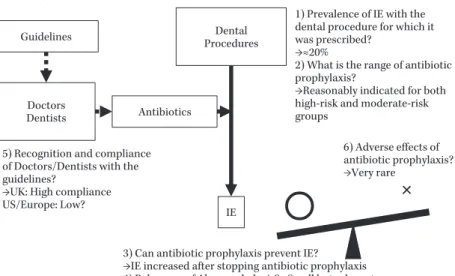
回と報告された36)。クリンダ マイシンでは偽膜性腸炎の副作用があるためと考えFig. 1. Summary of the Issues Regarding Antibiotic IE Prophylaxis for Invasive Dental Procedures
The guideline policy on antibiotic IE prophylaxis for invasive dental procedures should be discussed in terms of the issues regarding targets of antibiotic prophy- laxis 1), 2), efficacy and its magnitude of antibiotic prophylaxis 3), 4), prevalence of the guidelines 5), and the adverse effects 6).
IE, infective endocarditis; UK, United Kingdom; US, United States The Issues Regarding Antibiotic IE
Prophylaxis for Invasive Dental Procedures
Dental Procedures
IE Guidelines
Doctors
Dentists Antibiotics
1) Prevalence of IE with the dental procedure for which it was prescribed?
→≈20%
2) What is the range of antibiotic prophylaxis?
→Reasonably indicated for both high-risk and moderate-risk groups
3) Can antibiotic prophylaxis prevent IE?
→IE increased after stopping antibiotic prophylaxis 4) Relevance of Abx prophylaxis?→Small but relevant
6) Adverse effects of antibiotic prophylaxis?
→Very rare 5) Recognition and compliance
of Doctors/Dentists with the guidelines?
→UK: High compliance US/Europe: Low?
られる。
II. まとめ
以上をまとめると
Fig. 1
のようになる。1)観血的歯科処置に伴う IE
の頻度は20% 程度
であり,決して少なくはない。
2)IE
高度リスク,中等度リスク共に,観血的歯 科処置時において予防的抗菌薬投与の対象とするの が妥当である。3)予防的抗菌薬投与中止で IE
は増えたことが報告されてきており,予防的抗菌薬投与は
IE
予防 に一定程度の効果があると考えられる。4)予防的抗菌薬投与により予防できる IE
の頻度は多くはないが,いったん発症した場合の重篤度 を考慮すると,費用対効果を考えてもその価値は大 きいと考えられる。
5)医師/歯科医師のガイドライン認知度,遵守度
は十分ではなく,ガイドライン変更の効果を判定す るにはその点を考慮に入れる必要がある。6)予防的抗菌薬投与の副作用はきわめて少ない。
上記より,観血的歯科処置時に予防的抗菌薬投与 により予防できる症例数は全体の一部であるが,疾 患の重篤度を考慮すると予防的抗菌薬投与は妥当と
考えられる。2018年
3
月に『感染性心内膜炎の予 防と治療に関するガイドライン』の改訂版が発行さ れ,その中ではIE
リスクのある成人・小児に対す る観血的歯科処置時の予防的抗菌薬投与を推奨した。今後このガイドラインを周知,検証することが重要 と考えられる。さらに,本ガイドラインの英語訳が 発行されており,今後欧米の学会とも議論を深めて いくことが望まれる61)。
IE
に対する予防的抗菌薬投与の方針を決定する ためには,考慮すべき要素が多数あり議論は大変複 雑である。本稿による整理が,この問題の議論を今 後さらに深めていくうえでの一助となることを希望 する。利益相反自己申告:申告すべきものなし。
文献
1) Wilson W, Taubert K A, Gewitz M, Lockhart P
B, Baddour L M, Levison M, et al: Prevention
of infective endocarditis: guidelines from the
American Heart Association: a guideline from
the American Heart Association Rheumatic Fe-
ver, Endocarditis, and Kawasaki Disease Com-
mittee, Council on Cardiovascular Disease in
the Young, and the Council on Clinical Cardiol- ogy, Council on Cardiovascular Surgery and Anesthesia, and the Quality of Care and Out- comes Research Interdisciplinary Working Group. Circulation 2007; 116: 1736-54
2) Habib G, Lancellotti P, Antunes M J, Bongiorni M G, Casalta J P, Del Zotti F, et al: 2015 ESC Guidelines for the management of infective en- docarditis: The Task Force for the Manage- ment of Infective Endocarditis of the European Society of Cardiology (ESC). Endorsed by: Euro- pean Association for Cardio-Thoracic Surgery (EACTS), the European Association of Nuclear Medicine (EANM). Eur Heart J 2015; 36: 3075- 128
3) National Institute for Health and Clinical Excel- lence: Prophylaxis against infective endocardi- tis: antimicrobial prophylaxis against infective endocarditis in adults and children undergoing interventional procedures. 2008
https://www.nice.org.uk/guidance/cg64 ( ac- cessed 07/11/2016)
4)
中谷 敏,芦原京美,泉 知里,岩永史郎,江 石清行,大北 裕,他:感染性心内膜炎の予防 と治療に関するガイドライン(2017年改訂版)http://www.j-circ.or.jp/guideline/pdf/JCS2017̲
nakatani̲h.pdf(2019/03/05
アクセス)5) Delahaye F, MʼHammedi A, Guerpillon B, de Gevigney G, Boibieux A, Dauwalder O, et al:
Systematic Search for Present and Potential Portals of Entry for Infective Endocarditis. J Am Coll Cardiol 2016; 67: 151-8
6) Duval X, Delahaye F, Alla F, Tattevin P, Obadia J F, Le Moing V, et al: Temporal trends in infective endocarditis in the context of pro- phylaxis guideline modifications: three succes- sive population-based surveys. J Am Coll Car- diol 2012; 59: 1968-76
7) Strom B L, Abrutyn E, Berlin J A, Kinman J L, Feldman R S, Stolley P D, et al: Dental and car- diac risk factors for infective endocarditis. A population-based, case-control study. Ann In- tern Med 1998; 129: 761-9
8) Zegri-Reiriz I, de Alarcón A, Muñoz P, Martínez Sellés M, González-Ramallo V, Miro J M, et al: Infective Endocarditis in Patients With Bicuspid Aortic Valve or Mitral Valve Pro- lapse. J Am Coll Cardiol 2018; 71: 2731-40 9) Takayama Y, Okamoto R, Sunakawa K: Defi-
nite infective endocarditis: clinical and micro- biological features of 155 episodes in one Japa- nese university hospital. J Formos Med Assoc 2010; 109: 788-99
10) Nomura A, Omata F, Furukawa K: Risk factors of mid-term mortality of patients with infective endocarditis. Eur J Clin Microbiol Infect Dis 2010; 29: 1355-60
11) Nakatani S, Mitsutake K, Hozumi T, Yoshikawa J, Akiyama M, Yoshida K, et al: Current char- acteristics of infective endocarditis in Japan: an analysis of 848 cases in 2000 and 2001. Circ J 2003; 67: 901-5
12) Ohara T, Nakatani S, Kokubo Y, Yamamoto H, Mitsutake K, Hanai S, et al: Clinical predictors
of in-hospital death and early surgery for infec- tive endocarditis: results of CArdiac Disease REgistration (CADRE), a nation-wide survey in Japan. Int J Cardiol 2013; 167: 2688-94
13) Malinverni R, Overholser C D, Bille J, Glauser M P: Antibiotic prophylaxis of experimental en- docarditis after dental extractions. Circulation 1988; 77: 182-7
14) Imperiale T F, Horwitz R I: Does prophylaxis prevent postdental infective endocarditis? A controlled evaluation of protective efficacy. Am J Med 1990; 88: 131-6
15) Van der Meer J T, Van Wijk W, Thompson J, Vandenbroucke J P, Valkenburg H A, Michel M F: Efficacy of antibiotic prophylaxis for pre- vention of native-valve endocarditis. Lancet 1992; 339: 135-9
16) Durack D T, Kaplan E L, Bisno A L: Apparent failures of endocarditis prophylaxis. Analysis of 52 cases submitted to a national registry.
JAMA 1983; 250: 2318-22
17) Lockhart P B, Brennan M T, Sasser H C, Fox P C, Paster B J, Bahrani-Mougeot F K: Bactere- mia associated with toothbrushing and dental extraction. Circulation 2008; 117: 3118-25 18) Pant S, Patel N J, Deshmukh A, Golwala H, Pa-
tel N, Badheka A, et al: Trends in infective en- docarditis incidence, microbiology, and valve re- placement in the United States from 2000 to 2011. J Am Coll Cardiol 2015; 65: 2070-6 19) Keller K, von Bardeleben R S, Ostad M A, Ho-
bohm L, Munzel T, Konstantinides S, et al:
Temporal Trends in the Prevalence of Infec- tive Endocarditis in Germany Between 2005 and 2014. Am J Cardiol 2017; 119: 317-22 20) Bikdeli B, Wang Y, Kim N, Desai M M, Quagli-
arello V, Krumholz H M: Trends in hospitaliza- tion rates and outcomes of endocarditis among Medicare beneficiaries. J Am Coll Cardiol 2013;
62: 2217-26
21) Cahill T J, Harrison J L, Jewell P, Onakpoya I, Chambers J B, Dayer M, et al: Antibiotic pro- phylaxis for infective endocarditis: a systematic review and meta-analysis. Heart 2017; 103: 937- 44
22) DeSimone D C, Tleyjeh I M, Correa de Sa D D, Anavekar N S, Lahr B D, Sohail M R, et al: In- cidence of Infective Endocarditis Due to Viri- dans Group Streptococci Before and After the 2007 American Heart Associationʼs Prevention Guidelines: An Extended Evaluation of the Olmsted County, Minnesota, Population and Na- tionwide Inpatient Sample. Mayo Clin Proc 2015; 90: 874-81
23) Erichsen P, Gislason G H, Bruun N E: The in- creasing incidence of infective endocarditis in Denmark, 1994-2011. Eur J Intern Med 2016; 35:
95-9
24) Mackie A S, Liu W, Savu A, Marelli A J, Kaul P: Infective Endocarditis Hospitalizations Be- fore and After the 2007 American Heart Asso- ciation Prophylaxis Guidelines. Can J Cardiol 2016; 32: 942-8
25) van den Brink F S, Swaans M J, Hoogendijk M
G, Alipour A, Kelder J C, Jaarsma W, et al: In- creased incidence of infective endocarditis after the 2009 European Society of Cardiology guide- line update: a nationwide study in the Nether- lands. Eur Heart J Qual Care Clin Outcomes 2017; 3: 141-7
26) Toyoda N, Chikwe J, Itagaki S, Gelijns A C, Ad- ams D H, Egorova N N: Trends in Infective En- docarditis in California and New York State, 1998-2013. JAMA 2017; 317: 1652-60
27) Thornhill M H, Gibson T B, Cutler E, Dayer M J, Chu V H, Lockhart P B, et al: Antibiotic Pro- phylaxis and Incidence of Endocarditis Before and After the 2007 AHA Recommendations. J Am Coll Cardiol 2018; 72: 2443-54
28) Thornhill M H, Dayer M J, Forde J M, Corey G R, Chu V H, Couper D J, et al: Impact of the NICE guideline recommending cessation of an- tibiotic prophylaxis for prevention of infective endocarditis: before and after study. BMJ 2011;
342: d2392
29) Dayer M J, Jones S, Prendergast B, Baddour L M, Lockhart P B, Thornhill M H: Incidence of infective endocarditis in England, 2000-13: a secular trend, interrupted time-series analysis.
Lancet 2015; 385: 1219-28
30) Pasquali S K, He X, Mohamad Z, McCrindle B W, Newburger J W, Li J S, et al: Trends in en- docarditis hospitalizations at US childrenʼs hos- pitals: Impact of the 2007 American Heart As- sociation Antibiotic Prophylaxis Guidelines. Am Heart J 2012; 163: 894-9
31)
中澤 誠,丹羽 公 一 郎,吉 永 正 夫,寺 井 勝,越後茂之,藤原 卓,他:小児および成人先天 性心疾患における感染性心内膜炎の予防,治療 に関する全国調査―第
2
報―。日小児循環器会 誌2004; 20: 668-73
32) Dayer M J, Chambers J B, Prendergast B, San- doe J A, Thornhill M H: NICE guidance on an- tibiotic prophylaxis to prevent infective endo- carditis: a survey of cliniciansʼ attitudes. QJM 2013; 106: 237-43
33) Lockhart P B, Hanson N B, Ristic H, Menezes A R, Baddour L: Acceptance among and im- pact on dental practitioners and patients of American Heart Association recommendations for antibiotic prophylaxis. J Am Dent Assoc 2013; 144: 1030-5
34) Kokomoto K, Nomura R, Ohara T, Nakatani S, Ooshima T, Nakano K: Current knowledge among pediatric dentistry specialists in Japan regarding prevention of infective endocarditis.
Pediatric Dental Journal 2018; 28: 110-7 35) Nomura R, Kokomoto K, Ohara T, Nakatani S,
Ooshima T, Nakano K: Current knowledge among Japanese experienced general dentists regarding prevention of infective endocarditis.
Odontology 2018; 106: 297-305
36) Thornhill M H, Dayer M J, Prendergast B, Bad- dour L M, Jones S, Lockhart P B: Incidence and nature of adverse reactions to antibiotics used as endocarditis prophylaxis. J Antimicrob Che- mother 2015; 70: 2382-8
37) Baddour L M, Wilson W R, Bayer A S, Fowler
V G Jr, Tleyjeh I M, Rybak M J, et al: Infective Endocarditis in Adults: Diagnosis, Antimicro- bial Therapy, and Management of Complica- tions: A Scientific Statement for Healthcare Professionals From the American Heart Asso- ciation. Circulation 2015; 132: 1435-86
38) Mylonakis E, Calderwood S B: Infective endo- carditis in adults. N Engl J Med 2001; 345: 1318- 30
39) DeSimone D C, Tleyjeh I M, Correa de Sa D D, Anavekar N S, Lahr B D, Sohail M R, et al:
Temporal trends in infective endocarditis epi- demiology from 2007 to 2013 in Olmsted County, MN. Am Heart J 2015; 170: 830-6 40) Sy R W, Kritharides L: Health care exposure
and age in infective endocarditis: results of a contemporary population-based profile of 1536 patients in Australia. Eur Heart J 2010; 31:
1890-7
41) Cresti A, Chiavarelli M, Scalese M, Nencioni C, Valentini S, Guerrini F, et al: Epidemiological and mortality trends in infective endocarditis, a 17-year population-based prospective study.
Cardiovascu Diagn Ther 2017; 7: 27-35
42) Fedeli U, Schievano E, Buonfrate D, Pellizzer G, Spolaore P: Increasing incidence and mortality of infective endocarditis: a population-based study through a record-linkage system. BMC Infect Dis 2011; 11: 48
43)
厚生労働省:平成26
年結核登録者情報調査年 報集計結果(概況)http://www.mhlw.go.jp/bunya/kenkou/
kekkaku-kansenshou03/14.html(2017/04
ア ク セス)44) Hori M, Matsuda T, Shibata A, Katanoda K, Sobue T, Nishimoto H, et al: Cancer incidence and incidence rates in Japan in 2009: a study of 32 population-based cancer registries for the Monitoring of Cancer Incidence in Japan (MCIJ) project. Jpn J Clin Oncol 2015; 45: 884-91 45) Hata J, Ninomiya T, Hirakawa Y, Nagata M, Mukai N, Gotoh S, et al: Secular trends in car- diovascular disease and its risk factors in Japa- nese: half-century data from the Hisayama Study (1961-2009). Circulation 2013; 128: 1198- 205
46) Durante-Mangoni E, Bradley S, Selton-Suty C, Tripodi M F, Barsic B, Bouza E, et al: Current features of infective endocarditis in elderly pa- tients: results of the International Collaboration on Endocarditis Prospective Cohort Study.
Arch Intern Med 2008; 168: 2095-103
47) Schollin J, Bjarke B, Wesström G: Infective en- docarditis in Swedish children. I. Incidence, eti- ology, underlying factors and port of entry of infection. Acta Paediatr Scand 1986; 75: 993-8 48) Coward K, Tucker N, Darville T: Infective en-
docarditis in Arkansan children from 1990 through 2002. Pediatr Infect Dis J 2003; 22:
1048-52
49) Knirsch W, Nadal D: Infective endocarditis in congenital heart disease. Eur J Pediatr 2011;
170: 1111-27
50) Michel P L, Acar J: Native cardiac disease pre-
disposing to infective endocarditis. Eur Heart J 1995; 16 (Suppl B): 2-6
51) Moreillon P, Que Y A: Infective endocarditis.
Lancet 2004; 363: 139-49
52) Rushani D, Kaufman J S, Ionescu-Ittu R, Mackie A S, Pilote L, Therrien J, et al: Infec- tive endocarditis in children with congenital heart disease: cumulative incidence and predic- tors. Circulation 2013; 128: 1412-9
53) Verheugt C L, Uiterwaal C S, van der Velde E T, Meijboom F J, Pieper P G, Veen G, et al:
Turning 18 with congenital heart disease: pre- diction of infective endocarditis based on a large population. Eur Heart J 2011; 32: 1926-34 54) Corone P, Lévy A, Hallali P, Davido A, Wyler
Y, Corone A: 54 cases of infectious endocarditis seen in 32 years in a population of 2038 con- genital heart diseases. Arch Mal Coeur Vaiss 1989; 82: 779-84
55) Gersony W M, Hayes C J, Driscoll D J, Keane J F, Kidd L, OʼFallon W M, et al: Bacterial endo- carditis in patients with aortic stenosis, pulmo- nary stenosis, or ventricular septal defect. Cir- culation 1993; 87 (2 Suppl): I121-6
56) Morris C D, Reller M D, Menashe V D: Thirty- year incidence of infective endocarditis after surgery for congenital heart defect. JAMA
1998; 279: 599-603
57) Spirito P, Rapezzi C, Bellone P, Betocchi S, Au- tore C, Conte M R, et al: Infective endocarditis in hypertrophic cardiomyopathy: prevalence, in- cidence, and indications for antibiotic prophy- laxis. Circulation 1999; 99: 2132-7
58) Johansen J B, Jørgensen O D, Møller M, Arnsbo P, Mortensen P T, Nielsen J C: Infec- tion after pacemaker implantation: infection rates and risk factors associated with infection in a population-based cohort study of 46299 consecutive patients. Eur Heart J 2011; 32: 991- 8
59) Axelsson A, Søholm H, Dalsgaard M, Helweg- Larsen J, Ihlemann N, Bundgaard H, et al:
Echocardiographic findings suggestive of infec- tive endocarditis in asymptomatic Danish injec- tion drug users attending urban injection facili- ties. Am J Cardiol 2014; 114: 100-4
60) Abbott K C, Agodoa L Y: Hospitalizations for bacterial endocarditis after initiation of chronic dialysis in the United States. Nephron 2002; 91:
203-9
61) Nakatani S, Ohara T, Ashihara K, Izumi C, Iwanaga S, Eishi K, et al: JCS 2017 Guideline on Prevention and Treatment of Infective Endo- carditis. Circ J 2019; 83: 1767-809
Future direction of antibiotic prophylaxis for invasive dental procedures
―from the view of the Revision Committee of the Guidelines for Prevention and Treatment of Infective Endocarditis in Japan
Takahiro Ohara
1)and Satoshi Nakatani
2)1)
Division of Community Medicine, Tohoku Medical and Pharmaceutical University, 1―15―1 Fukumuro, Miyagino- ku, Sendai, Miyagi, Japan
2)