
• 検索結果がありません。

What’s Next for Salinity? B y t h e C L I VA R S A L I N I t y W o R k I N g g R o u p

N/A
N/A
Protected

Academic year: 2021

シェア "What’s Next for Salinity? B y t h e C L I VA R S A L I N I t y W o R k I N g g R o u p"

Copied!
4
0
0

読み込み中.... (全文を見る)

全文

(1)

Oceanography Vol.21, No.1 82

What’s Next for Salinity?

B y t h e C L I VA R S A L I N I t y W o R k I N g g R o u p

S p e C I A L I S S u e o N S A L I N I t y

CLIVAR (Climate Variability and Pre- dictability) is an international research effort focusing on the variability and predictability of the slowly varying components of the climate system. As part of the US contribution to CLIVAR, a “Salinity Working Group” was formed and charged with:

1. describing the role of ocean salinity in the global water cycle, global ocean circulation, and climate variability 2. identifying the requirements and chal-

lenges for analyzing, observing, and monitoring salinity, as well as simulat- ing processes critical for determining the ocean’s role in the transport and storage of salinity

3. providing guidance to the US National Aeronautics and Space Administration (NASA) (and the international community) on obser- vational and scientific activities that should be considered in advance of, and during, the Aquarius mission to improve measurement, analysis, and use of salinity information for the above purposes

To achieve these goals, we organized sessions on salinity at the 2006 and 2008 Ocean Sciences Meetings as well as a workshop at the Woods Hole Oceanographic Institution in May 2006.

In July 2007, we published a CLIVAR white paper on salinity (US CLIVAR Report No. 2007-1), available online at: http://www.usclivar.org/Pubs/

Salinity_final_report.pdf. The summary

and principal recommendations of that report are provided here.

There are several key motivations for improving knowledge of the role that ocean salinity variability plays in the global climate system:

• Ocean salinity is an important compo- nent (indicator) of “global water cycle”

variability. It provides information on the exchange of freshwater with the atmosphere (e.g., evaporation, pre- cipitation) and with the terrestrial and crysopheric components of the global climate system, and on storage within the ocean. Describing and predicting the global water cycle in the context of global climate change can be only be fully realized when the marine branch of the hydrological cycle is considered.

• Ocean salinity is a fundamental ocean state variable and a tracer of ocean circulation—an important dynamical ocean process that governs the uptake and redistribution of ocean heat and carbon, critical elements of the global climate system. Increasing evidence suggests that ocean variability is linked to changes in extremes of the water cycle (e.g., droughts,

floods) elsewhere.

• Ocean salinity likely contributes to predictability of the climate system (e.g., for El Niño-Southern Oscillation [ENSO] and for multidecadal vari- ability in the Atlantic).

• Ocean salinity changes have a direct impact on the exchange of CO

2

between ocean and atmosphere and may affect marine species and ecosystems.

Current knowledge of ocean salinity variability is hampered by lack of more than a few long-term salinity records.

Available observations indicate that remarkable changes of ocean salin- ity are underway in some regions.

Unfortunately, it is unclear if these changes are attributable to natural varia- tions, what processes may be involved, how they may or may not be consistent with changes in other components (e.g., precipitation) of the global water cycle, how long such changes have been underway, or how widespread they might be. The Argo float observa- tion network is a critical component of a global salinity observing system;

The CLIVAR SALInITy WoRkIng gRoup

Tim Boyer (National Oceanic and Atmospheric Administration, National Ocean Data Center), Jim Carton (co-chair, University of Maryland), yi Chao (NASA Jet Propulsion Laboratory), Arnold gordon (Lamont-Doherty Earth Observatory of Columbia University), greg Johnson (National Oceanic and Atmospheric Administration, Pacific Marine

Environmental Laboratory), gary Lagerloef (Earth and Space Research), Bill Large (National Center for Atmospheric Research), Steve Riser (University of Washington), and Ray Schmitt (co-chair, Woods Hole Oceanographic Institution, [email protected])

This article has been published in Oceanography, Volume 21, Number 1, a quarterly journal of The oceanography Society. Copyright 2008 by The oceanography Society. All rights reserved. permission is granted to copy this article for use in teaching and research. Republication, systemmatic reproduction, or collective redistirbution of any portion of this article by photocopy machine, reposting, or other means is permitted only with the approval of The oceanography Society. Send all correspondence to: [email protected] or Th e oceanography Society, po Box 1931, Rockville, MD 20849-1931, uSA.
(2)

Oceanography March 2008 83

however, it does not (as currently configured) sample below 2000 m nor near the ocean surface. It also does not provide observations in some critical regions (e.g., the Gulf of Mexico and the Caribbean Sea, key areas for hur- ricane intensification).

The value of future global surface salinity measurements from space is very promising. Their value can be greatly increased if surface salinity measure- ments are carefully analyzed within the context of the global water cycle, espe- cially its oceanic component. In practical terms, this analysis would require inte- grating the in situ and remotely sensed components of the salinity monitoring system. Such a system should aim to pro- vide a variety of products with specified uncertainties. Complementary products such as net freshwater flux into the ocean would also be very helpful in improving quantification of global coupled water cycle changes.

To fully characterize, understand, and predict changes of the global water cycle in the ocean, knowledge of the many mechanisms and coupled dynamics that determine salinity must be greatly expanded. There is an unacceptable range of uncertainty in estimates of the magnitude of freshwater exchanges between the ocean and atmosphere as well as the lateral fluxes of freshwater within the ocean. Closing the coupled water budgets in select regions would be very helpful in quantifying and nar- rowing these uncertainties in the marine hydrologic cycle. Planning for such ocean-based freshwater budget studies should begin now to take advantage of salinity mission validation efforts.

Finally, more efforts should be under- taken to use collective knowledge on

relevant processes and freshwater budget studies to analyze the fidelity of, and improve the depiction of, mixing and advection processes in coupled climate models and assimilation systems.

Through its activities, the Salinity Working Group identified several key scientific questions that should guide existing and future research and obser- vational efforts:

• What are the key knowledge gaps that limit the fidelity of coupled climate models in representing and predicting changes in the global water cycle and coupling to ocean circulation and climate variability?

• What physical mechanisms control the Atlantic meridional overturn- ing circulation and its sensitivity to interannual sea-surface salinity variability, and what regions are the highest priorities for long-term salin- ity observations?

• How does surface freshwater forcing influence ocean mixed layer dynam- ics in the tropics and high latitudes and regulate heat exchange with the atmosphere, and how do these pro- cesses feed back on ocean-atmosphere coupling on intraseasonal, seasonal, and interannual time scales?

• How do the varying surface fluxes of freshwater and heat generate temperature-salinity anomalies in mid-latitude waters and how are such anomalies incorporated into the central waters of the thermocline?

pRIoRIty ReCoMMeNDAtIoNS The following recommendations are aimed at improving understanding, monitoring capabilities, and, ultimately, modeling and predicting of the global climate system.

observing System expansion We advocate for the general expansion of salinity measurements on all ocean- observing platforms. However, we identify three near-term priorities for immediate consideration:

1. Maintain Argo program. With so many changes being documented in regional salinity trends, and the expanding salinity data sets being provided by the Argo floats, continued analysis of temporal variability will be of great interest.

2. Surface Argo salinity measurements (upper 5-m sensor). Present salinity sensors are turned off at 5-m depth to preserve calibration. It is important for Aquarius to obtain true surface salinity by incorporating a high- resolution salinity measurement that can be corrected for drift against the deeper-going sensor.

3. Sea-surface salinity (SSS) measure- ments on global Drifter program instruments. The longevity of SSS sensors in the face of biological fouling remains a challenging issue.

To have a significant complement of sensors deployed in the Global Drifter Program by the 2010 launch of Aquarius, it will be necessary to expand trials of various sensors and develop confidence in the technology.

In addition, we recommend the follow- ing future enhancements:

4. expand thermosalinograph usage on

volunteer observing ships (VoS). VOS

SSS data have the most impact in

assimilative models when they cross

regions of significant temperature

and salinity variability (i.e., across

water-mass fronts and areas with

strong mesoscale eddies). A review of

(3)

Oceanography Vol.21, No.1 84

potential new lines and feasibility of implementation should be developed by experts in this area.

5. Maintain/expand moored array salin- ity sensors. SSS sensors on moorings can be very valuable for determining the response to rainfall events, espe- cially if deployed on flux buoys. Issues such as the sensitivity of Aquarius to diurnal rainfall patterns could be addressed with such data sets.

6. Repeat CtD sections. The CLIVAR Repeat Hydrography program will provide important checks of salinity trends in deep waters. However, coverage is sparse and designed more for carbon and heat budgets than for freshwater. For example, extrema in meridional freshwater flux are found at approximately 50° and 10°

north and south latitudes, yet none of these are planned for inclusion in the CLIVAR Repeat Hydrography pro- gram. In particular, the 48°N Atlantic section AR19 could be considered as a freshwater flux line, especially if complemented with gliders or moor- ings for monitoring the shallow fresh currents at the western boundary.

7. glider lines. Glider technology is advancing quickly, and will be ideal for monitoring water masses and cur- rents in a variety of oceanic regimes.

The most immediate application may be in coastal boundary currents, which are generally fresher than offshore waters and thus represent significant freshwater transports.

These currents are accessible to pres- ent shallow-water gliders. Sites where they can complement an existing deep-water monitoring program are especially attractive (e.g., “Line W”

off New England).

8. Maintain the ocean time-series stations, especially those offshore of Bermuda and Hawaii, which can resolve seasonal and interannual fluctuations and long-term trends for the entire water column.

Analysis

Data quality control is of paramount importance for salinity, and only prop- erly vetted databases should be used for analysis and assimilations. The Argo and Global Ocean Data Assimilation Experiment (GODAE) projects may be providing the needed quality control, but such efforts should be monitored and reviewed for effectiveness on a regular basis. We recommend increased international and US coordination of data management activities that consider ocean salinity data, metadata, best practices of quality flagging, and provision of salinity information and products/analyses (currently these activities are distributed among several programs and centers).

Also of interest for mapping the salin- ity field is a better understanding of the scales of variability in different oceanic regimes. Surface salinity generally has shorter scales of variability than surface temperature because it lacks any direct feedback on atmospheric fluxes, which tend to smooth lateral variations in sea- surface temperature (SST). Some tropical regions have very abrupt, short scales of variability in salinity, while subtropical gyre regions appear to exhibit high cor- relation between salinity and tempera- ture changes in a density-compensating manner. Such correlations may allow use of SST maps to identify salinity fronts.

In all regions it would be helpful for mapping purposes to develop statistics

on correlation scales; analysis of existing thermosalinograph data sets for these relationships should be encouraged.

Model Improvements

Great progress has been made in the last decade in understanding how the interior ocean mixes through the use of tracer-release experiments. Dramatic spatial variability in diapycnal mixing rates is now known to be common. Such variations impose a much richer baro- clinic flow structure on the ocean than the uniform interior mixing assumed in most models. However, such variations in mixing rate are still largely missing from models. Upper-ocean mixing and its interaction with Ekman advection and outcropping isopycnals is a particularly challenging problem and one closely related to the use of SSS data to constrain net water fluxes between the ocean and atmosphere. We must also recognize that heat and salt do not mix at the same rates due to the action of double-diffusive mixing. The CLIVAR Climate Process Teams (CPTs—see www.usclivar.org/

science.html#model) may be helpful in this regard, but much greater resources are required to expand the number of teams and to bring a substantial observa- tional component to the efforts.

Quantitative Water Flux and process experiments

With significant progress apparent in the

use of autonomous floats and gliders for

the measurement of water properties and

velocities, it is now feasible to consider

a dedicated effort to constrain estimates

of air-sea interaction (e.g., evaporation-

precipitation [E-P]) with a control-

volume-type budget experiment for the

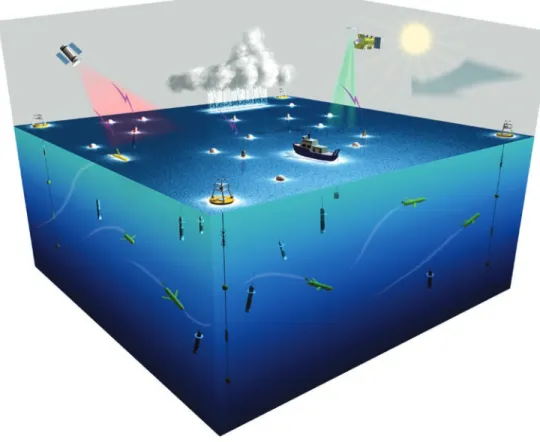
ocean (Figure 1). That is, with reasonable

(4)

Oceanography March 2008 85

Figure 1. Schematic showing floats, drifters, gliders, moorings, ships, and satellites sampling an ocean volume in sufficient density to constrain the upper-ocean salinity budget and thus surface freshwater flux. gliders patrol the boundaries, floats and drifters monitor the interior, and flux buoys and satellites assess air-sea interactions. Such control-volume experiments run over several seasonal cycles will greatly aid the representation of upper-ocean advection and mixing processes in climate models.

densities of surface drifters, moorings, and profiling floats in the interior of a control volume, and gliders monitoring the boundaries, coupled with satellite measurements of winds, sea-surface height and salinity from Aquarius/

SAC-D, it would be feasible to construct budgets for heat and freshwater for an upper-ocean parcel. Upper-ocean mixing processes must also be measured.

Two types of ocean regimes are pre- ferred for such an experiment. The first could be in a simple mid-gyre evapora- tion regime, where the subtropical salin- ity maxima are formed and precipitation is light. The second could be in a tropical high-rainfall regime.

1. evaporation Regime. At the salin- ity maximum, horizontal salinity gradients vanish, so advection is of small importance in the surface layer.

Generally, these areas have weak eddy fields, making the sampling problems less severe. Similarly, precipitation

is usually relatively weak, meaning less surface-salinity variance, thus increasing the signal-to-noise ratio.

With net surface evaporation and Ekman convergence, vertical mix- ing and subduction processes are of prime importance.

2. precipitation Regime. The strongest precipitation regimes are in the trop- ics, and tend to have strong zonal advection associated with them.

Because this advection, stronger eddy fields, and patchiness of fresh anoma- lies pose a greater sampling challenge, it is suggested as a second experiment.

The physics of barrier layers would be of interest. Calibration and validation of remote-sensing techniques for pre- cipitation, as well as the use of salinity measurements for constraining air-sea fluxes, would also be important.

In developing plans for such experi- ments, it will be important to identify high signal/noise areas, where the effort

can provide the greatest benefit in constraining estimates of surface forcing.

The seasonal cycle is the signal of most interest for these relatively short-term experiments (~ 2 years). Also, it would be useful to identify regions of greatest dis- agreement between present surface-flux climatologies. In refining experimental plans, observing-system simulation experiments should be carried out to optimize deployment of resources.

The water cycle is of fundamental importance to society and is largely unmonitored over the global ocean.

Changes in the water cycle are likely to present even greater challenges to human civilization than changes in temperature alone. Advances in salinity-sensing tech- nology offer us a way to use the ocean as a rain gauge, thus providing the potential for achieving new understanding of the global water cycle. With quantita- tive understanding comes improved modeling and predictive capability, the ultimate goal of all climate research.

ACkNoWLeDgeMeNtS

The Salinity Working Group recognizes

Cathy Stephens and David Legler

of the US CLIVAR Office as well as

Eric Lindstrom of NASA for their

support activities.

Figure 1. Schematic showing floats, drifters,  gliders, moorings, ships, and satellites sampling  an ocean volume in sufficient density to  constrain the upper-ocean salinity budget  and thus surface freshwater flux

参照

関連したドキュメント

[Publications] Yamagishi, S., Yonekura.H., Yamamoto, Y., Katsuno, K., Sato, F., Mita, I., Ooka, H., Satozawa, N., Kawakami, T., Nomura, M.and Yamamoto, H.: "Advanced

Found in the diatomite of Tochibori Nigata, Ureshino Saga, Hirazawa Miyagi, Kanou and Ooike Nagano, and in the mudstone of NakamuraIrizawa Yamanashi, Kawabe Nagano.. cal with

joint work with Michele D’Adderio and Anna Vanden Wyngaerd 2 september, 2019.. Thank you for

In the literature it is usually studied in one of several different contexts, for example in the game of Wythoff Nim, in connection with Beatty sequences and with so-called

Since (in both models) I X is defined in terms of the large deviation rate function I T (t) for the hitting times T n /n , this is related to the fact that inf t I T (t) = 0 for

S49119 Style Classic Flexor Grade 7.0 Fixation Manual Weight 215g Size range 35 - 52 TECHNOLOGY-HIGHLIGHTS. •

のようにすべきだと考えていますか。 やっと開通します。長野、太田地区方面  

5) Uemura O, Nagai T, Ishikura K, Ito S, Hataya H, Gotoh Y, Fujita N, Akioka Y, Kaneko T, Honda M: Creatinine-based equation to esti- mate the glomerular filtration rate in