Ambidextrous Management of High-Technology and Low-Medium Technology: A Case Study in FPD TV and
CRT TV Business of Sony Corporation
*By
Atsushi Osanai
†Abstract Regarding R & D management for long-term coexistence of new and existing businesses within a company in technological transition, development of high technology introduces conflict between existing low and medium technologies(LMT).
One solution, organizational separation of old and new technologies, can render the technological resources of separated R & D groups mutually inaccessible, thereby possibly necessitating duplication of investment costs. That situation might be prevented by brief coexistence of separate groups during a transition period.
Nevertheless, existing businesses based on LMT often retain large markets despite the success of new businesses. In the television business described herein, a technological shift began in the late 1990s to replace conventional CRT televisions with flat panel displays
(FPD), including LCDs and plasma display panels(PDPs). Today, despite great interest in FPD televisions, global shipments in 2006 included 130 million CRT televisions and 46 million FPD televisions. Varying unit prices prevent a simple comparison, but CRT televisions constitute a large, fiercely competitive market.
Continued coexistence of old and new businesses demands the contradictory conditions of independence of the two R & D groups while using mutual resources. Sonyʼs case has revealed a single technical development division serving both old and new R & D WASEDA BUSINESS & ECONOMIC STUDIES 2015 NO. 51
* This paper is revised and much-improved from an original Japanese paper in SOSHIKI KAGAKU(Organizational Science), Vol. 40, No. 1.
† Associate professor in technology and innovation management, Waseda University Business School.
groups, providing similar new technology for product development while co-ordinating these divisionsʼinterests. The technical development division integrates technological and product development to integrate developed technologies into downstream product development.
This integration process, so-called“Ambidextrous Management of Diverse R & Ds,”
incorporates downstream divisionsʼ technology and expertise into technological development, thereby enabling multiple downstream product development groups to acquire technology and expertise through technology that is integrated with that of other product divisions.
The processʼimplications include the following.
New businesses use existing business technology; existing businesses can incorporate new technology.
Viewing technological changes as diversification, existing and new businesses can increase opportunities through co-operation.
I. Introduction
Development of new high technology in an existing company sometimes involves conflict with existing low and medium technologies(LMT). Earlier studies have concluded that separation of a new business from the existing organization to concentrate on the new field would be an effective solution for such a problem of a company going through technological transition(Abernathy and Clark, 1985; Tushman and Anderson, 1986; Henderson and Clark, 1990; Utterback, 1994; Christensen, 1997).
Although such organizational separation prevents the existing business from negatively affecting the new business, it also isolates the new business from existing resources and hampers the effective use of resources that constitute a major advantage of a large company(Iansiti, McFarlan, and Westerman, 2003). The accessibility of existing resources a new separate business has not been emphasized in earlier research because precedent studies have assumed that new and existing businesses coexist only briefly during a transition period and that the existing business is soon replaced by the emerging business.
In reality, however, an existing business based on LMT often retains a large market and continues to benefit the company without being completely replaced by a new business. In the television industry examined in this study, a technological shift began in the late 1990s to replace the conventional CRT televisions with flat panel displays(FPD), including LCDs and plasma display panels(PDP). Today, the consumers in well developed countries are more interested in the latest FPD televisions, and the majority of researchers
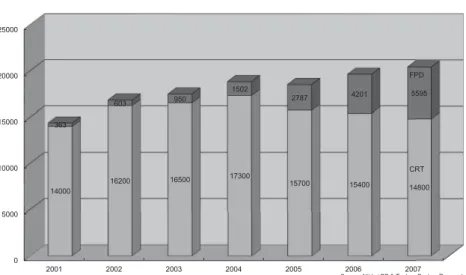
in innovation management study are exploring FPD industry as the most advanced technology. But, data provided by DisplaySearch indicate that global shipments of televisions in 2006 included 130 million CRT televisions, as opposed to 46 million FPD televisions.1 Figure 1 presents the estimated and actual numbers of televisions manufactured between 2001 and 2007 according to Nikkei Market Access magazine.
Despite a slight difference from the data of DisplaySearch, the figures generally suggest that a large market based on existing technology remains and that its coexistence with new technology will continue for some time.
Long-term coexistence of old and new businesses must satisfy the contradictory conditions that old and new R & D groups remain mutually independent while sharing their resources. Sonyʼs case, which is analyzed in this study, reveals a single technology development division placed above both old and new R & D groups, providing common new technology for old and new product development while coordinating the interests of these divisions. The upstream technology development division integrates technological and product development to adapt new technology to the downstream product development process.
1Source: DisplaySearch Japan, press release dated 14 February, 2007(Japanese). http://
www.displaysearch-japan.com/release/2007/02/r14.html(last accessed 6 June, 2007)
Figure 1. Global TV Production by Display Type
This study designates this integrative process as theAmbidextrous Management of Diverse R & Ds, which incorporates the technology and expertise of downstream divisions into the prior technology development. This integration enables the downstream product development groups to acquire the technology and expertise of other divisions by adopting the technology integrated with other product development divisions in a “black box”
manner without mutual contact. Implications of the ambidextrous management of diverse R & Ds include the following:
A new business is able to use the technology and expertise of existing businesses;
simultaneously, existing business are able to incorporate common new technology into the existing system.
Moreover, by viewing technological changes as diversification rather than mere changes, the existing and new businesses can avoid conflict and increase their business opportunities through cooperative efforts.
II. Compatible management of high technology and LMT
Before proceeding to the discussion of this study, the causes and measures for the negative effect of existing businesses on new business are summarized based on previous studies.
Tushman and Anderson(1986), and Abernathy and Clark(1985)demonstrate that technologies of the past and existing markets affect the competitiveness of companies and suggest that older technologies and knowledge of existing companies become useless in ability-disruptive innovation(radical innovation).
Henderson and Clark(1990)emphasized the differences in product architecture.
Their study defined the changes in relationships among parts that comprise a product as architectural innovation. Their results indicated that existing companies were not easily adaptable to architectural changes because their product development groups were intended for specific architectures.
In response to the argument of Abernathy and Clark(1985)about changes in market connections, Christensen(1997)analyzed the effect on competition of changing customer relationships. Christensen(1997)examined the hard-drive industry and concluded that even well-performing companies that are capable of appropriately addressing radical or architectural innovation might fail to adapt themselves to changes in major customers and their assessment criteria(disruptive innovation). Results of that study imply that, the better the company, the more loyal it is to the needs of its existing customers. For that reason, it is more incapable of accommodating itself to changes in
customers or customer needs.
Companies facing such discontinuity of innovation should eliminate limitations on new businesses that are imparted by existing business by isolating new businesses from existing businesses through organizational separation(Henderson and Clark, 1990;
Utterback, 1994; Christensen, 1997). However, the arguments supporting organizational separation emphasize the negative effect of existing businesses and fail to fully assess the accumulated technology and experience of existing businesses. In this sense, organizational separation constitutes only the requirements for arranging the same competitive conditions as emerging companies(Wi, 2001). Iansiti, McFarlan, and Westerman
(2003)also describe the risk of organizational separation that removes synergy between old and new organizations.
Recognizing such issues, some studies have examined the feasibility of using existing resources on the assumption of organizational separation(existing resource approach).
Because R & D activities requiring a substantial amount of fixed cost normally benefit large companies(Kamien and Schwartz, 1982), the resources that had been accumulated in past R & D activities should contribute to a competitive advantage over emerging companies(Wi, 2001; Iansiti, McFarlan, and Westerman, 2003). This study will review Tushman and OʼReilly III(1997), Wi(2001)and Iansiti, McFarlan, and Westerman
(2003)as representative studies of the available approaches to the use of existing resources.
Tushman and OʼReilly III(1997)present an“ambidextrous organization”that uses one of two types of organizational form depending on whether an organization is in a period of industrial progress or disruption. An ambidextrous organization seeks to adopt the optimal organizational form by promptly transforming itself according to industrial transition from the progressive phase to a disruptive phase, and to the next progressive phase. In other words, this is an organizational form to maintain both old and new businesses through time-divided organizational separation.
Wi(2001)assumed the disruptive innovation presented by Christensen(1997)
and explained the process of using existing resources: a new organization acquires existing resources by transferring development resources from former businesses. In the example of development of desktop PCs and laptop PCs used by Wi(2001), a new product development division is established as independent of existing businesses. It subsequently acquires existing resources through relocation of development engineers from existing organizations. This approach is characterized by the partial transfer of development resources of existing organizations to a new group when separating the organization.
Meanwhile, Iansiti, McFarlan, and Westerman(2003)explained that the advantage of organizational separation is its speed, which is extremely important at the initial stage of a new business, but the efficiency of an existing organization would gradually increase its importance as time passed. This research has introduced “the separated-integrated approach,” which separates the organization to take advantage of speed at the initial stage of a new business involving high uncertainty in the technology and market and subsequently integrates the once-separated businesses at the progressive stage. Much like the ambidextrous organization, this separated-integrated approach uses both separation and integration depending on the chronological phases; it, however, assumes a process in which old and new businesses are separated and coexist at the initial stage and are later integrated into one, whereas the ambidextrous organization changes itself according to shifts in industrial characteristics.
Although the timing and methods of transferring existing development resources to a new business vary, these approaches to using existing resources prevent older groups from accessing the resources that have already been moved to a new organization. All these studies seek chronological integration of existing and new businesses on the assumption that new businesses will replace existing businesses, which fail to present satisfactory solutions to achieve the continuous coexistence of old and new businesses. Although economic activities of companies expand globally, regional economic disparities remain.
An important approach for communities with a relatively low level of income is to develop businesses using LMT based on the attributes of each community(Prahalad, 2005); a global product development strategy requires development management that uses both high technology and LMT.
Those conventional papers, however, could not necessarily show possibility and validity of compatible management of old and new R & D. This paper provides a framework for separation and coexistence of old and new R & D technologies and an empirical study to explain the framework.
III. Framework for Ambidextrous Management of Diverse R & Ds
The framework for ambidextrous management of diverse R & Ds addressed in this study is an approach of using existing resources by implementing organizationally separate processes of old and new product development for discontinuous innovation along with a common technological development process for continual innovation.
The approaches to using existing resources described earlier specifically examine the discontinuity of innovation as a change from an existing business to a new one; they do
not assume coexistence of old and new businesses. Ambidextrous management of diverse R
& Ds is characterized by its assumption of diverse old and new businesses continuously coexisting based on existing common resources.
Examination of the use of existing resources requires a clear idea of usable existing resources. This is because discontinuous elemental technologies might suggest a low level of resources used for existing elemental technologies.
Discontinuous innovation, as discussed by Henderson and Clark(1990)and Christensen(1997), is related to relationships with product architecture and customers.
In this case, continuity of the existing technological system is not necessarily denied for a unit of elemental technologies.
Even with some discontinuous elemental technologies, not all technologies comprising a product system must be discontinuous. As noted by Mowery and Rosenberg
(1979), existing markets are not completely irrelevant to technologically aggressive R & D activities. Even if elemental technologies that constitute the core of a product are radical and unrelated to conventional markets and technologies, a considerable portion of some technologies based on incremental innovation included in the entire product system.
In other words, assuming coexistence of old and new development processes that should have separate R & D and assuming a shared development process based on conventional resources, the issue in achieving both organizational separation and use of existing resources is related to how to manage the balance between the common development process and the old and new independent development processes.
Iansiti(1993; 1995; 1998)proposed a framework of technology integration for the issue of effective R & D management. An effective process of technology integration requires two capabilities: a system-focused organization capability and an extensive problem-solving capability(Iansiti, 1995; 1998). The capability of a system-focused organization refers to the ability to predict the form and characteristics of a product as the entire system to be built in the future or the market in which the product will be sold when developing a technology that is to be applied to a future product. In an R & D process with such system-focused capability, technical information from a product development process closer to the market is provided to the process of elemental technology development, in which activities are adjusted to the predicted form of the product system(Fig. 2-(1)). The extensive problem-solving capability demands the acquisition of a wide range of knowledge of other relevant R & D projects.
The framework of technology ambidextrous management of diverse R & Ds is intended to achieve both organizational separation and use of existing resources by
specifically addressing system-focused prospects and adjustment functions. Figure 2-(2) depicts the bi-directional adjustment between the processes of elemental technology development and old and new product development, and exchanged technical information with R & D. Although this bi-directional integration functions primarily as the integration of R & D activities, the development process of common elemental technologies might also facilitate the exchange of technical information with old and new product development. In addition, extensive problem-solving skills should guarantee the compatibility of a development process of common elemental technologies with different old and new product development processes.
The following section presents an investigation of the functions of old and new R &
D technological integration using a case study.
IV. Case study
This section analyzes the case of Sony Corporation in its transition from CRT(tube televisions)to flat panel display(FPD)televisions between 1997 and 2002. The case study is divided into four phases according to changes in the business organization: the phase in which the company engaged full-time in the conventional business is designated
Figure 2. Technology Integration
asPhase 0; the phase in which a new business was conducted within the conventional organization is calledPhase 1; the phase in which a separate organization was established to carry out the new business is calledPhase 2; and the phase in which old and new businesses were integrated into one is calledPhase 3. The most distinctive characteristic of this example is that the changes during Phases 1 through 3 represent the organizational reform of a single company occurring in a short period of time during 1998─2002.
Moreover, the three different types of organizational systems were tried under nearly identical environmental conditions.
The research primarily used interviews of executives and staff of Sonyʼs TV Business Group conducted in 2003 and relevant publications, announcements and other reference materials.2
Phase 0(before entry into the FPD television market in 1997)
In Phase 0, Sony experienced success in its conventional business, arising from its advantages in CRT technology and flat CRT televisions developed through improvement of traditional CRT products.
In the latter 1990s, the company was a leading manufacturer in the world colour television market. Sony had adopted CRT technologies called Trinitron that were different from those used by other television manufacturers. In 1996, it succeeded in developing CRTs with a flat screen using its own superior CRT technologies(Katsumi, 1998). About this time, FPDs such as PDPs and LCDs were already expected to be the next-generation of television devices. Demand for FPDs in the consumer market at the time, however, was extremely limited because of their unacceptably high cost and inadequate performance, including brightness and panel life. Flat CRTs, on the other hand, maintained the affordability and performance of conventional CRTs. Moreover, the improvements over the conventional products were apparent to consumers in stores and the technology used was difficult for other manufacturers to compete with.
One opinion holds that the recent late start of Sonyʼs FPDs is attributable to the success in its CRT televisions during this Phase, which is not completely true. Sony had also begun developing various FPD technologies, and its flat CRTs were intended to
2 The interviews were conducted with executive officers, some managers and engineers in product design sections and elemental technology R & D sections, a product planning manager, and a marketing director during October-December 2003 at the Sony Corporation Osaki West Technology Center, Tokyo, Japan.
generate the funds for FPD development(Katsumi, 1998).
Phase 1(new technological development in the exiting organization during 1998
─2000)
The period in which FPD televisions were developed in the conventional television development group between 1998 and 2000 is called Phase 1. In Phase 0, the age of FPDs had been expected to come; the decision to enter the FPD television market was therefore not necessarily late. Despite Sonyʼs apparently appropriate actions, the result of Phase 1 was not satisfactory.
The argument on the fact that Sony was late to initiate its FPD business must be separated into the issue of development of display device technology and the issue of“set”
product development as a television. During this period, Sonyʼs FPD device development was, in fact, partially reduced, which undeniably contributed to its late start on FPDs. At this point, however, the company had already begun product development of PDP and LCD televisions through panel outsourcing, and the failure of its device development strategy alone does not fully explain the causes of delayed FPDs as television products.
The discussion of Phase 1 specifically pertains to PDP television development in the conventional organization and reveals the inconsistency in product concepts and architecture and constraints imposed by the conventional business.
Around 1998, Sony began the development of PDP televisions in its Home Network Company(HNC), the division in charge of television business.
The product development at the time was burdened with twin challenges. The first was the persistent ties to the conventional business, which limited the concept of new products to protect the conventional business, and which impeded the growth of new business.
Major PDP television manufacturers during this period consisted of subordinate manufacturers of existing businesses or entities other than the existing businesses, which were unlikely to be affected by conventional businesses. These manufacturers were actively seeking to reduce product prices to facilitate full-scale marketing of PDP televisions as an alternative to CRTs without being concerned much about the effect on their CRT business.
Meanwhile, Sony relied on CRT televisions for its income and did not emphasize the importance of PDPs as a business. It therefore continued to be concerned more about how to manage PDPs while also promoting CRTs. As a result, the products that were developed were limited within the concept of premium luxury, which were extremely
expensive compared to competing firmsʼ products, whose prices had been constantly reduced. At Sony, the products were perceived as niche products with performance that exceeded the customersʼneeds.
The other problem in Phase 1 was that product development based on the long- established architecture was continued despite critical changes made to the product architecture during the transition to FPD televisions, resulting in redundant circuit design and lower performance in product development.
The broadcasting and colour systems for colour televisions vary among regions. The screens are made in various sizes, which therefore require a great diversity of products to be developed. Television manufacturers were managing diversified product development by building a basic chassis and including elemental technologies into modules. The basic chassis refers to the central circuit board of a television, including a video signal processing circuit; the basic chassis of that time was designed as optimal architecture for CRT televisions.
Although all FPD televisions during Phase 1 were developed using the basic chassis of CRT televisions, they had device characteristics which differed from those of CRTs. The basic chassis for CRTs could not be applied directly as modules to FPDs. For instance, the circuit composition around a device called a Digital Reality Creation circuit module
(DRC), which digitally processes video signals to achieve a high definition picture, has distinctive architectural differences.
A difference between CRT and FPD televisions is whether the interface between the basic chassis and display device is analogue or digital. Because DRC itself is a digital device, images are converted to digital signals in the chip. However, a CRT is an analogue device and the processed digital signals are converted to analogue signals in the latter part of DRC of the basic chassis. An FPD, in contrast, is a digital device; therefore, the latter part of the DRC should be digitally processed. Because the CRT chassis outputs analogue signals, however, they must be reconverted to digital signals.
Another difference between CRTs and FPDs is whether resolution changes were absorbed into the chassis or the device. The resolution of video signals processed by DRC and resolution of an FPD are not always consistent. For that reason, additional conversion of resolution is required in the latter part of the DRC. Although a CRT is able to change the number of scan lines to be displayed by the device, the resolution of an FPD is fixed by the number of vertical pixels. The salient implication is that while a CRT television can absorb resolution changes with the display device, an FPD television must be added with a resolution conversion circuit on the basic chassis side.
That redundant signal conversion process degrades the picture quality. For that reason, the PDP development team substantially modified the chassis to replace all signal processing after DRC with digital circuits. A major modification of the basic chassis after it has been completed is laborious and very costly(Clark and Fujimoto, 1991).
Furthermore, colour television development teams in various regions at the time, including those of the U.S., Europe and Japan, employed different and incompatible basic chassis designs, which required numerous major modifications for additional designs to develop regionally specific PDP televisions. For that reason, only one model of PDP televisions developed in Phase 1 was released in Japan. Moreover, the development plan for the North American model was abandoned because of unreasonable inefficiency and time- consuming marketing.
Phase 2(new technological development in an independent organization in 2001)
During Phase 2, the new business successfully eliminated the constraints from the conventional business through organizational separation. However, a newly emergent challenge was the inaccessibility of existing resources.
Through the product development undertaken in Phase 1, the difficulties in promoting the FPD project in the conventional organizational system were recognized in the company. In April 2001, the project was isolated from HNCʼs television division to facilitate the FPD development; the Display Network Company(DNC)was estab- lished. This DNC had its own division of elemental technology development. This group had engaged in the development of FPD monitors for business use prior to the foundation of DNC and had extensive technical skills in FPD elemental technologies. However, it lacked experience related to consumer televisions.
The DNC developed a new chassis, the TS Chassis, exclusively for FPD televisions and adopted system LSI exclusive to FPDs developed by the DNC division of elemental technology development, as opposed to DRC, as the video signal processing device that was to serve as the core of the chassis.
The TS Chassis had two important characteristics. The optimal chassis for PDP televisions was developed exclusively from the beginning. In addition, unlike the regionally incompatible chassis, the TS Chassis was developed as a globally common chassis from the initial stage.
The TS Series of PDP televisions(photo 1)designed with the new chassis solved the problems of redundant signal processing and excessive performance that had been
recognized in Phase 1 and contributed significantly to cost reduction. The new product also helped reduce the development period to a considerable extent.
Priced very competitively, the TS Series rapidly increased its respective market shares in the U. S., Europe, and Japan. The price competitiveness of the TS Series was achieved primarily through the product concept, independent of the limitations imposed by the conventional business.
The DNC established the product concept of a tabletop model with a simple design focusing on the basic functions. It was also competitive against conventional products. The prior chassis was regionally incompatible because of various functions. Therefore, concentration on the basic functions facilitated the development of a globally common chassis and reduced both the development period and cost. The unit prices of FPD devices, with which technological innovation had frequently occurred, had been reduced continually. Moreover, the shorter development period contributed to cost reductions by allowing the selection of the latest panels at the lowest available prices.
The product concept, which had been freed from the restrictions of the conventional business, was evident also in the exterior design. The bottom speakers(design with speakers below the screen)adopted for the TS Series had been generally perceived as a cheap design in CRT televisions. The tabletop style had also been disapproved for difficulties in differentiating the new product from CRT televisions. These design
Photo 1. TS Series PDP Televisions(KZ-32TS1/KZ-42TS1)
The photo provided by courtesy of Sony Corporation
concepts were later adopted by other manufacturers for their FPD televisions to become the dominant design.3
The TS Series was intended to achieve the simplest possible functions while maintaining a high level of basic performance such as picture quality. Such functions were inferior even to average models of low-cost CRT televisions and the TS product plan was criticized at first as “impoverished PDPs” in the company. However, many customers preferred that the product be the most affordable among the slim and compact large- screen televisions; they apparently cared less that the functionality was below that of more expensive products. The new values created by PDP televisions, i.e., “slimness” and
“compact design,” are considered to represent a disruptive innovation and “value differentiation,”as later described(Kusunoki, 1999, 2004). In contrast to HNC having an enormous scale of existing organization and business, DNC was always aware of the organizational and product differences from HNC. The tension between them is thought to have effected a clear distinction between the product concepts of PDP and CRT televisions. This might have encouraged value differentiation.
Although Phase 2 provided the benefits of organizational separation as discussed so far, DNC was confronted with two new challenges deriving from its isolation from existing resources.
One was the use of existing resources. The new organization was no longer able to leverage the expertise in technology, market attributes of worldwide regions and other capabilities accumulated in the existing organization because of the distance from HNC.
According to the then chief of the DNC division, although the idea of employing DRC in the video signal processing was raised, the access to the information and cooperation of HNC was lost after establishing DNC, which made it difficult to use the devices of HNC.
He implied that a reason for TS Chassis to adopt its original video signal processing device was the inaccessibility to the conventional resources.
The other challenge was the dispersion of development resources. DNC division of elemental technology development alone was unable to implement large-scale technological development such as that of digital broadcasting receiving systems that was under way in HNC at the time. Although elemental technologies with comparable
3 A buyer for a large electronics retailer in the U.S. commented that the TS Series was favored for the convenience for customers to take the product and set it up without the help of a contractor. That the built-in stand was preferred to wall-mounted televisions was also a major purchasing motive of consumers.
functions developed separately by each respective technological development division of HNC and DNC allowed individual optimization of old and new product design, the company-wide strategy for development investment suffered inevitable overlapping investment.
Phase 3(integration of elemental technology development in 2002)
In response to inadequate development resources for the new business, HNC and DNC were integrated in April 2002 to form the new HNC, which continued the independence at the level of old and new business divisions from Phase 2. However, elemental technology development was combined into one organization shared by the old and new business divisions(Fig. 3).
The R & D organization of the new HNC not only solved the problem of overlapping investment of the technological development division, but enabled the new organization to approach the existing resources. The following section analyzes the mechanism of accomplishing both organizational separation and the use of existing resources by the product development organization in Phase 3 using the example of developing WEGA Engine processing module.4
Figure 3. Development Organizations in Phases 1-3
4 Currently called“BRAVIA Engine PRO.”
One characteristic of product development during this Phase is the redefinition of modules corresponding to technological continuity and discontinuity. In Phase 3, the division of elemental technology development was developing a common module called the“WEGA Engine”for the video signal processing circuit, which constitutes the core of the basic chassis.
Phase 3 maintained the basic development system in which the development division would develop elemental technologies and old and new product development divisions would individually develop a basic chassis. However, the responsibility of the division of elemental technology development was not limited to the development of individual video signal processing devices, but was instead extended to the overall video processing systems that had been previously included in the basic chassis development.
The division of elemental technology development took charge of the development of all video signal processing systems to reduce the redundancy arising from differences in the architecture of old and new products and to provide old and new products with efficient video signal processing circuits. Picture quality was perceived as an important factor in view of competition, and the importance of picture creation with the video processing circuit was particularly increasing because of the inadequate picture quality differentiation that was feasible with the devices of FPDs. The division of elemental technology development was consequently encouraged to develop video signal processing modules with an architecture capable of efficient signal processing for both the old and new products.
A more important characteristic of the R & D organization in Phase 3 was that the elemental technology division improved its ability to integrate technology. It began to bridge the technology and expertise of the existing organization to the new organization in the process of technological integration with each of the old and new product development organizations. This study designates these two technological integration processes as the technological ambidextrous management of diverse R & Ds(Fig. 4)and examines its roles using the process of transferring “picture creation” technology and expertise in WEGA Engine development.
The division of elemental technology development became deeply involved in the final product design. Consequently, it began to accumulate technology and expertise related to the final products through its experiences as a functional unit. The technology and knowledge of“picture creation,”for example, had been owned by the conventional organization that had developed the basic chassis. During Phase 3, the division of elemental technology development began to acquire such technical skills and information
from the conventional organization.
“Picture creation”refers to picture quality adjustment to improve the appearance of the television picture, which is mostly performed by fine-tuning the video signal processing devices included in the basic chassis. Although the basic criteria for the picture quality of PC and broadcasting monitors concern how exactly the signal sources are reflected, the fundamental idea of television picture quality is how“beautifully” the image is shown.
Picture creation for televisions is intended to elicit viewersʼsubjective sense of“beauty”
rather than faithfulness to the reference, which is affected by the broadcasting environment and culture of regions in which the products are used and norms of the time.5 In other words, technology and expertise in picture creation represent a combination of diverse and experiential knowledge gained through integration with external markets. That expertise was owned initially by the conventional organization that developed the basic chassis. The division of elemental technology development of DNC in Phase 2 was originally developing business-use FPD monitors and did not have such technology and expertise.
Traditionally, the division of elemental technology development of HNC had supported the picture creation of the conventional organization. The division, then, began developing the main part of the basic chassis on its own, which required it to carry out picture creation more actively. Consequently, the division, despite being a functional unit, aggressively absorbed various technical skills and knowledge of picture creation possessed by the conventional organization. Such activities of the technological development division consisted of incorporating the creation of picture quality accepted by the market into the development of the WEGA Engine, an elemental technology, in advance. This corresponds to the system-focused process in the technological integration presented by Iansiti(Fig. 4-1). The technological integration of the division of elemental technology development and conventional organization led to the inclusion of technical skills and knowledge of picture quality maintained using the conventional organization into WEGA Engine(Fig. 4-2).
5In Asia and the near and Middle East, for example, a rather bright and vivid picture
(called “Donshari(sharp-contrast)picture”)is preferred, whereas in the U.S. and Europe, a“mild picture”with darker and less intense colors tends to be more popular.
Such variety arises from differences in viewing and broadcasting environments, color preferences, and other aspects. The existing organization had been creating different pictures to serve markets based on the knowledge gained in various regions.
In addition, the technology and expertise obtained using the division of elemental technology development through the merger with the conventional business were transferred to the new organization in the course of its consolidation with the elemental technology division. As stated earlier, the WEGA Engine was made consistent with the architecture of new products, which is thought to have been adjusted in the process of technological integration between the division of elemental technology development and new organization(Fig. 4-3).6The WEGA Engine that was ultimately embedded in the new products also reflected the technology and expertise of the conventional organization;
the new organization used existing resources, as a black box in one sense, by adopting the WEGA Engine(Fig. 4-4). The director of the PDP TV division in Phase 3 commented that the chassis that was provided with“picture creation”and other know-how of the CRT division proved to be truly beneficial despite some complicated design work involved
Figure 4. Sharing resources by
6 An example of a specific adjustment process is that the division of elemental technology development and each product development division frequently reviewed the WEGA Engine specifications and adjusted the necessary various specifications among the product development divisions so that WEGA Engine would conform to different architecture and concepts of old and new products.
in the use of the WEGA Engine because the unavailability of such expertise constituted the most daunting obstacle at the time of DNC.7The remark suggests that the new organization recognized the benefits of using the existing resources through the WEGA Engine.
V. Discussion
During the case study, the elemental technology division generated two types of effects─absorption of technology and expertise held by the conventional organization and conversion of the technology and expertise into a form acceptable to the new organization─by integrating the technologies of the old and new product development divisions. These two roles consequently transferred the technology and knowledge from the conventional organization to the new organization, facilitating both organizational separation and the use of existing resources.
The following discusses the implications and limitations of this study.
1). Technology integration for diversity
In the R & D process of Phase 3, the division of elemental technology development plays a leading role in technological integration. This division creates picture quality that satisfies the needs of the end product market on its own and applies it through WEGA Engine development, which suggests its system-focused skills. Similarly, the division coordinates the old and new product development groups while meeting different product specifications demanded by each group. This is thought to be related to the wide range of its problem-solving skills.
These points concur with Iansitiʼs rationale for technological integration, but differ from Iansitiʼs argument in the uncertainty that arises in the technological ambidextrous management of diverse R & Ds. As in the conventional approach to the use of existing resources described earlier, Iansiti does not assume a situation in which old and new R &
D coexist. The uncertainty in his argument includes the size and speed of“changes”in technology and the market, but the uncertainty described in this study refers to the
“diversity”of technologies and markets at a given time; the coexistence of old and new businesses is interpreted as a response to that diversity.
7 “Complicated design work” refers to additional functions which are not required for new products, but which are necessitated by the use of common modules. In general, the use of modules is said to be associated with such problems of design redundancy.
As reviewed earlier, the approaches of Tushman and OʼReilly III(1997), Wi
(2001), and Iansiti, McFarlan, and Westerman(2003)to the use of existing resources address the transfer of existing resources to a new organization on the assumption that the new business replaces the conventional business. This is an argument on organizational separation in response to changes in technology and markets, which is inapplicable to the coexistence of old and new businesses. The organizational separation in the ambidextrous management of diverse R & Ds, on the other hand, introduces a new role of managing the diversity to allow old and new businesses to coexist using high technology and LMT.
The conventional argument on organizational separation had the principal objective of eliminating organizational continuity between old and new businesses because the former technology would hamper the process of change to a new technology when discontinuous innovation occurred.8Conversely, if discontinuous innovation takes place successively, rather than as changes, resulting in diverse product concepts, organizational separation becomes an effective means to expand business diversity.
The new product concept might continue to exist with the former concept as an additional concept that meets diverse needs when discontinuous innovation brings different product concepts(or when the innovation successively generates product concepts). This case study represents this type of coexistence of old and new product concepts. Discontinuous innovation in elemental technology for display devices, basic chassis architecture, product concepts, and other factors exist between old and new businesses. Meanwhile, the conventional business of CRT televisions continues to coexist with FPD business. The concept of FPD televisions, i.e., slim and large screen, does not replace, but rather coexists as an extension of the concept of CRT televisions, i.e., good basic performance at low cost, and diversifies the product concepts.
In such a case, the organizational separation in the old and new R & D integration
8 Although Christensen(1997)states that organizational separation requires disruptive innovation associated with changes in assessment criteria, this is only a relative argument that the limitations of an existing business have the greatest influence on disruptive innovation. It does not completely reject the necessity of organizational separation in other discontinuous innovations. For instance, Christensen(1997)accepts that existing organizations cannot easily adapt themselves to architectural innovation of Henderson and Clark(1990)because organizational architecture reflects product architecture, thereby simply indicating that the need for organizational separation in disruptive innovation is greater.
removes constraints from the conventional business and maintains the old and new businesses simultaneously to allow various coexisting innovations.
2). Re-evaluation of“the Innovatorʼs Dilemma”by Prof. Christensen
Christensen(1997)defined disruptive innovation as a change in customers who have varying criteria for product evaluation and argued that organizational separation had the purpose of responding to such change. Many cases introduced by Christensen(1997)
as examples of disruptive innovation, however, might also represent diversity in product concepts.
The case of the hard-drive industry, for instance, indicates that mainframe and PC manufacturers, who are the customers, have different assessment criteria for hard drives, and the more existing companies attempt to comply with the criteria of one side, the more difficult it becomes to follow the criteria of the other. Christensen(1997)emphasized the examination of who the important users were and regarded this phenomenon as a change in the principal customers. However, his argument did not place importance on the details of such assessment criteria.
Varied assessment criteria seem to be derived from differences in the product concepts of host systems(desktop and laptop PCs)in which the product(hard drive)
is installed. Whether a new product replaces a conventional product depends on whether the new product concept overthrows the previous concept. Cases in which a preceding product is removed and the new business is considered a change are certainly conceivable.
Nevertheless, numerous examples, including cases of CRT and FPD televisions in this study and the mainframe computers and desktop and laptop PCs described by Christensen
(1997), represent cases in which a new product is introduced with an additional concept and old and new products coexist without eliminating the previous product.
The organizational separation of Christensen(1997)does not go beyond the responses to changes because it limits new customers to“important users”and substitutes changes in these customers for the diversity of product concepts. However, a more important question is whether old and new businesses are able to maintain their respective product concepts. Responses to diversity that enable the“double gain”of old and new businesses would be more preferable if organizational separation is viewed as a prescription for existing companies. Exit from an existing business carries a high risk to an established company.
Prahalad(2005)also notes that companies do not necessarily need to select one of two businesses to serve two types of customers: those in the markets of developing
countries, typically called“the bottom of the pyramid,”and those in the markets of high value-added products in developed countries. Instead, they should formulate different business concepts and strategies in respective markets. The more globally a company expands its business, the more a product development mechanism to adapt to the diversity of product and business concepts might be demanded.
Figure 5 presents the shares of television shipment value by brand, including FPD, CRT, and all other types of televisions. Large manufacturers such as, Sony, Samsung, Philips, and LG, shown in this figure are also leading the CRT market. They are flexibly using old and new technologies depending on market needs. In contrast to the percentages of FPD televisions reaching as high 76% in North America, Europe, and Japan, CRT televisions are still used by a large part of the population in regions such as Asia(other than Japan, South Korea, and the other developed countries), Central and South America, and Africa. In China, for instance, the percentage of FPD televisions is only 18%(data from the fourth quarter of 2006; DisplaySearch). Such data also provide the justification for simultaneously providing products with old and new technologies.
3). Reciprocal R & D in old and new organizations
Focusing on diversification of product concepts, the integration between old and new R & D technologies is also expected to promote reciprocal R & D.
At the stage in which a product concept is unsettled, alternative concepts that might present a better option must be preserved(Kusunoki, 1999; 2004). Kusunoki calls this
“value differentiation”and indicates that R & D activities based on different concepts are promoted along with mutually benefit through competitive coexistence with tension among groups. He named the coexistence“bounded co-habitation.”
Bounded co-habitation refers to a conception concerning the independence and coexistence of multiple product development processes with separate product concepts based on common technology. The idea of bounded co-habitation includes technological integration between development processes of elemental technologies and diverse products. However, precedent studies have not defined a specific mechanism of such integration(Kusunoki, 1999; 2004). Ambidextrous management of diverse R & Ds also functions as a link between R & D projects to achieve bounded co-habitation.
The product concept of the TS Series that was formed in Phase 2 is the antithesis of that of the conventional organization, which constituted a business challenge to its predecessor in seeking increased sales and profit through competition with the established business. In this case, the existing business represents a hypothetical competitor that
becomes a goal for the new business, and such a tensional relationship between the former and latter businesses enhances the new product concept. This product concept is maintained in Phase 3, in which a reciprocal competition between the old and new R & D is created through organizational separation provided with a common technological base.
4). Limitations of the study
This study has presented the necessity and means of coexistence of old and new businesses. However, it fails to demonstrate fully the competitive advantage over emerging companies achieved through ambidextrous management of diverse R & Ds. Sonyʼs FPD television business has made the company a worldwide leading manufacturer as a result of increased sales of LCD televisions after 2005(Fig. 5). This performance might be a short-term effect, or the current market environment might offer more competitive advantage to efficient large companies than speedy new entrants. For those reasons, no definite conclusion is possible. On the other hand, while new FPD television manufacturers that started out with strong sales in Japan are struggling in the U. S. and Europe, Sony has entered and reached a high position in these markets in a short time.
This achievement is reportedly attributable to its brand power and existing resources such as expertise in product development in its CRT television business in the U. S. and Europe. This achievement might also be supporting evidence that ambidextrous management of diverse R & Ds offers competitive advantage to existing companies.
Another limitation of this study is that a simple comparison between Phases 2 and 3 is not feasible because the argument that Phase 2 is more effective than Phase 3 subsumes a
Figure 5. 2006 TV Shipment Value Share by Brand(%; incl. CRT, LCD, PDP, and projection TVs)
learning effect included in Phase 2. The argument nevertheless does not reject the organizational separation in Phase 2, but emphasizes the additional effect of diversity of organizational separation. The validity of ambidextrous management of diverse R & Ds is therefore deemed as justified.
Considering the fact that problems in organizational separation were identified through the experience of Phase 2, which led to the approach of Phase 3 as a means to overcome those problems, a simple organizational separation might be more desirable in the process of integrating the technologies of old and new R & D organizations.
5). Future issues
In this final section, some issues in extending the framework of this study to other industries and organizations are presented.
Addition of other industries to the subject of analysis in the framework of integration between old and new R & D technologies should reveal the characteristics of existing resources that can be shared and integration capabilities that are generally required of the division of elemental technology development, which were not fully discovered in this study. Verification in industries such as digital appliances, in which technologies and markets change rapidly and many product concepts are variable, and revalidation of the case of hard-drive development examined by Christensen(1997)might explain the implications of this study more clearly.
In addition, as the form of development organization integrating new and old R & D technologies, a basic research division in a company, such as a central research institution and corporate laboratory, might be more appropriate rather than a development division of a business entity as the case in this study. The new organization will also be influenced and the premises of organizational separation will not hold if the division of elemental technology development is strongly affected by the existing organization.
Despite some negative arguments about a basic research division in the form of a central research institution raised since the 1990s, the basic research activities of companies have not been disapproved(Myers and Rosenbloom, 1996). Consideration of the feasibility of integrating the product development activities of basic research divisions should provide an opportunity to rethink the contemporary significance of basic research activities of companies.
References
Abernathy, W.J., Clark, K.B., 1985. Innovation: mapping the winds of creative
destruction. Research Policy 14(1), 3-22.
Burgelman, R. A., Sayles, L. R., 1986. Inside Corporate Innovation: Strategy, Structure, and Managerial Skills. Free Press, New York.
Christensen, C.M., 1997. The Innovatorʼs Dilemma. Harvard Business School Press, Boston.
Clark, K.B., Fujimoto, T., 1991. Product Development Performance: Strategy, Organiza- tion, and Management in the World Auto Industry. Harvard Business School Press, Boston.
Henderson, R., Clark, K.B., 1990. Architectural innovation: the reconfiguration of existing product technologies and the failure of established firms. Administrative Science Quarterly. 35(1), 9-30.
Iansiti, M., 1993. Real-world R & D: jumping the product generation gap. Harvard Business Review. 71(3), 138-147.
Iansiti, M., 1995. Technology integration: managing the interaction between applied science and product development. Research Policy 24(4), 531-524.
Iansiti, M., 1998. Technology Integration. Harvard Business School Press, Boston.
Iansiti, M., McFarlan, F.W., Westerman, G., 2003. Leveraging the incumbentʼs advantage.
MIT Sloan Management Review 44(4), 58-64.
Kamien, M.I., Schwartz, N.L., 1982. Market Structure and Innovation. Cambridge University Press, Cambridge, U.K.
Katsumi, A. 1998. Sony No Idenshi: Heimen Braun-kan TV“WEGA”Tanjo Monogatari Ni Manabu Shohin Kaihatsu No Hosoku [Sonyʼs Genes: Law of product development learnt from the birth of flat CRT television“WEGA”]. Diamond Inc, Tokyo.(In Japanese)
Kusunoki, K., 1999. The phase variety of product systems and system-based differentiation: an alternative view on organizational capabilities of the Japanese firm for product innovation. In: Dirks, D., Huchet, J.F., Ribault, T.(ed.), Japanese Management in the Low Growth Era: Between External Shocks and Internal Evolution. Springer, Berlin, 357-375.
Kusunoki, K., 2004. Value differentiation: organizing“know-what”for product concept innovation. In: Takeuchi, H., Nonaka, I., 2004. Hitotsubashi on Knowledge Management. John Wiley & Sons(Asia), Singapore, 153-181.
Mowery, D., N. Rosenberg, N., 1979. The influence of market demand. Research Policy 8
(2), 102-153.
Myers, M.B., Rosenbloom, R.S., 1996. Rethinking the role of industrial research. In:
Rosenbloom, R.S., Spencer W.J., 1996. Engines of Innovation. Harvard Business School Press, Boston, 209-228.
Nobeoka, K., Cusumano, M. A., 1997. Multiproject strategy and sales growth: the benefits of rapid design transfer in new product development. Strategic Management Journal 18(3), 169-186.
Osanai, A., 2006 Soshiki Bunri To Kizon Shigen Katsuyo No Dilemma: Sony No Color TV Jigyo Ni Okeru Shin-Kyu Gijutu No Togo [Existing companyʼs dilemma between creating separated organizations and utilizing conventional resources: a case of new and established technology integration in Sonyʼs TV business]. Soshiki Kagaku[Organizational Science]40(1), 84-96.(In Japanese)
Prahalad, C.K., 2005. The Fortune at the Bottom of the Pyramid. Wharton School Publishing, Upper Saddle River, N.J.
Thomke, S., Fujimoto, T., 2000. The effect ofʻfront-loadingʼproblem solving on product development performance. Journal of Product Innovation Management 17(2), 128-142.
Tushman, M.L., Anderson, P., 1986. Technological discontinuities and organizational environments. Administrative Science Quarterly 31,439-465.
Tushman, M.L., OʼReilly III, C.A., 1997. Winning through Innovation. Harvard Business School Press, Boston.
Utterback, J.M., 1994. Mastering the Dynamics of Innovation. Harvard Business School Press, Boston.
Wi, J.H., 2002. Organizational strategy of established firms for adapting to a change in product architecture: the dynamic management of subunits inside an organization.
Annals of Business Administrative Science 1(1), 9-16.