SCHNICKEL Jacob・MARTIN Ron・丸山有香 MARUYAMA Yuka
Perspectives on Studying Abroad:
Motivations and Challenges
留学に対する展望:動機と課題
SCHNICKEL Jacob, MARTIN Ron, MARUYAMA Yuka
Key words:
動機、留学、不安、可能自己
motivation, study abroad, anxiety, possible selves
Abstract
This study compares university students’ beliefs about studying abroad with those presumed by their professors. The participants were 20 second-year Japanese university students enrolled in the College of Intercultural Communication, in which all students spend their fourth semester abroad. In their third semester, students completed a questionnaire designed to assess their reasons for studying abroad as well as their beliefs about the potential challenges and benefi ts of spending a semester in another culture. This questionnaire incorporated a possible selves approach, which is relatively new in the fi eld of SLA. Eight faculty members in the department completed the same questionnaire in order to determine the extent to which their beliefs about students' reasons for and concerns about studying abroad aligned with actual students' self reports. This paper also includes a review of literature related to the benefi ts and challenges of studying abroad.
1. Introduction
The initial motivation for conducting this study came during an English class at Rikkyo University. Students, all in the College of Intercultural Communication, were discussing a newspaper article about a Japanese man who had gone to live in the United States and while there had become a documentary fi lmmaker. The student leading the discussion focused on the question: Will we fi nd our future careers when we are studying abroad? This was a particularly salient topic because she and her peers in the class were deciding where they would study abroad the following year. Though the group wrestled with the question, no one seemed to have a sense of whether it would be possible to fi nd a career path while studying abroad. However, the signifi cance lay in the question itself and in the fact that it was asked by a student. It also became clear that we, their teachers, did not really know what the students expected from their study abroad experiences or what their concerns might be. It seemed simple enough to ask them. Thus began this project.
We approached this study as teachers with students who study abroad and as members of a department that aims to prepare students for success in intercultural contexts. Conducting this study has given us the opportunity to come to know our students better with respect to their beliefs about study abroad. We decided to investigate their motivations for and potential concerns about studying abroad. We anticipate that our fi ndings will allow us to better serve our students in the classroom and to off er our colleagues an additional perspective from which to consider the benefi ts and challenges of studying abroad.
2. Literature Review
2. 1. Study Abroad and Language Learning
Though it should be noted that language gains do not spontaneously occur in students while they spend time abroad (Taguchi, 2008), there is much that suggests study abroad does support language learning. Freed (1998), in concluding her comprehensive review of literature on the impact of study abroad on language learning, stated:
Those who have been abroad appear to speak with greater ease and confi dence,
expressed in part by a greater abundance of speech, spoken at a faster rate and
characterized by fewer dysfl uent–sounding pauses. As a group, they tend to
reformulate their speech to express more complicated and abstract thoughts,
SCHNICKEL Jacob・MARTIN Ron・丸山有香 MARUYAMA Yuka
display a wider range of communicative strategies and a broader repertoire of styles. It is equally clear that their linguistic identities extend beyond the expected acquisition of oral skills to new self–realization in the social world of literacy. (p. 50)
Llanes and Muñoz (2009), in their study of Spanish students studying English in English–speaking countries, found that, during short stays of three to four weeks, students made improvements in all of the areas they studied: listening comprehension, oral fl uency and accuracy. It seems clear that, while not a forgone conclusion, improvements in foreign–language skills are likely to be among the benefi ts for those studying abroad.
2. 2. The Intercultural Dimension of Study Abroad
Arguably more important than language learning in the study abroad experience is the intercultural dimension, which includes intercultural sensitivity and intercultural competence. Whereas foreign–language learning can be pursued in one’s home country, it is far more challenging to gain an understanding of another culture without traveling abroad. Anderson (2006) highlights the importance of study abroad as the most eff ective means of developing intercultural sensitivity:
At a time when most countries in the world are experiencing increasing cultural diversity and the world of business is becoming increasingly global, it is imperative that our schools prepare students to deal eff ectively with people having cultural orientations that diff er from their own. We desperately need to explore and evaluate alternatives for moving people to higher levels of intercultural sensitivity. Programs that put our students in face–to–face contact with people of diff erent cultures would seem to have the greatest likelihood of producing positive outcomes. (p. 467)
Intercultural sensitivity has been defi ned (Hammer, Bennett & Wiseman, 2003) as “the ability to discriminate and experience relevant cultural diff erences” and intercultural competence is “the ability to think and act in interculturally appropriate ways” (p. 422). In recent years, several studies have explored the link between study abroad and the intercultural dimension. Anderson (2006) has presented evidence suggesting that short–
term study abroad programs positively impact intercultural sensitivity. Other studies (e.g., Jackson, 2005; Williams, 2005) also suggest that study abroad helps students develop intercultural sensitivity, intercultural competence and intercultural communication skills.
The research conclusions presented above support our core beliefs about the benefi ts
of studying abroad. Study abroad students stand to gain improved language skills and intercultural awareness.
2. 3. Japanese Students and Study Abroad
Naturally, the study abroad literature looks at students with diff erent cultural and linguistic backgrounds and with diff erent reasons for studying abroad. What seems to hold true for one specifi c group, such as French students learning Chinese in Hong Kong, may not apply to another group, such as Japanese students studying engineering in the United States. Thus, one of our reasons for conducting this study was to learn more about a very specifi c group of students, those in our department. In turning to the literature that focuses specifi cally on Japanese students, less information is available.
We began our reading of the literature on Japanese students and the study abroad experience with Ono and Piper (2004), who have written of the lack of data about why Japanese students chose to study in North America. Though data may be sparse, some studies exist, such as the one conducted by the Japan–US Educational Commission (1994 as cited in Ono and Piper, 2004), which presented ranked reasons why male and female Japanese students choose to study in the United States. The top four reasons were the same for male and female students: First, "I want to improve my English," second, "I want to be international and broaden my views," third, "I want to draw on US study experience for my future career," and fourth "I want to learn about and experience American culture."
Tied for fourth place among females was, "I want to build a network through meeting various individuals." Males ranked this reason fi fth.
Cox (2003) surveyed a group of 24 university students before they embarked on a summer study abroad trip. Students cited the following as being their reasons for choosing to participate in the program: First, “personal development and challenge,”
second, “to meet diff erent kinds of people and make friends,” third, “to learn and understand a diff erent culture,” fourth, “to improve my English,” fi fth, “to have fun,” sixth
“for sightseeing and shopping,” seventh, “to contribute to my general education,” and eighth, “to help with my future employment” (p. 213). These reasons seem to describe a spectrum that runs from the superfi cial (sightseeing, fun and shopping) to the practical (language mastery) to the transformational (personal development, cultural awareness and future career ideas).
2. 4. Study Abroad Challenges
Along with the benefi ts of studying abroad come challenges, risks, worries and
concerns–real or perceived. Indeed, these are an essential part of the experience, without
which less development would occur in the student. Kim (2008), in discussing her stress–
SCHNICKEL Jacob・MARTIN Ron・丸山有香 MARUYAMA Yuka
adaptation–growth model, has suggested that stress and hardship push those living or studying abroad to turn inward and, ultimately, to adjust more eff ectively to the new culture.
Asaoka and Yano (2009) asked Japanese students who had completed study abroad programs about problems and disadvantages they had encountered. The resulting list included problems related to language, health, friendship, money, homesickness, and food. In the category of disadvantages, they learned that some students felt spending time with only Japanese students and not being able to make friends with members of the host country were drawbacks to studying abroad.
Martin and Rohrlich (as cited in McKeown, 2009, p. 48) found that predeparture concerns among American study abroad students diff ered to some extent between female and male students. Women tended to be more concerned about accommodation, weather, meeting new people and adjusting to unfamiliar customs. Men and women responded similarly in other areas, including homesickness and language.
Viewed together, these studies provide a substantial, though not exhaustive, list of the concerns faced by study abroad students.
2. 5. Faculty and Student Views on Study Abroad
Little investigation has been made into the extent to which students’ thinking about study abroad aligns with that of the faculty members in the same institution or department. Cox (1993) is an exception. In her predeparture study of 24 university students prior to embarking on a summer study abroad program, she asked some of the faculty members responsible for providing instruction to these students to complete the same survey. She found some interesting diff erences between these two groups. Whereas, for instance, students ranked "personal development and challenge" as being the most important reason for studying abroad, faculty members chose "to improve English language ability" as being most important with "personal development and challenge"
being ranked third. Students ranked English language development fourth (p. 213). Like ours, this was a small study, but it raises an important question: What happens when students and professors have diff erent beliefs about studying abroad? It seemed potentially valuable to follow Cox’s example so we began to consider the possibility of collecting data from several faculty members in our department.
3. Research Questions
Thus, in order to investigate student concerns, student motivations and faculty beliefs
with regard to student self–reports, our study was based upon the following research
questions:
1. To what degree are students concerned about their planned study abroad experience?
2. How closely aligned are faculty members’ beliefs about students’ concerns to actual students’ self–reports?
3. With regard to an array of motivational items, to what degree are students motivated now and how may their motivation be diff erent when refl ecting upon their future desires?
4. How closely aligned are faculty members’ beliefs about students’ motivations to actual students’ self–reports?
4. Methods
4. 1. Participants
This study involved 20 second–year university students (5 males and 15 females) enrolled in the College of Intercultural Communication at Rikkyo University. All participants were scheduled to depart for a one–semester study abroad experience two months after the time of data collection. Two of the participants were planning to enter regular academic courses while abroad whereas 18 participants were planning to enter language–oriented coursework.
4. 2 Instruments
4. 2. 1. Student concerns
In order to ascertain pre–departure concerns participants may have had with regard to social life, daily needs, personal attributes, or program length, a 15–item questionnaire (see Table 1 for the item list) using a Likert–type scale was developed. Participants were to choose one of four choices (strongly agree, agree, disagree or strongly disagree) in response to each item. Questionnaire items were translated into Japanese and incorporated into an English–Japanese bilingual instrument.
Faculty members received the same questionnaire and were given the following instruction: Respond based upon your belief of a how a “typical” student within the College of Intercultural Communication would reply.
4. 2. 2. Possible selves: Student motivations now and desired futures
The instrument used in this study to investigate participants’ possible selves (see
SCHNICKEL Jacob・MARTIN Ron・丸山有香 MARUYAMA Yuka
Csizer & Dornyei, 2005; Dornyei & Ushioda, 2009) was largely based upon the work of MacIntyre, Mackinnon, and Clement (2009) who developed a scale to investigate this new area of SLA research. The questionnaire asked participants to respond to 34 items in the following manner:
Variable Measure type
Describes me now. Dichotomous (yes / no)
Describes my future. Dichotomous (yes / no) Is this desired or undesired in your future? Likert scale: 1 (low) to 4 (high) How often have you thought about this? Likert scale: 1 (low) to 4 (high) How likely is this to happen? Likert scale: 1 (low) to 4 (high)
Items drew upon previous motivational research covering areas such as integrative and instrumental orientations (Dornyei, 2003; Gardner, 1985; Masgoret & Gardner, 2003), international posture (Yashima, 2002) and travel (Irie, 2003). A number of items were also created based upon informal discussions with Japanese university students.
Items 1 to 21 were thought to be specifi cally about the study abroad period rather than the participants’ overall future. Therefore, participants were not asked to respond to Describes my future for these items.
Items 22 to 34, however, were thought to be relevant at the time of data collection as well as far into the future. Therefore, for these items, participants were asked to respond to all variables of the questionnaire.
Questionnaire items were translated into Japanese and incorporated into an English–
Japanese bilingual instrument.
Faculty members received the same questionnaire items, but were asked to only respond to the two dichotomous variables, Describes students now and Describes their future. Faculty members were given the following instruction: Respond based upon your belief of a how a “typical” student within the College of Intercultural Communication would reply.
4. 3. Procedures
Data were collected during the fi rst semester of the participants’ second year two months prior to their study abroad departure. A brief introduction to the study was given in English at the end of a mandatory study abroad orientation. Participants were told that the results of the study would provide a better understanding of study abroad students’
motivations for undertaking such an overseas experience. Participants were also provided
with two example questions, one to provide a basic understanding of the variables in
relation to a single item and another example from the questionnaire itself. Students were told that participation was voluntary and were asked to return completed questionnaires directly to the authors two days later.
Faculty members were asked on a personal basis to voluntarily respond to the faculty version of the questionnaires and to then leave their completed questionnaires in the university mailbox of the lead investigator within two weeks’ time.
4. 4. Data Analysis
Of the 120 questionnaires that were distributed to students, 33 were returned. The data were entered into SPSS 17.0. Exploratory analysis showed that 13 cases had a large amount of missing data and that the majority of all participants did not answer Item 34 on the possible selves questionnaire. Therefore, 13 cases and Item 34 were dropped from further analysis.
Ten faculty members completed both questionnaires. Two of the questionnaires contained missing data, and therefore, were not included in the analysis. In addition, because of the number of missing values for Item 34 on the student version of the possible selves questionnaire, this item was also deleted from analysis on the faculty questionnaires.
Thus, data analysis was conducted on responses by student participants (N = 20) and faculty participants (N = 8) on the concern questionnaire and for Items 1 to 33 on the possible selves questionnaire.
Because of such a small N size coupled with a study based upon a new vein of SLA research, inferential statistical analysis could not be reliably conducted. However, comparisons between the students’ responses and the faculty members’ responses were done to gain insight into the areas of students’ concerns and students’ motivations. Three data comparisons were made. First, student and faculty responses to the concern questionnaire were compared. Second, student and faculty responses to Describes me/
them now for Items 1 to 33 on the possible selves questionnaire were compared. Third, student responses to Is this desired or undesired in your future? were transformed into a dichotomous variable by transforming strongly agree and agree into yes and disagree and strongly disagree into no. This new dichotomous variable was then compared to the faculty members’ responses to Describes their future.
The possible reasons for the low participant numbers and the number of missing
values are outlined in the limitations section of this study.
SCHNICKEL Jacob・MARTIN Ron・丸山有香 MARUYAMA Yuka
5. Results
5. 1. Student concerns
Table 1 shows the student responses to the concern questionnaire items. For Items 1, 2, 4, 5, 9, 11, 12, 13, 14, and 15, 70% or more of the students either agreed or strongly agreed that they were concerned. Nearly all of the students showed concern about academically-related items; agreement for items 12, 14 and 15 was 95%, 100% and 90%, respectively. In contrast, most students, 85%, were not concerned that their time abroad would be too long (Item 10). Daily matters such as fi nding food they like, being surrounded by other Japanese students, and running out of money were of concern to some students.
5. 2. Faculty beliefs of student concerns
Table 1 also shows the faculty responses to the concern questionnaire items. In a similar fashion, most faculty members believed that for Items 1, 2, 4, 5, 11, 12, 13, and 14,
Table 1. Student and faculty responses to the concern questionnaire items
Students (N=20) Faculty (N=8) Student-
Faculty Storongly agree Agree Subtotal Storongly agree Agree Subtotal Diff erence
# Item count (%) count (%) (%) count (%) count (%) (%) (%)
1 I am concerned that it will be diffi cult to make
friends in my study abroad country. 6 30 10 50 80 2 25 4 50 75 -5
2 I am concerned that it will be diffi cult to
communicate with my host family. 9 48 6 32 79 3 38 3 38 75 -4
3 I am concerned about fi nding food I like to eat. 3 15 5 25 40 0 0 2 25 25 -15
4 I am concerned about fi nding health care if I
become ill. 8 40 7 35 75 0 0 6 75 75 0
5 I am concerned that I will become homesick or
lonely while studying abroad. 7 35 7 35 70 1 13 6 75 87.5 +17.5
6 I am concerned that I will not make the most of
my time in another country. 4 20 6 30 50 0 0 1 13 12.5 -37.5
7 I am concerned that I will be surrounded by other
students from Japan. 2 10 5 25 35 0 0 0 0 0 -35
8 I am concerned that I will run out of money. 3 15 4 20 35 0 0 0 0 0 -35
9 I am concerned that my time abroad will be too
short. 7 35 8 40 75 2 25 2 25 50 -25
10 I am concerned that my time abroad will be too
long. 2 10 1 5 15 0 0 2 25 25 +10
11 I am concerned that it will be diffi cult for me to communicate with my non-Japanese classmates and teachers in class at my study abroad university.
9 45 7 35 80 3 38 3 38 75 -5
12 I am concerned that my reading skills will be
insuffi cient for my study abroad university classes. 9 45 10 50 95 1 13 5 63 75 -20
13 I am concerned that I will not be able to speak
out in class. 9 45 5 25 70 4 50 4 50 100 +30
14 I am concerned that my writing skills will be
insuffi cient for my study abroad university classes. 10 50 10 50 100 5 63 2 25 88 -12.5 15 I am concerned that I do not understand the
culture of my destination country well enolugh. 8 40 10 50 90 0 0 4 50 50 -40
students would be concerned. In particular, at least 7 of 8 faculty members believed that students would agree or strongly agree that they were concerned about becoming homesick, being able to speak out in class and having suffi cient writing skills. On the other hand, only one faculty member believed that students were concerned about making the most of their time while abroad, and none of the faculty members believed that the students were concerned about being surrounded by Japanese students or running out of money.
5. 3. Comparison of student concerns and faculty beliefs
In order to simply and allow for a comparison between the two groups, a student- faculty diff erence percentage was computed by subtracting the faculty agreement subtotal (agree and strongly agree) from the students’ agreement subtotal. A negative sign (–) indicates the faculty estimated less overall agreement while a positive sign (+) signifi es the faculty estimated more overall agreement than was true. Overall, the diff erence between the student responses and the faculty member responses showed that the students had a greater amount of concern for a majority of the items than what the faculty perceived the students’ concerns to be. Only for Items 5, 10 and 13 did the faculty members indicate a higher amount of concern than the students’ actual responses. For Items 6, 7, 8, 9, 13 and 15, there was 25% to 40% diff erence between the two groups.
5. 4. Possible selves: Student motivations now and desired futures
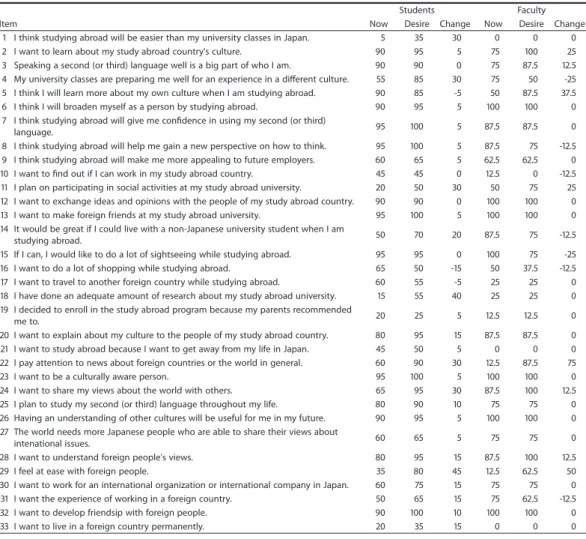
Results from the possible selves questionnaire indicated that the students agreed with the majority of the items at the time of data collection, i.e., students either agreed or strongly agreed to statements as Describes me now. Table 2 shows the results for both student and faculty responses to the motivation questionnaire for now and future desire as well as the overall change between them. A positive number under the change column indicates that a greater number of students agreed with an item in relation to future desire than now. In contrast, a negative number indicates that fewer students agreed with an item in relation to future desire than now.
Generally, students showed a moderate to high degree of agreement for almost all items as describing them now. However, it is important to note that 75% or more of the students felt that only fi ve items (1, 11, 18, 19, and 33) did not describe them at the time of the study.
With regard to future desires, most students also showed a considerable amount of agreement with most of the items. For 19 of the 33 items, 80% or more of the students showed agreement.
The change from Describes me now to Is desired in my future was relatively stable,
SCHNICKEL Jacob・MARTIN Ron・丸山有香 MARUYAMA Yuka
showing no to very little change across most items. However, though the majority of students disagreed with Items 1, 11 and 18 as describing them now, these items showed some of the greatest change. Students’ agreement to Items 1, 11, and 18 increased by 30%, 30% and 40%, respectively. Similar increases also occurred for Items 4, 22, 24 and 29.
5. 5. Faculty beliefs about student motivations now and desired futures
The faculty members showed moderate to a high degree of agreement for many of the items. For nine of the items, 75% or more of the faculty felt that they did not describe the students at the time of the study. For three of these items (1, 21, and 33), none of the faculty who participated in this study believed that a typical student would agree with
Table 2. Student and faculty responses to the possible selves questionnaire items
Students Faculty
Item Now Desire Change Now Desire Change
1 I think studying abroad will be easier than my university classes in Japan. 5 35 30 0 0 0
2 I want to learn about my study abroad country's culture. 90 95 5 75 100 25
3 Speaking a second (or third) language well is a big part of who I am. 90 90 0 75 87.5 12.5 4 My university classes are preparing me well for an experience in a diff erent culture. 55 85 30 75 50 -25 5 I think I will learn more about my own culture when I am studying abroad. 90 85 -5 50 87.5 37.5
6 I think I will broaden myself as a person by studying abroad. 90 95 5 100 100 0
7 I think studying abroad will give me confi dence in using my second (or third)
language. 95 100 5 87.5 87.5 0
8 I think studying abroad will help me gain a new perspective on how to think. 95 100 5 87.5 75 -12.5 9 I think studying abroad will make me more appealing to future employers. 60 65 5 62.5 62.5 0
10 I want to fi nd out if I can work in my study abroad country. 45 45 0 12.5 0 -12.5
11 I plan on participating in social activities at my study abroad university. 20 50 30 50 75 25 12 I want to exchange ideas and opinions with the people of my study abroad country. 90 90 0 100 100 0
13 I want to make foreign friends at my study abroad university. 95 100 5 100 100 0
14 It would be great if I could live with a non-Japanese university student when I am
studying abroad. 50 70 20 87.5 75 -12.5
15 If I can, I would like to do a lot of sightseeing while studying abroad. 95 95 0 100 75 -25
16 I want to do a lot of shopping while studying abroad. 65 50 -15 50 37.5 -12.5
17 I want to travel to another foreign country while studying abroad. 60 55 -5 25 25 0
18 I have done an adequate amount of research about my study abroad university. 15 55 40 25 25 0 19 I decided to enroll in the study abroad program because my parents recommended
me to. 20 25 5 12.5 12.5 0
20 I want to explain about my culture to the people of my study abroad country. 80 95 15 87.5 87.5 0
21 I want to study abroad because I want to get away from my life in Japan. 45 50 5 0 0 0
22 I pay attention to news about foreign countries or the world in general. 60 90 30 12.5 87.5 75
23 I want to be a culturally aware person. 95 100 5 100 100 0
24 I want to share my views about the world with others. 65 95 30 87.5 100 12.5
25 I plan to study my second (or third) language throughout my life. 80 90 10 75 75 0
26 Having an understanding of other cultures will be useful for me in my future. 90 95 5 100 100 0 27 The world needs more Japanese people who are able to share their views about
intenational issues. 60 65 5 75 75 0
28 I want to understand foreign people's views. 80 95 15 87.5 100 12.5
29 I feel at ease with foreign people. 35 80 45 12.5 62.5 50
30 I want to work for an international organization or international company in Japan. 60 75 15 75 75 0
31 I want the experience of working in a foreign country. 50 65 15 75 62.5 -12.5
32 I want to develop friendsip with foreign people. 90 100 10 100 100 0
33 I want to live in a foreign country permanently. 20 35 15 0 0 0
them.
For over half of the items, there was no overall change in the faculty response to describing students at the time of the study and student potential future desires. For most of the remaining items, there was only some moderate change (±25) among the faculty opinions; however, the faculty did indicate that they believed the students’ future desires for Items 5, 22 and 29 would be much higher when compared with the time of data collection.
5. 6. Comparison of student motivation and faculty beliefs
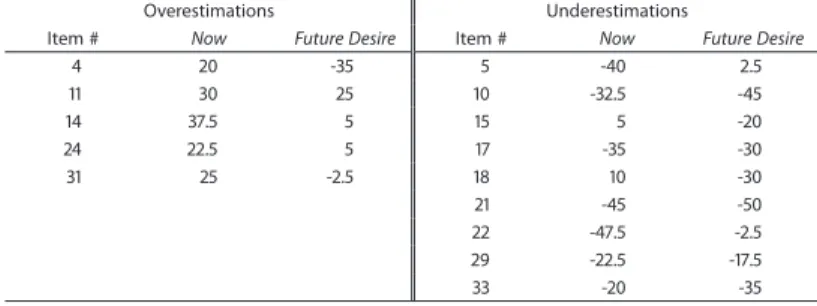
Though there was little diff erence (±17.5%) between student self-reports and faculty assumptions for most items on both scales, there were some notable diff erences (see Table 3). Table 3 is divided into two columns: a column of faculty overestimations and a column of faculty underestimations. Columns are sorted by item numbers and only show diff erences that are ±20%.
For Items 4, 11, 14, 24 and 31, the faculty overestimated the students’ agreement to these items in relation to now. The faculty also overestimated the students’ agreement to Item 11 in relation to the students’ future desire, and underestimated the students’
agreement to Item 4 in relation to future desire. For only Item 4 was there such an imbalance between the students’ self-reports and the faculty assumptions.
The faculty underestimated student agreement in relation to now for items 5, 10, 17, 21, 22, 29 and 33. The faculty underestimated student agreement in relation to future desire for items 10, 15, 17, 18, 50, 29 and 33. Thus, for items 10, 17, 21, 29 and 33, the faculty underestimated student agreement in relation to both now and the future desire.
Table 3. Faculty overestimations and underestimations of student responses to the possible selves questionnaire items
Overestimations Underestimations
Item # Now Future Desire Item # Now Future Desire
4 20 -35 5 -40 2.5
11 30 25 10 -32.5 -45
14 37.5 5 15 5 -20
24 22.5 5 17 -35 -30
31 25 -2.5 18 10 -30
21 -45 -50
22 -47.5 -2.5
29 -22.5 -17.5
33 -20 -35
SCHNICKEL Jacob・MARTIN Ron・丸山有香 MARUYAMA Yuka
6. Discussion
The low participant numbers and the inability to run reliable inferential statistics greatly limit what can said about the results. In addition, faculty members were asked to respond with a 'typical’ student in mind, when in fact, a 'typical’ student is only a concept that can easily be construed to have diff erent meanings for diff erent faculty members.
However, when devising any level of education directed toward a group of students, e.g., a class syllabus or an entire curriculum, a collective image of the student body is created.
Thus, the following discussion is based upon limited information, but is focused on what may be of potential interest to any faculty member within the College of Intercultural Communication with regard to these second–year students’ motivations and future desires which were collected two months prior to their study abroad departure. In the following, each research question will be considered in turn.
We asked to what degree students were concerned about their planned study abroad experience. The students were concerned about the majority of the items, a fi nding in line with Asaoka and Yano (2009). Primarily, they were concerned related to their language ability and cultural knowledge. Although only two of the 20 participants were planning to study academic coursework overseas, all participants believed that their writing skills would be insuffi cient, and 19 students felt the same about their reading skills. Nearly all students were also concerned that they did not understand the culture of their study abroad country well enough.
Other common, but less prominent, concerns were about perceived communication ability, fi nding health care, the length of the program, homesickness and being able to speak out in class. These concerns underscored the fact that the students were well aware of the needs beyond language ability and social communication.
Half of the students were concerned that they would not make the most of their time while abroad and even fewer were concerned about being “surrounded” by other Japanese students or running out of money. However, it was these items where the diff erence between the student responses and the faculty responses were most apparent.
Our second research question was about this precise point, i.e., how closely aligned were faculty members’ beliefs about students’ concerns to actual students’ self–reports?
Arguably, such individual day–to–day, non–academic concerns such as being around
other Japanese students while abroad, money, and even food are not the responsibility of
faculty members. Yet the faculty members were in nearly unanimous agreement that such
items would not be of concern to the students at all, but at the same time, the faculty
members expected more student agreement to the possibility of becoming homesick or
lonely. This raises the question of what being homesick or lonely means to these two
participant groups, and whether there is anything faculty members can or should do regarding such non–academic concerns.
Lastly, the students showed great concern about their language abilities and cultural knowledge. Such concerns are under the domain of the faculty. Though the number of participants for this study was low, there was some evidence that the faculty believed that the students’ primary concern would be their speaking ability rather than their writing or reading skills whereas this was opposite of the actual student concerns.
Furthermore, while nearly all students believed that they lacked enough cultural knowledge, only half of the faculty believed that this might be true. It may be worthwhile to investigate such academic concerns further.
The third and fourth discussion questions can be answered only in very general terms. We asked to what degree students were motivated at the time of data collection and how their motivation may change when refl ecting upon their future desires. We followed this inquiry by asking to what degree the faculty members’ ideas about the students’ motivations matched the actual student self–reports.
In order to help frame this discussion, we believe that the motivational items could represent an array of topics such as personal transformation, practical value, superfi cial experiences, social exchange and work. In addition, the items are already divided between how the students described themselves at the time of data collection and their overall future desires. Viewing the items from these perspectives provides a base from which to understand student responses and compare them with the faculty beliefs.
For items related to social exchange (Items 11, 12, 13, 14, 20, 24, 27, 28 and 32) as describing students at the time of data collection, i.e., now, the faculty members indicated a greater amount of student agreement than was actually true. Though the diff erence was minor in most cases, faculty members overestimated Items 11, 14, and 24 by 30%, 37.5%
and 22.5%, respectively. Such an outcome could be related to the potential faculty belief that students perceive study abroad as social exchange type of opportunity prior to departure more than students actually do. In relation to future desire, there is little diff erence between student and faculty response to these items, except for Item 11 where faculty expectation remained high.
In contrast, the faculty underestimated items that could be identifi ed as personal
transformation, the idea of students seeking information or experience in order to
develop or change themselves. As with the social exchange related items, the diff erences
here also largely occurred when describing students at the time of data collection. For
Items 5, 17, 21, 22, 29 and 33, the faculty underestimated the actual student responses by
20% to 47.5%. Perhaps because students feel at ease with foreign people, the study
abroad opportunity is less about social exchange and more about personal
SCHNICKEL Jacob・MARTIN Ron・丸山有香 MARUYAMA Yuka
transformation. The students put more stock in learning about their own culture and paying attention to world news while at the same time some even value the chance to get away from Japan and even consider the idea of living abroad permanently. By and large, the faculty did not perceive such agreement for these items, and only believed that students’ future desires would include learning about Japanese culture and paying attention to world news.
For practical value, superfi cial experiences, and work, the faculty responses were largely in line with the student responses. For a few isolated items there were some diff erences, but the diff erences were less prominent.
7. Limitations and suggestions for future studies
As with all research, this study suff ers from some limitations. First, the participants came from a single intact group. The data was collected from a homogenous group, who are in their second year in the same department. Second, this study was cross–sectional, not longitudinal. The data were collected at the end of their fi rst semester in their second year, just before the participants left for their study abroad programs. Third, the sample sizes were very small. After exclusion due to missing values, there were only 20 student participants and eight faculty participants. Finally, because possible selves research is new to SLA, both the research design and research outcomes have yet to be established.
Future research needs to look at diff erent and larger samples and to see which parts of motivation are similar or diff erent. For instance, the same questionnaire could be conducted with students who chose to study abroad as well as with students who are not studying abroad. Also, the research could be conducted over a longer term to see how students’ beliefs change after studying abroad. Similar research is needed to test whether the same result would apply with larger pool of participants. Future research using qualitative analytical methods such as follow–up interviews may provide greater insight regarding students’ reasons for studying abroad and their beliefs about the potential challenges and benefi ts of spending a semester in another culture. Furthermore, it would be benefi cial to work with a larger number of faculty members, asking them to both complete surveys and to have follow–up interviews. By analyzing such data, we may fi nd additional points of similarity and diff erence between actual students’ responses and faculty members’ beliefs.
8. Conclusion
Approximately half of the students surveyed were concerned that they would not
make the most of their time abroad. This raises an important question: What does it mean to make the most of one’s time studying in another country?
McKeown (2009), who presents an excellent case that study abroad leads to intellectual development, particularly among students going abroad for the fi rst time, states:
When asked, study abroad professionals often give anecdotal motivations for their students’ decisions to study abroad, such as to gain a broader perspective or to learn something that they cannot learn at home. Similarly... study abroad professionals describe their returning students often in anecdotal ways, such as that they are changed people, more mature and worldly. These attempts at understanding students’ motivations and outcomes, while often not rigorously researched, are based on a reserve of knowledge built from our collective action.
(p. 118)
Being members of a learning community in which study abroad is a central, formative experience for all students, it is essential to move beyond the anecdotal by engaging in a long–term dialogue with College of Intercultural Communication students.
This “dialogue” may take many forms: conducting pre–post design studies to track student linguistic and intellectual development or gains in intercultural sensitivity; asking students to keep intercultural refl ection journals (Jackson 2005; Jackson 2008); or inviting returning study abroad students to serve as near peer role models (Murphey & Arao, 2001) for those preparing to go abroad. In utilizing options such as these, all involved would be exposed to the richness and variety of beliefs held by the members of the evolving community. In other words, diff erences in perspective are assets when they are out in the open and subject to analysis, consideration and discussion.
Acknowledgements
We wish to thank the faculty of the College of Intercultural Communication for allowing us to conduct this study. We would also like to thank the College of Intercultural Communication Overseas Study Program and the Study Abroad Foundation for providing time for us to speak to students at their study abroad orientation meeting. We also extend our thanks to Professor Teresa Bruner Cox for generously sharing her knowledge of study abroad, and Dick Schnickel, Ginger Schnickel and Tim Shaw for their excellent proofreading and editing assistance.
SCHNICKEL Jacob・MARTIN Ron・丸山有香 MARUYAMA Yuka
References
Anderson, P., Lawton, L., Rexeisen, R., & Hubbard, A. (2006). Short–term study abroad and intercultural sensitivity: A pilot study. International Journal of Intercultural Relations, 30, 457–469.
Asaoka, T. and Yano, J. (2009). The contribution of "study abroad" programs to Japanese internationalization. Journal of Studies in International Education, 13,174–188.
Cox, T. (2003) Soai’s 1992 Summer Homestay/Study Abroad Program: A Survey of Student Reactions. 相愛大学研究論集, 9, 209–233.
Csizer, K., & Dornyei, Z. (2005). The internal structure of language learning motivation and its relationship with language choice and learning eff ort. The Modern Language Journal, 89(1), 19–36.
Dornyei, Z. (2003). Attitudes, orientations, and motivations in language learning: Advances in theory, research and applications. Language Learning, 53(1), 3–32.
Dornyei, Z., & Ushioda, E. (2009). Motivation, language identity and the L2 self. Multilingual Matters Limited.
Freed, B. F. (1998). An overview of issues and research in language learning in a study abroad setting. Frontiers: The Interdisciplinary Journal of Study Abroad, 4, 31–60.
Gardner, R. C. (1985). Social psychology and second language learning. London: Edward Arnold.
Hammer, M. R., Bennett, M. J., & Wiseman, R. (2003). Measuring intercultural sensitivity: The Intercultural Development Inventory. International Journal of Intercultural Relations, 27, 421–443.
Irie, K. (2003). What do we know about the language learning motivation of university students in Japan? Some patterns in survey studies. JALT Journal, 25(1), 86–100.
Kim, Y. (2008). Intercultural personhood: Globalization and a way of being. International Journal of Intercultural Relations, 32, 359–368.
Jackson, J. (2005). Assessing Intercultural learning through introspective accounts.
Frontiers: The Interdisciplinary Journal of Study Abroad, 11, 165–186.
Jackson, J. (2008). Globalization, internationalization, and short–term stays abroad. International Journal of Intercultural Relations, 32, 349–358.
Llanes, A. and Muñoz, C. (2009). A short stay abroad: Does it make a diff erence? System, 37, 353–365.
Macintyre, P. D., Mackinnon, S. P., & Clement, R. (2009). Toward the development of a scale to assess possible selves as a source of language learning motivation. In Z. Dornyei & E.
Ushioda (Eds.), Motivation, language identity and the L2 self (pp. 193–214).
Martin, J. N. & Rohrlich, B. (1991). The relationship between study–abroad student expectations and selected student characteristics. Journal of College Student Development, 32, 39–46.
Masgoret, A. M., & Gardner, R. C. (2003). Attitudes, motivation, and second language learning:
A meta–analysis of studies conducted by Gardner and associates. Language Learning, 53(1), 123–163.
McKeown, J.S. (2009). The fi rst time eff ect: The impact of study abroad on college student
intellectual development. Albany, NY: State University of New York Press.
Murphey, T. & Asao, H. (2001). Reported Belief Changes through Near Peer Role Modeling.
TESL–EJ. 5. Retrieved from http://www–writing.berkeley.edu/tesl–ej/ej19/a1.html
Ono, H. (2004). Japanese women studying abroad, the case of the United States. Women’s Studies International Forum, 27, 101–118.
SPSS, I. (2009). PASW Statistics (Version 17). Chicago: SPSS, Inc.
Taguchi, N. (2008). Cognition, language contact, and the development of pragmatic comprehension in a study–abroad context. Language Learning, 58, 33–71.
Yashima, T. (2002). Willingness to communicate in a second language: The Japanese EFL context. Modern Language Journal, 86(i), 54–66.