napht hobi s c hal c ogenadi az ol e c onj ugat ed pol ym
er
s ys t em
s and C61 der i vat i ve as or gani c
phot ovol t ai c s em
i c onduc t or s
著者
Fuj i t a Takehi r o, M
at s ui Tor u, Sum
i t a M
as at o,
I m
am
ur a Yut aka, M
or i has hi Kenj i
j our nal or
publ i c at i on t i t l e
Chem
i c al phys i c s l et t er s
vol um
e
693
page r ange
188- 193
year
2018- 02
権利
( C) 2018. Thi s m
anus c r i pt ver s i on i s m
ade
avai l abl e under t he CC- BY- N
C- N
D
4. 0 l i c ens e
ht t p: / / c r eat i vec om
m
ons . or g/ l i c ens es / by- nc - nd/ 4
. 0/
U
RL
ht t p: / / hdl . handl e. net / 2241/ 00151291
1 2 3 4 5 6 7 8 9 10 11 12 13 14 15 16 17 18 19 20 21 22 23 24 25 26 27 28 29 30 31 32 33 34 35 36 37 38 39 40 41 42 43 44 45 46 47 48 49 50 51 52 53 54 55 56 57 58 59
Theoretical study on naphthobischalcogenadiazole conjugated polymer
systems and C61 derivative as organic photovoltaic semiconductors
Takehiro Fujitaa, Toru Matsuia,*, Masato Sumitaa,b, Yutaka Imamurac, and Kenji Morihashia
a
Department of Chemistry, Graduate School of Pure and Applied Sciences, University of
Tsukuba, 1-1-1, Tennodai, Tsukuba, Ibaraki 305-8571, Japan. bCenter for Advanced
Intelligence Project, RIKEN Nihonbashi 1-chome Mitsui Building, 15th floor, 1-4-1
Nihonbashi, Chuo-ku, Tokyo, 103-0027, Japan. cDepartment of Chemistry, Graduate School of Science and Engineering, Tokyo Metropolitan University, 1-1 Minami-osawa,
Hachioji, Tokyo 192-0397, Japan.
3 4 5 6 7 8 9 10 11 12 13 14 15 16 17 18 19 20 21 22 23 24 25 26 27 28 29 30 31 32 33 34 35 36 37 38 39 40 41 42 43 44 45 46 47 48 49 50 51 52 53 54 55 56 57 58 59
Abstract
We investigated the charge-transfer reactions of solar cells including a quaterthiophene
copolymer with naphtho-bis-thiadiazole (PNTz4T) and naphtho-bis-oxadiazole
(PNOz4T) using constrained density functional theory (CDFT). According to our
calculations, the high electron-transfer rate results in a highly efficient solar cell, and the
stable charge-transfer state results in low energy loss. Our computations imply that the
following three factors are crucial to improve the performance of semiconducting
polymers: (i) large structural changes following charge-transfer, (ii) narrow band gap, and
(iii) spatially delocalized lowest unoccupied molecular orbital (LUMO) of the ground
state.
Keywords
3 4 5 6 7 8 9 10 11 12 13 14 15 16 17 18 19 20 21 22 23 24 25 26 27 28 29 30 31 32 33 34 35 36 37 38 39 40 41 42 43 44 45 46 47 48 49 50 51 52 53 54 55 56 57 58 59
1. Introduction
Polymer-based bulk-heterojunction solar cells (PSCs) [1] are a type of organic
photovoltaic cells (OPVs). Although dye-sensitized solar cells [2] suffer from sealing
defects because they utilize liquid electrolytes, PSCs are expected to function effectively
as durable solid photoelectric conversion devices. The implementation of polymer films
in PSCs as the charge transport material makes them superior to inorganic solar cells in
terms of weight and cost. However, two key issues must be addressed before PSCs can be
used in practice. The first is their low power conversion efficiency (PCE) relative to
inorganic solar cells, and the second is their large energy loss (Eloss) [3] (0.7–0.8 eV) as
solar energy is converted into electric power.
Although PSCs have several problems generating free electron–hole pairs from sunlight,
one method to improve their low PCE and large Eloss is to effectively combine their
constituent materials. PSCs consist of two types of organic semiconductors with many π
electrons; that is, hole transport and electron transport materials with electron-donating
and electron-accepting properties, respectively. Current PSCs are composed of
polycyclic aromatic hydrocarbons or π-electron conjugated (semiconducting) polymers
as the hole transport materials and fullerene derivatives as the electron transport materials.
3 4 5 6 7 8 9 10 11 12 13 14 15 16 17 18 19 20 21 22 23 24 25 26 27 28 29 30 31 32 33 34 35 36 37 38 39 40 41 42 43 44 45 46 47 48 49 50 51 52 53 54 55 56 57 58 59
main cause for the low PCE of PSCs. For materials with low bulk electrical conductivity,
charge recombination is attributed to unstable electron–hole pairs. Therefore, it is helpful
to analyse several combinations of hole transport and electron transport materials to
better understand their electronic structure.
To increase the PCE of PSCs, semiconducting polymers [5-7] have been developed in
the framework of two essential aspects; one is to control the thin film structure, such as its
crystallinity and orientation, so as to enhance the efficiency of charge transport, whereas
the other aspect is to control the polymers’ electronic structure, such as the absorption
wavelength and the energy levels of the frontier orbitals, which are important for exciton
formation. Regarding the electronic structure, a semiconducting polymer with a narrow
band gap and deep highest occupied molecular orbital (HOMO) level is preferable to
widen the absorption region and increase the open circuit voltage. Osaka et al. reported an
effective copolymer based on quaterthiophene and naphtho-bis-thiadiazole (PNTz4T) [8],
with the PCE of PNTz4T with [6,6]-phenyl-C61-butyric acid methyl ester (PCBM)
(PNTz4T/PCBM) reaching more than 10%. In addition, they also reported a
quaterthiophene and naphtho-bis-oxadiazole copolymer (PNOz4T)[9]. Both PNTz4T
and PNOz4T have a high crystallinity, narrow band gap, and deep HOMO level.
3 4 5 6 7 8 9 10 11 12 13 14 15 16 17 18 19 20 21 22 23 24 25 26 27 28 29 30 31 32 33 34 35 36 37 38 39 40 41 42 43 44 45 46 47 48 49 50 51 52 53 54 55 56 57 58 59
received considerable attention, particularly because of its small Eloss (0.53–0.55 eV).
Although clarifying the difference between PNTz4T/ and PNOz4T/PCBM will be helpful
to develop more efficient materials, experiments are often not suitable to observe details
of the charge-transfer process.
To this end, quantum chemical analyses are a powerful tool to obtain detailed
understanding of charge-transfer processes. However, conventional density functional
theory (DFT) struggles to describe the charge-transfer states where positive and negative
charges are localized in the hole transporting and electron transporting materials. This
shortcoming of several exchange–correlation DFT functionals results from
self-interaction error (SIE) [10], which includes unphysical electron interactions in the
energy evaluation.
Constrained density functional theory (CDFT) of Deberich et al. [11,12] is an effective
tool for solving charge-localized systems. CDFT can minimize the energy of the system
under the constraint that the charges and spins remain localized in particular regions of
the system by adding a Lagrange multiplier to the conventional Kohn-Sham DFT
equations. Wu et al. developed CDFT further by reporting a way to efficiently explore the
diabatic potential energy curves in Marcus’ electron-transfer theory [13], as well as a way
3 4 5 6 7 8 9 10 11 12 13 14 15 16 17 18 19 20 21 22 23 24 25 26 27 28 29 30 31 32 33 34 35 36 37 38 39 40 41 42 43 44 45 46 47 48 49 50 51 52 53 54 55 56 57 58 59
approach, a lot of electron-transfer reactions were explained [15-17] by computing the
electron-transfer rate constant within the Condon approximation [18]. Because of this
success, we adopted CDFT to estimate the charge-transfer reactions in PSCs.
This study aims to understand the qualitative differences between PNTz4T and PNOz4T
by comparing the electron-transfer rates (kET) and the stability of the charge-transfer state
between PNTz4T/PCBM and PNOz4T/PCBM. Moreover, we also investigated the
conformational dependence of these molecular species on kET.
2. Method
2.1. Modelling
In this study, we used a donor/acceptor complex extracted from the interface between
bulk PCBM and PNTz4T/PNOz4T. PNTz4T or PNOz4T was adopted as the electron
donor, and PCBM [19] was chosen as the electron acceptor, as in the experiments of
Osaka et al. [9]. The PCBM model systems with PNTz4T or PNOz4T were prepared as
follows. First, PNTz4T and PNOz4T were orientated face-on to PCBM at the interfaces,
and the polar substituents of PCBM were directed toward the bulk region due to
electrostatic repulsion. Hence, we created the donor–accepter complex models as shown
3 4 5 6 7 8 9 10 11 12 13 14 15 16 17 18 19 20 21 22 23 24 25 26 27 28 29 30 31 32 33 34 35 36 37 38 39 40 41 42 43 44 45 46 47 48 49 50 51 52 53 54 55 56 57 58 59
between the donor and acceptor atoms was approximately 4.0 Å. (see the SI for the
detailed initial structures.) For computational convenience, PNTz4T and PNOz4T were
modelled as monomers by replacing the alkyl chains with methyl groups, which are
hereafter termed NTz4T and NOz4T, respectively. We found that these small model
systems are sufficiently representative of the actual systems to reproduce the three
relevant electronic states of the system (i.e. before light irradiation, after exciton
formation, and after charge-transfer).
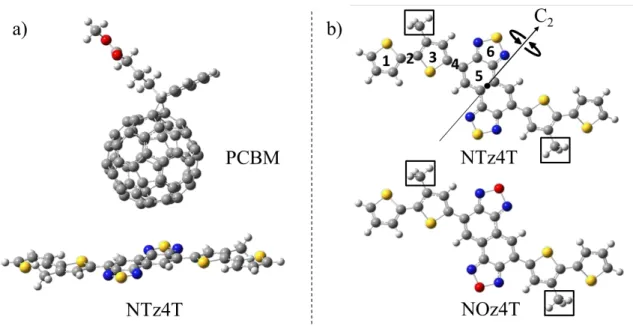
Additionally, we prepared six models for each NTz4T/PCBM and NOz4T/PCBM
complex (Figure 2) by rotation around the C2 axis (Figure 1b) to examine their
conformational dependence on kET. These models are hereafter referred to as s1-s6. As
shown in Figure 1b, PCBM was placed above the thiophene rings or the carbon–carbon
3 4 5 6 7 8 9 10 11 12 13 14 15 16 17 18 19 20 21 22 23 24 25 26 27 28 29 30 31 32 33 34 35 36 37 38 39 40 41 42 43 44 45 46 47 48 49 50 51 52 53 54 55 56 57 58 59
Figure 1. (a) Model of the NTz4T complex with PCBM (NTz4T/PCBM). Blue, red,
yellow, white, and grey spheres indicate nitrogen, oxygen, sulfur, hydrogen, and carbon
atoms, respectively. (b) Structures of NTz4T and NOz4T. PCBM is placed above the
NTz4T or NOz4T moieties and labelled from 1 to 6, as depicted as s1-s6 in Figure 2.
Face-on conformations were ensured by enforcing C2h symmetry of NTz4T/NOz4T.
2.2. Geometry Optimization and Single-Point Energy Calculations
All calculations in this study were performed using the B3LYP [20] hybrid density
functional and the 6-31G(d) basis set. The total energy of these models was determined
through the following three steps: (i) all-atom geometry optimization of the ground state,
(ii) geometry optimization of each molecule, and (iii) single-point energy calculations.
3 4 5 6 7 8 9 10 11 12 13 14 15 16 17 18 19 20 21 22 23 24 25 26 27 28 29 30 31 32 33 34 35 36 37 38 39 40 41 42 43 44 45 46 47 48 49 50 51 52 53 54 55 56 57 58 59
the optimized structures of s1-s6, and geometry optimizations of the singlet ground and
excited states and the radical cation state were performed. Time-dependent DFT
(TD-DFT) [22] as implemented in GAUSSIAN 09was used to calculate the singlet excited
state. For PCBM, geometry optimizations of the singlet ground and radical anion states
were also performed. These optimized molecules were then combined while maintaining
their ground-state interatomic distances. Finally, single point-energy calculations were
performed using our own CDFT program [15-17]. After the charge-transfer was
calculated for each system, the constraint was set to ensure charges of +1 and -1 for the
donor and acceptor, respectively.
2.3. Electron Transfer Rate and Stabilization Energy
The electron-transfer rate constants, kET, were calculated using Equation (1) [23]:
where h, kB,and T are Planck’s constant, Boltzmann’s constant, and absolute temperature,
3 4 5 6 7 8 9 10 11 12 13 14 15 16 17 18 19 20 21 22 23 24 25 26 27 28 29 30 31 32 33 34 35 36 37 38 39 40 41 42 43 44 45 46 47 48 49 50 51 52 53 54 55 56 57 58 59
energy calculations at the CDFT level of theory. kET was determined with T = 300 K and
Hab was calculated based on the theory proposed by Wu et al. [18]. Because CDFT
struggles to describe singlet excited states, Hab was approximated by assuming that the
triplet excited state is equal to the singlet excited state.
Hereafter, we use the standard notation E(a|b) to represent the energy in the “a” state
with the equilibrium structure in the “b” state. For example, each energy of the system
before light irradiation, after exciton formation, and after charge-transfer is expressed as
E(DA|DA),E(D*A|D*A), and E(D+•A-•| D+•A-•), respectively. Here, D and A indicate the
donor and acceptor, respectively. 'G0 was obtained approximately from the difference between the internal energies of the systems as follows:
Because we assumed that the electron-transfer occurs in a gas phase, outer sphere
reorganization energy due to the solvent relaxation is not taken into account. In this
case, the total reorganization energy Ois equal to its inner sphere energyOi as:
3 4 5 6 7 8 9 10 11 12 13 14 15 16 17 18 19 20 21 22 23 24 25 26 27 28 29 30 31 32 33 34 35 36 37 38 39 40 41 42 43 44 45 46 47 48 49 50 51 52 53 54 55 56 57 58 59
A stabilization energy Est was introduced to assess the stability of the charge-transfer
state (D+• and A-•); larger values of Est indicate higher stability of this state.
3. Results and Discussion
3.1 Structural Changes
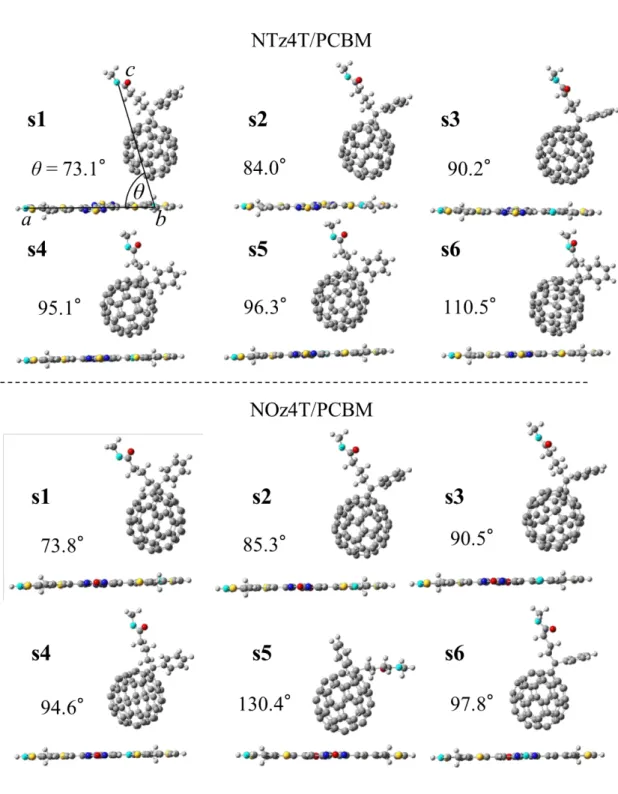
Figure 2 shows the optimized structures of s1-s6. Relative to their initial structures, no
significant changes of s1-s4 were evident. However, the optimized structures of s5 and s6
show slightly longer distances from NTz4T and NOz4T compared with their initial
structures.
Although NTz4T and NOz4T have slightly bent ground-state structures, they are almost
planar in the lowest-energy singlet excited state. The geometric difference between the
excited and radical cation states is not significant. Indeed, the root mean square deviation
(RMSD) of all atomic coordinates of s1-s6 is 0.0155 Å for NTz4T and 0.0167 Å for
NOz4T. Additionally, there was little structural difference between the ground state of
3 4 5 6 7 8 9 10 11 12 13 14 15 16 17 18 19 20 21 22 23 24 25 26 27 28 29 30 31 32 33 34 35 36 37 38 39 40 41 42 43 44 45 46 47 48 49 50 51 52 53 54 55 56 57 58 59
We also calculated λNTz4T, λNOz4T, and λPCBM to evaluate the contribution of the
reorganization energy to the stability of the entire system. The respective average values
of all conformations (s1-s6) are 8.38 kJ/mol, 9.06 kJ/mol, and
12.71 kJ/mol. Clearly, PCBM contributes the most to the total reorganization
3 4 5 6 7 8 9 10 11 12 13 14 15 16 17 18 19 20 21 22 23 24 25 26 27 28 29 30 31 32 33 34 35 36 37 38 39 40 41 42 43 44 45 46 47 48 49 50 51 52 53 54 55 56 57 58 59
Figure 2. Fully optimized structures of s1-s6. The nearest intermolecular distance
between the donor and acceptor atoms is almost identical to that of the initial structure.
The angles (T) between the cyan-coloured a, b, and c atoms are shown. a: terminal
3 4 5 6 7 8 9 10 11 12 13 14 15 16 17 18 19 20 21 22 23 24 25 26 27 28 29 30 31 32 33 34 35 36 37 38 39 40 41 42 43 44 45 46 47 48 49 50 51 52 53 54 55 56 57 58 59
oxygen atom of PCBM. s5 of NOz4T/PCBM has an especially large angle because the
orientation of the functional groups of PCBM is reversed.
3.2 Absorption Wavelengths and Molecular Orbitals
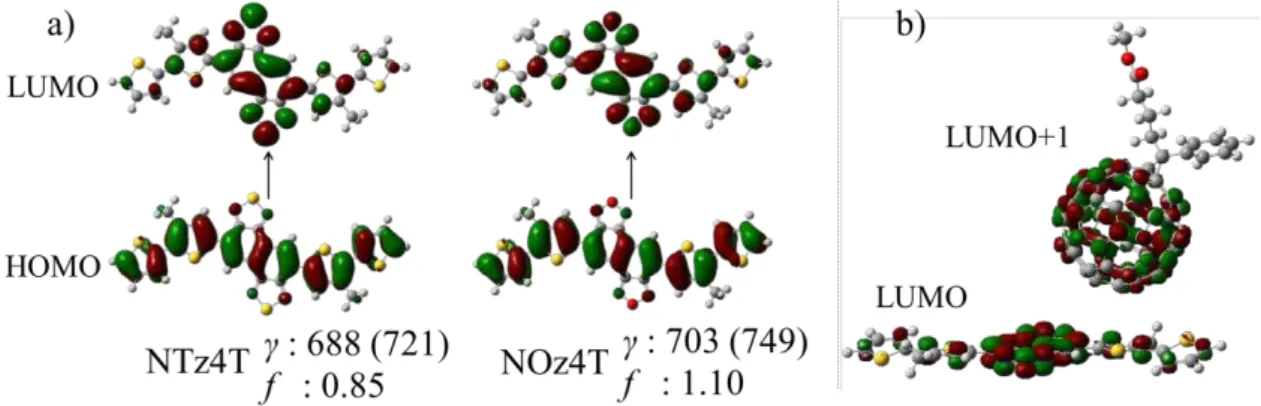
We compared the absorption wavelengths (γ) of NTz4T and NOz4T at the TD-DFT level
of theory with the experimental values [9] to examine whether the singlet excited state
corresponds to the actual system. According to our calculations, the first
transition-allowed excited state could be attributed to a single electron excitation from the
HOMO to the lowest unoccupied molecular orbital (LUMO) of NTz4T and NOz4T
(Figure 3). Although the computed absorption wavelength was slightly shorter than the
experimental value (<50 nm), because of the short-conjugated monomer model [24], the
tendency is consistent with experimental results; that is, NTz4T has a shorter absorption
wavelength and weaker oscillator strength than NOz4T [9]. It is expected that excitation
of NOz4T occurs more efficiently than that of NTz4T because the oscillator strength of
3 4 5 6 7 8 9 10 11 12 13 14 15 16 17 18 19 20 21 22 23 24 25 26 27 28 29 30 31 32 33 34 35 36 37 38 39 40 41 42 43 44 45 46 47 48 49 50 51 52 53 54 55 56 57 58 59
Figure 3. (a) HOMO/LUMO of NTz4T and NOz4T (isovalue of 0.020). The values of γ
are given in nm, and the experimental values are shown in parentheses. The values of the
absorption oscillator strength (f) are also given. (b) LUMO and LUMO+1 of
NOz4T/PCBM (isovalue of 0.020), which are almost degenerate (<5 kJ/mol).
3.3 Calculated kET and Est
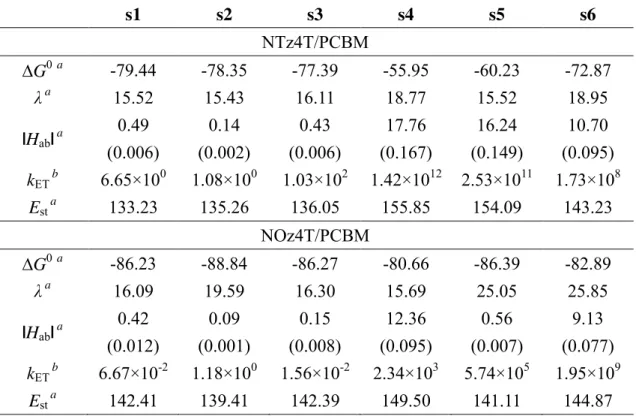
Table 1 shows the kET and Est of the systems and the three Marcus parameters. The
overlap integrals between the donor and acceptor are shown in parentheses as a
supplement to Hab. For clarity, the qualitative differences of these were considered.
Although efficient charge-transfer is expected in both models on the basis of kET, the
NTz4T/PCBM model has a relatively larger kET than that of NOz4T/PCBM. These results
reflect the high efficiency of PSCs using PNTz4T. Since the right-hand side of Eq. (1)
contains ('G0 + λ)2 in the exponential term, the kET difference between the models is
3 4 5 6 7 8 9 10 11 12 13 14 15 16 17 18 19 20 21 22 23 24 25 26 27 28 29 30 31 32 33 34 35 36 37 38 39 40 41 42 43 44 45 46 47 48 49 50 51 52 53 54 55 56 57 58 59
NTz4T/PCBM and NOz4T/PCBM models are -70.71 and -85.21 kJ/mol, respectively. As
for the average λin s1-s6, we obtain 16.72 kJ/mol for NTz4T/PCBM and 19.76 kJ/mol for
NOz4T/PCBM. From these results, this reaction occurs in the inverted region of Marcus
theory for both models, and the large kET of NTz4T/PCBM is attributed to its small ('G0
+ λ)2 value.
Moreover, the kET values of s4-s6 in NTz4T/PCBM tend to be much larger than those in
s1-s3, indicating that kET is conformation dependent. The primary difference between
s4-s6 and s1-s3 is attributed tothe difference in Hab; Hab for s4-s6 are ~100 times larger
than those of s1-s3. Therefore, we can speculate that conformation contributes to Hab,
which increases when the donor and acceptor couple strongly. The strength of the
coupling between the donor and acceptor is reflected in the value of the overlap integral,
which is increased when the MOs of the donor and acceptor are closer. Indeed, as shown
in Figure 3, the LUMOs in the ground state of NTz4T and NOz4T are localized in the
naphtho-bis-thiadiazole (NTz) and naphtho-bis-oxadiazole (NOz) moieties, and PCBM
in s4-s6 is in the proximity of these orbitals. Therefore, the overlap integral becomes large
(Table 1), and strong coupling occurs between the donor and acceptor.
Although the same tendency is found in s4-s6 of NOz4T/PCBM, the reorganization
3 4 5 6 7 8 9 10 11 12 13 14 15 16 17 18 19 20 21 22 23 24 25 26 27 28 29 30 31 32 33 34 35 36 37 38 39 40 41 42 43 44 45 46 47 48 49 50 51 52 53 54 55 56 57 58 59
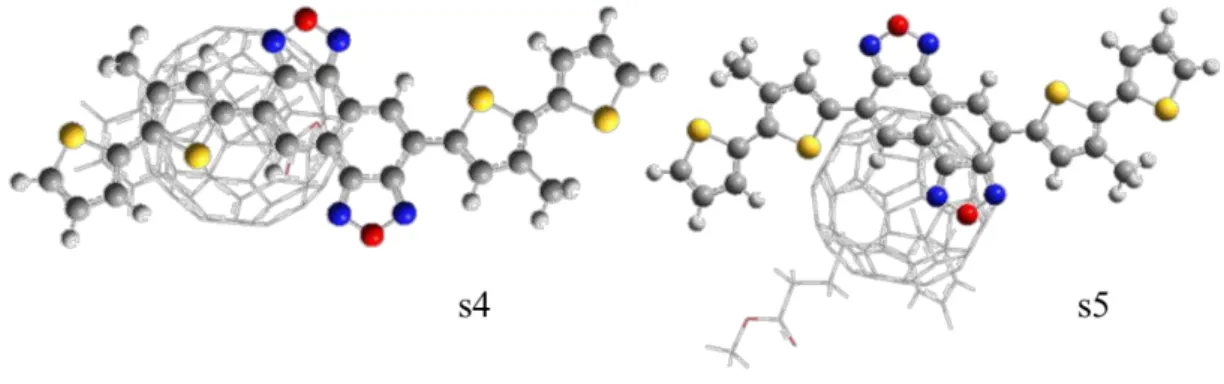
calculated coupling constant for s5 is very small. Structurally, PCBM is out of the ring
plane from the first step of the geometry optimization (Figure 4). The structural
specificity of s5 can also be ascertained from its relatively large angle involving PCBM
and its counterpart (Figure 2). Although it differs from the assumed conformation, we can
gauge the magnitude of the contribution of λ by comparing s5 with s1-s3.
The average value of Est for the NTz4T/PCBM system (136.94 kJ/mol) is smaller than
that of NOz4T/PCBM (143.28 kJ/mol). This result suggests that the large Est could be a
factor for lowering Eloss. Eloss is defined as Eg–eVOC, where Eg is the bandgap, e is the
elementary charge, and VOC is the open-circuit voltage. Est is a value derived using the
total energy of the system, whereas Eloss is a value derived using the bandgap; comparing
these two values directly is therefore questionable. Nevertheless, the values of Eg as
derived from γ are 1.80 eV for PNTz4T and 1.76 eV for PNOz4T, which do not differ
considerably from the experimental values [9]. Although there is no research that reports
the correlation between Est and Eg, or Est and Eloss, these properties could have a negative
correlation with each other. We intend to confirm the correlation between Est and Eg,and
subsequently Est and Eloss, in future studies by increasing the number of calculation
targets.
3 4 5 6 7 8 9 10 11 12 13 14 15 16 17 18 19 20 21 22 23 24 25 26 27 28 29 30 31 32 33 34 35 36 37 38 39 40 41 42 43 44 45 46 47 48 49 50 51 52 53 54 55 56 57 58 59
those of NOz4T/PCBM, because NTz4T has a large overlap integral with PCBM in these
conformations. The same tendency is also observed in s4 of NOz4T/PCBM.
Table 1. Calculated values of 'G0, λ, |Hab|, kET, and Est, with the overlap integral between
NTz4T/NOz4T and PCBM in parentheses.
a
kJ/mol. b s-1.
s1 s2 s3 s4 s5 s6
NTz4T/PCBM
'G0a -79.44 -78.35 -77.39 -55.95 -60.23 -72.87
λa
15.52 15.43 16.11 18.77 15.52 18.95
|Hab|a
0.49 (0.006)
0.14 (0.002)
0.43 (0.006)
17.76 (0.167)
16.24 (0.149)
10.70 (0.095)
kETb 6.65×100 1.08×100 1.03×10² 1.42×10¹² 2.53×10¹¹ 1.73×10⁸
Esta 133.23 135.26 136.05 155.85 154.09 143.23
NOz4T/PCBM
'G0a -86.23 -88.84 -86.27 -80.66 -86.39 -82.89
λa
16.09 19.59 16.30 15.69 25.05 25.85
|Hab|a
0.42 (0.012)
0.09 (0.001)
0.15 (0.008)
12.36 (0.095)
0.56 (0.007)
9.13 (0.077)
kETb 6.67×10⁻² 1.18×100 1.56×10⁻² 2.34×10³ 5.74×10⁵ 1.95×10⁹
3 4 5 6 7 8 9 10 11 12 13 14 15 16 17 18 19 20 21 22 23 24 25 26 27 28 29 30 31 32 33 34 35 36 37 38 39 40 41 42 43 44 45 46 47 48 49 50 51 52 53 54 55 56 57 58 59
Figure 4. Structures of s4 and s5 (NOz4T/PCBM) viewed from the side of NOz4T.
NOz4T and PCBM are depicted by ball-and-stick and wireframe styles, respectively.
3.4 Discussion
Osaka et al. [9] have estimated that the driving force for the electron-transfer reaction at
the PNOz4T/PCBM interface is ~12 kJ/mol on the basis of the energy gap between the
LUMO of the donor and acceptor (ΔEL). Its corresponding PCE is ~9%, which implies
that this reaction is efficient. However, the driving force of 12 kJ/mol is smaller than the
empirically known threshold value [25] of 0.30 eV (~30 kJ/mol) for efficient
electron-transfer, indicating that the PNOz4T/PCBM interface is an exception to the rule
suggested in Ref. 25. In this study, the driving force at the PNOz4T/PCBM interface was
estimated by using the total energy of the system, and a sufficient driving force was
attained even in the PSC using PNOz4T.
3 4 5 6 7 8 9 10 11 12 13 14 15 16 17 18 19 20 21 22 23 24 25 26 27 28 29 30 31 32 33 34 35 36 37 38 39 40 41 42 43 44 45 46 47 48 49 50 51 52 53 54 55 56 57 58 59
a small energy loss has a large Est. Therefore, a semiconducting polymer with an
improved PCE and small Eloss has both a large kET and Est.
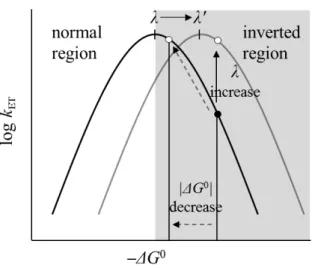
λ and 'G0 contribute greatly in determining the magnitude of kET. Since the sum of λ and
'G0 is negative,the reactions assumed in this study occur in the Marcus inverted region.
Here, kET increases with an increase of λ or a decrease of |'G0| (Figure 5). Because the
correlation between 'G0 and λis relatively weak, we conclude that these parameters are mutually independent. In contrast, 'G0 and Est are correlated through the energy of the
charge-transfer state E(D+•A-•| D+•A-•). Therefore, semiconducting polymers should be designed by focusing on lowering the energy of the lowest-energy singlet excited state
E(D*A|D*A) to decrease the absolute value of 'G0 without affecting Est; that is,
semiconducting polymers with a narrow bandgap are preferable. However, polymers that
experience large structural changes before and after charge-transfer should be considered
3 4 5 6 7 8 9 10 11 12 13 14 15 16 17 18 19 20 21 22 23 24 25 26 27 28 29 30 31 32 33 34 35 36 37 38 39 40 41 42 43 44 45 46 47 48 49 50 51 52 53 54 55 56 57 58 59
Figure 5. Conceptual diagram of the Marcus curve. Solid and dotted arrows represent the
direction of the λ increase and |'G0| decrease, respectively. The filled and open dots indicate plots of the actual and ideal systems, respectively.
To improve Est, increasing the contribution of charge delocalization (i.e. expanding the
π-conjugated system) seems to be effective. Because Est also tends to increase as Hab
increases, it is also conceivable to design a semiconducting polymer with a spatially
delocalized LUMO in the ground state.
4. Conclusion
This study investigated the electron-transfer rate constant (kET) by Marcus theory and
the stabilization energy of the charge-transfer state (Est) for each conformation of the
3 4 5 6 7 8 9 10 11 12 13 14 15 16 17 18 19 20 21 22 23 24 25 26 27 28 29 30 31 32 33 34 35 36 37 38 39 40 41 42 43 44 45 46 47 48 49 50 51 52 53 54 55 56 57 58 59
for NTz4T/PCBM with a large kET, and NOz4T/PCBMwith a large Est has a small Eloss.
In the s4-s6 conformations where PCBM exists above the NTz and NOz moieties, the
LUMO in the ground state of the donor has a large overlap integral with the acceptor,
resulting in a large kET. Therefore, we found that NOz and NTz, as introduced into a
semiconducting polymer by Osaka et al., greatly contribute to enhancing the efficiency of
electron-transfer.
It was also found that the PSC based on PNOz4T possesses a satisfactory driving force
for electron-transfer, as estimated from the total energy of the system. Overall, our
computational results support the high efficiency of PSCs based on PNOz4T, and the
scheme introduced by Wu et al. is applicable for estimating electron-transfer reactions in
PSCs. We expect that their scheme is effective to the electron-transfer reactions of other
PSC systems as well.
In order to develop semiconducting polymers with effectual PCE and small Eloss, it is
necessary to increase the magnitudes of both kET and Est. The requirements to improve the
performance of semiconducting polymers include: (i) large structural changes through
charge-transfer to enhance λ, (ii) narrow band gap to lower the driving force, and (iii)
3 4 5 6 7 8 9 10 11 12 13 14 15 16 17 18 19 20 21 22 23 24 25 26 27 28 29 30 31 32 33 34 35 36 37 38 39 40 41 42 43 44 45 46 47 48 49 50 51 52 53 54 55 56 57 58 59
Acknowledgements
This study was supported by Grants-in-Aid for Scientific Research (B) (No. 17H03034)
from the Japanese Society for the Promotion of Science (JSPS). Some calculations were
performed at the Research Center for Computational Science (RCCS), Okazaki Research
3 4 5 6 7 8 9 10 11 12 13 14 15 16 17 18 19 20 21 22 23 24 25 26 27 28 29 30 31 32 33 34 35 36 37 38 39 40 41 42 43 44 45 46 47 48 49 50 51 52 53 54 55 56 57 58 59
References
[1] I. Osaka, M. Shimawaki, H. Mori, I. Doi, E. Miyazaki, T. Koganezawa, K. Takimiya,
J. Am. Chem. Soc. 134 (2012) 3498.
[2] B. Liu, E. S. Aydil, J. Am. Chem. Soc. 131 (2009) 3466.
[3] M. Wang, H. Wang, T. Yokoyama, X. Liu, J. Am. Chem. Soc. 136 (2014) 12576.
[4] A. Pivrikas, N. S. Sariciftci, G. Juska, R. Osterbacka, Prog. Photovolt: Res. Appl. 15
(2007) 677.
[5] G. Yu, J. Gao, J. C. Hummelen, Science 270 (1995) 1789.
[6] A. Facchetti, Mater. Today 16 (2013) 123.
[7] Y. Liang, Z. Xu, J. Xia, Adv. Mater. 22 (2010) 135.
[8] V. Vohra, K. Kawashima, T. Kakara, T. Koganezawa, I. Osaka, K. Takimiya, H.
Murata, Nat. Photonics 9 (2015) 403.
[9] K. Kawashima, Y. Tamai, H. Ohkita, I. Osaka, and K. Takimiya, Nat. Commun. 6
(2015) 10085.
[10]I. Ciofini, C. Adamo, H. Chermette, Chem. Phys. 309 (2005) 67.
[11]P. H. Dederichs, S. Blugel, R. Zeller, H. Akai, Phys. Rev. Lett. 53 (1984) 2512.
[12]B. Kaduk, T. Kowalczyk, and T. V. Voorhis, Chem. Rev. 112 (2012) 321.
3 4 5 6 7 8 9 10 11 12 13 14 15 16 17 18 19 20 21 22 23 24 25 26 27 28 29 30 31 32 33 34 35 36 37 38 39 40 41 42 43 44 45 46 47 48 49 50 51 52 53 54 55 56 57 58 59
[14]Q. Wu, T. V. Voorhis, J. Phys. Chem. A 110 (2006) 9212.
[15]T. Ogawa, M. Sumita, Y. Shimodo, K. Morihashi, Chem. Phys. Lett. 511 (2011)
219.
[16]K. Aikawa, M. Sumita, Y. Shimodo, K. Morihashi, Phys. Chem. Chem. Phys. 17
(2015) 20923.
[17]K. Aikawa, T. Matsui, K. Morihashi, Chem. Lett. 45 (2016) 628.
[18]Q. Wu, T. V. Voorhis, J. Chem. Phys. 125 (2006) 164105.
[19]J. C. Hummelen, B. W. Knight, F. LePeq, F. Wudl, J. Org. Chem. 60 (1995) 532.
[20]A. D. Becke, J. Chem. Phys. 98 (1993) 5648.
[21]GAUSSIAN 09, Revision D. 01, M. J. Frisch, et al., Gaussian Inc. Wallingford CT,
200
[22]E. Runge, E. K. U. Gross, Phys. Rev. Lett. 52 (1984) 997.
[23]R. A. Marcus, N. Sutin, Biochem. BioPhys. 811 (1985) 265.
[24]T. Matsui, Y. Imamura, I. Osaka, K. Takimiya, T. Nakajima, J. Phys. Chem. C 120
(2016) 8305.