( )15
THE SCIENCE AND ENGINEERING REVIEW OF DOSHISHA UNIVERSITY, VOL. 52, NO.3October2011
Components of the Carrier Solvents and Separation Performance in the Tube Radial Distribution Chromatography Using a Fused-Silica Capillary Tube
Naoya JINNO*, Yoichiro HAYASHI*, Masahiko HASHIMOTO* and Kazuhiko TSUKAGOSHI*†
(Received June 21, 2011)
A novel capillary chromatography system has been developed using an open capillary tube and a water-hydrophilic-hydrophobic organic solvent mixture carrier solution; the system is called tube radial distribution chromatography.
In this study, we prepared various types of the carrier solution of the water-ethyl acetate (hydrophobic organic solvent) mixture including dioxane, 1-propanol, ethanol, acetonitrile, or methanol as a hydrophilic organic solvent, and examined their separation performance in the system using a fused-silica capillary tube. A mixture analyte of 1-naphthol and 2,6-naphthalenedisulfonic acid was adopted as a model and injected into the fused-silica capillary tube in the system. The analytes were well separated with the water-1-propanol-ethyl acetate mixture (volume ratio 2:3:6), the water-ethanol-ethyl acetate mixture (2:2:6), and the water-acetonitrile-ethyl acetate mixture (3:8:4) carrier solutions. 1-Naphthol was first eluted from the capillary tube, followed by 2,6-naphthalenedisulfonic acid. However, the analytes were not separated with the water-dioxane-ethyl acetate mixture (4:11:11) or the water-methanol-ethyl acetate mixture (2:2:9). The data obtained here indicated an extension in preparation of the carrier solution by using several hydrophilic organic solvents and provided insight regarding carrier solvent behavior based on the tube radial distribution in the system.
-G[YQTFUcapillary chromatography, tube radial distribution, water-hydrophilic-hydrophobic organic solvent mixture
+PVTQFWEVKQP
Capillary chromatography systems have attracted a great deal of attention in the field of analytical chemistry and in separation science since the last century. Most systems, such as capillary electrochromatography,1,2) micellar electrokinetic capillary chromatography,3,4) and capillary high-performance liquid chromatography using packed and monolithic capillary columns,5,6) feature rapid measurements, easy procedures, inexpensive and small apparatus, small sample volumes, and low cost.
However, only a few new concepts regarding capillary chromatography have been proposed in the last
decade.7–9)
We developed a novel capillary chromatography system using open capillary tubes composed of fused-silica, polyethylene, or poly(tetrafluoroethylene), and a water-hydrophilic-hydrophobic organic solvent mixture carrier solution.10,11) The mixture analytes of hydrophilic and hydrophobic compounds were separated with the water-acetonitrile-ethyl acetate mixture carrier solution. The separation performance in the system was explained based on the tube radial distribution of the carrier solvents in the capillary tube under laminar flow conditions. We call this a tube radial distribution chromatography (TRDC) system. The components of the carrier solvents were examined with
*Department of Chemical Engineering and Materials Science, Faculty of Science and Engineering, Doshisha University, Kyotanabe, Kyoto 610-0321, Japan
Telephone: +81-774-6595. Fax: +81-774-65-6803. E-mail: [email protected]
( )16 178
the TRDC system using a poly(tetrafluoroethylene) capillary tube before.12)
In the present study, we prepared various types of carrier solution of water-ethyl acetate mixtures including dioxane, 1-propanol, ethanol, acetonitrile, or methanol as a hydrophilic organic solvent, and examined their separation performance in the TRDC system using a fused-silica capillary tube. The results provided insight into carrier solvent behavior based on the tube radial distribution in the TRDC system.
'ZRGTKOGPVCN
Water was purified with an Elix UV 3 (Millipore Co.). All reagents used were commercially available and of analytical grade. 2,6-Naphthalenedisulfonic acid, 1-naphthol, dioxane, 1-propanol, ethanol, acetonitrile, methanol, and ethyl acetate were purchased from Wako Pure Chemical Industries, Ltd. A fused-silica capillary tube (75 Pm i.d., 150 Pm o.d.) was purchased from GL Science.
The capillary chromatography system consisted of a fused-silica capillary tube (110 cm in length;
effective length of 90 cm), a micro-syringe pump (MF-9090; Bioanalytical Systems, Inc.), and an absorption detector (modified SPD-6AV spectrophotometric detector; Shimadzu Co.).10,11) The following aqueous-organic solvent mixture carrier solutions were used: water-dioxane-ethyl acetate mixture (volume ratio 4:11:11), water-1-propanol-ethyl acetate mixture (2:3:6), water-ethanol-ethyl acetate mixture (2:2:6), water-acetonitrile-ethyl acetate mixture (3:8:4), and water-methanol-ethyl acetate mixture (2:2:9). The mixture analyte solution of 1-naphthol and 2,6-naphthalenedisulfonic acid was prepared with the carrier solutions.
The analyte solution was introduced directly into the capillary inlet for 20 s from a height of 20 cm by the gravity method. After analyte injection, the capillary inlet was connected through a joint to a microsyringe.
The syringe was set on the microsyringe pump. The carrier solution was fed in the capillary tube at a flow rate of 0.5 PL min-1 under laminar flow conditions.
On-capillary absorption detection (254 nm) was performed with the detector.
4GUWNVUCPF&KUEWUUKQP
Various mixtures consisting of hydrophilic and hydrophobic molecules as analytes were examined by the TRDC system using fused-silica, polyethylene, or poly(tetrafluoroethylene) capillary tubes and the water-acetonitrile-ethyl acetate mixture carrier solution.10,11) Based on our results, the separation performance in the system was proposed as follows. 1) Water and organic solvents in the carrier solution are not dispersed uniformly in the capillary tube based on the tube radial distribution of the solvents under laminar flow conditions. A major solvent phase (water-rich or organic solvent-rich) forms around the middle of the tube far from the inner wall, while a minor solvent phase (water-rich or organic solvent-rich) is generated near the inner wall of the capillary tube (pseudo-stationary phase). 2) Hydrophilic molecules in the analyte mixture are subsequently dispersed in the water-rich phase, and hydrophobic molecules are dissolved in the organic solvent-rich phase. 3) The analyte dispersed in the major solvent phase around the middle of the capillary tube is eluted with near average linear velocity, while the analyte dispersed in the minor solvent phase near the inner wall of the tube is eluted with a smaller than average linear velocity.
To extend our knowledge concerning the TRDC system, we prepared various types of the carrier solutions of the water-ethyl acetate mixture including dioxane, 1-propanol, ethanol, acetonitrile, or methanol as a hydrophilic organic solvent, and examined their influence on separation performance in the TRDC system. These carrier solutions of the water-hydrophilic-hydrophobic organic solvent mixtures Naoya JINNO, Yoichiro HAYASHI, Masahiko HASHIMOTO and Kazuhiko TSUKAGOSHI
( )17
179
were prepared by adding the hydrophilic organic solvent into the mixture solution of water-ethyl acetate (volume ratio; water < ethyl acetate) until the mixture solution became homogeneous.
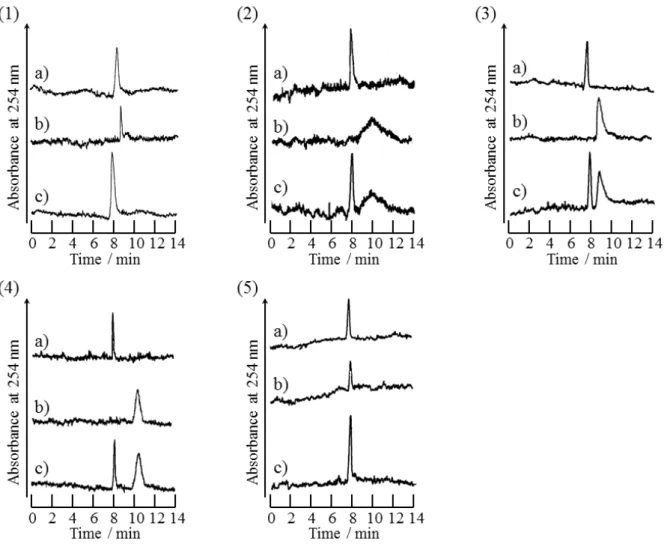
The analyte solutions of 1-naphthol, 2,6-naphthalenedisulfonic acid, and the mixture of 1-naphthol and 2,6-naphthalenedisulfonic acid were individually subjected to the present TRDC system with various types of aqueous-organic solvent mixture carrier solution. The obtained chromatograms are shown in Fig.
1. The results clearly confirmed that the analytes were separated with the carrier solutions of the
water-1-propanol-ethyl acetate mixture (volume ratio 2:3:6), the water-ethanol-ethyl acetate mixture (2:2:6), and the water-acetonitrile-ethyl acetate mixture (3:8:4).
1-Naphthol was eluted first from the capillary tube at ca.
8 min, followed by the elution of 2,6-dinaphthalenedisulfonic acid. That is, 1-naphthol was eluted with near average linear velocity, while 2,6-dinaphthalenedisulfonic acid was eluted with a lower than average linear velocity. On the other hand, they were not separated with the water-dioxane-ethyl acetate mixture (4:11:11) or the water-methanol-ethyl acetate mixture (2:2:9) carrier solution.
Fig. 1. The chromatograms of a mixture of 1-naphthol and 2,6-naphthalenedisulfonic acid obtained using the present TRDC system. a) 1-Naphthol, b) 2,6-naphthalenedisulfonic acid, and c) a mixture of 1-naphthol and 2,6-naphthalenedisulfonic acid. Conditions: Capillary tube, 110 cm (effective length: 90 cm) of 75 Pm i.d. fused-silica capillary; carrier, (1) water-dioxane-ethyl acetate mixture (volume ratio 4:11:11), (2) water-1-propanol-ethyl acetate mixture (2:3:6), (3) water-ethanol-ethyl acetate mixture (2:2:6), (4) water-acetonitrile-ethyl acetate mixture (3:8:4), and (5) water-methanol-ethyl acetate mixture (2:2:9); sample injection, 20 cm height (gravity) × 20 s; flow rate, 0.5 PL min-1; and analyte concentration, 1 mM each
.
Components of the Carrier Solvents and Separation Performance in the Tube Radial Distribution Chromatography Using a Fused-Silica Capillary Tube
( )18 180
The data obtained here indicated extension in the preparation of the aqueous-organic solvent mixture carrier solution by using hydrophilic organic solvents other than acetonitrile in the TRDC system using a fused-silica capillary tube, and yielded insight into carrier solvent behavior based on the tube radial distribution. Tentatively, we considered the data obtained here with Hildebrand’s solvent parameter (G (cal/cm3)1/2).13) This parameter indicates the degree of polarity of solvents. The solvent parameters of ethyl acetate, dioxane, 1-propanol, ethanol, acetonitrile, methanol, and water are 8.6, 9.8, 10.2, 11.2, 11.8, 12.9, and 21.0, respectively. Dioxane and methanol possess the lowest and highest solvent parameters, respectively, among the five hydrophilic organic solvents, and the water-ethyl acetate mixture carrier solutions including dioxane and methanol did not show separation performance in the present TRDC system. The polarity as well as the component ratio of solvents in the carrier solution must be closely related to the tube radial distribution of the solvents in the capillary tube under laminar flow conditions.
This work was supported by a Grant-in-Aid for Scientific Research (C) from the Ministry of Education, Culture, Sports, Science, and Technology, Japan. This work was also supported by “Advanced Study for Integrated Particle Science, and Technology,” Strategic Development of Research Infrastructure for Private Universities, the Ministry of Education, Culture, Sports, Science, and Technology, Japan.
In addition, it was supported by a grant from Science and Engineering Research Institute, Doshisha University.4GHGTGPEGU
1) X. Wang, X. Lin, Z. Xie, J. P. Giesy, “Preparation and Evaluation of a Neutral Methacrylate-Based Monolithic Column for Hydrophilic Interaction Stationary Phase by Pressurized Capillary Electrochromatography”, J.
Chromatogr., A, 1216, 4611-4617 (2009).
2) I. Mikšík, P. Sedláková, “Capillary
Electrochromatography of Proteins and Peptides”, J. Sep.
Sci., 30, 1686-1703 (2007).
3) M. Silva, “Micellar Electrokinetic Chromatography:
Methodological and Instrumental Advances Focused on Practical Aspects”, Electrophoresis, 30, 50-64 (2009).
4) K. Tsukagoshi, Y. Obata, R. Nakajima, “Miniaturization of Batch- and Flow-Type Chemiluminescence Detectors in Capillary Electrophoresis”, J. Chromatogr., A, 971, 255-260, (2002).
5) M. C. Jung, N. Munro, G. Shi, A. C. Michael, S. G.
Weber, “Use of Tris(2,2c-bipyridine)osmium as a Photoluminescence-Following Electron-Transfer Reagent for Postcolumn Detection in Capillary High-Performance Liquid Chromatography”, Anal.
Chem., 78, 1761-1768 (2006).
6) J. Urban, P. Jandera, “Polymethacrylate Monolithic Columns for Capillary Liquid Chromatography”, J.
Sep.Sci., 31, 2521-2540 (2008).
7) M. Harada, T. Kido, T. Masudo, T. Okada, “Solute Distribution Coupled with Laminar Flow in Wide-Bore Capillaries: What Can Be Separated without Chemical or Physical Fields?”, Anal. Sci., 21, 491-496 (2005).
8) K. Tsukagoshi, S. Ishida, R. Nakajima, “Micro-Flow System Comprised of a Fused-Silica Capillary and Chemiluminescence Detection That Works under Laminar Flow Condition”, J. Chem. Eng. Jpn., 41, 130-137 (2008).
9) T. Charoenraks, M. Tabata, K. Fujii, “Micro-Solvent Cluster Extraction Using Aqueous Mixed Solvents of Ionic Liquid”, Anal. Sci., 24, 1239-1244 (2008).
10) N. Jinno, M. Hashimoto, K. Tsukagoshi, “Micro-Flow Separation System Using an Open Capillary Tube That Works under Laminar Flow Conditions”, Anal. Sci., 25, 145-147 (2009).
11) N. Jinno, M. Itano, M. Hashimoto, K. Tsukagoshi,
“Capillary Chromatography Based on Tube Radial Distribution of Aqueous–Organic Mixture Carrier Solvents”, Talanta, 79, 1348-1353 (2009).
12) N. Jinno, M. Hashimoto, K. Tsukagoshi, “Experimental Consideration of Capillary Chromatography Based on Tube Radial Distribution of Ternary Mixture Carrier Solvents under Laminar Flow Conditions”, Anal. Sci., 27, 259-264 (2011).
13) J. J. Kirkland, High-performance liquid chromatography, (Kodansha, Tokyo, 1972), p. 116.
Naoya JINNO, Yoichiro HAYASHI, Masahiko HASHIMOTO and Kazuhiko TSUKAGOSHI