九州大学学術情報リポジトリ
Kyushu University Institutional Repository
Study on Electrocatalytic Cobalt-Carbon Bond- Mediated Perfluoroalkylation of (Hetero)Arenes by Vitamin B12 Derivative and Model Complex
崔, 潞霞
http://hdl.handle.net/2324/4110479
出版情報:九州大学, 2020, 博士(工学), 課程博士 バージョン:
権利関係:
(様式2)
氏 名 : 崔 潞霞 (CUI
LUXIA)
論 文 名 :
Study on Electrocatalytic Cobalt–Carbon Bond-Mediated Perfluoroalkylation of (Hetero)Arenes by Vitamin B
12Derivative and Model Complex (ビタミン B
12誘導体とモデル錯体を用いたコバルト–炭素結合を鍵とする(ヘテロ)アレーン のパーフルオロアルキル化電解触媒反応に関する研究)区 分 : 甲
論 文 内 容 の 要 旨
Cobalt–carbon bond-mediated direct perfluoroalkylations of aromatic compounds using the vitamin B12-type cobalt complexes as the catalysts through an electrochemical approach under mild conditions were described in this work.
Chapter one introduced the brief history and general functions of vitamin B12 derivative and its model complexes as well as the significance of these vitamin B12-type cobalt complexes on organic reactions. Additionally, the development of synthetic approaches for perfluoroalkylation of aromatic compounds was also presented here from the view point of transition-metal or non-metal-mediated methods.
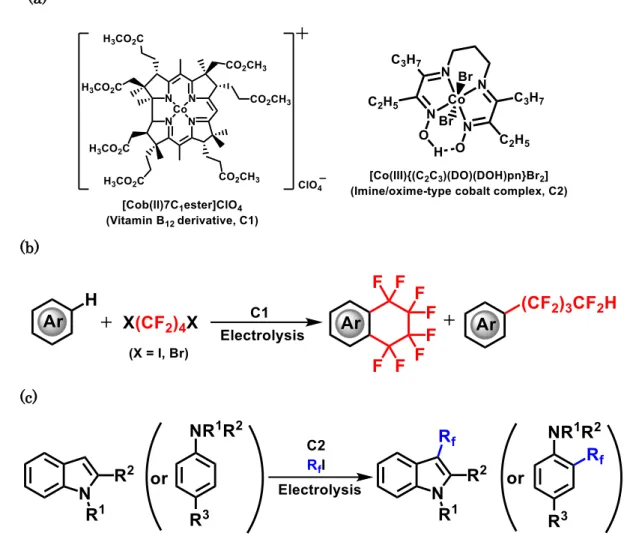
Chapter two demonstrated a valuable proof-of-concept for the one-step, synthetically challenging cyclic and acyclic perfluoroalkylation of (hetero)arenes driven by valence change of the cobalt species in a vitamin B12 derivative, heptamethyl cobyrinate perchlorate [Cob(II)7C1ester]ClO4 (C1), as a catalyst in the presence of fluoroalkylating X(CF2)4X (X = I, Br) reagents (Figure 1). Surprisingly, a kind of acyclic perfluoroalkylated compound containing –(CF2)nH group was obtained in the presence of X(CF2)nX (n = 4, 6) using this electrocatalytic method. This molecular transformations were established at –0.8 V vs. Ag/AgCl in methanol with 6 eq. fluoroalkylating reagent of aromatic substrate using C1 as a catalyst (1 mol%) for 12 h at room temperature. The consecutive formation of cobalt–carbon bonds and generation of fluoroalkyl radicals by homolysis are the key steps for the reaction to proceed. This represents the first report on catalytic cobalt–carbon bond-mediated intramolecular fluoroalkylating cyclization and perfluoroalkylation of (hetero)arenes, which offers a new pathway to a wide array of synthetically important functional compounds.
Chapter three demonstrated that an imine/oxime-type cobalt complex [Co(III){(C2C3)(DO)(DOH)pn}Br2] (C2), regarded as simple vitamin B12 model complex, was utilized as a catalyst for direct C–H perfluoroalkylation of indole and aniline derivatives using nonafluorobutyl iodide (n-C4F9I) as the readily available perfluoroalkyl source (Figure 1). The
synthetic approach described herein was performed under mild reaction conditions driven by controlled-potential electrolysis at –0.8 V vs. Ag/AgCl with 3 eq. n-C4F9I of aromatic substrate in organic solvents. The mechanistic investigations suggest that nonafluorobutyl radical species is a key intermediate obtained from the homolytic cleavage of the cobalt–carbon bond in the catalytic cycle. This is the first report concerning a fluoroalkylation reaction of (hetero)aromatics catalyzed by the simple vitamin B12 model complex. The convenient electrocatalytic method employing a simple cobalt complex provides a facile synthesis pathway toward novel fluoroalkylated compounds, demonstrating potential applications in the fields of pharmaceutical chemistry and materials science.
Chapter four concluded this electrochemically driven, cobalt–carbon bond-mediated perfluoroalkylations of aromatic compounds harnessing a readily available vitamin B12
derivative and model complex as catalysts, providing an important insight into application of new organic synthetic chemistry and organofluorine chemistry as well as understanding organocobalt chemistry. The further improvements and prospects on these research topics were also described here.
(a)
(b)
(c)
Figure 1. Summary of this thesis. (a) Cobalt catalysts: vitamin B12 derivative (C1) and its model complex (C2); (b) Chapter two: C1-mediated cyclic and acyclic perfluoroalkylation of (hetero)arenes; (c) Chapter three: C2-mediated perfluoroalkylation of indole and aniline derivatives.