Mahidol Wittayanusorn School and Otemae University Japanese Language and Cultural Exchange
著者別名 Motonobu SUZUKI
journal or
publication title
Journal of Research and Pedagogy of Otemae University Institute of International
Education
volume 7
page range 33‑42
year 2021‑03‑31
URL http://id.nii.ac.jp/1160/00002019/
Mahidol Wittayanusorn School and Otemae University Japanese Language and Cultural Exchange
Margaret Kim
Otemae University
Motonobu Suzuki
Otemae University
Reference Data:
Kim, M. and Suzuki, M. (2020). Mahidol Wittayanusorn School and Otemae University Japanese Language and Cultural Exchange. In K. Tanaka, & D. Tang (Eds.), Reflections on Higher Education and Online Teaching. Otemae University Institute of International Education.
Abstract
In this article, we discuss the initial collaboration between Otemae University and Mahidol Wittayanusorn School for an internship program in Thailand. Otemae interns had the opportunity to teach Thai high school students about Japanese language and culture. To make an intercultural program successful, it takes a lot of patience, preparation, and experience, and because it was the first collaboration between our schools there were a lot of unknown variables.
However, both schools began the project with open minds and acceptance of all possible outcomes. The interns learned to adapt to cultural differences in the classroom and in the broader culture. Overall, it became clear that active learning was more effective for beginner level students.
本稿では、大手前大学とタイのマヒドン高校との間で実施されたインターンシッププログラムの成 果について論じる。大手前大学の学生たちはインターンとしてマヒドン高校へ訪問し、そこで日本 語(初級)・日本の文化(祭り・高校生の生活)についてのクラスを担当するという貴重な機会が 与えられた。今回のようなインターンシッププログラムは両校にとって初の試みであったため事前 情報が少なく不明な点も多かったが、インターンの学生たちは本プログラムを成功させるために惜 しまず努力をし、授業の準備と練習を行った。両校における寛容で何事も受容する態度の助けもあ り、無事インターンシップを終えることができた。インターンたちはクラスの内外において、自ら を適応させることを学んだ。また今回担当した日本語初級のクラスでは文法や語彙よりもコミュニ ケーション主体のタスク重視型のアクティブラーニングを行い、マヒドン高校の生徒からは高い評 価を得ることができたため、初級学習者に対するアクティブラーニングの有効性が明らかとなった。
Introduction to the cultural exchange
During a business trip to Bangkok, Thailand in June, 2019, I (Margaret Kim) had the opportunity to make connections with schools in Thailand being the international liaison of the international programs at Otemae University. I planned to meet the coordinator for the English program at Mahidol Wittayanusorn School (MWIT), which is Thailand’s number one ranked high school. It is a government funded STEM-centered (Science, Technology, Engineering Mathematics) high school for gifted students. The students receive full scholarships for the entire three years they are
there and many of them receive university scholarships to study abroad. About 70% of the students become doctors.
They accept only 240 of the 1500 applicants who take their entrance exam each year, which means the students who are accepted are highly motivated and typically excel in their studies.
At Mahidol Wittayanusorn School, they teach Japanese as a third language. They have three Japanese schools who they have exchange programs with, Waseda Honjo, Hana Academy, and Ritsumeikan high schools. The English program coordinator mentioned that his school was looking for a Japanese language exchange teacher and inquired if our students were interested in working and teaching in Thailand as an exchange.
Mahidol Wittayanusorn School is located an hour outside of Bangkok, and the English program coordinator kindly arranged a meeting with his high school’s international relations department during my visit to his school on June 28th. I met with seven staff members of the international relations department. During our meeting we discussed ideas about an exchange with our schools, with the aim being to create a mutually beneficial and innovative program. They thought it would be a good idea to have student interns from our school complete an exchange program at their institution to teach different aspects of Japanese studies, including culture and language. This pattern of exchange had never been experienced at MWIT. They had a locally based Japanese native teacher who taught the students Japanese at the time.
However, they never had Japanese university students teach about Japan. Particularly because Japanese pop culture is popular amongst this age group in Thailand, so there was no hesitation to introduce this idea to MWIT to get their students interested and involved.
Hence, I approached Motonobu Suzuki because he oversees the 70 students enrolled in a course for certification to teach the Japanese language. For Otemae University students, there has never been this kind of opportunity to teach Japanese language abroad through the university. He had a great interest in this idea of a Japanese language teaching internship with Mahidol Wittayanusorn School (MWIT). Finally, we held an explanation meeting to introduce the program to interested students as an internship course on October 9th, 2020. We showed a video introduction of MWIT school, answered questions, and promoted this opportunity to students who attended.
Lesson Preparation
One of the bilingual students, Student A, was assigned to teach the Japanese culture lessons for the MWIT students. I (Margaret Kim) helped her brainstorm ideas to help prepare for her lessons. We were over-prepared and had more ideas than she could use. She taught a lesson on festivals in Japan.
In addition to Japanese culture lessons, we gave Japanese language lessons. Five interns, Student B, Student C, Student D, Student E, and Student F, were responsible for teaching these lessons. All of them were taking the Japanese language teacher training course at Otemae University, but this was the first time to teach the language. Five of them and the teacher in charge (Motonobu Suzuki) held meetings about how to teach Japanese language many times.
I (Suzuki) suggested to them one text book that was titled “NIHONGO GAKUSYUSHA NO TAMENO GENSEN DOKKAI TEMA 25+10”. This is a vocabulary, grammar and reading comprehension textbook. I chose some interesting topics about Japanese daily life and customs to center the lesson plans. I divided the lessons into three parts, which were vocabulary, grammar, and reading comprehension. After meeting together with the students about who would be in charge, we decided Student C and Student B would teach the vocabulary section, Student D and Student E would teach the grammar section and Student F was responsible for the reading comprehension part. They made PowerPoint files to teach each part.
The book I suggested was an upper beginner level text. Due to the fact that we did not know exact language levels for the students in Thailand, we also made other lesson plans in case this book was too difficult for the, MWIT students.
Other lesson plans were based on games such as Karuta (Japanese playing cards), Hata-age (raising flags), Origami (folding papers), and gesture games.
Details of Japanese Language Classes During the Internship
Table 1. Class Schedule
Class Date Language and Culture Class
1
Tue 11, 18:00-21:00
(3 hours)
-Introduction -Quiz about Japan -Name memorizing game
2
Wed 12, 13:00-17:00 hrs.
(4 hours)
-On the origin of Hiragana -Japanese Karuta
-About Japanese festivals -Presentation about Thai festivals
3
Mon 17, 18:00-21:00 hrs.
(3 hours)
-About Japanese high school lifestyle
-Presentation about the differences between Thai and Japanese high school student
-About Senryu
4
Tue 18, 17:00-21:00 hrs.
(4 hours)
-Raising flag game -Origami
-Soran bushi
5
Wed 19, 13:00-17:00 hrs.
(4 hours)
-Japanese Cultural Based Activities (Maki Cooking Class)
Class 1
The main goal of this first lesson was getting to know each other. Therefore, the interns wanted MWIT students to give a self-introduction and for our students to do the same. They emphasized that MWIT students don’t give a normal self- introduction, but an impressive one to be memorized by teachers. They did this task as a kind of a game. We divided the students into seven groups and one teacher was in each group. The number of people in each group was about six to eight people. Each student gave an impressive self-introduction to the teacher in the group and repeated it until the teacher memorized their name. After the teacher memorized all the student’s names, the teacher moved to the next group and did the same thing. This game was really exciting and we had so much fun.
Class 2
In the second class, one of the interns talked about the origin of Hiragana. The students already knew how to read and write Hiragana, but didn't know how it was created. The interns thought it would help them to learn about Japanese Kanji characters if the students knew that Hiragana was developed from Chinese characters. The teacher presented a slideshow of how Chinese characters changed to Hiragana. The school students seemed to be impressed by watching it.
Figure 1. An intern leads a class on the Japanese phonetic systems.
Then they played Karuta, which is a Japanese traditional card game that relies on reading hiragana. The interns gave a brief explanation about Karuta and started the game. They divided students into six groups. One teacher joined each group and read the cards. Students listened carefully to the teacher and looked for the card that matched to what card the teacher had read. There are 45 proverbs in this Karuta set, which was hard to understand for the beginner-level students, but the point was any student could search for the correct cards as long as they knew how to read Hiragana.
MWIT students understood the rules immediately and enjoyed their time playing Karuta.
Figure 2. Students play karuta.
After a short break, the latter half started. In that second section, the interns talked about Japanese festivals. One of the teachers, Student A, explained about some famous festivals in Japan with PowerPoint. She introduced the Nebuta festival in Aomori and the Danjiri festival in Kishiwada. After the explanation, the students talked about what the festivals in Thailand were like and made a speech in Japanese. One of the students in each group gave the speech. Most of them chose Songkran which is Thailand’s New Year's festival, commonly known as the water festival.
Class 3, 4, 5
In Class 3, our students taught about Japanese high school lifestyles. Every intern talked about their own high schools and how they spent their time using visuals. Afterwards, MWIT students divided into six groups and talked about life at high school in Thailand and compared it with Japanese high schools. One student from each group gave a speeches about the theme. The last task in Class 3 was learning about Senryu. Senryu is a Japanese traditional short poetry with 17 syllables. The interns gave explanations about Senryu and taught the Thai students how to write it.
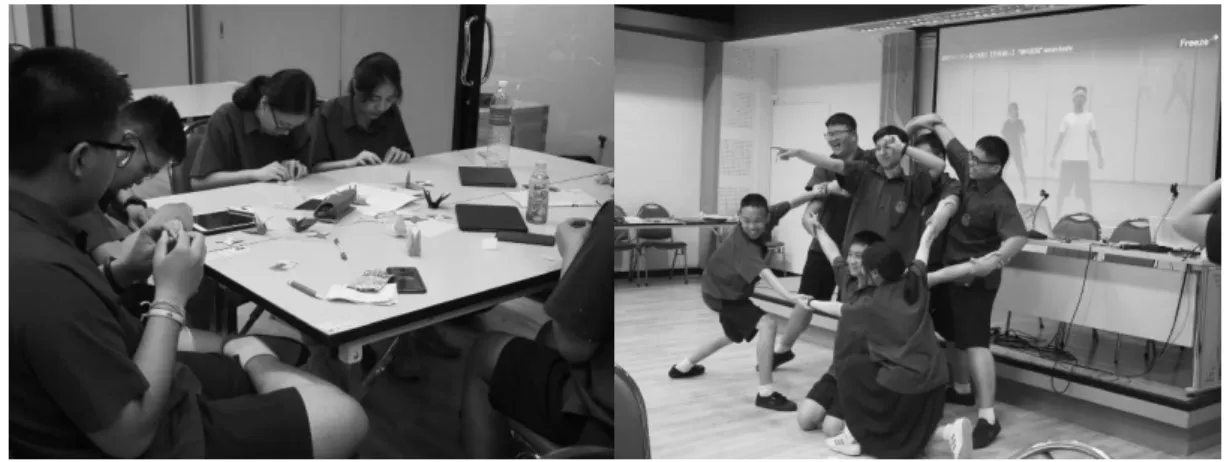
In the Class 4, the interns played a Japanese famous game called Hata-age as an ice- breaker activity. In this game, students follow the teachers order about raising flags. The order was limited to four patterns as follows. "Aka agete (Raise your red flag)", "Siro agete (Raise your white flag)", "Aka agenai (Don't raise your red flag)", and "Shiro agenai (Don't raise your white flag)". Unlike English, the negative comes at the end of sentence so students had to listen to the order carefully until the end of the sentences. After the game, MWIT students learned about how to make Origami, which is the art of paper folding. Some of the students already knew how to make a crane but they were taught some other folding paper art as well.
The last session was learning Japanese traditional dancing, called Soran Bushi. Soran Bushi is one of the most famous dances in Japan and most high-school students perform it in school festivals. All interns had the experience of dancing Soran Bushi. MWIT students learned it by watching YouTube and practiced about 30 minutes. In the last class, they performed Soran Bushi for us.
Figure 3. Students make origami and practice traditional dancing.
Class 5 was the final class. In the last class, all the interns and students enjoyed making and eating maki rolls (Maki Zushi). This was a community building hands-on activity for the students. It was the most successful event overall, as students were able to share language, making a cultural item, and then sharing a meal together.
Figure 4. Students make and share a Japanese meal together.
Post-Internship Survey Questions
Upon arrival back to Japan, the interns were given these survey questions to answer. Here are some of their replies.
1. What is the best experience you had during the internship?
● I had a chance to learn how the Japanese language is taught overseas. Teaching Japanese language by direct method was more difficult than I thought.
● To experience different cultures. To know the difficulties of teaching Japanese language.
2. What is the worst experience you had during the internship?
● Preparing for teaching was not enough.
● My English level was not enough.
3. Did you fulfill your personal goals?
● Yes. I really enjoyed teaching Japanese culture.
● My goal was to build a good relationship and gain trust. I think I could make it happen.
4. Did you overcome your weakness in teaching?
● I wouldn't say I could overcome it, but I was trained to teach flexibly.
● I don't think so. I need to get used to standing in front of many people.
5. What did you learn about Thai culture?
● Kindness and smiling.
● Hospitality and respect to others.
6. What teaching skills do you want to improve?
● I want to express one thing from a different side.
● I want to improve my English level and get to know ways of thinking in a different culture.
7. What is your advice for future students who experience this internship?
● Prepare a back-up lesson plan. In internship, lessons may change so if you prepare a back-up lesson plan you can conduct your lesson flexibly.
● It is important to know about Japanese culture well. Flexible response and English skills are needed.
8. Would you recommend this internship to other students? Why?
● This internship was very helpful to know cultural differences. So I recommend this internship not only to people who aim to be a Japanese language teacher but also who are interested in cross-cultural communication.
● I would suggest this program to everyone who is still looking for their future career. Originally, I was not interested in being a teacher. However, I thought of giving it a try as I am still looking for some options. I have no regrets on going for this internship as I manage to discover my own strengths.
MWIT English Program Coordinator Feedback
I would like to give my feedback on the recent internship program between Otemae University and MWIT. During this internship, I observed teaching sessions at MWIT and accompanied students to observe a university level Japanese class at Mahidol. I was impressed with the enthusiasm of the Japanese interns and the friendly atmosphere they created in the classroom when interacting with our students. Even though this was their first time being responsible for a class and teaching Japanese to Thai students, they displayed confidence and exhibited a reliable teaching persona. I think that for our first internship, this program was successful in that it had a positive effect on our students’ impression of Japan and the Japanese language.
Here are my suggestions for future internship programs.
Japanese Interns
1. It would be very useful to have a personal introduction of each intern that included information on why they applied for the program and what they hope to gain from it.
2. I don’t feel that it is necessary for interns to be fluent in English as long as they try their best to connect and communicate with our students.
3. I think it would be a good idea to have a post-internship feedback form that interns can fill out.
MWIT Students
1. MWIT students should be limited to only students who are interested in learning Japanese or pursuing further education in Japan.
2. MWIT students should be warned about using mobile phones or tablets during the class sessions. The Japanese interns mentioned to me that many MWIT students were using mobile phones during the teaching sessions and they asked me what was our school policy on mobile phone usage in the classroom. (Several MWIT students I spoke to afterwards admitted this was the case.)
3. We should assign two MWIT students to be buddies with each intern and do what they can to help the interns during their stay.
Class Schedule and Class Size
1. I think it would be better to limit each class session to two hours and increase their frequency. It is difficult for students to remain focused for three hours, especially after a full day of regular classes. Having them study more frequently would make it easier for students to retain the material.
2. It would be more effective to make the classes as small as possible by dividing up interns and students. I don’t think it is important to divide up the classes by levels as most all of the students are at a beginner level. If there were more advanced students in the class, they could be used as teaching assistants by pairing them up with weaker students.
3. Japanese intern teachers should be rotated around the classes so that our students are able to interact with everyone.
MWIT Class Observations
1. It would be a good idea to have the interns observe other MWIT language teaching classes, (English, Chinese, German) even though the target language is not Japanese, the techniques used for language teaching are the same.
By observing veteran teachers in action, the interns would learn various teaching approaches and teaching personas.
2. Rather than holding separate Thai culture classes for the Japanese interns, (Thai boxing, Thai dancing, Thai music, Art etc.) I think it would be more rewarding for them to attend classes with Thai students so they can see how Thai students learn these subjects and have the opportunity to interact with MWIT students one on one.
MIWT Student Feedback Reports
● In just two weeks, I've managed to learn and discover my own strengths. My goal before I graduate is to try anything and everything. This opportunity was a great start for me to overcome my fears and try new things.
Since we went as a group, I was hoping for my teammates to be as honest as possible. I take evaluations seriously so I wish they could be honest with me. I feel that there were times when we had to back up on our teamwork. Overall, everything went well and as planned.
● This internship taught me how difficult it is to teach Japanese language to others. I had heard how hard it was before the internship. There were a lot of things which you could find through real experience. For instance, knowing the levels of the students, making the teaching plan as students' level, setting a time schedule. I had to think a lot to prepare only one class. While I was teaching Japanese language in front of MWIT students, I was wondering if students got interested in and understood what I was saying. Sometimes I didn't know what to do in class but I tried something that I came up with. I think I need more knowledge about Japanese language including culture and English skills. The time of teaching was shorter than I expected. I wanted to teach more. This internship was only 10 days. During this short time we built a strong teamwork. I want to be a Japanese language teacher in future. If I could be a teacher, I would want to make a friendly relationship with the students. I want to enjoy teaching.
● I really enjoyed this internship. Before I went to Thailand, I was really anxious about teaching Japanese language. I could feel how MWIT students like Japan. They are so energetic and expressive. We changed our teaching plan during the internship. We didn’t take up grammar and vocabulary which we prepared in Japan but included some games. They really liked games and got excited. I think it's important to change lesson plans depending on who I am teaching to.
MWIT Students Class Survey Questions
1. What was your impression of the Japanese courses?
● Every teacher is energetic and joyful, you intend to teach us and make a good atmosphere for learning Japanese such as activities that we can join and have active learning and good performance of your teaching.
● This is an active-learning class. I like this. It is different from other classes which have only a lecture.
● First, I’m quite nervous about taking this class because I’m just a beginner in Japanese language and don’t know anything even hiragana. When I met the Japanese teachers, I wanted to study and do more activities with you. Everything I’ve learned in this class is fun and can be used in daily life. Thank you!
2. What other things would you like to learn about Japan?
● I would like to learn about Japanese provinces and Japanese food. Also like everyday life of Japanese people.
● I want to learn about phrases Japanese people use in everyday life and how to respond to some phrases like
“Gomen” because we may use this knowledge in the future. However, I understand that this is mostly a
cultural class that represents Japan’s culture. So I would suggest teaching us more about how to use phrases and also about traditions like “itadakimasu” and “tadaima”.
● I’d like to learn more about traveling in Japan and places to visit if I go there.
3. Would you like to participate in this course again?
● Yes! Because I have learnt many vocabularies, gained the experience in Japanese speaking and met the active teachers that make me feel delightful.
● はい。Please come back to teach me again.
● Yes! I really like Japanese culture and this course.
4. What did you learn in this Japanese course?
● There is a lot of knowledge I gained from this course, for example Japanese traditional events, how to introduce myself, new words, and lots of stuff. ps. I really like the games and origami class.
● I learned a lot in this course. First, I remember most of the hiragana letters now. Yay! I got to know more Japanese phrases and vocabulary.
● Japanese culture such as Origami, folk dance, hiragana, festival, school life, poem, karuta.
5. What did you think about the Japanese teachers?
● They are energetic teachers! When I join the class, they will give me positive energy. I feel happy to join their class and learn Japanese language.
● Teachers are kind and enthusiastic. They try to communicate with us. They have a lot of energy and it is very fun! They try to remember our name even though it’s hard for them. That’s my impression.
● I didn’t expect to know more about Japan this much, this Japanese course taught me a lot about Japanese stuff like schools, Japanese personalities, how strict they are... etc. So it’s a very good Japanese course for me.
This feedback suggests our program was successful but also has room to grow, and hints at ideas we can implement in the future. We feel these comments indicate we have a successful base on which to build a productive and innovative program.
Conclusion
During the novel coronavirus pandemic of 2020-2021, we are going to continue our relationship with MWIT and teach online instead of face-to-face because of the pandemic. We are coordinating with the Japanese language teacher there.
We hope that this will be the beginning of a continuous internship with MWIT. We also hope to tailor and improve our program. For example, to prepare the interns for their lessons, level testing was suggested by giving student interviews to assess their Japanese proficiency. We are also collaborating with the Japanese language teacher to plan the Japanese language classes. Further suggestions would be to create materials by the Japanese interns beforehand, introducing the topics they will teach with their Japanese language introduction to prepare the students for the short-term Japanese course. Learning a language is not just about the language, but also about the culture. The interns will use more cultural activities to enforce their teaching in a creative way.
Fortunately, one of the senior students, after returning from the internship in Thailand was able to get a job as a Japanese Language teacher at a Language School. She credits her experience with our students as an important part of how she got a job. The internship is a work in progress since it was the first year for our exchange. However, from the
feedback from the MWIT teachers, MWIT students, and Otemae University Japanese interns, we will build on our strong base to make changes for a much improved program suitable for the student’s needs for the future.
Bio Data
Margaret Kim earned her BA from the University of Michigan in Asian Studies/Japanese Language and an MA from the School for International Training (SIT) in Teaching. She has experience teaching in Malaysia, South Africa, the United States of America and Japan. She is currently an associate professor at Otemae University, Nishinomiya, Japan.
Her focus of research is on project based learning, intercultural training and gender issues. <[email protected]>
Motonobu Suzuki is assistant professor at Otemae University’s Faculties of Cultural and Historical Studies, where he teaches Japanese linguistics and Japanese language education. His research interests include Semantics and Pragmatics in Japanese language. <[email protected]>