Students’ attitudes towards NS and NNS Teachers in Japanese Language Teaching
The foreign language profession has discussed issues related to native versus non-native speaking teachers in recent years due to the increasing numerous non-native speaking teachers, especially in the field of English teaching. According to the Japan Foundation (2008), among the 45,000 Japanese teachers working abroad, almost 70 percent of them were non-native local people. It shows that it is not suitable to consider native teachers only while we study the Japanese education problem. However, in the field of Japanese language profession researching as a foreign language, studies focused on the differences between
NS and NNS were limited.
This study investigates the attitudes of Chinese students in different levels which were taught by native speakers (NSs) and non-native speakers (NNSs) of Japanese.
Background
In the field of foreign language teaching, it was considered ordinary that NSs were believed to be superior to NNSs, and the NNS teachers were second in knowledge and performance to NS teachers (Firth & Wagner (1997)). Some studies attempted to find out the reason for the notion. Phillipson (1992) argued that a greater facility in demonstrating fluent, idiomatically appropriate [Original Paper]
Students’ attitudes towards NS and NNS Teachers in Japanese
Language Teaching
Shuang LIU*
Abstract
With the increasing numbers of non-native Japanese speaking language teachers, it seems likely that it is important to investigate the effectiveness of non-native speaking teachers versus native speaking teachers, their self-perceptions, or the attitudes of students towards these teachers. Most of these studies have been conducted in English teaching context. The related studies in Japanese teaching were limited. This study investigates the attitudes of Chinese students in different levels which were taught by both NSs and NNSs of Japanese. The students were queried through a questionnaire and interviews. Findings indicated that the students recognized that NSs and NNSs both have strengths and weakness in knowledge, teaching ability and to communication. The students do not consider the NNS teachers to be globally inferior to NSs teachers. The results also provide that the students prefer NS to be oral models and teaching Japanese culture and they prefer the NNS to teaching grammar and to put their own successful language learning experience to good account in teaching. The advanced students appeared to have a more favorable attitude to these teachers, especially to the NS teachers.
2014年 3 月
KEY WORDS : native speakers, non-native speakers, students' attitudes, Japanese teachers
*大連外国語大学
九州共立大学共通教育センター *Dalian University of Foreign Language Kyushu Kyoritsu University, Career and General Education Center
language; a greater appreciation of the cultural connections of the language; the ability to judge a linguistic form were the reasons for the NSs’ advantage.
However, the commonly accepted views of NSs are superior than NNS teachers in the field of English language teaching was discussed recently. Philipson’s (1992:195) research showed the advantage of the NNS like the successful experience of learning foreign language, sharing the same culture context with the students. Medgyes (1992) indicated that both NSs and NNSs have strengths and weakness, and they have equal chance to achieve success. Recent studies in the ESL context also noticed that NS and NNS should not be divided into different camps. It was represented in Holliday(2005) and Pasternak & Bailey,(2001).
Hertel,T.J. & Sunderman,G. (2009) divided recent research on the NS and NNS debate into i n s t r u c t o r s ’ s e l f - p e r c e p t i o n s a n d s t u d e n t s ’ perceptions of instructors. Most NNS teachers feel deficient about their language problem and consider it will effect on their teaching (Medgyes,1994 ; Griffler,1999). As for student perceptions, recent research also questioned the widely held notion in language teaching that students prefer NS teachers. Both NS and NNS teachers have advantages and d i s a d v a n t a g e s . M a h b o o b’s (2001) research investigated the perceptions of 32 English students at a U.S. university. It showed that students preferred the NNSs’ teaching grammar and answering questions based on their own successful experience of learning English, and the students preferred the NSs’ teaching oral skills and vocabulary and culture. Moussu(2002) examined the 84 students’ perceptions towards the NNS teacher in university. He pointed out that the students expressed positive attitudes toward NNS instructors after a semester’s learning. A similar study was conducted by Cheuning,Y.L.& Braine,G.(2007). Their study also noticed that the high grade students expressed more favorable attitude.
Although much research concerning English in EFL contexts were conducted, the studies relating to Japanese language profession in Japanese Foreign
language contexts were not discussed until recently. Despite the strong presence of NNS Japanese teachers worldwide, the researchers concerning the difference between NSs and NNSs Japanese teachers in language teaching were limited. Lokugamage (2008) presented that NS had power than NNS Japanese teachers in Japanese teaching in Sri Lanka. Okamoto (2010) explored the NS and NNS teachers perceptions and their teaching practice in a team teaching situation. Findings showed that the NNS Japanese teachers considered the NSs were superior to themselves, while the NSs questioned the conception through the team teaching.
Recent studies focused on the self-perception of Japanese teachers but researchers focusing on the attitude of students’ were limited. This study aims to determine how students themselves feel about the question of NSs versus NNSs as Japanese language teachers by investigating specific domains such as knowledge, Pedagogical skills and communication. Methodology
Participants
Participants were drawn from the Dalian University of Foreign Language. 59 undergraduate students participated in this study, 30 of them were second-year and 29 of them were third-year students. In selecting participants for this study, I took the students who have had the experience taught by both NSs and NNSs Japanese teachers. They were chosen on the belief that students at this level are more objective in their view than first-year students who had no experience of applying both NS and NNS teacher’s course. For the follow-up interviews, 4 students took part. They answered the questions from 15 to 30 minutes.
Instruments
The questionnaire contained the participants’ information including gender, age, institution and number of years of previous study in Japanese. 13 statements were designed to crosscheck the students’ responses on the perceptions of NS and NNS Japanese teachers. According to the five-point
scale, 1 refers to ‘Strongly Disagree’, 2,’Disagree’, 3,’ Neutral’, 4,’Agree’, and 5,’Strongly Agree’, participants evaluated the items to show their positive or negative standpoint clearly in comparing NS with NNS Japanese teachers.
The items on the questionnaire included three main issues: knowledge of the subject, teaching methodology and communication with the students. Before the subjects filled in the questionnaire, the meaning of the terms ‘NS teachers of Japanese‘ and ‘NNS teachers of Japanese‘ were explained to the participants and the purpose of the study was stated. Interviews
Interviews were concluded with 4 students after their surveys questionnaire to confirm and broaden the date from the questionnaire surveys.
Two questions were asked. The first question elicited the interviewee’ opinions on the advantages and disadvantages of NNS teachers of Japanese. The second question focused on the NS Japanese teachers. All interviews were conducted in interviewees’ mother tongue, Chinese.
Results
The responses to the questionnaires were grouped and analyzed. Summaries were showed in Table 1-Table 4.
Table 1
Difference Average of NS Average of NNS Knowledge
1 .teach more vocabulary
and grammar 0.17 4.29 > 4.12 2.prefer to imitate the
pronunciation and spell 1.34 4.50 > 3.16 6.oral class 0.50 3.93 > 3.43 10.prefer them to teach
the writing class 0.35 3.72 < 4.07 13.prefer to teach culture
of Japan 0.28 4.37 > 4.09
In the content of Knowledge, students perceived NSs to be more knowledgeable with respect to pronunciation and oral skills. Knowledge of culture showed less confidence.
Table 1 also presents that there are not much difference on the students’ attitudes towards NS and NNS Japanese teachers.
Table 2
Difference Average of NS Average of NNS Teaching ability
7.correct the students’
mistake immediately 0.57 3.72 < 4.29 8.prefer to explain the
grammar 1.25 3.14 < 4.39
9.know what students want to express So as
to teach effectually 0.75 3.69 < 4.44 11.answer questions
based on their Own
successful experience 0.99 3.41 < 4.4
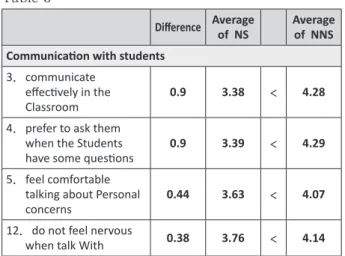
Table 2 presents the terms of teaching methodology on learners’ attitudes regarding NS versus NNS teachers. Students have a more positive attitude to NNS teachers than to NS teachers on the terms of teaching grammar, asking questions to teachers. The L1 language plays a important role in the Japanese teaching class.
Table 3
Difference Average of NS Average of NNS Communication with students
3.communicate effectively in the
Classroom 0.9 3.38 < 4.28 4.prefer to ask them
when the Students
have some questions 0.9 3.39 < 4.29 5.feel comfortable
talking about Personal
concerns 0.44 3.63 < 4.07 12.do not feel nervous
when talk With 0.38 3.76 < 4.14
Table 3 presents a multiple regression model on students’ attitudes regarding NS versus NNS teachers’ communication items with students. There is not much difference between NS and NNS which indicates that students want to communicate with NS teachers but using L1 language make them comfortable with NNS teachers.
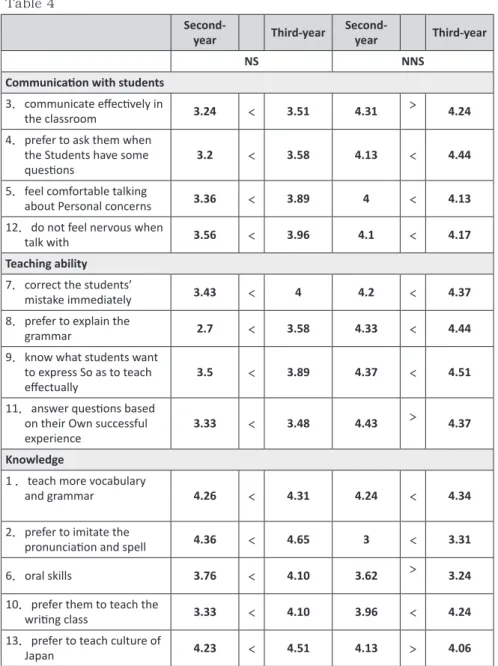
Table 4
Second-year Third-year Second-year Third-year
NS NNS
Communication with students
3.communicate effectively in
the classroom 3.24 < 3.51 4.31 > 4.24 4.prefer to ask them when
the Students have some
questions 3.2 < 3.58 4.13 < 4.44 5.feel comfortable talking
about Personal concerns 3.36 < 3.89 4 < 4.13 12.do not feel nervous when
talk with 3.56 < 3.96 4.1 < 4.17
Teaching ability
7.correct the students’
mistake immediately 3.43 < 4 4.2 < 4.37 8.prefer to explain the
grammar 2.7 < 3.58 4.33 < 4.44 9.know what students want
to express So as to teach
effectually 3.5 < 3.89 4.37 < 4.51 11.answer questions based
on their Own successful
experience 3.33 < 3.48 4.43
> 4.37
Knowledge
1 .teach more vocabulary
and grammar 4.26 < 4.31 4.24 < 4.34
2.prefer to imitate the
pronunciation and spell 4.36 < 4.65 3 < 3.31 6.oral skills 3.76 < 4.10 3.62 > 3.24
10.prefer them to teach the
writing class 3.33 < 4.10 3.96 < 4.24 13.prefer to teach culture of
Japan 4.23 < 4.51 4.13 > 4.06
Table 4 presents different proficiency level students’ attitudes towards NS and NNS teachers. In general, participants who were more proficient learners were more likely to judge NS teachers as better able to teach in all domains.
Interviews
The four interviewees all had experience being taught by both NS and NNS Japanese teachers. They were likely to judge teachers favorably in a number of areas. Gender showed no effects in the domains. The data was summarized according the 4 i n t e r v i e w e e s ’ a n s w e r . T h e s u b j e c t s w e r e summarized below.
NNS Teachers’ advantages Effective Pedagogical skills
The NNS teachers are successful in learning Japanese before, they can teach us by using their own experience. (Student A)
Knowledgeable in English Language
Most local NNS English teachers were educated in Japan. I loved learning Japanese after her teaching. (Student B)
Share the same context with students
how to say correctly, so we want them to teach us composition. (Student B)
Explain in students’ Mother Tongue
When we have some questions we can use Chinese to ask them, They can explain to us clearly. (Student C)
They teach us grammar explained in Chinese, so we can know it well. (Student D)
NS teachers’ advantages Knowledgeable in oral Japanese
We can become accustomed to the NS’ talking speed when the NS teachers teaching me. (Student C)
They can correct my pronunciation when I talking to them. (Student B)
Communication
I can raise my confidence if I always talk with NS teachers so I am glad to talk with them after class. (Student D)
Discussion
The present study investigated the perceptions of Chinese students toward NS and NNS Japanese teachers, and examined if a different language level would influence their perceptions. The results support previous ESL and EFL research in Japanese teaching context. As Medgyes (1992) has pointed out both NSs and NNSs have strengths and weakness. Not similar to Lokugamage’s (2008) study in Sri Lanka, in the students’ attitude, the NS teachers are not superior than the NNS teachers in all areas.
Similar to Moussu(2002) and Cheung,Y.L. & Braine,G.’s (2007) study, the students showed a positive attitude toward NNS teachers although the students in this study also want to communicate with NS Japanese teachers positively.
Like the participants in previous studies, Mahboob (2001) and Cheung (2002) had pointed out it is likely that students in this study prefer NSs to
be better pronunciation models and teaching Japanese culture. But it should be mentioned that the NSs in the present study are different from those imagined by Maboob (2001) when he cited that students preferred NS teachers with respect to teaching vocabulary.
The NNS Japanese teachers in this study were all Chinese and they share the same Chinese character radius with NS Japanese teacher. They also can tell the differences and teach the students. So there are not many differences between NS and NNS in the students’ view in this study. In grammar teaching, the students in this study were perceived NNS as superior to NS Japanese teachers. It support Medgyes (1992) and Mahboob (2001) and Hertel,T. J.& Sunderman,G. (2009)’s point also.
Similar to Philipson’s (1992:195) and Mahboob’ s (2001) qualitative investigation, NNS teachers’ own successful experience of learning English acted as an important role model when NNS teachers teaching language.
As for the communication with NS and NNS teachers, this study showed that students feel comfortable to ask questions to NNS teacher because they share the same culture context with NNS teachers. Philipson (1992:195) also expressed this opinion.
The variable of proficiency level influenced students from the date analysis in present study. Hertel,T.J.& Sunderman,G. (2009) also examine the attitudes of students enrolled in beginning and advanced students in Spanish language learning toward NS and NNS teachers. Similar to the current study, their results the more advanced learners judged the NS to be more knowledgeable, to have more teaching ability, to communicate more smoothly as compared to less experienced students. It seems likely that the less experienced students need the L1 support more than advanced students in the classroom. They also need the exposure to comparisons of grammar between Japanese and Chinese.
Conclusions
To sum up, this study, conducted in a Japanese Foreign Language context, supports the findings of Medgyes (1992), Manboob (2001), and Hertel,T.J.& Sunderman,G. (2009), which were conducted in the English context. The studies indicated that the students recognized that NSs and NNSs both have strengths and weakness in knowledge, teaching ability and to communication. The students do not consider the NNS teachers to be globally inferior to NSs teachers.
The results provide that the students prefer NS to be oral models and teaching Japanese culture and they prefer the NNS to teaching grammar and to put their own successful language learning experience to good use in teaching. When the administrators hire language teachers, they should consider these factors to contribute to effective language teaching.
The current study has provided quantitative data from the student participants. Future research could also examine the attitudes of NS and NNS teachers in order to gain a deeper and broader understanding. The present study investigated the Chinese students, the same script, such as English speaking students may also be conducted in future studies.
Received date 2014年1月6日 References
Canagarajah,S. (1999):Revisiting Linguistic Imperialism in English Teaching.Oxford: Oxford University Press.
Cheung,Y.L. (2002):The attitude of university students in Hong Kong towards native and non-native teachers of English. Unpublished M.Phil. thesis, The Chinese University of Hong Kong. Cheung,Y.L. and Braine,G. (2007):The Attitudes of University students towards Non-native speakers E n g l i s h T e a c h e r s i n H o n g K o n g . S A G E Publications, 38(3)257-277.
Firth, A. & Wagner, J. (1997):On Discourse, Communication, and (some) Fundamental Concepts in SLA research.Modern Language Journal,
81(3):285-300.
Hertel,T.J.&Sunderman,G.(2009):Student Attitudes T o w a r d N a t i v e a n d N o n - n a t i v e L a n g u a g e Instructors. Foreign Language Annals, 42(3), 468-482.
Holliday, A. (2005):The Struggle to Teach English as an International Language. Oxford: Oxford University Press.
Mahboob, A. (2001):Native or non-native: What do students enrolled in an intensive English problem think? In L.D.Kamshi-Stein (ED.), Learning and teaching from experience: Perspectives on non-native English speaking professionals ,pp.121-147. Ann Arbor: University of Michigan Press.
Medgyes,P.(1992):’Native or Non-native: Who’s Worth More?’.ELT Journal46,40:340-49.
Moussu,L. ,and Braine,G. (2006):’The Attitudes of ESL Students towards Non-native English Language Teachers’.TESL Reporter 39:33-47.
Phillipson, R. (1992):Linguistic Imperialism.Oxford: Oxford University Press.
岡本和恵(2008):ティーム・ティーチングを通した教 師同士の協同と学び.論叢, 大阪大学文学会,42:57-74. 国際交流基金(2008):海外の日本語教育の現状.日本 語教育機関調査.2006年概要. Lokugamage Samanthika(2008) :日本語を第2言語 とする日本語教師―スリランカにおける3人の教師の ケース・スタディーー .大阪大学大学院文学研究科博 士論文.