奈良教育大学学術リポジトリNEAR
Mutual Effect of Auxins and 2, 3,
5‑Tri‑iodobenzoic Acid on the Development of Tension Wood in the Herbaceous Stems
Horizontally Kept
著者 HIGASHIMURA Takako
journal or
publication title
奈良教育大学紀要. 自然科学
volume 19
number 2
page range 83‑92
year 1970‑11‑30
URL http://hdl.handle.net/10105/3030
^&#W*S!S f>19§ *2^ (ft88) H31J145-?
Bull. Nara U. Educ, Vol. 19, Ko.2, (Nat.), 1970
Mutual Effect of Auxins and 2, 3, 5-Tri-iodobenzoic Acid on the Development of Tension
Wood in the Herbaceous Stems Horizontally Kept
Takako HlGASHIMURA
(Biological Laboratory, Nara University of Education, Nara, Japan) (Received May 30, 1970)
Summary
The changes in the development of tension wood were induced through the mutual effect of 2, 3, 5-tri-iodobenzoic acid (TIBA) and a;-naphthaleneacetic acid (NAA) or TIBA and indole-3-acetic acid (IAA) which were simultaneously and separately applied to the upper side and the lower side of the stems placed hori- zontally. Especially, the development of tension wood was suppressed by application of TIBA to the upper side either at high concentrations Q.%~) or at low (0.5$), irrespective of concentrations of NAA applied to the lower side of the same stems, and also it was promoted by application of IAA (\% and 0.5^?) to the upper side, irrespective of concentrations of TIBA applied to the lower side of the same stems. These evidences are inconsistent with those shown by application of auxins alone or TIBA alone, and the mechanism concerned was suggested under the postulate that auxins exogeneously applied to the lower side of the horizontally placed stems might diffuse towards the upper side and that auxins and TIBA might have an antagonistic effect on the cambial activity with each other.
Introduction
Woody stems form tension wood on the upper side in general, as the result of response to the change of an orientation of stems to gravity which occurs when they are placed to an inclined or horizontal position, and show thus the so-called
'epitrophical growth'.
It is generally accepted that the development of tension wood is induced as the result of an occurrence of redistribution of natural auxins in the stems so that the auxin concentrations on the upper side reaches to low level which is optimal for cambial activity (Onaka 1949, Sato 1956, Cronshaw and Morey 1965).
Necesany (1956) has observed the fact that the development of tension wood is suppressed by application of auxin on the upper side of young, bent stems of Populus,
83
84 Takako HlGASHIMURA
and that it is brought about on the upper side of untreated inclined stems in association with low level of auxins and the presence of growth inhibitors. The author has suggested in the previous report (1965) that the normal differentiation
of tension wood on the upper side of horizontally held stems of herbs is an expression of response of cambium to low auxin level.
The experiment reported here was carried out in an attempt to find how auxins and TIBA applied to the upper and lower sides, simultaneously and separately, of horizontally held stems were able to effect mutually on the development of tension wood and the formation of vessels in herbs.
Materials and Methods
Seeds of jute plant were germinated in large flats. The seedlings selected for uniform size were planted in a single row in a narrow rectangular box and maintained in a vertical position before the experimental treatment. At a time when the seedlings reached to a height of 18-20cm and established their secondary growth to the fourth node of stem, they were horizontally positioned through an inclination of the box by 90 degrees. Both auxin and TIBA were each applied as dispersion in anhydrous lanolin at various concentrations along the entire length of the upper side and opposite lower as indicated in the Table. The experiments were terminated seven days later. Lanolin treated controls and untreated were examined in addition to treated seedlings. For anatomical investigation the sections were taken from the mid-point of the fourth internode. Observations were made on the sections stained with a combination of haematoxylin and safranin.
Table
u p p er T IB A 0 .5 %T I B A 0 .5 % N A A 0 .1 %N A A 1 7 oT IB A 0 .5 %T IB A 0 .5 % IA A 0 .1 % IA A
lo w er 0 .5 %N A A 0 .1 %N A A l %T IB A 0 .5 %T IB A 0 .5 % IA A 0 .1 % IA A T I B A 0 .5 % T I B A
Results
Controls : Xylem in an erect stem of the seedings just before the experimental treatment is composed of 12-15 layers of cells, including 4-5 layers of unlignified cells just differentiated from cambium.
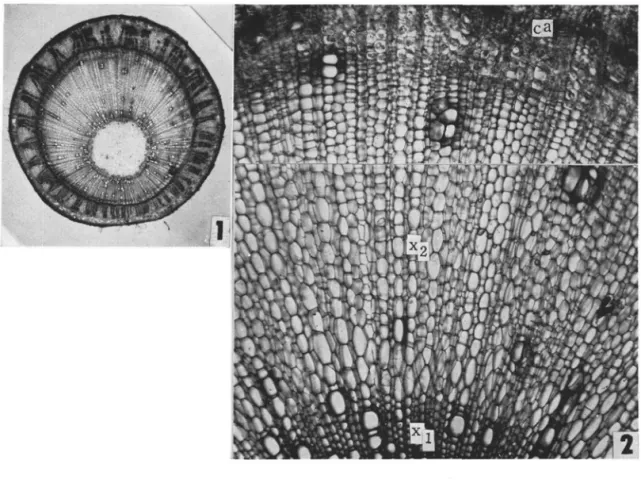
Controls non-applied and kept in a horizontal position for the period of 7 days show an epitrophical growth, developing the tension wood on the upper side.
The widest part of the xylem consists of 36-40 layers of cells (Fig. 1). These cells are radially elongated and thin-walled, and vessel elements which are relatively wide in size are sparsely distributed (Fig. 2, X2). It is conspicuous that the unlignified cells derived from cambium just before the start of the horizontal treatment are
Mutual Effect of Auxins and TIBA on the Development of Tension Wood
Fig. 1. Surface view of the cross section of jute stem kept horizontally for 7 days, showing reduced distribution of vessels and low lignification of cells in the tension wood. X ca. 10 Fig. 2. Magnification of part of tension wood in Fig. 1., showing that the cells differentiated just
before the horizontal treatment are remarkably elongated radially. X ca. 70
ca cambium
Xj, X2 xylem formed before and after horizontal treatment, respectively
remarkably elongated radially (Fig. 2, two or three layers of cells just adjacent to the portion indicated by Xi in Fig. 2)
Horizontally placed stems whose upper side was applied by 1% TIBA and whose lozver side by 0.5% NAA or IAA : The tension wood is reduced in the number
of layers of cells and in the thickness relatively to the non-applied stems kept horizontally, indicating suppression of both cambial activity and growth of cells.
Several layers of cambial derivatives are narrow and thick-walled, developing into vessel elements, and thus groups of narrow vessel elements are seen along the periphery of the tension wood (Fig. 3, 4 and 5).
Mutual Effect of Auxins and TIBA on the Development of Tension Wood 87
Horizontally placed stems zvhose upper side -was applied by 0.5% TIBA and å whoselower side 0.1% NAA or IAA : In the stems to which NAA was applied along the lower side, both the number of layers of cells and the thickness are slightly reduced, and cambial derivatives are somewhat narrow, especially in the vicinity of cambium, relatively to those of non-applied and horizontally held stems, indicating that cambial activity and growth of cells are suppressed to some extent.
The feature is similar to the stems mentioned above in point of the formation of groups of vessel elements, though the vessel elements are somewhat thin-walled and groups are sparsely distributed with wide intervals (Fig. 6 and 7). In the stems to which IAA is applied in place of NAA, on the other hand, cambial activity and growth of cells are somewhat promoted compared with those seen in the stems kept horizontally. Therefore, a small number of narrow cells and groups of narrow vessel elements are formed in the vicinity of cambium. As a whole, the xylem exceeds that on the upper side of the non-applied stems kept horizontally in the number of layers of cells and the thickness.
Horizontally placed stems zvhose upper side zvas applied by 0.5% NAA or IAA and zvhose lozver side by 1% TIBA: In the stems to which NAA was applied, the development of tension wood is suppressed relatively to that in the stems of non-applied controls, due to retardation in cambial activity and radial elongation of xylem cells. Cambial derivatives just differentiated are narrow and thin-walled, being in a state similar to that in the stems of non-applied controls. Several vessel elements lie in a radial row, and several rows in a grouped arrangement are distributed in xylem (Fig. 8 and 9). In the stems to which IAA was applied in place of NAA, cambial activity is accelerated and cells are successively elongated in a radial direction, with result that xylem is composed of larger number of layers of cells and is thicker than that in the non-treated and horizontally held stems.
The vessel elements, which are similar to those seen in the latter, are distributed in a large number.
Fig. 3. Surface view of cross section of jute stem horizontally kept and applied by 1% TIBA to the upper side and by 0.5% NAA to the lower side. X ca. 12
Fig. 4. Xylem on the upper side in Fig. 3., showing the groups of narrow vessel elements with thick- ened walls formed along the periphery of the tension wood. X ca. 130
Fig. 5. Magnification of part in Fig. 4, showing groups of narrow vessel elements. X ca. 240 Fig. 6. Transverse section of the upper side in jute stem kept horizontally and applied by 0.5% TIBA
to the upper side and 0.1% NAA to the lower side, separately. X ca. 130
Fig. 7. Magnification of part in Fig. 6, showing that groups of narrow vessel elements with thickened walls are sparsely formed along the periphery of tension wood. X ca. 240
ca cambium
Xj, Xg xylem formed before and after horizontal treatment, respectively
88 Takako Higashimura
Horizontally placed stems whose upper side was applied by 0.1% NAA and whose lower side by 0.5% TIBA '. In the stems to which NAA was applied, the development of tension wood is in the same extent as in the stems of non- applied controls, and vessel elemets are distributed in large number relatively to the former. Along the periphery of tension wood several layers of cells just differentiated from cambium are remarkably elongated in a radial direction and the formation of vessel elements hardly occurs there (Fig. 10 and ll). In the stems to which IAA was applied, the development of tension wood is remarkably accel- erated due to the cambial activity and successive growth of cells. The distribution of vessel elements is similar to that in the stems of non-applied controls. Unlike the cases mentioned above, cambial derivatives just differentiated are thin-walled and radially elongated remarkably.
Consideration
It is well known that TIBA acts as an auxin-antagonist by blocking transport of auxins in plants (Kuse 1954, Niedergang-Kamien and Skoog 1956, and Keitt and Skoog 1959). In particular, Cronshaw and Morey (1965, 1967) have found that the development of tension wood occurs in erect stems below the TIBA treatment site in Acer rubrum, and Necesany (1958) and Casperson (1963,1965) have confirmed that the development of tension wood on the upper side of hori- zontally placed stems of several hardwood species is readily inhibited through application of auxins to the upper side of the stems. The author (1969) has demonstrated an occurrence of the phenomenon similar to those just mentioned in the horizontally held stems of herbs similarly treated. These facts suggest that the development of tension wood on the upper side of the stems kept horizontally is a response of cambium to auxin deficiency on the upper side.
Fig. 8. Transverse section of the upper side in jute stem horizontally kept and applied by 0.5% NAA to the upper side and 1% TIBA to the lower side, separately. X ca. 95
Fig. 9. Magnification of part in Fig. 8, showing radial rows of vessel elements.
Fig. 10. Transverse section of the upper side in jute stem horizontally kept and applied by 0,1% NAA to the upper side and 0.5% TIBA to the lower side, separately. X ca. 60
Fig. ll. Magnification of part in Fig. 10, showing that cambial derivatives are radially elongated and few vessels are formed. X ca. 132
ca cambium
Xj, X2 xylem formed before and after horizontal treatment, respectively
90 Takako Higashimura
On a general survey of the experimental results, the mutual effects of TIBA and NAA or TIBA and IAA, exogeneously applied to both upper and lower sides
of the horizontally placed stems separately, upon the development of tension wood induced through the promotion of both cambial activity and growth of cambial derivatives which occur on the upper side as the result of horizontal treatment of stems may be mentioned as follows : With the treatment of the horizontally placed stems with high concentrations, the development of tension wood is reduced and narrow vessel elements densely occur in a grouped arrangement, when TIBA and NAA simultaneously applied separately to the upper side and opposite lower but IAA is effectively used in place of NAA for the development of tension wood with wide vessel elements diffusely distributed as seen in the controls merely horizontally kept, only when the application is made to the upper side. With the treatment of low concentrations, on the other hand, the development of tension wood is promoted and vessel elements are wide and diffusely distributed through the simultaneous and separate application of TIBA and IAA to the upper side and opposite lower and NAA is substituted for IAA with an inhibitory effects on the development of tension wood with vessel elements formed in a grouped arrangement, only when it is applied to the lower side.
The evidences that the development of tension wood is suppressed by the application of TIBA to the upper side either at high concentrations or at low concentrations, and promoted by the application of NAA or IAA to the upper side are inconsistent with those shown by the application of auxins (Cronshaw and Morey 1965, 1967) and TIBA (Necesany 1958, Casperson 1963, 1965 and Higashimura 1969) in association with the development of tension wood.
Wareing et at. (1964) have, however, shown the evidence that auxins exogeneously applied to the lower side of horizontally held stem segments of hardwood species move towards the upper side. In the horizontally held stems it has been suggested that natural auxins move towards the lower side from the upper along a transversal direction of the stems under the unilateral effect of gravity
(Onaka 1949, Sato 1956). Moreover, it is regarded that TIBA may physiologically compete with auxins, though the precise mode of its action is still unknown.
In addition it is well known that NAA is incomparably superior in activity to IAA.
Taking these facts into account, the contradiction mentioned above will be
Mutual Effect of Auxins and TIBA on the Development of Tension Wood 91 reconciled to some extent. As the result that exogeneously applied NAA and IAA at high concentrations to the lower side move towards the upper side, counteracting the effect of TIBA applied to the upper side, supra-optimal concentrations may be brought about on the upper side, being thus followed by suppression of the development of tension wood and an occurrence of groups of narrow vessel elements along the periphery of tension wood. Application of NAA at high concentrations to the upper side may naturally bring about supra-optimal level of auxin concentration there, whereas optimal level of auxin concentration may be brought about to the upper side, inducing the promotion of development of tension wood and of formation of groups of wide vessel elements there when IAA is applied in place of NAA to the upper side, as the former falls far below in action compared with the latter.
When at low concentrations NAA and IAA are separately applied to the lower side, supra-optimal level of auxin concentration and an optimal level of auxin concentration occur on the upper side for the development of tension wood and the formation of groups of narrow vessel elements, as the former counteracts the effect of TIBA applied to the upper side and the latter is made ineffective in competition with TIBA similarly used. When at low concentrations NAA is applied to the upper side, auxin level on the upper side may become similar to that in the controls non-applied and horizontally kept, because NAA is reduced its effectiveness (validity) to some extent through the competition with TIBA applied to the lower side, and when IAA is similarly used in place of NAA, optimal level of auxin concentration may be brought about on the upper side.
References
Casperson, G., 1963. Uber die Bildung der Zellwand beim Reaktionsholz. Zur Physiologie des Reakt- ionsholzes. Holztechnologie 4. 33-37
Cronshaw, J., and P. R. Morey, 1965. Induction of tension wood by 2, 3, 5,-tri-iodobenzoic acid.
Nature 205. 815-818.
Cronshaw, J., and P. R. Morey, 1968. The effect of plant growth substances on the development of tension wood in horizontally inclined stems of Acer rubrum seedlings. Protoplasma 65, 379-391.
Higashimura, T., 1969. The effect of Naphthaleneacetic acid on the epitrophical growth in horizontally positioned stem of Boehmeria. Bulletin of Nara Univ. Education. 18 No. 2, 45-58.
Keitt, G. W., and F. Skoog, 1959. Effect of some substituted benzoic acids and related compounds on the distribution of callus growth in tabacco stem explants. Plant Physiol. 34, 117-122.
Kuse, G.. 1954. Bud inhibition and correlative growth of petiole in sweet potato stem. Mem. Coll.
gci. Univ. Kyoto, Ser. B, 21, 107-114,
92 Takako HlGASHlMURA Necesany, V., 1958.
1 17-127.
Effect of /?-indoleacetic acid on the formation of reaction wood. Phyton ll,
Niedergang-Kamien, E., and F. Skoog, 1956. Studies on polarity and auxin transport in plants 1.
Modification of polarity and auxin transport by triiodobenzoic acid. Physiol. Plant. 9, 60-73.
Onaka, F., 1949. Studies on compression and tension wood. Bulletin No. 1, Wood Research Institute, Kyoto Univ., 1-88.
Sato, I., 1956. Studies on the georeaction shown in the axes of some herbaceous plants. Jap. J. Bot.
15. 249-269.
Wareing, P. F., G. E. A. Hanney, and J. Digby, 1964. The role of endogeneous hormones in cambial activity and xylem differentiation. In : The formation of Wood in Forest Trees, 323-344.
M. H. Zimmermann, ed., New York : Academic Press.