about the Authenticity of the Vinaya-sam�graha*
KISHINO Ryōji
Introduction
Bu ston Rin chen grub (1290–1364), a Tibetan Buddhist monk who is well known as a polymath and prolific writer, wrote several works concerning the monastic law code (Tib. ’dul ba; Skt. vinaya) that was brought from India to Tibet, i.e., the so-called Mūlasarvāstivāda-vinaya. Recently, it has become clearer that they may enable us to better understand this voluminous monastic code, and have therefore received the attention of Buddhist studies scholars, especially those who specialize in it. The ’Dul ba spyi’i rnam par gzhag pa (“The General Presentation of the Vinaya”; 1357) is one of these works.
1)As the title suggests, it includes brief overviews of the Mūlasarvāstivāda-vinaya and related Indian texts about which Bu ston knew. In his overview of the *Vinaya-sam�graha (Chin. Genbensapoduobu lüshe 根本薩婆多部律攝 [T. 1458]; Tib. ’Dul ba bsdus pa [Der. 4105
2)), the handbook of the Mūlasarvāstivāda-vinaya attributed to
*Viśes�amitra (Chin. Shengyou 勝友; Tib. Khyad par bshes gnyen; no later than 7th century), Bu ston critically states that five vinaya issues mentioned in the handbook do not appear in the Mūlasarvāstivāda-vinaya and Gun�aprabha’s handbook, the Vinaya-sūtra (5th–7th century CE). He concludes that
*Viśes�amitra might have been confused or unfamiliar with the Mūlasarvāstivāda-
vinaya, and therefore dismisses the Vinaya-sam�graha as unreliable. However, a
close inspection of these five vinaya issues based on the now widely available
recensions of the Mūlasarvāstivāda-vinaya, the Vinaya-sūtra, and the Vinaya-
sam�graha does not entirely support Bu ston’s critical statement. There appears
to be less disagreement than Bu ston claims between the Mūlasarvāstivāda-
vinaya/Vinaya-sūtra and the Vinaya-sam�graha. In this paper, I will report the result
of my investigation of Bu ston’s critical statement about the five vinaya issues in
the ’Dul ba spyi’i rnam par gzhag pa, and conclude that his criticism of them is not
always reasonable. Furthermore, I will discuss the significance of this
discrepancy between Bu ston’s and our understandings of these vinaya issues.
1. Bu ston’s Nine Works on the Mūlasarvāstivāda-vinaya and Its Related Indian Texts
Bu ston Rin chen grub is undoubtedly one of the most influential Tibetan monks who played an important role in the history of Tibetan Buddhism. His great influence on the traditions of Buddhist textual classification and transmission in general may be the most pronounced. Bu ston is well known for being an early compiler of a large collection of translated scholarly works of Indian Buddhist texts, which he designated as “bsTan ’gyur.”
3)It is also well known that he compiled detailed catalogues of various Buddhist texts on more than one occasion.
4)These labor-intensive works indicate that Bu ston had extensive knowledge of Buddhist texts. Since Bu ston composed several works on the Mūlasarvāstivāda-vinaya, his knowledge clearly encompassed it as well.
There are six vinaya texts extant and available to us that are generally thought to be fully preserved and to have been connected with different schools.
5)The Mūlasarvāstivāda-vinaya is the only one of these six vinaya texts that was transmitted from India to two different cultural spheres: Chinese and Tibetan. It was translated in the 8th century CE into Chinese by Yijing 義浄 (635–713), and in the 9th century CE into Tibetan. Yijing’s Chinese translation has not come down to us completely, but the Tibetan translation is generally thought to be fully preserved.
6)The Mūlasarvāstivāda-vinaya is the most voluminous of the six extant vinaya texts.
7)Probably due to its enormous size, a large number of commentaries and handbooks made by medieval Indian monks have come down to us. Bu ston composed at least nine works apparently concerning the Mūlasarvāstivāda-vinaya and some related Indian texts. These nine works are available to us in The Collected Works of Bu ston. In A Catalogue of the Tohoku University Collection of Tibetan Works on Buddhism (hereafter Tohoku Catalogue), 70–72, his works are itemized with Japanese titles and brief explanations in English as follows:
5185 (Zha 1–70) ’Dul ba spyi’i rnam par gzhag pa, ’dul ba rin po che’i mdzes rgyan. (律の総説, “律なる寶の麗荘厳” といふ書). Introduction to the vinaya in general in accordance with the Vinayasūtra (No. 4117).
5186 (Zha 1–295) ’Dul ba mdo’i don rnam par ’byed pa, ’dul ba rgya mtsho’i snying po rab tu gsal bar byed pa. (律経の義を分別せる “律海の心髄を 明らかにする” といふ書). A commentary on Gun�aprabha’s Vinayasūtra (No. 4117), referring to No. 1–6 and their commentaries.
cf. No. 4104–4116, 4119–4123.
5187 (Zha 1–125) Las brgya rtsa gcig gi rnam par bshad pa cho ga’i gsal la byed
ba. (百一作法の解説たる “作法を明らかにする” という書). A commentary on the Ekottarakarmaśataka by Gun�aprabha (No. 4118), referring to No. 5185–5186, 5188–5190.
5188 (Za 1–43) ’Dul ba’i lag len gyi cho ga, dri ma med pa’i phreng ba. (律を実 修する作法たる “無垢鬘” という書). Practical rules of the śrāman�eraśiks�āpadā and the upasam�padā. cf. No. 5187.
5189 (Za 1–17) ’Dul ba’i lag len gyi cho ga dri ma med pa’i phreng ba’i shar byung, khyim pa la phan gdags pa’i cho ga. (律の実修作法たる “無垢鬘” の補 録, “在家利益の作法” という書). An explanation of the discipline for upāsaka and upāsikā, written as a supplement to No. 5188.
5190 (Za 1–45) Dge slong ma’i rnam par ’byed pa’i don gsal bar byed pa, snying po gsla ba. (“比丘尼分別” の義を明らかにせる “心髄明” といふ書). A commentary on the Bhiks�un�ī-vinaya-vibhan
̇ga. cf. No. 5 (根本説一切 有部苾芻尼毘奈耶. 大正 1443).
5191 (Za 1–226) Ston pa bcom ldan ’das śākya thub pa’i rnam par thar pa ’dul ba’i lung las ’byung ba bsdus pa, dad cing dga’ skyed. (本師薄伽梵釋迦牟尼伝, 律文の出典により集成せるもの “信じ歓喜を生ず” といふ書).
Life of Śākyamuni compiled from the tales of Nidāna, Jātaka, and Itivutaka in vinaya canons and their commentaries.
5192 (H�a 1–419) ’Dul ba pha’i gleng ’bum chen mo. (律, 比丘十万説話大集).
This book entitled ‘A handred (sic.) thousand stories of Buddhist monks’ contains various stories on the behaviour of monks, collected from the vinaya canons. cf. No. 5193.
5193 (H�a 1–59) ’Dul ba dge slong ma’i gleng ’bum. (律, 比丘尼十万説話). This book entitled ‘A handred (sic.) thousand stories of nuns’ contains various stories on the behaviour of nuns, collected from the above said canons. cf. No. 5192.
It is not certain from where these brief explanations of the nine works originated or whether they are accurate. It should be repeated, moreover, especially for the benefit of those unfamiliar with Japanese, that the English explanations are not translations of the Japanese titles, which themselves are simply translations of the Tibetan titles. The ’Dul ba spyi’i rnam par gzhag pa (no.
5185), the principal text for this paper, for example, is said to be “in accordance
with the Vinayasūtra,” but its title does not support this explanation at all, and
several studies of this text published after this catalogue—we will discuss some
of them below soon—do not find any close relationship between the ’Dul ba spyi’i
rnam par gzhag pa and the Vinaya-sūtra.
8)It remains to be explored, therefore,
whether the other explanations are accurate. However, it is immediately
apparent from the titles of these nine texts that Bu ston worked not only on the canonical vinaya texts, but also on the Vinaya-sūtra and the *Ekottara-karma-śataka (nos. 5186 and 5187), both of which are attributed to Gun
�aprabha (5th–7th century CE), the medieval Indian vinaya master who is undoubtedly one of the most authoritative Indian monks in the Tibetan Buddhist traditions. The fact that Bu ston left two works on two of Gun�aprabha’s texts may suggest that Gun�aprabha was already highly esteemed by the time of Bu ston.
Research on the above nine texts has progressed at a snail’s pace in the modern field of Buddhist studies. A few of them have been dealt with by only a small handful of modern scholars, and most of them remain largely unexplored. There are, however, several pioneering studies about the ’Dul ba pha’i gleng ’bum chen mo (no. 5192) and the ’Dul ba spyi’i rnam par gzhag pa (no.
5185).
9)With regard to the ’Dul ba pha’i gleng ’bum chen mo, Schopen (1998: esp.
178, n. 67) noted that while it appears to be simply a collection of the narrative stories from the Mūlasarvāstivāda-vinaya, it is far more than that. The stories collected therein are arranged in order according to Gun�aprabha’s sūtra-form digest of the Mūlasarvāstivāda-vinaya, or the Vinaya-sūtra, and as a result, the ’Dul ba pha’i gleng ’bum chen mo in its entirety also serves as “a condensed version of the entire Mūlasarvāstivāda-vinaya,” just like the Vinaya-sūtra.
10)The ’Dul ba spyi’i rnam par gzhag pa (hereafter ’Dul spyi) has also already received scholarly attention to some degree. In his discussion about Bu ston’s views on Buddhist schools in early India, Vogel (1985: 110) noted that the ’Dul spyi includes an interesting passage in which Bu ston states his suspicion that the Tibetan Bhiks�un�ī-vibhan˙ga belongs to a non-Mūlasarvāstivādin tradition.
11)Ever since Vogel drew our attention to this, scholars have discussed what Bu ston’s suspicion exactly means. It seems that it may be best explained by his ignorance of the multiple traditions of the Mūlasarvāstivāda-vinaya rules for nuns.
12)Maeda (2001) focuses on the ’Dul spyi in his discussion about the history of the transmission of vinaya texts in Tibet. Though Maeda never references Vogel’s work, he also notes in further detail that the ’Dul spyi contains Bu ston’s brief overviews of the Mūlasarvāstivāda-vinaya and related Indian texts, including his interesting suspicion about the Bhiks�un�ī-vibhan˙ga that Vogel discussed.
Moreover, Maeda highlights that Bu ston reported that there were some Indian texts related to the Mūlasarvāstivāda-vinaya of which he had only heard or which had not been translated into Tibetan.
13)These important studies indicate that the ’Dul spyi is worthy of more
scholarly attention: it shares with us the situation surrounding the circulation
and transmission of vinaya texts in Tibet, and, more interestingly, includes
some of Bu ston’s thought-provoking opinions on the Mūlasarvāstivāda-vinaya
tradition. His overview of the Vinaya-sam�graha, which I will quote and discuss in detail in this paper, is a good example of this.
14)2. The Vinaya-sam�graha
Before analyzing Bu ston’s overview of the Vinaya-sam�graha, I will provide some general information on this text. There are about thirty Indian commentaries on and handbooks of the Mūlasarvāstivāda-vinaya extant and available to us. The Vinaya-sam�graha is one of them. It is generally regarded as a commentary on the Prātimoks
�a rules for monks,
15)and attributed to
*Viśes�amitra (Chin. Shengyou 勝友; Tib. Khyad par bshes gnyen). Details are not known about *Viśes�amitra, who appears to have lived in the 7th century CE or earlier. While most of the thirty Indian commentaries on and handbooks of the Mūlasarvāstivāda-vinaya have come down to us only in Tibetan translations, the Vinaya-sam�graha is one of only two exceptions.
16)It was transmitted into both the Chinese and Tibetan cultural spheres and has been fully preserved not only in Tibetan translation (’Dul ba bsdus pa: D. 4105, Nu 88a–268a, 13 bam po
17)) but also in Yijing’s 義浄 Chinese translation (Genbensapoduobu lüshe 根本薩婆多 部律攝: T. 1458 [24] 525a–617a, 14 juan 卷).
Although it is unclear how much attention the Vinaya-sam�graha received in India, it seems certain that Buddhists in Chinese and Tibetan cultural spheres had conflicting attitudes toward it. Yijing 義浄, a Chinese pilgrim who spent time at Nālandā, seems to have esteemed the Vinaya-sam�graha as much as the Mūlasarvāstivāda-vinaya itself. When he returned to China from his long journey, he translated the Vinaya-sam�graha before any of the canonical vinaya texts.
18)Also, in his travel record (the Nanhai jigui neifazhuan 南海寄帰内法伝), Yijing quotes many passages from the Vinaya-sam�graha, as well as from the Mūlasarvāstivāda-vinaya itself.
19)Furthermore, in Japan the Vinaya-sam�graha was read as intensively as (and perhaps more intensively than) the Mūlasarvāstivāda- vinaya around 1000 years after Yijing’s death, especially by monks of the Shingon 真言 school. These monks were aware that in his so-called Sangaku roku 三学録, the founder of their school, Kūkai 空海 (774–835), referred to Yijing’s vinaya corpus, including the Vinaya-sam�graha, as all-important texts.
One of the Shingon monks, Gakunyo 學如 (1716–1773), who insisted that they should lead the monastic life based primarily on the Mūlasarvāstivāda-vinaya, highly valued the Vinaya-sam�graha, and even published an annotated edition.
20)In Tibetan Buddhist traditions, however, the Vinaya-sam�graha seems to
have not been so popular. There seems to be little, if any, evidence that the
Vinaya-sam�graha was ever studied in them as intensively as any other Indian text
related to the Mūlasarvāstivāda-vinaya, such as Gun�prabha’s Vinaya-sūtra and Viśākha(deva)’s Vinaya-kārikā.
21)More significantly, as we will see below, one of the most influential monks in Tibetan Buddhist traditions, Bu ston, doubted the authenticity of the Vinaya-sam�graha and explicitly asserted that it was not trustworthy.
3. Bu ston’s Overview of the Vinaya-sam�graha in His ’Dul spyi
The Collected Works of Bu ston, part 21 Zha, 114 (57 verso) ll. 3–6.
so so thar pa’i ’grel pa ’dul ba bsdus pa bam po bco lnga pa slob dpon khyad par bshes gnyen gyis mdzad pa / bai ro tsa na dang / rgyal ba shes rab dang / shākya bshes gnyen gyi ’gyur / ’di la (1) bslab pa phul ba’i go yang chod la sdom pa mi gtong ba dang / (2) byang sgra mi snyan pa las brkus na pham pa ’ong ba dang / (3) dge tshul gyi lhung bzed dang chos gos byin gyis rlob pa dang / (4) bla ma gnas su gyur pa’i dge slong rnams la pus mo btsugs pas phyag gi go chod bya ba dang / (5) rung khang byin gyis rlob pa la ’jug pa zhan pa’i byin rlabs / shes pa chung ngu’i byin rlabs zhes pa la sogs pa lung sde bzhi / ’dul ba’i mdo dang ’gal ba mang po yod pa’i phyir sde pa gzhan gyi grub mtha’ ’chug pa’am / yang na / gzhi thams cad yod smra’i ’dul ba mi shes pa zhig gis byas par snang bas ’di la yid brtan mi bya’o //
The Vinaya-sam�graha, a commentary on the Prātimoks
�a-[sūtra] in 15 bam po, was made by Ācārya *Viśes�amitra. It is a translation by Vairocana[- raks
�ita], rGyal ba shes rab, and Shākya bshes gnyen.
22)Because in this [work], there are many [statements] that conflict with [those in] the Vinaya of Four Parts (= the Mūlasarvāstivāda-vinaya
23)) and the Vinaya-sūtra, such as (1) abandonment of the training (Skt. śiks�ā-pratyācaks�a, -pratyākhyāna), even though it functions [i.e., has been accomplished], is not followed by renouncement of sam�vara, (2) Pārājika offense occurs when one steals from the Uttarakurus, (3) a novice’s taking formal possession of a bowl and a robe, (4) [a monk] showing reverence to respectable ones (Skt. guru) and those who are worthy of great respect (Skt. guru-sthānīya
24)) by [a monk’s]
falling on his knee towards them, and (5) with regard to the formal
recognition [of a place] as a kalpika-śālā,
25)a formal recognition [of a place
as kalpika-śālā can be proposed] by a monk of silly disposition and of little
intelligence, [this work] appears to have been made by one who confused
[Mūlasarvāstivādins’ doctrine with] another school’s doctrine, or who did
not know about the Mūlasarvāstivāda-vinaya. Therefore, you should not
trust this [work].
26)The wording of the Tibetan text above is too terse to immediately understand. Moreover, it includes several technical vinaya terms. Byin gyis rlob pa, for example, is one. It is commonly known as the attested translation of derivatives of Skt. adhi-√ sthā and refers in Buddhist text in general to the Buddha or some other prominent ones manifesting a supernatural or magical power.
27)In vinaya texts, however, it is used to signify that monks and nuns turn something new into something formal, official, or legal.
28)Those who are unfamiliar with vinaya texts might be misled by such technical vinaya terms, and could misunderstand the passage.
The purport of the passage quoted above is, however, virtually certain. Bu ston provides bibliographical information about the Vinaya-sam�graha and claims that it is not trustworthy because it includes more than five statements—which I numbered from (1) to (5) in the text and translation above—that, he suggests, contradict the Mūlasarvāstivāda-vinaya and the Vinaya-sūtra, and are therefore problematic. Bu ston’s claims can be summarized, uncritically, as follows:
Table I: Bu ston’s claims regarding the V.-sam�graha, MSV, and VS (V.-sam�graha ≈ Vinayasam�graha; MSV ≈ Mūlasarvāstivāda-vinaya; VS ≈ Vinaya-sūtra)
V.-sam�graha MSV VS (1) Abandonment of the training that does not
entail renouncement of sam�vara
◯× ×
(2) Pārājika offense occurs when one steals from
the Uttarakurus
◯× ×
(3) A novice’s taking formal possession of a bowl
and a robe
◯× ×
(4) Showing reverence to respectable ones (Skt.
guru) and those who are worthy of great respect (Skt. guru-sthānīya) by falling on the knee
◯
× ×
(5) Formal recognition of a place as a kalpika-śālā by
a monk of silly disposition and little intelligence
◯× ×
◯
: included, ×: not included
If the situation is exactly as this table shows, Bu ston’s rejection of the
Vinaya-sam�graha might be reasonable. However, some examination would be
required to determine whether his rejection holds water. As I mentioned above,
it has become clearer that Bu ston’s skepticism of the authenticity of the
Bhiks�un�ī-vinaya in this same work is misguided. In addition, I have already
noted that though Bu ston referred to the last of the four major parts of the
Mūlasarvāstivāda-vinaya, the Uttaragrantha, as “commentary-like (’grel pa lta bu)”
in his History of Buddhism, this description may also be inaccurate.
29)It is possible, therefore, that Bu ston’s rejection of the Vinaya-sam�graha may also lack sufficient justification. His rejection can be only regarded as valid if the five statements that Bu ston indicates appear in the Vinaya-sam�graha and are completely dismissed or unheeded in the Mūlasarvāstivāda-vinaya and the Vinaya- sūtra. We will discuss, then, the five statements one by one in the following.
4. An Examination of Bu ston’s Overview of the Vinaya-sam�graha in His ’Dul spyi
4. 1. Possible Problems in the Bibliographical Information
Before we begin discussing the five statements that Bu ston held to be peculiar to the Vinaya-sam�graha, let us briefly address the bibliographical information about it provided by Bu ston. He refers to it as “a commentary on the Prātimoks�a-[sūtra] in 15 bam po.” This description is noteworthy in two ways.
First, the number of bam po that Bu ston indicates differs from the number we find in two major xylograph editions that are most accessible to us today. While Bu ston states that the Vinaya-sam�graha consists of 15 bam po, the texts preserved in the Derge and Peking xylograph editions contain just 13 bam po. Given that Bu ston himself refers to the text as containing 13 bam po in another of his major works in 1335, the so-called Zhwa lu Tanjur catalogue,
30)his reference to the Vinaya-sam�graha as 15 bam po in the ’Dul spyi might indicate that there were two different versions of the Vinaya-sam�graha in Tibetan Buddhist traditions.
We will discuss this issue in some more detail later.
The second notable point regarding Bu ston’s bibliographical information is that he states that the text is “a commentary” on the Prātimoks�a rules. Though it is not clear what he means by “commentary,” it seems that his statement does not fully capture the major textual characteristics of the Vinaya-sam�graha.
It is true that the Vinaya-sam�graha addresses each of the rules comprising the
Prātimoks�a-sūtra, following the order of presentation of the rules. As Nishimoto
(1933) precisely notes, however, it also provides various regulations that are
preserved in the four major sections of the Mūlasarvāstivāda-vinaya and are not
always closely related to the Prātimok
ṣa rules. That is, the Vinaya-sam�graha in its
entirety seems to be more an essential compendium of the Mūlasarvāstivāda-
vinaya than a commentary on the Prātimoks�a-sūtra.
31)It is true that Bu ston does
not make an argument that the Vinaya-sam�graha is a commentary as opposed to
a handbook. However, his reference to it as simply as a commentary on the
Prātimoks�a-sūtra is possibly a misleading statement.
32) 4. 2. Statement (5)Now let us discuss the five statements in question. I will start my discussion by addressing statement (5), since its meaning is clear, and Bu ston’s comments about it are simple. In contrast, statement (1) includes several technical vinaya terms that require some further explanations, and moreover, Bu ston’s criticism of the Vinaya-sam�graha based on this statement is slightly complicated. For these reasons, I will discuss the five statements in reverse order: (5)
→(4)
→... (1).
The passage in which statement (5) appears is found in the Tibetan version of the Vinaya-sam�graha that is available to us. It appears after the reference to five kalpika-śālās as follows:
gtsug lag khang du ni rung ba’i khang pa bsko bar bya’o // de yang lnga ste / bteg pa’i mtha’ las byung ba dang / sems bsdus pa’i mtha’ las byung ba dang / ba lang gi lhas lta bu dang / ’phral la byung ba dang / bskos pa ste lnga pa’o // bteg pa’i mtha’
las byung ba zhes bya ba ni ... shes pa chung ba dang / blun po’i rgyud kyis rung bar bya ba ni dge ’dun la bstan pa ma byas kyang ltung ba med do //
33)Within the vihāra, the kalpika-śālā must be established. [In regard to kalpika- śālās] there are also five: [the one] made by piling up [bricks], [the one]
made by attracting attention, [the one] like a cowshed, [the one] made by abandonment [of a place], and [the one formally] established. Regarding [the kalpika-śālā] made by piling up [bricks], it is ... Regarding [the case in which] a monk of silly disposition and of little intelligence sets [a place as]
the kalpika-śālā, there is no fault, even if he does not let the community know [about it].
34)It has been noted that the five kalpika-śālās appear but are not clearly
explained in the Bhais�ajya-vastu of the Mūlasarvāstivāda-vinaya.
35)Given that its
passage is almost identical to the passage I cited above from the Vinaya-sam�graha,
it appears that the above was sourced from the Bhais�ajya-vastu. In the Bhais�ajya-
vastu, however, there is no reference to the case in which a monk of silly
disposition or of little intelligence sets a place as a kalpika-śālā. Likewise, the
Vinaya-sūtra also includes a series of sūtras that concern the regulations regarding
the kalpika-śālā, which must have been sourced from the Bhais�ajya-vastu,
36)but
no reference to a monk of silly disposition or of little intelligence appears in the
sūtras.
37)Taking this textual evidence into account, it might be safe to say that statement (5) is unique to the Vinaya-sam�graha, as Bu ston suggests. That is to say, based on statement (5), Bu ston’s criticism of the Vinaya-sam�graha appears to be tenable.
4. 3. Statement (4)
The passage in which statement (4) appears is preserved in both Chinese and Tibetan versions of the Vinaya-sam�graha. It is a description of the proper manners of junior monks when showing reverence to senior monks:
bla ma dang bla ma’i gnas lta bu la pus mo gzugs pa dang / ’dud par bcas pa’am / thal mo sbyar ba bcas pa ’am / sgyid pa nas ’khyud pa ’am / de bzhin du tsog pus
’dug pa’o //
38)[One must show reverence] to respectable ones (Skt. guru) and those who are worthy of great respect (Skt. guru-sthānīya) by either kneeling and maintaining a bowing posture, maintaining the gesture of supplication with one’s hands, holding their knees in one’s arms, or maintaining the posture of squatting.
Instructions regarding proper manners to show reverence are preserved in the Pravrajyā-vastu and the Ks�udraka-vastu of the Mūlasarvāstivāda-vinaya.
39)Therein, however, there are only two ways of showing reverence: 1) throwing down one’s whole body on the ground, and 2) holding respectable ones’ knees in one’s arms. No reference to a monk’s kneeling on the ground is found. The Vinaya-sūtra also includes a sūtra that refers to two ways of showing reverence, and there is no mention of kneeling.
40)It is true, thus, that statement (4), like statement (5), appears to be unique to the Vinaya-sam�graha, as Bu ston suggests.
On closer investigation, however, one notices that the way of showing reverence by kneeling is referred to as one of the “others’ views” in the Vinaya-sam�graha:
gzhan dag na re ston pa las dkyil ’khor chen po lnga pas phyag bya’o // bla ma dang bla ma’i gnas lta bu la pus mo gzugs pa dang / ’dud par bcas pa’am / thal mo sbyar ba bcas pa ’am / sgyid pa nas ’khyud pa ’am / de bzhin du tsog pus ’dug pa’o //
tshangs pa mtshungs par spyod pa gzhan rnams la ni mgo ’dud dam / thal mo sbyar ba ’am / ngag yang dag par brjod pa’o zhes kyang zer ba’o //
44)It is also said by others that one must show reverence to the Teacher (i.e.,
the Buddha) by throwing down the whole body on the ground, to respectable ones (Skt. guru) and those who are worthy of great respect (Skt.
guru-sthānīya) by either kneeling and maintaining a bowing posture, maintaining the gesture of supplication with one’s hands, holding their knees in one’s arms, or maintaining the posture of squatting, and to fellow- monks (Skt. sabrahmacārin) by either bowing, maintaining the gesture of supplication with one’s hands, or greeting with words.
There is little, if any, that one can say with certainty about the “others’
views” that *Viśes�amitra mentions in the Vinaya-sam�graha. His opinion of them is unclear, since he expresses neither criticism nor approval towards them. The source of these views also remains to be explored. It seems certain, however, that he does not regard them as standard or mainstream interpretations. If they are in fact not standard or mainstream interpretations, it would be natural that they appear neither in the Mūlasarvāstivāda-vinaya, which is undoubtedly the main source for the Vinaya-sam�graha, nor in the Vinaya-sūtra, which probably does not provide atypical interpretations of the Mūlasarvāstivāda-vinaya. In the end, Bu ston’s suggestion that the way of showing reverence by kneeling is found solely in the Vinaya-sam�graha and not in the other two texts is well supported. It does not mean, however, that we can conclude that the Vinaya- sam�graha contradicts the other two texts, since it refers to showing reverence by kneeling not as Viśe
ṣamitra’s own view, but as one of the “others’ views.” In short, Bu ston’s criticism of the Vinaya-sam�graha based on statement (4) is not entirely reasonable.
4. 4. Statement (3)
Statement (3) concerns taking formal possession of a bowl and robes, one of the ritual acts that must be performed by a candidate through a pronouncement during the ordination ceremony.
42)It is unclear, however, why Bu ston criticizes the Vinaya-sam�graha based on this statement.
As is well known, there are two successive steps a male layman takes in Buddhist ordination: the first step is from a layman (Skt. upāsaka) to a novice (Skt. śrāman�era), and the second step is from a novice to a monk (Skt. bhiks�u).
The Mūlasarvāstivāda-vinaya prescribes in the Pravrajyā-vastu that a novice takes formal possession of a bowl and robes in the process of becoming a monk,
43)and the Vinaya-sūtra appears to have included this prescription.
44)The Vinaya-sam�graha also provides a variety of information about
ordination in its explanations of the 72nd pāyantikā offense and states as follows
that a novice must take formal possession of a bowl and robes during the ordination ceremony:
chos gos rnams dang lhung bzed ni dge ’dun la bstan te / byin gyis brlab par bya’o //
45)Regarding robes and a bowl, [they] must be shown to the community and taken formal possession of.
Here we see that the Vinaya-sam�graha, along with the Mūlasarvāstivāda- vinaya and the Vinaya-sūtra, refers to a novice’s taking formal possession of a bowl and robes during the ordination. It seems, therefore, that the reason for Bu ston’s criticism is not that the reference is not found in the latter two texts.
There must be another issue for which Bu ston criticizes the Vinaya-sam�graha based on statement (3). The disagreement between the Vinaya-sam�graha and the Vinaya-sūtra, noted by Yamagiwa Nobuyuki, about the time when a bowl is given to a candidate in the ordination procedures should be mentioned here;
perhaps it is the issue that Bu ston considers problematic in statement (3).
In his discussion about the characteristics of the procedures for becoming a Buddhist novice preserved in various texts related to the Mūlasarvāstivāda- vinaya, Yamagiwa (1987: 84) notes that the Vinaya-sūtra and also one of the commentaries on it attributed to Gun�aprabha himself, the Vinayasūtra-vṛtty- abhidhānasvavyākhyana, suggest that only a robe should be given to the candidate before he becomes a novice,
46)while it is explicitly mentioned in the Vinaya- sam�graha that a bowl absolutely must be given to the candidate in the process of becoming a novice, i.e., before he becomes a novice.
47)Since the disagreement noted by Yamagiwa concerns a bowl and statement (3) also refers to “a novice’s bowl,” it might be possible to connect the two. That is to say, “a novice’s bowl” in statement (3) may refer to a novice’s own bowl, i.e., the bowl that the novice already possesses. Perhaps we can see the Vinaya- sam�graha as instructing that a novice takes formal possession of the bowl that he obtained before becoming a novice, and the Vinaya-sūtra as suggesting that a novice should take formal possession of a new bowl which is given after he has become a novice. If this is the case, and as long as we give preference to the Vinaya-sūtra over the Vinaya-sam�graha, we may conclude that Bu ston’s criticism is reasonable to an extent.
However, Yamagiwa notes another important fact: it is not only the Vinaya-
sam�graha but also the Mūlasarvāstivāda-vinaya that stipulates that a bowl should
be given to the candidate before he becomes a novice.
48)That is to say, the
Vinaya-sam�graha and the Mūlasarvāstivāda-vinaya agree on the issue of when to
give a bowl to a candidate, which, according to Yamagiwa, conflicts with the position of the Vinaya-sūtra.
49)Therefore, even if Bu ston is criticizing the Vinaya- sam�graha due to its difference from the Vinaya-sūtra, it follows that he disregards the same disagreement between the Mūlasarvāstivāda-vinaya and the Vinaya-sūtra.
However, this is technically unlikely: it means that Bu ston prioritized the Vinaya-sūtra over not only the Vinaya-sam�graha but also the canonical vinaya.
50)In any case, Bu ston’s criticism is not well supported by the current versions of the three texts, and it remains uncertain what he regards as problematic in statement (3).
4. 5. Statement (2)
Next, we will look at statement (2). The problem with Bu ston’s criticism of the Vinaya-sam�graha is most apparent here. It is not only because a similar statement does not appear in the Vinaya-sam�graha, but because it includes an explanation that suggests that the monks are free from any grave faults, even if they steal something from Uttarakurus:
byang gi sgra mi snyan na ni yongs su ’dzin pa med pas ma byin par len pa med do //
51)Since there is no possession [of anything] in Uttarakuru, there is no stealing.
The statement above suggests that the Vinaya-sam�graha takes the position that no one could possess anything in Uttarakuru, a sort of utopia where people semi-permanently lead happy and comfortable lives without any negative thoughts or actions, such as killing and stealing,
52)and therefore, stealing would never occur. This position is presumably shared by both the Mūlasarvāstivāda- vinaya and the Vinaya-sūtra, since both texts include almost the same statements.
53)More importantly, this position appears to suggest that those who have stolen something from the Uttarakurus could not be charged with the offense of stealing—a Pārājika offense. There seems no doubt, in any case, that there is little difference between the Vinaya-sam�graha and the Mūlasarvāstivāda-vinaya/
Vinaya-sūtra regarding monks’ stealing from the Uttrakurus. We can therefore
conclude that Bu ston’s rejection of the Vinaya-sam�graha based on statement (2)
seems to be poorly supported.
4. 6. Statement (1)
Statement (1) is about the relationship between “abandonment of the training” and “renouncement of sam�vara.” Both are technical phrases.
“Abandonment of the training” is established in the rule of celibacy (the 1st Pārājika) as a means for monks to avoid violating this rule. Even if they engage in sexual intercourse, they are not considered to have transgressed the rule as long as they have first declared that they abandon the training.
54)This is because the declaration brings about secession of monkhood; it turns monks into laymen, i.e., those who are out of reach of any monastic rules.
55)Regarding sam�vara, though details about it are absent in the Mūlasarvāstivāda-vinaya,
56)it seems to refer to what we may translate as “self-restraint,” which deters undesirable actions
57)and which monks should always possess. Given that
“abandoning the training” essentially means the loss of monkhood,
“abandonment of the training” appears to be closely linked to “renouncement of sam�vara.”
As far as I can tell from my research, there is no specific discussion about the relationship between abandonment of training and sam�vara in the Mūlasarvāstivāda-vinaya. As I mentioned above, there is little, if any, reference to sam�vara in the Mūlasarvāstivāda-vinaya. The Vinaya-sūtra includes several sūtras that refer to sam�vara, but, to the best of my knowledge, they do not concern its relationship to abandonment of the training. It is difficult, thus, to find a conclusive passage in the Mūlasarvāstivāda-vinaya and the Vinaya-sūtra that confirms the close relationship between abandonment of the training and renouncement of sam�vara. In his study of the Sanskrit text of the Vinayasūtra- vṛtty-abhidhānasvavyākhyana, however, Nakagawa Masanori notes that it includes a passage that explicitly refers to abandonment of the training and the sam�vara, and, more importantly, explains that the former entails the renouncement of the latter.
58)If, as Bu ston suggests, the Vinaya-sam�graha did consider abandonment of the training and renouncement of sam�vara to be unconnected, it would be reasonable for him to have been so puzzled at the reference in the Vinaya- sam�graha that he was led to doubt the authenticity of the text as a whole. Such a statement, however, is not found in the Vinaya-sam�graha. On the contrary, it explains, as the Sanskrit version of the Vinayasūtra-vṛtty-abhidhānasvavyākhyana suggests, that “abandonment of the training” and “renouncement of sam�vara”
are virtually the same:
bslab pa ma phul zhes bya ba ni / sdom pa gtong bar ’gyur pa’i rgyu rnams kyis sdom
pa ma btang (Der: gtang) ba zhes bya ba’i tha tshig go / de’i rgyu ni bzhi ste / bslab pa phul ba dang / mtshan gnyis byung ba dang / dge ba’i rtsa ba med pa dang / shi
’phos pa’o //
59)Regarding the expression “without abandoning the training,” it means that [the monk] does not renounce sam�vara by meeting the conditions for renouncement of sam�vara. The conditions are four: abandonment of the training, occurrence of two sexes, cessation of the root of merit, and death.
It is obvious that the relationship between abandonment of the training and renouncement of sam�vara is explained here. Since there seems to be no other passage in the Vinaya-sam�graha in which both of these are mentioned together, the passage I quoted above is most likely the one Bu ston refers to in his statement (1). It seems, however, the above passage and this statement have opposite meanings. In the Vinaya-sam�graha, “abandonment of the training” is explained as synonym for “renouncement of sam�vara.” On the other hand, Bu ston suggests with statement (1) that the Vinaya-sam�graha holds that abandonment of the training does not entail renouncement of sam�vara. What Bu ston suggests about the Vinaya-sam�graha here and what we actually find in the current versions of the Vinaya-sam�graha do not match. That is to say, Bu ston’s criticism of the Vinaya-sam�graha based on statement (1) seems to be untenable.
Conclusion
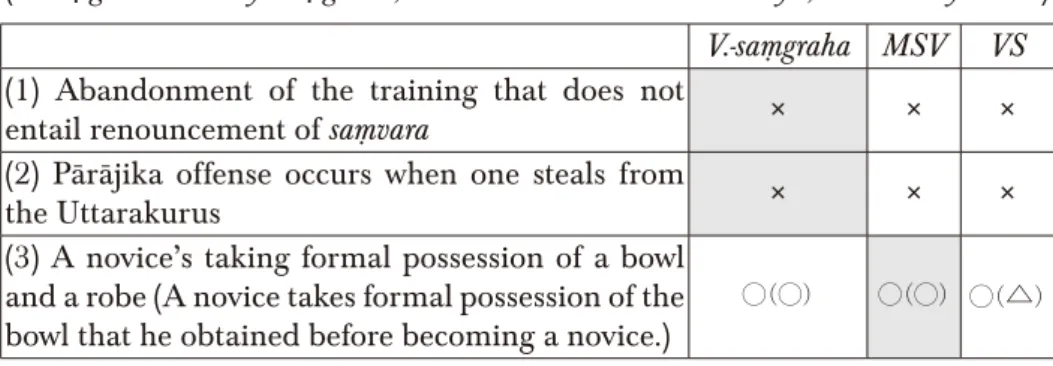
I have inspected the five statements that Bu ston, in his ’Dul spyi, suggests appear exclusively in the Vinaya-sam�graha and are therefore problematic. It turns out that Bu ston’s claim may not hold true in every case. I have shown this in the table below:
Table II: Statements (1)–(5) in V.-sam�graha, MSV, and VS
(V.-sam�graha ≈ Vinayasam�graha; MSV ≈ Mūlasarvāstivāda-vinaya; VS ≈ Vinaya-sūtra) V.-sam�graha MSV VS (1) Abandonment of the training that does not
entail renouncement of sam�vara × × ×
(2) Pārājika offense occurs when one steals from
the Uttarakurus × × ×
(3) A novice’s taking formal possession of a bowl and a robe (A novice takes formal possession of the bowl that he obtained before becoming a novice.)
◯(◯) ◯(◯) ◯(△)
(4) Showing reverence to respectable ones (Skt.
guru) and those who are worthy of great respect (Skt. guru-sthānīya) by falling on the knee
△
× ×
(5) Formal recognition of a place as a kalpika-śālā by
a monk of silly disposition and little intelligence
◯× ×
◯
: included,
△: partially matches, ×: not included
There are at least three ways to explain this result. First, Bu ston might have not sufficiently read the Vinaya-sam�graha. Second, the texts of ’Dul spyi might have somewhat changed through a process of transmission, and consequently the current version that we see today in Bu ston’s complete works may differ to some extent from the original version that he wrote in 1357.
Third, Bu ston saw a version of the Tibetan translation of the Vinaya-sam�graha different from the one that has come down to us.
60)This third possibility might be supported by two facts: the Chinese translation of the Vinaya-sam�graha is said to have circulated in two versions—14 juan 巻 and 20 juan versions—the latter of which is not commonly available at present,
61)and the Tibetan translation also seems to have circulated in two versions—13 bam po and 15 bam po versions
62)— the former of which is, as I briefly mentioned above, available to us in Derge and Peking xylograph editions. However, it is unclear what these different juan 巻 and bam po numbers mean. It is possible that they are merely due to the differences between recensions, and though each of Tibetan and Chinese translations of the Vinaya-sam�graha was circulated in two versions, the two might not differ so much in content.
63) The 15 bam po version of the Tibetan translation of the Vinaya-sam�graha does not seem to be extant. It seems, however, that the 20 juan version of Chinese Vinaya-sam�graha has come down to us. It is reported that the old manuscripts of Chinese Buddhist texts that have been preserved in several temples in Japan, such as Ishiyamadera 石山寺 and Kōshōji 興聖寺, include full copies of the 20 juan 巻 version of Chinese Vinaya-sam�graha.64) I hope to view them in the near future to verify whether they include significant textual variations that do not appear in the 14 juan version.
65)
There seems to be no doubt, in any case, that Bu ston’s brief overview of
the Vinaya-sam�graha in his ’Dul spyi is an interesting account that provides us
with a further glimpse of the unpopularity of the Vinaya-sam�graha in the Tibetan
Buddhist tradition, prompts us to consider credibility of Bu ston’s works that
are extant and available to us, and points to the multiple circulations or
transmissions of the Vinaya-sam�graha.
Notes
* I have discussed the same topic in Kishino (2017). In that paper, however, I had to limit myself to a partial discussion and refrained from including extensive notes and references due to space limitations. The present paper enables me to engage in a full discussion and provide more detailed information. I wish to thank Emeritus Professor Mimaki Katsumi 御牧克己 for giving me a chance to submit this paper to this prestigious journal. I am also indebted to Mr. Dylan Luers Toda, Dr. Shayne Clarke, and Mr. Warren Kadoya for their careful checks of the English and useful comments, all of which improve this paper. This acknowledgement, however, does not imply their entire approval or agreement. I alone remain responsible for any and all errors, inaccuracies, and inconsistencies. I would also like to express my gratitude to JSPS for providing financial support (Grant-in-Aid for JSPS Fellows 18K12204).
1) van der Kuijp (2016: 281, n. 189): “Bu ston completed this work [= ’Dul ba spyi’i rnam par gzhag pa] on the tenth day of ’gro zhun month of a gser ’phyang year, that is, on July 27, 1357.”
2) The text numbers of Derge edition that I provide in this paper are based on Chibetto Daizōkyō sōmokuroku 西蔵大蔵経総目録. Edited by Tōhoku Teikoku Daigaku Hōbungakubu 東北帝国大学法文学部. Tokyo: Meicho Shuppan 名著出版, 1970.
3) Mimaki (1987: 281–282). Mimaki (2000: 1155) notes that Bu ston was the first to designate the two large groups of the translated Indian Buddhist texts as bKa’ ’gyur (The Buddha Words in Translation) and bsTan ’gyur (Scholarly Works in Translation).
4) Hadano (1987: 115–116).
5) These six vinaya texts are as follows: the Shisong lü 十誦律 (a vinaya of the Sarvāstivādins;
T. 1435 [23]), the Sifen lü 四分律 (a vinaya of the Dharmaguptakas; T. 1428 [22]), the Wufen lü 五分律 (a vinaya of the Mahīśāsakas; T. 1421 [22]), the Mohesengqi lü 摩訶僧 祇律 (a vinaya of the Mahāsām�ghikas; T. 1425 [22]), the vinaya of those who call themselves “Theravādins” extant in Pāli (the so-called “Pāli Vinaya”; regarding the problem with referring to them as “Theravādins,” see S. Sasaki [2000: 386, n. 1]), and a series of vinaya texts that modern scholars collectively refer to as the
“Mūlasarvāstivāda-vinaya” (a vinaya of the Mūlasarvāstivādins, or rather another vinaya of the Sarvāstivādins; regarding the well-known discussion about the precise meaning of the term “mūlasarvāstivāda,” see, for convenience, Kishino [2013: 6–9]).
6) The Mūlasarvāstivāda-vinaya is partially but relatively well preserved in Sanskrit. The Sanskrit manuscripts identified as the Mūlasarvāstivāda-vinaya are mostly from Gilgit.
For detailed information about them, see, for convenience, Clarke (2014: 1–17).
7) Hirakawa (1982: 11), for example, calculates that the Mūlasarvāstivāda-vinaya is “about four times longer than other vinayas.” Most recently, Clarke (2016–2017 [2018]: 203–
204) more precisely compares the length of the vinaya with that of the other four Chinese vinaya texts, saying: “the Mūlasarvāstivāda-vinaya would have been approximately seven times longer than the Mahīśāsaka-vinaya (the Wufen lü 五分律), six times the length of the Mahāsām�ghika-vinaya (the Mohesengqi lü 摩訶僧祇律), and four times that of the Dharmaguptaka- and Sarvāstivāda-vinayas (the Sifen lü 四分律 and the Shisong lü 十誦律).”
8) Luo Hong repeatedly refers to the ’Dul ba spyi’i rnam par gzhag pa in his discussions
about the Vinaya-sūtra; Luo (2011a; 2011b). In these papers, however, he does not explain the relationship between the two texts. As we will see below, Maeda (2001) is one of the few studies that even mention the ’Dul ba spyi’i rnam par gzhag pa. In that paper, Maeda explicitly states that the text is “a commentary on the Indian Gun�apraha’s Vinaya-sūtra (インドの Yon tan ’od, Vinyasūtra の解説書)”; Maeda (2001:
1). He does not provide, however, any evidence that supports his statement. He is probably just basing it on the explanation attached to the Tohoku Catalogue. The relationship between the ’Dul ba spyi’i rnam par gzhag pa and the Vinaya-sūtra remains to be examined.
9) There is also a brief reference to the Las brgya rtsa gcig gi rnam par bshad pa cho ga’i gsal la byed ba (5187) in Kishino (2015: 180, n. 69; 183–184, n. 78).
10) For Schopen’s other references to the ’Dul ba pha’i gleng ’bum chen mo in his works, see, among others, Schopen (2001: esp. 103–104); cf. Ende (2016: 85–87). Note also that Hadano (1987: 105) states that Bu ston made the ’Dul ba pha’i gleng ’bum chen mo and the ’Dul ba dge slong ma’i gleng ’bum after he learned the vinaya from Shangs pa Jo ston, who composed a commentary on the Vinaya-kārikā. (“Śākyaśrī が... ≪Ḥdul-ba Me- tog-phre͘n-rgyud) を釈説し、それを Seṅ-ge zil-gnon と Śaṅs-pa Jo-ston が聴聞し、
各自注釈を作ったが、前者 Seṅ-ge zil-gnon に Tshad-mḥi skyes-bu, 後者にプトン が聴聞して ≪Gle͘n-ḥbum ṭīkā-chen-po) (東北大・西蔵撰述仏典目録, Nos. 5192, 5193) を著作した...”) This explanation of Hadano might suggest that the ’Dul ba pha’i gleng ’bum chen mo (and the ’Dul ba dge slong ma’i gleng ’bum) is connected to the Vinaya-kārikā.
11) Bu ston again alludes to his suspicion that the Tibetan Bhikṣuṇī-vibhaṅga belongs to a non-Mūlasarvāstivādin tradition in his ’Dul ba dge slong ma’i gleng ’bum; Schopen (1998:
178, n. 67); most recently and in more detail, Clarke (2016–2017 [2018]: 209–210, n.
26).
12) Schopen (2004a: 180–181; 2008: 230–232); Clarke (2012; 2016–2017: esp. 209–211).
13) Recently, van der Kuijp (2016: 281, n. 189) has also noted the importance of Bu ston’s brief overviews of the Mūlasarvāstivāda-vinaya and related Indian texts in his ’Dul spyi, saying “it contains some precious information on the early Tibetan vinaya literature.”
14) Maeda (2001: 5) provided a partial translation of Bu ston’s overview of the Vinaya- sam�graha in question. His translation, however, leaves some room for improvement.
See n. 26 (esp. underlined parts) below.
15) See, for example, K. Sasaki (1985 [1977]: 168). Sakaino (1932: 2) suggests that the Vinaya-sam�graha is a commentary on the Vinaya-vibha͘nga: “『薩婆多律攝』の内容 は、比丘の『毘奈耶』の逐条的の要領を説いたものである…” Note, however, there seems to be little, if any, decisive evidence for the claim that the Vinaya-sam�graha is a commentary on the Prātimoks�a rules or the Vinaya-vibha͘nga. See the discussion below (4. 1.).
16) There is one more text related to the Mūlasarvāstivāda-vinaya and attributed to a medieval Indian monk that was transmitted and preserved in both Chinese and Tibetan translations: Viśākha(deva)’s (Chin. Pisheqia 毘舎佉; Tib. Sa ga[’i lha]) verse summary of the Mūlasarvāstivāda-vinaya entitled Vinaya-kārikā (Chin. Genbenshuoyiqieyoubu pinaiye song 根本説一切有部毘奈耶頌 [T. 1459]; Tib. ’Dul ba tshig le’ur byas pa [Der.
4123]). Sanskrit fragments (14 folios) of the Vinaya-kārikā have come down to us, though they have yet to be published; Liu & Andrews (2017: 13, n. 17). For a preliminary
report of the Sanskrit fragments, see Clarke’s forthcoming work on the Vinaya-kārikā:
“A Preliminary Survey of Viśākha(deva)’s Bhiks�u-vinayakārikā-kusuma-sraj.”
17) Several fragments of the Tibetan Vinaya-sam�graha are preserved in the Pelliot collection of Tibetan manuscripts from Dunhuang, and have been studied by Yang (2012).
18) Sakaino (1932: 2).
19) K. Sasaki (1985 [1977]: 175–176). Note, however, that Yijing 義浄 started to translate the Vinaya-kārikā during his stay in Nālandā in India, though he did not revise and complete it until he returned to China; Sakaino (1932: 2).
20) For Gakunyo’s 學如 edition of the Vinaya-sam�graha, see Clarke (2006: 26–27); Baba (2016: 269–271).
21) It is well known that the Vinaya-sūtra has been held in high esteem as the fundamental text for the study of vinaya by the dGe-lugs-pa school; Nagao (1954: 16); Onoda (1982:
196–197). Also, the Vinaya-kārikā, which is commonly called Me tog gi phreng rgyud in the Tibetan Buddhist traditions, was intensively taught and studied at Snar thang monastery especially from the 13th to 15th century; Liu (2014). See also n. 10 above.
22) cf. Otani Tanjur Catalogue (5606): “Ind. の師匠 Çīlendrabodhi と Ind. の師匠 Çākyaprabhaと大校修譯官 Vairocanarakṣita 譯. 再び, Kaçmīr の師匠 Jñānaçrībhadra と譯官・釋迦比丘 Rgyal ba çes rab と譯官釋迦比丘 Çākya bçes gñen とが改訂, 検 閲, 刊定.”
23) The view that the Mūlasarvāstivāda-vinaya comprises four major parts (the Vinaya- vibhaṅga, the so-called Seventeen Vastus, the Ks�udraka-vastu, and the Uttaragrantha) seems to be popular in Tibetan Buddhist traditions; cf. Bod rgya tshig mdzod chen mo (s.v.
’dul ba lung sde bzhi). Given that several Indic commentaries on the Mūlasarvāstivāda- vinaya refer to this fourfold structure, the tradition without a doubt originated in India. For details, see Kishino (2013: 32, n. 29).
24) cf. Sam�ghabheda-vastu (Tib. Der. 1 Nga 92b1 ≈ Skt. Gnoli I, 185): Tib. mkhan po dang / slob dpon dang / bla ma dang / bla ma’i gnas lta bu rnams kyi ... ≈ Skt. ācāryopādhyāyānām� gurūn�ām� gurusthānīyānām� ...
25) cf. Yamagiwa (2001: 321): Tib. rung ba’i gnas ≈ Skt. kalpika-śālā; the Vinaya-sūtra (Tib.
Der. 4117, 72a2 ≈ Skt. R. Sāṅkr�tyāyana, 89, no. 301): Tib. rung ba’i khang pa ≈ Skt.
kalpika-śālā. A kalpika-śālā is a special place where several behaviors regarding food, such as cooking and storing, that are forbidden by the vinaya are exceptionally permitted. Yamagiwa (2001) notes that the Pāli Vinaya, the Sifen lü 四分律, and the Wufen lü 五分律 refer to four types of kalpika-śālas, while the Mūlasarvāstivāda-vinaya refers to five. We will see the details of the five below; cf. CPD (s.v. kappiya-kuṭī): “house for (items, i.e., food that) is permitted (for storing and cooking): kitchen; corresponds to rasavatī (q.v.) in a non-ecclesiastical context; built on a compound called kappiyabhūmī (q.v.).”
26) cf. Maeda (2001: 5): “プトンはこの書を根本説一切有部の律と異なっていること を主張している. すなわち,「この書は學を与え終わった段階で制戒 (sdom pa) を与えていないこと, 北倶盧洲のものより偸盗し波羅夷罪になることと, 師の 座となる諸々の比丘に女子をあてがい手伝い (phyag gi go chod) をすることと, また受持の厨房に入る, (身体の) 弱い者の受持とか, 知の少ないものの受持をは じめとする四部門にわたり, Vinayasūtra と多く矛盾することがあるため、他の 部派の極上説を誤ったのか、根本説一切有部の律を知らないものが著したこ とが明らかであり, 信託できない」(57b4–6) と述べている.”
27) Watanabe (1977).
28) Kishino (2009).
29) Kishino (2013: 25, n. 1).
30) cf. Fujita (2004: 201): “... これをシャル本テンギュルともいう... プトンはこれ に対する目録『テンギュル目録』(Toh. 5205)を作成した (1335年完成, プトンは 45歳).”
31) For more details on the textual characteristics of the Vinaya-sam�graha, see Kishino (2018).
32) Kun mkhyen mtsho sna ba shes rab bzang po (12th–13th century CE; cf. Tsedroen 1992: 76–77) also refers to the Vinaya-sam�graha as a commentary on the Prātimoks�a-sūtra in his commentary on the Vinaya-sūtra, ’Dul ba mdo rtsa’i rnam bshad nyi ma’i ’od zer legs bshad lung gi rgya mtsho: gzhan yang so sor thar pa’i ’grel pa ’Dul ba bsdus pa slob dpon Khyad par bshes gnyen gyis mdzad pa ste ’gyur snga phyi gnyis dang /... (’Dul ṭi ka nyi ma’i ’od zer legs bshad lung rigs kyi rgya mtsho, Vol. II, 370, 16–17). The identification of the Vinaya- saṃgraha as a Prātimoks�a-sūtra commentary might not have been peculiar to Bu ston; it was widely found in Tibetan Buddhist traditions at the latest in the 13th century.
33) Der. 4105, 127b4–128b3.
34) Yijing’s version of the Vinaya-sam�graha also refers to the necessity of establishing a kalpika-śālā (jingchu 淨厨) within the vihāra and to the five kalpika-śālās. It does not mention, however, a monk of silly disposition or of little intelligence; T. 1458 [24]
545b2–: 次明作淨厨法. 凡是寺内, 應作淨厨. 此類不同. 有其五種: 一生心作, 二共 印持, 三如牛臥, 四故廢處, 五衆結作. 言 “生心” 者...
35) Edgerton (s.v. kalpika-śālā): “five are listed ... all are ‘explained’ in 6ff but the glosses are not all very clear.”; Yamagiwa (2001: 320–322, esp. n. 14): “それぞれに簡潔な説 明が付されているが、チベット訳が難解であるため明確に意味を把握できな い部分がある”; cf. Bhaiṣajya-vastu (Tib. Der. 1 Ga 24b2– ≈ Skt. Dutt, 235 [mostly reconstruction]): Tib. bcom ldan ’das kyis rung ba’i gnas bsko bar bya’o zhes bka’ stsal pa dang / dge slong rnams kyis ci ’dra ba dang ji tsam pa ma shes nas / bcom ldan ’das kyis bka’ stsal pa / rung ba’i gnas lnga ste / rtsom pa’i mtha’ can dang / sems gtod pa’i mtha’ can dang / ba nyal ba lta bu dang / stong pa’i gnas dang / bskos pa’o // (cf. Yao, 2013: 542: “世尊が「浄地を劃 定してよい」とおおせられたところ, 諸比丘はどのような, またどれだけの大 きさのものかを知らなかったので, 世尊はおおせられた. 「浄地は五種である.
すなわち【1】建設に関するものと,【2】注意を向けることに関するものと,
【3】牛舎のようなものと,【4】空の場所と,【5】劃定されたものである.」”) ≈ Skt. [ ... bhagavān āha / pañca kalpikaśālā bhavanti / ārabhyamān�āntikā ucchrīyamān�āntikā gonis�ādikā udbhūtava] stukā saṁmatikā ca / ... (cf. Yamagiwa, 2001: 321, n. 14: “更に
「五種の浄地」をDuttは, ① ārabhyamān�āntikā, ② ucchrīyamān�āntikā, ③ gonis�ādikā, ④ udbhūtavastukā, ⑤ sam�matikā, に対応させているが, 松田和信氏 が所蔵するギルギット写本マイクロフィルム中の当該部分 (Folio No. 266) で確 認した所, 写本で単語を確定出来るのは、① ucchrayan�āntikā, ③ gonis�ādikā, ④
udbhūtavastukā, ⑤ sam�matikā, の四種であり②を示す部分は欠損していて判明
しない.”). The Muktaka of the Mūlasarvāstivāda-vinaya also includes a reference to the procedures for establishing a kalpika-śālā (Tib. rung ba’i khang pa ≈ Chin. jingchu 淨厨);
Kishino (2016: 243, § 1.9.4).
36) The Vinaya-sūtra (Tib. Der. 4117, 78a5 ≈ Skt. R. Sāṅkr�tyāyana, 95, nos. 179–192). There seems to be no doubt that the series of sūtras deal with four kalpika-śālās, since it begins with the Tib. ’di la dus bźi yod do / ≈ Skt. catvārātra kālāh� / (“There are four occasions”),
which the Vinayasūtra-vr�tty-abhidhānasvavyākhyana comments on, saying: Tib. ’di la dus bzhi yod do zhes bya ba ni ’dir rung ba’i khang pa byin gyis brlab pa ’di la dus bzhi yod pa’o //
(“Regarding [the sūtra] ‘there are four occasions,’ [it means that] there are four occasions on which the kalpika-śālā is formally recognized”). It is not completely clear, however, what the following sūtras (and also the comments on them in the Vinayasūtra- vr�tty-abhidhānasvavyākhyana) exactly mean. As a result, I am uncertain which four of the five kalpika-śālās are being mentioned in the Vinaya-sūtra.
37) The Vinayasūtra-vr�tty-abhidhānasvavyākhyana also does not mention a monk of silly disposition or of little intelligence in the comments on the sūtras concerning the kalpika-śālās; Derge Der. 4119 Zu 163a5–b3.
38) Der. 4105, 243b2–3; cf. Chin. T. 1458 [24] 599a26–27: 若尊及尊類, 應*手膝至地, 或 時曲躬, 低頭合掌, 或捉腨, 或蹲踞合掌. *雙=宮内省図書寮本 (旧宋本), 正倉院聖 語蔵本 (天平写経).
39) Pravrajyā-vastu (Tib. Der. 1 Ka 52a3; Eimer 136): phyag ni gnyis te / yan lag lngas phyag
’tshal ba dang / sgyid pa nas ’khyud pa ste ’dir gaṅ yaṅ ruṅ ṅo //; Kṣudraka-vastu (Tib. Der. 6 Tha 194a5–6 ≈ Chin. T. 1451 [24] 273a26–27): Tib. “nye bar ’khor ’on kyang ’phags pa’i chos
’dul ba la ni phyag gnyis te / yan lag lnga dang / byin pa la ’khyud pa’o //” ≈ Chin. “然鄔波 離, 於我法律, 有二種敬禮. 云何為二. 一者, 五輪著地. 二者, 兩手捉腨.”
40) The Vinaya-sūtra (Tib. Der. 4117, 93b4): phyag ni rnam par gnyis te / yan lag lngas phyag
’tshal ba dang / sgyid pa la ’khyud pas ’tshal ba’o //. The Sanskrit text published by R.
Sāṅkr�tyāyana seems to be incorrect. Therein, there is no phrase equivalent to the Tibetan rnam par gnyis te (R. Sāṅkr�tyāyana, 111 no. 92): ... cade (? ceda)-vandane pañcaman�d�alakena jaṃghaprapī[d�a]nikayā ca /. The Vinaya-kārikā (Tib. Der. 4123, 47b3 ≈ Chin. T. 1459 [24] 647c14) also refers to the two postures: Tib. gcig ni dkyil ’khor lnga pa ste // gzhan gyi sgyid pa nas ’khyud yin // ≈ Chin. 一謂以五輪 二乃搦其腨.
41) Der. 4105, 243b2–3. Yijing’s version also refers to the way of showing reverence by kneeling as one of the others’ views (T. 1458 [24] 599a25–28): 有説: 禮大師時, 五輪 至地. 若尊及尊類, 應手膝至地, 或時曲躬低頭合掌, 或捉腨, 或蹲踞合掌. 若對所 餘, 同梵行者, 若但合掌, 或復低頭, 或口云畔睇.
42) Kishino (2009: 187–188).
43) Pravrajyā-vastu (Tib. Der. 1 Ka 52a7–53a7, 53b3–5; Eimer 136–139; 139–140): de’i ’og tu mkhan po rang gis de la chos gos gsum byin gyis brlab par bya’o // ...; de’i ’og tu mkhan po rang gis de la lhung bzed byin gyis brlab par bya’o // ...
44) cf. Vinaya-sūtra (Tib. Der. 4117, 2b3–4; 2b4 ≈ Skt. R. Sāṅkr�tyāyana 2, no. 40; nos. 41–42;
cf. Vinayasūtra-vr�tty-abhidhānasvavyākhyana [Bapat & Gokhale, 1982: 10–11; Ritsukyō shukkeji kenkyūkai, 2005: 57 [text]; 62–63 [Jp. translation]]): Tib. de rang gis de la chos gos gsum byin gyis brlab par bya’o //; lhung bzed kyang mi chung ngam mi che ’am mi skya ba’am zhes dge ’dun la bstan nas so // thams cad kyis de lta bu nyid ma yin na lhung bzed bzang ngo zhes brjod par bya’o // ≈ Skt. sa svayam enam. tricīvaram adhis�t�hāpayet /; pātram� copadarśya monam� adhikam� pān�d�aram� veti sam�ghe / supātram ity anevam�tve brūyuh� sarve /.
45) Peking 5606, 315a7. cf. Der. 4105, 241b5–6: chos gos rnams dang lhung bzed ni dge ’dun la brten te byin gyis brlab par bya’o //. Yijing’s version also seems to support Peking’s reading (T. 1458 [24] 598c3–5): 次令捧鉢巡行. 呈現大衆, 一一已, 咸云: “好鉢,” 不道者, 得 惡作罪. 即對衆前本師為, 守持衣鉢.
46) cf. Vinaya-sūtra (Tib. Der. 4117, 2a3 ≈ Skt. R. Sāṅkr�tyāyana 1 no. 16; cf. Vinayasūtra-vr�tty- abhidhānasvavyākhyana [Bapat & Gokhale, 1982: 7; Ritsukyō shukkeji kenkyūkai, 2003:
71 [text]; 88 [Jp. translation]]): Tib. mkhan pos gos ngur smrig dag sbyin par bya’o // ≈ Skt.
upādhyā yah� kās�āyān�i vastrān�i dadyāt /.
47) cf. Vinaya-saṃgraha (Tib. Der. 4105, 241b6 ≈ Chin. T. 1458 [24] 598b27–28): lhung bzed med par dge tshul du mi bya’o // ≈ 應畜鉢盂. 若無鉢者, 不應出家.
48) Yamagiwa (1987: 84); cf. Pravrajyā-vastu (Der. no. 1 Ka 50b2; Eimer, 132): de’i ’og tu mkhan pos lhung bzed dang gos ngur smrig dag sbyin par bya zhing des kyang rkang pa gnyis la gtugs nas blang bar bya’o //; the Kṣudraka-vastu (Tib. Der. 6 Tha 228a1–2 ≈ Chin. T. 1451 [24] 284a4–5): bcom ldan ’das kyis bka’ stsal pa / dge slong gis lhung bzed med pa rab tu dbyung bar mi bya ste / rab tu ’byin na ’gal tshabs can du ’gyur ro // ≈ 佛言: “不應無鉢, 與他出家.
作者, 得越法罪.”
49) Note, however, that though Yamagiwa does not refer to it, the Vinaya-sūtra also includes a sūtra that may be taken as suggesting that a bowl must be given to the candidate (Tib. Der. 4117, 7a3 ≈ Skt. R. Sāṅkṛtyāyana 7, no. 279): Tib. lhuṅ bzed med par rab tu dbyuṅ ba daṅ bsñen par rdzogs par mi bya'o // “Do not have one enter the religious life and be fully ordained without a bowl.” ≈ Skt. nāpātrakam� pravrājayeyur upasampādayeyur vā /.
50) Note, however, that it would not be uncommon in Tibetan Buddhist traditions for the Vinaya-sūtra to be prioritized more than the canonical vinaya. In the dGe-lugs-pa school, for example, the Vinaya-sūtra, rather than the canonical vinaya, has been held in high esteem. See n. 21 above.
51) Der. 4105, 108b7; cf. Yang, 2012: 124; cf. Chin. T. 1458 [24] 536b23–24: 北倶盧洲物, 非己想, 無不與取故, 無盜罪.
52) For details on the characteristics of Uttarakuru, see Honjō (1999).
53) The Upāli-paripr�cchā of the Mūlasarvāstivāda-vinaya (Der. 7 Na 6a4–5; cf. Kishino, 2006a:
§ 1.2.2 no. 31c): btsun pa byang gi sgra mi snyan gyi gling du ma stsal bar brkus na cir ’gyur lags / nye ba ’khor de na ni ma byin par len pa med de / gal te brku sems bskyed na ni nyes pa sbom por
’gyur ro // ; the Vinaya-sūtra (Tib. D. 4117, 15b4–5 ≈ Skt. R. Sāṅkṛtyāyana 17 no. 200):
byang gi sgra mi snyan na ni yongs su ’dzin pa med pa nyid do // ≈ aparigrahatvam uttarakurau /; cf. Vinayasūtra-vr�tty-abhidhānasvavyākhyana (Der. 4119, 69b6): byang gi sgra mi snyan pa rnams kyi rdzas rkus pa bzhin du de la ma byin par len pa med de / bdag tu ma byas pa nyid kyi phyir ro //.
54) cf. Prātimoks�a-sūtra (Tib. Der. 2 Ca 3b1–4 ≈ Skt. [reconstruction] Banerjee, 1977: 14 ≈ Chin. T. 1454 [24] 501a8–10): Tib. yang dge slong gang dge slong rnams dang lhan cig bslab pa mtshungs par gyur pas bslab pa ma phul bslab pa nyams par ma byas par mi tshangs par spyod pa ’khrig pa’i chos bsten na / tha na dud ’gro’i skye gnas su skyes pa dang lhan cig kyang rung ste / dge slong de pham par gyur pa yin gyis gnas par mi bya’o // (cf. Vidyabhusana, 1915: 12:
“Whatsoever monk, who has received the monk’s system of training and has not abandoned or injured it, indulges himself in impure intercourse down even with a brute beast, incurs Defeat and must not live in the community of monks.”) ≈ Skt. [yaḥ punar bhiks�ur bhiks�ūn�ām� śiks�āsājīvasamā pannah� śiks�ām apratyākhyāya śiks�ādaurbalyam anāvis�kr�tyābrahmacaryam� maithunam� dharmam� pratisevate antatas tiryagyonigatayāpi sārdham�, ayam api bhiks�uh� pārājiko bhavaty asam�vāsyah� / ] (cf. Prebish, 1975: 51: “Whatever monk, having undertaken the proper course and training of the monks, should, not having rejected the training and not having revealed his weakness in the training, indulge in sexual intercourse, an unchaste thing, even so much as with an animal, this monk is pārājika, expelled.” This translation is based on Banerjee’s reconstructed text. Relatedly, it might be noted that a collection of Sanskrit manuscripts found in