How to prepare and use compost for sustainable agriculture
+ Topics on Green Manure
Kiyoshi Tsutsuki
Prof. Ph.D in Soil Science ([email protected])
Obihiro University of Agriculture and Veterinary Medicine
Part 3: Quality of Compost.
Compost maturity
• Mature compost is material in which biological activity has slowed. All of the easily degraded molecules have been broken down, leaving the complex organic material behind. It is difficult to identify the original feedstock materials. A fine texture, dark color, and a rich earthy smell often characterize mature composts.
Immature composts 1
• The high level of microbial activity in unfinished compost requires a large
intake of oxygen, and the microbes may pull this from the surrounding soil,
essentially suffocating the roots.
Immature composts 2
• The high C:N ratio of immature compost also means that as the carbon compounds continue to break down, microorganisms will draw on soil nitrogen to assist in the process, leaving the root zone temporarily nitrogen poor.
Immature composts 3
• Immature compost may also become a substrate for plant pathogenic
microbes and enhances the activity of soil borne plant diseases.
• Stunting of seedlings by a Fungi Pythium spp is a good example.
Immature composts 4
• It is therefore crucial that responsible compost producers ensure that their
compost has time to fully mature before handed to customers or applied to soil.
• Compost that is still “hot” can do serious damage to both customers plantings and your reputation.
Stability and Maturity
• The term stability is often used interchangeably with maturity. They are not really equivalent, however, and you must be sure that you are assessing maturity, rather than simply stability, when monitoring your composting process.
Maturity
• Biological activity has slowed, as most remaining molecules are
difficult to break down any further.
Stability
• Biological activity has slowed, but this may be due to a variety of factors – the material may be mature, or it may lack adequate nitrogen or water for the process to continue. In this case, if the missing factors are added, biological activity will resume at active levels.
Indicators for compost maturity
• Detection of NH4+ or NH3 (by Nesler reagent). Occurrence of NH4+ or NH3 suggests that the compost is still immature. There are exceptional cases and can not be a single measure.
Detection of NO
3-• Detection of NO3- (by diphenylamine reagent). Occurrence of NO3- suggests that the composting process reached final stage. Easily subverted by adding chemical NO3- to compost. Detection of nitrate is interfered by several ions in the compost.
NH4+, NH3
Temperature
NO3-
Temperature change
• Applicable to all types of composting materials.
Indicators for compost maturity
Thermophilic stage
60℃
Mature
pH
• First increase due to ammonia, then decrease due to nitrate, carbonate, and humic substances.
7 8
6
Electron conductivity (EC)
• Increase through composting,
but should not reach toxic level.
(< 5 mS/cm)
Plastic bag method
• Compost mixture is put in a plastic bag and tightly closed. If the compost is immature, the plastic bag will inflate due to the emission of carbon dioxide from the compost.
Immature CO2 inflate
Cation exchange capacity
• Increase during composting. Applicable to composts using straws, wood and bark, sewage sludge, and municipal wastes as feedstocks.
HOOC COOH
COOH
COOH OH
OH
C/N ratio
• When C/N was higher than 30 at the start and it reached 15 – 20, it shows that the compost has fully matured. It is not applicable when composting mixture had low C/N from the beginning.
Carbon
Organic nitrogen
Inorganic nitrogen
Soil
Microbes
When soil microbes proliferate utilizing organic matter with wide C:N ratio, they also absorb soil inorganic nitrogen.
This causes nitrogen starvation for crops.
CO2
Optical density of water extract of composts.
• Samples of compost are suspended in a hot water at 60 degree C in 1:10 wet weight ratios and shaken for 30 min. Supernatant is centrifuged at 10,000 g and filtered through 0.45 micrometer membrane filter. Optical densities at 280, 465, and 665 nm are measured. They increase in the mid-stage of composting, then decrease in the final stage.
Earthworm method
• Put a compost sample in a cup.
• Place a few earthworms on it.
• Cover the cup with a black cloth.
• If the earthworms creep into the compost, it is mature.
• If they try to escape, it is immature.
Earthworm escapes if your compost does not taste good.
Germination test
• Seeds of Komatsuna(Brassica campestris), Cress (Lepidium sativum), or radish (Raphanus sativus) may be used, because these seed are small, quick to germinate, and sensitive to phytotoxic (plant damaging) substances like the organic acids temporarily present in immature composts. Using the water extract of the compost, germinating rate is compared with the control (distilled water).
Control (Distilled Water) Starting time of composting
24 hrs after composting 2 weeks after composting
Example of Failure Case in Composting
Germination Test
Seedling growth method
• Compost (150 g) and soil (350 g) are mixed and put in a Neubauer pot. The control is only the soil (500 g). Each 35mg of N, P2O5, and K2O are applied to each pot in forms of ammonium sulfate, ammonium phosphate, and potassium sulfate.
Water is applied to about 60 % of the water holding capacity. Twenty seeds of Brassica campestris are sawn on the surface of mixture, and germination rate and growth rate are observed.
Seedling growth method 2
• Compost (equivalent to 100, 200, 300, 400 mg of nitrogen) are mixed with soil (500 g) in Neubauer pots. The control is only the soil (500 g). 25 mg of N, P2O5, and K2O are applied to each pot in forms of ammonium sulfate, ammonium phosphate, and potassium sulfate. Water is applied to about 60 % of the water holding capacity. Twenty seeds of Brassica campestris are sawn on the surface of mixture, and germination rate and growth rate are observed.
Growth of Brassica campestris
To 500mL of soil, compost equivalent to 400mg of N was applied (1 week after seed sowing)
Soil + Chemical
Fertilizer (control)
Raw Sewage sludge
After 1st turning
After 5th turning
Effect of Sewage Sludge Compost on the Growth of Brassica campestris
To 500mL of soil, compost equivalent to 400mg of N was applied (19 days after seed sowing)
Soil + Chemical
Fertilizer (control)
Raw Sewage sludge
After 1st turning
After 5th turning
Compost standards in Japan
RegulaIons on the quality of compost handled in market
Common standards for all composts
• As < 50 mg/kg, Cd <5mg/kg, Hg <2mg/kg
• No irregular growth of plants. Seedling growth test using Komatsuna (Brassica campestris) is recommended.
• Copper content < 600 ppm, Zinc content
<1800ppm (weight/weight oven dry basis).
Following items should be indicated on the package of the compost (1)
• Raw materials should be indicated. (For example: cow manure and saw-dust)
• Organic matter (%) > 60 %
• Carbon:Nitrogen ratio (C/N ratio): < 30
• Total nitrogen content: > 1% dry matter basis
• Total phosphate (P2O5) content: > 1% dry matter basis
Following items should be indicated on the package of the compost (2)
• Total potassium (K2O) content: > 1% dry matter basis
• Total copper content : < 600 mg/kg
• Total zinc content : < 1800 mg/kg
• Total calcium (CaO) content
• Moisture: < 70% of the raw product
Electron conductivity
• Should be <5 mS/cm for raw product
• need not be indicated on the package of the compost.
For production of manure compost
• Compost should be piled for more than three months with turning several times.
Total regulation for heavy metal content in soil
• Zinc content in the plowed soil should not exceed 120 ppm. In soils which exceed this level, composts made from sewage sludge or municipal wastes should not be applied any more.
( G u i d e l i n e b y t h e M i n i s t r y o f Environment: 1984)
Total contents C ontents in w ater extracts (1:10)
A rsenic (A s) 50 m g/kg 1.5 m g/L
C adm ium (C d) 5 m g/kg 0.3 m g/L
M ercury (H g) 2 m g/kg 0.005 m g/L
Lead (P b) 3 m g/L
O rgano-phosphorus
com pounds 1 m g/L
C r 6+ 1.5 m g/L
C yan (C N-) 1 m g/L
A lkyl m er c
u r y should not be detected
P C B 0.03 m g/L
M ethod
O fficial Fertilizer A nalysis M ethod by M inistry of A griculture
O fficial m ethods for determ ining harm ful
m aterial s i n i i n e d m e P r ustry wastes by t h
M inister's O ffice
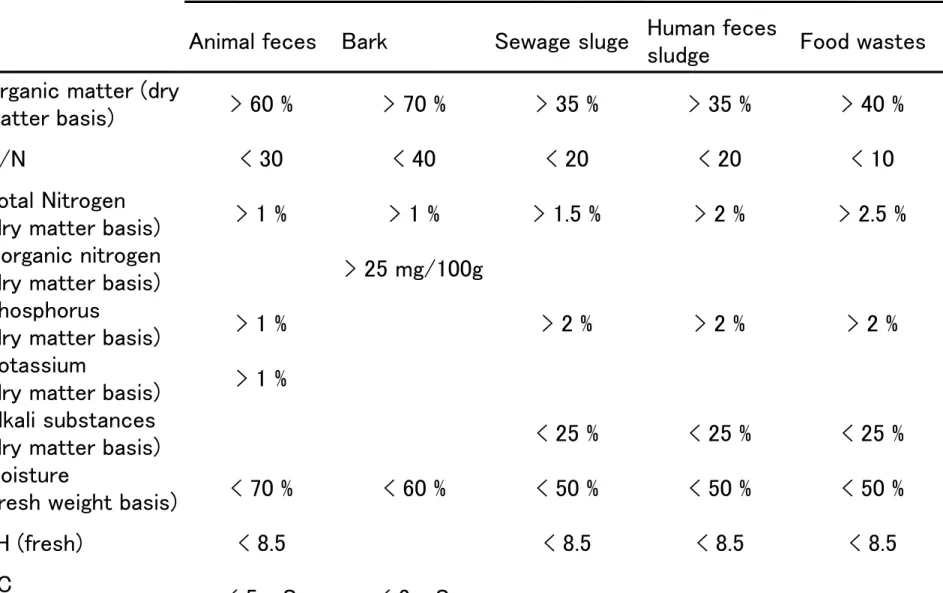
Table 7. Regulated values (upper limits) for heavy metals in special fertilizers including sewage sludges according to Ministry of Agriculture of Japan
Animal feces Bark Sewage sluge Human feces
sludge Food wastes
Organic matter (dry
matter basis) > 60 % > 70 % > 35 % > 35 % > 40 %
C/N < 30 < 40 < 20 < 20 < 10
Total Nitrogen
(dry matter basis) > 1 % > 1 % > 1.5 % > 2 % > 2.5 %
Inorganic nitrogen
(dry matter basis) > 25 mg/100g
Phosphorus
(dry matter basis) > 1 % > 2 % > 2 % > 2 %
Potassium
(dry matter basis) > 1 %
Alkali substances
(dry matter basis) < 25 % < 25 % < 25 %
Moisture
(fresh weight basis) < 70 % < 60 % < 50 % < 50 % < 50 %
pH (fresh) < 8.5 < 8.5 < 8.5 < 8.5
EC
(fresh weight basis) < 5 mS < 3 mS
CEC
(fresh weight basis) > 70 meq/100g
Table 8. Standard and recommended values for composts by the central federation of
agricultural cooperative associations in Japan
Raw material
Constituents in animal feces composts A:Cow,
B:Pig, C:Chicken
A B C A B C A B C A B C A B C A B C A B C A B C
Moisture