I. Introduction
The second language (L2) acquisition of functional morphology has been widely researched for the past few decades. Especially, a large number of studies have been made on L2 English learners’ inconsistent uses of verbal inflections such as the past tense –ed and the third person present singular –s (Hawkins and Liszka 2003;
Ionin and Wexler 2002; Lardiere 1998a, b; White 2003b, among others). Although the inconsistent suppliance of verbal morphology in L2 has been an object for a long time, there is little agreement as to source of the inconsistency. Specifically, there are two contrasting views on the interlanguage grammar giving rise to the inconsistency: the Impaired Functional Representation and the Full Functional Representation views. In the former view, it is claimed that adult L2 learners are unable to access functional categories and their associated formal features which are absent in their first language (L1), so their L2 functional representation is ‘impaired’
(Tsimpli and Roussou 1991, Hawkins and Chan 1997, Tsimpli 2003, Hawkins and Hattori 2006, among others).
In contrast, the latter view assumes that adult L2 learners are able to ‘fully’ represent functional categories and associated features in their interlanguage grammar. It is further proposed that the inconsistent use of functional morphology is due to mapping problems from formal features to their surface morphology (Schwartz and Sprouse 1994; 1996, Lardiere 1998a, 1998b; Prévost and White 2000; Goad and White 2006; among others).
Asymmetry between Suppletive and Affixal Inflections in Second Language Acquisition
山崎 妙
Tae YAMAZAKI
Abstract
The present paper aims at exploring a reason behind omission and inappropriate uses of verbal inflections in second language (L2) acquisition. An asymmetry between the uses of suppletive and affixal inflections was focused on. Seventeen Japanese-speaking learners of English participated in the study. The results from an elicited imitation task and a grammaticality judgment task revealed that the L2 learners’ inconsistent uses of the agreement morphology was compatible with neither the verb-raising account (Ionin and Wexler 2002) nor the semantic content account (Parodi 2000). I thus propose to take frequency effects into consideration.
Among numerous attempts to contribute to the debate mentioned above, there is an interesting finding concerning L2 acquisition of agreement morphology: learners of L2 English acquired the suppletive agreement such as the auxiliary/ copula be earlier than the affixal agreement such as the third person present singular –s (Ionin and Wexler 2002, Lardiere 1999). According to an account given by Ionin and Wexler, L2 learners become able to use the suppletive inflection more easily than the affixal one, because the inflection on raised verbs (i.e., the be form) is required by the language universal rules whereas the verbal affixation (i.e., -s), involving unraised thematic verbs, is led by the English-specific rules.
In the present study, I consider reasons behind the asymmetry in the acquisition of suppletive and affixal inflections in L2 English of 17 adult Japanese speakers through two tasks: an elicited imitation task and a grammaticality judgment task. First, the plausibility of the Ionin and Wexler’s account is examined by comparing the realisation of agreement on the auxiliary do, the auxiliary/ copula be and thematic verbs, on the assumption that the auxiliary do and thematic verbs do not raise overtly to obtain agreement morphology while the be form involves raising. I also refer to alternative accounts of the asymmetry between the suppletive and the affixal inflections used by L2 English learners.
This paper is organized as follows. Section II reviews relevant studies on morphological variability in L2 acquisition and introduces the existing views to the L2 grammar. Section III presents the results and anslyses of the current experimental study. Section IV discusses possible sources of the inconsistent use of verbal inflections. Finally, Section V summarises the findings and proposes an account of the L2 acquisition of verbal inflections.
II. Background
2.1 Morphological variability in L2 acquisition Impaired functional representations
Inconsistent uses of functional morphology have provoked a great deal of controversy. The crucial issue is the presence or absence of certain functional categories and the specification of associated features in the L2 grammar. Various L2 studies attributed the morphological variability to a deficit in the L2 grammatical representations. Among them, the Minimal Tree Hypothesis (Vainikka and Young-Scholten 1996, 1998) and the Valueless Feature Hypothesis (Eubank 1993/4) indicated that functional projections and/ or features are impaired at an early stage of L2 development (White 2003a: 185). According to the Minimal Tree Hypothesis, L2 learners transfer a bare VP projection at the beginning of acquisition. Then they project an underspecified functional projection, or Finite Phrase (FP), which is evidenced by various L2 phenomena such as the optional verb-raising and the lack of agreement morphology. Next, AgrP is projected, and finally CP is projected. The
166
functional categories, namely FP, AgrP and CP, are not subject to L1 transfer, but acquired through accessing UG (Vainikka and Young-Scholten 1998: 17). The Valueless Feature Hypothesis (Eubank 1993/4) proposed that L1 lexical and functional categories are present at an early stage of L2 development due to L1 transfer.
However, feature values in those functional categories are inert, so that L2 learners at this stage apply verb-raising in an inconsistent manner. It was also suggested that feature strength is acquired developmentally through acquisition of the associated morphological paradigm (White 2003a: 87). In sum, both the Minimal Tree Hypothesis and the Valueless Feature Hypothesis assume the existence of representational deficits in early L2 grammar; however, they propose that such deficits are restricted to an early stage, and that L2 grammar develops as L1 grammar does (White 2003a: 185).
Contrary to these two hypotheses, some studies claim that L2 grammar is defective throughout the course of development and that L2 acquisition is not constrained by UG. Clahsen and Muysken (1989) compared L1 and L2 German acquisition and found differences between L1 and L2 learning. For example, the attainment of subject-verb agreement, which is indicated by the emergence of the second person inflection –st, is associated with the acquisition of the verb-second constraint in L1 acquisition, whereas in L2 they are not related each other. It was thus concluded that L1 acquisition is guided by UG principles but L2 acquisition is not.
In addition, there are some researchers arguing that L2 grammar is permanently impaired in a more restricted way. For instance, Hawkins and Liszka (2003) examined the English tense marking by advanced L2 learners, whose L1s are Chinese, Japanese or German. They found that only Chinese speakers showed highly optional past tense marking. The result can be explained by claiming that Chinese speakers cannot establish the [+/- past] feature in T because it is absent in Chinese language, while Japanese and German speakers can establish the feature because their L1s have it in T. Accordingly, it is argued that a permanent deficit in L2 grammar is restrictively attributed to features which do not exist in L1 grammar.
Problems in the morphological realisation
Some work on L2 acquisition have proposed that inconsistent uses of functional morphology is not due to the representational deficit but due to problems in realising appropriate surface morphology (Haznedar 2001; Ionin and Wexler 2002; Lardiere 1998a, b; White 2003b). For instance, Lardiere (1998a, b) examined an end-state L2 grammar by observing spontaneous speech production of an adult advanced speaker of L2 English. The subject, Patty, was 32 years old, and had lived for about 10 years in the United States at the time of the first recording.
The second and the third recordings were conducted eight and a half years after the first recording. Lardiere
examined Patty’s use of verbal inflection and other syntactic phenomena which are associated with Tense and
Agreement, such as nominative case assignment on pronominal subjects, null subjects and thematic
verb-raising in relation to the negators and adverbs. Results showed that the suppliance of verbal inflections in obligatory contexts were low (34.7% for the past tense –ed and 4.6% for the third person present singular –s);
nevertheless, almost no errors were found concerning pronominal case marking, null subjects and verb-raising.
Accordingly, it was suggested that a T-projection which is fully specified in terms of finiteness and strength is present in Patty’s L2 grammar, although the surface inflection is not overtly realised. Lardiere concluded that the inconsistent suppliance of verbal inflections is not due to impairment of functional categories or features.
Assuming that the absence of verbal morphology does not necessarily indicate the absence of the target-like functional representation, researchers have tried to identify the reasons of L2 learners’ optional use of inflections. For instance, Prévost and White (2000) elaborated on the reason behind the use of non-finite forms in finite contexts, by referring to Distributed Morphology (Halle and Marantz 1993).
Following a ‘principles-and-parameters’ grammar, Distributed Morphology (DM) assumes the structure described in (1):
(1)
(Halle and Marantz 1993: 114)
Firstly, according to DM, the five levels in the tree above consist of terminal elements, and they consist of complexes of grammatical features. These terminal elements are supplied with phonological features only after Vocabulary insertion at MS. Secondly, Vocabulary entries which are specified for grammatical features are in competition for insertion in a particular terminal node; specifically, such entries are ‘ordered by the principle that the most specified entry takes precedence over entries that are less specified’ (p.120). In addition, a Vocabulary entry can be inserted into the terminal node as far as its features form a subset of the features on the terminal node; in other words, the Vocabulary insertion takes place even when its features does not exactly match those in the terminal node.
The Missing Surface Inflection Hypothesis (MSIH), advanced by Prévost and White (2000) and White (2003a), proposed to differentiate lexical underspecification from underspecification of functional categories or features. It further suggested that Vocabulary items can be underspecified in the L2 lexicon while terminal
DS (D-Structure) SS (S-Structure)
(Logical Form) LF MS (Morphological Structure) PF (Phonological Form)
168
nodes in syntax are appropriately specified. Let us consider an example in German:
(2)
(White 2003a: 197 with some modifications)
(3) a. verstehen: [α finite, α person, α number]
b. verstehst: [+finite, 2SG]
c. versteht: [+finite, 3SG] (White 2003a: 198)
In German, a sentence du verstehst (you understand in English) is grammatical; however, a sentence du verstehen, which has an incorrectly inflected form, is also found in L2 German. Such an incorrect form appears for the following reason. Given the MSIH, on the one hand, terminal nodes in syntax are appropriately specified as illustrated in (2) since L2 learners have target-like abstract syntactic knowledge. On the other hand, lexical entries for the terminal node I in (2) are given in (3). Following DM, lexical entries may be underspecified while terminal nodes are fully specified; for example, the lexical item in (3a) is underspecified with respect to finiteness, person and number features. Furthermore, a lexical item can be inserted in a terminal node even if its features do not match with all the features on the terminal node. The lexical item in (3b) can be inserted in I because its features match the features in I. Next, the lexical item in (3c) cannot be inserted in I because its person and number features are distinct from those in I. Finally, the lexical item in (3a) can be inserted in I because its features are not distinct from those in I although they do not exactly match each other.
This account is compatible with L2 learners’ inconsistent uses of inflections; that is, non-finite forms appear in a variety of contexts because they are underspecified, whereas fully specified forms do not.
In this subsection, I have reviewed some studies dealing with variability in inflectional morphology in L2 acquisition, and introduced two contrasting views to explain the reasons behind the variability. In the next subsection, I will examine Ionin and Wexler’s (2002) study, which is in favour of the MSIH.
IP
Spec I'
[2SG]
I
[+finite, 2SG]
2.2 The asymmetry between suppletive and affixal inflections
Ionin and Wexler (2002) analysed spontaneous production and grammaticality judgement data of L1 Russian children learning English, and found that the functional category T is present and features in T are appropriately specified in their L2 grammar. They examined various verbal inflections as well as the realization of syntactic properties associated with Tense and Agreement. I will limit the scope to their findings with regard to suppliance of the third person present singular –s on thematic verbs and the auxiliary/ copula be. It was reported that the L2 learners used the auxiliary/ copula be more frequently than the affixal inflections on the thematic verbs. The omission in obligatory contexts was 78% for the third person present singular –s on the one hand, it was 33% for the auxiliary be and 16% for the copula be, on the other hand. Non-target-like uses were extremely rare irrespective of types of inflections: 5% for –s, 7% for the auxiliary be and 9% for the copula be.
Ionin and Wexler (2002: 116) suggested that the asymmetry in suppliance of the suppletive inflection (i.e., the be form) and the affixal inflection (i.e., -s) can be attributed to the ‘different raising possibilities of these two verb types.’ Specifically, copulas and auxiliaries raise to Tense in English, whereas thematic verbs stay in situ and the affix is lowered. Here are examples of a sentence with be in (4a) and that with a thematic verb in (4b):
(4) a. the suppletive inflection
The suggestion above was derived from the assumption that ‘L2 learners initially associate morphological agreement with overt movement to Tense (p.116).’ The assumption is confirmed by referring to Guasti and Rizzi’s (2001) proposal about the L1 acquisition: ‘if a feature is checked overtly, it is expressed in the b. the affixal inflection
TP
DP T' John
jT VP
is
DP V'
t
jV DP is a student
TP
DP T' John
jT VP
Tns
DP V'
t
jV run+s
170
morphology (as long as the relevant morphological paradigm exists in the language); features that are checked covertly (at LF), on the other hand, may or may not be expressed morphologically, depending on the language-specific rules (Ionin and Wexler 2002: 117).’ Moreover, they cited another proposal by Guasti and Rizzi (2001) that ‘the UG-based rule governing morphological expression of overtly checked features is fully available to children acquiring their L1; in contrast, the language-specific rules governing expression of covertly checked features take children a long time to acquire (Ionin and Wexler 2002: 117).’ Extending these proposals to the domain of L2 acquisition, they assumed that L2 learners, like children learning their L1, have more difficulty in applying language-specific rules than UG-based ones. To put it more concretely, since the affix-lowering on thematic verbs, which remain in V, is subject to an English-specific rule, L2 learners of English have difficulty with the affixal inflection on thematic verbs. On the other hand, given that the auxiliary/
copula overtly raise to T and check their features, L2 learners have no difficulty with the be forms since the overt verb-raising is a UG-rule.
Concerning Ionin and Wexler’s (2002) account, we are now confronted with the following two problems. Firstly, there are L2 acquisition studies in which involvement of the overt verb-raising cannot explain the suppliance of inflections (White 2003a). For instance, Prévost and White (2000) reported about a study on two adults learning German and indicated that they are more accurate on the suppletive (94% and 87.7%) than on the affixal inflections (79.8% and 80.7%). Under Ionin and Wexler’s account, however, accuracy of the suppletive and the affixal inflections should be the same since thematic verbs as well as auxiliaries raise overtly in German. Similarly, Parodi (2000) showed that L2 learners of German acquired the subject-verb agreement on nonthematic verbs earlier than that on thematic verbs. She pointed out that thematic verbs deal with lexical information, whereas nonthematic ones are underspecified with lexical content at an early stage of the L2 development. It is then suggested that the asymmetry in the acquisition of the agreement inflections can be ascribed to the assumption that nonthematic verbs ‘act as carriers of syntactic information (p.377).’ To sum up, considering that thematic verbs as well as nonthematic verbs raise overtly in German, we cannot explain the findings above by means of the involvement of verb-raising.
Secondly, although Ionin and Wexler (2002) basically argue for the MSIH, their account is not
compatible with the assumption of DM. Within its framework, syntactic operations are completed before
Vocabulary insertion at MS. Considering that the MSIH claims that terminal nodes in syntax are appropriately
specified, it is assumed that syntactic operations such as the verb-raising and the affix-lowering, which have
taken place before terminal nodes are specified, cannot have any effects on Vocabulary insertion. In this sense,
Ionin and Wexler’s account is incompatible with the MSIH.
III. The present study 4.1 Hypotheses
The overview of the studies of Ionin and Wexler (2002) and Parodi (2000) led me to formulate the following two hypotheses concerning the asymmetry in the acquisition of verbal morphology in L2 English.
Hypothesis 1: Whether the verb-raising is involved or not affects L2 learners’ use of functional morphology.
This hypothesis will be supported by providing evidence that inflections involving verb-raising are used more accurately than those not involving it.
Hypothesis 2: Whether a vocabulary item has semantic content or not affects L2 learners’ use of functional morphology.
Hypothesis 2 will be supported by the evidence that inflections with non-thematic verbs are used more accurately than those with thematic ones.
I will give a brief account of the syntactic structures and operations for the sentences relevant to the experiment. All the accounts below are based on the anaylsis by Radford (2004). First of all, the be form merges in V, and then moves to T in affirmative, negative and interrogative sentences in English. Here are examples:
(5) a. Affirmative (be) b. Negative (be)
CP
C TP ø
PRN T' She
iT VP is
PRN V' t
iV DP is
a student
CP
C TP ø
PRN T' She
iT NegP is
Neg VP not
PRN V' t
iV DP
is
a student T is n't b'. contraction
172
c. Interrogative (be)
(5a) is for She is a student, (5b) is for She is not a student and (5c) is for Is she a student? When the negative sentence in (5b) has a contracted form isnt’t, the structure below T is like (5b’). In an interrogative sentence, be further moves to C, and merges with the question suffix Q in C.
Next, let us consider the structures for sentences with thematic verbs. In English, thematic verbs do not move to T overtly; instead, either affix hopping or do-support is applied at PF in order to attach an affix to an appropriate host. The illustrations in (6) serve as examples. In (6a), the sentence He enjoys the class, Tense affix in T is lowered onto a verb in V. This operation is called affix hopping. On the other hand, expletive verb do is attached to the Tense affix in (6b-d), resulting in He does not enjoy the class as shown in (6b), Does he enjoy the class? as shown in (6c), and He does enjoy the class as shown in (6d). Sentences with the contraction such as He doesn't enjoy the class has the structure illustrated in (6b'). In interrogative sentences with thematic verbs, the Tense affix moves to C and merges with the question suffix Q, and then do-support is applied.
CP
C TP
Is Q PRN T' she
iT VP is PRN V' t
iV DP is
a student
(6) a. Affirmative (thematic) CP
C TP ø
PRN T' He
iT VP Tns
PRN V' t
iV DP enjoy
the class b. Negative (thematic)
CP
C TP ø
PRN T' He
iT NegP
DO+Tns
Neg VP not
PRN V' t
iV DP enjoy
the class
b'. contraction T
DO+Tns n't
174
c. Interrogative (thematic)
d. Affirmative (thematic + do)
All the seven types of sentences described above were used in the experiment: affirmative sentences with thematic verb and do (Type 1), affirmative sentences with be (Type 2), negative sentences with do (Type 3),
he
iCP
C TP
DO +Tns Q PRN T' T VP Tns
PRN V' t
iV DP enjoy
the class
CP
C TP ø
PRN T' He
iT VP DO+ Tns
PRN V' t
iV DP
enjoy
the class
negative sentences with be (Type 4), interrogative sentences with do (Type 5), interrogative sentence with be (Type 6), and affirmative sentences with thematic verb (Type 7). Among those sentences, sentences with be, that is, sentences of Types 2, 4, 6, involve verb-raising, but the other sentences of Types 1, 3, 5, 7 do not.
Although sentences of Type 5 involve raising of Tns affix from T to C, I propose that this movement does not correspond to nonthematic verb-raising which is dealt with in Ionin and Wexler's account. Moreover, agreement inflection is attached to the thematic verb in sentences of Type 7.
Having considered these descriptions, the following predictions are provided:
Prediction 1: If Hypothesis 1 is right, L2 learners will use the agreement morphology more accurately with be than with do and thematic verbs, in affirmative, negative and interrogative sentences.
Prediction 2: If Hypothesis 2 is right, in affirmative sentences, L2 learners will more accurately use the agreement morphology with do and be than with thematic verbs.
4.2 Participants
The participants were seventeen Japanese-speaking learners of English (aged from 20 to 40), who were students in three different English language schools in the UK. All but three participants had been staying in the UK for one to fifteen months at the time of the experiment. The other three had arrived in the UK on the week of the experiment.
To divide the participants into two proficiency groups, a cloze test was conducted. According to Oller (1979), a passage with more than 50 blanks is favourable; however, a 170-word passage with 30 blanks was used due to time constraint. For scoring, the exact word method, in which the exactly same words as the original ones are scored, was adopted (Oller, 1979: 367). The average scores for the two groups were 7.9 for the lower group, and 14.3 for the higher group. A t-test showed that there was a significant difference between the two groups (t(15)=4.87; p<.01).
4.3 Procedures
An elicited imitation (EI) task and a grammaticality judgment (GJ) task were administered to all the participants in addition to the cloze test. It is suggested that both tasks evaluate developing language abilities in a similar manner; however, ‘the GJ task elicits an L2 learner's belief about the target grammar, whereas the EI task elicits a linguistic utterance (Munnich et al. 1994: 230).’ Therefore, I conducted both tasks in the present study.
176
The elicited imitation task
In the EI tasks, participants were asked to repeat sentences which were designed to elicit the grammatical factors in question. These sentences should be controlled in length for number of words and syllables;
moreover, the number of words and syllables should exceed short-term memory capacity (Munnich et al. 1994).
Prior to the experiment, I conducted a trial EI task with a Japanese speaker who had lived in the UK for 7 months. The task consisted of sentences varying in the number of words from 7 to 10. He correctly imitated 4 out of 5 seven-word sentences, 4 out of 6 eight-word sentences, 4 out of 6 nine-word sentences, and 0 out of 3 ten-word sentences. These performances made me decide to construct an EI task consisting of eight- and nine-word sentences. Moreover, I controlled the sentences so that all target forms appear in the second position of each sentence.
The task consisted of 36 sentences: 28 target sentences and 8 fillers. The target sentences were classified into the following 7 types:
(7)
Type 1: do-support in affirmative sentences (e.g., He does want to be an opera singer.) Type 2: be form in affirmative sentences (e.g., I'm a conductor of an orchestra in Germany.) Type 3: do-support in negative sentences (e.g., Jane doesn't go to the lab on Sunday.) Type 4: be form in negative sentences (e.g., Jane isn't a member of the rowing club.)
Type 5: do-support in interrogative sentences (e.g., Max, does Jane clean her house every day?) Type 6: be form in interrogative sentences (e.g., Jack, is Anne absent today because of the flu?) Type 7: thematic verbs in affirmative sentences (e.g., She goes to school by bus.)
The target sentences had the third person singular subjects, either a nominative pronoun or a proper noun. The task consisted of the same number of grammatical and ungrammatical sentences. They were ungrammatical because an agreement inflection was missing, such as *She do need more time to finish homework (Type 1), *I not a student in the Department of Economics (Type 4), or *Bill work for a travel agency in Tokyo (Type 7).
Ungrammatical sentences with agreement errors, such as *He are not a candidate for the national team, were not included in the EI task but they were in the GJ task. All the test sentences are shown in Appendix 1.
The sentences were read by a native speaker of British English and recorded prior to the experiment.
The participants were asked to repeat each sentence which they heard over a head set. I recorded the sentences
that they repeated. Then the sentences were transcribed and coded. If participants revised their own speech, the
revised sentences were analysed. Some sentences were excluded from analyses: sentences without do/does
concerning Types 1, 3 and 5; sentences without not in negative contexts (i.e., Types 3, 4); and sentences
without subjects. The words after the target verbs did not affect the coding; namely, I'm conductor in Germany was considered "a correct repetition" although the target sentence was I'm a conductor of an orchestra in Germany. Finally, an repeated ungrammatical sentence was regarded as "a correct repetition" when participants repeated them as they were.
The grammaticality judgment task
In the grammaticality judgment (GJ) task, the participants were asked to judge if a sentence is grammatical or ungrammatical with a 4-point scale: 0 for ungrammatical, 1 for probably ungrammatical, 2 for probably grammatical and 3 for grammatical. They were also asked to make corrections on sentences which they judged as ungrammatical or probably ungrammatical.
The task consisted of 26 sentences: 21 target sentences and 5 fillers. Three target sentences were assigned for each sentence types (Types 1 through 7). These three sentences consisted of grammatical sentences, sentences with missing inflections, and sentences with wrong inflections. The sentences are shown in Appendix 2.
If a participant chose 2 or 3 for a grammatical sentence, then the answer was coded ‘right’. On the other hand, if s/he chose 0 or 1 for an ungrammatical sentence, and if s/he makes corrections appropriately, then the answer was coded ‘right’.
4.4 Results
4.4.1 The elicited imitation task Affirmative sentences
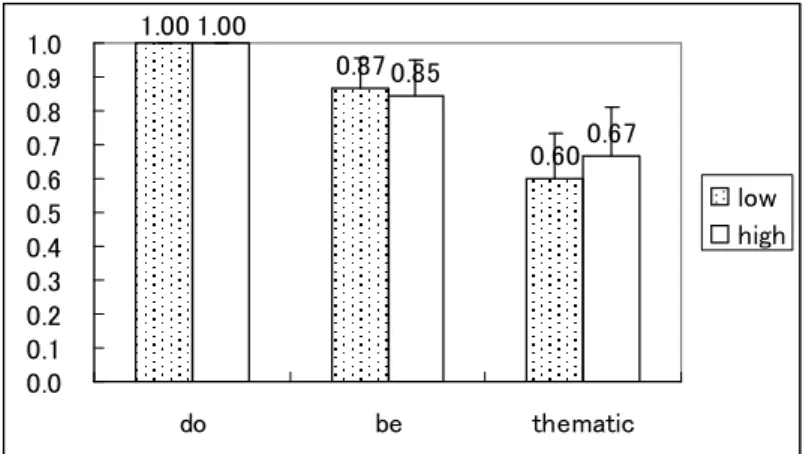
The rates of correct imitation for grammatical sentences are shown in Figure 1.
Figure 1. Correct imitation in grammatical affirmative sentences 1.00
0.87
0.60 1.00
0.85
0.67
0.0 0.1 0.2 0.3 0.4 0.5 0.6 0.7 0.8 0.9 1.0
do be thematic
low high
178
As Figure 1 illustrates, both groups of learners imitated thematic verbs less accurately than the other two.
Considering that both do and thematic verb do not involve the verb-raising, they both should be easier than be.
Therefore, Hypothesis 1 was not supported. The rates of correct imitation of do and be were not different, suggesting that lack of semantic content may play a role to facilitate the use of the agreement inflections on these items, as Hypothesis 2 suggests.
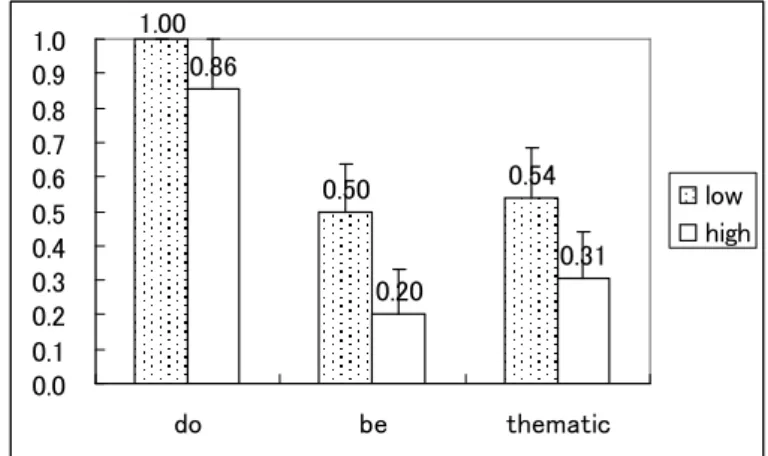
Figure 2. Correct imitation in ungrammatical affirmative sentences
Next, the results for ungrammatical sentences were shown in Figure 2. They indicated that both groups repeated most ungrammatical sentences with do as they were, which implies that they are not sensitive to such an error. By contrast, they did not repeat the ungrammatical sentences with be and thematic verbs, so it is suggested that they identified the errors. Thus, neither Hypotheses can be supported; instead, I speculate that this result can be explained by virtue of frequency of these items in their L2 input; namely, since do in affirmative sentences is quite rare, it was hard to deal with.
Negative sentences
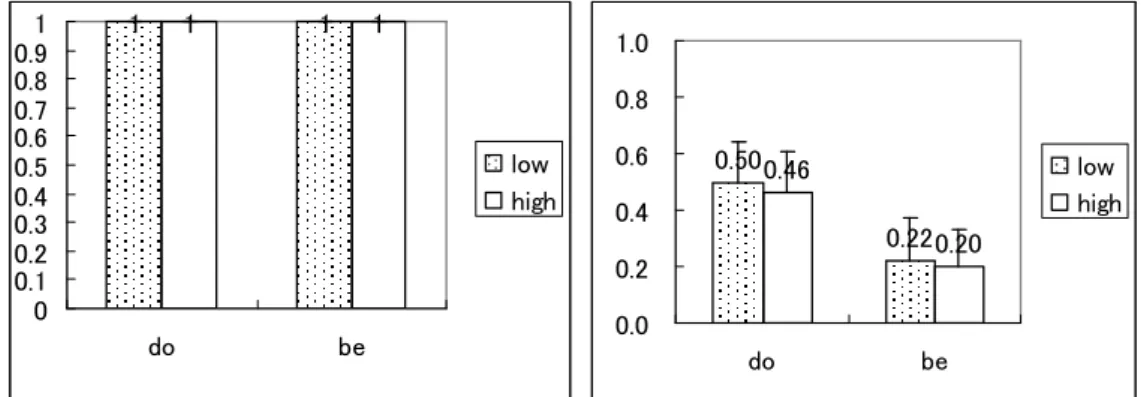
Now the rates of correct imitation for grammatical negative sentences are shown in Figure 3, and those for ungrammatical ones are in Figure 4.
1.00
0.50 0.54
0.86
0.20
0.31
0.0 0.1 0.2 0.3 0.4 0.5 0.6 0.7 0.8 0.9 1.0
do be thematic
low
high
Figure 3. Correct imitation in grammatical Figure 4. Correct imitation in ungrammatical
negative sentences negative sentences
Concerning the grammatical sentences, the learners showed no difference of difficulty between do (i.e. without verb-raising) and be (i.e., with verb-raising), suggesting that Hypothesis 1 does not hold. The results of ungrammatical sentences indicated that the learners were more sensitive to the wrong sentences with be than those with do. This implies that inflections on be are easier than those on do, confirming Hypothesis 1.
Interrogative sentences
Finally, the rates of correct imitation for grammatical interrogative sentences are shown in Figure 5, and those for ungrammatical ones are in Figure 6.
Figure 5. Correct imitation in grammatical Figure 6. Correct imitation in ungrammatical interrogative sentences interrogative sentences
With regard to grammatical interrogative sentences, the learners failed to correctly repeat sentences with be, but did not with do. This indicates that they had more difficulty on be than do, contra Hypothesis 1. Turning to Figure 6, both groups of learners did not repeat ungrammatical sentences with do, but learners with the lower
1 1 1 1
0 0.1 0.2 0.3 0.4 0.5 0.6 0.7 0.8 0.9 1
do be
low high
0.50
0.22 0.46
0.20 0.0
0.2 0.4 0.6 0.8 1.0
do be
low high
1.00
0.67 1.00
0.60
0.0 0.2 0.4 0.6 0.8 1.0
do be
low high
0.13
1.00
0.15 0.20
0.0 0.2 0.4 0.6 0.8 1.0
do be
low high
180
proficiency failed to identify the errors in sentences with be. It means that sentences with be were more problematic, suggesting that Hypothesis 1 does not hold.
4.4.2 The grammaticality judgment task Affirmative sentences
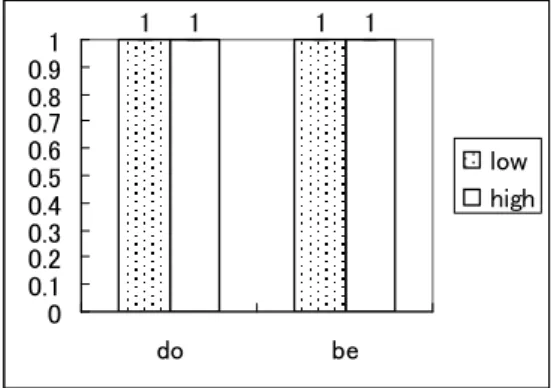
Now let us turn to the GI task. Figure 7 shows accuracy of judgment on grammatical affirmative sentences.
Figure 7. Accuracy of judgment on grammatical affirmative sentences
The results indicated that the learners correctly judged most sentences, and that they judged the three types of sentences equally. Thus, neither Hypothesis 1 nor 2 was proved wrong. Again, I suppose that the reason why the lower proficiency learners failed to accept some sentences with do can be ascribed to its low frequency in their L2 input.
Next, the results of ungrammatical affirmative sentences are presented. First, Figure 8 shows the results of sentences with inflection omission.
Figure 8. Accuracy of judgment on affirmative sentences with inflection omission 0.83
1.00 1.00
1.00 1.00 1.00
0.0 0.1 0.2 0.3 0.4 0.5 0.6 0.7 0.8 0.9 1.0
do be thematic
low high
0.67
0.44 0.83 0.90
0.71
0.86
0.0 0.1 0.2 0.3 0.4 0.5 0.6 0.7 0.8 0.9 1.0
do be thematic
low
high
The results revealed that the L2 learners correctly judged most sentences with thematic verbs, while they judged sentences with do and be less accurately. It is thus indicated that neither hypotheses are supported.
Second, Figure 9 shows the results of sentences with incorrect inflections.
Figure 9. Accuracy of judgment on affirmative sentences with incorrect inflection
The higher proficiency learners performed very well with sentences with thematic verbs, but judged those with do and be less accurately. This result does not confirm neither hypotheses. The performances of the lower proficiency learners do not confirm the hypotheses, either.
Negative sentences
The results of grammatical negative sentences are shown in Figure 10. Apparently, there are no differences between the learner groups and between do and be. All the participants accepted all the grammatical negative sentences, contradicting Hypothesis 1.
Figure 10. Accuracy of judgment on grammatical negative sentences 0.63
0.44 0.50
0.86
0.71
1.00
0.0 0.1 0.2 0.3 0.4 0.5 0.6 0.7 0.8 0.9 1.0
do be thematic
low high
1 1 1 1
0 0.1 0.2 0.3 0.4 0.5 0.6 0.7 0.8 0.9 1
do be
low high
182
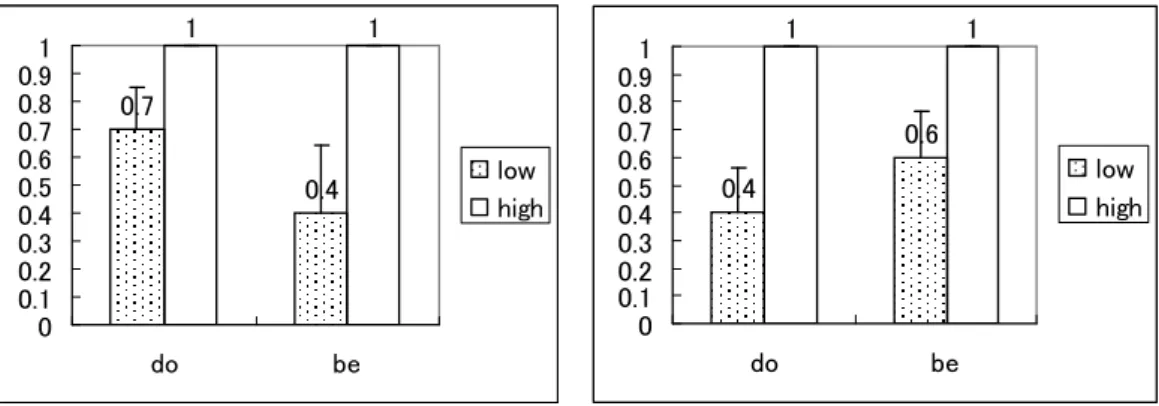
Next, Figures 11 and 12 show the result for ungrammatical negative sentences with omission and incorrect inflections, respectively. The higher proficiency learners perfectly identified both types of errors, contra Hypothesis 1. The performances of the lower proficiency subjects lacked consistency.
Figure 11. Accuracy of judgment on negative Figure 12. Accuracy of judgment on negative sentences with inflection omission sentences with incorrect inflection
Interrogative sentences
Finally, let us consider interrogative sentences. Figure 13 shows the results of grammatical sentences.
Figure 13. Accuracy of judgment on grammatical interrogative sentences
The participants successfully accepted the grammatical sentences with both do and be. This result does not confirm Hypothesis 1.
0.7
0.4
1 1
0 0.1 0.2 0.3 0.4 0.5 0.6 0.7 0.8 0.9 1
do be
low
high 0.4
0.6
1 1
0 0.1 0.2 0.3 0.4 0.5 0.6 0.7 0.8 0.9 1
do be
low high
0.9 1 1 1
0 0.1 0.2 0.3 0.4 0.5 0.6 0.7 0.8 0.9 1
do be
low
high
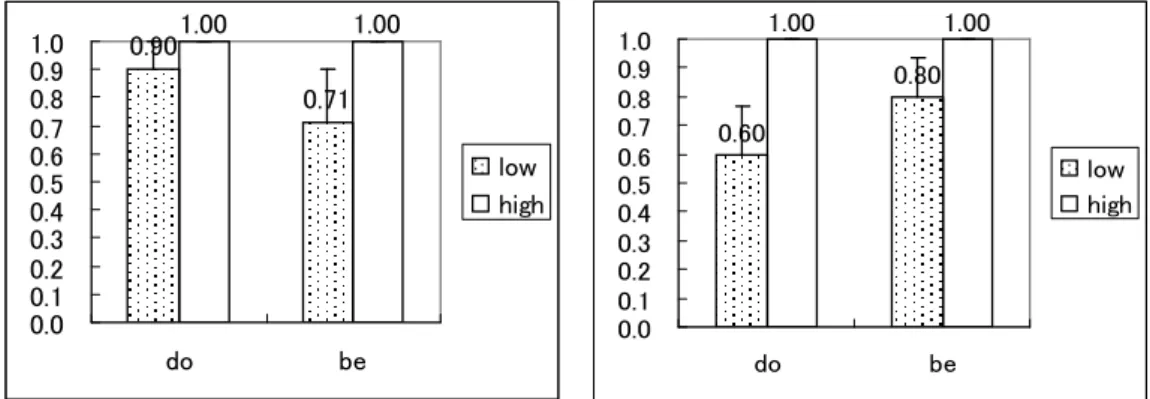
Figure 14. Accuracy of judgment on interrogative Figure 15. Accuracy of judgment on sentences with inflection omission interrogative sentences with incorrect inflection
Lastly, results of interrogative sentences with inflection omissions (Figure 14) and incorrect inflections (Figure 15) are considered. They were similar to the results of ungrammatical negative sentences. The higher proficiency subjects correctly rejected the sentences with omissions and incorrect inflections, contra Hypothesis 1.
On the other hand, the lower proficiency subjects gave rise to mixed results: sentences with be were more difficult with regard to test items with omission while those with do were more problematic with regard to items with incorrect inflections.
IV. Discussion
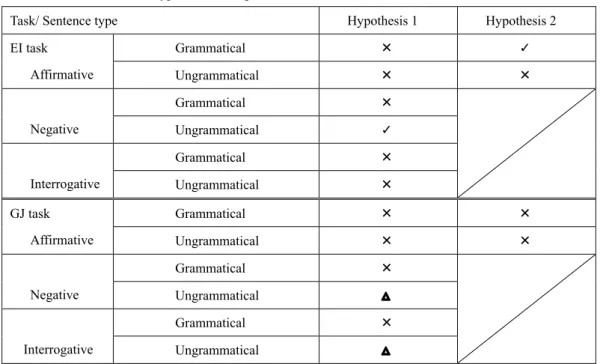
To begin with, the results of the hypothesis testing is represented in Table 1. Here the two hypotheses are presented again:
Hypothesis 1: Whether the verb-raising is involved or not affects L2 learners’ use of functional morphology.
Hypothesis 2: Whether a vocabulary item has semantic content or not affects L2 learners’ use of functional morphology.
0.90
0.71
1.00 1.00
0.0 0.1 0.2 0.3 0.4 0.5 0.6 0.7 0.8 0.9 1.0
do be
low high
0.60
0.80
1.00 1.00
0.0 0.1 0.2 0.3 0.4 0.5 0.6 0.7 0.8 0.9 1.0
do be
low high
184
Table 1. The results of the hypothesis testing
Task/ Sentence type Hypothesis 1 Hypothesis 2
EI task Affirmative
Grammatical ✕ ✓
Ungrammatical ✕ ✕
Negative
Grammatical ✕
Ungrammatical ✓
Interrogative
Grammatical ✕
Ungrammatical ✕
GJ task Affirmative
Grammatical ✕ ✕
Ungrammatical ✕ ✕
Negative
Grammatical ✕
Ungrammatical
Interrogative
Grammatical ✕
Ungrammatical
Note: ✓ means "supported"; ✕ means "rejected"; means "partly supported"
First of all, Hypothesis 1 was rejected in most cases; namely, it was supported only with negative ungrammatical sentences in the EI task. Hypothesis 2 was also rejected under three out of four conditions. This reveals that Ionin and Wexler’s (2002) and Parodi’s (2000) proposals cannot fully explain the results in this study.
Next, I will examine the actual sentences which the participants produced in the EI task. In ungrammatical affirmative contexts, 11 out of 17 participants supplemented sentences with inflected be, whereas one changed do into does. I suppose that this unexpected performance was derived from the fact that the learners were not familiar with the structure of affirmative sentences with do-support (i.e., Type 1). In ungrammatical negative contexts, however, 13 learners supplemented sentences with inflected be, whereas 12 learners changed do into does. Moreover, 6 learners produced a sentence like Anne, do you hate ...? after they heard *Anne do hate .... Likewise, 10 learners changed a sentence like *Jane, do David take ...? into Jane, do you/ they...?. What follows from these examples is that the L2 learners tried to match do with the subject, or tried to match the subject with do in terms of Agreement when they encountered a sentence lacking such agreement. With these observations in mind, I suggest that the L2 learners seem sensitive to the agreement feature on do as well as on be.
The results in the EI task and the GJ task revealed that the accuracy of inflections on do and be was
not very different under most conditions; therefore, the results serve as counterevidence to Ionin and Wexler's (2002) account, claiming that the suppletive form is acquired more easily than the affixal inflection in English because the former involves the verb-raising.
Then, what is an alternative way of explaining the difference of suppliance among verbal inflections? I propose that frequency of a particular inflected form may affect L2 learners’ use of inflections. Recall that in the EI task learners were likely to repeat ungrammatical affirmative sentences with do (i.e., Type 1). They also failed to correctly judge these sentences in the GJ task. These results can be accounted for by neither hypotheses; however, I suppose that the fact that the instances of do and does in affirmative sentences are thought to be much less in the learners’ L2 input than be and thematic verbs bearing the agreement inflections may affect the L2 learners’ performances.
V. Conclusion
Among studies dealing with L2 acquisition of functional morphology, I focused on the Ionin and Wexler's (2002) account of the asymmetry in the suppliance of L2 English verbal inflections, which claims that L2 learners acquire the suppletive inflection (i.e., the inflected be) prior to the affixal one on thematic verbs because the former involves verb-raising. After considering several studies which maintain that verb–raising does not necessarily facilitate the suppliance of the agreement inflection, I formulated two hypotheses and tested them. The results of the experiment revealed that neither hypotheses did hold; neither the involvement of verb-raising nor the presence/ absence of semantic content of lexical items was able to nicely explain the reasons behind the L2 learners’ inconsistent uses of the agreement morphology. I thus referred to a role of L2 input; namely, I suppose that it is important to turn our attention to effects of frequency, in addition to syntactic and morphological representations in L2 grammar.
186
References
Clahsen, H. and Muysken, P. (1989). The UG paradox in L2 acquisition. Second Language Research, 5, 1-29.
Eubank, L. (1993/4). On the transfer of parametric values in L2 development. Language Acquisition, 3, 183-208.
Goad, H. &White, L. (2006). Prosodic transfer: L1 effects on the production of L2 determiners. BUCLD 30 Proceedings. 213-24.
Guasti, M. T. and Rizzi, L. (2001). Agreement and tense as distinct syntactic positions: evidence from acquisition. In: G. Cinque (ed.). Functional structure in DP and IP. Oxford: Oxford University Press.
Halle, M. and Marantz, A. (1993). Distributed Morphology and the Pieces of Inflection. In: K. Hale and S. J.
Keyser (eds). The view from building 20. 111-176.
Hawkins, R. and Chan, Y.-H. C. (1997). The partial availability of Universal Grammar in second language acquisition: The ‘failed functional features hypothesis’. Second Language Research, 13, 187-226.
Hawkins, R. and Hattori, H. (2006). Interpretation of English multiple wh-questions by Japanese speakers: A missing uninterpretable feature account. Second Language Research, 22, 269-301.
Hawkins, R. and Liszka, S. (2003). Locating the source of defective past tense marking in advanced L2 English speakers. In: R. Van Hout, A. Hulk, F. Kuiken, and R. Towell (eds). The lexicon-syntax interface. Amsterdam:
John Benjamin. 21-44.
Haznedar, B. (2001). The acquisition of the IP system in child L2 English. Studies in Second Language Acquisition, 23, 1-39.
Ionin, T. and Wexler, K. (2002). Why is 'is' easier than '-s' ?: acquisition of tense/agreement morphology by child second language learners of English. Second Language Research, 18, 2, 95-136.
Lardiere, D. (1998a). Case and tense in the 'fossilized' steady state. Second Language Research, 14, 1, 1-26.
Lardiere, D. (1998b). Dissociating syntax from morphology in a divergent end-state grammar. Second Language Research, 14, 359-75.
Lardiere, D. (1999). Suppletive agreement in second language acquisition. In: A. Greenhill, H. Littlefield, and C. Tano (eds). Proceedings of the 23rd Annual Boston University Conference on Language Development.
Somerville, MA: Cascadilla Press. 386-96.
Munnich, E., Flynn, S., and Martohardjono, G. (1994). Elicited imitation and grammaticality judgment tasks:
What they measure and how they relate to each other. In: E. E. Tarone, S. M. Gass, A. D.Cohen (eds). Research methodology in second-language acquisition. Hove, UK: Lawrence Erlbaum Associates. 227-243.
Oller, J. W. Jr. (1979). Language tests at school. London: Longman.
Parodi, T. (2000). Finiteness and verb placement in second language acquisition. Second Language Research, 16, 4, 355-381.
Prévost, P. and White, L. (2000). Missing Surface Inflection or Impairment in second language acquisition?
Evidence from tense and agreement. Second Language Research, 16, 2, 103-133.
Radford, A. (2004). English syntax: an introduction. Cambridge: Cambridge University Press.
Schwartz, B. D. and Sprouse, R. A. (1994). Word order and nominative case in nonnative language acquisition:
A longitudinal study of (L1 Turkish) German interlanguage. In: T. Hoekstra and B. D. Schwartz (eds), Language Acquisition Studies in Generative Grammar (317-68). Amsterdam: John Benjamins.
Schwartz, B. D. and Sprouse, R. A. (1996). L2 cognitive states and the full transfer/ full access model. Second Language Research, 12, 40-72.
Tsimpli, I.-M. (2003). Clitics and determiners in L2 Greek. In: J. M. Liceras, H. Zobl and H. Goodluck (eds), Proceedings of the 6th Generative Approaches to Second Language Acquisition Conference (GASLA 2002), 331-39.
188
Tsimpli, I.-M. and Roussou, A. (1991). Parameter resetting in L2? University College London Working Papers in Linguistics, 3, 149-69.
Vainikka, A. and Young-Scholten, M. (1996). The early stages of adult L2 syntax: additional evidence from Romance speakers. Second Language Research, 12, 2, 140-76.
Vainikka, A. and Young-Scholten, M. (1998). The initial state in the L2 acquisition of phrase structure. In: S.
Flynn, G. Martohardjono, and W. O'neil (eds). The generative study of second language acquisition. London:
Lawrence Erlbaum Associates. 17-34.
White, L. (2003a). Second language acquisition and Universal Grammar. Cambridge: Cambridge University Press.
White, L. (2003b). Fossilization in steady state L2 grammars: persistent problems with inflectional morphology.
Bilingualism: Language and Cognition, 6, 2, 129-141.
Appendix 1
Test items for the elicited imitation task
1 He does want to be an opera singer someday.
2 Max does cook for his family every night.
3* Anne do hate eating at her college dining hall.
4* She do need more time to finish homework.
5 She doesn't visit her aunt in hospital on weekends.
6 Jane doesn’t go to the lab on Sundays.
7* Jack don't sleep for more than 4 hours.
8* He don't like watching films on video very much.
9 Max, does Jane clean her house every day?
10 Anne, does he cook for his family on weekends?
11* Tom, do she go to gym or aerobics class?
12* Jane, do David take dance classes after work?
13 I'm a conductor of an orchestra in Germany.
14 We're interested in watching classic French films very much.
15* Jack taller than any other student in his class.
16* She a high school teacher here in Cambridge.
17 You aren't kind enough to your wife at all.
18 Jane isn't a member of the rowing club.
19* We not ready for the presentation next Monday.
20* I not a student in the Department of Economics.
21 Tom, am I qualified to attend those seminars?
22 Jack, is Anne absent today because of the flu?
23* Bill, you satisfied with your current family doctor?
24* Jim, she a supervisor of a postgraduate course now?
25 She goes to school by bus every day.
26 Anne checks email every 15 minutes throughout the day.
27* Bill work for a travel agency in Tokyo.
28* He read books on the train going to work.
29 I really like chocolate cake and apple pie.
30* They used to living in Paris for 10 years.
31 I never drink coffee or tea after 9 pm.
32* I've already finish reading the book you lent me.
190