43
Corporate Social Responsibility and Financial Performance Linkage: A Preliminary Study for
the Conceptual Framework
Sarwar U. Ahmed* Shigeru Uchida**
Abstract:
Over the last three decades, the pressure on firms to engage in Corporate Social Responsibility(CSR)activities and establish themselves as highly socially respon- sible companies has increased. However, on the issue of incentive, some corpora- tions view CSR activities as simply a costly hindrance and some companies use CSR methodologies as a strategic tactic to obtain public support for their presence in global markets which could help companies to sustain a competitive advantage by using their social contributions. Researchers around the world have reported a positive, negative, mixed and neutral impacts of corporate social responsibility on corporate financial performance(CFP).On this background, this study aimed at summarizing the findings of major empirical studies and drawing the conceptual framework to investigate the relationship between CSR and CFP.
Keywords: Corporate Social Responsibility, Financial Performance, Banks, Global Market
1. Introduction
In the current perspective of global competitive market, companies must endeavor to rev- eal a picture of themselves as highly socially responsible companies. Active involvement in socially beneficial programs provides extra advantages to the company. Through globaliza- tion not a few corporations usually pursue growth and they have faced new challenges that restricted to their growth and potential profits. Companies in different countries of the world
Fig.1 CSR activities linking the firm towards attainment of the ultimate goal
have to play a role in social issues otherwise government regulations, environmental restric- tions, tariff, varying standards of what constitutes labor exploitation are problems that can cost companies a lot. One of the primary encouraging factors is the idea that Corporate So- cial Responsibility(CSR)could be considered to increase long term profitability and sus- tainability of the company as well as enhance the reputation of the organization(see Fig.1).
Over the last three decades, the pressure on firms to engage in CSR has increased. Among the global and/or multinational companies in the world, some view CSR issues as simply a costly hindrance and some companies use CSR methodologies as a strategic tactic to obtain public support for their presence in global markets which could help companies to sustain a competitive advantage by using their social contributions. Researchers around the world have reported a positive, negative, mixed and neutral impacts of corporate social responsibil- ity on corporate financial performance (CFP).On this background, the objective this study is to draw a conceptual framework for examining the direction of linkage between corporate social responsibility and financial performance.
2.Overview of CSR
Corporate social responsibility(CSR)is defined about how businesses align their values
Corporate Social Responsibility and Financial Performance Linkage:
A Preliminary Study for the Conceptual Framework 45
and behavior with the expectations and needs of stakeholders‑not just customers and inves- tors, but also employees, suppliers, communities, regulators, special interest groups and society as a whole. CSR describes a company's commitment to be accountable to its stake- holders. CSR is necessary a growing term that does not have a standard definition or fully recognized set of specific criteria. CSR is generally understood to be the way a company at- tains a balance or integration of economic, environmental, and social imperatives while at the same time addressing shareholder and stakeholder expectations, with the understanding that businesses play a key role on job and wealth creation in society. Corporate social responsibility has become a prominent topic both in the business and academic press. Never- theless, opinions differ as to whether a firm's CSR activity provides any economic benefits.
According to Frankental(2001) CSR is a vague and intangible term which can mean any- thing to anybody, and therefore is effective without meaning. On the other hand, the Commission for the European Communities(2001)defines CSR as a concept whereby companies integrate social and environmental concerns in the business operations and in their interactions with their stakeholders on a voluntary basis. According to Wood(1991),
the basic idea of CSR is that business and society are interwoven rather than distinct enti- ties and for Mallenbaker(2005), CSR is about how companies manage the business process to produce an overall positive impact on society .More generally, a distinction has been drawn between CSR seen as philanthropy as opposed to CSR as a core business activi- ty(Jones et al.,2007).Carroll(1979)observed that the social responsibility of business encompasses the economic, legal, ethical, and discretionary expectations of organizations that society has at a given point in time .
3.Empirical Studies on CSR and Financial Performance
3.1.Corporate social performance(CSP)to measure CSR
McWilliams and Siegel(2000),found that, when research and development(R&D)and industry factors are excluded, the coefficient on corporate social performance(CSP)(a measure of CSR),is positive and statistically significant. However, when R&D and industry factors are included, the degrees of the coefficient reduce dramatically and are no longer sig- nificant and CSP showed a neutral effect on profitability. Through a broad-based index of corporate social performance, Waddock and Graves(1997)analyses whether there is a posi- tive relationship between corporate social performance and financial performance and whether both slack resource and good management theory may be operating simultaneously.
Using the improved measurement version, they found that corporate social performance
does depend on financial performance and that the sign of the relationship is positive.
Researchers view that, corporate social performance is a kind ofvirtuous circle, there is a simultaneous relationship, and corporate social performance is both a predictor and consequence of company financial performance. Klassen and McLaughlin(1996)found that, environmental management has the potential to play an essential role in the financial performance of the firm. They used financial event methodology and archival data of firm-level environmental and financial performance. For strong environmental management significant positive returns were measured as indicated by environmental performance awards, and significant negative returns were measured for weak environmental manage- ment as indicated by environmental crises. McGuire et al.,(1988)analysis shows that a firms' prior performance, assessed by both stock‑market returns and accounting-based measures, is more closely related to corporate social responsibility than is subsequent performance and the measures of risk are more closely associated with social responsibility.
The researchers suggest that, firms low in social responsibility also experience lower return on assets(ROA)and stock-market returns than do firms high in social responsibility.
Cochran and Wood(1984)reexamined the relationships between corporate social respon- sibility and financial performance and they found that exclusion of asset turnover and asset age led to spurious positive correlations between CSR and financial performance and with this variable included, there is still weak evidence of positive correlation between CSR and financial performance. Mostly there are two types of empirical studies of the relationship between CSR and financial performance(Clinebell and Clinebell,1994; Hannon and Milkovich,1996; Posnikoff,1997; Teoh et al.,1999; Worrell et al.,1991; Wright and Ferris,1997).Some studies use the event study methodology to assess the short-run financial impact(abnormal returns)when firms engage in socially responsible or irresponsi- ble acts and the results of these studies have been mixed. Teoh et al.(1999)found no relationship between CSR and financial performance, Wright and Ferris(1997)found a negative relationship and Posnikoff(1997)reported a positive relationship; and McWil- liams and Siegel(1997)studies are inconsistent on the relationship between CSR and short run financial returns.
3.1.2 Accounting profit to measure financial performance
There are also other studies which examined the nature of the relationship between cor- porate social performance, CSP(a measure of CSR),and long term firm performance, us- ing accounting or financial measures of profitability(Aupperle et al.1985; McGuire et al. 1998; and Waddock and Graves,1997).They found mixed results, while Aupperle et al.
Corporate Social Responsibility and Financial Performance Linkage:
A Preliminary Study for the Conceptual Framework 47
(1985)found no relationship between CSP and profitability. In contrast, McGuire et al. (1998)found that, prior performance was more closely related to CSP than was subsequent performance, and Waddock and Graves(1997)found significant positive relationships between an index of CSP and performance measures such as ROA in the following year.
Another study using measures of return based on the stock market by Vance(1975)indicate negative CSP/CFP relationship. In contrast, Alexander and Buchholz(1978)improved on Vance's analysis by evaluating stock market performance of an identical group of stocks on a risk adjusted basis, which produce an inconclusive result.
3.1.3 Studies using accounting profit ratios
Studies using accounting profit ratios(ROA/ROE(Return on Equity)/ROI(Return on Investment)/ROS(Return on Sales))find merely strong positive relations between cor- porate social responsibility and financial performance(Berman et al.,1999; Brown and Perry,1994; Dooley and Lerner,1994).Greening(1995)found positive relations and Johnson and Greening(1999)got moderate and mixed relations. Patten(1991)found strong results but no effect on the relationship between CSR and Financial performance.
3.1.4 Stock market returns to measure financial performance
Studies using stock market returns find an ambiguous relation between CSR and financial performance. Average return studies done by Freedman and Stagliano(1991); McGuire et al.(1988); Ingram(1978); Brown(1998)find moderate result and positive relationships between CSR and financial performance. Vance(1975)finds strong results but negative relationships and Guerard Jr.(1997b)find moderate and mixed results and Davidson III and Worrell(1992)find weak result but mixed relationships. On the other hand, Brown(1997) find positive relationships but weak result. But Alexander and Buchholz(1978)find weak result but no effect. Guerard Jr.(1997a)finds no effect and Chen and Metcalf(1980)find weak result and no effect between CSR and financial performance.
4.Generally accepted methods of measuring CSR
There are two generally accepted methods of measuring CSR, first one is the reputation index and in this method knowledgeable observers rate firms on the basis of one or more dimensions of social performance. One reputation index was generated by Milton Moskowitz, who over a period of several years rated a number of firms as outstanding, honorable mention, or worst(Moskowitz,1972).Content analysis is the second method of
measuring CSR. Normally, in content analysis the extent of the reporting of CSR activities in various firm publications and especially in the annual report(used by Bowman and Haire, 1975; Abbott&Monsen,1979; Anderson&Frankle,1980; Ingram,1978).
5.Common measures of financial performance
Common measures of financial performance fall into two broad categories: investor returns and accounting returns. The basic idea of investor returns is that, the return should be measured from the perspective of shareholders. Whereas, accounting return measures of financial performance focuses on how firm earnings respond to different managerial poli- cies.
McGuire et al.,(1988)used market performance which was measured by risk-adjusted return, or alpha, and total return as measured of financial performance. Accounting-based performance measures were ROA, total assets, sales growth, asset growth, and operating in- come growth. The ratio of debt to assets, operating leverage, and the standard deviation of operating income were the accounting-based measures of risk. Waddock and Graves(1997) measured financial performance using three accounting variables: return on assets, return on equity, and return on sales, providing a range of measures used to assess corporate finan- cial performance by the investment community.
In some studies, the most common measure of accounting returns used are simply earn- ings per share(EPS)or price/earnings(P/E)ratios(Bragdon and Marlin1972).On the other hand, Cochran and Wood(1984)used three accounting returns measures: the ratio of operating earnings to assets, the ratio of operating earnings to sales, and excess market valuation. In addition to this, three other measures of financial performance are used by researchers: Market-to-book ratio; Accounting profit ratio(return on assets, return on e- quity, return on investment, return on sales)and stock market returns.
6.Conceptual framework of the research
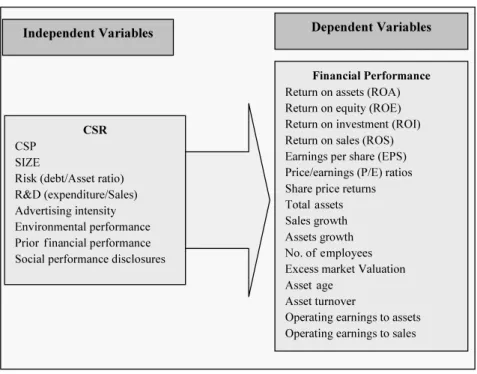
In this study, we have conducted a comprehensive literature survey on both direction of relationship between CSR and CSP and ways to measure them. The result of this survey study might be concluded in the following way by drawing a conceptual framework as shown in Fig.2:
1.Various empirical studies around the world have reported a positive, negative, mixed and neutral impacts of corporate social responsibility(CSR)on corporate financial
Corporate Social Responsibility and Financial Performance Linkage:
A Preliminary Study for the Conceptual Framework 49
Fig.2 Conceptual Framework
performance(CFP).Hence rather than having any preconceived idea on the direction of the relationship, we should have an open view on this, as the linkage between CSR and CSP will depend on various factors, e.g.,industry, location, size etc.
2.Among the two common methods of measuring CSR, content analysis would be more appropriate as first step to measure the relationship between CSR and CSP. Because in this case the measuring parameters would have a more common and unbiased sources, based on annual reports.
3.Corporate Financial Performance(CFP)can be measured form both by investors return and accounting return.
* Associate Professor, School of Business, Independent University Bangladesh
** Professor, Faculty of Economics, Nagasaki University
References
Abbott, W. F. and J. R. Monson,(1979),On the measurement of corporate social responsibility:Self-report- ed disclosure as a method of measuring corporate social involvement,Academy of Management Journal,
22,pp.501‑515.
Alexander, G. J. and R. A. Buchholz,(1978),Corporate social performance and stock market performance, Academy of Management Journal,21,pp.479‑486.
Anderson, J. C. and A. W. Frankle,(1980),Voluntary social reporting:An isobeta portfolio analysis ,
Accounting Review,55,pp.467‑479.
Aupperle, K.,A. Carroll, and J. Hatfield,(1985), An empirical examination of the relationship between corporate social responsibility and profitability ,Academy of Management Journal,28 (2),pp.446‑463.
Berman, S. L.,A. C. Wicks, S. Kotha, and T. M. Jones,(1999),Does stakeholder orientation matter?The relationship between stakeholder management models and firm financial performance,Academy of Management Journal,42,pp.488‑506.
Bowman, E. H. and M. Haire,(1975),A strategic posture toward corporate social responsibility,Califor- nia Management Review,18 (2),pp.49‑58.
Bragdon Jr.,J. H.,and J. A. T. Marlin,(1972),Is pollution profitable? ,Risk Management,19,pp.9‑
18.
Brown, B.(1997),Stock market valuation of reputation for corporate social performance,Corporate Repu- tation Review,1,pp.76‑80.
Brown, B.(1998), Do stock market investors reward reputation for corporate social performance? , Corporate Reputation Review,1,pp.271‑282.
Brown, B. and S. Perry,(1994),Removing the financial performance halo from Fortunes Most Admired Companies,Academy of Management Journal,37,pp.1346‑1359.
Carroll, A. B.(1979),A three-dimensional conceptual model of corporate social performance ,Academy of Management Review,4,pp.497‑505.
Chen, K. H. and R. W. Metcalf,(1980),The relationship between pollution control record and financial indi- cators revisited ,Accounting Review,55,pp.168‑177.
Clinebell, S. K. and J.M. Clinebell,(1994),The effect of advanced notice of plant closing on firm value , Journal of Management,20,pp.553‑564
Cochran, P. L.,and R. A. Wood,(1984), Corporate social responsibility and financial performance , Academy of Management Journal,27,pp.42‑56.
Commission of the European Communities(2001),Promoting a European framework for Corporate Social Responsibility, available at: http://europa.eu.int/eur‑lex/en/comgpr/2001/com2001̲0366en01.pdf Davidson III, W. N.,and D. L. Worrell,(1992), Research notes and communications: The effect of
product recall announcements on shareholder wealth,Strategic Management Journal,13,pp.467‑473.
Dooley, R. S. and L. D. Lerner,(1994),Pollution, profits, and stakeholders:The constraining effect of economic performance on CEO concern with stakeholder expectations ,Journal of Business Ethics,13,
pp.701‑711.
Frankental, P.(2001), Corporate social responsibility‑a PR invention? ,Corporate communication,Vol. 6No.1,pp.1‑6.
Freedman, M. and A. J. Stagliano,(1991), Differences in social‑cost disclosures: A market test of investor reactions ,Accounting, Auditing and Accountability Journal,4,pp.68‑83.
Greening, D. W.(1995), Conservation strategies, firm performance, and corporate reputation in the US electric utility industry ,InResearch in corporate social performance and policy, supplement1 (pp.345‑368).
Greenwich, CT:JAI Press.
Guerard Jr. J. B.(1997a),Is there a cost to being socially responsible in investing? ,Journal of Investing,
6,pp.11‑18.
Guerard Jr. J. B.(1997b),Additional evidence on the cost of being socially responsible in investing,Jour- nal of Investing,6,pp.31‑36.
Corporate Social Responsibility and Financial Performance Linkage:
A Preliminary Study for the Conceptual Framework 51
Hannon, J. and G. Milkovich,(1996),The effect of human resource reputation signals on share prices:An event study, Human Resource Management,35 (3),pp.405‑424
Ingram, R. W.(1978),An investigation of the information content of(certain)social responsibility dis- closures ,Journal of Accounting Research,16(2),pp.270‑285.
Johnson, R. A. and Greening, D. W.(1999) The offects of corporate governance and institutional ownership types on corporate social performance .Academy of Management Journal,42,pp.564‑576.
Jones, P.,D. Comfort, and D. Hiller,(2007), Marketing and corporate social responsibility within food stores ,British Food Journal,Vol.109,No.8.pp.582‑593
Klassen, R. D.,and C. P. McLaughlin,(1996), The Impact of Environmental Management on Firm Perfor- mance,Management Science,INFORMS, Vol.42,No.8,pp.1199‑1214
Mallenbaker(2005),Corporate Social Responsibility‑What does it mean?,available at:www.mallenbaker. net/csr/CSRfiles/definition.html
McGuire, J. B.,A. Sundgren, and T. Schneeweis,(1988),Corporate Social Responsibility and Firm Finan- cial Performance, Academy of Management Journal,31 (4),pp.854‑872.
McWilliams, A. and D. Siegel,(1997),Event studies in management research:Theoretical and empirical is- sues ,Academy of Management Journal,40 (3),pp.626‑657.
McWilliams, A.,and D. Siegel,(2000),Corporate Social Responsibility and Financial Performance: Corre- lation or Misspecification? ,Strategic Management Journal,Vol.21,No.5,pp.603‑609.
Moskowitz, M.(1972),Choosing socially responsible stocks ,Business and Society,1,pp.71‑75.
Patten, D. M.(1991),Exposure, legitimacy, and social disclosure .Journal of Accounting and Public Policy, 10,pp.297‑308.
Posnikoff, J. F.(1997),Disinvestment from South Africa:They did well by doing good, Contemporary Eco- nomic Policy,15 (1),pp.76‑86.
Teoh, S. H.,I. Welch, and C. P. Wazzan,(1999), The effect of socially activist investment policies on the financial markets:Evidence from the South African boycott ,Journal of Business,72 (1),pp.35‑89 Vance, S.(1975),Are socially responsible firms good investment risks? ,Management Review,64,pp.18‑
24.
Waddock, S. A.,and S. B. Graves,(1997),The Corporate Social Performance-Financial Performance Link , Strategic Management Journal, Vol.18,No.4,pp.303‑319.
Wood, D. J.(1991),Corporate Social Performance Revisited,The Academy of Management Review,Vol.16,
No.4,pp.691‑718.
Worrell, D.,W. N. Davidson, and V.N. Sharma,(1991), Layoff announcements and stockholder wealth, Academy of Management Journal,34 (3),pp.662‑678.
Wright, P.,and S. Ferris,(1997),Agency conflict and corporate strategy:The effect of divestment on cor- porate value ,Strategic Management Journal,18 (1),pp.77‑83.